Can Turnitin Detect Perplexity AI? What the Report Can Actually Tell You
12 min read
Perplexity writes cited answers that look ready to paste, and that is the kind of text a Turnitin AI Writing Report scores. So can Turnitin detect Perplexity AI? It may flag prose produced through Perplexity as likely AI-written, but it cannot name Perplexity as the source or prove authorship.
Perplexity routes one question through several language models, so no single detection promise covers every answer. Citations affect the Similarity Report, while the AI score is a separate check. We compared Turnitin's current model list with Perplexity's model selector; the sections below show what the report can and cannot tell you.
Want a Second Opinion on a Draft? Run a Free Scan
Can Turnitin Detect Perplexity AI? The Short Answer 🎯
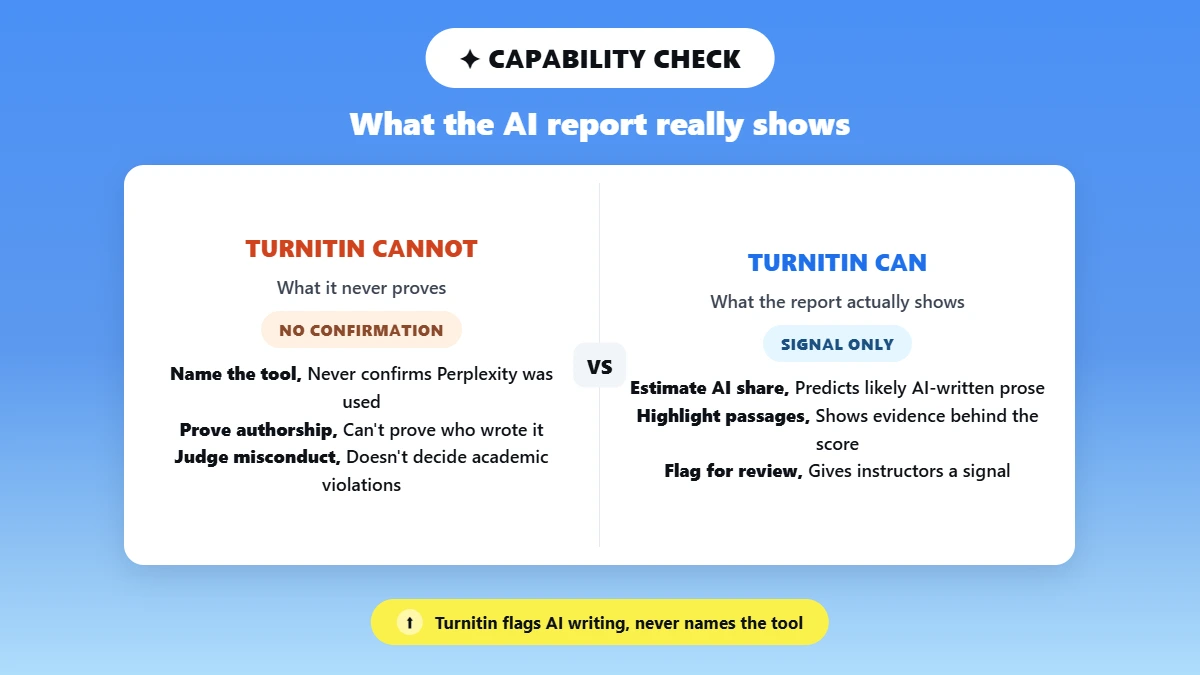
Yes, Perplexity AI can be detected by Turnitin, but only as likely AI writing, never as Perplexity. The AI Writing Report estimates how much of a paper's prose looks AI-written, but it never names the tool behind it. Turnitin's August 2026 report update removed highlight distinctions that could imply certainty about "the specific tool or workflow used." An instructor now sees one score and one set of blue highlights.
The detector compares your sentences against statistical patterns learned from AI-written and human-written academic text, which is a different job from telling which AI tool was used. A Perplexity answer carries no label that survives copying, and its numbered citations tell Turnitin nothing about where the prose came from.
The same limit applies to the best Turnitin alternatives a school might run instead, because every detector reads the submitted text and nothing else.
Turnitin CAN | Turnitin CANNOT |
|---|---|
✅ Estimate the share of qualifying prose that appears likely AI-generated or AI-modified | ❌ Confirm that Perplexity was the tool used |
✅ Highlight the passages behind its prediction | ❌ Prove who wrote the document |
✅ Give instructors a signal for further review | ❌ Decide whether academic misconduct occurred |
✅ Produce a separate Similarity Report | ❌ Treat an AI score as a plagiarism score |
Why the Perplexity Model Matters 🔀
Perplexity is an answer engine that combines live web search with models built by Perplexity and by other AI companies, so the model behind any single answer can change. Which model runs depends on your plan, the mode you use, and whether you left the selector on Best.
What Models Does Perplexity Use? 🧠
As of September 2026, Perplexity's help center lists ten Search models on its Pro and Max plans:
Perplexity's own Sonar 2
GPT-5.6 Terra and GPT-5.6 Sol from OpenAI (Sol is Max only)
Gemini 3.7 Flash from Google
Claude Sonnet 5 and Claude Opus 5 from Anthropic (Opus 5 is Max only)
Kimi K3 (Moonshot AI), GLM 5.3 (Z.ai), Grok 4.6 (xAI), and Nemotron 3 Ultra (NVIDIA)
Perplexity calls the list a snapshot, adds and retires models as providers release them, and says the selector in your account is the source of truth. Free-plan users stay on Best and cannot pick an advanced model by hand.
Does Perplexity's Best mode use one fixed model? ⚙️
Best does not use one fixed model; it picks a suitable model for each query, so two answers in one thread can come from different models. Deep Research, which Perplexity's help center also calls Research mode, runs dozens of searches and reads hundreds of sources to write a full report, and it selects its models automatically too.
Does the Perplexity Model I Choose Affect Detection? 🎛️
The model you choose changes the writing patterns Turnitin evaluates, so your choice can affect the result, but no Perplexity model is confirmed detectable or safe. Turnitin's detectable-model list, updated in August 2026, tops out at GPT-5.4, Gemini 3.1 Pro Preview, Claude Sonnet 4.6, Claude Opus 4.5, and Grok 4.1. It also covers tools built on any listed model.
💡 None of the ten Search models Perplexity listed in September 2026 appears by exact version on Turnitin's August 2026 list. Turnitin lists older versions of the same families and covers "tools based on these LLMs," and it keeps expanding. The missing name is not proof that Perplexity output cannot be flagged.
Perplexity route | How the model is selected | What can be said about Turnitin |
|---|---|---|
Best | Perplexity chooses automatically | The underlying model may vary, so no tool-wide detection promise holds. |
Paid Search model | You pick an eligible current model | Compare the exact version with Turnitin's current public list, but treat absence as unknown, never as immunity. |
Deep Research | Perplexity selects models automatically | The final report can mix retrieved text and generated prose, so results stay document-specific. |
Sources: Perplexity help center model snapshot (September 2026) and Turnitin's AI writing detection FAQ (August 2026). Both lists change often.
Perplexity can route an answer through OpenAI models, so how Turnitin handles ChatGPT-generated text applies to those answers too.
How Turnitin Checks AI Writing 🔍
Turnitin checks AI writing in four steps:
It extracts the sentences from your submission.
It splits them into overlapping segments.
It scores each segment from 0 to 1 for the probability that it is AI-generated.
It pools the sentence scores into the document percentage.
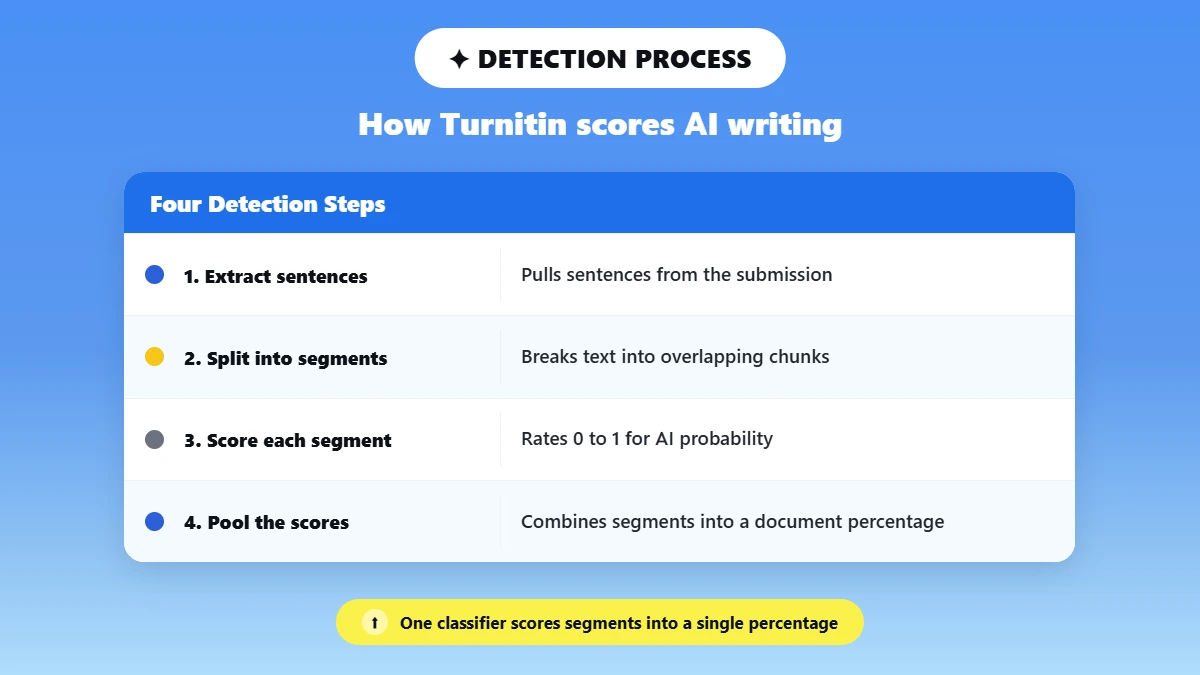
The model is a transformer-based deep learning classifier trained on Turnitin's own collection of human-written and AI-generated academic writing. Turnitin states that it is not explicitly programmed to evaluate "burstiness," "perplexity" (the statistical measure that shares a name with the tool), or any other single metric. It learns patterns from training data, so Turnitin cannot always say which pattern drove one prediction.
In July 2026 Turnitin merged its multi-model ensemble into a single model. The current model scores a resubmitted paper, so its percentage can differ from an older report.
What Types of Text Can Turnitin Process for AI Writing? 📄
Turnitin processes long-form prose only, and it needs at least 300 words of it to generate a report. Its file requirements for an AI Writing Report are:
300 to 30,000 words of prose in a long-form format
A file under 100 MB
.docx, .pdf, .txt, or .rtf
English, Spanish, Japanese, or Modern Standard Arabic
Detection of AI-modified text (paraphrased or run through a bypass tool) for English submissions only
Poetry, code, scripts, tables, bullet lists, and annotated bibliographies are not reliably processed
Because only prose counts, the percentage can differ from the amount of text you see highlighted.
Use Phrasly Free AI Checker to compare the overall result with the highlighted passages.
Do not chase a target score or treat one checker as a preview of Turnitin. 👇
Every checker weighs sentences differently, and a short guide on how to interpret AI-detector results helps you read the highlights without over-reading the number.
Do Perplexity Citations Affect Turnitin Results? 📚
Perplexity citations can affect the Similarity Report, where matching or quoted text shows up. They leave the AI Writing Report untouched, because that report scores the prose around them. A citation tells a reader where a claim came from; it does not label a sentence as human for Turnitin.
Why Is the Turnitin AI Score Different From the Similarity Score? 🔄
The Similarity score is the percentage of your text that matches sources in Turnitin's database. The AI score is the percentage of qualifying prose the model predicts was AI-generated or AI-modified. Turnitin says the two are completely independent. That leaves three separate questions for a Perplexity-assisted paper:
Question | Relevant check |
|---|---|
Does the wording match an existing source? | Similarity Report |
Does the qualifying prose resemble generated writing? | AI Writing Report |
Does each citation support the claim it is attached to? | Human source verification |
Are Perplexity Citations Checked for Plagiarism? 🔎
The citations themselves are not "checked," but the sentences you copy with them are, because a citation number changes nothing about the wording around it. The Similarity Report compares every submitted sentence against Turnitin's database, so a copied Perplexity summary can match its own source even with the citation attached. The third check, whether the source supports the claim, is yours to run:
📖 Open every cited source and read the passage the claim rests on.
🗓️ Confirm the author, title, and date match what Perplexity showed.
🎯 Check that the source supports the exact claim, and drop it if it does not.
✍️ Cite the original source in your own words and leave Perplexity's sentence out.
📊 In the Tow Center's March 2025 test, researchers ran 1,600 news-source queries across eight AI search tools. Perplexity performed best, yet it still answered 37% incorrectly. The test only asked each tool to identify a news article's headline, publisher, date, and URL, so it says nothing about academic sources in general. It is still a measured reason to open every citation.
What Changes Whether Perplexity Text Is Flagged? 📊
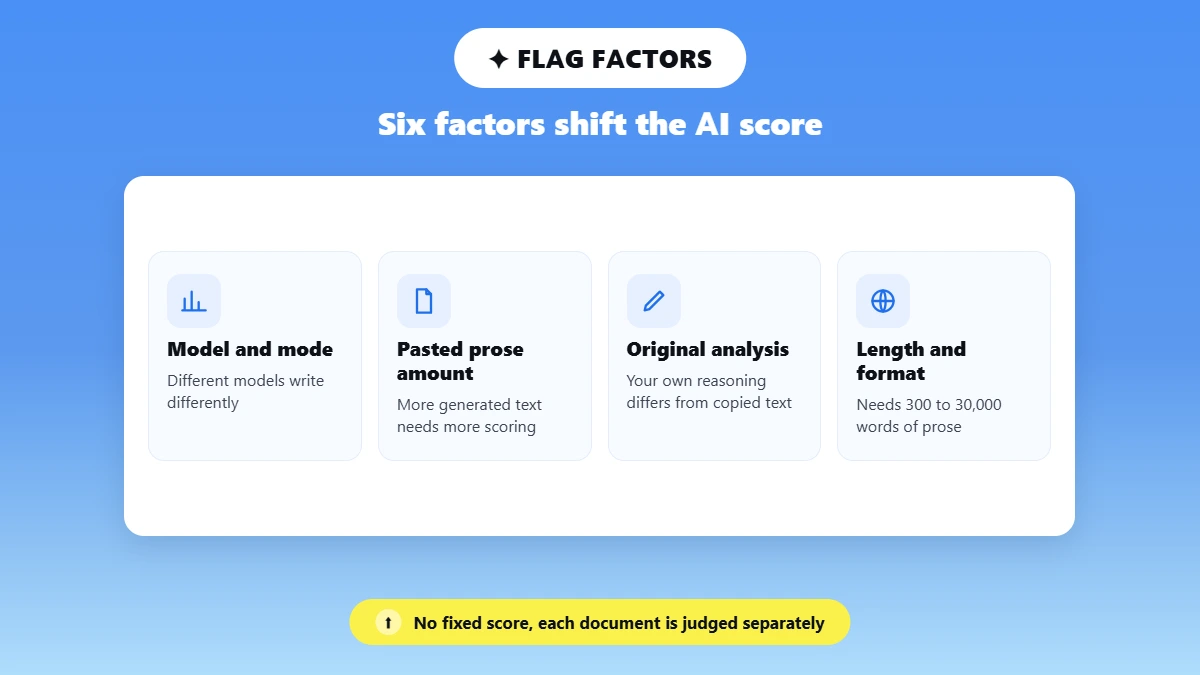
Six things decide whether Perplexity text gets flagged, and none of them is a fixed detection percentage. The report scores the document Turnitin receives, so the same Perplexity answer can score differently in two papers.
Factor | Why it matters |
|---|---|
Underlying model and mode | Perplexity may route the answer through a Perplexity, OpenAI, Google, Anthropic, or other model, and each writes differently. |
Amount of pasted generated prose | The report estimates qualifying prose at document level, so more pasted text means more text to score. |
Genuine original analysis | A paper built from your own reasoning is a different document from copied generated prose. |
Length and format | Turnitin needs 300 to 30,000 words of long-form prose, and Turnitin skips non-prose formats. |
Language | Detection differs across English, Spanish, Japanese, and Arabic, and paraphrase detection covers English only. |
Turnitin release and institution settings | The model changed in July 2026, and the AI feature must be licensed and turned on by the school. |
No "safe score" exists, and a percentage quoted for one model on one date says nothing about your paper on submission day.
How to Use Perplexity Responsibly for Academic Work ✅
Read your course's AI policy first, use Perplexity to find concepts and sources, and write the final analysis from your own understanding. Colleges check for AI in different ways, and policies differ by school and even by instructor. One course may allow AI for research only, and the next may ban it or require a written disclosure, so the rule for your assignment decides how far Perplexity can go.
A workflow that keeps the work yours looks like this:
Read the course or institution's AI policy before using Perplexity.
Use Perplexity to identify concepts, search terms, and possible sources.
Open and read the original sources, and remove any citation that is inaccurate or off topic.
Take notes in your own words without copying Perplexity's generated sentences.
Build the argument and write the final prose from your own understanding.
Add analysis, examples, calculations, or reflections that belong to the assignment.
Disclose permitted AI assistance when the policy requires it.
Keep outlines, notes, source records, and document version history.
Steps 4 and 5 decide whether the prose is yours, and a human reader notices the difference too. Instructors read for the same difference a detector scores, which is why students ask whether professors detect ChatGPT even in classes that run no software.
If AI assistance is permitted, use the Phrasly AI Humanizer to improve clarity, flow, and voice in a draft you are allowed to edit. Then check every fact, citation, and change in meaning yourself. 👇
What Does a Turnitin AI Score Actually Mean? 🧮
The Turnitin AI score is Turnitin's estimate of the share of qualifying prose that was likely AI-generated or AI-modified. That share can be smaller than the whole document. Lists, tables, and short fragments never enter the percentage.
Scores from 1% to 19% appear as an asterisk (*%) with no highlights, because Turnitin's testing found more false positives in that range. Only instructors and administrators see the indicator; a student sees it when the instructor downloads the PDF report and shares it.
Turnitin reports a false-positive rate under 1% for documents with more than 20% likely AI writing. It says it tests every model update against more than 700,000 academic papers written before ChatGPT existed. That is a vendor-reported, document-level figure. It does not prove that any single highlighted passage, or any single student, used AI, and Turnitin accepts missing some AI text to keep that rate low.
What counts as an acceptable number is a school policy question. A guide to what a Turnitin AI score means walks through how different schools read the thresholds.
Is a Turnitin AI Score Proof That a Student Used AI? ⚖️
Turnitin treats the score as a signal for review and says the percentage should not be the sole basis for action or grading. Turnitin makes no misconduct determination; it provides data for an instructor to weigh against the school's policy.
What Should You Do If Human-Written Work Is Flagged? 🛡️
Keep the writing, gather your evidence, and ask your instructor for a human review. Turnitin says false positives can happen with prose that has little structural variation, repeats itself, or paraphrases without new ideas. Read the highlighted passages with that in mind and revise only where the writing needs it.
🔍 Review the highlighted sections for repeated, formulaic, or underdeveloped prose.
🗂️ Gather outlines, notes, source annotations, timestamps, and version history.
🗣️ Be ready to explain your argument and how you used each source.
🤝 Share any permitted AI assistance openly and point to the course policy.
📩 Ask the instructor to review the full evidence.
Do not rewrite authentic work only to make a number disappear; your process evidence carries more weight than a lower score. A step-by-step guide on what to do when Turnitin flags human writing covers the appeal conversation itself.
Can Turnitin detect Perplexity AI? Yes, the report may flag Perplexity-generated prose, and no, it cannot identify Perplexity or prove who wrote it.
The part you control is the workflow: read the policy before anything else, let Perplexity find the sources, verify and analyze them yourself, and disclose help when the course requires it. Keep your drafts, because those records settle a flag faster than any score can.
FAQs ❓
Can Perplexity AI be detected by Turnitin?
Some Perplexity-generated prose may be flagged as likely AI-written. The result varies because Perplexity can route one answer through different underlying models, and Turnitin scores the submitted document with no way to see a "Perplexity" label. The original writing around any pasted text changes the result too.
Can Turnitin tell that Perplexity specifically wrote my text?
Turnitin cannot name Perplexity or any other tool. Its report estimates how much qualifying prose looks machine-written, highlights those passages, and stops there. It confirms no specific model and proves nothing about authorship, which is why Turnitin tells instructors to treat the score as one input for a human review.
Does Perplexity use ChatGPT?
Perplexity can use OpenAI models, and in September 2026 it listed GPT-5.6 Terra and Sol. It also offers its own Sonar 2 model plus models from Anthropic, Google, xAI, and others. The list changes over time, and Best and Deep Research pick models automatically.
Do Perplexity citations stop Turnitin from detecting AI writing?
Citations do not protect the prose around them. Turnitin's AI Writing Report runs separately from the Similarity Report, so a cited sentence generated by Perplexity can still receive an AI-writing prediction. Turnitin reads a citation as ordinary text and gives it no human label.
Is using Perplexity AI plagiarism?
Perplexity use by itself is not plagiarism. Source discovery or brainstorming may be allowed, while copied generated wording, misrepresented authorship, or an uncited borrowed idea can break course rules. Your school's policy and how you actually used the tool decide the answer.
What does *% mean in Turnitin's AI report?
An asterisk means Turnitin found some likely AI writing below its 20% reporting threshold. Turnitin withholds the exact number and the highlights for that low range because its own testing showed those results are less reliable. A 0% result means no qualifying text was flagged at all.
Can students see the Turnitin AI score?
Students do not see the score by default; Turnitin shows the AI indicator and report to instructors and administrators. An instructor can download the report as a PDF and choose to share it, and school policies differ on when that happens.
What should I do if Turnitin flags writing I wrote myself?
Keep your draft history, notes, source records, and outline, review the highlighted passages, and request a human review from the instructor. Turnitin describes the score as data for an educator's judgment, so your process evidence and a calm explanation of it are what the review turns on.

Written by
Alina Shah
SEO Content Specialist · Karachi, Pakistan
She writes about AI so you don't have to guess. 8+ years in content strategy and editing. Now she puts AI writing tools and detection systems through real tests and shares what actually works.