Do ChatGPT, Claude & Gemini Watermark Text? [2026 Guide]
15 min read
Google's Gemini uses its SynthID watermark for generated text, and Anthropic now adds an imperceptible text watermark to supported Claude models. OpenAI has not publicly deployed a text watermark in ChatGPT as of August 2026.
Anthropic's rollout is model-dependent. New Claude models released on or after August 2, 2026 are designed to mark generated text from launch, while Anthropic is working to extend support to older Claude models.
Where AI text watermarks do exist, they're invisible markers. Typically, statistical in nature built into a model's writing process.
They don't change what you see on the page. Instead, they quietly influence which words a model chooses, so a detector can identify the text later.
Understanding how GPT, Gemini, and Claude watermarks actually work matters for students, content creators, and professionals. They rely on AI tools every day.
AI writing is becoming more common. Questions about authenticity, plagiarism, and detection are only growing louder. The law is catching up. The EU AI Act's transparency rules for AI-generated content began enforcement on August 2, 2026.
The rules push AI providers toward machine-readable content marking. But the technology differs by provider. Gemini uses SynthID, supported Claude models now use Anthropic's own text watermark, while ChatGPT does not currently have a publicly deployed text watermark.
AI Text Watermarks Are Invisible Patterns Embedded During Generation
An AI text watermark is an embedded statistical pattern that can be inserted into text during its creation by biasing the probabilities of tokens. It is imperceptible to human readers but recognizable by tools designed to look for them.
An AI watermark is like invisible ink. If you examine the text normally it looks perfectly natural. But when you shine the "UV light" of a detection algorithm on it, you can see that there are patterns. Patterns that tell you this content was AI generated.
AI text watermarks aren’t visible like watermarks on images or videos. They don’t alter how text looks or reads. Instead, they work behind the scenes by affecting how an AI model chooses words as it writes.
The text looks normal to humans but includes statistical signals detection tools can read later. Invisible AI watermarks are designed to allow people to verify where a piece of AI-generated content came from and whether it has been altered.
They’re being developed by researchers and AI companies as a potential method for proving the provenance of text, discouraging misuse of generative AI, and simplifying the detection of machine‑generated writing when needed.
Does Claude Leave Watermarks in Text?
Yes. Anthropic has begun rolling out text watermarks for supported Claude models as part of its AI content transparency measures in August 2026. According to Anthropic's guidance on how Claude marks AI-generated content, new Claude models are designed to support marking from launch, while support for older models is being added over time.
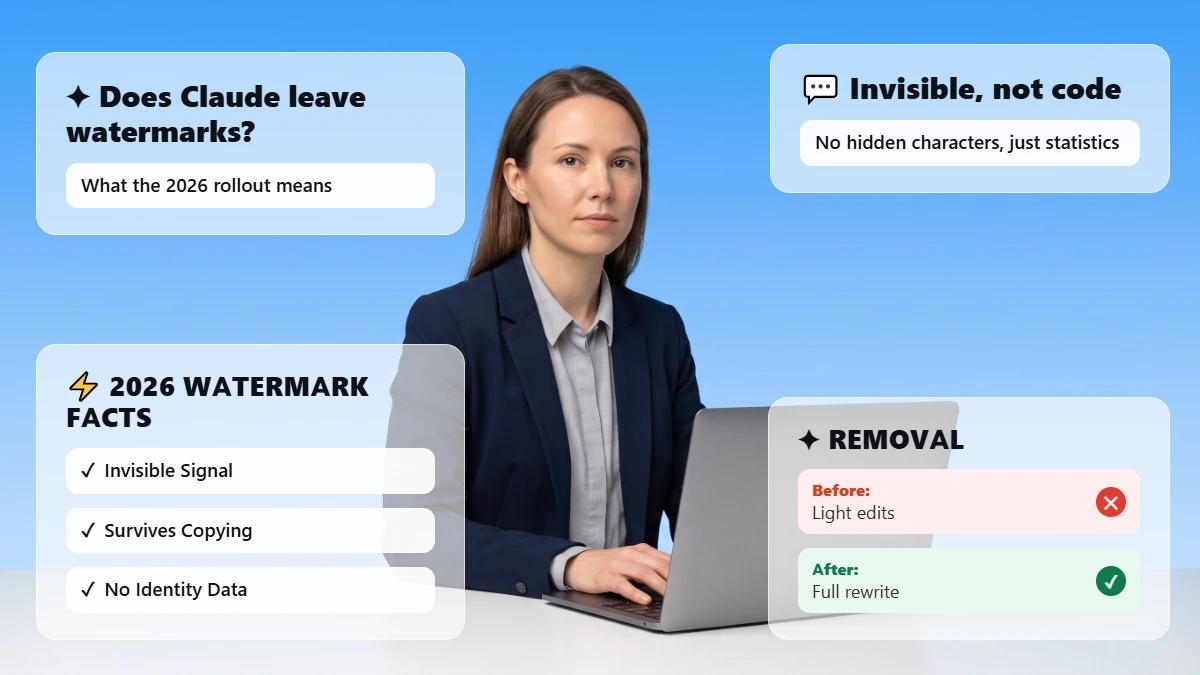
The Claude text watermark is built into the text generation process. It is not a visible label or a string of hidden Unicode characters. Instead, Anthropic creates an imperceptible statistical pattern through the choices Claude makes while generating text.
Because the watermark is part of the text itself, it travels with the text when you copy and paste it and may remain detectable after some editing. Anthropic is applying the marking system at the model level, including across supported Claude products and third-party cloud platforms. Reporting on Anthropic's watermark rollout also confirms that the system is intended to work across Claude surfaces rather than only on Claude.ai.
However, this does not mean every piece of Claude text is currently watermarked. New Claude models released after the new transparency requirements took effect are designed to include marking from launch, while Anthropic is still extending the system to older models.
A Claude watermark also does not prove that Claude authored the entire document. A mark can indicate that Claude was involved in processing the text, including when it helps generate, rewrite, summarize, translate, or proofread content.
That is different from a general AI detector. AI detection tools estimate whether writing appears AI-generated using their own models and signals, while Claude watermark detection looks for a specific pattern intentionally embedded by Anthropic.
Which AI Models Add Watermarks to Text in 2026?
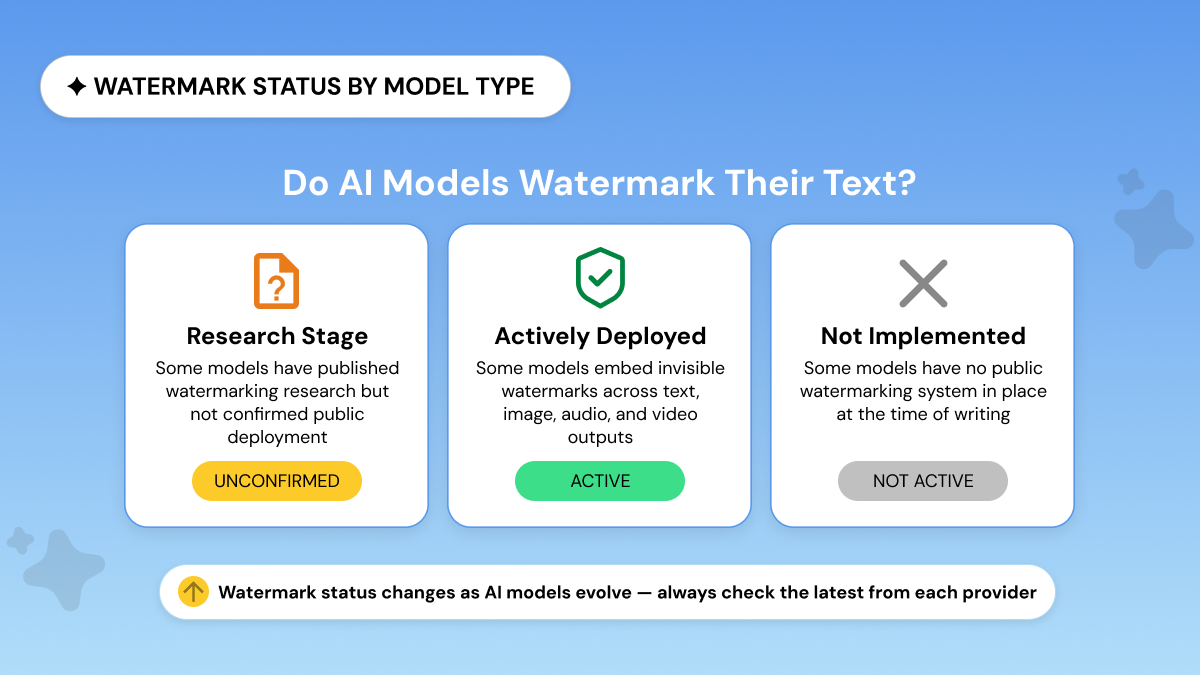
Google and Anthropic now both use text watermarking in supported AI products. Gemini uses Google's SynthID system, while supported Claude models use Anthropic's own imperceptible text watermark. OpenAI has researched text watermarking but has not publicly deployed it for ordinary ChatGPT text as of August 2026.
(See comparison table below.)
Model | Watermarks text? | Method | Can anyone verify it? |
Google Gemini | Yes | SynthID (token-probability watermark) | Yes via Google's SynthID / Gemini app detector |
ChatGPT / GPT-5 (OpenAI) | No | None deployed for text; C2PA + SynthID used for images since May 19, 2026, and audio since July 31, 2026 | Not applicable to text yet |
Claude (Anthropic) | Yes, on supported models | Imperceptible model-level text watermark | Anthropic is developing detection tools for users and third parties |
Open-source models | No | Watermarking exists in research, rarely deployed by default | Varies by implementation |
Some AI developers use watermarks and others do not. Knowing which AI tools incorporate watermarks can help educators, creators and professionals determine accuracy of AI detectors and validity of content.
ChatGPT & GPT-4/GPT-5 Watermarks
OpenAI researchers have studied how statistical watermarks can be embedded in machine-generated text by manipulating token probabilities. According to OpenAI's watermarking research, these techniques create a concealed signature within GPT-generated text.
OpenAI still hasn't shipped a text watermark in ChatGPT. But the company has moved quickly on other content types. On May 19, 2026, OpenAI joined the C2PA steering committee.
OpenAI began embedding Google DeepMind's SynthID watermark in images from ChatGPT, Codex, and the OpenAI API, alongside C2PA Content Credentials. That coverage expanded to ChatGPT's voice output (GPT-Live) on July 31, 2026.
Text-based watermarking remains unreleased. If you're trying to understand how ChatGPT text is currently detected instead, see this guide on how to remove a ChatGPT watermark.
Google Gemini (SynthID)
Google's SynthID takes another tack. The company already is using it for content created with Gemini, including text, photos, audio and video.
SynthID inserts an embedded, verifiable watermark into content that detection tools can use to definitively flag whether something was created by AI.
For full technical details regarding Gemini watermarking, see the official SynthID documentation from Google DeepMind.
For text, this means Gemini-generated content can, if needed, be traced back to Gemini. This supports efforts to verify the authenticity and provenance of content.
Claude (Anthropic)
Anthropic now adds an invisible text watermark to supported Claude models. The watermark is embedded at the model level and is designed to remain with the text when it is copied and pasted.
How Token Probability Watermarking Works?
Before we dig into watermarking, it’s important to understand how AI models generate text.
Large language models don’t “write” text the way we do. Essentially, they assign a probability to what the next word (token) will be. The model considers thousands of possible tokens at each step in a sentence and chooses the one with the highest probability.
For example, imagine an AI generating this sentence:
“Artificial intelligence is transforming the way people…”
Possible next tokens might include:
work
learn
communicate
create
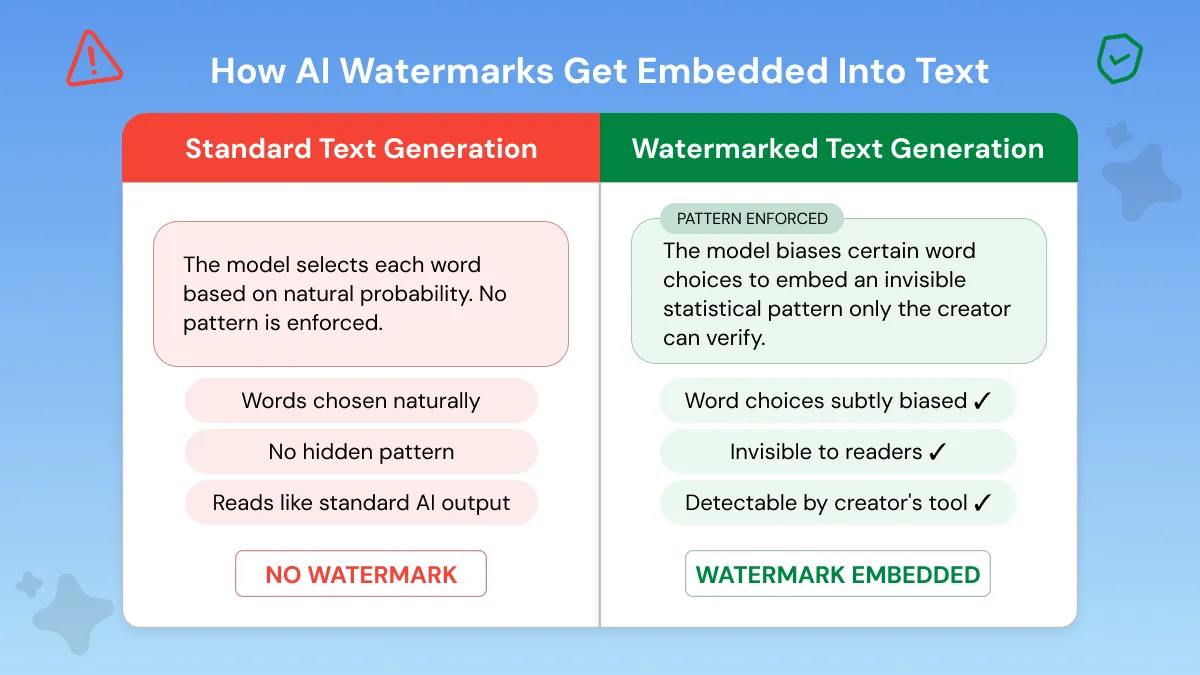
Statistical watermarking works differently. With this technique, the language model slightly favors some tokens over others. It subtly nudges certain words to occur more frequently and others to occur less.
This creates a hidden pattern across the text. One that’s nearly impossible for readers to notice but detectable by the watermarking system.
This creates a statistical signature across hundreds of tokens. Tools can analyze the text and assess if the probability pattern matches the watermark of a particular model.
Normal generation: tokens are chosen purely by probability.
Watermarked generation: token probabilities are gently biased to create a hidden pattern.
This approach traces back to academic research. Most notably, the 2023 paper "A Watermark for Large Language Models" by Kirchenbauer et al., which formalized the green-list/red-list token-biasing method that SynthID and similar systems build on.
What Does an AI Text Watermark Look Like?
It looks like nothing at all. A text watermark isn't a visible mark, a special character, or anything you could point to on the page. It's a statistical pattern in which words a model favored over others.
You can't see it. You can't select and delete it the way you would a stray character.
That's a common source of confusion. Some tools and articles conflate statistical watermarks with zero-width Unicode characters. Invisible characters sometimes inserted into text as crude tracking markers.
Those are a different, much cruder technique. They can be found and stripped out with a simple text scan.
A real statistical watermark, like SynthID, has no discrete character to find. It's spread across the probability choices behind hundreds of words. This is exactly what makes it harder to detect and harder to remove without a genuine rewrite.
Anthropic has also confirmed that Claude's text watermark does not use invisible or zero-width characters. Instead, the watermark comes from subtle patterns in the words Claude chooses while generating text, rather than hidden characters added to the document.
Can AI Text Watermarks Be Detected?
Watermarks are detectable by the creator of the model via a verification tool, but typical AI detectors such as GPTZero and Turnitin do not scan for watermarks. They detect AI through their own technology like linguistics, perplexity, and statistical analysis.
It’s important to understand the difference between watermark detection and general AI detection:
To detect watermarks, you need access to the secret pattern/key that the AI model inserted. Only the developer who trained the model can reliably confirm watermarks.
AI detection tools such as Turnitin or GPTZero scan for indirect evidence that text was created by AI. They look for patterns in grammar, sentence structure, and token probabilities that seem unusual.
There's also a newer risk worth knowing about. Spoofing and false positives. Watermark detection relies on statistical likelihoods rather than certainty. It's possible for a mimicked pattern to trigger a false match.
Or for genuinely human-written text to be misattributed to AI. No detection method, watermark-based or not should be treated as absolute proof of authorship.
Turnitin does not yet have any capability to identify AI watermarks. Turnitin looks for AI-style writing characteristics, not hidden statistical watermarks. Therefore, watermarked submissions would not be flagged unless sent through the same AI as was used to create the watermark.
If you want to test your own content, a free AI detector can give you a quick idea of how your text scores. This is especially useful for Claude and ChatGPT text. Since there's no watermark detector to fall back on.
A general AI detector is the only signal available. For a deeper look at how reliable these tools actually are, this breakdown of AI detection accuracy across popular checkers is worth reading.
Can AI Watermarks Be Removed from Text?
Yes. Because AI text watermarks rely on statistical patterns in word choice. Sufficient rewriting either done manually or with specialized tools can disrupt the pattern and effectively remove the watermark.
AI watermarking works by subtly influencing how an AI model selects tokens during generation. Over the length of a paragraph or article, these small probability shifts create a recognizable statistical signature.
If you change the wording and structure of a document enough, you can make that hidden signature go away. In many cases, basic paraphrasing won’t suffice.
For instance, replacing words such as important with significant or useful with helpful leaves the token patterns throughout the document mostly intact.
Rather, rephrasing at a structural level works much better. Sentence structure can be changed, idea order can be shuffled, paragraph flow altered, and new patterns of phrasing introduced.
By altering the text this much deeper down, the chances of disrupting the probabilities of tokens that watermark tools look for are greatly increased.
It's worth separating safe edits from risky ones. Light paraphrasing, swapping a few words for synonyms is usually safe. But rarely effective on its own. Heavy structural rewriting is more effective at disrupting a watermark.
But pushed too far it can also introduce factual errors or awkward phrasing. Text that reads worse can still read as AI-written. For a deeper walkthrough, see this guide to removing AI watermarks from text.
If you're working with Gemini output, heavy structural rewriting is what disrupts the SynthID signal. If you're working with Claude or ChatGPT text, there's no watermark to begin with.
So the real goal is reducing AI-detectable patterns rather than removing a hidden signal. Either way, you can automate this with an AI text watermark remover. It rewrites text to disrupt statistical patterns and reduce detectability.
AI Watermarking and the Law: What the EU AI Act Means in 2026
The EU AI Act's transparency obligations under Article 50 began to apply on August 2, 2026. It requires providers of AI systems that generate text, audio, image, or video content to embed machine-readable markings wherever technically feasible.
The law doesn't mandate a specific watermarking technology. But it's a major reason provenance tools such as SynthID, C2PA-based Content Credentials, and similar systems are advancing quickly across the industry.
It also helps explain why major AI providers are expanding their content-marking systems. Anthropic now watermarks text from supported Claude models, Google uses SynthID for Gemini-generated text, and OpenAI continues to research text provenance while currently using watermarking and provenance technologies for other supported media.
For the underlying legal text, see the European Commission's guidance on Article 50 transparency obligations.
For readers, the practical takeaway is that "is my AI text marked?" is increasingly a live regulatory question, not just a technical curiosity. And the answer still depends entirely on which model produced the text.
AI Watermark Removal vs AI Humanization, What’s the Difference?
Watermark removal disrupts the hidden statistical pattern a model embeds. AI humanization rewrites text to sound more natural. They solve different problems, and the strongest results combine both.
Watermark removal obfuscates the statistical patterns created by AI models. AI humanization alters text to read as human authored. The most effective tools employ both strategies.
While watermarks and humanization are frequently discussed together, they address separate issues with AI text.
Feature | AI Watermark Removal | AI Humanization |
Main Purpose | Removes or disrupts the statistical watermark pattern embedded by AI models. | Rewrites AI text to make it sound more natural and human-like. |
Focus Area | Technical token probability patterns used in watermarking. | Writing style, tone, and readability. |
How It Works | Changes sentence structure and wording to break the hidden statistical signature left by the AI model. | Adjusts phrasing, sentence variation, and tone to mimic human writing patterns. |
Goal | Prevent watermark verification by disrupting the hidden pattern. | Reduce the “robotic” feel of AI-generated content. |
Effect on Readability | May or may not improve readability since the main goal is pattern disruption. | Specifically improves flow, tone, and clarity. |
Best Used When | You want to remove AI watermark signals embedded during generation. | You want the text to sound more natural and less AI-like. |
Ideal Solution | Works best when combined with humanization techniques. | Most effective when paired with watermark removal to handle both style and detection signals. |
When Do You Need Each?
The choice depends on the situation:
Watermark removal helps you when you want to obfuscate invisible statistical watermarks created by AI models.
An AI humanizer helps you when you want your text to sound less like a robot wrote it.
Both together are often the most effective solution. They address both technical detection signals and writing style patterns.
Note that Turnitin detects QuillBot, so combining both approaches gives you the most complete coverage.
For a broader roundup of tools that handle both jobs, see this picks for the best AI text cleaners.
AI text watermarks are becoming an increasingly important part of the conversation around AI-generated content. Watermarking will likely become more prevalent across various outlets and mediums as large language models advance, including text, images, and video.
This is already reflected at the industry level, the C2PA (Coalition for Content Provenance and Authenticity) is the leading standards body developing open specifications for verifying the origin of digital content, backed by Adobe, Microsoft, BBC, and Intel.
The problem is that since they are based on probabilistic models of word choice, they are not permanent. Given enough rewriting by hand or with the assistance of certain tools, you can shift the statistics back and forth to remove the watermark while maintaining the integrity of the content.
Not sure where you stand first? Run a free AI detector check, then use the remover to address whatever it flags.
FAQs
Do AI Watermarks Affect Turnitin or GPTZero Results?
Not directly! Turnitin and GPTZero don't scan for the SynthID watermark or any other statistical watermark. They run their own AI-detection analysis. A watermarked Gemini submission would need to be checked with Google's SynthID tool specifically.
Turnitin and GPTZero would only flag it (if at all) the same way they flag any other AI-written text.
Can You Remove a Claude Watermark?
Yes, Phrasly’s AI Text Watermark Remover can help readers rewrite and polish Claude-assisted text while preserving the original meaning. However, Anthropic's new Claude watermark is a statistical pattern built into supported model output, so no third-party tool should guarantee complete removal in every case. Significant rewriting may weaken the signal, while light edits may not.
What Does an AI Text Watermark Look Like?
Nothing visible! It's a statistical pattern in word choice, not a character or symbol you can see, copy, or delete. Which is different from cruder tricks like invisible Unicode characters.
Does Gemini Watermark Text?
Yes! Google's Gemini uses SynthID. A statistical watermark embedded by biasing token probabilities during generation. It's the only text watermark deployed at scale by a major AI provider in 2026. And it's verifiable through Google's detection tools.
Does Claude Leave Watermarks in Text?
Yes, supported Claude models now watermark generated text. Anthropic's system embeds an invisible signal during generation rather than adding visible labels or hidden Unicode characters.
New Claude models released on or after August 2, 2026 support marking from launch, while Anthropic is adding support to older models. The date also aligns with the EU AI Act's AI transparency rules, which began applying on August 2, 2026.
What Is an AI Text Watermark?
AI text watermark is a machine invisible statistical signal inserted into AI-generated text by biasing token probabilities during generation. It leaves the text visually unchanged but can be recognized by verification tools.
Does ChatGPT Watermark Its Text?
No, not for text. OpenAI has studied statistical text watermarking and, as of May 2026. Embeds Google's SynthID watermark in ChatGPT-generated images (and, since July 2026, in GPT-Live audio).
But no text watermark has been deployed in ChatGPT as of 2026.
Can AI Watermarks Be Removed?
Yes! Since watermarks are based on statistical word-choice patterns, enough rewriting to change the structure will break the pattern, removing the watermark.
If you are unsure of what an AI humanizer is, it is worth knowing that tools combining both approaches tend to give the most complete results.
Do AI Detectors Check for Watermarks?
No, tools like GPTZero and Turnitin do not check watermarks. They statistically analyze the text themselves to predict if it was AI-generated. However, it's worth knowing that AI detectors can be wrong, so no single method should be fully relied upon.
What’s the Difference Between Watermark Removal and Humanization?
Watermark removal breaks hidden statistical patterns embedded by AI models. AI humanization focuses on making text sound more natural. The most effective tools combine both approaches.

Written by
Muhammad Usman Ali
Pakistan
Muhammad Usman Ali is an experienced SEO content writer with 3+ years of professional writing experience. He specializes in AI tools, AI detection technologies, and search engine optimized content.