Can AI Detectors Tell Which AI Model Wrote a Text?
14 min read
A standard AI detector can estimate that a passage looks AI-written, but it cannot prove the text came from ChatGPT rather than Claude or Gemini.
The word identify covers two different questions. One asks whether writing carries patterns linked to AI, which detectors handle reasonably well on longer samples. The other asks whether AI detectors can identify ChatGPT, Claude or Gemini as the exact source.
We checked what Google, Anthropic and OpenAI actually publish about marking their own output, and what a score supports once you have one.
Below: the line between detection and attribution, what each provider marks in September 2026, and how to review authorship fairly.
Want to know whether a passage shows common AI-writing signals? Check it with the free Phrasly AI Detector, and read the result as an AI-likelihood estimate, not proof of the source model.👇
Can AI Detectors Identify the Exact AI Model?
No. A public AI detector returns an AI-likelihood score, and a score carries no company name.
A detector can flag Claude output as AI without ever knowing that Claude wrote it. Five methods get used to check a document, and only two of them, a provider watermark and a signed content credential, ever point at a company.
Method | Flags AI-like text? | Names a provider or model? | What a positive result means | Main limitation |
|---|---|---|---|---|
General AI detector | ✅ Yes, as a probability | ❌ Usually not reliably | The language resembles patterns learned from AI and human samples | False positives and false negatives; model drift |
Closed-set attribution classifier | ✅ Yes | ⚠️ Sometimes, among known candidates | One known model is the closest statistical match | Weakens with new models, editing, mixed authorship |
Provider watermark verifier | ⚠️ Only for marked output | ✅ May indicate the participating provider | The provider's keyed signal shows up, with a confidence level | Depends on rollout, key access, length, rewriting |
Metadata or content credential | ❌ Not necessarily | ✅ Can name the issuing tool or workflow | A signed file record shows origin or processing history | Absent, stripped, or unsupported for pasted text |
Draft or version history | ❌ No | ❌ No | The document shows a writing and revision process | May be incomplete; cannot prove every source |
📘 What is model attribution?
AI model attribution is the attempt to link text to the system that produced it, such as ChatGPT, Claude or Gemini. General AI detection asks a broader question: does this writing look machine-generated at all? Attribution asks which machine, and the evidence behind that answer is far weaker.
Can AI Detectors Detect ChatGPT, Claude, and Gemini?
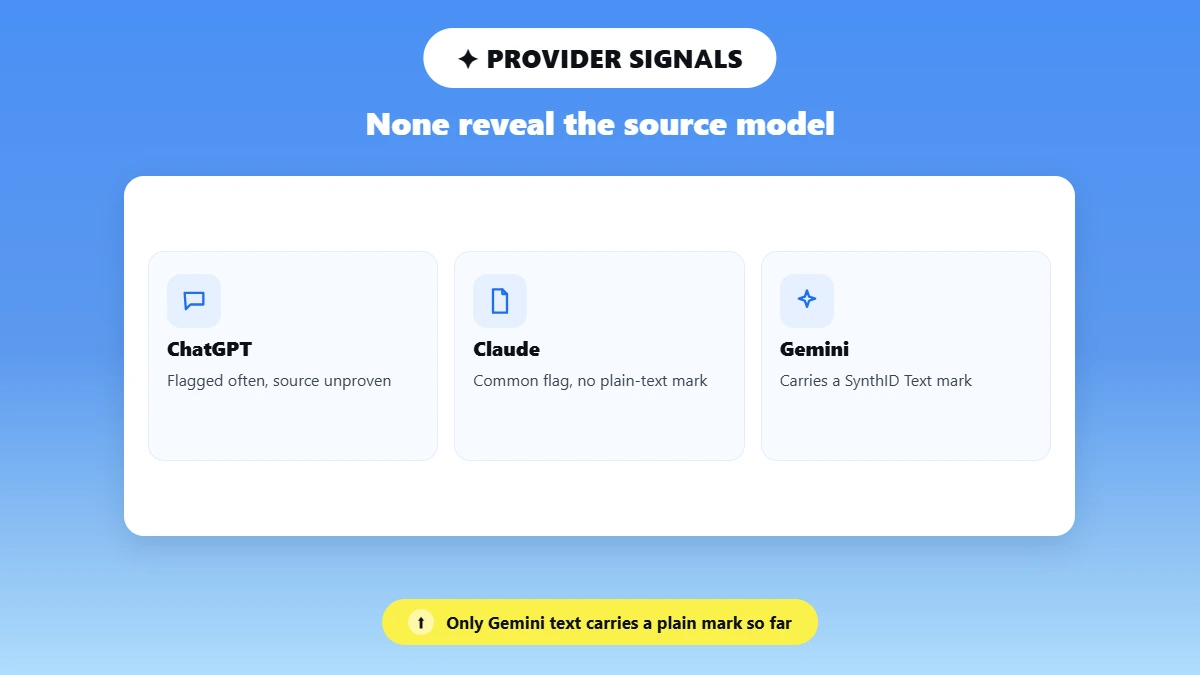
Yes. General AI detectors often flag ChatGPT, Claude and Gemini output as AI-written. No mainstream detector names which of the three produced an unknown passage. Results shift with length, topic, model version and editing.
Source | Detector can flag its output? | Ordinary detector proves the exact source? | Provider signal as of September 2026 |
|---|---|---|---|
ChatGPT | ✅ Often, depending on length, model and editing | ❌ Generally no | Pictures and audio only, via C2PA metadata plus SynthID. No plain-text mark. |
Claude | ✅ Often; Claude coverage is common among vendors | ❌ Generally no | Newer models mark text at launch. Earlier ones are being added. |
Gemini | ✅ Often; results vary by sample and detector | ❌ Generally no, from a style score | App and web output carries Google's SynthID Text mark. |
Provider facts reflect each company's own live documentation, checked September 2026, and all three pages should be re-checked on publication day.
Can AI detectors identify ChatGPT, Claude or Gemini by name, or distinguish between AI models? Not from a score. No tool can reliably distinguish Claude and Gemini, or distinguish ChatGPT and Gemini, once text reaches you without its history. All three write similar formal prose, and a classifier scores prose, not its author.
Can AI detectors detect ChatGPT text?
Yes for AI likelihood, and no for the source. A detector can flag ChatGPT prose as AI-written without proving that ChatGPT produced it, because ChatGPT text detection and ChatGPT authorship detection are different jobs. Any ChatGPT generated text detector you try does ChatGPT model detection by style alone, and OpenAI publishes no plain-text watermark to check against.
OpenAI's provenance documentation lists C2PA metadata and SynthID watermarks for supported images, and SynthID for audio. The company says its goal is to extend provenance signals to all modalities including text.
Until that ships, a ChatGPT claim rests on style evidence alone. So can ChatGPT be detected? It can often be detected as AI writing, and it can never be detected as ChatGPT specifically.
Can AI detectors identify Claude text?
Yes. Detectors can flag Claude text as AI-written, and only a keyed verifier tests for Anthropic's mark. Claude AI detection works like detection for any model: a classifier reads Claude writing patterns and scores them as AI-like. No public Claude text detector holds Anthropic's key, so no ordinary tool can detect Claude as Claude.
Anthropic's August 2026 watermark explainer says future models carry the mark at launch. Earlier ones, released before the EU transparency rule took effect, are being added over the coming months. So no, not every Claude output made by August 2026 carries one.
A watermark hit proves less than readers expect, because Anthropic states that it answers one question only: how likely it is that Claude was involved. The mark cannot confirm human authorship, cannot spot a rival's AI, and cannot separate writing from heavy editing. It ties text to no person and no chat.
Our breakdown of does Claude leave watermarks in text covers what survives copying.
Can AI detectors identify Gemini text?
Yes. Detectors can flag Gemini text as AI-written, and SynthID Text is a separate provider signal. Gemini AI detection through an ordinary classifier reads style, so a tool can detect Gemini output as AI without naming Google. Google separately marks app and website output by adjusting token probabilities during generation, which leaves the wording normal while a pattern forms.
Google DeepMind says the technique works best on longer, varied responses and survives cropping and mild paraphrasing. Confidence falls when text is thoroughly rewritten or translated, and the mark weakens where few word choices are open.
Can SynthID prove a paragraph came from Gemini? No. A verifier reports a keyed Google signal with a stated likelihood, which points at Gemini involvement without naming a person, a prompt or a document.
If you are unsure about a passage, run it through the detector and start from the highlighted sentences.👇
What "Detects ChatGPT, Claude, and Gemini" Really Means
A detector's coverage claim describes which AI systems it was trained or tested on. It promises nothing about text you paste today, and it makes no tool a model-specific AI detector.
✅ What the claim can mean | ❌ What it never means |
|---|---|
📚 Samples from those models went into training data | Proof of which app or model version wrote the text |
🧪 Those models appeared in a release test or benchmark | That every output from those models gets caught |
🔁 The tool reads habits common across many language models | That a highlighted sentence is entirely machine-written |
📊 The tool can score their output as probably AI | That a score names a person, account, prompt or conversation |
That a score proves anyone set out to deceive |
Every headline accuracy figure here comes from the vendor. Phrasly's detector page states the limit plainly: it analyzes universal patterns in AI-generated text rather than tool-specific signatures. Cross-model detection returns one likelihood estimate across model families, with no source label.
How AI Detection and Model Attribution Work
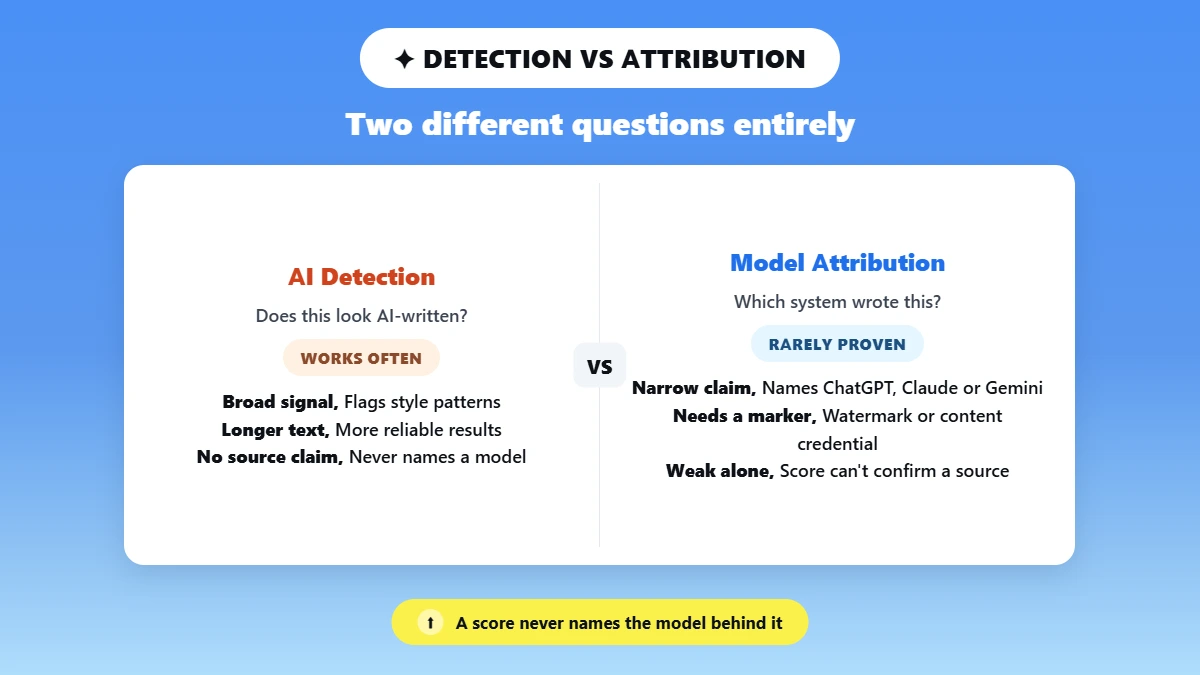
Detection compares your text against patterns learned from labeled human and AI samples. Attribution tries to match it to one model. Both run on statistics, and they differ in how much evidence stands behind the answer.
Five methods carry the label AI text attribution, and readers treat them as one thing:
🤖 Classifier detection. A model trained on labeled writing learns statistical and stylistic differences, then scores new text.
🎯 Closed-set attribution. The tool performs source model identification against a fixed list of candidates, and it answers only within that list.
🌐 Open-set attribution. The classifier meets a model or version it never saw in training, which is most web text.
🔑 Watermark verification. A checker tests for a keyed signal added during generation, and needs the matching key.
📄 Provenance evidence. Signed metadata or creation history records where a file came from.
None of it reduces to word frequency or punctuation. Our guide on how to tell if text was written by AI shows what a score gives you.
Why is open-set attribution harder?
Open-set attribution is harder because the model that wrote the text may not be on the classifier's list. A closed-set classifier returns the closest match among models it knows. Give it text from a model outside that list and it still returns a name, at full confidence.
Can a model-attribution classifier recognize a model it was never trained on?
Not reliably. A classifier meeting an unseen model still returns a name from its training list. A LREC-COLING 2024 study on source attribution found promising results for naming source models and model families under controlled conditions. It also found larger models harder to detect, with results shifting on the match between training data and model size. A classifier tested against a fixed candidate list holds an advantage it loses the moment an unknown web paragraph arrives from a model nobody listed.
Why Exact Model Attribution Is Difficult
The signal that would identify one model keeps moving underneath the tools trying to read it. Providers swap models and route between versions, so a pattern learned from last year's output no longer describes what the same product writes today.
🔄 Models and routing change. Providers update versions and route requests between them.
📝 Formal prose converges. Different models write similar academic and business prose.
⚙️ Setup moves the output. One model varies across prompts, system instructions, tools and fine-tuning.
✍️ People edit. Human revision and mixed authorship blur the original signal.
📏 Short samples say little. Brief, factual, tabular or code-like text carries less evidence.
⏳ Training ages. A classifier built on older output may not generalize to a new release.
Why do the same detector scores differ for ChatGPT, Claude, and Gemini?
Because detectors perform unevenly across source models. The same tool, at the same setting, catches three source models at three measurably different rates, which is why a score cannot double as a source label.
📊 One detector, very different results by source model
An ICLR 2026 benchmark evaluated 18 detection methods on AI-written peer reviews from GPT-4o, Gemini and Claude. At a 1% false-positive setting, the best general method caught roughly 45% of GPT-4o reviews and about 85% of Gemini reviews. Peer review is one narrow domain, so read the figures as domain-specific.
Uneven performance explains why a false negative on one checker is a confident flag on another. See AI detection accuracy shows the spread on identical text.
Can Watermarks or Metadata Reveal Which AI Was Used?
Sometimes. A provider watermark or a signed content credential can point to the company whose system was involved, and only for marked output checked with the right verifier. A provider watermark beats a style score as evidence of provider involvement, and it still identifies no person, proves no sole authorship and establishes no rule-breaking.
Are provider watermarks more reliable than AI writing detectors? For the narrow question of which company's system was involved, yes, because the check uses the provider's key instead of guessing from style. Coverage is the catch: a mark exists only where the provider put one, and only a key holder reads it.
Evidence type | Example | Supports provider attribution? | What it cannot prove |
|---|---|---|---|
Statistical text watermark | Gemini SynthID Text; eligible Claude output | ⚠️ Sometimes, with the matching verifier or key | User identity, sole authorship, accuracy, or misconduct |
General AI detector score | Phrasly and other cross-model classifiers | ❌ Usually not exact provider attribution | A definite source, person, prompt, or conversation |
C2PA content credential | Supported generated files | ✅ May point to the tool that made the file | That plain copied text kept the credential |
Version history | Google Docs or Word revisions | ❌ No, it supports process verification | Which hidden model, if any, supplied a particular idea |
What does each provider mark in September 2026?
Google marks Gemini text, Anthropic marks newer Claude output, and OpenAI marks pictures and audio. The three content provenance systems use different signals and formats.
🟦 Google DeepMind. SynthID Text covers app and website output. Confidence drops after a thorough rewrite or translation.
🟪 Anthropic. New models mark output at launch, with earlier ones added later. The detection API is in private preview for eligible organizations, so most people cannot run this check.
🟩 OpenAI. Provenance covers supported images and audio. Text is a stated goal, not a shipped feature.
The mechanics are in our guide to ChatGPT, Claude and Gemini watermark text.
Does a missing watermark prove a human wrote the text?
No. A missing watermark does not prove that a human wrote the text. A clean check means the verifier found nothing, which has ordinary explanations. The output came from a system outside coverage, predates the rollout, or is too short to carry a signal.
What Can You Conclude From an AI Detector Score?
A score supports a closer look and little else. It only estimates how far your text resembles patterns the tool links to AI writing. If a detector returns 90% AI, it still cannot say whether the source was ChatGPT or Claude, because the model was never the question.
✅ A score CAN support
The text resembles patterns the detector links to AI writing
Specific passages deserve a closer read
A longer sample may be worth checking
More process evidence is needed before deciding
🚫 A score CANNOT establish on its own
That ChatGPT, Claude or Gemini wrote the text
That one named person generated or pasted it
That the whole document is machine-authored
That a low score proves human authorship
That a policy was broken
The largest institutional vendor says as much. Turnitin's guidance states that its model may misidentify human-written, AI-generated and AI-paraphrased text, and should not be the sole basis for adverse action. It also withholds percentages between 1% and 19%, where its own testing found more false positives.
📊 Detectors disagree, and people do worse
A 2025 study in Advances in Simulation ran academic introductions through three detectors, Phrasly included, across five conditions from human to machine-written. The tools separated the conditions and disagreed sharply on the score itself. Five blinded human raters managed 19% accuracy, no better than guessing.
A percentage means something only once your school or employer writes down what it triggers. Our guide to how much AI detection is acceptable covers sensible thresholds.
How to Investigate Authorship Responsibly
Start with a long enough sample, and finish with the writer's own account of the work. A detector score tells you where to look, and the drafts, timestamps, citations and the writer's own account of the argument are what settle the question.
📄 Check a representative prose sample. Turnitin needs at least 300 words of prose. Short excerpts give unstable results.
🔍 Read the sentence-level flags. Highlighted passages tell more than the headline number.
🕘 Look at the writing record. Draft history, timestamps, notes, outlines and citations show how it came together.
📚 Use earlier work as context only. A change in style is a reason to ask, never an answer.
💬 Ask the writer to explain the argument. Someone who built it can say what they cut and why.
📋 Apply the policy consistently. Write the standard down before you need it, and apply it to every writer.
See how to detect academic AI writing and what professors look for.
Check General AI-Writing Signals With Phrasly
Phrasly's AI detector scores how closely a passage matches AI-writing patterns across model families, then shows you the sentences behind the score. Those highlighted sentences are what turn a percentage into something you can act on.
📋 Paste a representative prose sample. Use a paragraph or more rather than a single sentence.
👀 Read the result and the highlights together. The overall figure alone hides where the signal came from.
✅ Verify before you judge. Check claims, citations and writing history first.
Phrasly reports 99.8% accuracy in its own product materials, a vendor number like every other here. Our study of nearly 38,000 human-written essays found a 26.4% false-positive rate for one popular free checker. The method is in our test of whether ZeroGPT works.
The detector is free to use. You get three checks, then a free account unlocks unlimited checking.
✏️ Refining your own AI-assisted draft
If a draft is accurate but sounds generic or unlike your voice, the Phrasly AI Humanizer refines tone, rhythm and clarity. Review every change, keep your citations and meaning intact, and disclose AI assistance wherever your school, employer, client or publisher requires it.👇
Before acting on any score, ask what the number covers, how long the sample was, and what the document itself shows about how it was written.
Keep your drafts, notes and sources, because that record answers an authorship question better than any percentage and it is the one part of the evidence you control.
Run your passage through the detector and see what it flags.👇
Frequently Asked Questions
Can AI detectors tell which AI model wrote a text?
Usually not. Most public detectors estimate how much a passage resembles AI writing, and they do not attribute unknown text to one provider or version. A vendor's coverage list reflects what it trained and tested on rather than a source label it could defend.
Can AI detectors tell ChatGPT and Claude apart?
Not dependably. Research classifiers separate known candidates in controlled tests, where the source list is fixed and the samples are clean. An everyday score on real-world text proves nothing about which of the two wrote a passage.
Can AI detectors identify Gemini-generated text?
Yes for AI likelihood, and separately for the watermark. General detectors may flag Gemini output as AI-like. App and website text can also carry Google's SynthID mark, which a key holder reads directly instead of inferring it from style.
Does Turnitin identify whether ChatGPT, Claude, or Gemini was used?
No. Turnitin reports the share of qualifying text it considers likely AI-generated or AI-paraphrased, and it names no source model. Its own guidance says the result cannot decide a case alone. See whether Turnitin detects ChatGPT.
Does ChatGPT put a watermark in text?
No, not as of September 2026. OpenAI's published provenance work covers images and sound files. The company says it aims to widen those signals to every format, text included, so check its documentation first.
Does Claude watermark its text?
Some of it. Anthropic said in August 2026 that new releases add a keyed mark at launch, with earlier models following later. Do not assume every Claude output has one, and do not read a mark as proof of authorship. See does Claude leave watermarks in text for what survives copying.
Can an AI detector prove that someone cheated?
No. A score is one signal. A fair decision also needs the document's history, its sources and drafts, the writer's explanation, and the policy that applies. See how professors detect ChatGPT for that process.
Can editing change an AI detector score?
Yes. Ordinary revision changes the patterns a classifier reads, so a score moves either way. Heavy rewriting or translation weakens a provider watermark. A changed score still names no author. See AI detection accuracy for how far scores move on identical text.

Written by
Alina Shah
SEO Content Specialist · Karachi, Pakistan
She writes about AI so you don't have to guess. 8+ years in content strategy and editing. Now she puts AI writing tools and detection systems through real tests and shares what actually works.