Does Claude Leave Watermarks in Your Text? What to Know in 2026
12 min read
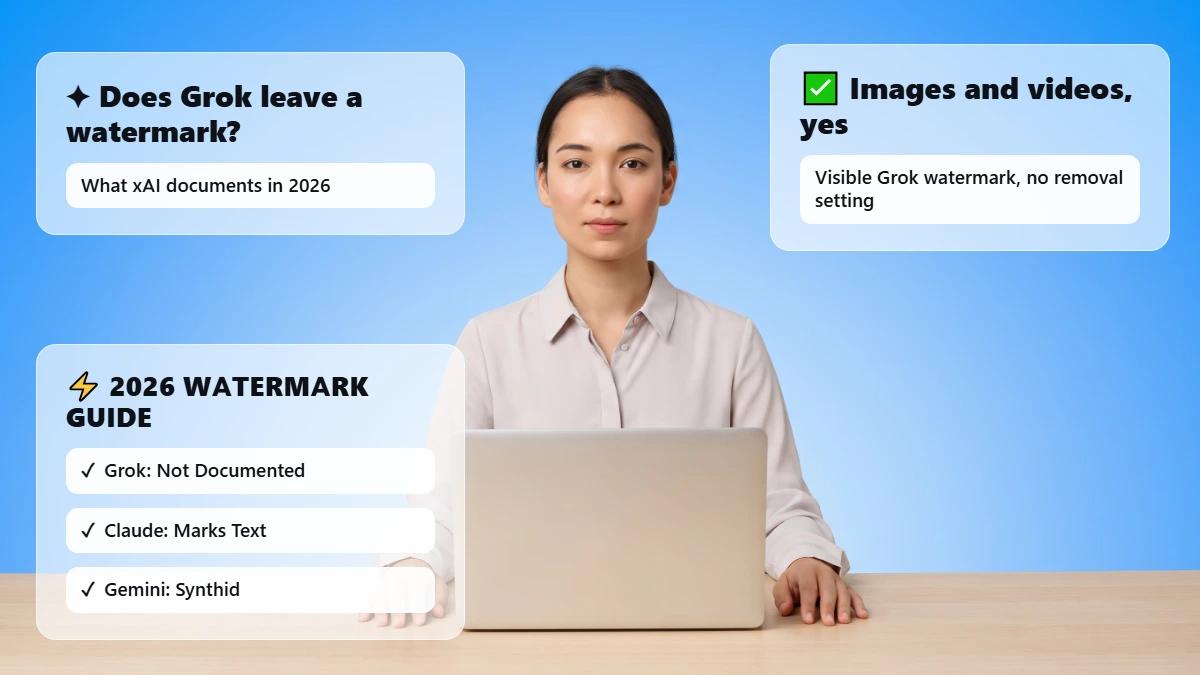
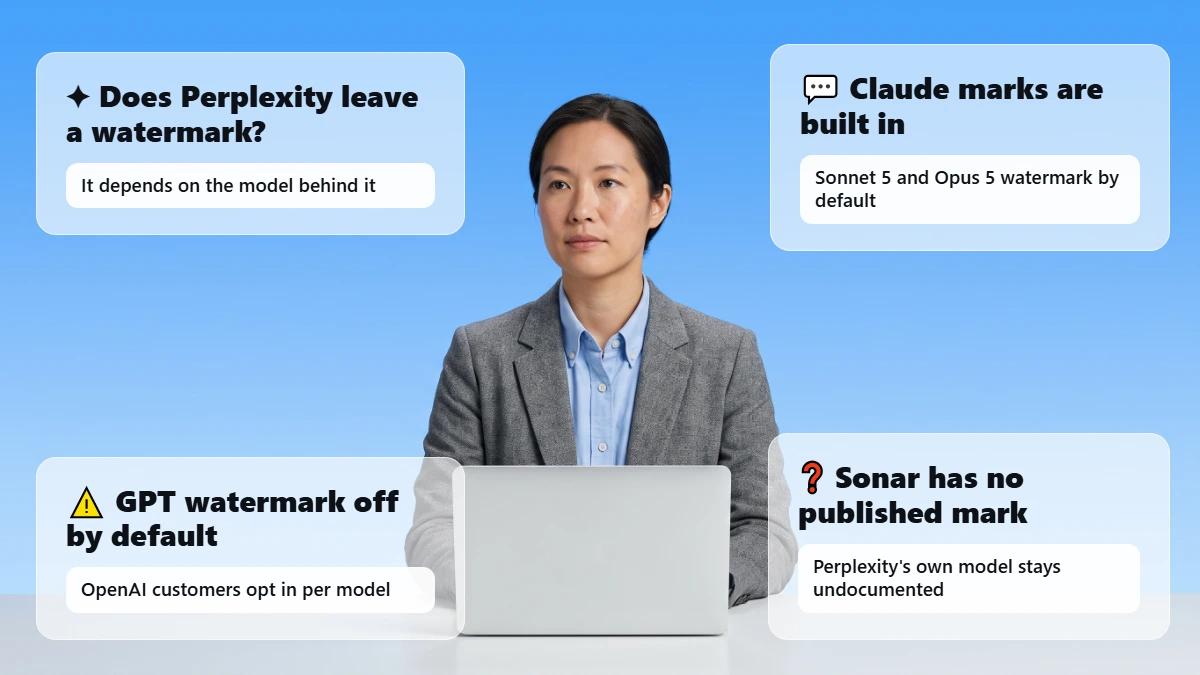
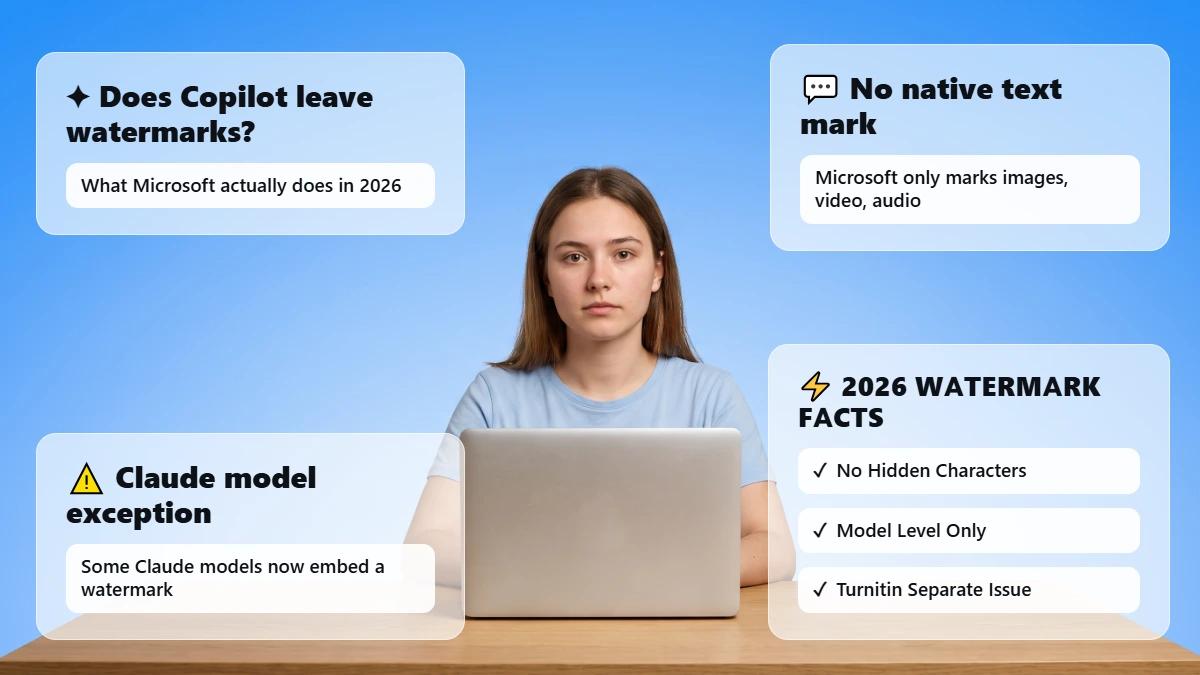
Yes, Anthropic has implemented an invisible statistical watermark on text outputs from supported Claude models. This does not imply that all Claude responses that you see today will have a watermark.
New models launched on or after 2 August mark text at launch. Old models will continue to receive updates. This mark is a statistical indicator, not a hidden character, and it can survive copying and minor edits.
This guide explains Anthropic’s watermark process precisely.
How it works, what does Claude leave watermarks mean for your work, if copying or editing removes it, what it can actually prove, and what you can and can’t do with Claude-generated drafts.
Does Claude Leave Watermarks in Text?
Yes, Claude AI watermark models add an invisible statistical watermark to text they generate. This allows someone with Anthropic's key to estimate the probability Claude was used.
The watermark is not visible, is not a concealed character, and does not contain any identifying information. This feature is being deployed by Anthropic as part of their EU AI Act compliance.
Current status box (as of 18 Aug 2026)
✅ Confirmed: Supported Claude models can embed Claude text watermarks; new models (launched on or after 2 Aug 2026) mark at launch.
❌ Not confirmed publicly: A model-by-model list showing which pre-2 Aug Claude versions already have marking enabled. Rollout to older models is ongoing.
Does Every Claude Response Have a Watermark?
Not always! Anthropic mentions new models will be marked at launch and older models will be updated over time, but hasn't released a model-by-model rundown of which models have been updated.
Therefore, the launch date of a model cannot determine if a given response provided today already has the invisible Claude watermark.
Claim | Accurate as of 18 Aug 2026 |
|---|---|
Claude now uses text watermarking | ✅ Yes, on supported models |
Every Claude response today is definitely marked | ❌ Not publicly confirmed; older-model rollout ongoing |
The watermark is hidden Unicode | ❌ No; it is statistical, nothing is added |
Copy and paste removes it | ❌ No; the word sequence is unchanged |
Light editing definitely removes it | ❌ No, per Anthropic |
A full rewrite can remove it | ✅ Yes, per Anthropic |
A watermark proves Claude wrote everything | ❌ No; only that Claude was likely involved |
The watermark identifies your account | ❌ No; it carries no identifying information |
Anthropic has a public detector today | ❌ Not yet; the detection API is forthcoming |
How Does Claude's Invisible Text Watermark Work?
Claude's language model probabilities often have multiple plausible options for the next word. Watermarking adjusts the origin of that randomness:
Instead of only considering the previous words, a secret key also helps determine the choice. This creates a statistical fingerprint that can be uniquely detected and scored. Claude uses a variant of Google DeepMind's SynthID-Text watermarking.
Practically speaking, it goes like this:
Claude reaches a point in generation where several next-words are equally plausible.
A secret key combines with the preceding words to bias which option gets picked.
This slight bias repeats at every such decision point across the response.
The accumulated pattern becomes a statistical fingerprint unique to the key.
A detector holding that key can later score the text for the pattern.
This pattern accumulates over the entire response. Then a detector with the key can score the text for the pattern. Anthropic is clear that this doesn't drive Claude towards strange or unnatural words.
This adjusts Claude watermark selection, rather than word quality.
For a more comprehensive list of what AI models watermark their text, check out AI text watermarks.
Is It a Hidden Unicode Character?
No! Anthropic states explicitly that nothing is added to the text and there are no hidden characters.
The Claude text watermark is statistical. It is not affected by Unicode-cleaning tools that remove zero-width characters.
Can You See a Claude Watermark? ❗
No! A Claude AI watermark is not a logo, font change/formatting, a hidden space, or metadata in plain text someone pastes.
A watermark is a statistical pattern of word choice that humans can't see. It can only be seen by someone with Anthropic's key. Watermarked text looks the same to you as unwatermarked text.
Does Copying Claude Text Remove the Watermark?
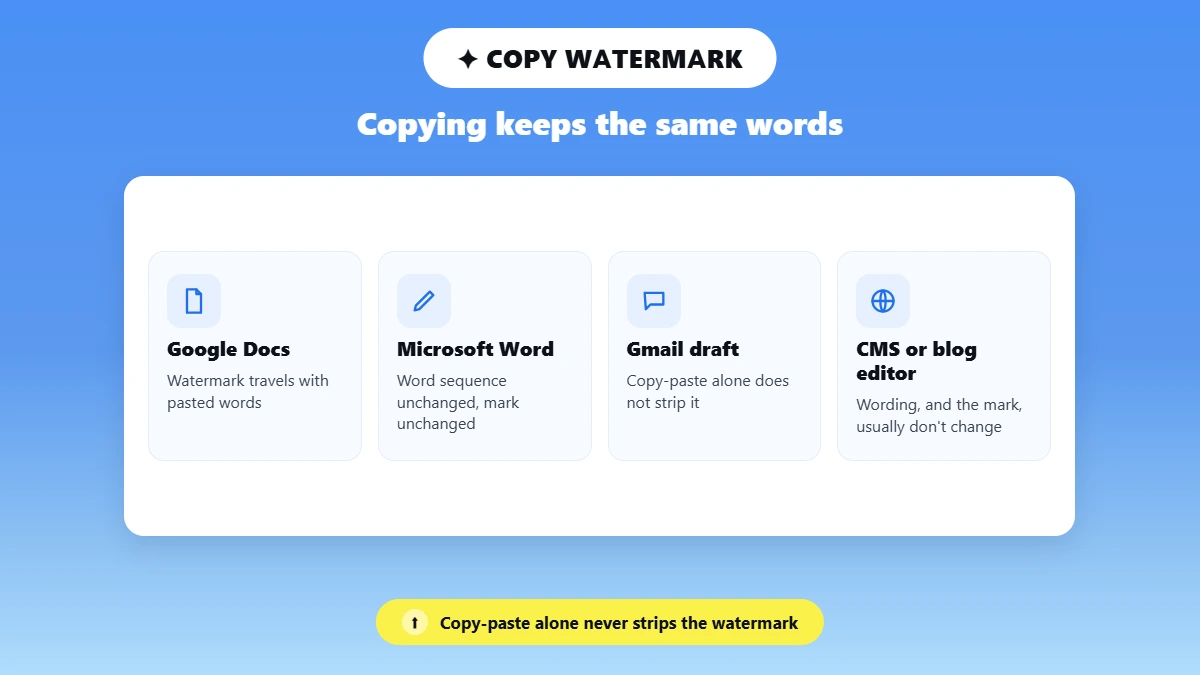
No, not by itself. Copy/pasting preserves the original word order, and Anthropic indicates that the Claude watermark propagates with copied text and may persist through some editing.
Paste Claude output into Google Docs, Word, Gmail, or a CMS, and you still have the same word choices carrying the signal.
Claude → Google Docs: Watermark travels with the pasted words.
Claude → Microsoft Word: Word sequence unchanged, mark unchanged.
Claude → Gmail draft: Copy-paste alone does not strip it.
Claude → CMS/blog editor: Formatting changes, but wording (and the mark) usually doesn't.
Does Editing Claude Text Remove the Watermark?
It varies based on how extensively you edit. Anthropic claims that light editing will likely not remove the watermark, but a rewrite that replaces every word will.
By altering the actual word choice, you throw off the statistical patterns the watermark depends on. Anthropic does not disclose a specific cutoff percentage on how much text can change.
Be wary of anyone who claims to know the exact cutoff.
Does Claude Watermark Text It Proofreads or Edits?
No, not necessarily! The watermark only gets applied to words that Claude chooses to use.
If Claude only makes grammar and punctuation changes to your writing, it will use very few of your words, which may not be enough for a detectable signal.
The less Claude rewrites, the less space the does Claude use watermarks mechanism has to imprint a pattern. The misconception that Claude will watermark your entire paper after each proofreading pass is false.
Does Claude Watermark Translations?
Yes! Because when Claude generates a translation, it is selecting the wording of the translated text.
So, the Claude watermark can get attached to it just like normal generated text.
If you translate something yourself with Claude, the translated output can be watermarked even though the concept is yours.
Does Claude Watermark Code?
Potentially yes, but often not as much as prose. Whenever a token has to be exact, the watermark isn't used, and code generally needs exact tokens, so it has a much weaker signal.
Arbitrary decisions like comments or variable names can be marked, with essentially no impact on how the code executes.
Watermarks don't get added to every line of Claude Code; that’s too broad of a claim.
Can a Claude Watermark Identify You? ❌
No! According to Anthropic, the Claude AI watermark contains no information that can be used to identify a particular user, organization, account, or conversation.
It can only be used to probabilistically estimate whether Claude was used to produce a given text.
Nothing about the watermark itself or the key can be used to reconstruct who prompted Claude or what was said.
Can Anyone Detect a Claude Watermark Yet?
No, not publicly anyway! Anthropic says they will release a Claude watermark detector API eventually but are still finalizing things.
Note that Claude-watermark detection will not be typical AI detection.
Generic detectors will not have access to Anthropic's secret key and will have to detect based on patterns in AI writing. Here's the crucial distinction.
Claude-watermarked detection requires Anthropic's private key. This is not publicly available. General AI detection looks for patterns, which is publicly available today.
Curious whether a piece of writing came from AI?
You can check whether text looks AI-generated in seconds.
It's worth knowing that tools like this work by spotting statistical patterns in phrasing and structure, not by reading some kind of hidden tag the AI left behind.
Phrasly’s detector reads general AI patterns and does NOT read Claude’s private watermark.
For background on the difference, see how to detect an AI watermark.
What Does a Claude Watermark Actually Prove?
One interpretation is that it means Claude likely interacted with the text in some way. It cannot confirm Claude wrote the entirety of the text, and Anthropic explicitly states that it cannot tell “Claude wrote this” and “Claude heavily edited this.”
Additionally, it does not specify who owns the text. The detected mark is merely indicative, not irrefutable evidence. This is important for students, teachers, and other professionals taking Anthropic watermark claims at face value.
Can Claude's Text Watermark Be Removed?
Sort of! Anthropic says light editing will likely leave it intact, but that fully rewriting the passage so that you replace the wording will remove it.
Deleting symbols or copying the output into another app doesn't affect the Claude text watermark since it's statistical, not based on a hidden character or anything. You actually have to change the words.
What Does Not Remove It?
None of the following affect the pattern, since it isn't tied to formatting or characters:
Unicode cleaners: the mark isn't Unicode-based.
Copying to another program: the word sequence stays the same.
Removing em dashes or special characters: those aren't the watermark either.
Changing fonts, spacing, or formatting: none of this touches word choice.
What Substantial Rewriting Changes?
Rewriting sentences, vocabulary, phrasing, and paragraph structure modifies the sequence of tokens that encode the statistical signal.
This is also why replacing a few words with synonyms doesn't trick pattern-matching AI detectors.
Since the overall statistical fingerprint stays largely intact, here's why swapping words doesn't fool detectors in more detail.
If you're looking at a more thorough approach instead, this guide on removing AI watermarks from text walks through what actually changes the signal versus what just moves words around.
👊 Working with a Claude-assisted draft?
If you used Claude to draft or edit and want the final copy to reflect your own structure and voice, Phrasly's AI Text Watermark Remover rewrites wording and sentence structure while preserving meaning.
Why Is Anthropic Watermarking Claude Text?
To align with the EU AI Act. Anthropic joined the EU Code of Practice on Transparency of AI-Generated Content on July 2026 with approximately 190 other signatories, and Article 50 Transparency Requirements went into effect on 2 August 2026.
Anthropic applies the Anthropic watermark globally. Because it has no durable way to scope it by region yet. All the other large-scale model providers have agreed to follow this Code of Practice as well.
Watermarking is an industry-wide change, not something Claude is doing on its own. Google's Gemini, for example, also watersources their output with SynthID.
If you're looking to go further, here's a guide on removing Gemini's SynthID text watermark.
The announcement drew a mixed reaction from users when it was first announced.
See Forbes' coverage of the initial backlash for more on how that played out.
Does the Claude Watermark Affect Writing Quality?
Anthropic disagrees! Their internal evaluations showed no degradation to content, creativity, or readability, and watermarked text is not perceptibly different from unwatermarked text to readers.
This was backed up by the underlying SynthID-Text paper, which reported sustained quality from a large-scale Gemini traffic study and a human evaluation.
This is not independent third-party validation of Claude. This is Anthropic's internal validation of its Claude watermark.
Claude Text Watermarks vs C2PA File Metadata
Claude watermarks text and files differently. Generated text is watermarked with a statistical watermark embedded into the words used. Generated files that are of a supported file type are watermarked with C2PA signed provenance metadata.
This is a separate industry standard label that gets attached to the file itself.
See Anthropic's Help Center article on how Claude marks AI-generated content for the full breakdown of which products and file types are covered.
People commonly get these two confused. The file metadata is not embedded in the Claude text watermark.
Claude output | Marking approach |
|---|---|
Generated text | Statistical embedded watermark (supported models) |
.png / .jpg / .svg files | C2PA signed provenance metadata, where supported |
Copied and pasted prose | Text watermark can travel with it and may survive some edits |
Screenshot of text | A screenshot is an image; file metadata can be lost |
What We Can and Can't Test Yet
Anthropic has shared how its marking functions but hasn’t released its official public detector. Without that, nobody outside Anthropic can confirm if a given passage is officially watermarked by Claude or if a rewrite removed it.
A general-purpose AI detector such as Phrasly's AI Detector will detect AI-generated text based on AI detection methodologies not Claude's watermarking technology.
Anthropic has stated that the two technologies are not related. Claiming that it is a "Claude watermark test" would be misleading.
If your goal is to turn a Claude-assisted draft into writing that better reflects your own structure and voice, you can run it through Phrasly's AI Text Watermark Remover.
Then review the output for meaning, accuracy, and any disclosure your context requires.
Frequently Asked Questions
1. Does Claude Leave Watermarks in Text?
Yes! Supported Claude models embed an invisible statistical watermark in generated text. See Anthropic's own explanation of how Claude's text watermark works for the full mechanism.
It isn't a hidden character, contains no identifying information, and allows someone with Anthropic's key to roughly estimate how likely it is that Claude was used to generate the text.
2. Does Every Claude Response Have a Watermark?
Not confirmed! Newer models are watermarked at launch, but older ones are being updated as we go, and Anthropic hasn't released a list of each model's watermark status.
Therefore, you shouldn't expect all active Claude responses to be watermarked.
3. Does Claude Use Invisible Characters?
No, Anthropic claims nothing is added to the text, and there are no invisible characters. The watermark is simply a stylometric pattern in word usage; hence, tools that strip zero-width Unicode characters will not remove it.
4. Does Copying Claude Text Remove the Watermark?
No! Copying and pasting does not change the order of words, and Anthropic mentions that the watermark gets copied with text and can persist through some editing.
Pasting text into another application doesn't alter the word choices that transport it.
5. Does Claude Watermark Text It Proofreads?
Yes, but usually not noticeably. The watermark only binds to words selected by Claude. Very minor grammar or punctuation edits may not leave enough Claude-selected words to be noticeable.
Substantial rewrites allow it to bind to more text.
6. Can Turnitin Detect Claude's Watermark?
It cannot if there is any evidence. General AI detectors and Claude-watermark verification operate on different technology.
Anthropic also says regular detectors do not have that key. Anthropic has its own detector, but hasn’t released it to the public.
7. Can You Remove a Claude Watermark?
Anthropic claims removal is possible with enough rewriting, but not with light edits. Statistical nature means Unicode cleaners and copy/paste are ineffective.
Only actual rewording works. Removal can't be checked by third parties until release of Anthropic's detector. If you want to explore what's out there, take a look at AI text cleaners for related tools.
8. Does a Claude Watermark Prove Someone Used AI to Write Everything?
No! Because it only suggests that Claude probably wrote it at some point and can't differentiate between writing something vs. heavily editing something.
Anthropic clearly states that it doesn't tell you who owns/built/wrote/etc., so treat as an indication, not confirmation.
Conclusion
Does Claude leave watermarks? Yes, on supported models, though rollout on older models is ongoing. It is statistical, not Unicode. Survives copy/paste and mild manipulation, but intense rewriting can break it.
Used to show likely usage, not definitive authorship. No public Claude watermark detector currently. When writing with Claude, the Honest takeaway is simple:
✅ Know what the watermark can and can't do: disclose AI assistance if your context demands it, and edit heavily if you're truly aiming for original wording.

Written by
Muhammad Usman Ali
Pakistan
Muhammad Usman Ali is an experienced SEO content writer with 3+ years of professional writing experience. He specializes in AI tools, AI detection technologies, and search engine optimized content.