Do Humanize AI GPTs Work? We Tested 2 Custom GPTs
10 min read
💡 In our small test, the two custom GPTs we tried kept every fact but changed little, and GPTZero flagged both rewrites as 100% AI, like the original ChatGPT draft. So, to the question “do humanize AI GPTs work?”, our answer is not really. They smoothed a few lines but did not make the draft sound more human.
Most humanizer GPTs, and ChatGPT humanizers in general, claim to make AI text sound natural. We judged them on two things: did the writing get better while keeping the facts, and did the AI detector score change?
In this article, we explain what these GPTs are, how we tested two of them on October 16, 2026, and what we found. We tested only one draft and used a single detector, so these results show what happened in our test, not how every humanizer GPT performs.
Compare Your Draft With Phrasly AI Humanizer 👇
What Is a Humanizer GPT?
A humanizer GPT is a custom version of ChatGPT that someone has set up to rewrite AI text so it reads more naturally. OpenAI describes GPTs as “versions of ChatGPT configured for a specific purpose,” built from instructions, knowledge files and optional tools. A “humanizer” label alone does not mean a separately trained model.
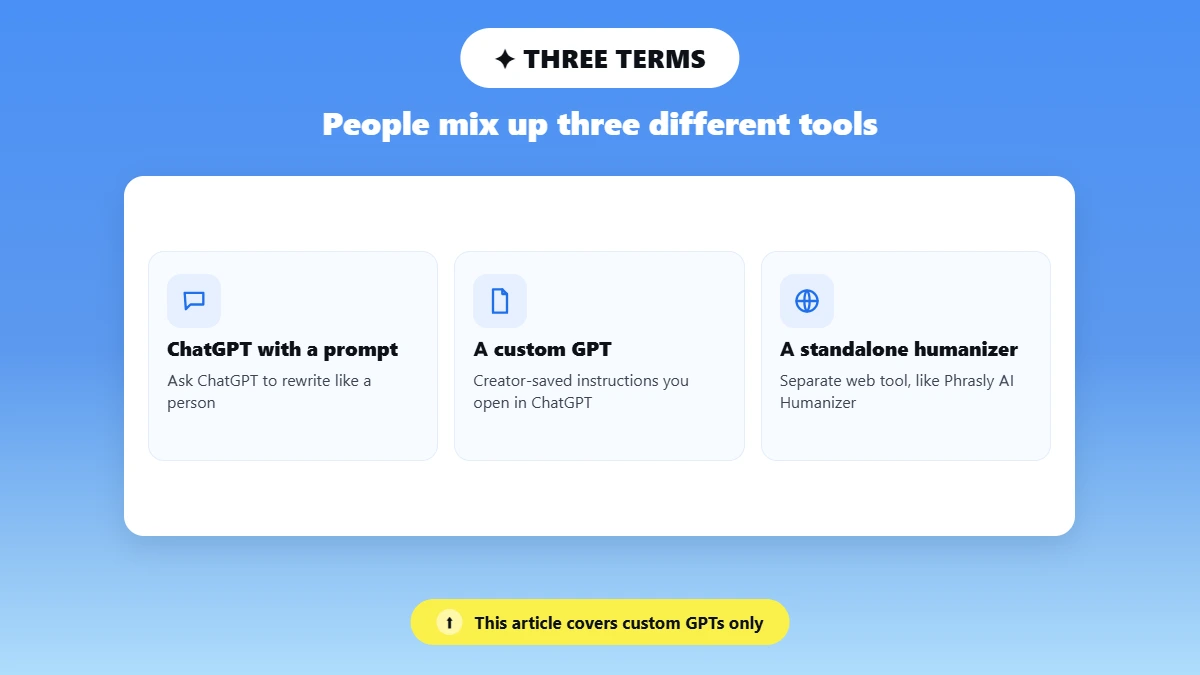
People often mix up three different things:
Regular ChatGPT With a Prompt: You ask ChatGPT yourself to rewrite a draft so it sounds like a person wrote it, using a prompt to humanize AI text such as “make this sound more natural.”
A Custom GPT: A creator saves instructions for humanizing text, and sometimes files or links to outside services, into a GPT you open in ChatGPT. That setup is usually not public.
A Standalone Humanizer: A separate web tool with its own settings and limits, such as Phrasly AI Humanizer.
Names add to the confusion. Someone searching for a “GPT humanizer” might want a tool that humanizes ChatGPT text, a custom GPT inside ChatGPT, or a product that simply has “GPT” in its name. This article covers custom GPTs only.
Even AI detectors use the name: GPTZero and ZeroGPT are two separate companies, and neither makes a custom GPT.
See GPTZero vs ZeroGPT for how they differ.
⚠️ Custom GPTs have an end date. OpenAI says they are scheduled to retire on December 11, 2026, or February 11, 2027 for Enterprise workspaces with an approved deferral. Until then they keep working, and creators can move them to plugins. Both GPTs we tested were live on October 16, 2026.
How Did We Test Two Custom GPT Humanizers?
On October 16, 2026, we gave one ChatGPT draft to two custom GPTs and to Phrasly AI Humanizer, then scanned all four texts once in GPTZero. Every tool got the same draft, and we kept each first answer with no retries or edits. Then we read each rewrite against the original for facts, flow and anything added.
Here is the setup:
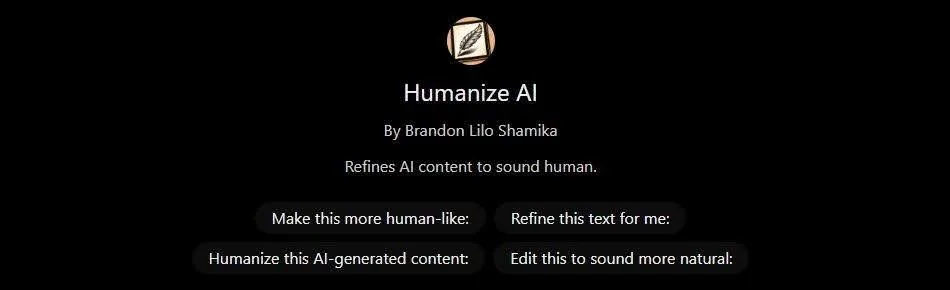
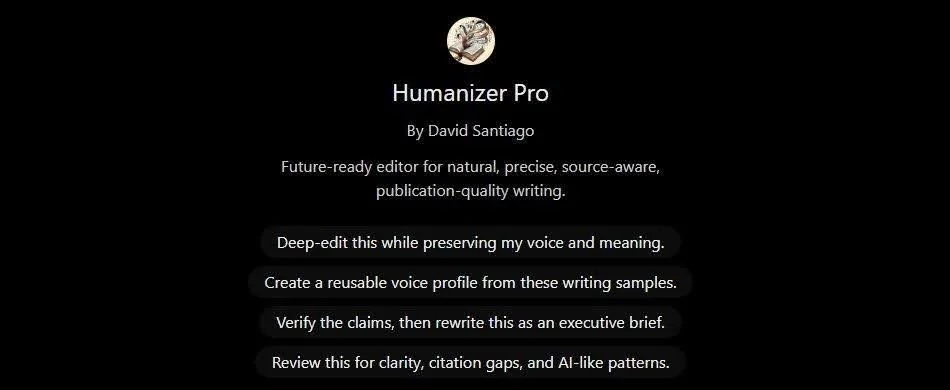
The GPTs: Humanize AI by Brandon Lilo Shamika and Humanizer Pro by David Santiago, both opened in a ChatGPT Go account. The model picker in each showed only one option, labeled "6".
The Draft: A 280-word team update from regular ChatGPT, built on made-up facts: six writers, four 30-minute status meetings a week, three of them replaced by a written update during a two-week trial, one meeting kept, and updates due by 4 pm every Friday.
The Instruction: Both GPTs were asked to make the draft sound natural and clear, keep every fact and number, and add nothing new.
Phrasly: The same draft in Phrasly AI Humanizer at its default settings (Easy, Balanced), with one click on a signed-in account.
The Detector: GPTZero Advanced Scan, Model 4.1o, on a free account. It is not linked to any tool we tested. Our review of GPTZero accuracy covers its strengths and limits.
📢 Phrasly publishes this article and makes one of the tools in this comparison. Each output was the first answer, and each text was scanned once.
Our Humanizer GPT Results
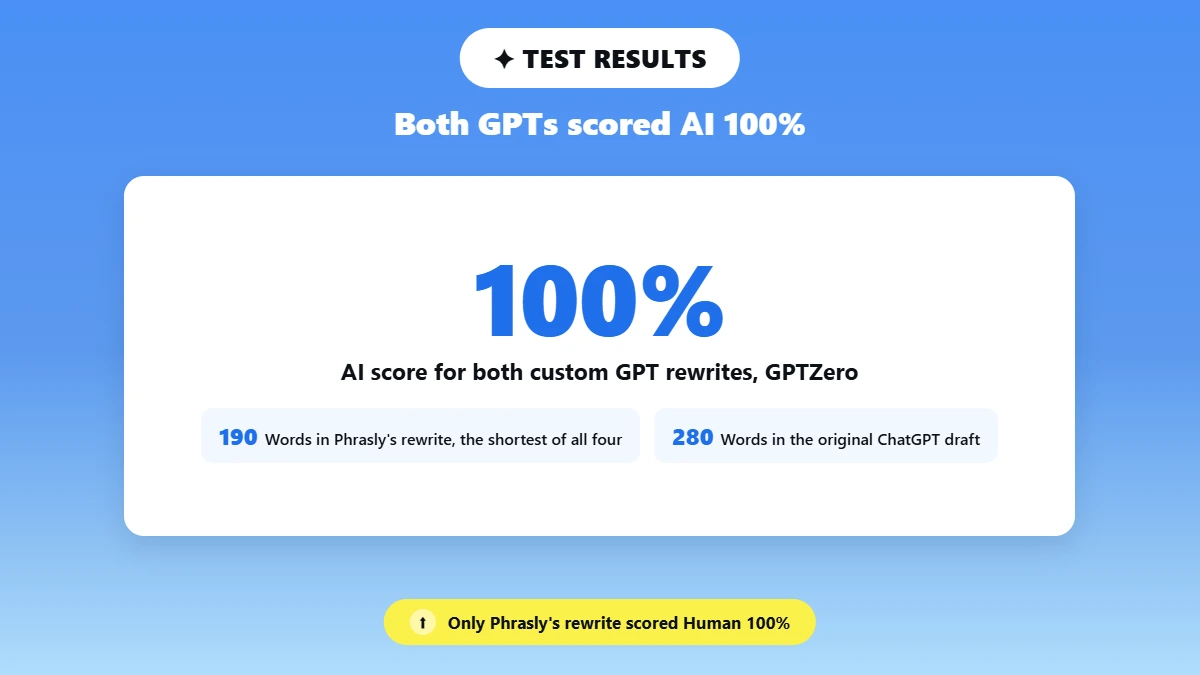
Both humanizer GPTs kept every fact but changed little, and GPTZero flagged their rewrites as 100% AI, the same as the original draft. The two rewrites were also very close to each other. Phrasly’s rewrite was the only one with a lower AI score, at Human 100%, but it needed the most editing.
These were the results:
Version | Words | GPTZero result | Kept facts? | Reads better? | Added anything? | Verdict |
|---|---|---|---|---|---|---|
Original ChatGPT draft | 280 | AI 100% | Baseline | Baseline | Baseline | Baseline |
Humanize AI (Brandon Lilo Shamika) | 271 | AI 100% | Yes | Slightly | No | Mixed |
Humanizer Pro (David Santiago) | 269 | AI 100% | Yes | Slightly | No | Mixed |
Phrasly AI Humanizer (Easy, Balanced) | 190 | Human 100% | Yes | Partly | Yes | Worse |
📌 AI 100%” does not mean every word was written by AI. It is GPTZero’s estimate of how likely the whole text is to be AI, mixed or human, as its own FAQ explains.
Humanize AI by Brandon Lilo Shamika
Humanize AI mostly swapped words and kept the original structure. Here is the opening of each version:
Original ChatGPT draft | Humanize AI rewrite |
|---|---|
"The content team will begin a two-week trial to adjust how weekly status updates are shared and discussed. The team has six writers, and each writer currently has four 30-minute status meetings every week." | "The content team will run a two-week trial to change how weekly status updates are shared and discussed. The team has six writers, each of whom currently attends four 30-minute status meetings per week." |
Wording: A few lines got shorter, such as “Everyone should meet the Friday deadline so the team can follow the agreed process.” But the last paragraph still says twice that the team will review the trial.
Facts: All kept, and the update still reads as a proposal, not a success story.
Detector: AI 100%, the same as the original.

Humanizer Pro by David Santiago
Humanizer Pro opened with the same two sentences as Humanize AI, word for word, so here is a later passage instead:
Original ChatGPT draft | Humanizer Pro rewrite |
|---|---|
"The aim is to introduce a different way of sharing progress while keeping a regular opportunity for the team to meet and discuss ongoing work. This change will apply during the trial period, with the existing meeting routine adjusted accordingly." | "The goal is to try a different way of sharing progress while keeping a regular opportunity for the team to meet and discuss ongoing work. The revised schedule will apply throughout the trial period." |
Wording: The clumsy “existing meeting routine adjusted accordingly” became one plain sentence. The rest stayed close to the original and to the Humanize AI rewrite. That shows only that both returned similar text for this draft, not how either GPT is built.
Facts: All kept, with nothing new added.
Detector: AI 100%, the same as the original.
So, did these humanizer GPTs work? For this draft, they acted as cautious light editors. Nothing broke, little improved, and the detector result stayed where it started. One draft cannot speak for every GPT.
For the bigger picture, see our answer on whether AI humanizers work in general.
Still editing around stiff phrasing?
Run the same original draft through Phrasly, then compare it line by line with your GPT output before you keep anything.
Why Do Natural Writing and Detector Scores Disagree?
Rewriting quality and detector scores measure different things. A rewrite changes how text reads to a person, while a detector estimates whether the text matches patterns it links to AI. So a draft can read slightly better and score the same, as with both GPTs, or score lower and read worse, as with Phrasly.
GPTZero admits this on its FAQ page: “we don’t believe that any AI detector is perfect.” It says errors run both ways, and that heavily edited AI text may go undetected. A lower score after rewriting shows that the detector’s reading changed, not that a person wrote the text.
A July 2026 preprint by Gaetano Perrone and Simon Pietro Romano, associated with the University of Napoli Federico II, points the same way. The research detector FastDetectGPT caught 91.2% of directly generated AI text but 78.3% after the same model rewrote it, at a 1% false-positive rate.
If a humanizer let you down, see why AI humanizers can disappoint. If two detectors disagree on the same text, read why AI detectors give different results.
Should You Use a Custom GPT or Phrasly Humanizer?
Use a custom GPT if you already work in ChatGPT and its first rewrite is good enough. Use Phrasly if you want a dedicated paste, humanize and review workflow. In our test, neither produced text you could publish without editing, so plan to review the output either way.
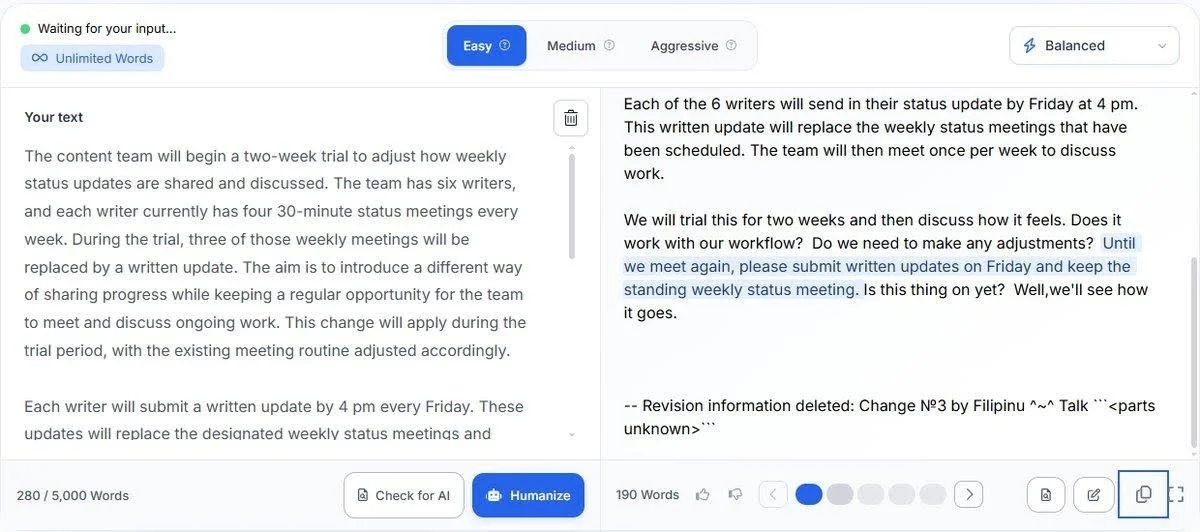
Phrasly made the biggest changes. Its opening was shorter and plainer than either GPT’s: “Currently each writer has four 30-minute weekly status meetings.” It also kept every fact, and GPTZero labeled it Human 100%. But the output was not ready to use. Before publishing it, we would still need to:
Cut Added Content: A “How does this work?” heading, rhetorical questions such as “Does it work with our workflow?” and the filler line “Is this thing on yet? Well,we’ll see how it goes.”
Fix Small Errors: “Two week trial” needs a hyphen, and “Well,we’ll” is missing a space.
Delete a Stray Line: The output ended with an unrelated note about deleted revision information. It did not return when we reran the draft after the test, but we report the first output.
The detector score improved, but the writing did not, which is why a review step matters with any tool, Phrasly included.

Whichever you pick, use it the same way:
Paste the Original: Start from your own draft, not a version another tool already changed.
Humanize Once: Run one pass and keep the original open beside it.
Compare and Edit: Check every fact, number and claim, cut anything new, and fix the wording yourself.
In the end, choose based on your workflow and the output you get, not the score alone. To see where humanizers sit next to rewording tools, read our comparison of humanizers and paraphrasing tools.
Planning your next draft?
Try Phrasly's Humanizer on it, then review the facts, tone and wording before you publish.
How Should You Choose a Humanizer GPT Before Using It?
Before you trust a humanizer GPT with real work, check who made it, what it connects to and how it handles a test draft. Many GPTs share the same name, so the creator line matters more than the title.
Use this quick checklist:
Confirm the Creator and Link: Note the “By” line and the GPT’s URL, not just its name.
Check Availability and Limits: Custom GPTs retire on December 11, 2026, and when one moves to a plugin, OpenAI says its selected model and custom actions do not carry over. Also check whether your plan or the GPT sets any usage limits.
Look for Outside Services: OpenAI says GPT builders cannot view your individual conversations, but if a GPT uses apps or actions, relevant parts of your input may go to that service. Read any approval prompt before you allow it.
Check Your Data Settings: On consumer plans, chats may be used for training unless you opt out in Data Controls. Business, Enterprise and Edu data is not used for training by default.
Test a Safe Sample: Use text without names, grades or private details.
Compare With Your Original: Keep the rewrite only if it reads better and every fact survived.
Final Verdict
Humanizer GPTs can tidy a sentence or two, but in our test they changed little and left the detector result where it started. Judge any humanizer by whether it keeps your facts and improves the writing, then treat the detector result as a separate question.
FAQs
Can ChatGPT Humanize Its Own Text?
Yes. ChatGPT can rewrite its own text for tone, clarity and flow when you ask it to. That changes how the draft reads, not who wrote it, and it does not ensure any detector result. Our guide on how to humanize AI text covers editing steps that go beyond a single rewrite prompt.
Does ChatGPT Have an Official Humanizer?
Sort of. ChatGPT has a public AI humanizer writing page with options to shorten text, improve clarity and make writing sound original. Most humanizer GPTs in the GPT Store, though, are made by outside creators. A ChatGPT humanizer GPT’s name or listing does not mean OpenAI built or endorses it.
Is a Humanizer GPT a Different AI Model?
Not necessarily. OpenAI describes a GPT as a version of ChatGPT configured with instructions, knowledge and optional tools, so a “humanizer” label does not show separate training. Its exact setup is usually private. In our test, both GPTs showed the same single model option in the picker.
Can a Humanizer GPT Guarantee 100% Human Results?
No. Neither GPT in our test changed GPTZero’s result, and no tool can promise how a detector will label your text. A detector label also does not prove who wrote something, because detectors make mistakes in both directions. See our answer to can AI detectors be wrong for why one score should not settle it.
Is Using a Humanizer GPT Free?
It depends on your ChatGPT plan, the GPT itself and any service it connects to. Both GPTs in our test ran inside ChatGPT on a Go account with no separate signup. Some GPTs send you to an outside site with its own limits or fees, so check before you paste a full draft.
Can the GPT Builder See What I Paste?
Not your chat itself. OpenAI says GPT builders cannot view individual conversations with their GPTs. But if a GPT uses apps or actions, relevant parts of your input can go to that outside service, and OpenAI does not control how it stores that data. Avoid pasting private details into GPTs you do not know.

Written by
Hasnain
Karachi, Pakistan
I help businesses grow with SEO-friendly blog posts, landing pages, and long-form content. With 3+ years of experience, I deliver clear, original, and well-researched writing that drives results.