
Do AI Humanizers Actually Work? An Honest Answer
Do AI humanizers actually work? Yes—but only the good ones. The best tools improve readability, vary sentence flow, and preserve meaning, while poor ones just swap words and ruin context. Use them as a first step, then edit for a truly natural, human voice.
Do AI humanizers actually work? It depends on what you mean by “work.” And most people who ask this question are thinking of two very different things.
One of those questions. Does an AI humanizer actually improve the writing? Does it sound like a real person wrote it? Is the rhythm natural? Is the meaning clear?
That's a much more difficult question than can a tool improve your score, and it's the question we want to answer.
If you've already read about why AI humanizers don't work, this is the other side of that conversation what good humanization actually looks like when done right.
What Do AI Humanizers Actually Do?
AI humanizers take AI generated text and humanize it by restructuring sentences, shortening and lengthening sentences, changing word choice, playing with rhythm etc. Basically you want the output to read more naturally to someone.
This is a fundamentally different goal from paraphrasing. If you're unsure how the two approaches compare, this breakdown of AI humanizer vs paraphrasing tools explains the distinction clearly.
The Technical Mechanism
The majority of AI written text follows predictable statistical patterns. It uses words that are very common (perplexity), and phrases words in sentences of similar length (burstiness).
Transitions follow a predictable template such as "Furthermore," "Additionally," "In conclusion." AI humanizers seek to interrupt these patterns.
They decrease predictability by varying things up such as shorter sentences following longer ones, more precise word choice, and less formulaic connective tissue.
People write more diversely. A good humanizer programmed with that knowledge can truly write more human-like text.
Why Some Humanizers Produce Garbled Output?
Lots of tools try to achieve humanization by replacing words with synonyms. Find boring words and replace them with fancier ones, repeat, and done. The issue is that Thesaurus logic is context blind.
A real-world example documented in third-party testing. "Tap your Apple ID" becomes "Faucet your Apple ID." It's technically a synonym for the word. Context is destroyed. The output doesn't improve upon the original AI written text. It makes it worse.
This is the core failure mode of low-quality humanizers. Third-party testing by SlashGear documented exactly this pattern: garbled output, inconsistent results, and humanized text that read worse than the original AI draft.
It's surprisingly common. There is a big difference between a humanizer that just disrupts statistical patterns, and one that helps you write better. This article evaluates the second definition.
Tired of humanizers that mangle your writing? Phrasly is built differently. It rewrites for rhythm, meaning, and readability, not just pattern disruption. See the difference on your own text right now!
Do AI Humanizers Actually Improve Writing Quality?
The truth is: it depends on the tool and how you use it. But there is a distinction between tools that help you write better and tools that just change your writing.
What Good Humanization Looks Like?
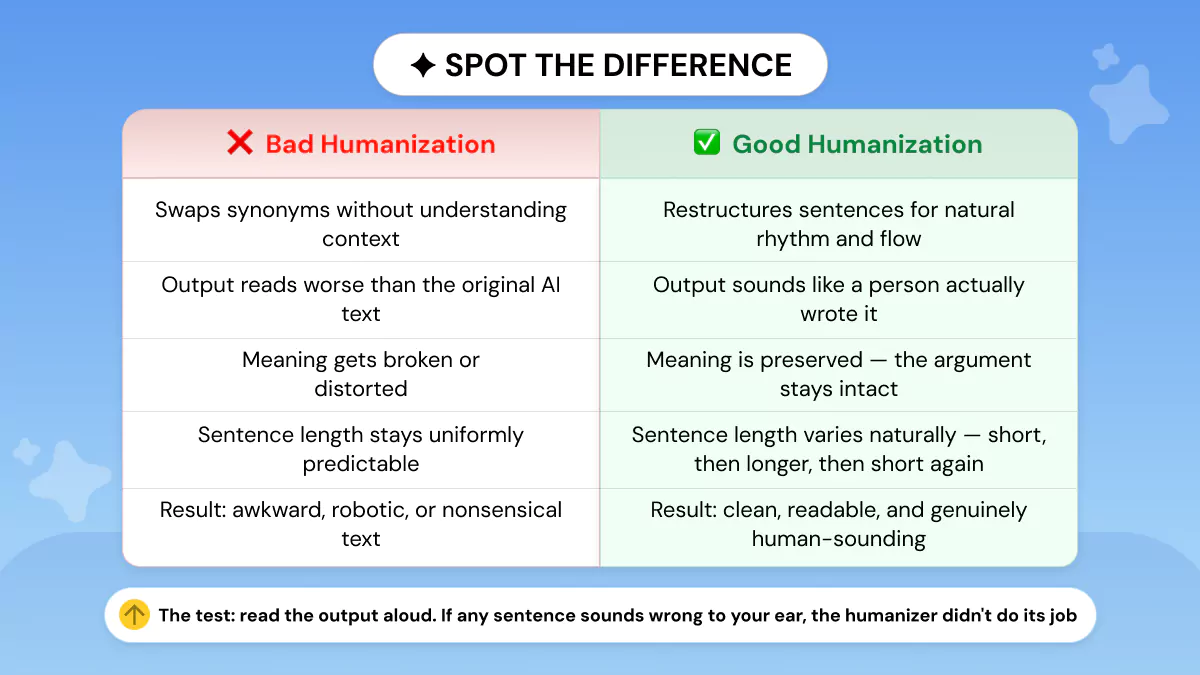
Natural humanized output sounds like it was written by a particular human. Some sentences are short. Others are long and intricate. Transition phrases aren’t cheesy; they’re earned. Meaning isn’t lost or diluted. Words are chosen; they aren’t substituted.
Here's one simple test. Read your output aloud. If you find yourself stumbling, pausing mid-sentence to rephrase yourself, or having to stop completely to decipher what a sentence means, then your humanizer is doing a poor job.
When properly humanized, text should sound like something natural to say aloud. The difference between a good AI humanizer and a bad one? Yup, that's it. Will the resulting output read smoothly aloud, with meaning?
What Bad Humanization Looks Like?
Bad humanization is obvious when you see it. Keyword swaps that destroy semantics. Sentence constructions that sound more robotic than the original text.
This happens surprisingly often when your tools are focused solely on disrupting patterns instead of maintaining meaning. It can also erase the author's intended point. Structural edits that obfuscate the logic, rather than clarify it.
Bad humanization is sometimes actively worse than the original AI text. This is the standard we should be aiming for. If humanizing text does not improve its readability, it has utterly failed at what it was supposed to do.
The Manual Rewriting Comparison
Third-party testing (SlashGear, January 2025) revealed that manually substituting words with a basic synonym tool yielded comparable outcomes to numerous low-quality AI humanizers. Same pattern destruction, same likelihood of garbling, same inconsistency.
This observation suggests a simple rule. If your humanizer is basically functioning as a thesaurus, throw it away. Rewriting by hand allows you finer control with fewer risks of garbled output.
The ones that are useful do what a thesaurus can't. They change up sentence structure, tweak the cadence, and preserve the flow of the original argument. For large quantities of content, a humanizer will save you hours of time improving your first draft.
If you only have one important piece of content to produce, completely rewriting by hand with edits will yield higher quality. The practical answer: humanize your first draft, then edit the output.
Try Phrasly and Judge the Output Yourself
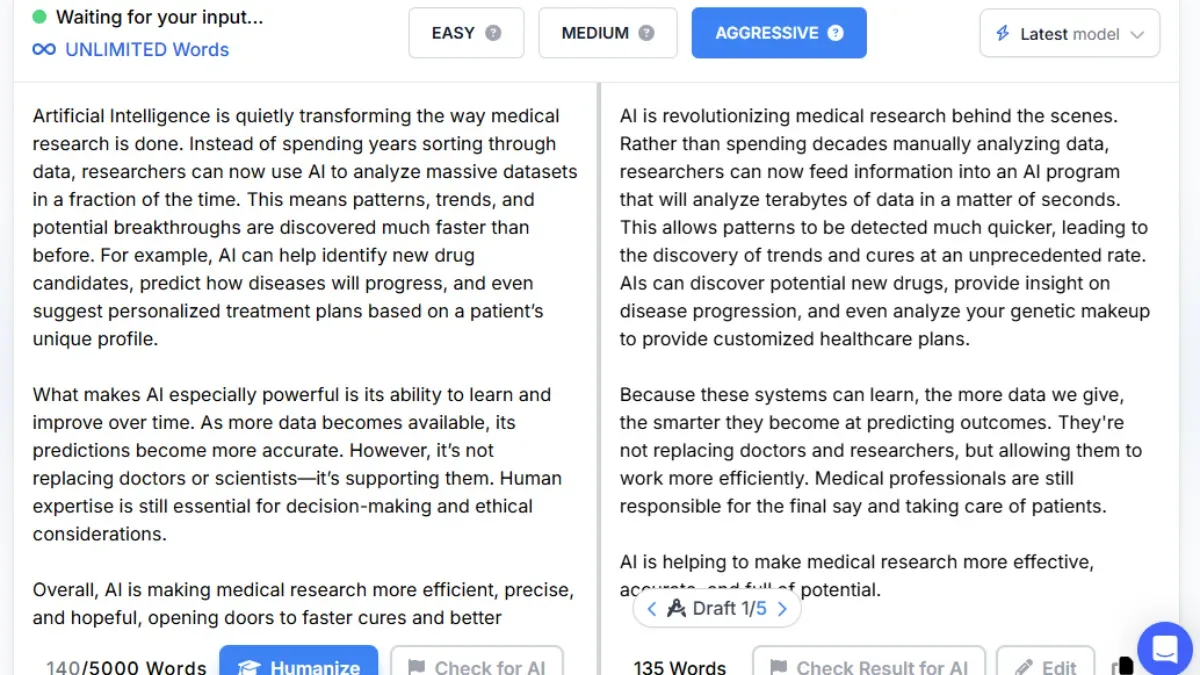
Phrasly AI Humanizer is built around how the output reads to a human not just how it scores. Paste your text and see the difference.
Are AI Humanizers Useful for Students?
For students using AI to brainstorm ideas: yes, productively but only as a first step, and only with the proper process.
AI humanizers are best utilized by students who've already had AI generate a rough draft that they want to rewrite into their own voice. Here's the responsible way to do it.
Use AI to write a rough draft, run the output through a humanizer as a sort of first-pass rewrite, then edit the humanized output heavily to include your own voice, specific examples you pull from yourself, and your own analysis.
What Humanizers can't do? Generate original ideas for you, incorporate personal experience, mimic your unique analytical voice, or think critically for you. They make your writing read better they don't make it say better.
Humanizers enhance overall naturalness and sentence flow, but mimicking an individual's exact word choice, stylistic habits and tone require lots of human editing. A humanizer can get you closer. The humanizer can't clone your voice.
When to Use a Humanizer Vs When to Rewrite Manually?
Use a humanizer if you've got masses of AI-generated draft text requiring first-pass polishing-up such as blog posts, research summaries, long-form notes.
Rewrite by hand if it's short, high value, or needs a distinct personal voice that your output has to carry on its own. Either way: always proof read the humanized output before utilizing. Ensure continuity of meaning.
Rewrite fragments that sound weird, or change the thrust of your argument. Humanizer is a starting point, not the final draft.
How to Get the Best Results from an AI Humanizer?
Using a good humanizer effectively yields legitimate better writing. Using a good humanizer poorly yields mixed results. The difference is methodology.
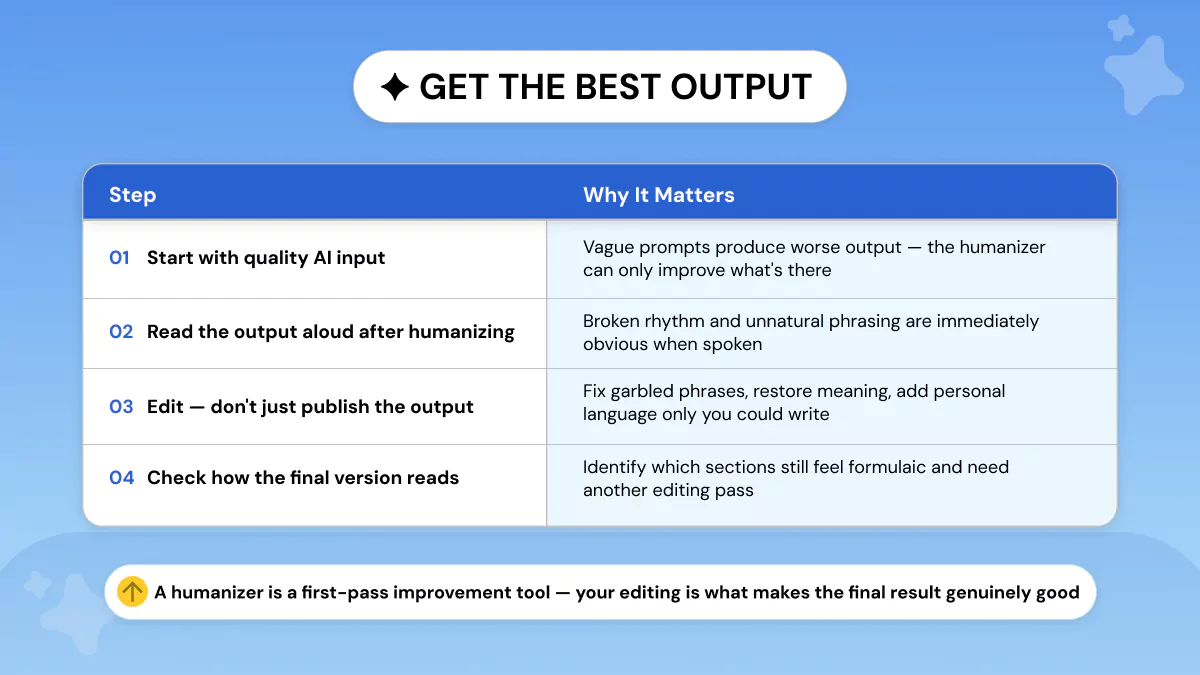
Step 1: Start with quality AI input. The clearer, less-generic your original AI output is, the better your humanizer output will be.
Generic, vague AI output creates worse humanized output. There's less good source material for the tool to work with. Write carefully, then humanize.
Step 2: Run through the humanizer once, then read aloud. When you read something aloud, errors in rhythm, unnatural phrasing, and wrong meanings that looked okay on screen are instantly exposed. If reading a sentence trips you up, rewrite it.
Step 3: Edit the output. Fix any garbled phrases. If something got mangled trying to restructure, fix any lost meaning. Include your own voice such as unique details, examples, observations that only you can add.
This is the step that makes humanized text genuinely yours.
Step 4: Check how the output reads in context. Use Phrasly's AI Detector on your final draft. See where Phrasly thinks it still sounds phony and consider editing those parts again.
You don't need to hit a certain score, just use the assessments to locate template sentences and improve them.
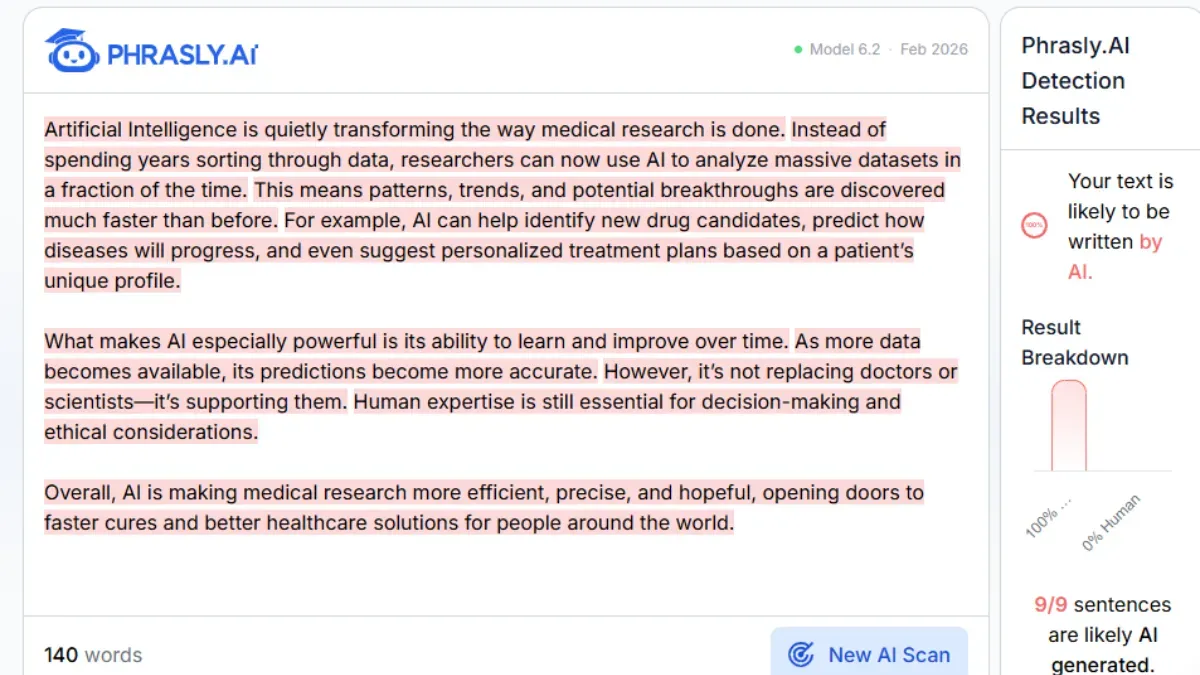
That simple four-step mantra – quality input > humanize > read aloud > edit has always yielded better results than copy/pasting something into a tool and hitting publish.
FAQs
Do AI humanizers actually work?
Yes, but there's huge quality difference between tools. Humanizers that rewrite sentences, adjust rhythm, and retain meaning create truly better writing. Humanizers that substitute synonyms tend to produce gibberish that sounds worse than the original.
How do AI humanizers work?
AI humanizers analyze the statistical patterns of AI written work such as repetitive word usage, monotonous sentence length, canned transitions and rewrite the text to make it less uniform.
Are AI humanizers useful for students?
Yes, if used in the correct workflow. AI humanizers work best as a first pass rewriting tool for AI-assisted content. The student still needs to edit the output, include original analysis, and rewrite the material in their own voice.
Does undetectable AI actually work?
The better question is whether the output quality is actually improved. Some tools produce text that sounds better after processing; others produce incomprehensible garbage that sounds worse than the original.
Once you've humanized your draft, check your AI score to identify any sections that still read as templated or unnatural then revise those spots before publishing.
What is the best AI humanizer for producing natural, high-quality writing?
The only way to objectively measure AI humanizers is by how human their writing sounds to an actual reader. Tools that emphasize sentence cadence, structural editing, and natural voice have always beaten tools that simply replace synonyms.
Phrasly free AI Humanizer is designed around readability not just pattern disruption.
Do AI humanizers work on Turnitin?
Turnitin AI Detection analyzes writing patterns and coherence. Will your humanized text be flagged? If the tool's output reads like good writing, it won't. If the output looks like garbage, it will. Why? Because the answer is: write well.
Craft coherent sentences before you process them.
Is it better to use an AI humanizer or rewrite manually?
If you're doing high-volume content, an effective humanizer will save you time improving copy on first-pass. If you have one piece that needs to carry your own personal voice, rewriting by hand will give you more control.
The best solution is usually both. Humanize once with an AI humanizer, then rewrite/edit the output yourself.
AI humanizers do work but only the ones that enhance the readability of the text, not the score. Good humanizers vary sentence cadence, maintain meaning, and create readable output that resembles something a person would write.
Bad ones are automatic thesauruses that create nonsense and inconsistent results. Understanding the difference will save you time and your writing will improve.
Use a humanizer as a first-pass improvement tool, then edit the output yourself. That combination of quality tool, then human editing produces genuinely good writing.


Keep reading

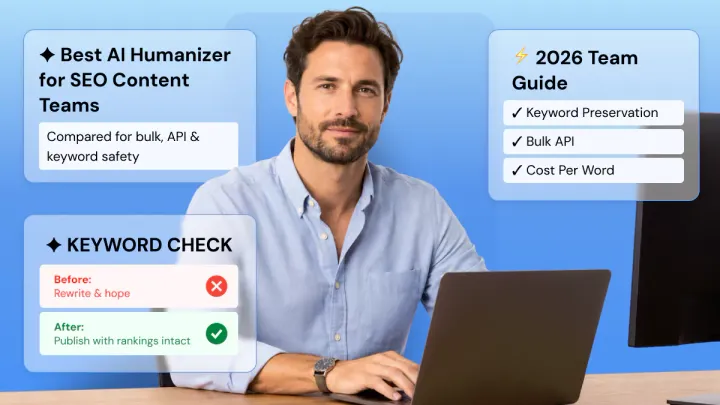
Best AI Humanizer for SEO Content Teams in 2026
Comparing AI humanizers for SEO content teams? Phrasly, Undetectable AI, and Humbot lead for bulk use, but keyword preservation is the real risk. Learn what to test before running your content calendar through any tool, plus true cost-per-word at scale and picks by team size.
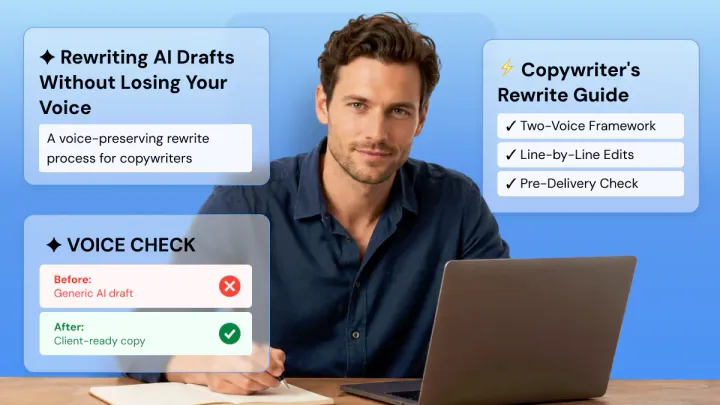
Rewriting AI Drafts for Client Deliverables Without Losing Your Voice
AI can draft your client copy in minutes, but that's not what clients pay for. Learn how to treat AI drafts as scaffolding, not final copy, rewrite for both your voice and your client's brand guidelines, cut hedge words, vary rhythm, and proofread before delivery so nothing generic ships.