Phrasly Ultra and Lite, Measured: How Our Models Work and How We Test Them
The technical write-up behind our November 2026 benchmark: test design, scoring, margins of error, what a rewrite changes and how to reproduce it.
9 min read
This is the technical write-up behind our November 2026 benchmark. The benchmark page has the results. This post explains how the two models work, how the test is built and scored, how far the numbers could move, and how to reproduce them from the published data.
The two models
Phrasly Ultra and Phrasly Lite are language models we build and run on our own servers. Both do one job: rewrite a draft that reads as AI so it reads as a person's writing, without changing what it says.
Phrasly Ultra | Phrasly Lite | |
|---|---|---|
Who it is for | Paid plans and 3 Day Access | Everyone, free |
Modes | Five, from Gentle to Max | One, tuned for grammar and readability |
Text settings | Sentence length, Cleaner grammar, Proofread | None |
Words per run | Up to 5,000 | Up to 2,500 |
Languages | Every language | Every language |
One pass over the whole text. Each model receives the entire text in one request and writes the entire rewrite. Nothing is split into sentences and stitched back together, so a point that runs across paragraphs stays connected.
Modes change the decoding, not the model. Ultra's five modes are one model run with different decoding settings. Gentle and Light stay closest to your wording; Strong and Max rewrite harder for detectors. The instructions the model gets are the same in every mode.
Text settings. Sentence length and Cleaner grammar also adjust the decoding. Proofread is different: it runs after the rewrite, as a separate pass that only fixes apostrophes, capitals and missing commas.
In place, in every language. A text is rewritten in the language it was written in. There is no translation step.
No watermark. Neither model adds an AI watermark to its output.
Test design
The benchmark has two sets of texts, built to answer different questions.
60 fresh AI texts
The question: can the model take text that every detector flags and make it read as human?
6 chatbots, 10 kinds of writing. GPT-6.2 Sol, GPT-6.1 Terra, Claude Sonnet 5.5, Gemini 4 Argon, Grok 4.7, and DeepSeek V4.1 Flash each wrote 10 texts, generated through OpenRouter, one of each kind: an argumentative essay, a literature essay, a discussion post, a research summary, a personal statement, a blog post, a work email, a cover letter, marketing copy, and a report.
60 prompts, each used once. Every text has its own topic and target length, and the prompt asks for finished plain text with no headings or Markdown. The texts run from 147 to 1,171 words, with a median of 424.
Only flagged texts count. A text enters the test set only if all four detectors flag the original. All 60 did: before humanizing they averaged a 0.9% human score.
Why fresh. Detectors retrain and chatbots change, so texts written by this month's models test what people face now.
876 real-world texts
The question: does it hold up on ordinary writing, at scale? These are real-world texts we keep aside for testing, including 48 documents of 1,000 to 1,800 words and 28 texts in languages other than English. No detector filtered them, so some already read as partly human: before humanizing they averaged 16.4% across the four detectors.
Rules for both sets
Each model rewrote each text once, with no retries and no choosing between drafts. Ultra ran in Balanced, its default mode, with every text setting at its default. Ultra also ran in Strong and Max on the fresh texts; every figure in this post is from Balanced.
Scoring
A detector can label a text human, mixed or AI, and each one draws those lines differently. Counting passes throws information away: a text scored 51% human and one scored 99% human both count as one pass. So every rewrite gets each detector's own human score for the whole text, from 0 to 100, and we average that score over the texts.
Detector | What its API reports | Human score we use |
|---|---|---|
Pangram (version 4.1) | The fractions of the text it reads as human, as AI-assisted and as AI | The human fraction, as a percentage |
GPTZero | Probabilities that the document is human, mixed or AI | The human probability, as a percentage |
Originality.ai (version 5.0) | An AI score for the text, from 0 to 1 | 100 minus the AI score as a percentage |
ZeroGPT | The percentage of the text it reads as AI | 100 minus that percentage |
The figure for all four detectors is the plain average of the four detector averages, with no detector weighted. The versions are what the APIs reported on November 17, 2026. GPTZero's and ZeroGPT's responses carry no version; GPTZero released its Model 5.0b on November 4, 2026, two weeks before this run.
Results on the 60 fresh texts
Detector | Phrasly Ultra | Phrasly Lite | Original AI text |
|---|---|---|---|
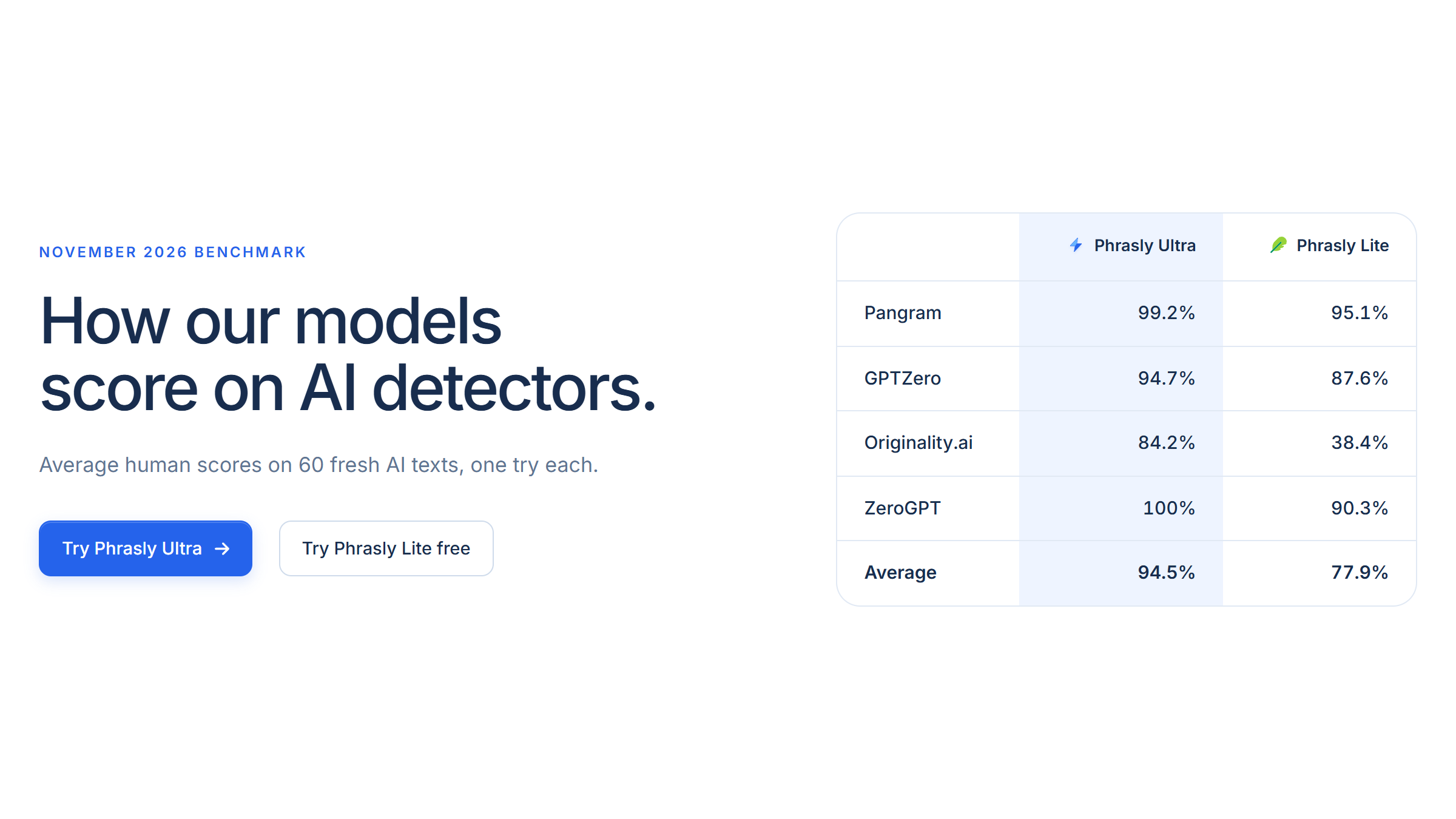
Pangram | 99.2% (97.7 to 100) | 95.1% (89.8 to 99.0) | 0% |
GPTZero | 94.7% (89.1 to 98.9) | 87.6% (79.3 to 94.7) | 0% |
Originality.ai | 84.2% (77.0 to 90.6) | 38.4% (28.9 to 48.4) | 3.4% |
ZeroGPT | 100% (100 to 100) | 90.3% (83.6 to 96.0) | 0% |
Average of the four | 94.5% (91.7 to 96.9) | 77.9% (73.5 to 82.0) | 0.9% |
The ranges in brackets are 95% intervals: where each average would be expected to land if we drew another 60 texts like these. Ultra's lead over Lite on the four-detector average is 16.7 points, with an interval of 12.4 to 21.2, so the gap does not depend on which texts happened to be in the set.
They are bootstrap percentile intervals. We resampled the 60 texts with replacement 10,000 times, recomputed every average on each resample, and took the 2.5th and 97.5th percentiles. Both models are resampled on the same texts, so the interval of the gap accounts for a hard text being hard for both. ZeroGPT scored every Ultra rewrite 100% human, so that interval has no width: it says these 60 rewrites did not vary, not that a miss is impossible.
Verdicts
For readers who prefer passes, these are the labels behind the scores: how many of the 60 rewrites each detector called human, mixed and AI.
Detector | Phrasly Ultra: human / mixed / AI | Phrasly Lite: human / mixed / AI |
|---|---|---|
Pangram | 59 / 1 / 0 | 53 / 5 / 2 |
GPTZero | 58 / 0 / 2 | 53 / 1 / 6 |
Originality.ai | 52 / 1 / 7 | 19 / 3 / 38 |
ZeroGPT | 60 / 0 / 0 | 55 / 0 / 5 |
All four detectors returned a human verdict on 51 of Ultra's 60 rewrites and 15 of Lite's. Text by text, Ultra's median rewrite averages 98.5% across the four detectors; 50 of the 60 average 90% or more, and the lowest averages 41.6%. Lite's median is 77.5%, with 15 at 90% or more.
Results on the 876 real-world texts
Detector | Phrasly Ultra | Phrasly Lite | Original text |
|---|---|---|---|
Pangram | 99.5% | 95.2% | 18.2% |
GPTZero | 98.7% | 95.9% | 16.4% |
Originality.ai | 88.0% | 60.7% | 17.7% |
ZeroGPT | 98.5% | 86.9% | 13.3% |
Average of the four | 96.2% | 84.7% | 16.4% |
Both models score higher here than on the fresh texts: 96.2% against 94.5% for Ultra, 84.7% against 77.9% for Lite. The fresh set is the harder test by construction, because every text in it was flagged by all four detectors first. Originality.ai does not check texts under 30 words, so its averages cover 868 of Ultra's 876 rewrites and 870 of Lite's. The detector checks ran from November 12, 2026 to November 17, 2026.
An interval narrows with the square root of the number of texts. If these texts vary as much as the fresh ones do, the intervals here are about a quarter as wide.
What a rewrite changes
A detector score says nothing about whether the rewrite is still good writing, so we measure that separately.
Length. On the fresh texts, an Ultra rewrite averages 103% of the original's word count (median 102%, from 66% to 139%), and a Lite rewrite 101% (median 98%, from 83% to 126%). Neither model pads or summarizes as a rule.
Writing quality. On the 876 real-world texts, an automated grader read each rewrite beside its original and scored grammar, fluency and how much of the meaning was kept, each out of 10, with the same instructions for both models. A style check counted odd shortcuts per 100 words: slashes between words, ampersands, clipped words and bracketed asides.
Writing quality, 876 texts | Phrasly Ultra | Phrasly Lite |
|---|---|---|
Grammar, out of 10 | 9.20 | 9.34 |
Fluency, out of 10 | 9.01 | 9.09 |
Meaning kept, out of 10 | 7.25 | 7.19 |
Odd shortcuts per 100 words (lower is better) | 0.1 | 0.3 |
Lite edges Ultra on grammar and fluency, which it was tuned for. Ultra keeps slightly more of the meaning and leaves fewer shortcuts. An automated grader is consistent across hundreds of texts, but it is not a human reader, so read the grades as one model against the other.
Where the scores drop
Originality.ai. It is the lowest score for both models on both sets: 84.2% and 88.0% for Ultra, 38.4% and 60.7% for Lite.
Long texts, for Lite. Split the fresh texts into thirds by length, and Lite's Originality.ai score falls from 57.3% (147 to 271 words) to 37.8% to 20.3% (660 to 1,171 words). Ultra's goes 86.6%, 83.5%, 82.6%, a difference its interval does not separate from noise.
Some kinds of writing. With 6 texts per kind this is a hint, not a finding: Ultra's lowest four-detector averages were on the work email texts (85.0%) and the blog post texts (86.7%). Every other kind averaged 93% or more.
One chatbot and detector pair. Across the 6 chatbots, Ultra's lowest score was 64.6%, from Originality.ai on the 10 texts by GPT-6.1 Terra.
Limits
Turnitin is not included. It has no public API, so we cannot run it under the same rules.
The breakdowns rest on few texts. 60 texts support the headline averages to within about 3 points for Ultra. 10 per chatbot and 6 per kind support much less.
A dated snapshot. These are the scores of November 17, 2026. Detectors retrain, and a retrained detector can move every number here.
Our two models only. This edition tests no other humanizer. The September 2026 edition on the benchmark page compared Ultra with StealthGPT, WriteHuman and Undetectable AI on Pangram.
Averages are not promises. One text can land well below the average. Check your own rewrite, read it against your original before you submit it, and follow your school's or employer's rules on AI use.
Reproduce it
The benchmark page has one CSV per model for the 60 fresh texts. Each row is one text: the input itself, the prompt and chatbot that wrote it, its kind and word count, and each detector's verdict, raw score and human score for the original and for the rewrite.
Take the texts in the "input" column and humanize each one once.
Send each rewrite to the four detectors through their APIs.
Turn each response into a human score with the table under Scoring, then average per detector.
For the intervals, resample the 60 rows with replacement 10,000 times and take the 2.5th and 97.5th percentiles of the resampled averages.
Detectors update, so a rerun today may not match ours exactly: the "evaluated_at" column records the day each row was scored. The real-world set is reported as averages.
We also put money on the results. Our money-back guarantee refunds your latest payment if another public AI humanizer scores more human than Ultra on the same text of 500 words or more, and the $500 Beat Ultra challenge sends a $500 gift card to anyone who shows another humanizer beating Ultra on average across at least 10 random real-world AI texts. Both are judged on Pangram, GPTZero, Copyleaks and Originality.ai, and the other tool has to come out ahead on at least two of them.
Frequently asked questions
Each rewrite gets each detector's own human score for the whole text, from 0 to 100: Pangram's human fraction, GPTZero's human probability, and 100 minus Originality.ai's and ZeroGPT's AI scores. We average those over the texts, and the figure for all four detectors is the plain average of the four.

Written by