
How Can You Prevent Plagiarism? 10 Proven Strategies for Students (2026)
Learn how to prevent plagiarism with 10 practical strategies, including proper citation, paraphrasing, note-taking, and plagiarism checking, to submit original work with confidence.
You can prevent plagiarism by using other people's work correctly: quote direct wording, paraphrase ideas in your own words and sentence structure, credit every source, keep organized research notes, and check your final draft before submitting it.
Many students don't intend to plagiarize, yet they still make mistakes because they forget a citation, paraphrase too closely, or lose track of their sources. The good news is that plagiarism is easier to avoid than most people think.
In this guide, you'll learn the most common ways plagiarism happens, practical strategies to prevent plagiarism, and simple habits that help you submit original work with confidence.
What Is Plagiarism (and Why Does It Happen by Accident)?
According to Merriam-Webster, plagiarism means using another person's words or ideas as your own without proper credit. Yes, plagiarism can be accidental, and most schools penalize it the same as intentional copying.
While some students plagiarize deliberately, most cases result from sloppy research notes, forgotten citations, or poor paraphrasing. Even without any intention to cheat, a failure to credit the original author can still violate academic integrity policies.
Knowing what plagiarism is and why it happens by accident is the first step toward avoiding it and creating honest, original academic work.
Why Preventing Plagiarism Matters
Preventing plagiarism matters because it can affect both your grades and your future. Schools, universities, and other institutions take plagiarism seriously, and the penalties depend on how severe the violation is.
You could receive a zero on an assignment, fail a course, or in serious cases, face suspension or dismissal. Some universities also record academic integrity violations on a student's academic record.
For example, the University of Bradford lists penalties ranging from capped marks to permanent exclusion, while Manhattan University allows sanctions such as zero credit, course failure, academic probation, or dismissal depending on the severity of the violation.
The consequences don't stop after graduation either. Plagiarism has led to research papers being retracted, people losing their jobs, and even copyright disputes.
10 Ways to Prevent Plagiarism
The following strategies help you prevent plagiarism at every stage of the writing process. From planning and research to citation and final review, each step reduces the risk of accidental plagiarism.
1. Start Early and Plan Your Paper
Starting your paper early gives you enough time to research, organize your notes, and cite your sources correctly. When you leave everything until the last minute, you're more likely to make careless mistakes, such as forgetting a citation or paraphrasing too closely to the original source.
According to Harvard's guidance on avoiding plagiarism, honest mistakes often happen when students are tired, stressed, or rushing to finish an assignment. Giving yourself enough time makes it easier to review your work carefully and reduce the risk of accidental plagiarism.
2. Track Sources While You Research
Whenever you're researching for an assignment, you'll come across sources that you may want to use later. Instead of telling yourself you'll save them later, write down the author's name, the URL, and the publication date as soon as you find them.
Keep your research notes in a separate document rather than mixing them with your draft. Also, never copy and paste text from a source directly into your draft. It's easy to forget which words came from the original source, and that can lead to missing citations or accidental plagiarism.
3. Cite Every Source in the Required Style
When writing, always cite every source you use in the required citation style. Different schools and instructors may ask you to follow MLA, APA, Chicago, or Harvard style, so make sure you use the correct one consistently throughout your paper.
Many students use Purdue OWL to learn MLA, APA, and other citation styles. If you're comparing citation resources, our Purdue OWL plagiarism checker guide explains how it fits into a plagiarism-prevention workflow.
If you're ever unsure whether a source needs a citation, it's usually better to cite it. Proper citations not only help prevent plagiarism but also strengthen your paper by showing readers where your information came from.
4. Quote Exactly
If you want to use someone else's exact words, quote them exactly as they appear in the original source. Don't change or remove any words. Always place the quoted text inside quotation marks and include a proper citation, even if you're only using a short phrase. If you don't want to quote the original wording, paraphrase it instead.
5. Paraphrase Properly
To avoid plagiarism when paraphrasing, change both the words and the sentence structure of the original, then cite the source anyway. Proper paraphrasing is more than replacing a few words with their synonyms.
You should rewrite the idea completely in your own words while keeping the original meaning and giving credit to the source. The example below shows the difference between a poor paraphrase and a proper one.
Example: Good vs. Bad Paraphrasing
Original Passage (Harvard University)
"Moments of carelessness are more common when you leave your essay until the last minute—and when you are tired or stressed."
Bad Paraphrase (Still Plagiarism)
Careless mistakes are more common when you leave your essay until the last minute or when you are tired or stressed.
Why it's wrong: Only a few words have been changed, while the sentence structure and wording remain almost identical to the original.
Good Paraphrase
Working on an assignment at the last minute or while feeling tired increases the chances of making careless mistakes that may lead to accidental plagiarism (Harvard University).
Why it's correct: The wording and sentence structure have both changed, and the original source is still acknowledged through a citation.
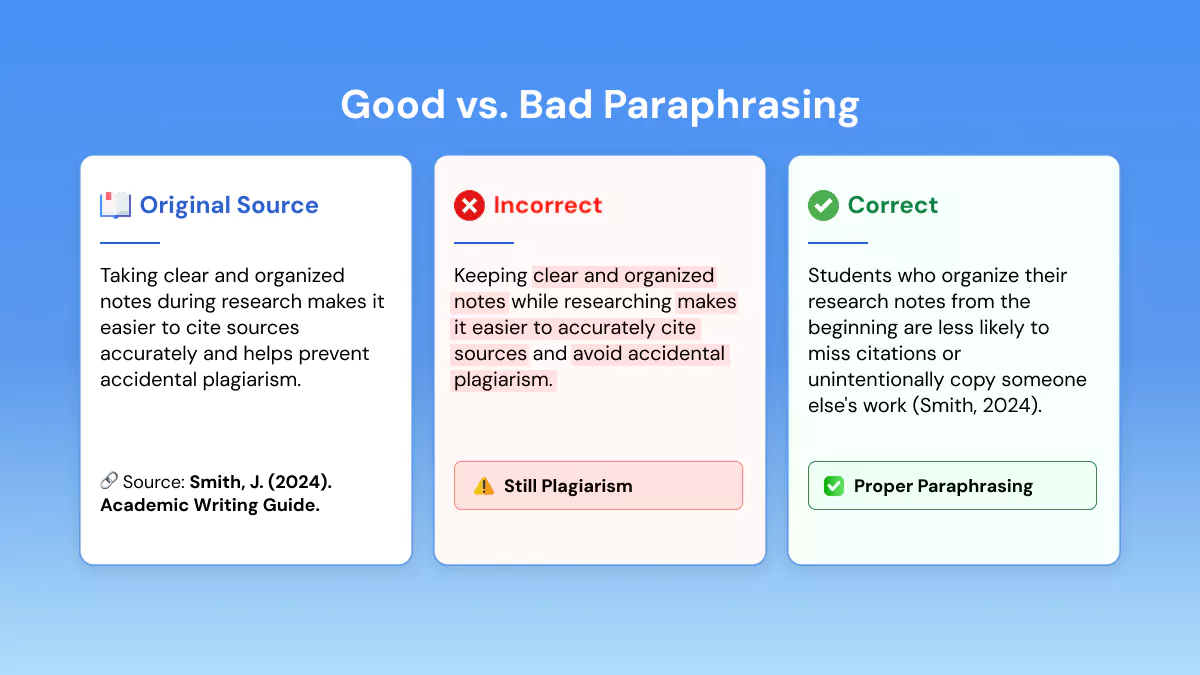
Whenever you paraphrase information from another source, don't just swap words with synonyms. Rewrite the idea in your own writing style, use a different sentence structure, and always include a citation. Doing all three helps you avoid accidental plagiarism while keeping your work original.
6. Cite As You Write, Never "Later"
Many students leave citations until the end because they think they will add them later. This often leads to forgotten sources, missing references, and accidental plagiarism. A better habit is to cite every source as soon as you use it. It only takes a few seconds and saves you from searching for references after your paper is finished.
7. Know the Common-Knowledge Exception
Not every fact requires a citation. Some information is considered common knowledge, which means most people already know it or it appears in many reliable sources without attribution.
For example, Washington, D.C. is the capital of the United States and Mount Everest is the world's tallest mountain do not need citations.
Before leaving out a citation, ask yourself two questions: Would most readers already know this? and Can I find this fact in many reliable sources without attribution? If the answer to both questions is yes, you probably don't need a citation. If you're unsure, it's always safer to cite the source.
8. Don't Plagiarize Yourself
Many students think, "It's my own work, so I can use it again." However, that isn't always true.
Reusing an essay, assignment, or research paper that you previously submitted without your instructor's permission is known as self-plagiarism and may violate your school's academic integrity policy. If you want to reuse your previous work, ask for permission first and cite it if required.
9. Use AI Writing Tools Responsibly
You can use AI to brainstorm ideas, create an outline, or refine your own drafts. However, don't copy and submit AI-generated content as your own. Many schools consider this a violation of their academic integrity policies, even if the text appears original.
AI may also generate text that closely matches existing sources. Review, edit, and verify your work before submitting it. Follow your institution's AI policy and disclose AI use if required.
If you use AI during the writing process, check how your draft appears to AI detection tools with Phrasly's free AI Detector before you submit your assignment.
Phrasly also analyzed more than 30,000 human-written essays using ZeroGPT and found that AI detection tools can produce false positives.
10. Run a Plagiarism Checker Before You Submit
Once your final draft is ready, don't submit it without running it through a plagiarism checker. It acts as a final safety net by identifying missed citations, weak paraphrasing, uncited quotations, and other issues that could lead to accidental plagiarism.
A tool like Phrasly's Plagiarism Checker scans 10B+ web pages and academic papers, flags matched passages with source URLs and a similarity percentage, and can even detect paraphrased or mosaic matches. This helps you verify your own work and fix any remaining issues before submission.
If you're comparing different options, see our guide to the best plagiarism checkers before choosing one.
Plagiarism Types and How to Prevent Each One
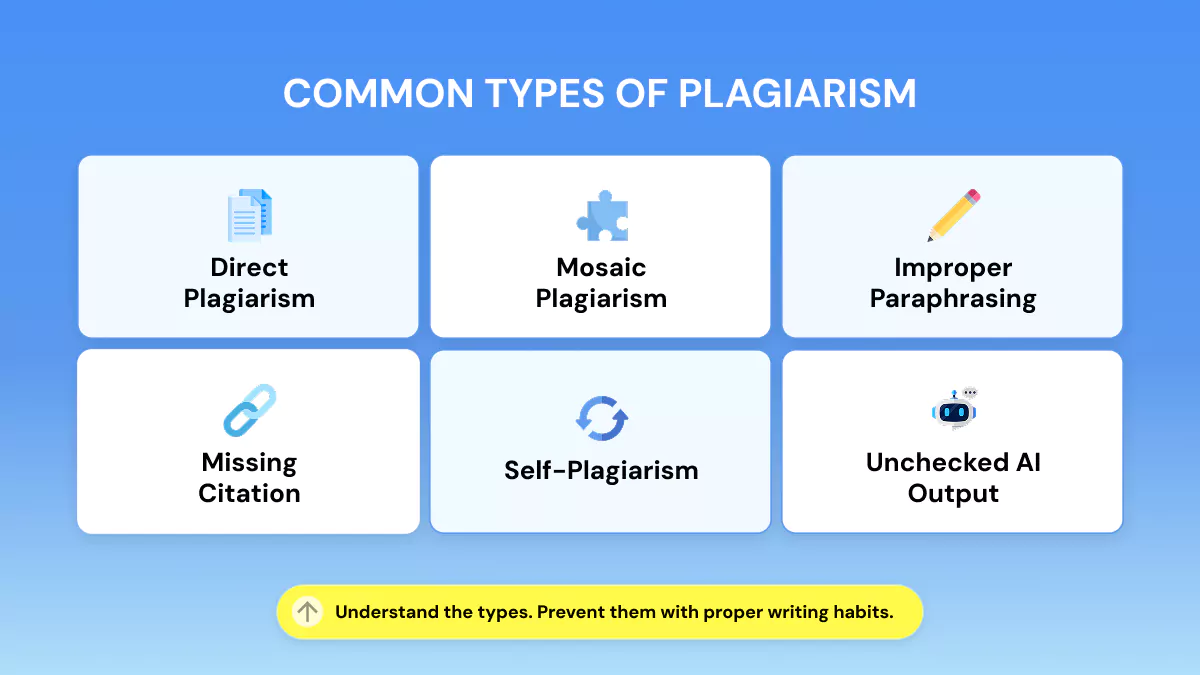
The table below outlines the most common types of plagiarism, what they look like, and the best way to prevent each one.
| Type | What It Looks Like | How to Prevent It |
|---|---|---|
|
Direct Copy-Paste |
Copying text word for word from a source without quotation marks or a citation. | Quote the original text correctly and follow Strategy #4: Quote Exactly. |
|
Mosaic (Patchwork) |
Mixing phrases from multiple sources while keeping much of the original wording. | Rewrite the content completely in your own words and follow Strategy #5: Paraphrase Properly. |
|
Improper Paraphrase |
Changing a few words with synonyms while keeping the original sentence structure. | Rewrite with new wording and a new structure, then cite the source (Strategy #5). |
|
Missing Citation |
Using someone else's ideas or information without giving proper credit. | Cite every source as you write using Strategy #3 and Strategy #6. |
|
Self- Plagiarism |
Submitting your previously completed work without permission. | Ask for permission before reusing your work (Strategy #8). |
|
Unchecked AI Output |
Submitting AI-generated text without reviewing it or following your institution's AI policy. | Review and refine AI-assisted drafts and follow Strategy #9: Use AI Writing Tools Responsibly. |
How Can a Good Writing Process Help You Prevent Plagiarism?
A good writing process helps prevent plagiarism by giving you enough time to plan, organize your research, keep source material separate from your own ideas, and cite information as you write. This makes it much less likely that you will miss citations or accidentally plagiarize someone else's work.
Step 1: Plan Your Paper
Plan your paper before you start writing. Decide on your topic, word count, requirements, and timeline to stay organized and avoid last-minute mistakes.
Step 2: Research With a Source Log
Once your planning is complete, create a source log for every source you use. Record the author, URL, and publication date, and keep your research notes separate from your draft to avoid confusion and make citations easier.
Step 3: Create an Outline
Create a clear outline before you start writing. Organize your paper into an introduction, body headings, and a conclusion so you can follow your own structure instead of relying on your sources, making plagiarism less likely.
Step 4: Draft From Notes
Create notes as you research, then write your draft from those notes instead of the original sources. This encourages original writing and reduces the risk of accidental plagiarism.
Step 5: Verify With a Checker
The final step is to run your paper through a plagiarism checker before submitting it. It can help identify matched passages, missed citations, and other potential plagiarism issues so you can review and correct them before submission.
Preventing plagiarism isn't difficult if you're committed to producing original work. The strategies in this guide can help you build better writing habits, but the responsibility to write honestly, cite your sources, and submit original work ultimately rests with you.
Don't hand it in on a guess. Run your paper through Phrasly's Plagiarism Checker and fix any matches before your professor sees them.
Frequently Asked Questions
Is it plagiarism if you cite the source?
No, if you quote or paraphrase properly and cite; yes, if you copy verbatim without quotation marks, even with a citation.
What are 5 ways to avoid plagiarism?
1. Cite every source. 2. Quote exact wording with quotation marks. 3. Paraphrase properly using your own words and structure. 4. Cite sources as you write, not later. 5. Run a plagiarism checker before submitting your work.
Can plagiarism be accidental?
Yes. Plagiarism can be accidental, and most schools penalize it the same as intentional copying. Common causes include forgotten citations, sloppy research notes, and poor paraphrasing.
Is using Grammarly or AI tools plagiarism?
No, using Grammarly for grammar and spelling is not plagiarism. However, submitting AI-generated text as your own is usually considered an academic integrity violation. Always review AI-assisted writing and follow your school or institution's AI policy.
How do teachers detect plagiarism?
Teachers detect plagiarism using originality software such as Turnitin, by noticing sudden changes in writing style, and by searching suspicious phrases online. Students can also check their work with a plagiarism checker before submitting to identify potential issues.
How do plagiarism checkers work?
A plagiarism checker compares your text with web pages, academic databases, and other available sources to find matching content. It highlights matched passages, shows a similarity score, and helps you identify potential plagiarism before submitting your work.


Keep reading

12 Types of Plagiarism Explained (With Real Examples)
Learn the 12 types of plagiarism with real examples, understand the consequences, and discover practical ways to avoid academic mistakes before you submit your work.

6 Best SafeAssign Plagiarism Checker Alternatives Students Can Actually Use (2026)
You can't run SafeAssign yourself; only your instructor can. Compare the 6 best alternatives students can actually use in 2026, with real pricing, AI detection, honest free-tier limits, and which checker fits your situation.