5 Free Plagiarism Checkers Reddit Users Recommend, Tested in 2026
16 min read
Reddit outranks every tool brand on Google when people search for a free plagiarism checker, so the advice students act on comes from strangers in comment threads. We took the four names those threads repeat, Quetext, SmallSEOTools, DupliChecker and PlagiarismDetector.net, and ran them against Phrasly on four identical samples in October 2026.
Phrasly is our own tool, added to the test as the challenger and scored on the same weights as the rest. Phrasly and Quetext were the only two that found every planted source. Every checker here finds matching text, and none of them decides whether plagiarism happened.
Check Your Own Draft Against the Same Report Format
Paste a paragraph below and open the matched sources, which is what the test scores each tool on.
Quick Verdict: What Is the Best Free Plagiarism Checker Reddit Recommends?
Phrasly scored highest across the four samples with 88 out of 100, finding 3 of the 3 planted sources and returning zero false matches. Quetext, the name Reddit repeats most, matched it on detection and finished second at 86 because its free plan lets you keep checking without paying. This was one test on one day with four samples, so it tells you how these tools handled this text rather than how they will score every paper.
Tool | Score | Correct sources found | Free limit observed | Signup? | Best for | Main limitation |
|---|---|---|---|---|---|---|
Phrasly | 88 | 3 of 3 | One free scan, then paid | ✅ | Naming the true original page | Paid after the first scan |
Quetext | 86 | 3 of 3 | 1,000 words per check | ✅ | Repeat checks at no cost | Capped per check, so long papers split |
DupliChecker | 76 | 2 of 3 | 10,000 characters per scan | ❌ | Longer drafts without an account | Credited a copy of Wikipedia, not Wikipedia |
SmallSEOTools | 75 | 2 of 3 | 1,000 words per scan | ❌ | A quick check with no friction | Credited a copy of Wikipedia, not Wikipedia |
PlagiarismDetector.net | 54 | 1 of 3 confirmable | 1,000 words per scan | ❌ | A fast first look | Two of its five sources were paywalled |
Free allowances and prices reflect each provider’s own live pages as checked in October 2026 and can change. Confirm the current limit before you rely on one. Last tested October 2026.
📌 Publisher disclosure: Phrasly publishes this comparison and was one of the tools tested. Every checker received the same samples, settings, and evaluation criteria.
What Plagiarism Checkers Do Reddit Users Actually Recommend?
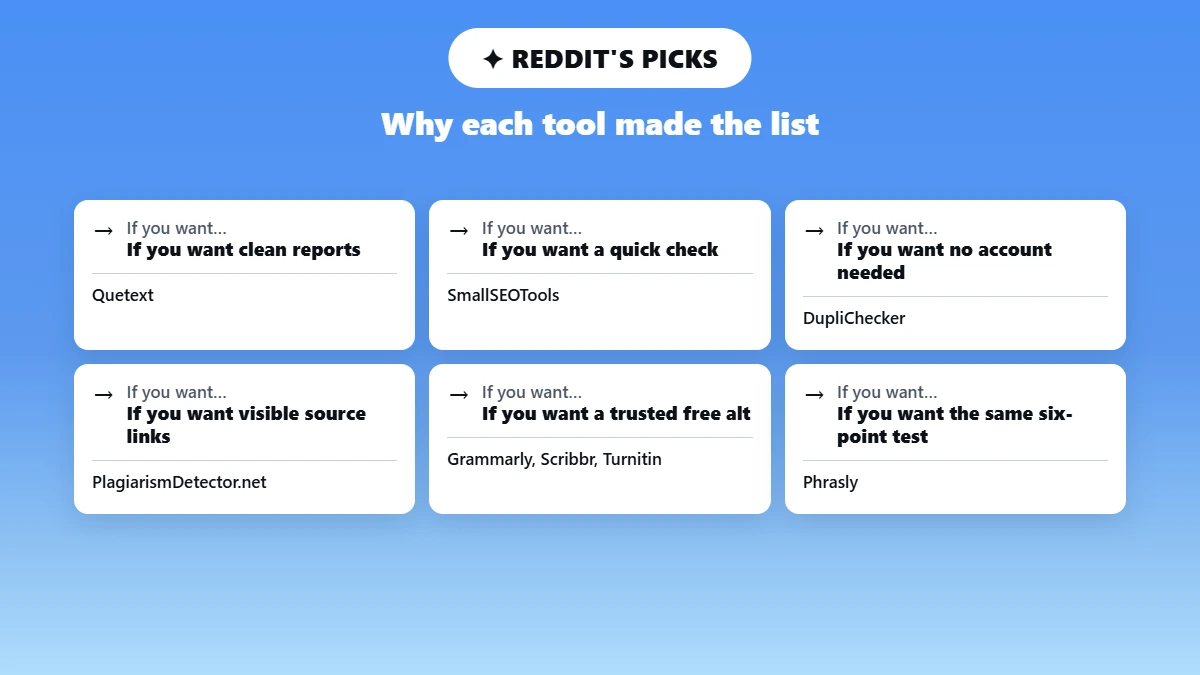
Quetext, SmallSEOTools, DupliChecker and PlagiarismDetector.net are the four names that keep coming back when students and academics ask for a free checker. The threads below are where we drew that shortlist, and the question running through all of them is whether any free tool names the matched passage and its source instead of handing back a percentage.
Reddit is useful for finding tools worth testing and poor for judging how accurate they are. Some of those threads are years old, some contradict each other on the same tool, and none reports a controlled test. That is why we retested the four names instead of repeating them.
Is there any reliable free tool available for plagiarism checking? in r/PhD
What is the best plagiarism checker? in r/academia
What are the free plagiarism check websites? in r/AskAcademia
Any good plagiarism checker alternatives? in r/academia
Those discussions name the tools. They do not measure them, so we put each one through the same four samples and recorded what came back:
Tool | Why it made the shortlist | What we checked |
|---|---|---|
Quetext | The name raised most often, for clean reports and highlighted sources | Whether the free allowance matches the published figure |
SmallSEOTools | Named as the no-cost starting point | Page friction, and whether the report names real sources |
DupliChecker | Named for free checks without an account | The logged-out limit against the advertised one |
PlagiarismDetector.net | Named for giving percentages with source links | Whether those links reach the original page |
Grammarly, Scribbr and Turnitin | Raised as the trusted alternatives | What each one gives an individual at no cost |
Phrasly | Added by us as the publisher’s tool | The same four samples on the same weights |
Two jobs show up across those discussions. Students check a draft before submission, and writers check whether someone republished their work. The second job needs a report that names matched URLs, because a percentage says nothing about who published first.
Phrasly does not appear in any of them. We added it as the publisher’s comparison tool and judged it by the same six criteria.
How We Tested the Free Plagiarism Checkers
Each tool received identical text in October 2026, one attempt per sample, logged out in an incognito window, on default settings. We screenshotted every input and result, and we never re-ran a sample for a nicer number.
The four samples each test something different:
Sample A, exact copy. The opening of Wikipedia’s Photosynthesis article, one planted source. A tool that misses it fails the core job.
Sample B, two sources in one document. Original sentences wrapped around copied passages from Wikipedia’s Amazon rainforest page and NASA’s What Is Climate Change?. A tool that flags only one has missed a source.
Sample C, a cited quotation. One famous quoted line inside original writing, to see whether the report treats a citation as a citation or just inflates the percentage.
Sample D, unpublished original. Writing that has never been online. Anything confidently matched here is a false positive.
Six weighted criteria produce each score, and the highest total takes the top spot. Correct source detection and missed matches are counted straight from the results. Report usefulness, free-tier usability, privacy transparency and speed are our own ratings out of 5, which is worth knowing before you read them.
Tool | Sources 35% | Missed and false 20% | Report 15% | Free tier 15% | Privacy 10% | Speed 5% |
|---|---|---|---|---|---|---|
Phrasly | 100% | 100% | 5/5 | 1/5 | 5/5 | 5/5 |
Quetext | 100% | 100% | 4/5 | 3/5 | 3/5 | 4/5 |
DupliChecker | 67% | 80% | 4/5 | 4/5 | 5/5 | 3/5 |
SmallSEOTools | 67% | 80% | 4/5 | 5/5 | 3/5 | 3/5 |
33% | 60% | 2/5 | 3/5 | 5/5 | 5/5 |
⚠️ What this test cannot prove
• It cannot measure every source database each tool reaches.
• One tool’s percentage is not directly comparable to another’s.
• It cannot predict the Turnitin score your school will see.
• A match on its own does not establish that plagiarism occurred.
The Free Plagiarism Checkers, Ranked
The order below follows the weighted scorecard. A 100% unique result only means nothing matched that tool’s index, and a checker with a bigger index can still find a match in the same text.
💡 The result that surprised us: three of the five tools credited the Amazon passage to a site that had copied Wikipedia, rather than to Wikipedia itself. Only Phrasly and Quetext named the real page. If you are checking whether someone stole your work, the wrong source link sends you after the wrong website.
1. Phrasly: Best for Naming the True Original Page
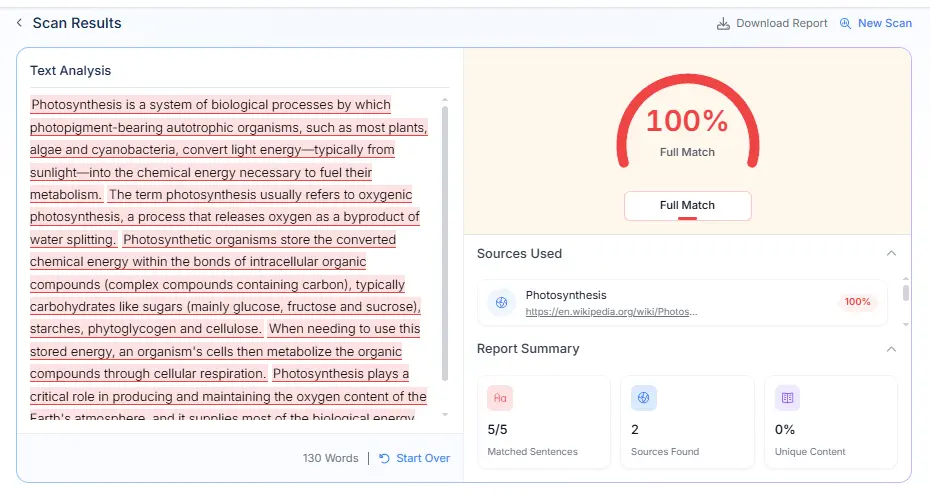
Phrasly located all 3 planted sources and returned zero false matches on the unpublished sample. It scored Sample A at 100%, tracing 5 of 5 sentences to the Wikipedia Photosynthesis page, and it named both planted pages on Sample B.
Its report was the most precise of the five. Hovering a highlighted sentence showed the source without leaving the page, and the link jumped straight to the matched passage rather than dropping you at the top of the page. No other tool did that.
Phrasly states on its product page that the checker scans 10B+ sources and deletes submitted content immediately after scanning. Both are the company’s own claims. The test could confirm that the report named and linked real sources, and database size is not something an outside test can measure.
Is Phrasly’s plagiarism checker free?
New accounts get one free scan, and every scan after that is paid at $5 per scan or $20 per month for 20,000 words. Subscribers get the checker inside the $20 package that also covers the Humanizer and the free tools. The AI detector is a separate tool on the same platform and does not run inside the plagiarism scan.
Best for: checking whether a page copied your work, because the source links point at the original and land on the exact sentence.
Privacy: Phrasly states that documents are never stored, indexed or shared, and that content is deleted immediately after scanning.
Honest note: an article about free checkers has to say this plainly. Phrasly is the paid entry on this list once the first scan is used, so a student who needs repeat checks at no cost is better served by Quetext below. Earned bonus words apply to the AI writing tools and do not unlock a plagiarism scan.
Compare our result with your own draft and inspect every matched source, not just the percentage. 👇
2. Quetext: Best for Repeat Checks at No Cost
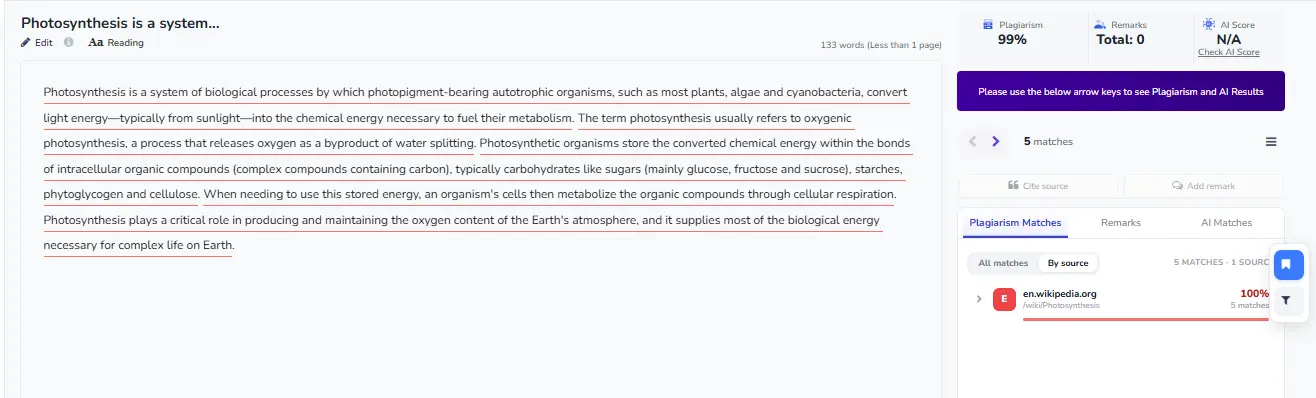
Quetext matched all 3 planted sources and produced no false matches, which puts its detection level with Phrasly. It scored Sample A at 99%, and on Sample B it reached 70% with both planted pages listed among six matches.
Quetext’s pricing page lists a free plan covering 1,000 words per plagiarism check, with Essential from $14.99 a month for 100,000 words. Its own new-user screen states 500 words for the same free plan, so expect the lower figure and check the counter before you paste. A free account was required before the first scan, and no card was asked for.
Best for: a student checking essay after essay at no cost, as long as each one fits inside the per-check cap.
Privacy: Quetext says it does not save your text to its database, and a separate help article says your text is stored within your account as a report that never joins the searchable database. The two statements pull in different directions, so read both before uploading sensitive work.
Honest note: the free plan is capped per check rather than per month, so a long paper still has to be broken up. For the full breakdown of its reports and limits, read our Quetext plagiarism checker review.
3. DupliChecker: Best for Longer Drafts Without an Account
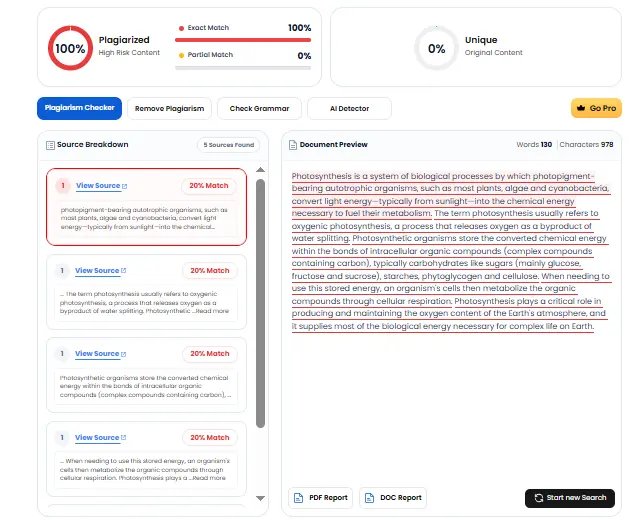
DupliChecker flagged 2 of the 3 planted sources. It found Wikipedia and NASA, then pointed the Amazon match at historyview.org, a site carrying the same Wikipedia text. Its report gives each match a percentage and a snippet, and Samples C and D came back clean.
What is DupliChecker’s real limit without an account?
DupliChecker’s free box caps you at 10,000 characters, which is roughly 1,600 words, and that is the most generous free allowance of the five. The 25,000-word figure its homepage mentions belongs to the premium plan, listed in the same feature strip as ad-free scanning. Our DupliChecker review records the same behavior across three earlier tests.
A human verification step appeared before every scan, results arrived inside two minutes, and no account was needed at any point.
Best for: a draft too long for a 1,000-word box, when you do not want to create an account.
Privacy: DupliChecker states that it does not save or store text uploaded to its web tools. Its policy adds that submitted content is removed once a scan completes, and that search engines never index it.
4. SmallSEOTools: Best for a Quick Check With No Friction
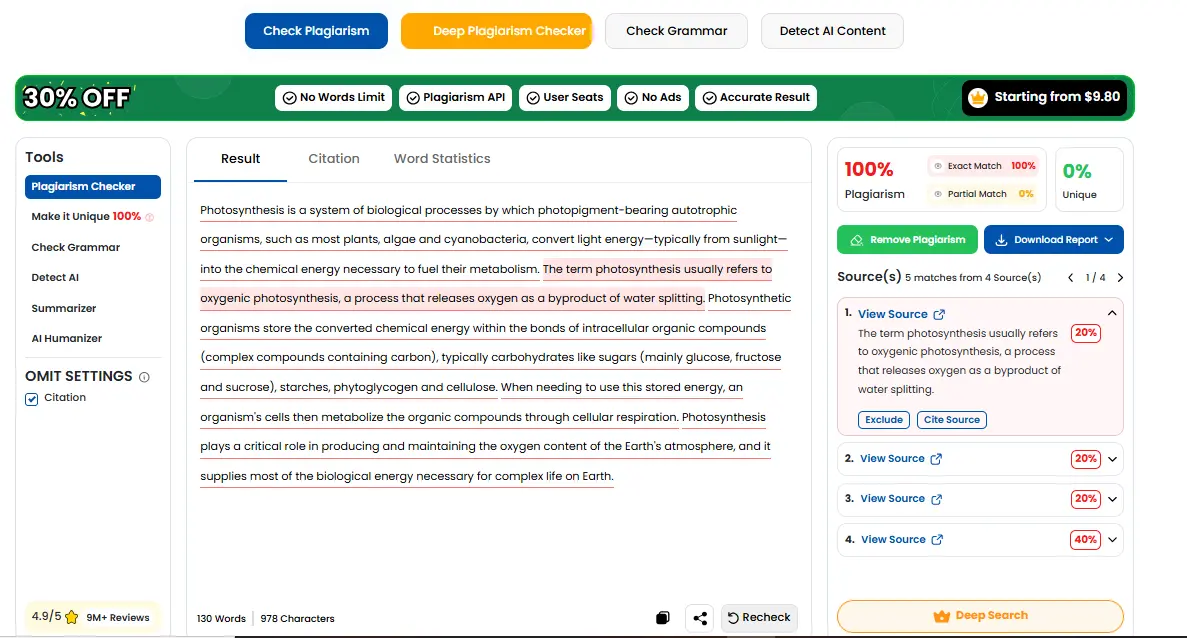
SmallSEOTools picked up 2 of the 3 planted sources with no false flags on the never-published sample. It returned 100% on Sample A, traced correctly to Wikipedia. On Sample B it caught NASA but attributed the Amazon text to storymaps.arcgis.com, so the original page never appeared.
Its plagiarism checker page states a free allowance of 1,000 words per scan, which means anything longer has to be split, and copying that straddles the split can pass unnoticed.
Page friction is the complaint that follows this tool around, and the test did not find it. Nothing interrupted the four scans, no account was requested, and each result arrived inside two minutes.
Best for: a short piece you want checked in one go, with nothing to sign up for.
Privacy: the checker page carries one line, saying your information is secured and the tool does not save or share your data with any third party. It says nothing about deletion.
Honest note: the 1,000-word cap is the real constraint here, not the report. Our Small SEO Tools review covers how it handled longer documents.
5. PlagiarismDetector.net: Best for a Fast First Look
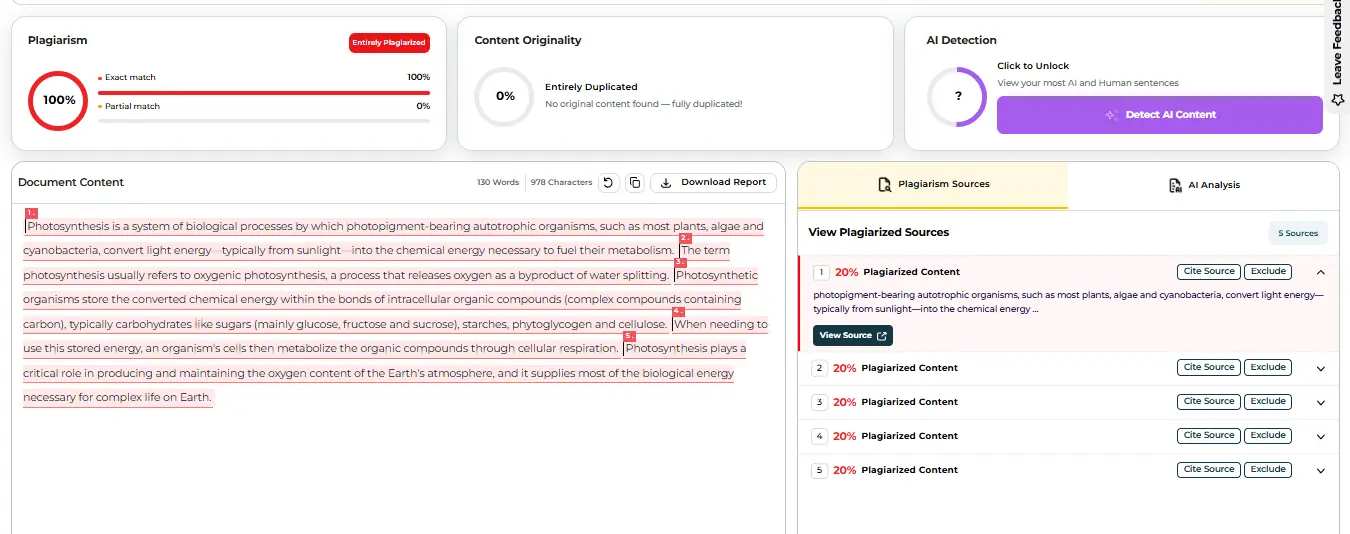
PlagiarismDetector.net confirmed 1 of the 3 planted sources, and the reason is worth understanding before you trust its report. On Sample A it listed five sources, and only the first three could be opened. Those three were the Wikipedia Photosynthesis page. Sources four and five were locked behind a paywall, so a free user cannot see where those matches came from.
Sample B repeated the pattern. Its visible sources pointed at historyview.org and storymaps.arcgis.com rather than Wikipedia, and the remaining two were locked again. The last two samples returned 0% with nothing found.
Its checker page counts input against a 1,000-word free limit and stops with an upgrade prompt at the cut-off, with paid plans starting at $9.99 a month for 36,000 words. No account was needed, and it was the fastest tool in the test alongside Phrasly.
Best for: a quick percentage when you only need to know whether something matched at all.
Privacy: the site states that content uploaded for a plagiarism check is never saved, that it leaves the system once processing finishes, and that search engines cannot index it.
Honest note: a source link is only useful once you open it. Two of five locked behind payment is the weakest part of this report, because the percentage on its own tells you nothing you can act on.
Which Reddit Recommendations Are Not Completely Free?
Turnitin, Grammarly and Scribbr are named just as often in those discussions, and none hands an ordinary individual a full similarity report at no cost. Each is blocked at a different point.
Turnitin. Its help center states that a student cannot self-check a paper without submitting to an instructor-created assignment, unless the school has switched on Draft Coach. Our Turnitin plagiarism guide covers the workarounds.
Grammarly. Grammarly’s support documentation says the plagiarism checker requires a paid account, which keeps its scan against 16 billion web pages and ProQuest databases behind Premium. Details are in our Grammarly plagiarism checker review.
Scribbr. The free version returns a preview, and the full report is pay-per-document at $19.95 to $39.95 depending on length, with no monthly subscription.
PapersOwl. It was not a recurring top recommendation, so it stays off the tested list. Our PapersOwl plagiarism checker review covers it for anyone weighing it.
💡 The paid gap comes from database access. Scribbr’s own benchmark of free and paid checkers put free tools at an average 43% detection against 88% for its paid check. Free checkers scan publicly indexed pages, and material behind journal paywalls and student repositories stays out of reach.
For the paid options compared properly, our 12 best plagiarism checkers roundup covers both free and paid tools.
Can a Free Plagiarism Checker Give the Same Result as Turnitin?
No free checker reproduces a Turnitin score, because Turnitin compares your work against a repository of papers other students have submitted, and public web checkers cannot reach it. Different databases and different matching rules produce different percentages on identical text, which is how the same paragraph comes back at 5% in one report and 40% in another.
Our own run showed exactly that spread. Sample B returned 40% on Phrasly, 44% on SmallSEOTools, 67% on DupliChecker and PlagiarismDetector.net, and 70% on Quetext, all from the identical paragraph.
Turnitin is also direct about what its number means. Its own help pages say that Turnitin does not check for plagiarism or define whether a paper has been plagiarized, that the figure is a similarity score, and that there is no single acceptable score. A high percentage can come from correctly cited quotations.
For a thesis, the safest check is the one your institution runs, because that is the report your examiners see. An outside scan is still worth running first on a long document, where an uncited passage is easiest to lose track of.
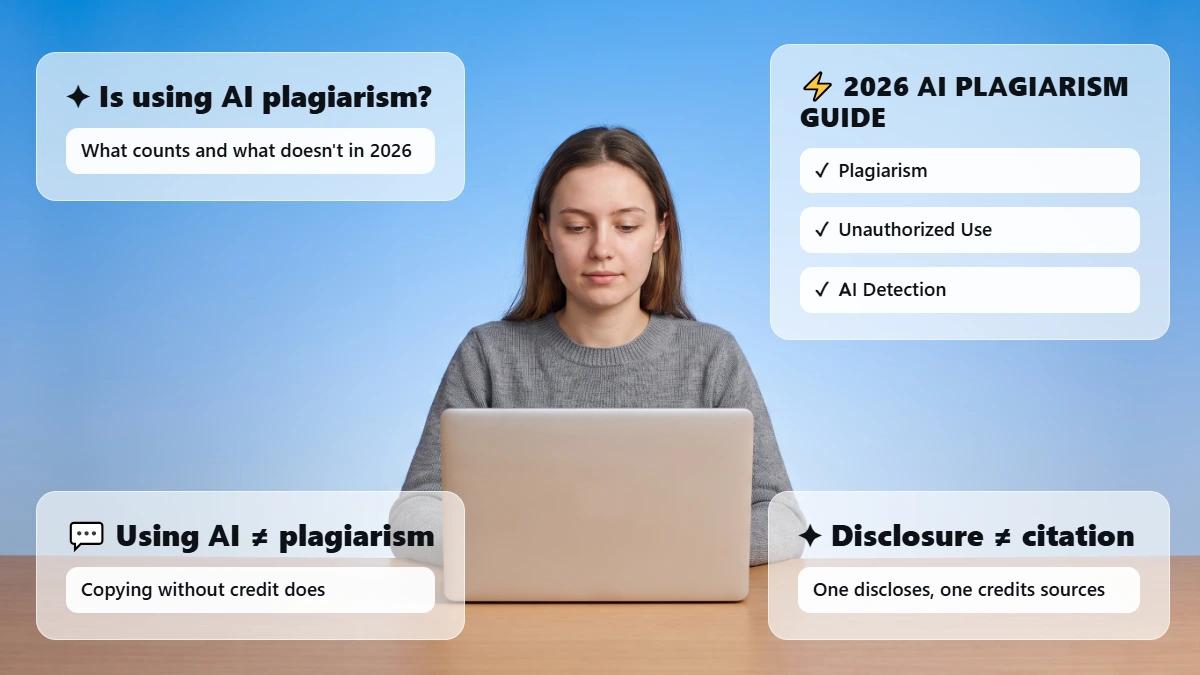
AI detection causes the other common mix-up. A plagiarism checker looks for text matching an existing source, an AI detector reads writing patterns, and AI-generated text is not automatically plagiarism. A tool offering both runs them as separate scans.
📊 Why this keeps coming up: 26% of US teens aged 13 to 17 said they had used ChatGPT for schoolwork in Pew Research Center’s January 2025 report, double the 13% recorded in 2023. More drafts now pass through a chatbot, so students are checking two different things on one document.
How to Use a Free Plagiarism Report Before Submitting
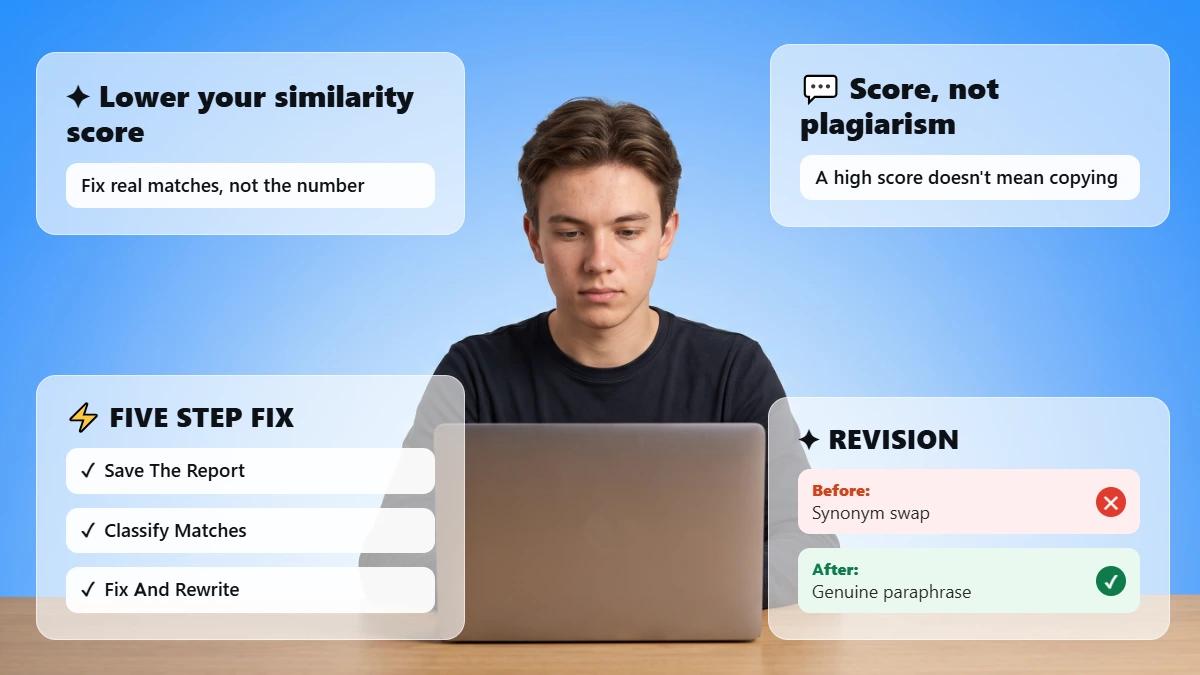
Open every highlighted match before you look at the percentage. An essay plagiarism checker reports how much of your text matched something else, and nothing about whether the match is a problem. Work through the report in this order:
🔍 Open each highlighted match and read the passage behind it.
🔗 Confirm the linked page is the original source rather than a site that copied it later.
⏸️ Set the headline percentage aside until the matches are reviewed.
✂️ Separate quotations, citations, reference lists and common phrasing from genuine problems.
✍️ Add attribution wherever an idea or a wording came from another source, which is where accidental plagiarism usually starts.
🔁 Rewrite patchwritten passages from your own understanding and keep the citation. Our guide to whether paraphrasing is plagiarism shows where the line falls.
📋 Check your assignment brief and your school’s rules on quotation and citation.
🔒 Remove names and identifying details before uploading sensitive work to any free tool.
💾 Save your drafts and source notes, the evidence that settles a question later.
✅ Run one final check after your revisions are in.
After you have corrected uncited or overly close wording, run one last check to confirm the remaining matches are quoted or attributed properly. 👇
The best app to check for plagiarism is the one whose report names the source, and our run showed that three of five named a copy instead. Anything past 1,000 words also has to be split across several scans on most of these tools, and a match falling across a split can go unreported. Judge your best website for plagiarism check on the report it hands back rather than the number at the top, and read every match yourself before you change a line.
Frequently Asked Questions
What is the best free plagiarism checker according to Reddit?
Reddit recommends Quetext more than any other checker, with SmallSEOTools and DupliChecker named as the no-cost starting points and PlagiarismDetector.net named for its source links. Those threads report opinions rather than measurements, and several of them are years old. On our four-sample test Quetext backed the recommendation up, finding every planted source and finishing second overall. We put it through a longer test of its own as well.
Are free plagiarism checkers accurate?
Free checkers catch copied text that is already indexed on the open web and miss a lot of what is held behind journal paywalls and in student repositories. Scribbr’s published comparison measured that gap at roughly half. No checker is 100% accurate, and one that promises it is overstating. Our best plagiarism guid covers the paid options that close part of that gap.
Can I check my paper for free before submitting it to Turnitin?
A free web check is possible, and it will not match the report your instructor sees. Turnitin controls self-checking through your school, so an outside scan counts as preparation rather than a preview. Use it to find uncited passages and fix them, then expect a different number when the official report arrives.
Why do two plagiarism checkers give different percentages?
Each tool searches a different database and applies different matching rules. Our own run put the same paragraph between 40% and 70% across five tools. Neither report is broken when the numbers disagree, so compare what each one matched rather than the figures at the top.
What plagiarism percentage is acceptable?
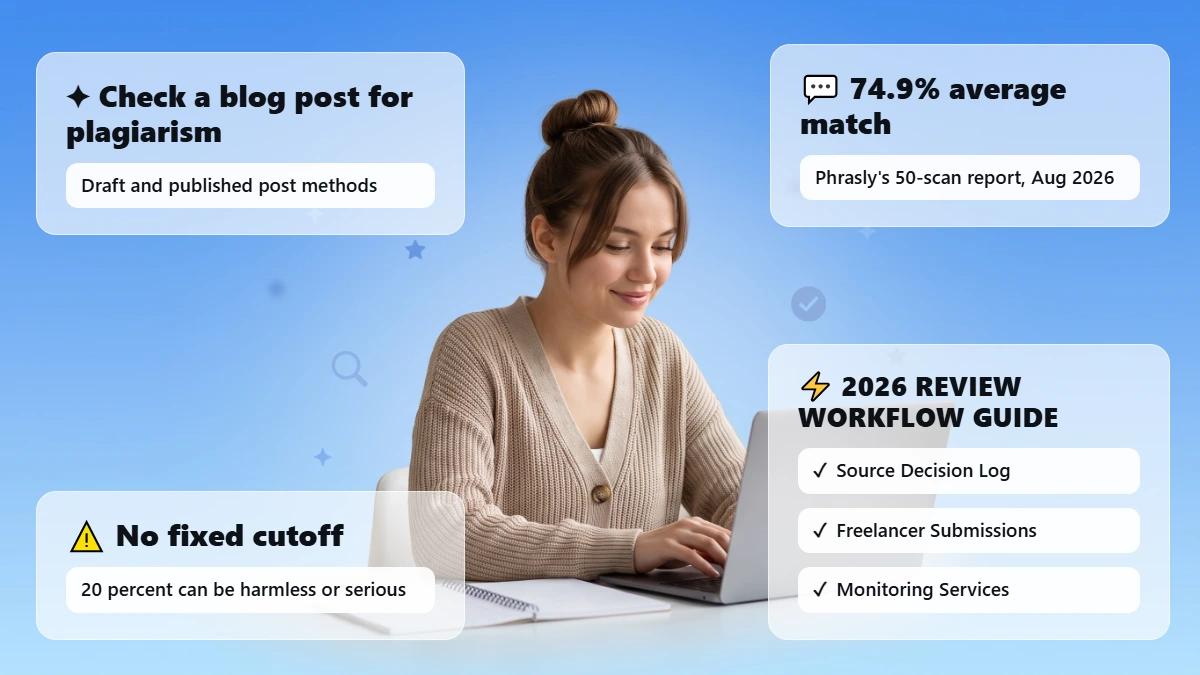
There is no fixed number, and Turnitin says so in its own help center. Institutions set their own expectations, and what matters is what produced the match. A paper full of properly cited quotations can score high and be fine, while a small uncited passage can be a serious problem.
Are free plagiarism checkers safe for unpublished papers?
Safety depends on the wording of each tool’s own storage policy, which is why privacy transparency carries 10% of the score here. DupliChecker and PlagiarismDetector.net both state that submitted text is deleted after processing, while SmallSEOTools offers one line and no deletion promise. Strip names and identifying details from sensitive work before you upload it anywhere.
Is a plagiarism score the same as an AI-detection score?
They measure two different things. A plagiarism score is the share of your writing that matches an existing source, and an AI-detection score estimates how likely a machine wrote it. Text can be entirely original and still get flagged as AI, and copied text can score low on an AI check.

Written by
Alina Shah
SEO Content Specialist · Karachi, Pakistan
She writes about AI so you don't have to guess. 8+ years in content strategy and editing. Now she puts AI writing tools and detection systems through real tests and shares what actually works.