Does Perplexity Leave a Watermark in Text?
9 min read
Does Perplexity leave a watermark in text? Not one of its own.
Perplexity's public documentation, checked on October 9, 2026, describes no Perplexity watermark.
But its answers are written by models from several companies. And some of those models now mark text as they write it.
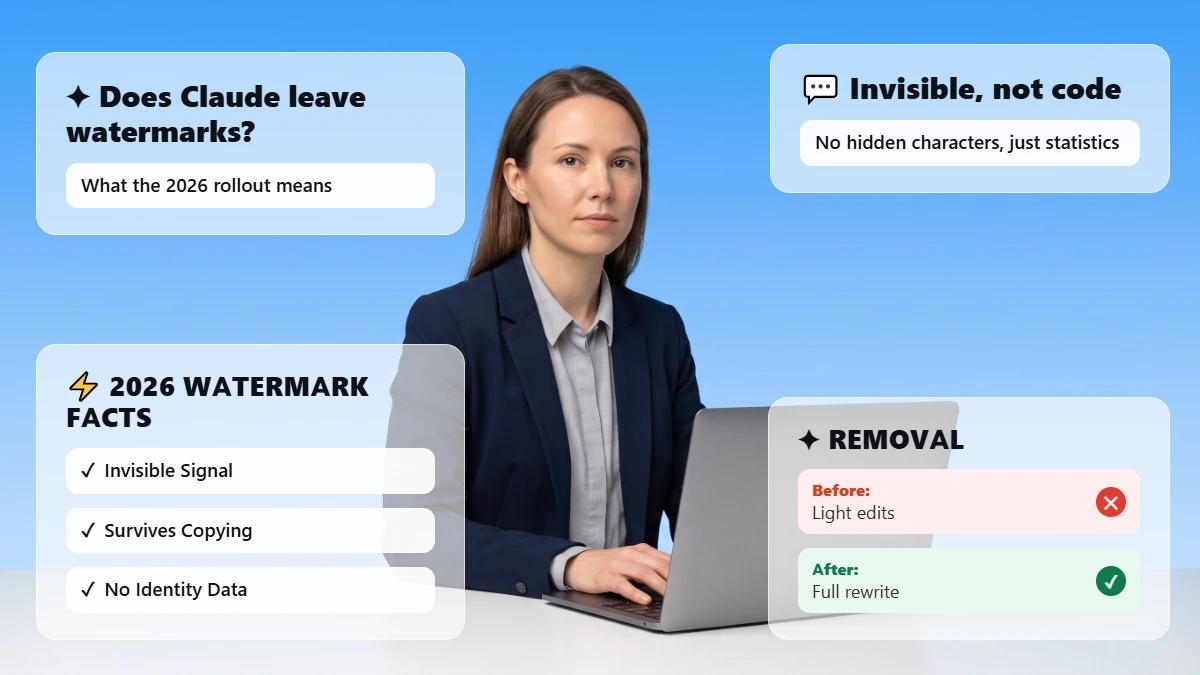
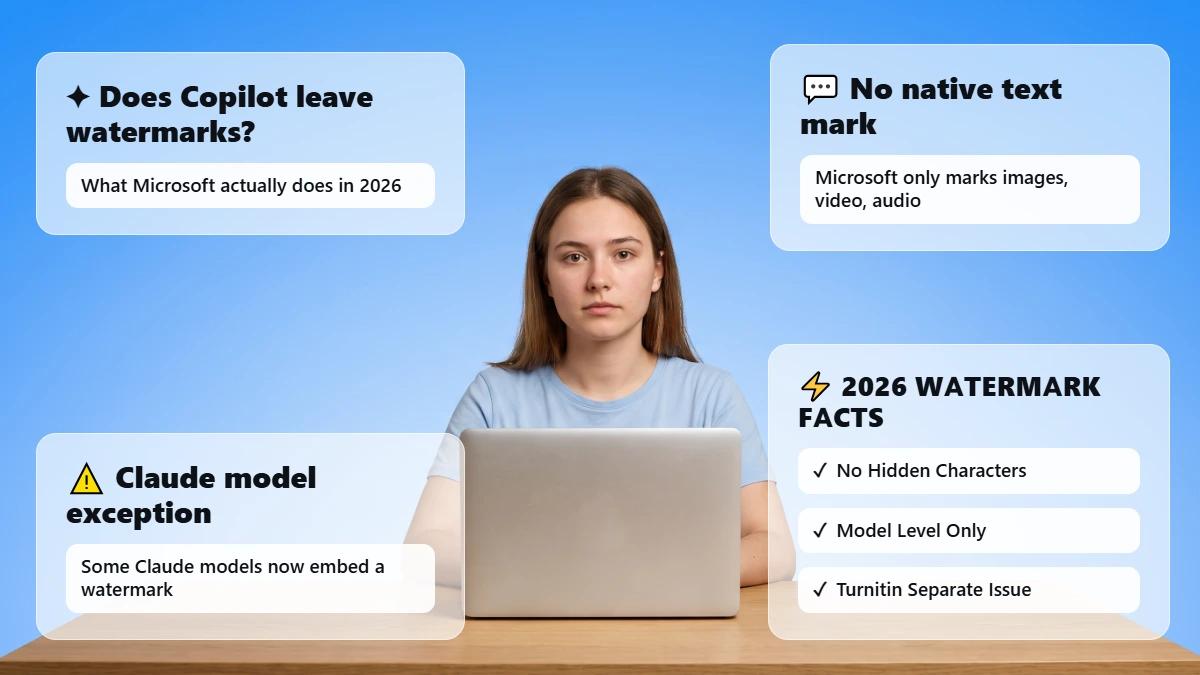
Anthropic says Claude Sonnet 5 and Opus 5, both in Perplexity's model picker, carry an invisible watermark wherever Claude is offered.
OpenAI keeps its text watermark off by default for API customers.
Google documents SynthID text for its own Gemini app.
So, the real answer depends on which model wrote your answer. Here is what is documented. And how to check a copied answer.
Clean Up Perplexity Text With Phrasly's AI Watermark Remover
Paste your Perplexity draft to smooth stiff wording. Then check the facts and citations before you publish. A free trial is available.
Does Perplexity AI Have a Watermark of Its Own?
Perplexity does not document a watermark of its own. Its help center explains which models it offers. It explains how the automatic Best option works. But says nothing about marking AI text.
That is not proof that answers are never marked. Because the model that writes an answer can add its own invisible signal.
Perplexity runs its own model, Sonar 2, alongside models from OpenAI, Anthropic, Google, xAI, Moonshot AI, Z.ai, and NVIDIA. It layers its own search, citations, and prompts on top.
So, a model can behave differently in Perplexity than in its maker's app. Free accounts use Best, which picks a model for each question. Pro and Max let you choose the model yourself.
And Perplexity's help center calls the model selector "the source of truth for your account." So, when this article says there is no Perplexity text watermark, it means "not documented". Not "absent".
For the basics of how text watermarks work, see this guide to AI text watermarks.
Which Perplexity Models Can Carry a Watermark?
It depends on the model that wrote the answer.
Anthropic says supported Claude models, including Sonnet 5 and Opus 5, carry its watermark wherever Claude is offered.
OpenAI's API watermark is off by default. Google documents SynthID for the Gemini app. Perplexity's own Sonar has no published scheme.
Last reviewed: October 9, 2026 (model list from Perplexity's September 4, 2026 snapshot
Model in Perplexity | What the maker documents | What it means for a Perplexity answer |
Sonar 2 (Perplexity) | No published text watermarking scheme found | ❓ No evidence of a mark; not proof there is none |
Claude Sonnet 5; Claude Opus 5 (Max only) | Anthropic lists both as supporting its text watermark, applied at the model level wherever Claude is offered, including through cloud platforms (Anthropic) | ⚠️ Likely marked, per Anthropic. Perplexity has not confirmed it. |
GPT-5.6 Terra; GPT-5.6 Sol (Max only) | OpenAI (Oct 5, 2026): textGrain is off by default in the API; customers can opt in for select models (OpenAI) | ❓ Marked only if Perplexity opted in. Not confirmed. |
Gemini 3.7 Flash | Google DeepMind documents SynthID text for the Gemini app and web experience; API coverage is not stated in official docs (Google DeepMind) | ❓ Unconfirmed either way |
Kimi K3, GLM 5.3, Grok 4.6, Nemotron 3 Ultra | No primary source found in this review | ❓ Unknown |
Best (automatic) | Perplexity picks a model per question | Follows whichever model answered. Note what the interface shows. |
"Model level" means the mark is woven into word choices as the model writes. So, Perplexity's app does not need to add anything for a Claude mark to be present.
That is the core of the Perplexity Claude watermark question.
For more on that route, read whether Claude leaves watermarks.
Are GPT answers in Perplexity watermarked? Only if Perplexity has opted in. As of October 5, 2026, OpenAI says its text watermark is off by default in its API.
API customers can opt in for select models. It is not public whether Perplexity has done so. So, treat GPT-5.6 Terra and Sol answers as unconfirmed either way.
Why now? The EU AI Act's transparency rules started applying on August 2, 2026. Both Anthropic and OpenAI cite them. On Perplexity SynthID, there's no confirmation either way.
Anthropic adds its own caveat. A detected mark suggests Claude was involved. But no mark does not mean a person wrote the text.
Does Copying a Perplexity Answer Remove a Watermark?
No! A statistical watermark lives in the word choices. So it travels with the words.
Anthropic says its mark carries through copy and paste. It may persist through some editing.
Copying can change formatting, links, and spacing. But that is a separate issue from where the text came from.
There are two kinds of "mark" to keep apart. A statistical mark lives in which words were chosen. A character-level oddity lives in the encoding. Copying can change the second. Not the first.
OpenAI describes textGrain the same way. An invisible statistical signal in the model's word choices. Not hidden symbols. Pasting as plain text drops bold and links.
But it can keep characters such as no-break spaces. So don't assume it removes every invisible character.
Are Citations, Hidden Characters, and AI Scores Watermarks?
No! Numbered citations point to sources. Hidden characters are encoding details that can come from web pages or editors. And AI detector scores are one classifier's estimate.
None of them confirms or rules out a provider watermark. Because each answers a different question.
What you see | What it tells you | What it cannot prove on its own |
[1] or a source link | The answer cited a source | That a watermark is present, or who wrote the wording |
A no-break or zero-width character | That Unicode code point is in your copy | That Perplexity put it there on purpose |
An AI-likelihood score | How one classifier reads the passage | That a provider watermark is present or gone |
A positive result from the provider's own detector | Evidence of that provider's mark, under its test conditions | Who edited the text, or how much a person wrote |
Perplexity quotes live web pages, so odd spaces can come from the source page, the browser, or your editor. A character you find is a fact about the text. Not a motive.
Classifier scores are a separate topic.
See whether Turnitin can detect Perplexity AI.
The same model-by-model logic applies to other apps that run other companies' models, such as Copilot's watermarks.
🔎 Perplexity Hidden Characters Worth Knowing
These are the characters people usually mean by invisible characters in Perplexity text:
U+00A0 no-break space: Looks like a normal space. But stops a line break.
U+202F narrow no-break space: A thinner version, common around numbers and units.
U+200B zero width space: Invisible, and one of the classic zero-width spaces that can break searches or word counts.
U+200D zero width joiner: Has real jobs in emoji and some scripts, per Unicode's emoji standard. So never delete it blindly.
The full list sits in Unicode's General Punctuation chart.
None of these is a writing-style pattern. And writing style is not a kind of watermark either.
How Can You Check a Copied Perplexity Answer?
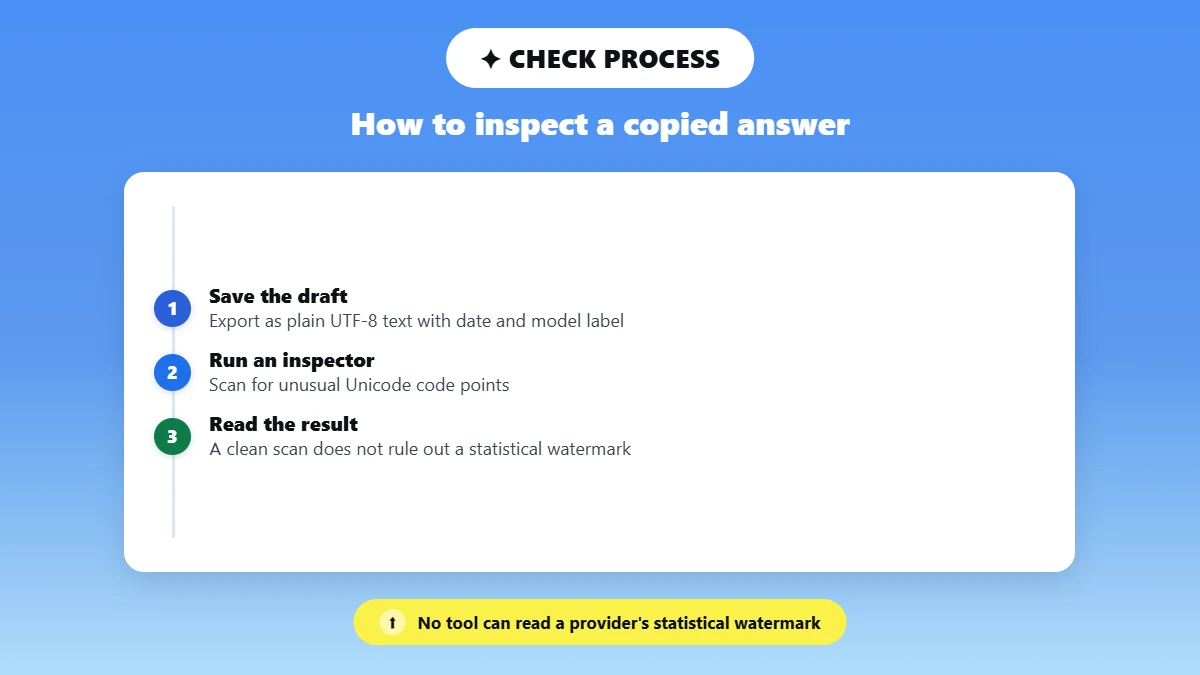
You can check a copy for hidden characters and formatting. But not for a statistical watermark.
Paste the answer into a plain-text file. Run a free Unicode inspector to list unusual code points. No public tool can read Claude's or OpenAI's text watermarks. So a clean scan proves nothing about provenance.
Save the answer as a plain UTF-8 .txt file, along with the date. And the model label Perplexity showed.
Run an inspector, such as this short Python script. Or any Unicode code point viewer.
import sys, unicodedata
text = open(sys.argv[1], encoding="utf-8").read()
for i, ch in enumerate(text):
cat = unicodedata.category(ch)
if cat == "Cf" or (cat.startswith("Z") and ch != " "):
print(i, "U+%04X" % ord(ch), unicodedata.name(ch, "UNNAMED"))
Read the result carefully. If it finds a character, that tells you what is in the copy. Not why it got there. If it finds none, that does not rule out a statistical watermark.
Who can check a watermark, then? Only the provider. Anthropic's watermark detection is in private preview. And OpenAI's detector is limited to approved researchers and expert organizations.
How to detect an AI watermark covers the general methods.
Can a Perplexity Watermark Remover Prove the Watermark Is Gone?
No! A tool cannot prove removal by returning edited text or a lower AI score.
That applies to any Perplexity watermark cleaner too. Checking a statistical watermark needs the provider's own detector key. And Anthropic and OpenAI limit detector access.
What a remover can do is improve what you control. Clearer wording, cleaner formatting, and a draft that sounds like you. OpenAI's own numbers show why.
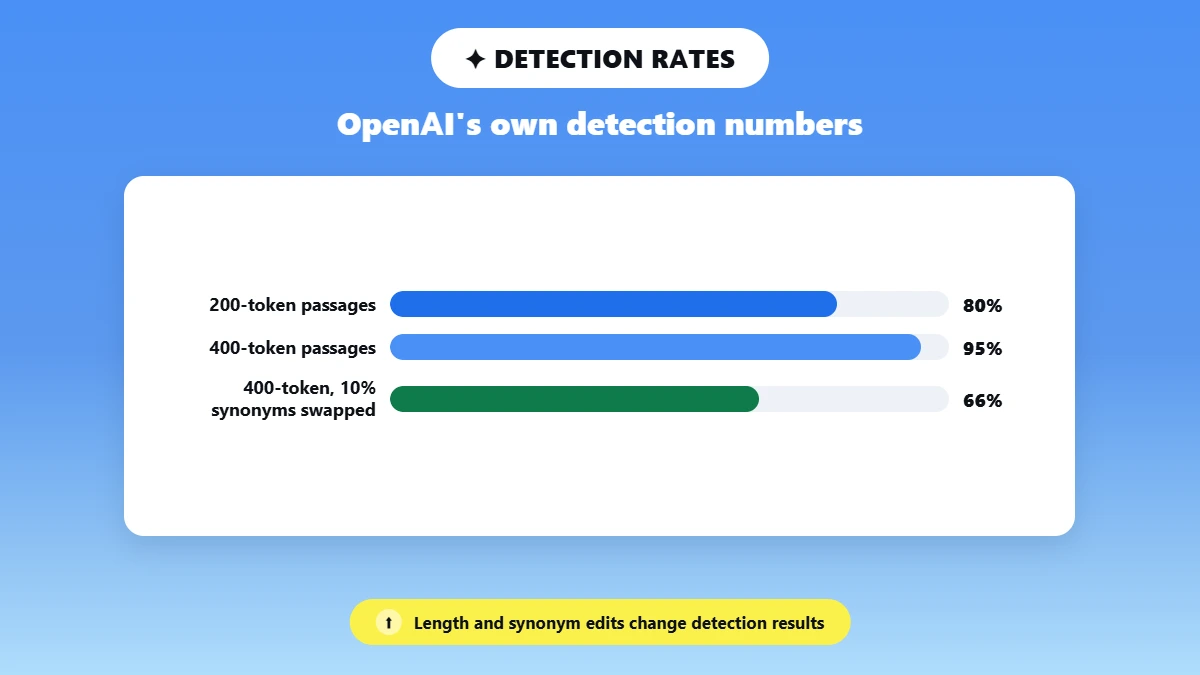
In its evaluation, detection ran at about 80% on 200-token passages and about 95% on 400-token passages. Swapping 10% of words for synonyms cut detection on 400-token passages from about 92% to 66%.
That is OpenAI's data. Not Perplexity's. But the point holds. Length and edits change results. So no tool's "clean" label is proof.
This guide to removing AI watermarks from text covers the wider picture.
🧭 Quick Decision Guide
✅ Formatting problem: Fix the characters.
✅ Wording problem: Revise the text.
❌ Provenance question: Only the provider can verify it.
Can Phrasly help clean up Perplexity text? Yes, as an editing step.
Phrasly's AI text watermark remover rewrites your draft at the strength you choose.
So, it reads more like your own edit. Compare the result with your sources afterward. It improves the writing. It does not certify that a watermark existed or is gone.
How Should You Review Perplexity Text Before Publishing?
Keep the original answer and its sources. Fix any formatting problems. Revise the wording for your reader. Then recheck every fact and citation.
Follow any AI disclosure rules your school, client, or employer has. Cleanup improves the draft. It does not change where the first version came from.
Here's how to clean Perplexity text responsibly:
Save the original. Keep the answer, its source list, the date, and the model label shown.
Check the paste. Look at spacing, line breaks, links, and citation numbers in your editor.
Fix the real formatting issue. Replace stray no-break spaces where they break your layout. But don't strip joiners from emoji or non-Latin text.
Revise for your reader. Cut repetition, add your own context and examples, and make claims specific.
Recheck facts and sources. Confirm names, figures, and quotes. Make sure each citation still supports its sentence.
Want help with step 4? Use Phrasly's watermark remover for Perplexity text to smooth stiff wording. Then run step 5 on the result.
Frequently Asked Questions
Does Copying Perplexity Text into Word or Google Docs Remove a Watermark?
No! Copying can change formatting, links, and spacing. But a statistical watermark is carried by the words themselves. If the words stay the same, any mark stays too. Treat formatting cleanup and watermark questions as separate jobs.
Can Anyone Check Whether My Perplexity Answer Has a Claude Watermark?
Not publicly yet! Anthropic's watermark detection is in private preview for eligible organizations. Public "watermark checkers" scan for characters. Not Anthropic's statistical mark.
See whether Claude AI is detectable for what checkers can tell you today.
Are Perplexity's Numbered Citations a Watermark?
No! They point to the pages Perplexity used. They help readers check claims but say nothing about a watermark. When you reuse an answer, keep the sources and cite them properly instead of deleting the numbers.
Can I Ask Perplexity Whether Its Answer Is Watermarked?
You can ask. But the reply isn't verification. The model may not know how its deployment is set up. Rely on the provider's documentation for the model you used. Or a result from the provider's own detector.
Can Edited Perplexity Text Still Be Flagged by an AI Detector?
Yes! AI detectors are classifiers that read writing patterns. They don't check watermarks. Fixing spacing won't change a score. A lower score doesn't prove a watermark is gone. Learn how AI detectors work before trusting any result.
Does the Perplexity Free Plan Change Any of This?
Free accounts use Best, which picks a model for each question. So, you may not know which company's model wrote the answer.
The same rule applies. Does Perplexity watermark text? It depends on the model behind the answer. Check whether your answer shows which model it used.
Three checks, three owners. Provenance questions go to the model's provider. Copying problems are about characters you can inspect. And quality comes down to your own editing.

Written by
Muhammad Usman Ali
Pakistan
Muhammad Usman Ali is an experienced SEO content writer with 3+ years of professional writing experience. He specializes in AI tools, AI detection technologies, and search engine optimized content.