Does DeepSeek Leave a Watermark in Its Text?
10 min read
DeepSeek has not documented a statistical watermark in its text. And our test of copied DeepSeek output found no hidden characters and no embedded metadata.
What it does use is a visible AI-content label. It is required by China's labeling law.
That mix-up between a label and a watermark is why people keep asking the question.
This post continues Phrasly's model-by-model series, after Claude, Copilot, Gemini, ChatGPT, and Perplexity. Everything below comes from real DeepSeek output. Checked for hidden Unicode and metadata.
Clean Up DeepSeek Text with Phrasly's AI Text Watermark Remover
Need text cleaned of leftover AI traces? Paste it in to tidy formatting and stray characters. Then review the result.
DeepSeek Does Not Hide a Statistical Watermark in Its Text
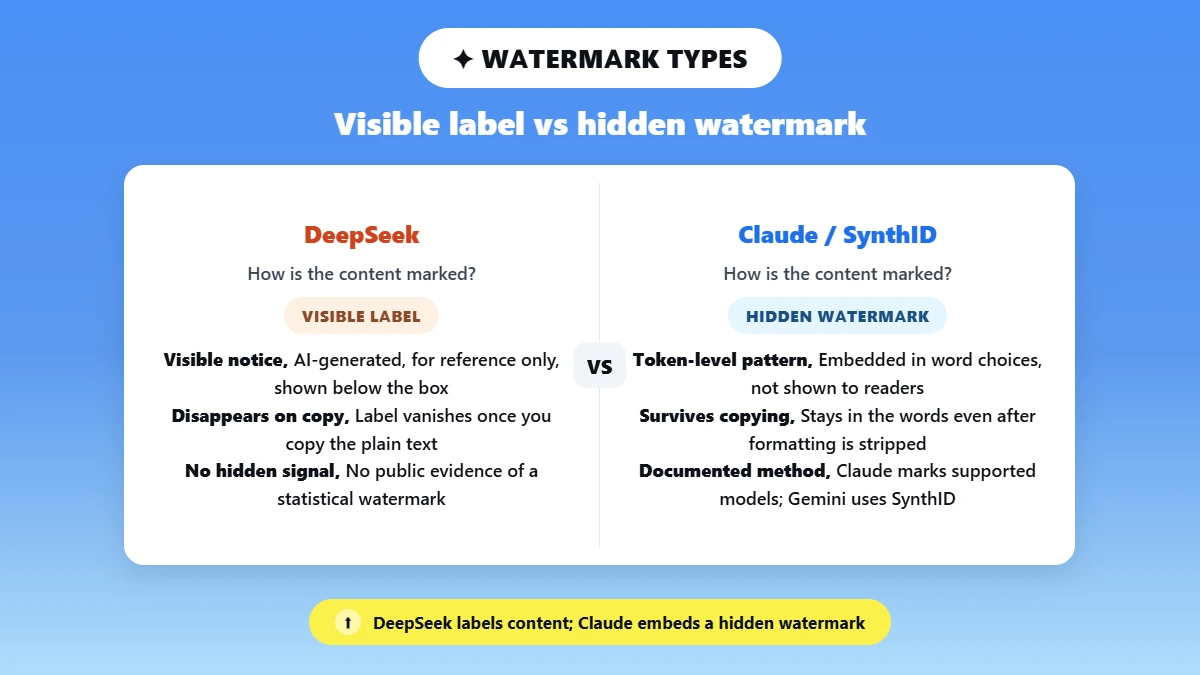
Does DeepSeek add a hidden watermark to the text it generates? No public evidence says it does. DeepSeek attaches a visible disclosure label instead.
This is a different thing from the token-level patterns Google's SynthID or Anthropic's Claude watermark embeds in word choices.
The practical difference matters. A visible label disappears the moment you copy plain text. A true statistical watermark stays in the words themselves even after formatting is stripped.
So a search for a DeepSeek watermark remover is usually about cleaning formatting. Not removing a hidden signal.
DeepSeek also stands apart from the rest of this series. Claude now carries a statistical text watermark on supported models. DeepSeek's label-only approach is closer to older chatbots than to Claude.
DeepSeek's September 1, 2025 labeling announcement describes visible and metadata labels. It asks users not to delete or alter them, but says nothing about a statistical text watermark.
AI detectors can still flag DeepSeek text through writing patterns. A separate method covered below.
What China's GB 45438-2025 Labeling Law Actually Requires
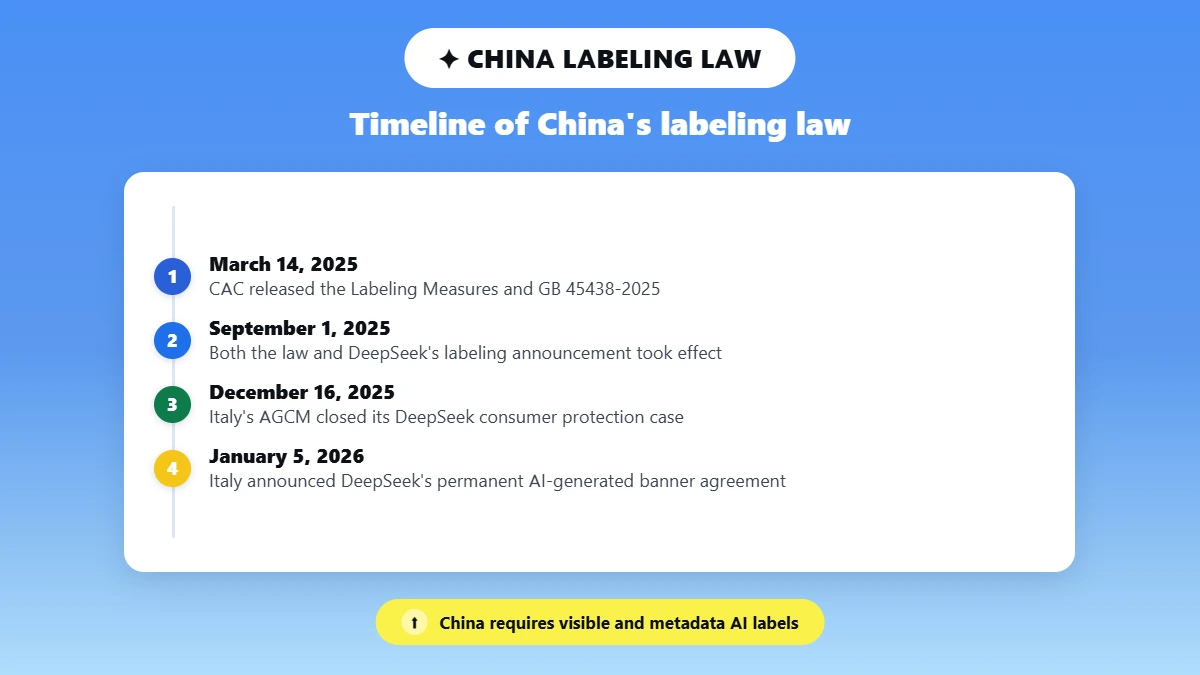
China's labeling rules require AI providers to add a visible label. And an invisible metadata label to AI-generated content. The China AI labeling law GB 45438-2025 sets the technical method.
It applies to every AI provider serving users in China. Not just DeepSeek.
The Cyberspace Administration of China released the Labeling Measures and the mandatory standard GB 45438-2025 on March 14, 2025. Both took effect on September 1, 2025.
The rules set out two label types:
Explicit labeling: Visible text, audio, or graphics that tell users the content is AI-generated, such as an "AI-generated" notice.
Implicit labeling: Metadata embedded in the file, such as the provider's name and a content ID, that users don't easily see.
The DeepSeek implicit labeling requirement is a metadata-level duty. Not a statistical text watermark. Plain chat text has no file metadata to carry it. This is why copied DeepSeek answers show no hidden mark.
Resemble AI's summary of China's labeling measures notes enforcement by the CAC, with removal and platform sanctions for non-compliant content.
Outside China, Italy's competition authority (AGCM) closed its consumer protection case on December 16, 2025.
It announced this on January 5, 2026, after DeepSeek agreed to a permanent Italian banner below the prompt box saying content is AI-generated and may be inaccurate.
Does the Chinese Regulation Apply Only to DeepSeek?
No! GB 45438-2025 is a national standard for all AI content providers under Chinese jurisdiction.
Every China-serving platform faces the same explicit and implicit labeling duties.
For compliance teams, one regulatory checklist covers every Chinese AI vendor. Not just DeepSeek.
We Tested DeepSeek for Hidden Characters and Metadata
In our October 22, 2026 test on DeepSeek's website, the copied answer contained no zero-width characters, no hidden Unicode, and no DeepSeek metadata.
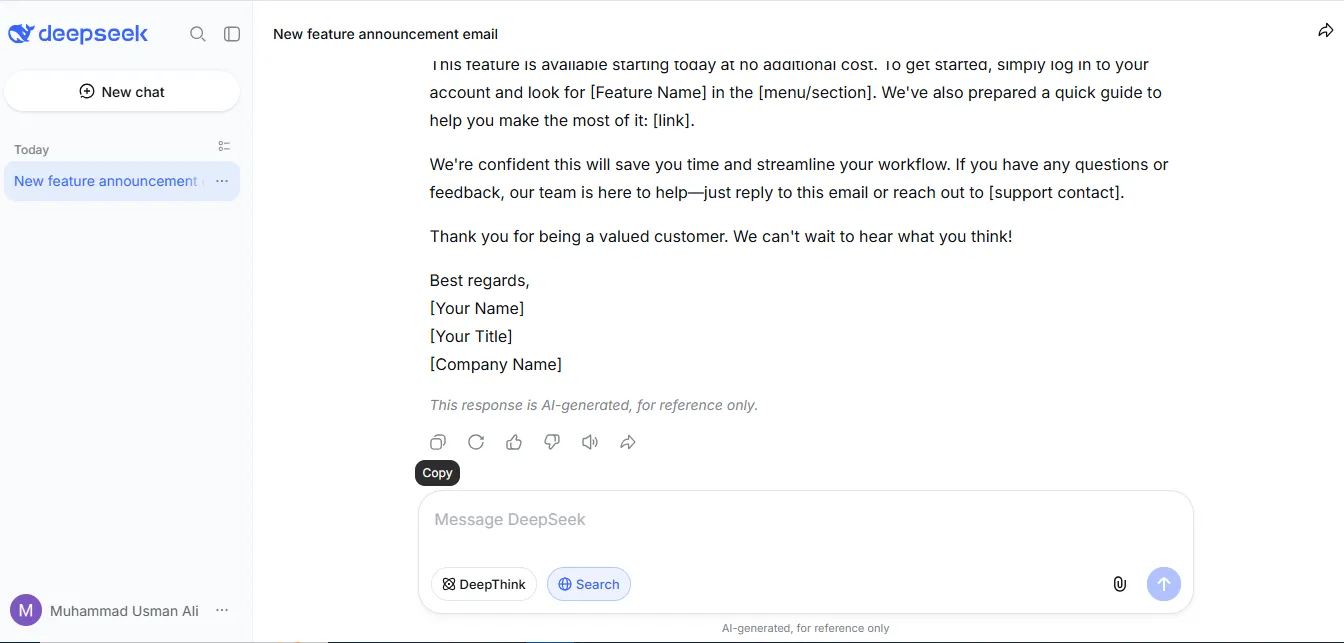
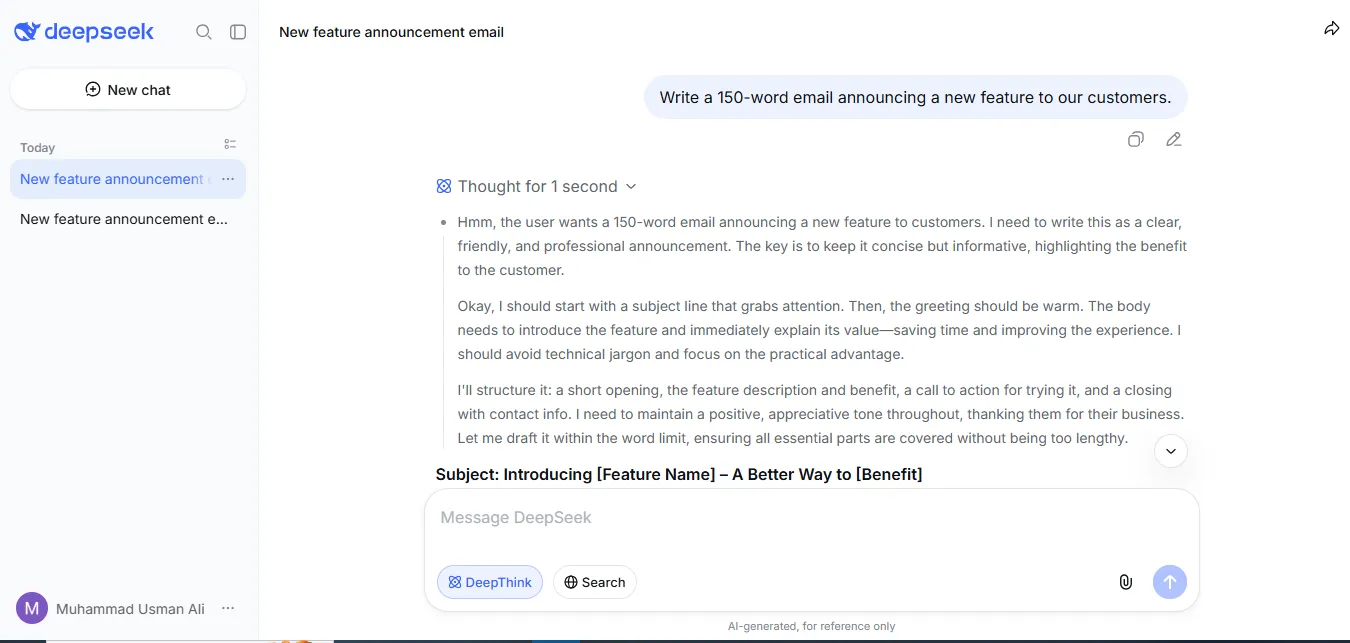
The only marking was the visible interface label, “AI-generated, for reference only”, which doesn't copy with the text.
We used the same method as the rest of this series, explained in how to detect an AI watermark.
How can you check if a document was written by DeepSeek? You can check the text for invisible Unicode characters and the file for metadata. But neither proves authorship. A DeepSeek watermark checker that promises more is guessing.
Test Method and Tools Used
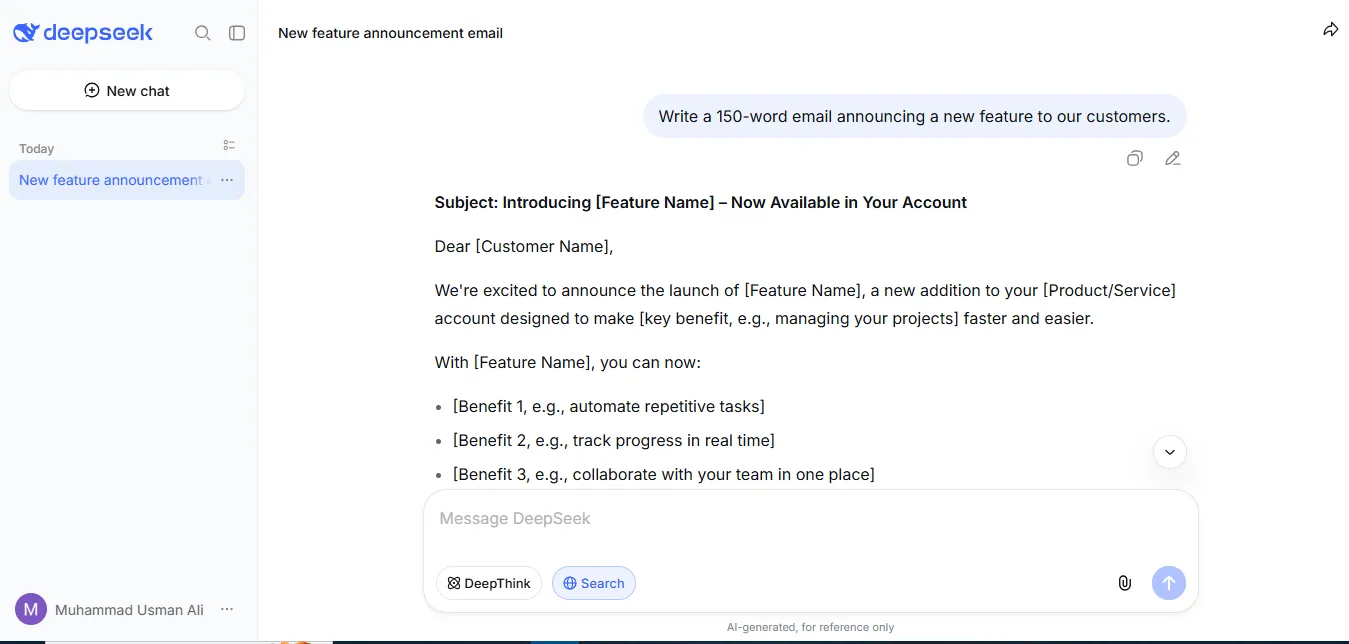
Prompt and model: “Write a 150-word email announcing a new feature to our customers.”, run on DeepSeek's default chat model (no model name shown in the interface; DeepThink off, Search on) on the website (chat.deepseek.com) on October 22, 2026.
Hidden-character scan: A Unicode inspector checking for zero-width characters such as U+200B and U+200D. We used a Python script that lists every Unicode format character and non-standard space.
Metadata check: The exported file's document properties, inspected with Word (File, then Info, then Properties) and the file's core properties.
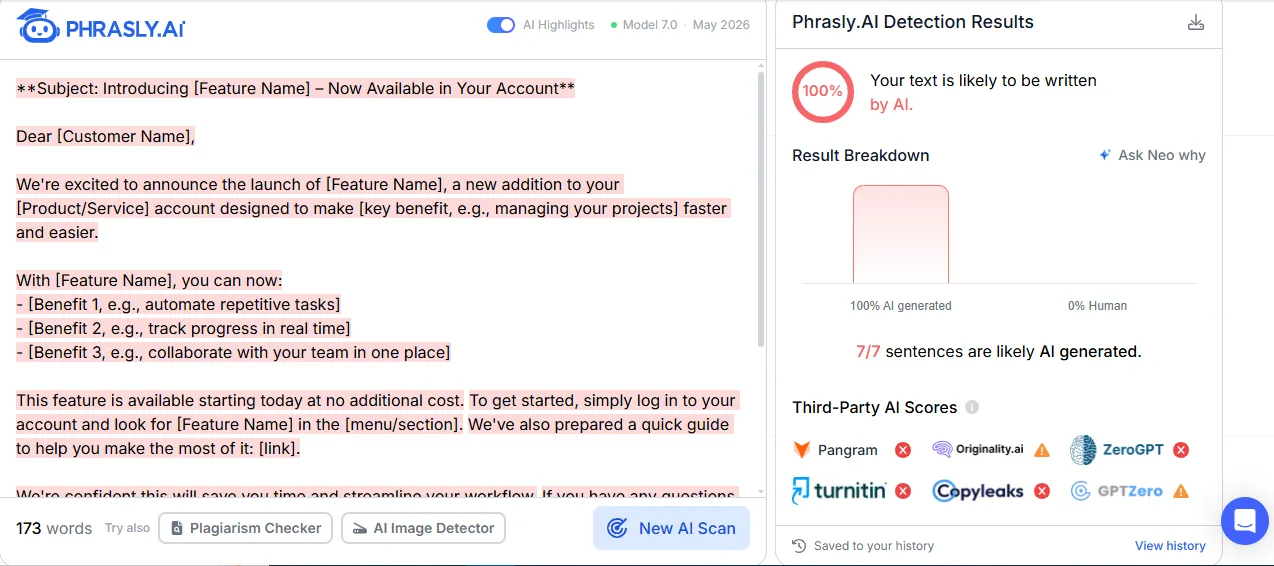
Detector check: One pass through Phrasly's AI Detector (Model 7.0) to separate pattern detection from watermark detection.
What We Found in the Raw Text
The interface showed “AI-generated, for reference only” in small grey text below the message box. The copied text had no hidden characters.
What it did carry was visible formatting: 4 markdown asterisks around the bold subject line, 3 markdown dash bullets, one en dash and one em dash. The 173-word answer ran longer than the 150 words requested.
For comparison, see how Claude's watermark compares.
Check performed | Tool used | Result on DeepSeek sample |
Zero-width character scan | Python Unicode scan | ✅ None detected |
Visible label check | Manual review of app/website output | ✅ “AI-generated, for reference only”, below the message box |
Document metadata scan | Word document properties | ✅ No watermark tag; only “Dell User” (our PC) and Microsoft Word |
AI detector pattern match | Phrasly AI Detector (Model 7.0) | 100% AI; 7/7 sentences (pattern based, not watermark based) |
Tested October 22, 2026 on DeepSeek's website, default chat model.
Searches for DeepSeek hidden characters’ text usually mean these copy-paste artifacts.
Found Asterisks or Stray Dashes in Your Copy?
Our test turned up markdown asterisks, dash bullets, and typographic dashes. Not a hidden watermark. Tidy DeepSeek text with Phrasly before you paste it into your CMS or document. Then keep any AI disclosure your policy requires.
Where DeepSeek's Visible Label Appears: App, Website, and API
DeepSeek shows its AI-content label in the interface. Not inside the words of the answer. That's why it vanishes when you copy text out. The DeepSeek API works differently again. There's no interface to display a label.
📱 The App and Website
In the DeepSeek app and website, the label appears as “AI-generated, for reference only”, in small grey text centered below the message box.
It discloses the content as AI-generated to the person reading it in DeepSeek. This satisfies the explicit labeling rule.
⚙️ The API and Resellers
DeepSeek's Open Platform terms describe the API as a neutral, basic model technology service.
And don't mention any label in API responses. If you show API output to users, any labeling your market requires is your job.
Does using DeepSeek's API or running it locally avoid any watermarking? There's no hidden text watermark to avoid in the first place. Any implicit, metadata-level duty under GB 45438-2025 sits with the service that delivers the content.
Check how resellers such as OpenRouter or Azure handle it.
Metadata residue is a separate concern for compliance teams that archive AI output. Exported files can carry creation tools, timestamps, or author fields that say nothing about a watermark.
Is It Illegal to Delete DeepSeek's Visible AI Label?
This is an open legal question. Not a settled one. China's rules place the labeling duty mainly on providers and platforms. And other countries are moving toward penalties for tampering with required labels.
South Korea, for example, has seen a bill, reported in May 2026, that would add penalties of up to two years in prison or about 20 million won (roughly $13,500) for removing or altering AI watermarks.
It covers AI-generated content generally. Not DeepSeek by name, and it was still a proposal as of mid-2026.
Treat label removal as a regulatory question, especially when you republish content in a regulated setting.
DeepSeek Vs. ChatGPT, Claude, and Gemini: Watermark Comparison
DeepSeek uses a visible compliance label. ChatGPT, Claude, and Gemini now use, or have announced, hidden statistical watermarks. That's the core of the DeepSeek vs. ChatGPT watermark question.
What's the difference between DeepSeek's labeling and ChatGPT's watermark? OpenAI announced on October 5, 2026, that its textGrain watermark, a pattern in word choices, is coming to ChatGPT text in the EU. Its API watermark stays off by default.
DeepSeek's label is a notice. Not an embedded signal.
For Claude watermarking, Anthropic marks text from supported models such as Sonnet 5 and Opus 5.
Gemini SynthID works at the token-probability level in the Gemini app. This is closer to ChatGPT than to DeepSeek. The EU AI Act marking rules (Article 50, applying from August 2, 2026) are pushing Western labs toward machine-readable marking.
Model | Marking type | Hidden / statistical? | Visible label? | Regulatory driver |
DeepSeek | Compliance label | ❌ None documented | ✅ Yes | GB 45438-2025 (China, effective Sept 1, 2025) |
ChatGPT (textGrain) | Statistical watermark | ✅ Announced for EU ChatGPT text | ❌ No | EU AI Act |
Claude | Statistical watermark | ✅ Yes, on supported models | ❌ No | EU AI Act |
Gemini (SynthID) | Statistical watermark | ✅ Yes, in the Gemini app | ❌ No | Google policy; EU AI Act |
Provider statements checked October 19, 2026.
Do Open-Weight and Locally Run DeepSeek Models Carry Any Marking?
DeepSeek open-weight models’ watermark status is simple. None documented. Open-weight models you run locally, through Ollama, vLLM, or similar, carry no built-in visible label.
Because the label is added by DeepSeek's hosted app. Not by the model weights.
Does running DeepSeek locally remove any marking? It never adds the hosted label to begin with. If you serve users in China, the labeling duty under GB 45438-2025 becomes yours. And the model won't handle it for you.
Before assuming output is "clean," check:
Which weights you run: An open-weight release behaves differently from the hosted API.
Your application layer: Add any label your users or regulators require.
The model card: DeepSeek's open-weight model cards, such as Janus-Pro's on Hugging Face, cover architecture and license terms. But don't mention labeling or watermarking.
The output itself: Run the same Hidden-Unicode and metadata check this series uses.
Does DeepSeek's Image Generator (Janus-Pro) Carry a Watermark?
Does DeepSeek leave a watermark on images? Undisclosed! Janus-Pro's README and model card say nothing about a watermark. Chinese image generators face the same GB 45438-2025 labeling rules as text.
A metadata label is plausible but unconfirmed.
Run your own EXIF or metadata check on Janus-Pro output rather than assuming either way.
Is DeepSeek Text Detectable by AI Detectors Like GPTZero?
Yes, usually! But that has nothing to do with a watermark. An AI content detector reads writing patterns. Not labels. DeepSeek's visible notice neither helps nor hurts detection.
So, is DeepSeek detectable? In Originality.ai's tests, its detectors caught DeepSeek-Chat with 99.3% recall on a 150-sample dataset. GPTZero reached 97.3% on the same set, according to Originality.ai's own study.
Originality.ai's 2026 update reports 96% to 99%+ recall across DeepSeek V3.2, V4 Flash, and V4 Pro. Those are a detector vendor's own figures. Treat them as vendor results.
Any DeepSeek AI detector result is a pattern estimate. Not proof that DeepSeek wrote a text.
Clean Hidden Characters and Reasoning Leftovers from DeepSeek Text
The real cleanup job is copy-paste artifacts. Not a hidden watermark. Check DeepSeek output for these before you publish:
Reasoning token leftovers: Think-tag or chain-of-thought fragments pasted in by mistake. In our DeepThink test, the copy button returned only the email. The reasoning stays in an on-screen “Thought for 1 second” box (for example, “Hmm, the user wants a 150-word email...”) and only lands in your document if you select and copy it by hand.
Mixed script typography: Full-width punctuation or CJK-adjacent characters bleeding into English text.
Invisible spacing: Stray Unicode spaces picked up when copying from the interface.
Markdown leftovers: Asterisks or # symbols that render oddly outside the chat window. In our tests, the copy button kept markdown asterisks around bold text, while selecting the answer by hand gave clean plain text.
Can you remove the hidden characters DeepSeek puts in its answers? Yes! Because they're formatting artifacts. Matches what this series finds when scanning for hidden Unicode and metadata.
For the full method, read Cleaning Leftover AI Text Traces.
A watermark removal tool is useful here for tidying formatting and stiff phrasing. As long as you aren't removing a disclosure your policy or local law requires.
Paste your DeepSeek draft into Phrasly's AI text watermark remover to tidy stray characters and formatting. Then check the facts and keep any disclosure you're required to show.
Frequently Asked Questions
Is It Illegal to Delete DeepSeek's Visible AI Label?
GB 45438-2025 places the labeling duty mainly on AI providers and platforms. Not individual users. And penalties for users aren't spelled out in current guidance. Be cautious if you republish content in a regulated setting.
Check local rules rather than assuming you face personal legal risk.
Does the Chinese Regulation Apply Only to DeepSeek?
No! GB 45438-2025 is a national, sector-wide standard for every AI content provider in China. It covers text, images, audio, and video. Other domestic AI platforms face the same explicit and implicit labeling requirements. It isn't a DeepSeek-specific rule.
Does DeepSeek's Image Generator Carry a Watermark?
It's not confirmed. Public research hasn't shown whether DeepSeek's image models, such as Janus-Pro, embed a hidden watermark. No direct metadata test has been published. That question is separate from the text findings in this post.
We did not run an image test for this article.
Is There a Tool That Actually Removes DeepSeek's Watermark?
There's no statistical watermark to remove. Only a visible disclosure label plus occasional hidden spacing or formatting artifacts. Cleanup tools can strip those artifacts.
For how other models compare, read the Copilot watermark test.
Does DeepSeek Watermark Its Text Output?
No! DeepSeek doesn't embed a documented statistical or token-level watermark in generated text. Its only confirmed marking is the visible AI disclosure label required by Chinese law.
See the first section above and this guide to what AI text watermarks actually are.

Written by
Muhammad Usman Ali
Pakistan
Muhammad Usman Ali is an experienced SEO content writer with 3+ years of professional writing experience. He specializes in AI tools, AI detection technologies, and search engine optimized content.