
12 Types of Plagiarism Explained (With Real Examples)
Learn the 12 types of plagiarism with real examples, understand the consequences, and discover practical ways to avoid academic mistakes before you submit your work.
The main types of plagiarism include direct, complete, paraphrasing, patchwork (mosaic), self-plagiarism, accidental, source-based, incremental, and AI-assisted plagiarism. There is no single official count, and most universities recognize between 4 and 12 types. All of them can carry academic penalties, even when the plagiarism is unintentional.
Most plagiarism cases happen because of missed citations or poor research habits, which is why understanding each type is the first step toward avoiding costly academic mistakes.
What Is Considered Plagiarism?
Plagiarism means presenting someone else's words, ideas, research, or creative work as your own without giving proper credit. It includes copying text without quotation marks or citation, paraphrasing another person's work without attribution, and reusing your own previously submitted work (self-plagiarism) without permission.
Don't confuse plagiarism with copyright infringement. Plagiarism is an academic and ethical issue, whereas copyright infringement is a legal issue involving protected intellectual property.
The 12 Types of Plagiarism
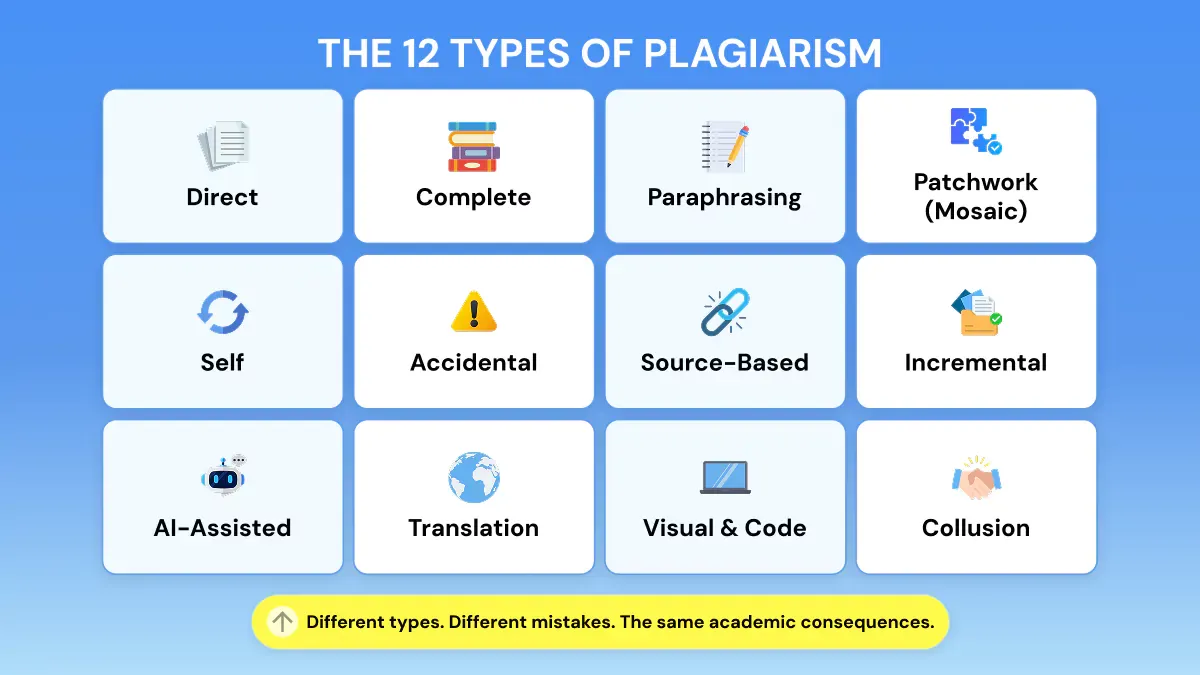
While the exact number varies between institutions, the following 12 types cover the most widely recognized forms of academic plagiarism. Understanding each one can help you avoid costly mistakes.
1. Direct (Verbatim) Plagiarism
Direct plagiarism is copying someone else's words word-for-word and presenting them as your own without quotation marks, proper citation, or acknowledgment of the original source.
E.g.: John is writing an essay. He finds a research article online and copies several paragraphs word-for-word into his assignment without using quotation marks or providing a citation. He submits it as his own.
Intentional or Accidental?
Intentional. The writer knowingly copies someone else's words without giving credit.
How It Gets Caught
Plagiarism checkers compare your text with published sources and highlight exact matching passages.
How to Avoid It
Use quotation marks for copied text, cite the original source, and paraphrase whenever possible.
2. Complete (Global) Plagiarism
Complete (Global) plagiarism is submitting someone else's entire work as your own instead of creating your own.
E.g.: A student obtains an essay from a senior student or an online source. He submits the entire paper without changing a word or providing a citation.
Complete plagiarism is one of the most serious forms of academic misconduct.
Intentional or Accidental?
Almost always intentional because the writer knowingly submits someone else's work.
How It Gets Caught
Plagiarism checkers and institutional submission databases can match it to the original document or a previously submitted assignment.
How to Avoid It
Create your own work. If you use another source for ideas, write in your own words and cite the original source.
3. Paraphrasing Plagiarism
Paraphrasing plagiarism is rewording someone else's ideas or content without properly citing or acknowledging the original source.
E.g.: Alex found a journal article for his assignment. Instead of writing in his own words, he replaced a few words with synonyms and slightly changed the sentence structure while keeping the original meaning.
Intentional or Accidental?
Both. Some students intentionally hide copying, while others do not know how to paraphrase correctly.
How It Gets Caught
Modern plagiarism checkers use semantic similarity detection to identify heavily reworded text, while instructors may notice similarities in writing style.
How to Avoid It
Understand the source, write it in your own words, cite the original source, and use quotation marks for exact wording.
4. Patchwork (Mosaic) Plagiarism
Patchwork (Mosaic) plagiarism is stitching together phrases and ideas from multiple sources with your own connecting sentences to create what appears to be original writing without proper attribution.
E.g.: A college student copies a few sentences from one website, a paragraph from a research paper, and a few lines from another source. She joins them with her own connector sentences without acknowledging the original sources.
Intentional or Accidental?
Both. Some students do it intentionally, while others mistakenly believe combining sources makes the writing original.
How It Gets Caught
Plagiarism checkers compare your writing against multiple sources and identify copied phrases joined with connector sentences.
How to Avoid It
Write the paragraph in your own words and properly cite every source you use.
5. Self-Plagiarism
Self-plagiarism is reusing your own previously submitted work without your instructor's permission or approval.
E.g.: Sarah is assigned an essay. She remembers that she wrote the same essay for another course last semester, so she submits the same paper again without asking her instructor for permission. She believes it is acceptable because it is her own work.
Intentional or Accidental?
Both, but often accidental because many students do not realize reusing previous work without permission is self-plagiarism.
How It Gets Caught
Institutional submission databases compare new assignments with previously submitted papers and identify reused work.
How to Avoid It
Ask your instructor before reusing previous work. If permission is denied, write a new paper.
6. Accidental Plagiarism
Accidental plagiarism is the most common type of plagiarism. It happens because of missed citations or forgotten quotation marks. Academic penalties may still apply because intent does not excuse plagiarism.
E.g.: An MBA student finishes an assignment on startup funding trends but accidentally submits the final draft before adding the citations.
Intentional or Accidental?
Accidental. The writer unintentionally misses citations, quotation marks, or references before submission.
How It Gets Caught
Plagiarism checkers and instructors can quickly identify matching text, missing citations, and quotation marks.
How to Avoid It
Review your final draft for missing citations, quotation marks, and references, and avoid last-minute submissions.
7. Source-Based Plagiarism
Source-Based Plagiarism is using fake, misleading, or incorrect citations that do not accurately reflect the original source. This includes citing a secondary source as the primary source, inventing references, or using AI-generated citations that do not exist.
E.g.: Peter cannot find enough academic sources to support his thesis, so he deliberately invents several journal references and includes them in his bibliography to make his research appear more credible.
Intentional or Accidental?
Intentional. The writer knowingly uses fake or misleading citations to make the work appear properly referenced.
How It Gets Caught
Instructors verify cited sources, while plagiarism checkers identify fake or misleading references that do not match the cited content.
How to Avoid It
Verify every citation before submission. Use only sources you have read, and never include fake or AI-generated references.
8. Incremental Plagiarism
Incremental Plagiarism is the gradual addition of copied content during research, drafting, or revision. Small copied fragments build up over time.
E.g.: A nursing student copies a definition during research, planning to rewrite it later. While editing, she adds a few more uncited lines from other sources and forgets to replace them before submission.
Intentional or Accidental?
Accidental. The writer plans to rewrite copied content but forgets before submission.
How It Gets Caught
Plagiarism checkers and instructors can identify matching passages, even from small copied fragments.
How to Avoid It
Record every source in your draft, then rewrite or properly cite every copied fragment before submission.
9. AI-Assisted Plagiarism
AI-Assisted Plagiarism is submitting AI-generated content without proper disclosure when your instructor or institution prohibits or restricts its use. Policies differ by institution, and many 2026 university policies now require students to disclose AI use in assignments.
E.g.: A Manhattan University student uses AI to write parts of a thesis but does not disclose it, even though university policy requires AI use to be disclosed and verified.
Intentional or Accidental?
Both. Some students intentionally hide AI use, while others are unaware that disclosure is required.
How It Gets Caught
It is detected through AI detectors, instructor review, and plagiarism checkers with AI detection.
How to Avoid It
Follow your institution's AI policy, disclose AI use when required, verify AI-generated claims, and check your work with a free AI detector.
10. Translation Plagiarism
Translation Plagiarism is translating someone else's work from another language and presenting it as your own without proper citation.
E.g.: A French student writes an assignment in English. He finds a French article related to his topic, translates it into English, and submits it without citing the original source.
Intentional or Accidental?
Both. Some writers knowingly submit translated work as their own, while others are unaware that translation still requires citation.
How It Gets Caught
Plagiarism checkers compare your work against sources in multiple languages and identify translated content.
How to Avoid It
Translate foreign-language sources for understanding, then write in your own words and cite the original source.
11. Visual / Code Plagiarism
Visual / Code Plagiarism is not limited to text. It includes using someone else's images, charts, infographics, code, or data without attribution or citation.
E.g.: A Computer Science student copies code from GitHub, Stack Overflow, or another student's project without attribution. Another student uses a chart from the internet without crediting the original source.
Intentional or Accidental?
Both. Some students intentionally use images, code, or charts without attribution, while others believe plagiarism applies only to text.
How It Gets Caught
Instructors, plagiarism checkers, reverse image search, and code similarity tools can detect it.
How to Avoid It
Always credit the original creator when using someone else's images, charts, code, or data. A Creative Commons license does not remove attribution requirements. Follow the license terms.
12. Collusion
Collusion is collaborating with others beyond what an assignment allows. It includes unauthorized help, co-writing answers for an individual assignment, or outsourcing work to someone else. Studying together is usually acceptable, but submitting shared answers is not.
E.g.: A group of college friends receives the same individual assignment and co-writes it instead of preparing separate answers. Another student asks a senior to write part of the assignment without permission.
Intentional or Accidental?
Both. Some students knowingly collaborate beyond what the assignment allows, while others misunderstand the rules.
How It Gets Caught
Instructors, plagiarism checkers, and submission databases can flag similar assignments.
How to Avoid It
Collaborate only within your instructor's guidelines. Discuss ideas together, but submit your own work.
Types of Plagiarism at a Glance
| Type | Intentional? | Quick Example | Severity |
|---|---|---|---|
| 1. Direct | Usually | Copying text word-for-word | High |
| 2. Complete | Always | Submitting someone else's assignment | Severe |
| 3. Paraphrasing | Both | Rewording without citation | High |
| 4. Patchwork | Both | Combining uncited sources | High |
| 5. Self | Both | Reusing your old assignment | Moderate |
| 6. Accidental | Accidental | Missing citations | Moderate |
| 7. Source-Based | Intentional | Using fake citations | High |
| 8. Incremental | Accidental | Leaving copied fragments | Moderate |
| 9. AI-Assisted | Both | Undisclosed AI-generated content | High |
| 10. Translation | Both | Translating without citation | High |
| 11. Visual / Code | Both | Using uncited code or images | High |
| 12. Collusion | Both | Co-writing an individual assignment | High |
The 3 Most Common Types of Plagiarism
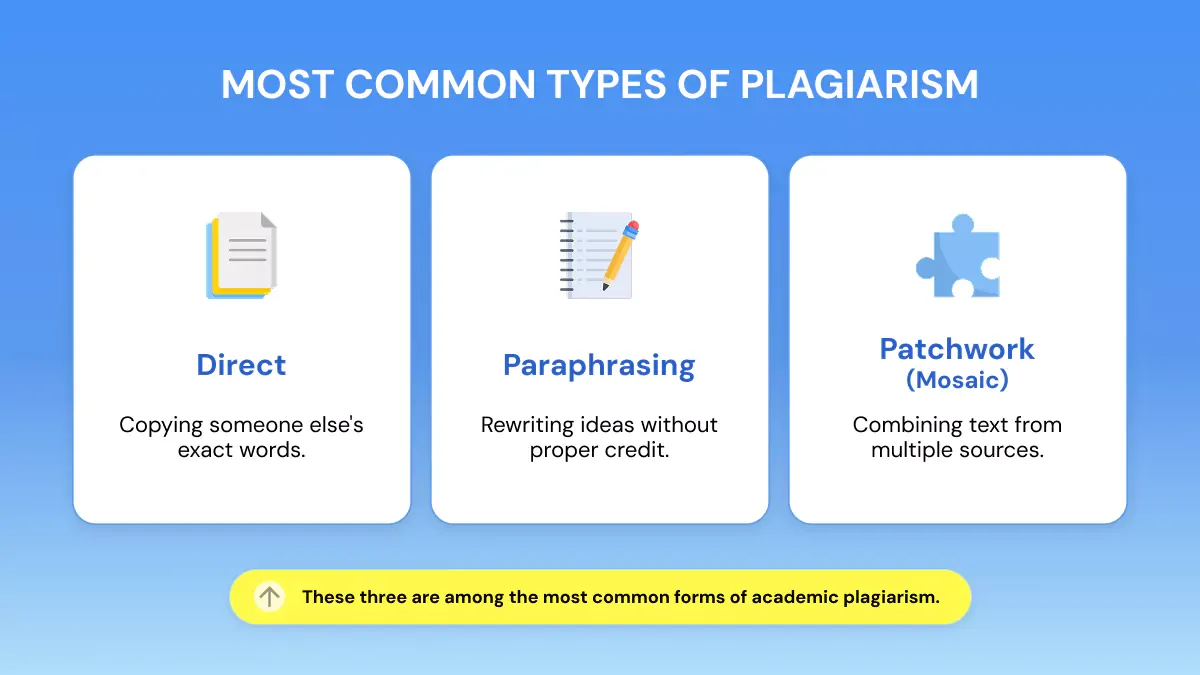
If your instructor mentions "the 3 types of plagiarism," they usually mean:
- Direct plagiarism
- Paraphrasing plagiarism
- Patchwork (Mosaic) plagiarism
Some schools and websites use a 5-type framework by adding self-plagiarism and accidental plagiarism. Others list 7, 10, or 12 types by separating newer forms such as AI-assisted plagiarism, source-based plagiarism, translation plagiarism, and collusion.
The exact number depends on the institution, but the underlying principles remain the same.
What Are the Consequences of Plagiarism?
The consequences of plagiarism generally fall into three categories: academic, professional, and legal.
Academic Consequences
Academic consequences can range from receiving a failing grade or zero marks to being required to resubmit an assignment or repeat the course. In more serious cases, students may face suspension, a year back, or even expulsion, depending on their institution's plagiarism policy.
Professional Consequences
Professional consequences include reputational damage, lost job opportunities, and paper retractions. In academic research, plagiarized papers may be retracted, and repeated misconduct can harm your long-term professional career.
Legal Consequences
Legal consequences are often misunderstood. Plagiarism itself is generally not a criminal offence in the United States, so it does not usually result in jail.
However, if plagiarism involves related legal violations such as copyright infringement, fraud, or forgery, legal action and, in some cases, criminal penalties may apply.
How to Avoid Every Type of Plagiarism
To avoid every type of plagiarism, follow this checklist before submitting your work. For a deeper walkthrough, see our guide on how to prevent plagiarism.
- Cite every source as you research instead of leaving citations until the end.
- Use quotation marks and provide a citation whenever you copy text word for word.
- Paraphrase from memory first, then compare your version with the original source and cite it properly.
- Keep track of every source using a citation manager or organized research notes.
- Know your instructor's or institution's AI policy and follow its requirements throughout the assignment.
- Run a plagiarism check before submitting. If you're comparing tools first, see our guide to the best plagiarism checkers before choosing one.
No matter which type of plagiarism it is, the consequences can be serious. Whether the mistake is intentional or accidental, you are still responsible for the work you submit.
Whether a mistake is intentional or accidental, you're still responsible for the work you submit, and every type of plagiarism carries the same academic penalty.
So the safest habit is simple: check your paper before it's graded, not after. Phrasly's plagiarism checker scans your draft against 10B+ web pages and academic papers, so you can catch anything that needs a citation while you still have time to fix it.
Frequently Asked Questions
What are the different types of plagiarism?
The 12 main types of plagiarism are direct plagiarism, complete plagiarism, paraphrasing plagiarism, patchwork (mosaic) plagiarism, self-plagiarism, accidental plagiarism, source-based plagiarism, incremental plagiarism, AI-assisted plagiarism, translation plagiarism, visual/code plagiarism, and collusion.
What is the most common type of plagiarism?
Accidental plagiarism is the most common type of plagiarism. It usually happens when writers unintentionally forget citations, quotation marks, or references, even though they did not intend to copy someone else's work. Before submitting, run your paper through a Phrasly plagiarism checker to catch missed citations and accidental matches.
Can you go to jail for plagiarism?
No. Plagiarism itself is generally not a criminal offence in the United States. However, if it involves related offences such as copyright infringement, fraud, or forgery, legal action and, in some cases, criminal penalties may apply.
Is plagiarism a type of copyright violation?
No. Plagiarism and copyright infringement are related but not the same. Plagiarism is an ethical or academic issue involving uncredited work, while copyright infringement is a legal violation of copyright law. In some cases, the same act can involve both.
Is paraphrasing plagiarism?
No. Paraphrasing is not plagiarism if you rewrite the content in your own words and provide a proper citation. It becomes plagiarism only when you paraphrase someone else's work without citing the original source.
Is self-plagiarism a real thing?
Yes. Self-plagiarism is a real form of academic misconduct. Many universities, including Harrisburg University, prohibit submitting your previously completed work as original without permission. If you reuse your own work, always follow your instructor's policy and cite it when required.
Is using AI to write essays plagiarism?
It depends on your institution's AI policy. Many schools allow limited AI use if it is properly disclosed, while others restrict or prohibit it. Submitting AI-generated content without required disclosure may be considered academic misconduct.


Keep reading

How Can You Prevent Plagiarism? 10 Proven Strategies for Students (2026)
Learn how to prevent plagiarism with 10 practical strategies, including proper citation, paraphrasing, note-taking, and plagiarism checking, to submit original work with confidence.

6 Best SafeAssign Plagiarism Checker Alternatives Students Can Actually Use (2026)
You can't run SafeAssign yourself; only your instructor can. Compare the 6 best alternatives students can actually use in 2026, with real pricing, AI detection, honest free-tier limits, and which checker fits your situation.