We Tested PapersOwl's Plagiarism Checker. Here's the Real Verdict
13 min read
PapersOwl’s checker is free and fast, but it belongs to an essay-writing service where students can hire writers for academic work. That matters because Turnitin treats outsourcing academic work to a third party as contract cheating or ghostwriting. (Turnitin)
That's the part no other review mentions, and it's the reason we ran our own test instead of trusting the marketing.
For academic submissions, the papersowl plagiarism checker is fine as a quick pre-check for web-sourced copying, but it won't predict your university's result and has no AI detection, so it isn't enough to rely on alone.
This PapersOwl plagiarism checker review covers what "free" actually means, how the similarity score works, where the upsell kicks in, and how its results held up against a tool built for academic integrity.
If you want a straight answer on the best plagiarism checker for students 2026, this is it.
Check Your Work for Plagiarism 👇 before you Submit
Quick Verdict: PapersOwl Plagiarism Checker Scorecard
Overall: 5/10. Useful for a fast, free pre-check on web-sourced content, but not reliable enough to trust as your final submission check.
Criteria | Rating | Why |
Ease of Use | ⭐ 8/10 | Clean interface, fast scan, low friction. Two checks before any signup. |
Is It Actually Free? | 7/10 | Yes, with limits. 2 free scans, then signup for unlimited (19,900 characters per scan). |
Accuracy: Verbatim Copy | 5/10 | In our test it caught just 7% and one source, where Phrasly flagged 93% across 7. |
Accuracy: Paraphrased Text | 3/10 | A source-matcher at heart. Misses most reworded, restructured, or mosaic plagiarism. |
AI Content Detection | 1/10 | None in the plagiarism scan. The separate AI detector page is a different tool. |
Database Coverage vs Turnitin | 3/10 | No access to Turnitin's student-paper database. A clean score here predicts nothing. |
Data Privacy Transparency | 4/10 | Promotes "Data Safety," but no specifics on retention, encryption, or third-party access. |
🏆 Overall Verdict | 5/10 | Fine as a quick web-source pre-check. Not enough for a high-stakes academic submission. |
What Is PapersOwl's Plagiarism Checker and How Does It Work?
The PapersOwl Plagiarism Checker is a free tool that scans your text against web pages and academic databases like Google Scholar, PubMed, and JSTOR. It does not confirm access to private institutional databases, such as Turnitin's student paper repository, which is the one your university most likely uses.
PapersOwl itself is an essay-writing marketplace where students hire writers for essays, research papers, dissertations, and coursework. The plagiarism checker isn't the main product. It's one of several free tools sitting inside a platform built around paid writing, editing, and rewriting services.
The tool works like any standard online scanner. You paste your text or upload a document, and PapersOwl compares it against online content and the academic sources its system can reach. You get a report back in seconds.
The plagiarism report format is straightforward:
An overall similarity score
Highlighted matching passages
Source attribution with matched URLs
A similarity percentage for each detected match
PapersOwl describes that overall score as a weighted average, so the single number sums up every match across your whole document.
You can paste your text directly or upload a file. PapersOwl supports common formats including Word documents, PDFs, and TXT files, plus uploads from Google Docs and Dropbox.
What Does 'Free' Actually Mean on PapersOwl?
The PapersOwl plagiarism checker free version is genuinely free, but not unlimited or frictionless. In our test, it allowed two free scans before signup, as long as you agree to the terms and conditions. After that, you have to create an account to keep going.
Once signed in, you get unlimited free checks. The catch is a per-scan limit. Each scan is capped at around 19,900 characters, which works out to roughly 3,000 words depending on spacing and citations.
So for the papersowl free plagiarism checker word limit: short essays, discussion posts, and standard assignments fit fine. Longer papers, dissertations, or research-heavy submissions have to be split across multiple scans.
The real paywall sits behind the "make it unique" feature. If the tool detects plagiarism, PapersOwl pushes you toward paid editing help, matching you with one of its editors. The options run from Gold and Diamond tiers up to a $9.99 hand-picked editor add-on.
That's the part students should clock. The free scan works as a basic submission-ready check, but it also feeds PapersOwl's paid editing and writing services.
For any plagiarism checker for students 2026, the question isn't only whether the scan is free. It's what happens after, and whether the tool supports your academic integrity or just routes you toward a "fix my paper" upsell.
Do You Need to Create an Account to Use PapersOwl's Plagiarism Checker?
Not right away.
In our test, PapersOwl allowed two free scans before signup, once you agree to the terms and conditions.
After those two, signup is required to continue. Signed-in users then get unlimited free checks, each capped at 19,900 characters per scan.
How Accurate Is PapersOwl's Plagiarism Checker? An Honest Verdict
The PapersOwl plagiarism checker is accurate at one thing: catching obvious copy-paste plagiarism from public web pages and some academic sources.
As a final pre-submission check, it falls short, because it hides its database size, can't reach institutional student-paper databases, and runs no AI detection at all.
What it gets right: PapersOwl scans thousands of web pages and academic databases like Google Scholar, PubMed, and JSTOR.
The report gives you the essentials, including a similarity score, highlighted matches, source attribution, and per-source percentages. Results are fast and the interface is clean.
To see where it breaks, we ran two real tests. Both exposed a gap that matters for students.
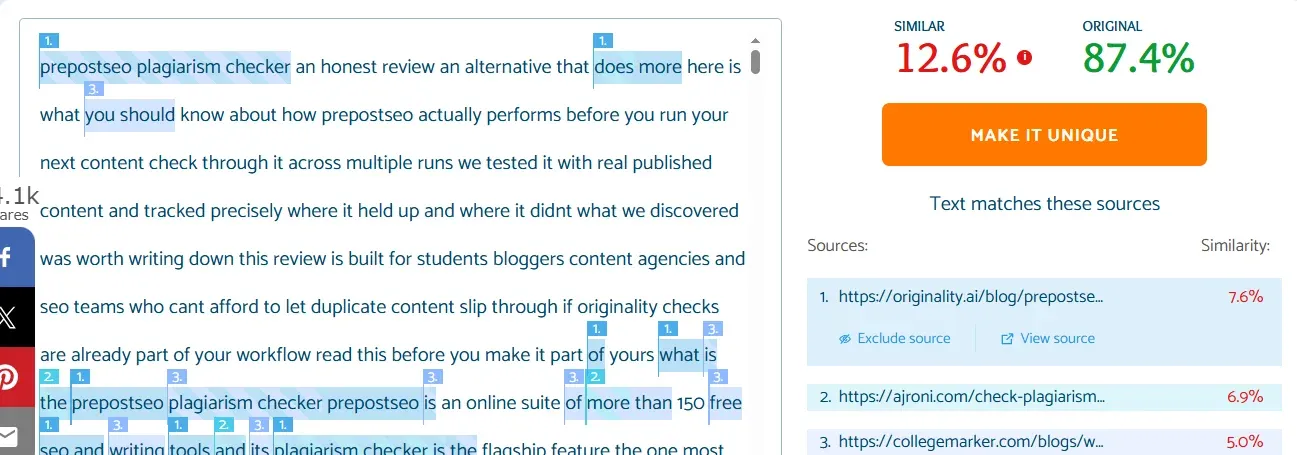
Test 1: Paraphrased Content → 87.4% "Original"
What we did: Took a published 2,000-word blog ("Prepostseo Plagiarism Checker Review"), lightly rephrased it, and ran it through PapersOwl.
Result: 12.6% similar · 87.4% original · processed in ~30 seconds.
A paper built entirely from existing content came back 87% original. That's the paraphrasing blind spot in action: PapersOwl is a web-and-source matcher, so lightly reworded text slips through clean even when your university's checker would flag it. This is how incremental plagiarism builds up unnoticed across a long paper.
Test 2: ChatGPT Text → 100% "Original"
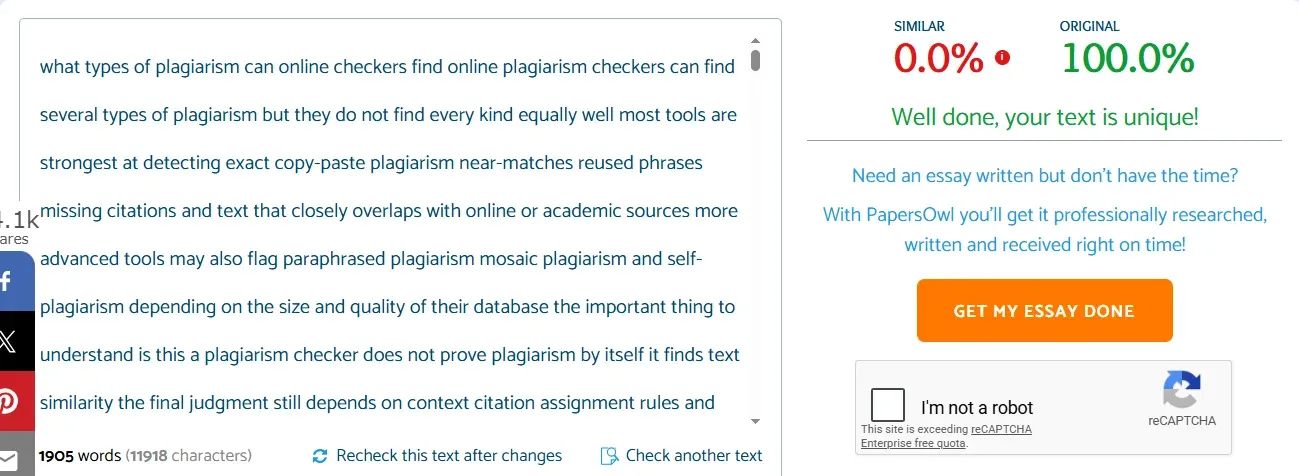
What we did: Generated a 1,500-word blog ("What Types of Plagiarism Can Online Checkers Find?") with ChatGPT and ran it through PapersOwl's plagiarism checker.
Result: 0.0% similar · 100% original.
Fully AI-written text passed completely clean. No, PapersOwl does not detect AI-generated content, because a similarity scan has nothing to match unique AI output against. The checker matches similarity, not ChatGPT-style writing, and that's a separate limitation in 2026 submissions.
The Third Gap: No Published Database Size
Beyond what the tests showed, PapersOwl never states how big its database is, unlike tools that publish their coverage outright (for example, 10B+ sources).
For any plagiarism checker in 2026, that matters, because Turnitin and other institutional tools now flag AI writing right alongside similarity. A clean PapersOwl score says nothing about how your paper holds up against AI review.
What PapersOwl's Similarity Score Actually Measures
The PapersOwl similarity score is a weighted average similarity across your whole document. PapersOwl explains it plainly: if half your paper is fully plagiarized, the overall score reads 50%.
That makes the number useful but easy to misread. A paper can have one badly copied section and still show a moderate overall percentage, as long as the rest is original. So a "low" score doesn't always mean a safe paper.
Don't treat the similarity report as a pass/fail verdict. Read the highlighted passages, open the matched sources, and fix missing citations before you submit. For academic integrity, the source list tells you more than the final percentage does.
PapersOwl Doesn't Check What Your University Uses: Here's Why That Matters
A clean PapersOwl score is not the same as passing Turnitin. PapersOwl catches obvious web-sourced plagiarism, but it doesn't check the same database your university almost certainly uses.
The whole difference in PapersOwl vs Turnitin plagiarism comes down to one thing: what each tool can see.
PapersOwl scans public web pages, thematic sites, and academic libraries like Google Scholar, PubMed, and JSTOR.
Turnitin scans all of that, plus its student paper database: student papers, archived submissions, premium publications, and decades of internet content, and plugs straight into university systems.
That second database is the one PapersOwl can't touch. A clean PapersOwl score does not mean you've passed Turnitin. A low score there only tells you your text didn't match the public sources PapersOwl was able to scan.
Here's how that plays out in a real submission:
Same paper, two tools | Score | Why |
PapersOwl | 3% | Copied source isn't published online |
Turnitin | 40% | Match comes from another student's unpublished essay |
So treat PapersOwl as a rough pre-check, not a final verdict. It flags obvious matches from public sources, but it can't predict your university's result.
If you want a tool built for academic work, we tested Paperpal's plagiarism checker here.
Which Plagiarism Checker Databases Actually Matter for University Submissions?
For university work, the databases that count aren't just public web pages. An institutional plagiarism checker also scans student papers, archived submissions, academic publications, and subscription content that never reached the open web.
That's why the Turnitin student paper database matters so much. It can surface matches from essays, dissertations, and coursework that you'll never find on Google.
No public tool is a plagiarism checker that checks the Turnitin database directly, so a free web checker can still support your academic integrity, but it shouldn't replace the system your instructor actually grades you through.
The Business Model Behind the Free Tool: Essay Mill, Upsell, and Your Data
The PapersOwl Plagiarism Checker is not independent from its essay-writing service. The same company that profits when students buy rewriting and ghostwriting also runs the free checker, which is the trade-off worth understanding before you upload anything.
On storage, PapersOwl says uploaded documents are deleted after scanning, but it publishes no specifics on data retention, encryption, or third-party access. So you're trusting a marketing claim, not a documented policy.
PapersOwl is reasonably safe for a quick scan. But since you're handing your work to a business built on selling academic writing, three things are worth a closer look before you rely on it.
1. The free scan feeds a paid funnel
PapersOwl's checker page surfaces paid options the moment your scan finishes:
Rewrite up to 75% of your content
Edit up to 50%
Rewrite the paper from scratch, with "Hire Editor" and "Hire Writer" buttons
2. The checker comes from the same company that sells the fix
Running the tool that finds the problem and the service that fixes it creates an incentive a standalone integrity tool doesn't have.
That doesn't prove the checker is rigged, but when the scan flags similarity, the next prompt isn't only "review your citations." It's also "hire a writer."
3. The data specifics are thin
Beyond the "deleted after scanning" line, there's no published detail on how long files are held, whether they're encrypted, or whether anything is reused to improve the product.
Anyone uploading original work should read the current privacy policy rather than the document privacy marketing, and verify it before trusting the tool.
A free checker is genuinely useful. But when it's attached to an essay mill marketplace, you should know what the service is built to sell you after you upload your assignment.
Plenty of standalone tools share the same web-only blind spot, we ran Prepostseo Plagiarism Checker through the same kind of test, and it missed most paraphrased content too.
What Happens After PapersOwl Flags Your Similarity Score?
After PapersOwl flags similarity, the report goes past matched sources and a score. It also offers paid ways to "make it unique," including hiring editors or writers straight from the results screen.
In our test, that paid flow included editor tiers (Diamond, Gold, all editors) plus an extra $9.99 hand-pick option. The sequence is clear: the free scan identifies the problem, then PapersOwl presents paid services to fix it.
Who Should and Shouldn't Use PapersOwl's Plagiarism Checker
PapersOwl works best as a quick first-pass tool, not a final university submission check. It catches obvious web-source matches, but it won't replace your institution's system or an AI-writing review.
Use PapersOwl If…
You want a fast, free pre-check for duplicate wording from public web sources.
You're a blogger or content creator checking web content for duplication, not submitting academic work.
You don't have access to your university's plagiarism system and just want a rough baseline.
You need quick results with no complex setup, and you'll review the highlighted matches and source links yourself before revising. For a basic submission-ready check, that's enough.
Don't Rely on PapersOwl If…
You're submitting to Turnitin, SafeAssign, or any institutional checker. A clean PapersOwl score won't predict your university's result, because PapersOwl can't access private student-paper databases. The same goes for platforms like Gradescope, which only scan if your instructor turns Turnitin on.
You need AI content detection. PapersOwl has none.
You want to know whether your paraphrasing will get flagged. PapersOwl misses most lightly reworded content.
You're uncomfortable with the upsell model or unsure what happens to your uploaded document.
As a plagiarism checker for students 2026, PapersOwl is fine for surface-level checking but not enough for high-stakes submissions.
If you need stronger plagiarism detection and a dedicated AI detector on one platform, Phrasly covers both 👇
PapersOwl Plagiarism Checker vs. Phrasly: Side-by-Side
If you need plagiarism detection that actually catches paraphrased copying and doesn't route you to a ghostwriting marketplace after your scan, here's how the two tools compare.
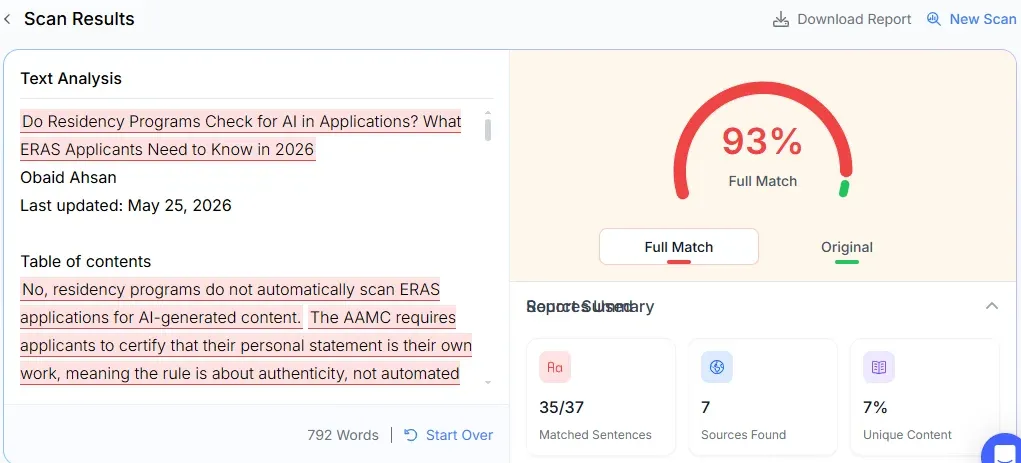
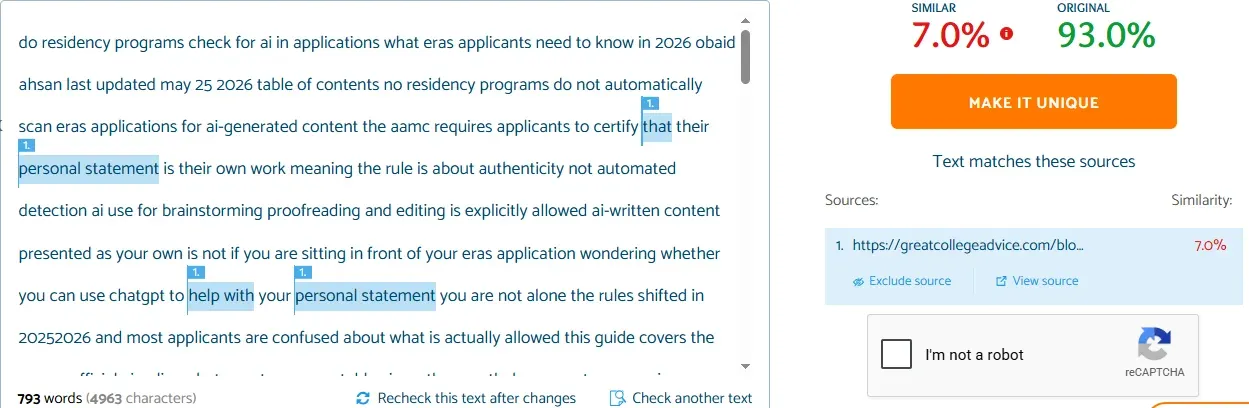
We ran the same 2000-words blog sample, "Do Residency Programs Check for AI in Applications?", through both checkers. Phrasly flagged 93% matched content across 7 sources. PapersOwl flagged just 7%, with a single source. Same text, two very different verdicts, driven by database coverage and how deeply each tool matches.
Phrasly Result:
PapersOwl Result:
Here's the full breakdown:
Feature | 🦉 PapersOwl | ⚡ Phrasly |
Our Test Result | 7% similar · 1 source | 93% match · 35/37 sentences · 7 sources |
Plagiarism Database | Web + academic (size unspecified) | 10B+ web pages + academic papers |
AI Content Detection | ❌ None | ✅ Separate AI detector on the same platform |
Free Access | 2 free scans, then signup required | Free for Humanizer users · 20,000-word scan |
Report Detail | % score · source links · color highlights | % score · source links |
Paraphrasing Detection | ⚠️ Weak on reworded text | ✅ Stronger across rewrite types |
Data Privacy | Claims deletion, no specifics | Content deleted immediately after scan |
File Formats | PDF, DOC, DOCX, paste text | PDF, DOCX, TXT, paste text |
Upsell After Scan? | ❌ Yes — ghostwriting/editing offered | ✅ No — standalone tool |
Turnitin Database Access | ❌ No | ❌ No (independent database) |
Best For | Quick web-source pre-check | Deeper plagiarism + paraphrase detection |
The PapersOwl Plagiarism Checker works as a quick, free check for obvious copy-paste, but our tests showed it misses paraphrased text and flags zero AI content.
It also can't see Turnitin's student database, so a clean score here won't tell you how your paper does at university. For a final pre-submission check, you'd want stronger paraphrase detection and an dedicated AI Detector.
Frequently Asked Questions
Is PapersOwl's Plagiarism Checker Really Free?
Yes, with a catch. You get two free scans before signup, then unlimited checks after you create an account, capped at roughly 19,900 characters (about 3,000 words) per scan. The scan itself is free, but it sits next to paid "make it unique" editing and rewriting offers.
Does PapersOwl Detect AI-Generated Content?
The plagiarism checker does not. PapersOwl runs a separate AI Content Detector tool on its site, but that's a different product from the plagiarism scan and isn't part of the similarity report you get back. For an AI check, you'd have to run your text through that other tool separately.
Can PapersOwl Detect ChatGPT?
Not through its plagiarism checker. A similarity scan matches your text against existing sources, so unique AI-written text usually returns a clean score even when it's fully ChatGPT-generated. Turnitin added a separate AI-writing detection layer in April 2023 that your university likely uses, so a clean PapersOwl result says nothing about how AI text holds up there. Your university likely uses Turnitin's separate AI layer instead, and our guide on whether Turnitin detects ChatGPT explains what that actually catches.
Is It Safe to Upload My Paper to PapersOwl?
For a quick scan, it's reasonably safe. The concern is that PapersOwl is an essay-writing marketplace, so you're uploading original work to a company that profits from selling academic writing. It states documents are deleted after scanning but publishes no detail on retention or encryption, so check the current privacy policy first. If your school runs on Blackboard, it's worth knowing what SafeAssign does and doesn't catch before you trust any single tool.
Can PapersOwl See My Document After I Scan It?
PapersOwl says uploaded documents are deleted after scanning. It does not publish technical specifics on how long files are stored, whether they're encrypted, or whether any third party can access them. If your work is sensitive or unpublished, treat that deletion claim as a marketing statement until the privacy policy confirms it.
Does PapersOwl Have a Word Limit for Free Checks?
Yes. After signup, each scan is capped at around 19,900 characters, which is roughly 3,000 words depending on spacing and citations. Short essays and discussion posts fit in one scan, but a dissertation or long research paper has to be split into multiple checks.
Is Using PapersOwl the Same as Contract Cheating?
Running the free plagiarism checker is not. But PapersOwl's main business is selling ghostwritten essays, and submitting work a third party wrote for you is contract cheating, which is treated as serious academic misconduct. In the UK, essay-mill services became a criminal offence under the 2022 Skills and Post-16 Education Act. Using the checker is fine; buying a paper to submit as your own is not.

Written by
Obaid Ahsan
Content Lead · Pakistan
Obaid Ahsan is a Content Lead with 5+ years of experience in SEO, content strategy, and AI-focused publishing. At Phrasly, he leads content development with a focus on accurate research, search performance, and useful, trustworthy information for readers.