How Do Teachers Check for AI? What They Actually Look For in 2026
11 min read
Teachers use several methods to check whether a student may have used AI. One common approach is to run the work through AI detectors such as Turnitin, Phrasly, GPTZero, Copyleaks, or Pangram. However, an AI detector result alone does not prove that AI was used.
Teachers may also compare the work with previous writing, verify sources and facts, review drafts and version history, inspect writing-process data, and ask students to explain their work. Current academic-integrity guidance says AI detection should be treated as a flag, not proof on its own.
Want to see what a detector sees before your teacher does? Paste your text below and check it in seconds. It's free, with no sign-up.
What Teachers Check: AI Detection Table
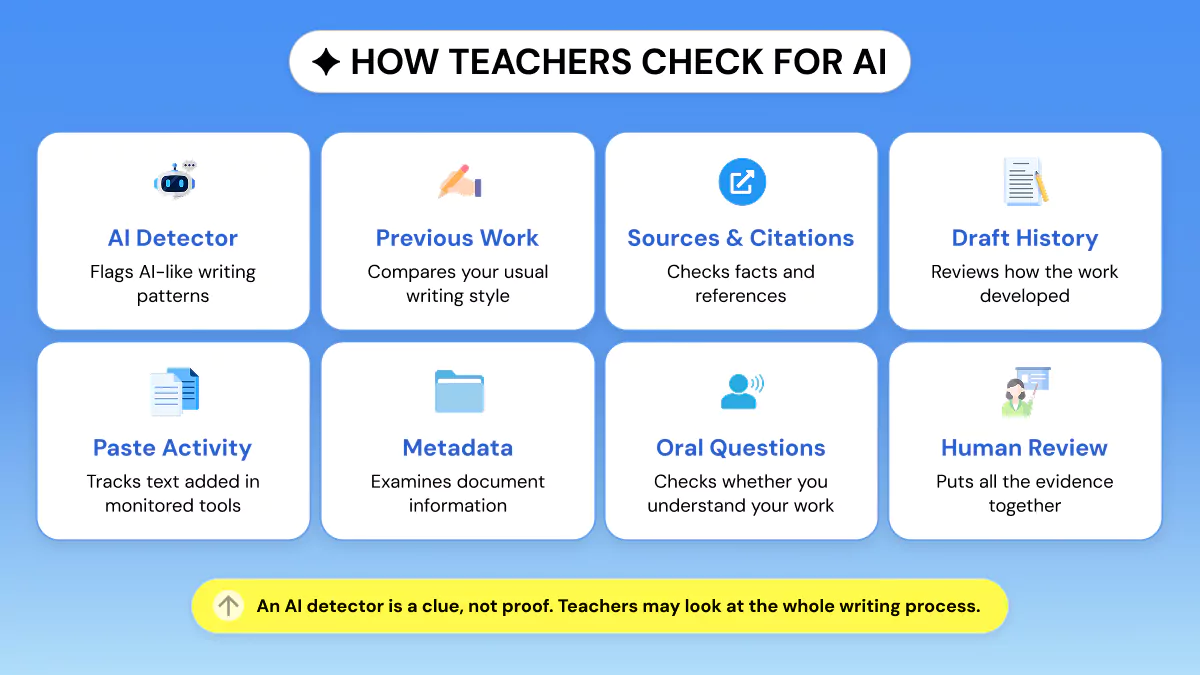
What Teachers Check | What It Looks For | Proof by Itself? |
|---|---|---|
| AI-like patterns in the text | No; a flag only |
| Sudden change in voice, skill, vocabulary | No; a clue only |
| Fake or mismatched sources | Strong, but shows an integrity problem, not necessarily AI |
| How the document developed | Strong process evidence |
| How text entered a monitored editor | Useful context |
| Author, edits, fonts, formatting | Supporting evidence |
| Whether the student can explain the work | Important supporting evidence |
| Whether ChatGPT claims it generated the text | Not reliable evidence |
1. Teachers May Run the Work Through an AI Detector
Teachers can use different AI detectors to check whether submitted writing shows patterns commonly associated with AI-generated text. The specific detector depends on what their school or university uses. Some of the tools educators may use include:
Turnitin AI Writing Detection: Estimates how much qualifying prose may be AI-generated. Its AI Writing score is separate from its Similarity Score.
Copyleaks:Analyzes writing for patterns associated with AI-generated content and is used by some schools and universities.
GPTZero: Looks for signals associated with AI-generated writing and provides an AI-detection result. Like other detectors, its result is a signal, not proof.
Pangram: Analyzes writing for signs associated with AI generation and can provide another signal during an investigation.
AI detection is not the same as plagiarism detection. A Similarity Score looks for text matching existing sources, while an AI detector estimates whether writing may have been generated by AI. They are separate checks.
💡 Google Classroom's Originality Reports are also different: they check for matching or uncited sources rather than functioning as a ChatGPT detector. What a Turnitin AI Percentage Actually Means
A Turnitin AI percentage represents the portion of qualifying prose that Turnitin identifies as likely AI-generated. It does not mean the probability that a student cheated, that ChatGPT wrote the text, or that a specific AI tool was used.
Turnitin's AI Writing score is also separate from its Similarity Score. A document can have matching source material without being AI-generated, or receive an AI-writing flag without a high Similarity Score
For AI scores above 0% but below 20%, Turnitin displays an asterisk rather than a specific percentage because this range has a higher risk of false positives.
Its AI Writing Detection requires at least 300 words of qualifying long-form prose and supports submissions of up to 30,000 words. As of August 2026, it supports English, Spanish, and Japanese.
The system is not designed to reliably assess every type of writing, including poetry, scripts, code, bullet lists, tables, or very short answers.
A detector score is a guess, not a verdict, but it can still be useful to understand how your draft may be classified before you submit it.
Run your draft through Phrasly's free AI Detector and see how it reads.
2. They Review the Flag Instead of Trusting the Percentage
When work gets flagged, teachers do not simply rely on the AI percentage. They review the flagged content and look for additional evidence.
Even a high AI score does not, by itself, prove that AI was used or that academic misconduct occurred.
Turnitin says its AI detection model can misidentify both human-written and AI-generated text, so the result should not be the sole basis for action.
💡 Human review and the institution’s academic-integrity process are needed alongside the score.
The University of Melbourne similarly states that a high AI score is not proof of misconduct and that additional evidence is required before an allegation is made.
TEQSA’s May 2026 guidance also says an AI score alone is insufficient for a misconduct allegation.
Educators should consider evidence that both supports and disconfirms possible AI use to reduce confirmation bias.
In other words, an AI flag is a starting point for investigation, not an automatic verdict.
3. They Compare It With Your Previous Work
Teachers may notice when a student’s new work suddenly differs from their previous writing in vocabulary, sophistication, tone, or subject knowledge.
These differences can raise questions about how the work was produced.
However, a change in writing style does not prove AI use. Students naturally improve, tutors may help, and grammar or editing tools can change how writing sounds.
The University of Melbourne lists significant differences between current and previous work as possible supporting evidence, but not as proof of academic misconduct.
4. They Check Citations, Sources and Facts
Teachers may check the citations, sources, and facts in a paper. Generative AI can sometimes produce fake references, incorrect authors, made-up article titles, false DOI numbers or URLs, and quotes that do not appear in the original source.
For example, a student might cite: Smith & Peterson (2024), Journal of Cognitive Learning, Vol. 17. If a teacher searches the journal database and cannot find the paper, that gives them a concrete reason to investigate the source rather than simply judging the writing by how it sounds.
TEQSA lists made-up or “mashed-up” references as possible evidence of investigation. A fabricated reference can also be an academic-integrity issue even when AI use itself cannot be proven.
5. They Review Drafts and Version History
Teachers may review drafts and version history to see how an assignment developed. TEQSA recommends verifiable version histories in tools such as Google Docs, Microsoft 365, and Overleaf for take-home work.
A normal history may show research, a first draft, revisions, and a final version. A document that suddenly receives a large block of polished text with little earlier editing can look different from one developed gradually.
If you wrote in Google Docs and your teacher has access, they can open File → Version history to review earlier versions. This does not prove AI use, but the writing process can provide additional evidence.
Some Tools Now Track Writing and Paste Activity
Some writing platforms give instructors more detailed information about the writing process.
For example, Turnitin Clarity's Writing Report can show active writing time, writing sessions, revision activity, pasted-text events, how much pasted text remains in the final document, and a playback of the writing process.
Turnitin currently flags documents when more than 50% of the final document is pasted text or more than 40% of the total words added were pasted. This does not mean every teacher can see a complete copy-and-paste history from a normal Word document; paste tracking applies to monitored writing environments such as Turnitin Clarity.
Pasting also does not prove ChatGPT use. Students may paste quotations, notes, references, or text written elsewhere. TEQSA also names Cadmus, Inktrail, and Grammarly Authorship as tools that can track aspects of the writing process.
6. They May Check Document Metadata
Teachers may also check a document’s metadata, especially during a misconduct investigation. A .docx file can contain information such as the author name, who last modified it, creation details, fonts, and formatting.
Turnitin’s Authorship tools can collect this type of information as part of an investigation.
However, unusual metadata is not proof of AI use. A document may show another person’s name because it was created on a shared, family, or school device, or because the student started with a template.
Turnitin also recognizes these as legitimate explanations.
7. They May Ask You to Explain Your Work
Teachers may ask you to explain your assignment, such as why you made a particular argument, where a source came from, why you chose a methodology, or what a specific paragraph means.
If you researched and wrote the assignment yourself, you should generally be able to explain the choices behind your work.
TEQSA also identifies an inability to answer questions about an assignment, including during a post-assignment viva, as a possible signal of misconduct.
However, this is not proof of AI use by itself. Teachers may consider a student’s explanation alongside other evidence, such as AI-detection results, sources, and writing history.
What Happens After Your Work Gets Flagged?
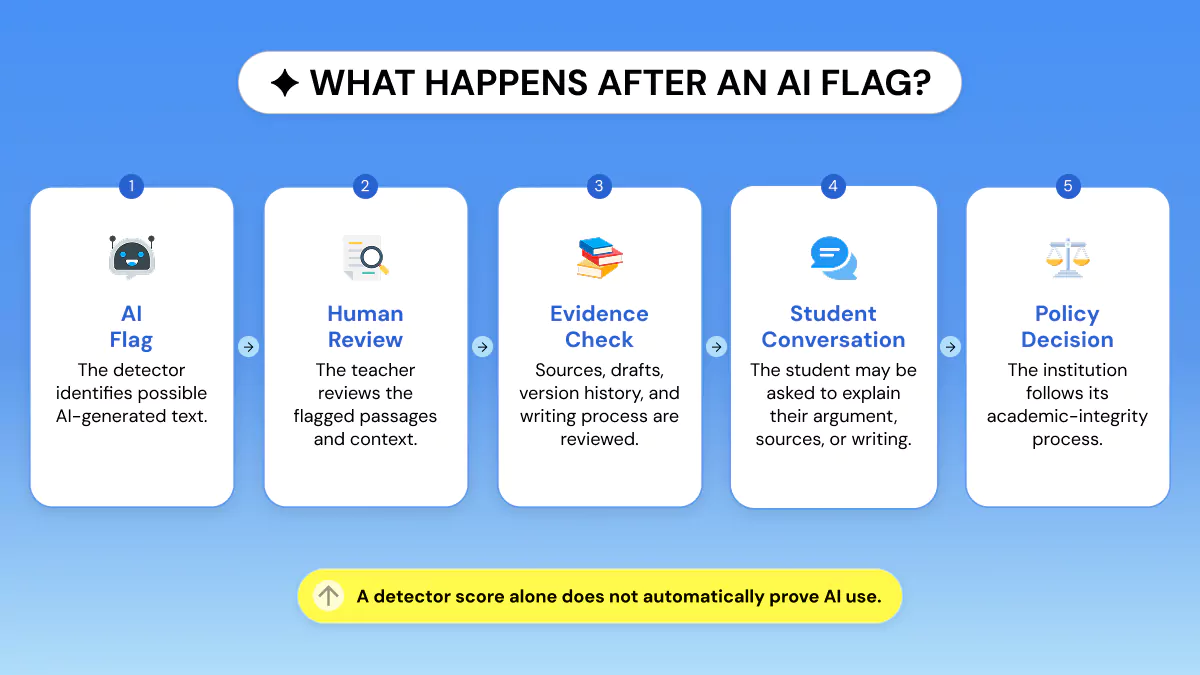
If an AI detector flags your work, the next step is usually a broader review of the assignment. Teachers may review flagged passages, sources, citations, drafts, and writing history.
They may then gather both supporting and disconfirming evidence. Fake sources, missing drafts, or unusual writing activity may raise concerns, while genuine sources, a complete writing history, and a clear explanation may provide evidence against the suspicion.
If concerns remain after the review, the teacher may discuss the assignment with you and ask you to explain your sources, arguments, or writing process.
The matter may then move into the institution’s academic-integrity process if the concerns are not resolved.
💡 The idea that “the detector says 80%, so you are automatically guilty” is therefore misleading. The outcome depends on the evidence available and the school or university’s academic-integrity procedures.
Can Teachers Tell Exactly Which AI You Used?
Usually, no. An AI detector may classify text as likely AI-generated by analyzing patterns, but it cannot establish whether it came from ChatGPT, Claude, Gemini, DeepSeek, or another tool.
It also cannot normally identify your exact prompt, who typed the text, or prove that every flagged sentence came from AI.
Turnitin changed how it presents its AI results on August 4, 2026. It merged its previous separate categories for “AI-generated only” and “AI-generated text that was AI-paraphrased” into a single blue AI-generated category.
Turnitin says the change is intended to reduce misinterpretation about specific tools or workflows and keep the focus on whether likely AI-generated content is present.
How Accurate Are the AI Detectors Teachers Use?
You might wonder which AI detector is best for teachers, but no single tool can reliably prove whether a student used AI. Detector results vary depending on the type of writing being analyzed.
A peer-reviewed study published on June 29, 2026, in the International Journal for Educational Integrity tested Turnitin, Copyleaks, GPTZero, and Pangram on 160 controlled papers.
The papers included fully human-written, fully AI-generated, hybrid, and humanised AI writing. Turnitin achieved 60% accuracy on hybrid papers and 50% on humanised papers.
Copyleaks and GPTZero performed worse on these two categories, while Pangram performed better, reaching 92.5% strict accuracy for both hybrid and humanised papers.
The researchers concluded that AI detectors can be useful as initial flags but should not be treated as the sole evidence in high-stakes academic decisions. The study was limited to 160 papers, so its findings represent a snapshot of detection technology.
Phrasly’s own large-scale testing also found false-positive concerns. In a study of 37,874 verified human-written essays, ZeroGPT incorrectly flagged 9,987 essays as AI-generated, a 26.4% false-positive rate.
AI models and detection tools also change quickly, meaning these results should not be treated as permanent rankings of which detector is best.
No tool can guarantee how a specific teacher or Turnitin instance will score your work.
💡 Detectors can disagree with each other and sometimes flag real human writing. If you write with AI help, it is worth checking your draft and making sure it still reads naturally and reflects your own ideas.
Phrasly’s Humanizer can also refine AI-assisted drafts into more natural writing. It is designed to help polish your own draft, not to guarantee that a detector will not flag it.
What to Do If Your Work Is Flagged?
If your work is flagged for AI use, do not panic. Keep your drafts and preserve your document’s revision history so you can show how the assignment developed.
Retain your research notes and other material you used while writing, and verify that your citations and sources are genuine.
Be ready to explain your reasoning, arguments, and sources if your teacher asks about the assignment. If you believe the flag is a false positive, follow your school or university’s academic-integrity and appeal process.
Schools may also have their own procedures for detecting ChatGPT use .
False positives can happen, so evidence of your writing process can be your strongest defence.
💡 Drafts, revision history, research notes, and genuine sources can help provide context and show how your work was actually created.
FAQs
Can teachers tell if you used ChatGPT?
Not with certainty. A teacher cannot reliably tell from one AI detector test that you used ChatGPT. They may use a detector and then check your sources, drafts, version history, and ability to explain your work before reaching a conclusion. For the professor-specific version, see Can professors detect ChatGPT?
What AI detector do most teachers use?
Turnitin is one of the most commonly used AI detection tools because many universities already use it for assignment submissions. Some institutions also use Copyleaks, GPTZero, Pangram, or other tools, while others do not use AI detectors at all.
Can teachers see if you copy and paste from ChatGPT?
Not from an ordinary submitted document. However, writing-process tools such as Turnitin Clarity can record paste events and flag when large portions of the final text were pasted. Pasting alone is not proof of AI because students also paste quotes, notes, and references.
Can teachers see your Google Docs edit history?
If you shared the document or submitted it through a linked system, a teacher can often open File → Version history to see how it developed. A single massive paste with no earlier drafts looks different from text written gradually over several sessions.
Can ChatGPT tell a teacher whether it wrote an essay?
No. OpenAI states that ChatGPT has no record of whether it generated a specific piece of text. If a teacher asks ChatGPT whether it wrote an essay, it may answer, but that response has no factual basis and cannot reliably establish authorship.
Is a Turnitin AI score proof of cheating?
No. A Turnitin AI score can misclassify text and should not be the sole basis for action. The percentage represents the share of qualifying prose flagged as likely AI-generated, not the probability that you cheated. It is also separate from Turnitin’s plagiarism Similarity Score.
Can Teachers Detect AI in Short Answers?
Often not through Turnitin, which needs at least 300 words of qualifying prose to generate an AI Writing Report. Teachers may still investigate short answers using other tools or manual review, but the main detector workflow may not apply.
Do All Teachers Use AI Detectors?
No. Some schools license one, some another, and some disable AI detection over false-positive concerns; Vanderbilt is a well-known example. Colleges may also have their own policies on whether they check for AI. Many rely on process evidence and conversations instead. There's no single procedure every teacher uses.

Written by
Hasnain
Karachi, Pakistan
I help businesses grow with SEO-friendly blog posts, landing pages, and long-form content. With 3+ years of experience, I deliver clear, original, and well-researched writing that drives results.