Academic Integrity AI Detection News: Latest 2026 Updates
9 min read
Last updated: August 19, 2026
Universities are reassessing how much weight they should give to AI detection results, with many universities asking teachers to treat detector scores as a signal rather than proof of AI use.
At the same time, AI detection technology continues to evolve as companies update their models and detection methods.
The latest developments in academic integrity and AI detection covered here include university policy changes, Turnitin and other product updates, new research, legal developments, and what these changes mean for students.
💡 As universities take different approaches to AI detection, students and teachers need to understand how detection tools are being used and what a flagged result actually means.
Academic Integrity AI Detection News: Latest 2026 Updates
Date | Update | Category | Why It Matters |
|---|---|---|---|
Turnitin launches AI-writing detection for Modern Standard Arabic | Product | Shows that AI detection is expanding to more languages. | |
Turnitin Clarity adds timestamps to the Writing Report. | Product | Gives instructors more insight into the writing process. | |
Turnitin launches multipart assignments | Product | More focus on feedback, drafts, and revision. | |
Universities restrict AI detectors as sole evidence of academic misconduct. | University Policy | Pushes institutions toward more AI-resilient assessment design. | |
Turnitin simplifies its AI report to a single highlight. | Product | Aims to reduce misinterpretation and unwarranted misconduct reviews. | |
Matter of Newby v. Adelphi University decided | Legal | Court annulled an academic-integrity finding that relied on a 100% Turnitin AI score | |
Peer-reviewed detector reliability study | Research | Shows AI detectors have reliability and fairness limits | |
Curtin disables Turnitin AI-writing detection | University Policy | Concrete institutional policy change |
What Changed With Academic Integrity and AI Detection in 2026?
In 2026, academic integrity policies are increasingly shifting away from treating AI detectors as definitive proof of misconduct.
Universities are reassessing how these tools are used, while research continues to highlight concerns around accuracy, false positives, fairness, and mixed human-AI writing.
Some institutions are also changing their policies directly: Curtin University, for example, disabled Turnitin’s AI-writing detection feature from January 1, 2026, while keeping its standard text-matching checks.
August 2026 Academic Integrity and AI Detection Updates
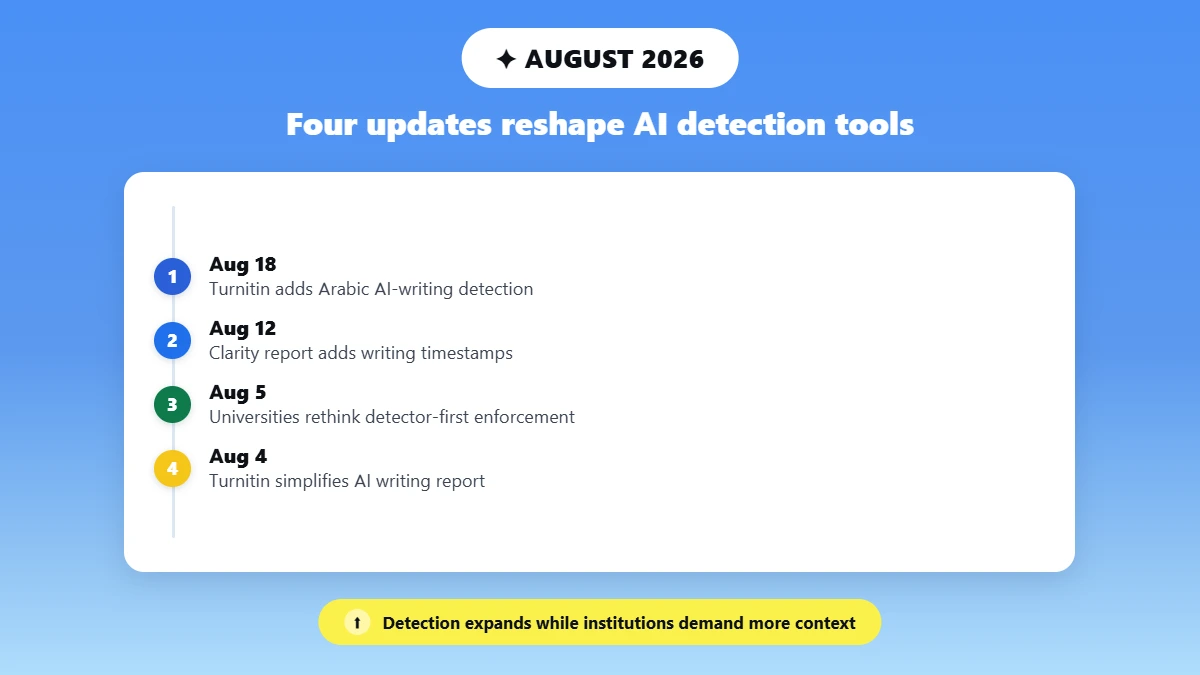
August 2026 has brought several new developments in AI detection and academic integrity.
The changes show that institutions and detection providers are taking different approaches to AI-generated writing, from expanding detection capabilities to giving instructors more information about how students write.
August 18: Turnitin Expands AI Detection to Arabic
Turnitin has expanded its range of AI detection languages. Its AI-writing detection now covers Arabic alongside English, Spanish, and Japanese.
The expansion means institutions working with Arabic-language writing can now use Turnitin’s AI detection capabilities in another widely used language. It also challenges the idea that AI detection is simply disappearing from academic integrity processes; instead, some detection capabilities are continuing to expand.
August 12: Turnitin Adds Writing-Process Timestamps
To make the writing process more transparent for instructors, Turnitin Clarity’s Writing Report now includes session timestamps that show when writing activity took place.
💡 This gives instructors more visibility into how a document develops over time, rather than relying only on the final submitted text. It reflects a broader shift from final-output detection toward evidence from the writing process.
August 5: Universities Rethink Detector-First Enforcement
Inside Higher Ed reports that a growing number of institutions are rethinking detector-first enforcement, considering other evidence and placing greater emphasis on assessment design rather than relying solely on AI detectors.
Instead of treating a detector result as enough to establish misconduct, these institutions are looking at other evidence before making a decision about a student’s work. The shift reflects a broader move toward using AI detection as one piece of evidence rather than the final decision.
August 4: Turnitin Simplifies Its AI Writing Report
Turnitin has simplified its AI Writing Report. Previously, the report used separate blue and purple highlights, which could make the results more difficult to interpret for instructors.
Turnitin has now moved toward unified highlighting to reduce overinterpretation of which AI workflow may have produced a piece of text and help cut down on unwarranted misconduct reviews.
Why Are Universities Rethinking AI Detector Scores?
Universities are not rethinking AI detector scores because of an overnight change. As these tools emerged, many institutions gradually added them to their academic integrity processes, believing they could provide useful evidence of AI use.
Important: As concerns about their limitations have grown, however, some universities are reconsidering how much weight detector scores should carry in enforcement decisions. Several factors are driving this shift.
Factor 1: Reliability Varies
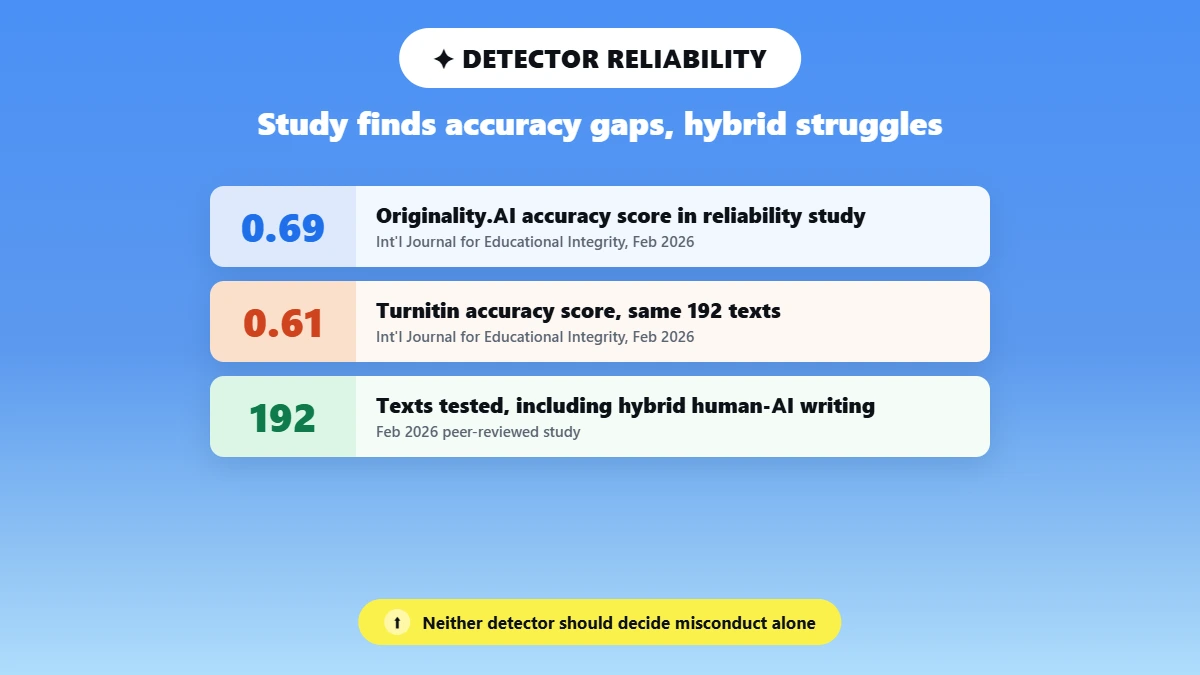
A February 2026 peer-reviewed study evaluated Turnitin and Originality.AI using 192 texts, including authentic EFL student writing, professional human-authored texts, AI-generated outputs, and hybrid compositions.
Originality achieved higher overall accuracy than Turnitin (0.69 versus 0.61), but both detectors performed poorly on hybrid texts, and their performance varied across text length and genre.
Factor 2: A Detector Score Does Not Establish How AI Was Used
The score also cannot show whether AI was used for light editing, full text generation, or as part of a mixed human-AI writing process, since each situation raises different questions about authorship and academic integrity.
Factor 3: High-Stakes Accusations Need Broader Evidence
A detector score should not be treated as enough evidence for a high-stakes academic misconduct accusation.
Yale, Cornell, and the University of Pittsburgh all caution against treating AI detection as definitive evidence, with their guidance emphasizing the limitations of detection tools and the need to consider broader context.
Are Universities Banning AI Detectors in 2026?
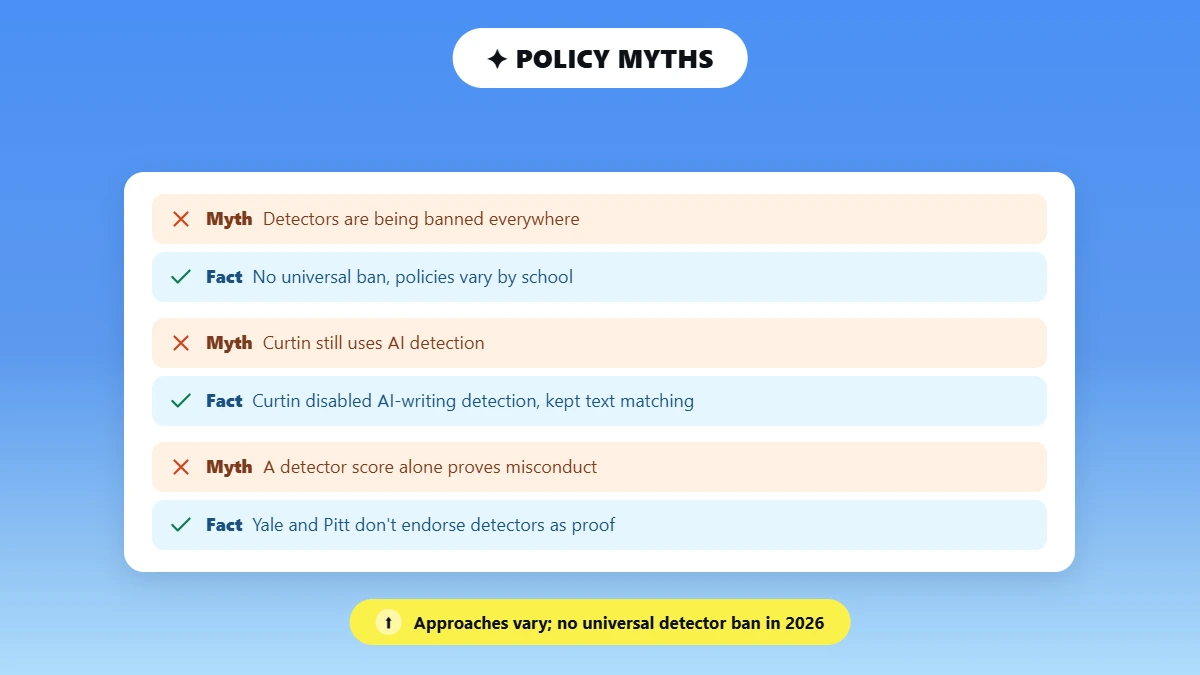
No, there is no universal ban on AI detectors in universities in 2026.
Different institutions are taking different approaches: some have disabled AI-detection features, some discourage using detector scores as standalone evidence, while others continue using detection tools as vendors expand their capabilities.
Students may still wonder, do colleges check for AI? Yes, they do, but the methods and policies can vary by institution.
Institution | Current Approach | What Changed | Source / Date |
|---|---|---|---|
Curtin | AI-writing detection disabled; text matching still active | Turned off Turnitin AI-writing detection | |
Yale Poorvu Center | Does not endorse detection; feature off in Canvas | Disabled Turnitin AI-detection tool | |
Pitt Teaching Center | Does not endorse detectors as proof | Recommends focus on writing standards and process |
The 2026 Adelphi AI Detection Case: What the Court Actually Decided
The case dates back to January 28, 2026, when Adelphi University found a student’s paper to be 100% AI-generated based on a Turnitin AI-detection score.
The matter reached the New York Supreme Court, which found problems with the university’s evidentiary basis and disciplinary process. The court annulled the violation finding and directed Adelphi to expunge it and rescind the sanctions against the student.
What 2026 Research Says About AI Detector Reliability
A February 2026 peer-reviewed study published in the International Journal for Educational Integrity tested Turnitin and Originality.AI on 192 texts, including EFL student writing, professional human-authored texts, AI-generated content, and hybrid compositions.
In this study, Turnitin reached 0.61 overall accuracy under the researchers’ setup, compared with 0.69 for Originality.
Both detectors struggled particularly with hybrid writing, leading the researchers to conclude that detector output should not be used as the sole basis for academic misconduct decisions.
However, for a broader look at AI detector accuracy and how different checkers perform, see ai detection accuracy which checkers work
What Universities Are Using Instead of Detector-Only Decisions
Universities are not explicitly relying on AI detectors alone when reviewing student work. They can set clear AI rules in the syllabus and assignment instructions, then look at how the work developed through drafts, checkpoints, and version history.
They can also verify whether sources and citations are genuine and accurate. If questions remain, they may ask students to explain or defend their work, alongside other methods covered in our how do teachers check for ai, guide.
Some institutions are also using authentic or scaffolded assessments that make the writing process more visible.
Four Types of Academic Integrity Evidence
Evidence Type | Example |
|---|---|
Detector Signal | AI likelihood score |
Process Evidence | Drafts, timestamps, version history |
Content Evidence | Fabricated citations, unexplained methods |
Student Evidence | Ability to explain and defend the work |
This approach is also reflected in guidance from Cornell, which emphasizes objective evidence, conversations with students, and multiple forms of evidence rather than relying on a single signal.
Turnitin’s Clarity and multipart features similarly point toward greater visibility into the writing process.
What the 2026 Changes Mean for Students
The 2026 changes mean students do not need to rely entirely on AI detectors. Detector results can go wrong in either direction: AI-assisted writing may not be fully flagged, while entirely human-written work may still receive an AI score.
A detector score may trigger a review, but it should not be treated as definitive proof of authorship. Students who are unsure how to interpret an AI detection score can also read how much AI detection is acceptable in different contexts.
The availability of an AI detector does not determine whether AI use is allowed; detection capability and academic policy are separate issues. Course and institution policies remain decisive, and AI use is not universally prohibited.
Students should follow their specific rules, keep drafts, version history, and sources as evidence of their writing process, and disclose AI use when required. Yale, for example, notes that permitted AI use can vary by course and instructor.
Students who want to see how detector software reads a draft can run it through an AI detector before submitting, but no detector result should override their school’s policy or be treated as definitive proof of authorship.
What the Changes Mean for Educators and Universities
💡 For educators and universities, the changes mean that AI detectors should not be treated as the single source of truth when reviewing student work. Institutions need to clearly define where and how AI is allowed, including any limits or disclosure requirements.
They also need to make sure detector scores do not replace broader evidence and instructor judgment, while redesigning assessments where appropriate to make students’ learning and writing processes more visible.
Frequently Asked Questions
Are universities banning AI detectors in 2026?
No. Universities are not completely banning AI detectors in 2026. Instead, many are becoming more cautious, using multiple forms of evidence, and treating detector results as a signal rather than proof.
Did Turnitin stop using AI detection?
No, Turnitin did not stop using AI detection in 2026. Instead, it has continued expanding and updating its AI detection features, including changes to its AI Writing Report. Turnitin also acknowledges that AI detection results can be misinterpreted and should not be treated as definitive proof of misconduct.
Can a Turnitin AI score prove cheating?
No, not on its own. A Turnitin AI score is only a signal that may prompt further review. The result can be incorrect, so it should be considered alongside other evidence rather than treated as proof that a student cheated.
Why are some universities disabling AI detection?
Some universities are disabling AI detection because detector scores alone are not sufficient to establish misconduct, and their results are not always reliable. Institutions may prefer to consider other evidence, such as the student’s writing process, drafts, sources, and explanation of the work, before making an academic integrity decision.
What should students do if an AI detector flags their work?
If an AI detector flags your work, stay calm and keep your original drafts, version history, research notes, and source links. Be prepared to explain how you developed the assignment and follow your instructor’s academic integrity process. For more guidance, read our AI detector false positives guide.
What is the difference between AI detection and plagiarism detection?
AI detection estimates whether text may have been generated or substantially written by AI, while plagiarism detection checks whether the text matches existing published or indexed sources. In simple terms, AI detection focuses on possible AI authorship, while plagiarism detection focuses on similarities with other people’s work.

Written by
Hasnain
Karachi, Pakistan
I help businesses grow with SEO-friendly blog posts, landing pages, and long-form content. With 3+ years of experience, I deliver clear, original, and well-researched writing that drives results.