AI Humanizer for Academic Writing: How to Protect Meaning, Citations, and Tone
14 min read
Academic writing doesn’t sound like conversation with citations stuck on top of it. When you run your AI-assisted student or researcher draft through an AI humanizer for academic writing, you aren’t trying to make your paper sound casual.
You are trying to eliminate repetitive AI patterns and maintain every citation, statistic, and technical term in its proper place.
That’s an important difference. A tool designed for tweets or social captions will clean up a sentence and can, subtly, transform a hedge such as “may improve” into a bald assertion like “improves.”
When writing a thesis chapter or peer-reviewed manuscript, drift of that nature is not a style concern. It is a research integrity concern.
Phrasly can aid in the rewriting phase of an AI-generated paper, but the author remains responsible for the research, sources & argument.
An AI humanizer for academic writing will assist you in making AI-edited prose sound less robotic and repetitive, but it cannot fact check your research or promise you a detector result. Edit with a humanizer as a draft.
Go through your paper section by section. Double-check every edit with the original paper. Check all references/citations, numbers, and technical terms. Report AI use when asked by your university or journal.
What Does an AI Humanizer Do in Academic Writing?
An academic humanizer looks for patterns of repetitious sentences, mechanical phrasing, and dull rhythm instead of just replacing words with synonyms.
Used on a research paper, it should smooth transitions and sentence structure while leaving citations, data, and terminology intact, which is a more specialized task than general humanizing.
AI humanizer Vs. Paraphraser
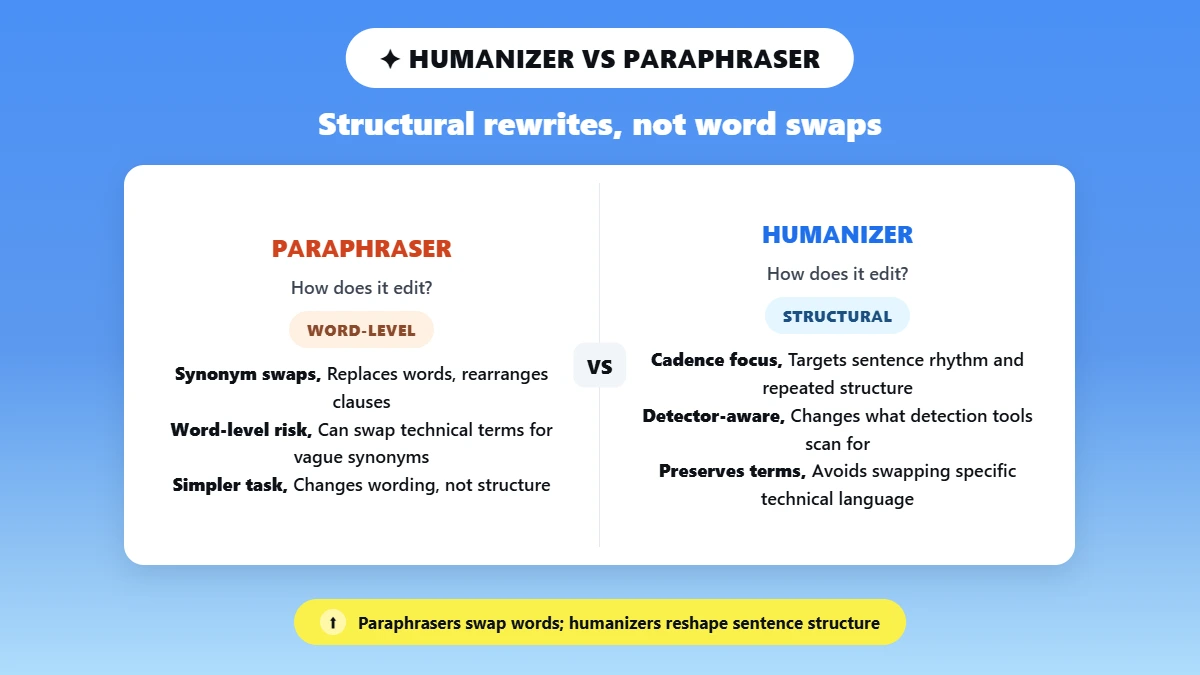
A paraphraser typically changes sentences by replacing words with synonyms and rearranging clauses.
The difference between an AI humanizer vs. and a paraphrasing tool is usually complexity.
A humanizer looks at sentence cadence and repeated structure, what AI detection tools are searching for, and changes them at the structural level, not word-for-word.
It matters for academic writing because paraphrasing at the word-level is more likely to inadvertently substitute a specific technical word for a less specific synonym.
What an AI Humanizer Cannot Do?
An AI humanizer can't fact-check that a source is real, evaluate if an argument is valid, confirm a quote is worded correctly, or ensure that any detector won't detect.
It just rewrites your text; you are responsible for everything your paper states. For example, it can’t:
❌ Confirm that a cited source actually exists or says what the paper claims it says.
❌ Judge whether an argument, methodology, or interpretation is sound.
❌ Validate research methods, data, or statistical analysis.
❌ Guarantee a specific score from Turnitin, GPTZero, Copyleaks, or any other detector.
❌ Decide whether AI use complies with a university or journal policy.
❌ Prove human authorship.
What Should an Academic AI Humanizer Preserve?
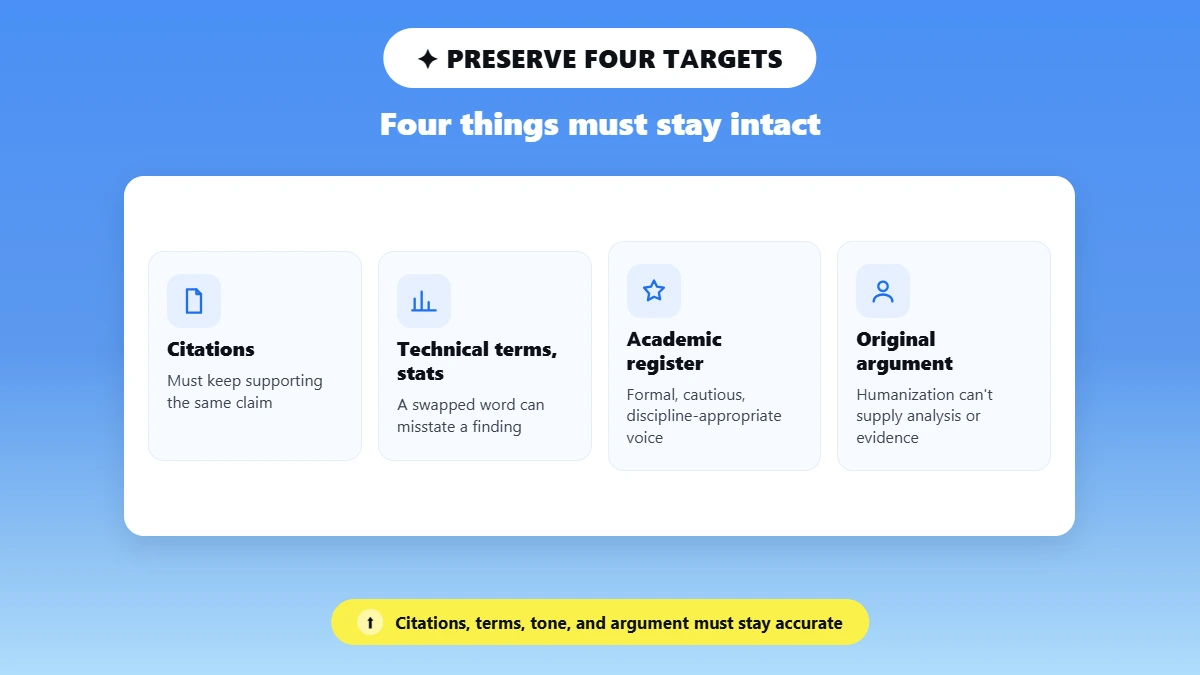
An academic-safe workflow safeguards four targets simultaneously:
Citations, jargon/stats, scholarly voice, and the writer's argument.
An AI humanizer that preserves citations and humanizes AI text without changing meaning.
What to protect | Why it matters |
Citations and references | A moved or mismatched citation can end up supporting the wrong claim, even if the citation string itself is untouched. |
Technical terms, statistics, units | A single swapped word or shifted decimal can misstate a finding. |
Academic register and tone | Formal, cautious, discipline-appropriate voice signals credibility and precision. |
The author's original argument | Humanization can refine expression, but it cannot supply analysis, evidence, or interpretation. |
Citations and Reference Relationships
Relocating a citation string without changing it may change its target finding simply by placing it in another sentence or appending it to a revised claim.
That's the difficulty of humanizing text without changing citations: the citation must continue to support the same claim.
It covers parenthetical citations, signal phrases or narrative citations, footnotes and endnotes, quotes with page numbers, numbered references, and reference-list consistency.
Citation Styles and Formats to Protect
APA in-text citations and the matching reference-list entry.
MLA parenthetical citations and Works Cited formatting
Chicago-style footnotes, endnotes, and bibliography entries
Numbered or IEEE-style reference systems common in STEM papers
Treat this as something you verify yourself. An AI humanizer for APA / MLA citations/references isn’t automatically aware of citations unless specifically constructed and tested for that purpose.
So, confirm yourself before-and-after rather than trusting the formatting made it through.
Technical Terms, Statistics, and Units
Minor changes that alter a paper's conclusions: changing language from "associated with" to "caused", "may improve" to "improves".
Slightly altering a confidence interval, sample size, or decimal when transcribing, or substituting a nonspecific synonym for a technical term. Most relevant when one wants to preserve academic tone / technical terms instead of sounding natural.
Common Risky Edits to Watch For
Pay special attention to hedged language becoming absolute. Causal language substituting for correlational language. Shifting numbers or units, and jargon swapped for a vague common word.
None of these will be flagged as a "typo," so they can be easily missed during a quick skim.
Academic Register and Scholarly Voice
Output should remain formal, but readable. They should be precise rather than inflated. They should err on the side of being cautious. They should maintain the same tense and person throughout.
They should not contain conversational expressions or fabricated personal experiences. Together, these guidelines are what make academic writing sound natural, which actually means in academia. Natural does not equate to casual.
The Author's Original Argument
Humanization improves fluency. It doesn't create analysis, evidence, or interpretation, and should never replace the writer's thinking.
One 2025 preprint study that evaluated 19 humanizer and paraphrasing tools found that lower-quality tools introduced nonsense wording or misrepresented meaning in some cases.
Treat that finding as preliminary since its authors are affiliated with a detection company. But the underlying quality warning still holds. Cheaper or poorly built tools are more likely to damage meaning than carefully engineered ones.
Is Phrasly Suitable for Academic Writing?
Phrasly can serve as a controlled layer of revision for AI-assisted academic writing using adjustable rewriting strength and a built-in AI detector.
However, sections that are citation-dense or extremely technical will still require word-by-word human revision regardless of mode. Below specs are pulled directly from Phrasly's product claims as of August 2026.
Verify each bullet point on Phrasly's live AI Humanizer page prior to publishing, as specs are updated.
Verified product fact | How to use it for academic writing |
Three rewriting strengths: Easy, Medium, Aggressive | Choose Easy or Medium for carefully worded passages; reserve Aggressive for sections you can closely compare against the original. |
Free account plus a free, unlimited AI detector | Test a single paragraph at no cost before committing to a full pass. |
Up to 5,000 words per request; unlimited monthly usage on paid plans | Practical for full essays, but still review citation-heavy or technical papers section by section. |
20+ languages supported (Phrasly claim) | Useful for non-native English researchers revising translated drafts. |
Proprietary humanization models, positioned as “built to keep your meaning” | This is a Phrasly product claim, not an independent guarantee. Verify it with your own before-and-after comparison. |
Ideal placement: Phrasly works best if applied as a directed revision layer when you have already done your research, constructed your argument, and verified sources.
If you want to test out a section first before committing to a paid plan, Phrasly's free account is a decent option as the best free AI humanizer for academic writing.
It gives you three rewriting strengths and a free unlimited AI detector to try on a single paragraph at no cost.
It works best as the last step in the process, not the first.
✔️ Honest Limitation: Although an entire paper may fit within a single request, papers that are citation-dense or particularly technical should still be proofread section by section.
While Phrasly attempts to preserve meaning, it is still up to the author to manually check citations, jargon, quotations, numbers, and strength of claims before publishing.
Try the workflow on one paragraph with Phrasly's humanization controls. Start with a lighter mode and increase the strength only if the passage still feels repetitive.
How to Humanize a Research Paper Without Changing Its Meaning?
The safest way to safely humanize text is to treat humanization as just one phase in the editing process rather than the entire process.
Read the relevant AI policy first; Only humanize from research you fully understand, isolate anything controversial before humanizing, and cross-check all modifications with the source text before deeming it complete.
Here's a brief rundown on how to humanize academic writing, followed by a more detailed explanation.
1. Check the applicable AI policy First
Look at the syllabus for the course, assignment guidelines, your department's policy, and your university's academic-integrity policy.
Also check the author guidelines of the target journal for graduate work. Rules differ greatly between these documents. Something acceptable for one class or journal may not be allowed elsewhere.
2. Start with Research and Analysis You Understand
Start with something that is not an unchecked AI-produced paper.
Before humanization, the writer should be able to explain their question/research, argument, method, sources, results, and limitations from memory.
3. Protect Sensitive Elements Before Rewriting
Create a quick verification checklist before you put anything into a tool, so you have a definitive list of things to verify after it completes:
Every citation, quotation, and page number.
Names, dates, and proper nouns.
Statistics, formulas, and units of measurement.
Defined technical terms and abbreviations.
4. Process One Logical Section at a Time
Use Easy or Medium mode for well-written passages and leave Aggressive mode for cases where the author can verify the output line by line. This is preferable to running an entire chapter of a dissertation at once.
Try the workflow on one paragraph with Phrasly's humanization controls before running it across a full chapter.
If you're unsure how to phrase your request to the tool, a prompt to humanize AI text can help you get more consistent.
5. Compare the Revision Line by Line
Ask five questions of every paragraph:
Did the central claim change, did cautious wording become certain, is each citation still attached to the right claim, were numbers, units, or names altered, and does the paragraph still support the overall argument?
6. Restore the Author's Analysis and Disciplinary Voice
Go ahead and insert detailed interpretation, reasoning, limitations, and source-source connections back into this document.
Please don't add fictitious personal anecdotes just to help it "sound human." That actually damages your credibility more than helps cover it up.
7. Verify Every Source and Citation
Verify that you are looking at the original sources, not only the citation string. Check that the publication actually exists, authors and dates are accurate.
The source verifies the claim being attached to it, quotations are exact, and the DOI/URL link resolves correctly.
8. Run Final Quality Checks
Perform grammar, citation style, plagiarism/similarity, and AI-pattern checks. Maintain a history of original and edited versions.
An AI detector and plagiarism checker answer completely different questions. One concern writing style, the other text similarity. For this reason, they don't replace one another.
Use Phrasly's free AI detector and plagiarism checker as one input among several, not a final verdict.
How to Handle Each Section of a Research Paper?
Safest rule of thumb for an entire paper: Be extremely conservative in Methods/results.
Because changing one word could change what your study is actually claiming, and be less conservative in intro/discussion (where humanizing is mainly affects flow).
Paper section | Appropriate humanizer use | Main risk to check |
Abstract | Remove repetition, improve flow | Changing results, scope, sample size, or conclusion |
Introduction | Improve clarity and transitions | Strengthening unsupported claims |
Literature review | Reduce repetitive source summaries | Moving citations or misrepresenting authors |
Methodology | Improve readability conservatively | Altering procedures, variables, materials, or tense |
Results | Minimal stylistic editing | Changing numbers, significance, units, or uncertainty |
Discussion | Improve argument flow | Turning interpretation into fact; removing limitations |
Conclusion | Tighten repetition | Introducing a claim not established in the paper |
Thesis / dissertation chapter | Process by subsection | Inconsistent terminology or voice across a long document |
Whether the document in question is a brief essay or an entire thesis, this visual represents how the process breaks down section-by-section.
An academic essay humanizer to humanize an AI essay and an AI humanizer for thesis writing to use as a dissertation humanizer or thesis humanizer are essentially the same tool just used on different levels.
The primary distinction lies in the number of segments you must manage to maintain uniform terminology and tone.
For extensive graduate papers, Phrasly's thesis generator and AI writing editor for students can assist you in maintaining consistency throughout each chapter.
Are AI Humanizers Allowed in Academic Writing?
Whether or not AI humanizers are allowed depends completely on the assignment, school, and intended publication. There is no yes or no answer to are AI humanizers are allowed in academic writing if you can use AI to write a paper.
Just because they're used widely, doesn't mean they're allowed to be used. Don't conflate the two.
The HEPI Student Generative AI Survey 2026 was made up of responses from 1,054 undergraduates across UK universities. It found that 94 percent of students use generative AI to complete assessed work, up significantly from previous studies.
The fact it is near-universally used does not determine whether a particular humanizing/remixing tool is acceptable for a particular task. That is why verifying the policy itself is step 1, not an optional second step.
According to the International Committee of Medical Journal Editors (ICMJE), authors should disclose if they used AI-assisted technologies to prepare the manuscript.
Describe how they were used, and take full responsibility for the accuracy, originality, and integrity of the work regardless of the tools utilized.
The APA has a comparable policy. Disclose and cite generative AI use if it was involved in drafting a manuscript submitted to an APA journal.
Collectively, these announcements illustrate a trend:
Whether using an AI humanizer is cheating/plagiarism often depends on how you disclose and use it, not whether you use it at all.
If the policy says... | Recommended action |
AI editing is explicitly permitted | Use it within the stated limits and disclose if required |
AI may be used only for specific tasks | Limit use to those tasks and document the process |
Generative AI or rewriting tools are prohibited | Do not use a humanizer for that assignment at all |
Can Turnitin or Another Detector Identify Humanized Text?
Sometimes! Results will vary based on which detector you try it against, the model it's built on, length of the document, language, how much human editing was applied on top, etc.
So no AI humanizer for research papers can guarantee you a specific score on every detector with every paper.
Can Turnitin detect humanized text? is one of the most-searched questions on this topic. And the truthful answer is, it depends on the document, not just by tool.
If your work keeps getting flagged despite being your own writing, it's worth understanding why your essay is detected as AI before assuming a humanizer is the only fix.
A lower score does not prove human authorship. A high score does not prove misconduct on its own.
Australia's higher-education regulator, TEQSA, has also warned that many current AI-detection tools are significantly less effective on edited generated text, and that output from detectors "alone should not form the basis of a misconduct decision".
It also cautions users that uploading student or research work to non-approved third-party services can lead to privacy and intellectual-property issues.
This is a legitimate concern with respect to AI detector false positives in academic writing, as well as with any system that stores text people submit to it.
Final Academic Humanization Checklist
A quick, reusable pass before you submit anything:
✅ I understand and can defend every argument in the paper.
✅ Every source exists and supports the claim it is attached to.
✅ Citations remain in the correct locations.
✅ Quotations and page numbers are unchanged.
✅ Statistics, units, formulas, and sample sizes are correct.
✅ Technical terminology retains its original meaning.
✅ Cautious claims have not become absolute.
✅ The tone remains appropriate for my discipline.
✅ I added my own analysis and interpretation.
✅ My AI use follows the relevant policy.
✅ I documented or disclosed AI assistance when required.
👊 Ready to refine your draft? Use the Phrasly AI Humanizer to test a section, compare the revision with your original, and keep only the changes that improve your writing without weakening the research.
Frequently Asked Questions
What is the best AI humanizer for academic writing?
There is no single universal answer. But the strongest fit for academic work is a tool you can test on one paragraph. That offers adjustable rewriting strength, and that pairs with a detector so you can compare results before and after.
Always verify citations and terminology yourself afterward.
Is there a free AI humanizer for research papers?
Yes! Phrasly has a free account that includes three rewriting strengths and a free unlimited AI detector.
This allows it to function as a best AI humanizer for academic writing free tool for students trying out short texts before purchasing for longer essays.
Students who want to check their own drafts before submission can also use it as an AI checker for students to see how their writing scores before relying on Phrasly's rewriting tools.
Can an AI humanizer preserve citations?
It will leave citation strings alone; however, it cannot ensure that the citation is backing up the same claim once rewritten. Be sure to double-check that all citations are still attached to the appropriate sentence.
Can AI humanizers change the meaning of academic text?
Yes, this is the primary danger. Hedged words can become absolute. Correlative statements can imply causation. Numbers or units can change. Verify line-by-line with the original.
Is using an AI humanizer cheating or plagiarism?
Context matters and different institutions have different policies.
There's a difference between humanizing your own AI-generated draft (potentially disclosing that if needed) versus passing straight AI-generated text off as your own work without revision.
Can Turnitin detect humanized AI writing?
Sometimes! Scores will differ between detectors, documents, and the number of human edits performed. Regulators such as TEQSA have warned that detector scores are not reliable indicators of AI usage or academic misconduct.
Should I humanize an entire research paper at once?
No! Process section by section, with Methods and Results treated most conservatively. This makes it easier to catch a change that alters meaning before it reaches the final draft.
What is the difference between an AI humanizer and a paraphraser?
A paraphraser mainly reworks wording at the sentence level. A humanizer works on structural patterns like sentence rhythm and repetition. This is closer to what AI detectors actually measure.
The Bottom Line
An AI humanizer for academic writing is not research assistance, and it is not a guarantee. Applied correctly, it can help clean up AI-assisted prose. The hard part is left to the author:
Editing articles, fact-checking, ensuring technical accuracy, and applying the relevant policy. Used indiscriminately, it can subtly change all the very things you are expecting the paper to verify for you.
Proofread one section, side by line with the original, before determining if it should be part of the article.

Written by
Muhammad Usman Ali
Pakistan
Muhammad Usman Ali is an experienced SEO content writer with 3+ years of professional writing experience. He specializes in AI tools, AI detection technologies, and search engine optimized content.