Is Grammarly Considered AI? What Counts, What Gets Flagged, and Is It Cheating? (2026)
16 min read
Yes, Grammarly is AI, but not every Grammarly edit is generative AI.
Its spelling and grammar suggestions correct the writing you already produced.
Its generative features compose, rewrite, and paraphrase for you, and that is where flags and policy trouble begin.
We checked Grammarly's own help documentation, Turnitin's current detection guides, and four named US university policies. Here's what counts as AI, what actually gets flagged, and where the line to cheating sits.
See how your paper reads to a detector before your professor does. 👇
Is Grammarly Considered AI?
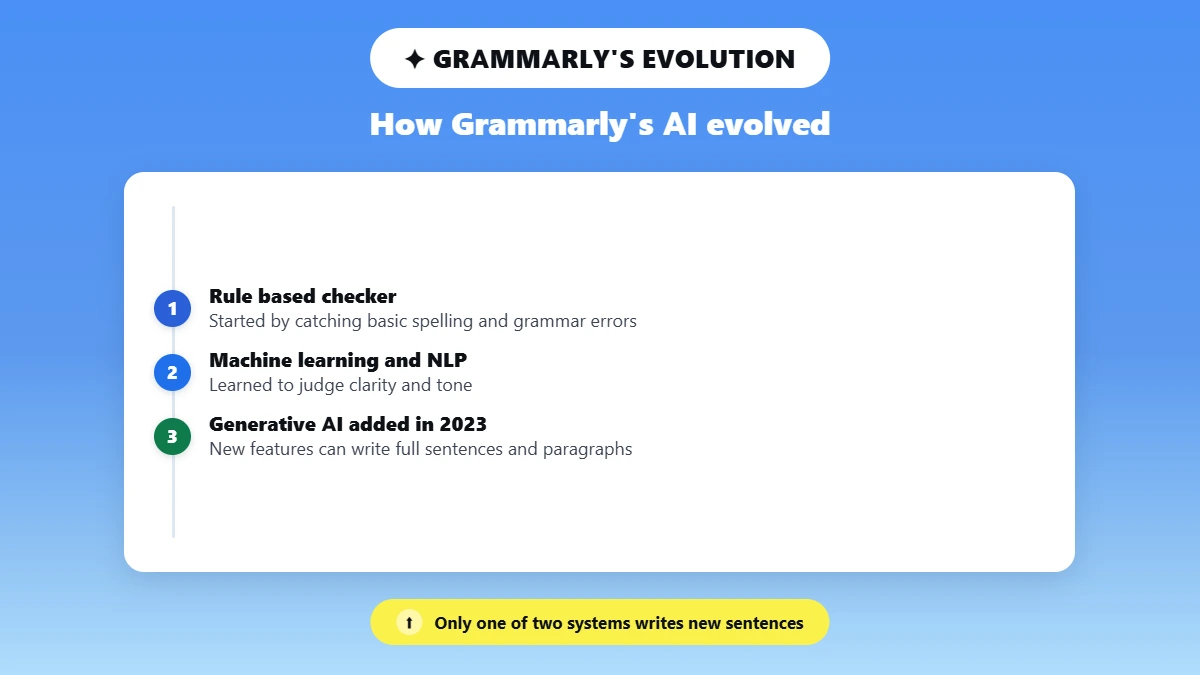
Yes. Grammarly is AI, and it has been AI since long before ChatGPT existed. What changed is the kind of AI inside it. The app now runs two kinds, and only one of them writes new sentences for you.
Grammarly started as a rule-based checker, then moved to machine learning and natural language processing, which is how it learned to judge clarity and tone.
In 2023 it added generative features that write and rewrite on demand, and by 2026 those had grown into a set of named agents sitting alongside the old underlines.
⏳ If you still think that Grammarly is just a grammar checker, that description stopped matching the product the moment those features shipped.
Traditional Grammarly vs Grammarly's Generative AI
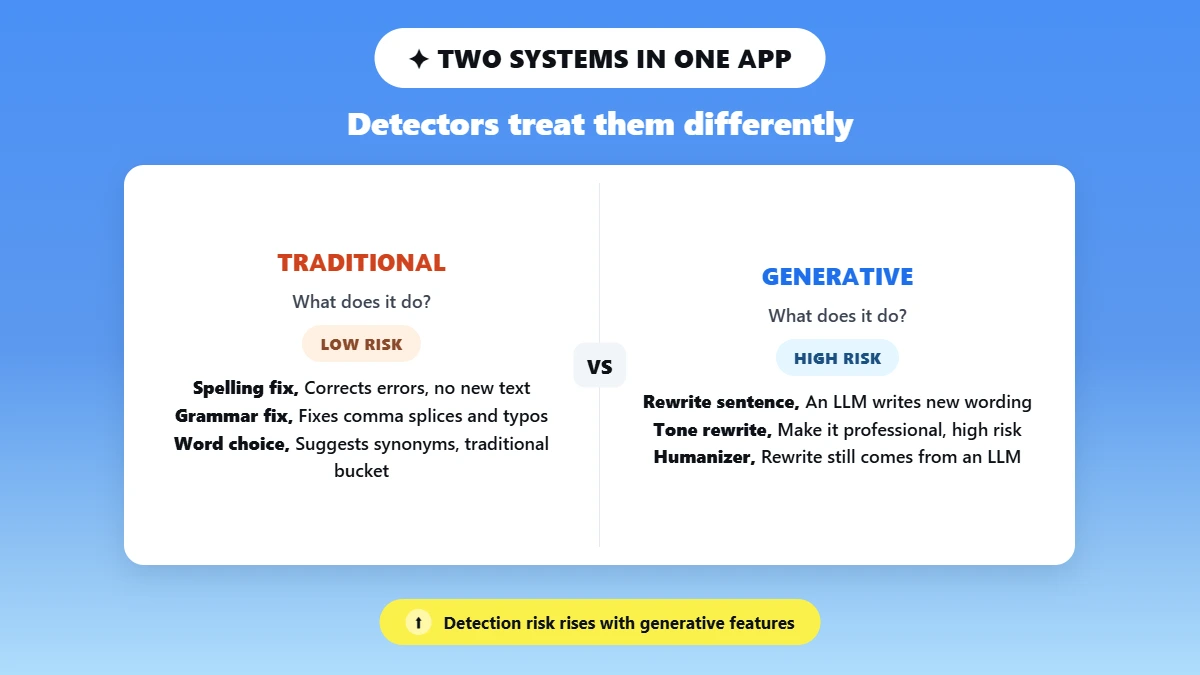
Grammarly runs two systems in one app:
One corrects text you already wrote
One produces new text for you
Detectors and university policies treat those very differently, so the feature you clicked matters more than the app you opened.
The traditional side is the red and blue underlines.
Fix a comma splice
Change dont to don't
Swap a repeated word
The generative side is different work. Ask it to rewrite a paragraph so it sounds more persuasive and an LLM writes that paragraph.
Grammarly's own Authorship docuentation tracks the two kinds of edit separately. Our side-by-side of Phrasly vs Grammarly shows where each platform puts that same divide.
Table 1: What counts as generative AI inside Grammarly
Grammarly action | Uses AI? | Generative? | Detection risk | Integrity risk (policy-dependent) |
|---|---|---|---|---|
Spelling / punctuation fix | Yes | No | Low | Usually low |
Grammar correction | Yes | No | Low | Usually low |
Word-choice suggestion | Yes | Traditional bucket | Low | Usually low; definitions vary |
Ask for feedback, then rewrite it yourself | Yes | Yes, but not in your text | Low | Low to moderate; AI advises, you author |
“Rewrite this sentence” | Yes | Yes | Moderate to high | Higher |
Tone rewrite (“make it professional”) | Yes | Yes | High | Higher |
Paraphraser | Yes | Yes | High | Higher; adds attribution issues |
Humanizer | Yes | Yes | High | Higher; rewrite still comes from an LLM |
Generate a paragraph or essay | Yes | Yes | Very high | Very high where writing is assessed |
Brainstorm / outline with AI | Yes | Yes | N/A (not in final text) | Depends strongly on the course |
Uses AI is not the same as generative. Risk levels reflect the feature type, and your course policy is the deciding factor.
Read the two risk columns as three bands:
✅ Low is usually safe.
⚠️ Low to moderate and moderate mean check your syllabus first.
🚫 High and very high are the ones most likely to be restricted, and often need disclosing.
Which Grammarly Features Count as Generative AI?
The generative features are the ones that write or rewrite for you: the Paraphraser, the Humanizer, tone rewrites, “rewrite this sentence,” and full text generation. Paraphrasing and rewriting both count as Generative AI. However, accepting a spelling or fixing a punctuation does not.
Grammarly changed the name of its features, and most articles haven't caught up. Plenty still call Grammarly's whole generative side “GrammarlyGO,” which was the 2023 branding.
In 2026 generative features are part of Superhuman Go and a set of separate agents, including:
Paraphraser
Humanizer
AI Grader
Citation Finder
GrammarlyGO is good to know as a search term, but what you will actually see in the app are the agent names.
There's an honest gray area. Some clarity suggestions stay in Grammarly's traditional bucket even though they change your phrasing, while a paragraph rewrite is clearly generative, however small it looks. Students call both “using Grammarly,” and that's where the confusion starts.
The one question to ask yourself: did you accept a fix on a sentence you wrote, or did you ask for new wording?
Does Grammarly Get Flagged as AI?
Basic proofreading rarely gets flagged. Generative rewrites can get flagged, because that text comes out of an LLM and resembles AI writing to a detector. The passages a model rewrote are the ones most at risk, and no rule says Grammarly-edited text always passes or always fails.
Grammarly says this itself, in plain terms. Its AI Detector user guide warns that when its Grammarly, Paraphraser, and Humanizer agents rewrite your text, the result comes from Grammarly's own LLM and its own detector is likely to flag it. Its advice is to use those agents for feedback you apply yourself.
The same guide is clear about the other direction: traditional red and blue underline corrections should typically not move the score at all. How reliable that score is in the first place is a separate question, and we stress-tested it across six samples in is Grammarly AI checker accurate.
📊 How unpredictable are the scores? In a peer-reviewed study published in SAGE's Indian Journal of Psychological Medicine, researchers rephrased AI-generated text with Grammarly Premium's generative feature and ran it through ten detectors. Detection across those tools landed anywhere from 0% to 100%. Read that as a warning against trusting any single score, in either direction.
Source: Kar et al., SAGE Journals.
Why does Grammarly make writing look AI-generated in the first place? A model rewrites toward the smoothest phrasing available. Your own writing carries uneven rhythm and sentences of wildly different lengths. A rewrite sands those down, and that evenness is what detectors are trained to notice.
Run your draft through a free AI check while you still have time to revise it in your own voice. 👇
Does Turnitin Detect Grammarly?
No. Turnitin doesn't flag “Grammarly was used.” It analyses your submitted text for patterns it reads as likely AI-generated or AI-modified. Grammarly's generative rewrites can be caught by that process, but Turnitin is reading the text, not the app.
Turnitin addresses Grammarly directly in its AI writing detection FAQs. The detector isn't tuned to target Grammarly's spelling, grammar, and punctuation changes, and in its own testing those mostly weren't flagged.
Content produced with Grammarly generative features, including draft generation, paraphrasing, and summarizing, will likely be flagged by Turnitin.
For raw AI text rather than edited text, our breakdown of does Turnitin detect ChatGPT shows what it catches and where it slips.
How Turnitin's AI detection behaves in 2026
Most articles on this topic still describe the 2023 tool. Here's the current behaviour, taken from Turnitin's own guides:
Two model updates this year: a February 2026 release that improved recall, and a July 2026 consolidation of a multi-model ensemble into a single model.
A false positive rate under 1% for documents where more than 20% of the text is flagged, validated against academic papers written before ChatGPT launched.
An asterisk instead of a number for scores in the 1% to 19% range, because that band is less reliable.
A 300-word minimum for English submissions, and prose only, so bullet lists and code aren't analysed.
Support for English, Spanish, and Japanese, though the part that spots paraphrasing tools runs on English submissions only.
No recalculation of older reports when the model changes, so a paper has to be resubmitted to get a current score.
That asterisk band is where most of the panic sits. We broke down how much AI detection is acceptable before an instructor is likely to act on it.
📈 Why schools are watching scores more closely this year. Between October 2025 and February 2026, an average of 14.8% of English-language submissions to Turnitin's latest detector contained 80% or more AI-generated writing. When the original detector launched in 2023, that figure was 3.3%.
Source: Turnitin's February 2026 data release. That figure counts essays that are mostly AI, not how many students touched an AI tool.
Keep in mind that: If your school issues Grammarly with the generative features switched off, the app can only make the low-risk corrections, so there is far less for Turnitin to read as AI.
But if you sign in with a personal account, it puts the generative agents back in reach, which is the situation Franklin University warns its students about (check Table 2).
Curious how the passage you just edited actually scores? 🤔
Paste it below and see which sentences read as machine-written. 🤖
You can now rewrite 📝those in your own words.
Check your writing for AI before you submit it 👇
Is Using Grammarly Cheating?
Using Grammarly is not automatically cheating. The answer depends on which feature you used, what skill the assignment is testing. It also heavily depends on what your school's rules say.
Proofreading is usually fine. Generating, paraphrasing, or heavily rewriting graded work is often restricted, and sometimes you must disclose it before you submit.
Grammar and spelling corrections
Usually treated as editing, and the lowest-risk thing you can do in the app. You wrote the sentence and a tool caught the error, so using Grammarly this way rarely counts as cheating on its own. Although a blanket ban on “AI” can still cover it.
Rewriting and paraphrasing
Higher risk, because the AI now supplies expression rather than fixing errors. If your assignment is graded on how you argue and phrase things, a paraphrase hands part of that grade to a model.
What if I rewrite the AI's rewrite?
Editing AI-produced wording doesn't automatically make it yours. Columbia Law (check Table 2) states this outright:
Revising, editing, or paraphrasing AI-generated text does not by itself turn it into student-generated work.
Generating paragraphs or essays
This carries the highest risk when your writing is what the assignment grades, and most schools ban it outright. Detectors exist to catch exactly this, and integrity boards act on it.
Brainstorming and outlining
Genuinely varies by course. Some instructors encourage it, others treat planning as part of what they're grading. None of it lands in your final text, so detection isn't the issue here. Policy is.
Does brainstorming need to be disclosed?
Sometimes, yes. It’s best to ask your instructor. Columbia Law requires disclosure of any AI use that contributes to a submission, and it doesn't say whether planning counts.
What US Universities Actually Say About Grammarly and AI (2026)
There's no single US rule. Permission is set at the course level, not nationally. Most policies now separate proofreading, which is often allowed, from generative writing, which is often restricted, and several require disclosure even when the tool was permitted.
Table 2: What some US institutions say
Institution | Stance (summary) | Notable detail |
|---|---|---|
Correcting your own writing is often acceptable; having the tool rewrite or regenerate usually is not. | No single university-wide rule. Instructors decide which tools each course allows. | |
Correcting grammar, spelling, or punctuation is not treated as generative-AI use. Automatic edits or drafting new text is. | Policy revised for the 2025 to 2026 academic year. | |
Names AI embedded in Grammarly, yet permits clarity, alternate phrasing, tone, concision, and error correction. | Requires disclosure of any AI use that contributes to a submission. | |
Issues Grammarly with generative features switched off, leaving spelling, grammar, and punctuation. | Warns that a personal account restores generative features that may raise flags. |
Policies reflect the institutions' live pages as of August 2026 and are revised each term. Check your own syllabus and program handbook before relying on any row above.
Columbia Law shows the modern approach clearly. Its default policy took effect on August 1, 2026, and names AI tools embedded in programs such as Grammarly right in the definition.
It still permits students to improve clarity, test alternate phrasing, adjust tone, and correct grammar. What it prohibits is letting AI perform the analysis or compose the work.
💡 The pattern across all four: modern policies ask what task the AI performed, not whether AI was anywhere near the document. That's why “I only used Grammarly” isn't an answer on its own.
Can I use Grammarly if my professor says no AI?
Read the exact wording, then ask. If the syllabus bans AI completely, that phrasing matters: a ban on “generative AI” may treat a comma fix differently from a paragraph rewrite, while a ban on “AI” with no qualifier is broad enough to include Grammarly.
To settle it, send a two-line email for clarity. It will also give you a record that you can point to later.
Is Using Grammarly Plagiarism?
No. Plagiarism means passing off someone else's words or ideas as your own, and Grammarly puts nobody else's words in your paper.
Unauthorised AI use may still break your course's academic-integrity policy, but schools often categorise that as unauthorised assistance rather than plagiarism, which is a different charge carrying different evidence standards.
That distinction matters at a hearing. Buffalo, for example, handles unauthorized AI use under falsifying academic materials rather than its plagiarism rules.
If your question is about Grammarly's plagiarism tool instead, our tested review of the Grammarly plagiarism checker covers what it catches and what it misses.
Do You Have to Disclose Grammarly?
Sometimes, yes. Permitted and “no need to mention it” are two different things. A growing number of 2026 policies ask you to disclose AI assistance, including editorial help you were allowed to use.
Columbia Law is explicit. Students must disclose any AI use that contributes to a written submission, and instructors may add their own citation protocols on top of the school-wide rule. This reason exists because it lets instructors see how students use these tools.
Practical rule: if a policy allows the tool but says nothing about disclosure, a one-line note costs you nothing. “Grammarly used for spelling and grammar corrections” is enough.
Can a Professor Tell You Used Grammarly?
Not directly. No report hands your professor a label saying “Grammarly was used.” A detector may flag characteristics of the text itself, and you can choose to share a Grammarly Authorship report, but neither one proves which app was open.
Keep two things separate:
A detector score is probabilistic and describes the finished text.
Authorship is process evidence and describes how it got there.
Only one is something you control.
Grammarly makes the same point about its own tool. Its AI Detector page states that no AI detector can conclusively determine whether AI was used and that a score should be one part of a wider look at originality rather than the whole answer.
What Is Grammarly Authorship?
Authorship is Grammarly's process-tracking feature. Enabled in Google Docs or Word, it categorises text as you write:
Typed by you
Pasted from a browser source
Pasted from an unknown source
AI-generated
Modified with generative AI
Edited with traditional Grammarly suggestions
The report colour-codes your document by source, shows time spent across sessions, and replays how the text appeared. You choose who sees it.
⚠️ Where Authorship stops.
Grammarly acknowledges the gaps itself:
keystrokes can be typed too fast to capture accurately
text pasted from a desktop source where Grammarly doesn't run may go uncategorised
and content from a newly launched AI tool may not yet be classified
Treat an Authorship report as useful evidence, never as proof.
Grammarly also states that Authorship is not AI detection. Every label is assigned live, based on where the text came from, not by analysing the finished text.
What to Do If Your Own Writing Gets Flagged as AI
Start with evidence rather than edits. Don't panic-edit the document, because rewriting it after the fact damages the version history that proves you wrote it.
Keep your version history. Google Docs and Word retain it automatically, and that timeline is the strongest thing you own.
Cross-check with a second, independent detector. Scores differ between tools, so a low score elsewhere is meaningful context to bring with you.
Write down which Grammarly features you used, on which sections, and whether they were generative. Specifics land better than “I only used Grammarly.”
Talk to your instructor early, with your evidence in hand. Ask what the flag was based on.
How often do detectors flag human writing?
Often enough that a single score shouldn't decide anything. Phrasly ran 37,874 student essays written between 2010 and 2021, years before ChatGPT existed, through ZeroGPT's API. The tool flagged 9,987 of them as AI-generated, a false-positive rate of 26.4%. Formal academic prose is the style most likely to trip an older detector, and detectors also misfire more often on non-native English writing.
Full method and results: our 30k-essay ZeroGPT analysis. If English is your second language, say so when you raise the flag.
What happened to the student flagged for using Grammarly
The most public case is Marley Stevens. In October 2023 her criminal justice professor emailed to say her paper had been flagged for AI use. Stevens says she had only used Grammarly for spelling and punctuation, and notes this was before the platform's major AI expansion. Her first video about it has since passed 5.7 million views.
The outcome matters before you assume going public wins the argument. At her February 2024 hearing, Stevens says she was given little chance to speak before being placed on academic probation for a year. She served it and graduated in December 2025.
🎓 My biggest piece of advice is to thoroughly read your syllabus every semester.
Stevens adds that every professor sets different rules, so the syllabus is the place to start.
Two things her case does not prove. It describes 2023 Grammarly rather than the 2026 product, and nothing about what she used was confirmed by her university, which cited student privacy.
What it does show is how the process runs once a flag is raised. Our step-by-step guide for when Turnitin says I used AI but I didn't covers the appeal itself, and free AI checkers for students compares the tools you can run on your own work first.
Cross-check your own work with a second detector and bring the result to the conversation. 👇
Grammarly is AI, and it always has been. What decides your situation is which half of the app you used.
Proofreading corrections keep you the author and rarely move a detector score. Generative rewrites hand the wording to an LLM, and Grammarly, Turnitin, and your university all treat that as a different act.
That leaves two separate questions, and mixing them up is what causes most of the panic:
Detection estimates what your text resembles.
Policy decides what you were allowed to do.
Before you call anything safe, detected, or cheating, name the feature you used and the policy that governs your assignment.
Frequently Asked Questions
Is Grammarly considered AI?
Yes. Grammarly has used AI since it launched and now includes generative AI too. Using an AI editor to fix a comma is a different act from having it write your paper, and that difference is what policies measure.
Does Grammarly count as AI in Turnitin?
No. Turnitin doesn't flag “Grammarly was used.” It analyses your text for patterns it reads as AI-generated. Generative rewrites can be flagged, and basic corrections rarely are. Students without access can still learn how to check plagiarism in Turnitin.
Is using Grammarly cheating?
Not automatically. It depends on the feature, the assignment, and your school's policy. Proofreading is usually fine. Generating or heavily rewriting graded work may be restricted or need disclosure.
Is Grammarly allowed in college?
It varies. Policies differ by institution, program, and professor. Most 2026 rules allow proofreading and restrict generative writing. Ask your instructor if a “no AI” rule doesn't say which features it covers.
Can teachers tell if you used Grammarly?
Not directly. Nothing shows your professor the app name. A detector may flag characteristics of the text, and you can share a Grammarly Authorship report, but that's your decision rather than proof they obtain.
Is Grammarly plagiarism?
No. Plagiarism means presenting others' words as your own. Unauthorised AI use may still break an integrity policy, and schools often treat that as unauthorised assistance instead. Our guide to how do teachers check for AI covers the other signals they use.
How do I turn off AI in Grammarly?
Disable generative suggestions in your Grammarly settings and stay with spelling, grammar, and punctuation. Some schools issue accounts with those already switched off. If your course bans AI, confirm the details with your instructor.
Does the Grammarly Humanizer make text undetectable?
No. Grammarly's documentation says Humanizer rewrites come from its LLM and are likely flagged by its own detector. A natural-sounding rewrite is still an AI rewrite. For how that detector performs on other text, see is Grammarly AI checker accurate.

Written by
Alina Shah
SEO Content Specialist · Karachi, Pakistan
She writes about AI so you don't have to guess. 8+ years in content strategy and editing. Now she puts AI writing tools and detection systems through real tests and shares what actually works.