Is Grammarly AI Checker Accurate? We Stress-Tested It (2026 Results)
11 min read
Whether Grammarly's AI checker is accurate depends entirely on what you feed it. We stress-tested it with six samples: pure AI, fully human, and paraphrased versions of each.
Here is what we found: it scored fully AI-generated writing 84% and 71%, and fully human writing 0% and 8%.
Read on below to see the full results, what the percentage really means, how it lines up against Turnitin, what it costs, and three alternatives worth knowing. It also gives no sentence-level explanation, so you can't see what was flagged.
What Is Grammarly's AI Checker and How Does It Work?
Grammarly's AI checker is a machine-learning model trained, in Grammarly's own words, on hundreds of thousands of human and AI-generated texts. You paste text, it returns one number: the percentage that reads as AI-generated.
That single number is the whole output. There's no sentence highlighting in the standard checker and no explanation of why text was flagged, which shapes everything else in this review. For the mechanics behind tools like this, see our guide to how AI detectors work.
Grammarly access runs through an account and, for full AI detection, a paid plan with a 7-day free trial for new users: Grammarly's support documentation lists it as a paid feature across the product.
Grammarly is also unusually honest about the output: the score, it says, "should not be used as an objective source of truth." Keep that quote in mind; it does half this article's work.
Curious where your own draft stands? Compare your Grammarly score with Phrasly's 👇
Stress Test: How Accurate Is Grammarly AI Checker in Real Use?
Accurate on clean text, eroding within minutes on edited text: that is what the Grammarly AI check produced across our six samples. We built the test around three questions:
does it catch raw AI?
does it clear genuine human writing?
and does it hold up once someone edits the AI text?
The design: 6 samples. Two AI-generated pieces (an academic essay and a creative blog post). Two confirmed fully human pieces of the same types. And the two AI pieces again after a two-minute pass through a standard paraphrasing tool.
We ran each sample the same week that covers Grammarly AI detection accuracy for academic and everyday writing alike.
The paraphrase step is the one that matters most. Almost nobody submits raw AI output; real drafts get edited, reworded, and mixed with human sentences. Anyone can replicate this in about 30 minutes, and that's the point: a detector's accuracy claim should survive a test you can run yourself.
For how other tools handle the identical challenge, our AI detection accuracy across checkers roundup uses the same method.
Use Case 1: Academic Essays
Academic text carries the highest stakes: this is the writing that faces Turnitin and instructor judgment, so accuracy here matters most.
Test 1A: Fully AI-Generated Essay
Test process: a standard academic essay on Annual Fun Day at School, generated with ChatGPT (GPT-5.5), with the prompt "Write a 400-word essay on our school’s Annual Fun Day," pasted in with no edits.
Result: 84% AI.
Verdict: Passed. Obvious AI gets caught. If someone pastes a ChatGPT essay straight in, this checker will see it.
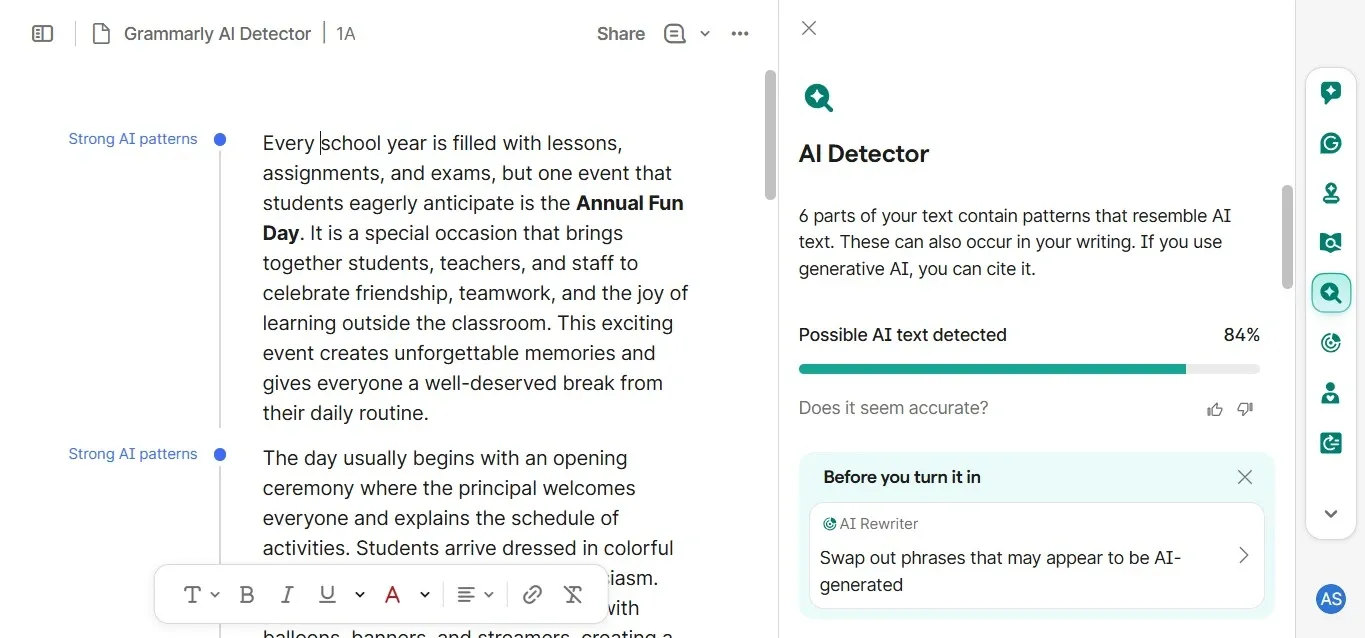
Uncropped Grammarly result for Test 1A
Test 1B: Fully Human-Written Essay
Test process: an essay we wrote ourselves, with a verifiable drafting history, pasted in unedited.
Result: 0% AI.
Verdict: Passed. No false positive, which is real reassurance for a student checking work they actually wrote.
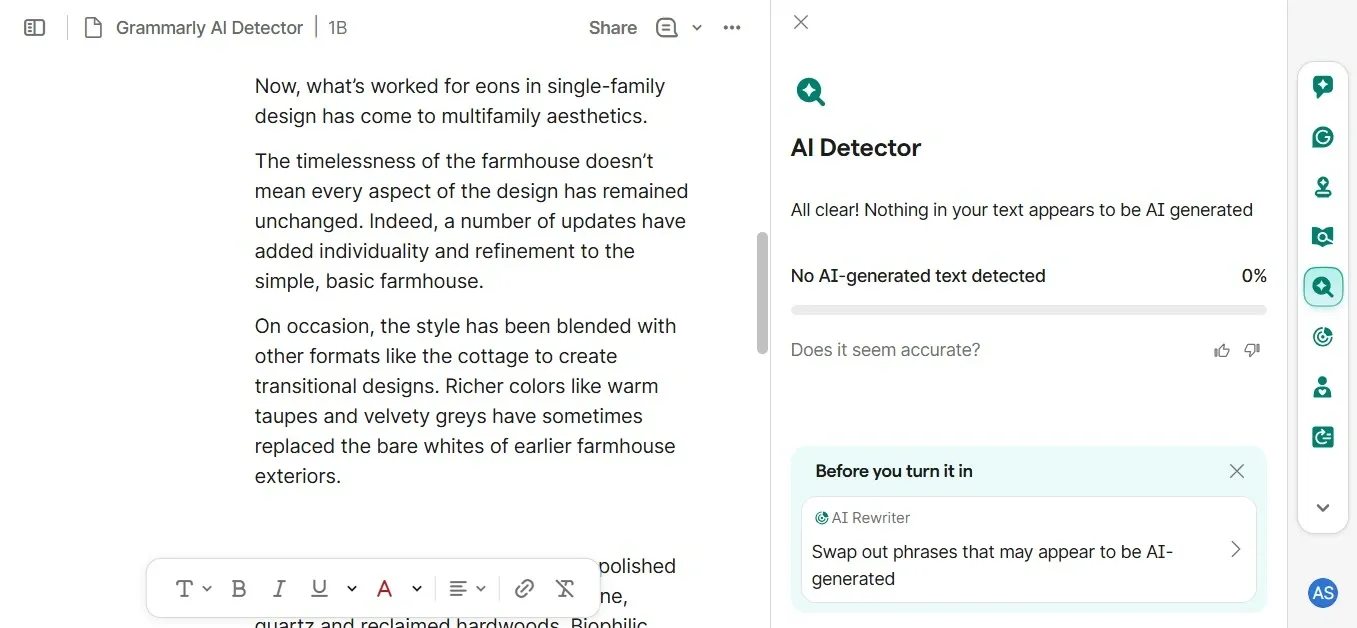
Test 1B result
Test 1C: Paraphrased AI Essay (the Real Test)
Test process: the same essay from Test 1A, run through a standard paraphrasing tool for about two minutes. Minor changes only; the argument and structure stayed identical.
Result: 67% AI.
Verdict: Weakened. 67% still reads as AI, but a two-minute paraphrase erased 17 points without touching the argument. Can Grammarly detect paraphrased AI text? Partly: it flagged ours at a reduced score, and the direction is the warning.
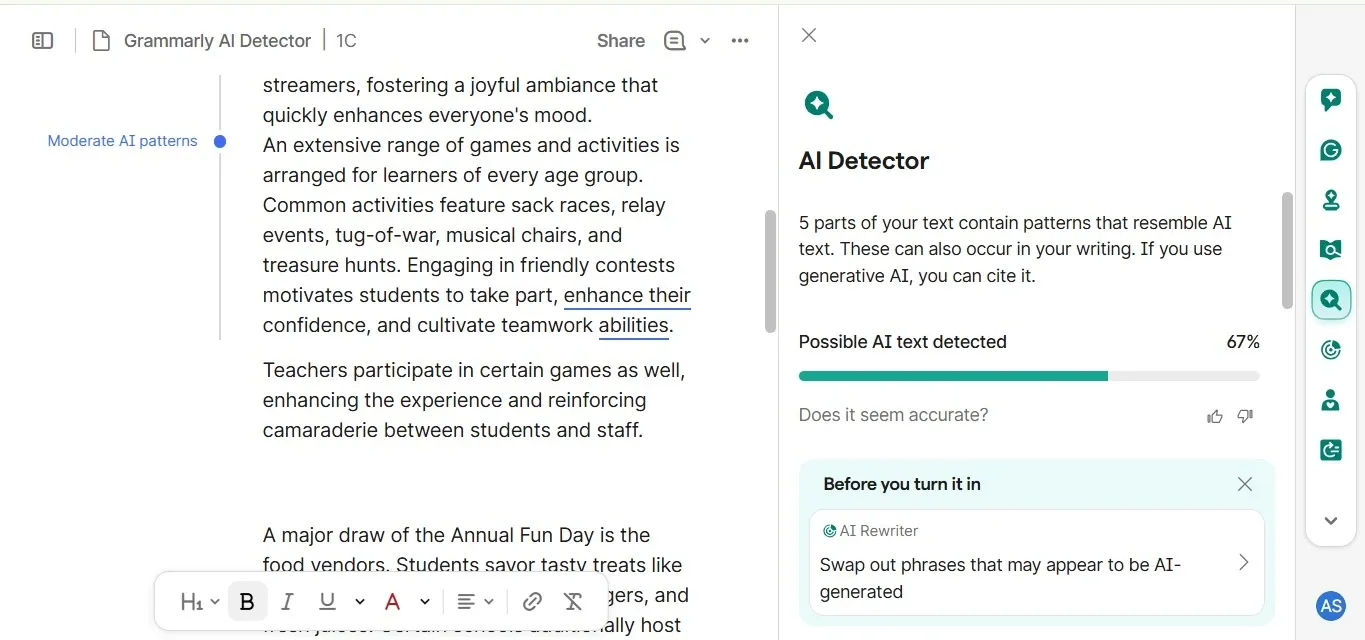
Test 1C result
Use Case 2: Creative Writing
Same three-test design on a blog-style creative piece, because most non-student users are checking exactly this kind of writing, and AI mimics casual voice better than academic structure.
Test 2A: AI-Generated Creative Blog
Test process: a conversational blog post on How to Make a Picnic Party at Home, generated with the same ChatGPT model (GPT-5.5), pasted in unedited.
Result: 71% AI.
Verdict: Passed, with a caveat: flagged clearly, but softer than the academic sample. Creative phrasing hides AI patterns better.
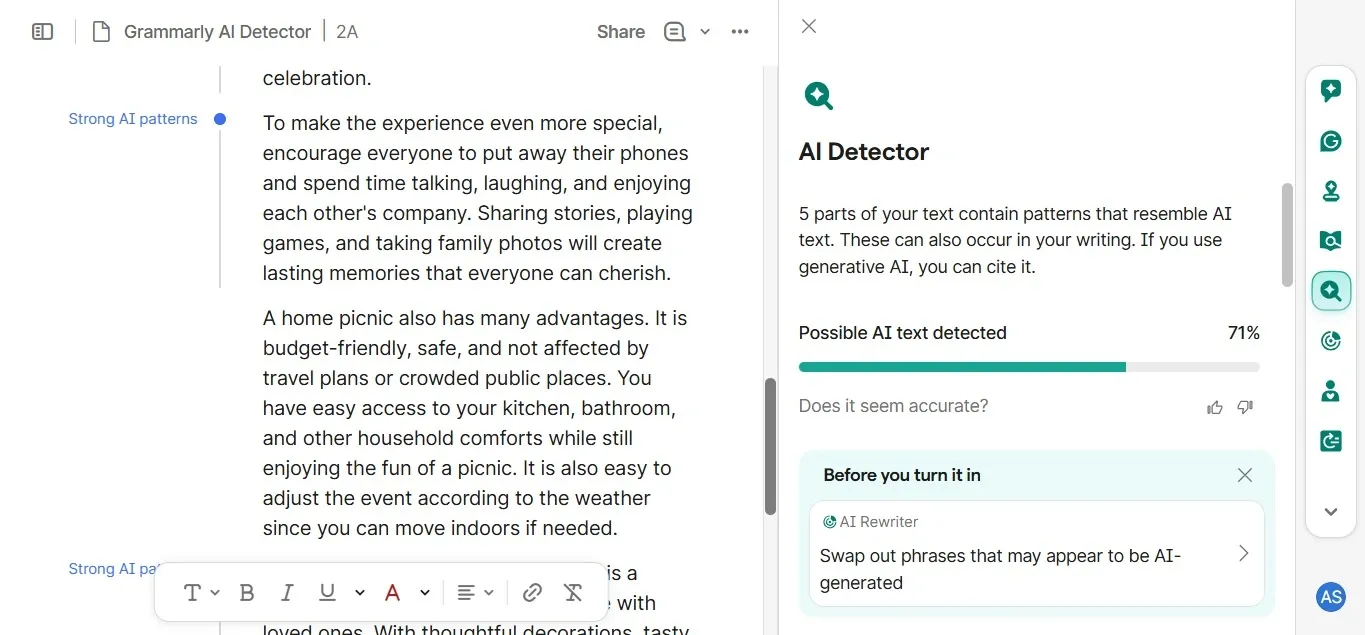
Test 2A result
Test 2B: Human-Written Creative Piece
Test process: a creative piece with confirmed human origin, pasted in unedited.
Result: 8% AI.
Verdict: Passed. Accurate again on clean human text.
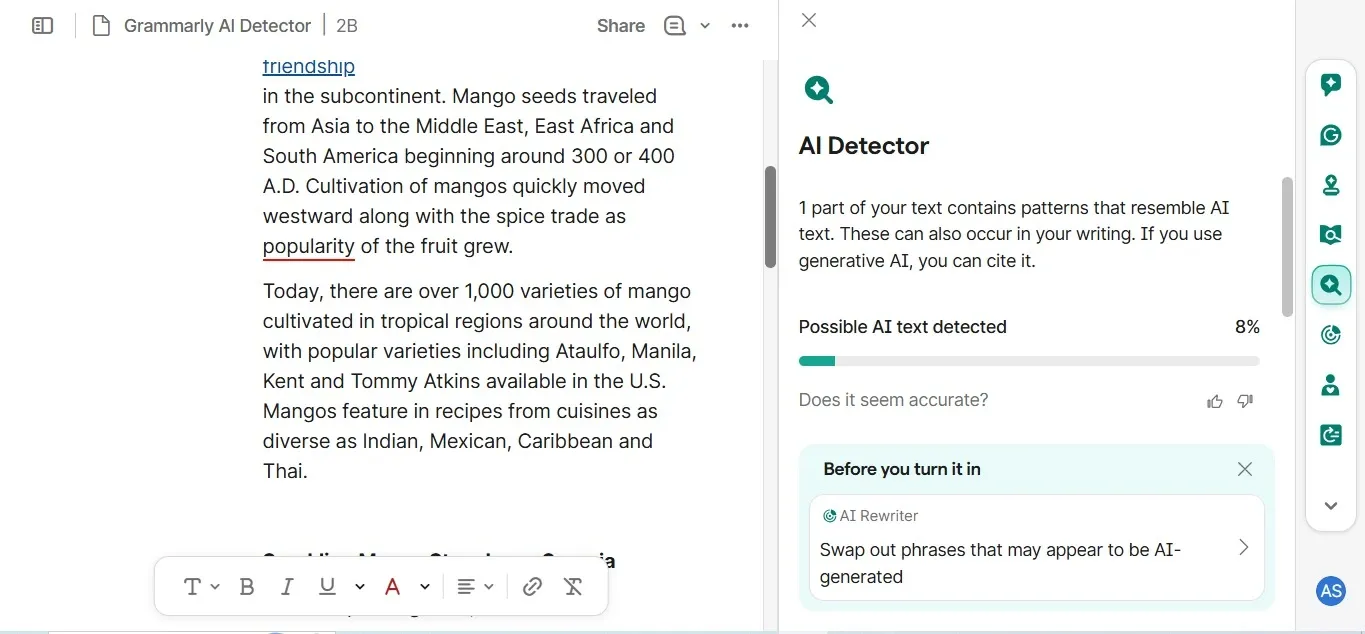
Test 2B result
Test 2C: Paraphrased AI Creative Piece
Test process: the Test 2A text, paraphrased for about two minutes.
Result: 45% AI.
Verdict: Failed. 45% sits in the gray zone: too low to act on, too high to clear. The same two-minute edit that dented the essay score broke the creative one.
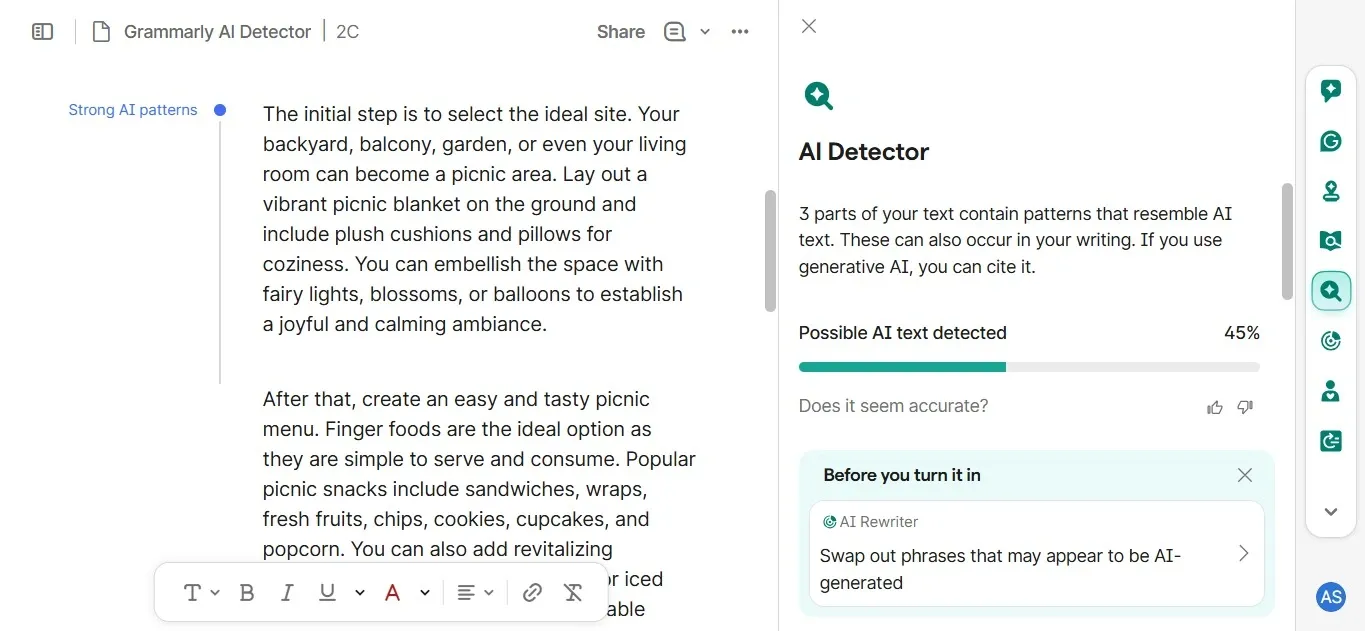
Test 2C result
Results at a Glance
Test | Content type | What it actually was | Grammarly score | Verdict |
|---|---|---|---|---|
1A | Academic essay | Fully AI-generated | 84% | Pass |
1B | Academic essay | Fully human | 0% | Pass |
1C | Academic essay | AI, paraphrased 2 min | 67% | Weakened |
2A | Creative blog | Fully AI-generated | 71% | Pass |
2B | Creative blog | Fully human | 8% | Pass |
2C | Creative blog | AI, paraphrased 2 min | 45% | Fail |
Final Verdict: What Grammarly's AI Detector Did Right, and Where It Failed
Grammarly was accurate in both directions at the extremes: it caught pure AI and returned 0% and 8% on human work, avoiding the two most damaging failure modes at once.
A detector that misses obvious AI fails at its one job; a detector that falsely accuses a real writer does harm. Grammarly did neither, and Grammarly says its model is deliberately optimized to minimize false positives.
Then the weakness. Two minutes of paraphrasing erased 17 points from the academic score and dropped from 84% to 67%. It also reduced the creative piece from 71% to 45%.
Our sample isn't alone: RAID benchmark analysis measured Grammarly at an F1 score of 0.364 with roughly 22% accuracy under adversarial edits like paraphrasing and spelling swaps.
In plain terms, once text has been deliberately altered, the detector misses far more than it catches, across a benchmark much larger than our six samples.
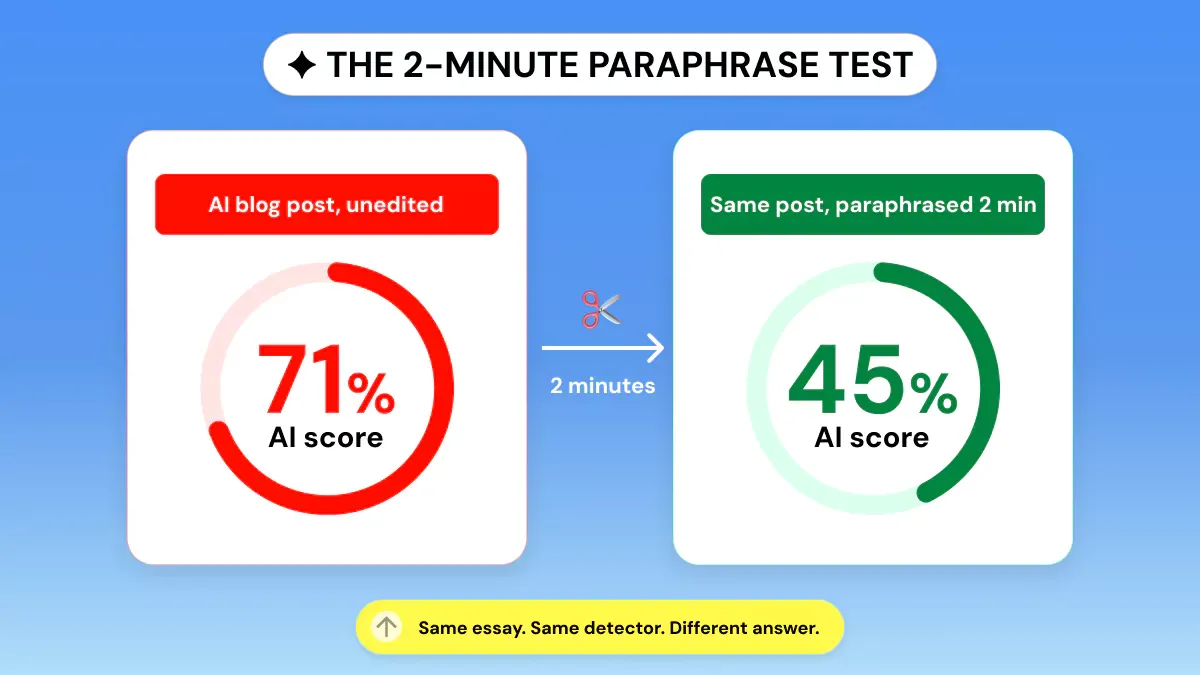
The same blog post, two minutes of paraphrasing apart
Add the missing sentence-level evidence and the shape is clear. A score that drops with every editing pass cannot anchor an integrity decision, and it never tells you which sentences raised the flag.
Because single-tool scores swing this much, cross-check any important draft with a second opinion. Phrasly's AI Detector is free and unlimited, and shows how AI-like your text reads before a professor or client ever sees it.
Is Grammarly AI Checker Accurate for Turnitin?
No. A Grammarly AI score does not predict a Turnitin score, in either direction. They're different models with different training data and thresholds, and Grammarly's own support doc says exactly this: its scores "may differ from those of other solutions like Turnitin, GPTZero, Copyleaks."
That cuts both ways. A 0% on Grammarly can still get flagged by Turnitin, and a nervous 30% on Grammarly can come back clean. Treat the two as unrelated opinions, because statistically they are.
Grammarly's own support docs say it plainly: no score from its AI detection is "a clear indication that your professor will see the same score."
The practical takeaway for students: chasing a Grammarly number before submission protects nothing. Instead, keep your drafting evidence, version history, notes, outlines, because that record defends you against any detector score.
One distinction protects a lot of students: regular Grammarly corrections, spelling, grammar, punctuation, don't make your writing read as AI. Generative rewrites through GrammarlyGo are different; they produce AI text, and AI text is what detectors look for.
If Turnitin has flagged work you actually wrote, that guide covers what to do next.
Why Grammarly's AI Scores Fluctuate (and What a Percentage Really Means)
Because the model keeps changing under your text. The top-ranked Reddit thread on this exact question documents the pattern: users report the same text scoring 0%, then 35%, then 90% across months as Grammarly updated its model. Nothing about the writing changed; the judge did.
That is not a flaw unique to Grammarly. Every detector retrains as new AI models ship, and every retrain moves scores. The single averaged number makes it worse: with no sentence view, you cannot see where the change came from.
Mixed human-plus-AI writing also sits in the gray zone where every detector degrades most, which matters because mixed drafting is now how most people write: 4 in 5 university students use generative AI, per Stanford's 2026 AI Index.
What Does Your Grammarly AI Score Actually Mean?
A 16% means the model found faint AI-like patterns; on a draft you wrote or heavily rewrote yourself. A 30% is worth a second look at any sections you pasted or lightly edited from AI output. Neither number, on its own, should worry someone who did their own work.
Read any score as a signal, never a verdict. A high score says "this text patterns like AI," not "this person cheated," and detectors can flag genuine human writing, especially polished, formal, or non-native prose.
Even Grammarly tells you not to treat its output as objective truth. No score, from any tool, is proof of anything on its own.
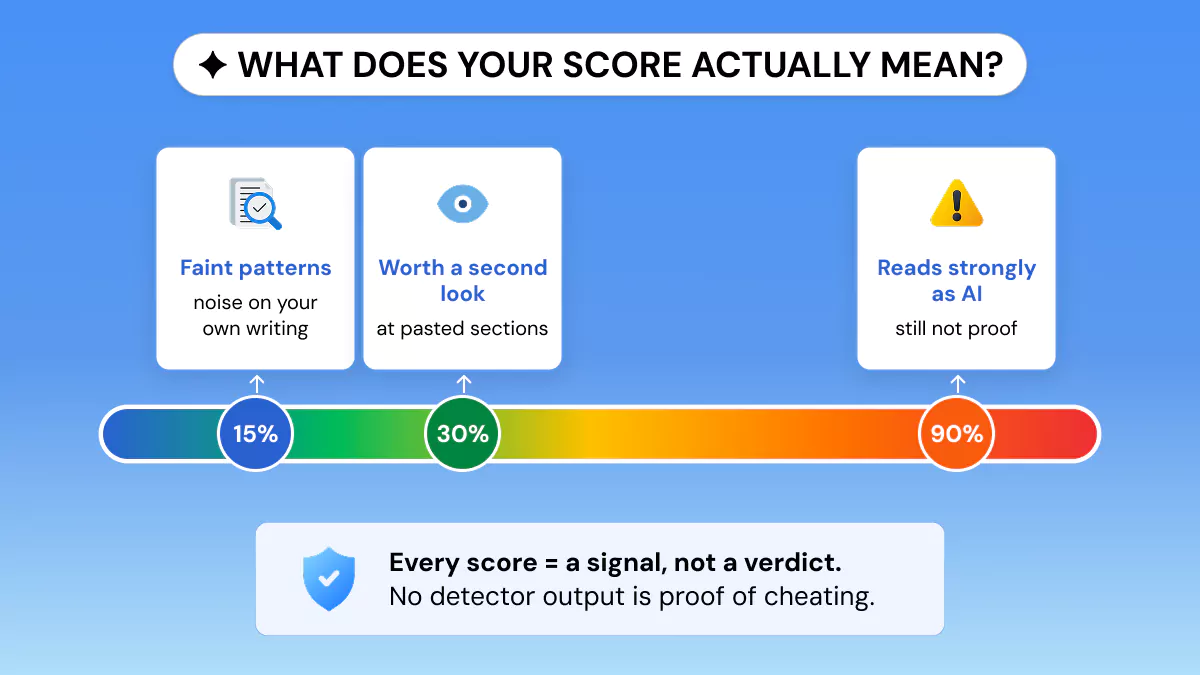
A score is a signal to review, never proof of anything
Grammarly AI Checker vs Dedicated AI Detectors
Each tool on this table wins somewhere, and the differences that matter are evidence, cost, and how each one handles edited text.
Here is where each stands: GPTZero shows sentence-level highlighting Grammarly lacks. Turnitin is what universities actually run.
Phrasly's detector is free, unlimited, and tuned on exactly the edited and paraphrased text that slipped past Grammarly in our tests, a focus that comes from being built alongside a humanizer and validated in our published 30,000-essay ZeroGPT study. The full head-to-head lives in Phrasly vs Grammarly.
Tool | Price / access | Sentence-level evidence | Handles paraphrased AI | Best for |
|---|---|---|---|---|
Phrasly AI Detector | Free, unlimited | Yes | Strong (tuned on edited AI text) | Students and writers self-checking drafts |
Grammarly AI checker | Paid plans; 7-day free trial | No | Erodes under light edits (our 2-min test) | Quick first pass on unedited text |
GPTZero | Free tier; paid plans | Yes | Moderate | Detail-level review of flagged text |
Turnitin AI indicator | Institutional only | Partial | Moderate | What universities actually see |
Run a paragraph of your own through Phrasly's AI Detector and compare it against your Grammarly score. Your first checks need no signup, and a free account unlocks unlimited runs.
When Should You Actually Use Grammarly's AI Checker?
Use it on drafts you wrote yourself. It gives a fast, reliable read on clean text, and it catches obviously pasted AI before the work goes anywhere. The free 1,400-word first scan covers a pre-send check on client work too.
Skip it for high-stakes academic screening, for judging edited or mixed drafts, and for any decision about another person's work. Is Grammarly's AI checker good for teachers? Not for enforcement: with no sentence evidence and a score its own maker calls subjective, it can't fairly carry an accusation.
An educator who suspects AI use needs tools that show their evidence, and a conversation with the student, before any score enters the picture. The suspicion has a real base rate behind it: 12% of students now include AI-generated text directly in assessed work, up from 8% in 2025, per HEPI's 2026 Student Generative AI Survey.
Put simply, Grammarly is an accurate AI checker for one job: clean, unedited text you want a fast read on. For anything you have edited, a detector built for that case, such as Phrasly's, gives a second opinion worth having. Students can also start with our roundup of the best free AI checkers for students.
Verdict: Is Grammarly's AI Checker Accurate in 2026?
Yes, at the extremes: 84% and 71% on pure AI, 0% and 8% on human writing in our August 2026 stress test. In the middle, where real drafts live, it wobbles: two minutes of paraphrasing cut those scores to 67% and 45%, the creative piece landing in the gray zone, and the tool never shows which sentences drove any number.
As of August 2026, Grammarly's AI checker is a reasonable first-pass signal for unedited text, but it is not steady enough on edited AI text to carry academic decisions.
Who should rely on it: writers doing a quick sanity check on their own unedited drafts.
Who should not: students facing institutional detectors, anyone judging someone else's work, and anyone whose draft mixes AI and human writing, which in 2026 is most people.
If you use AI to draft and then rewrite in your own voice, run the final version through Phrasly: humanize your AI-assisted draft, then verify it with the free detector before you submit.
FAQs
Is Grammarly's AI checker accurate?
Accurate at the extremes, shakier in between. Our August 2026 tests: 84% and 71% on pure AI, 0% and 8% on human writing; two-minute paraphrases cut those to 67% and 45%. Treat it as a first-pass signal, never a verdict.
Is Grammarly plagiarism and AI checker accurate?
They're different features with different records. The Grammarly plagiarism checker is a decent paid feature; the AI checker is the weak link, eroding on edited AI text in our tests.
Can Grammarly's AI detector give false positives?
Yes, though rarely on clean human text: our human samples scored 0% and 8%. Grammarly says the model is optimized to minimize false positives. Polished, formal, or non-native prose carries the higher risk, as with every detector.
Does Grammarly show which sentences are AI?
No. The checker returns one averaged percentage with no sentence-level evidence, its biggest limitation against GPTZero and Phrasly, which both highlight the text behind the score.
Will my Grammarly AI score match Turnitin's?
No. They're separate proprietary models, and Grammarly's own documentation warns its scores may differ from Turnitin's. Never assume one predicts how Turnitin detects AI, in either direction.
Can you trick Grammarly's AI checker?
Our tests show minor paraphrasing lowered its scores in both tests, dropping the creative piece into the gray zone, which is a weakness in the detector, not advice. Instructors use additional checks, so a lowered score protects nobody.
Does using regular Grammarly corrections get my writing flagged as AI?
No. Grammar, spelling, and punctuation fixes don't create AI patterns. GrammarlyGo's generative rewrites can, because they produce AI-written text.
Is Grammarly's AI checker free?
The first check is, up to 1,400 words with no account. After that it asks you to sign up, and continued AI detection sits behind a paywall with a 7-day free trial for new users. One quick scan costs nothing; regular use is paid.

Written by
Alina Shah
SEO Content Specialist · Karachi, Pakistan
She writes about AI so you don't have to guess. 8+ years in content strategy and editing. Now she puts AI writing tools and detection systems through real tests and shares what actually works.