
Why Turnitin Flags Human Writing as AI (And How to Fix It)
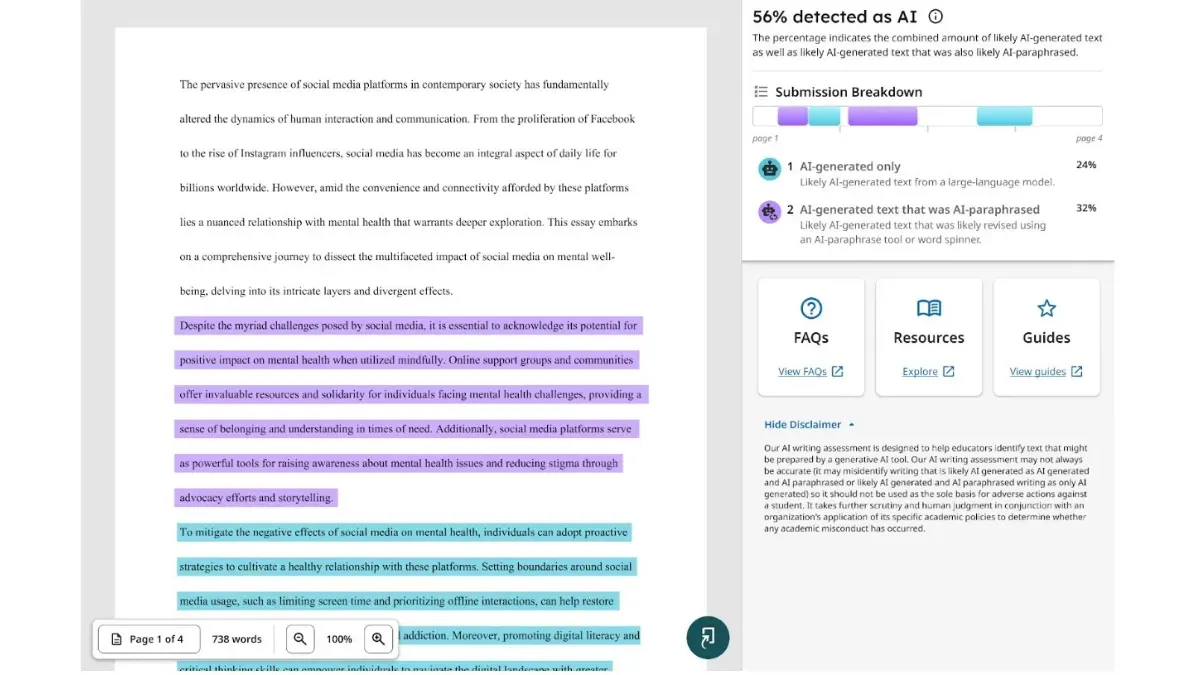
Turnitin flagged your essay as AI but you wrote every word yourself. False positives are real, even Turnitin admits it. Learn why it happens, what triggers the detector, and how to appeal with evidence that actually works.
You submitted an essay you wrote yourself. Every word, every sentence, every late-night revision. Then Turnitin's AI detector says you used AI, but you didn't.
You're looking at a score that just doesn't reflect the truth. You're questioning how the tool could possibly get this one thing so incorrect when you know with absolute certainty that you're right. It happens. And, most importantly, you're not helpless either.
Turnitin false positives are a known, verified occurrence. Here's why Turnitin says you used AI when you didn't, what kinds of writing trigger them most, and how to document and appeal your submission if needed.
Can Turnitin's AI Detector Be Wrong?
Yes, and Turnitin says so themselves.
1% seems low until you realize Turnitin checks hundreds of millions of submissions from around the world. At less than 1%, that's tens of thousands of genuine students flagged each year.
If you want to understand why this keeps happening, this detailed breakdown of AI detector false positives explains the core reasons behind the problem.
More importantly, Turnitin itself makes clear that its AI score is not a determination of misconduct. Their documentation is clear. The score is information for instructors to consider as part of a holistic, human review. It is not evidence.
No instructor should, and no fair institution will act on an AI score without using professional judgment and talking to the student. If the AI detector says your writing is AI, but it's not, you have not been convicted of anything.
AI Score Vs Similarity Score — These Are Not the Same Thing
One big misconception students have is that they believe the Turnitin AI score and similarity score mean the same thing. They are entirely different metrics.
The similarity score shows how much of your paper matches sources in Turnitin's database (websites, journal articles, papers previously submitted to Turnitin) and identifies overlapping text.
The higher your similarity score, the more potential plagiarism from the sources found.
Unlike the Similarity score, the AI score does not compare your document to anything else.
The AI score analyzes your document’s writing style, looking for characteristics such as word predictability and sentence repetition to identify how likely it is that the text was written by AI.
A high AI score does not mean plagiarism if the similarity score is low. A high similarity score does not mean AI use if the AI score is low. Read both scores separately.
What Writing Patterns Trigger Turnitin's AI Detector?
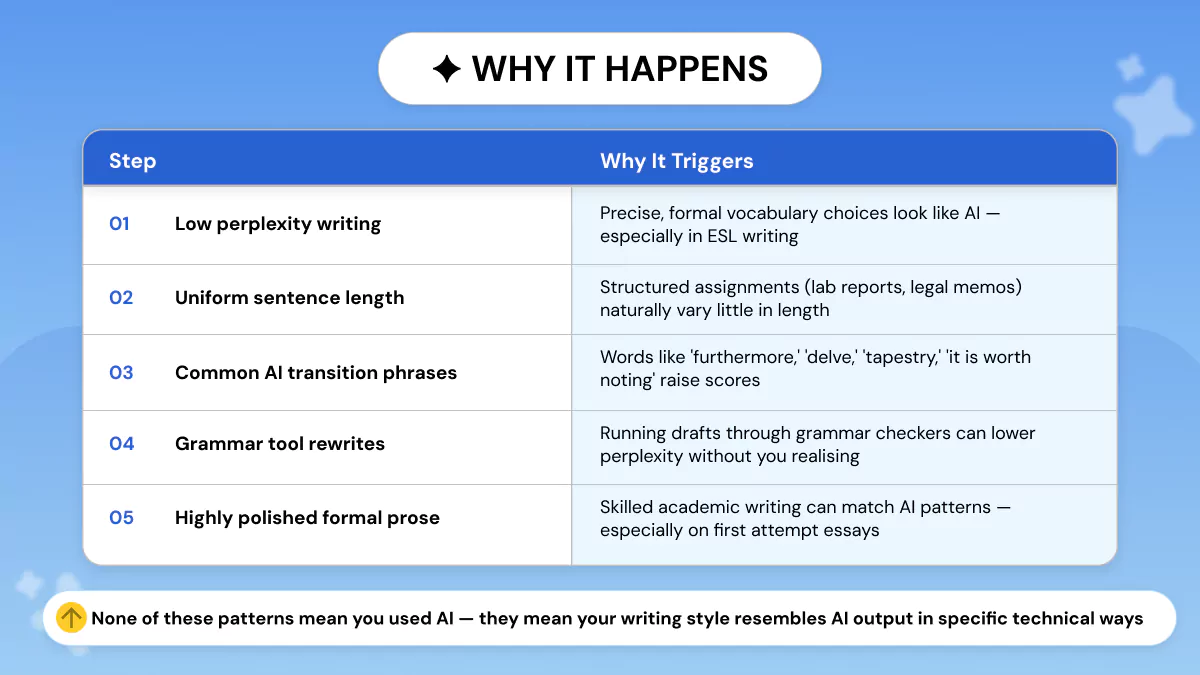
If you want to know why is the AI checker saying you used AI when you didn't… You have to understand how the detection model itself works.
There are several well-documented reasons why essays get flagged as AI, and most of them have nothing to do with actually using ChatGPT or any other AI tool.
Turnitin's AI detector doesn't search for telltale phrases that were copied directly from ChatGPT and how Turnitin detects ChatGPT is more nuanced than most students realize.
Instead, it models two statistical properties of text (perplexity and burstiness) and flags any documents that have similar measurements to what the AI produces. The problem is that some perfectly natural writing styles have the same statistical fingerprint.
Low Perplexity in Polished Academic Writing
Perplexity is a measure of how predictable each word choice is given the previous words. Language models in AI always pick the statistically most likely next word, leading to extremely low perplexity scores.
The problem is that skilled, careful academic writing does this as well.
An author fluent in academic register using precise word choice, standard discipline specific jargon, and uniform sentence structure can unintentionally create highly statistically predictable content to the detector.
ESL writers in particular are prone targets. Formal English learned through textbooks and scholarly articles can resemble AI word patterns very closely.
Low Burstiness from Structured Assignment Formats
Burstiness measures the variation in sentence length across a piece of writing. When a human writes something, they don’t make every sentence exactly the same length.
Some will be short; others long. AI sentences tend to be about the same length, giving them a low burst score.
That said, some assignments naturally limit variation because of their required structure. Laboratory reports, legal cases, engineering memorandums, and rigidly structured academic essays all utilize formats that inherently limit variation.
If you were assigned a paper where every sentence had to be the same length and structure, your formal academic writing could have very low burstiness organically.
Common AI-Associated Phrases in Your Vocabulary
Some words and phrases show up too frequently in AI writing, not because AI 'created' them, but because writing by language models over-represents them due to their prevalence in training data.
When they show up repeatedly in your work, they raise your Turnitin AI score even if your work is entirely human-written. The table below shows common trigger phrases and natural alternatives:
A Note for ESL Students: Why You're Disproportionately Affected
Numerous studies evaluating AI detection accuracy have identified a disturbing trend. Higher-than-average false positive rates for essays written in students' second or third language.
The sanitized, academic style many ESL students learn to write in English classes (precise, well-organized, devoid of contractions) strongly resembles the types of linguistic patterns AI detectors look for.
This is not a judgment on your intelligence or character. It's a known deficiency of the tools currently available, and it strengthens any appeal you make to your institution.
Using Grammarly or QuillBot Before Submission
A frequent reason for seeing a surprisingly high AI score on work you know is genuinely human-written: Copying and pasting your essay into Grammarly, QuillBot, or another grammar/style checker prior to submission.
Students do this all the time without realizing it can impact their Turnitin score. These tools offer sentence restructure and word swaps that, when accepted, change the statistical fingerprint of your essay.
The edited version can decrease perplexity and burstiness enough to artificially increase your score, even though the thoughts were original.
If Grammarly says you used AI but you didn't, or Turnitin caught work you submitted that went through a grammar checker, this is probably why.
The solution? Accept grammar and punctuation edits from any AI writing tool, but never edits that fundamentally rewrite your work.
Turnitin Says You Used AI? Cross-Check with Phrasly First
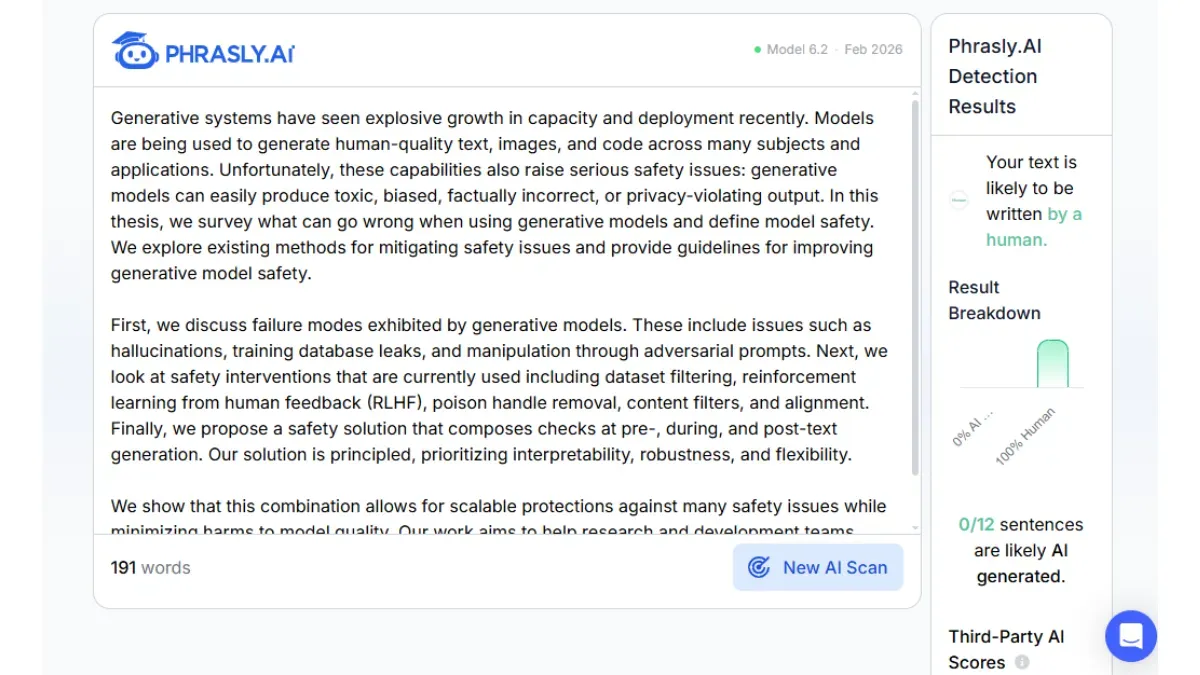
Don't email your professor in panic or start revising your paper. Try running it through Phrasly AI Detector again.
When Phrasly outputs a low AI likelihood score on text Turnitin flagged as AI, that variance between two independent tools is meaningful evidence in your favor if you appeal or speak with your school.
AI detectors employ different models. They're trained on different data. They use different thresholds. Questions about Copyleaks accuracy and other third party tools highlight exactly this point.
If two tools reach diametrically opposed conclusions about the same text, it demonstrates that the detection result is not clear-cut.
That's exactly what you need to argue when challenging a false positive. Even Turnitin's instructions to teachers encourage the use of professional judgment, rather than treating any one tool's output as definitive.
Run the content through Phrasly AI Detector. This will serve as your initial double check. Take a screenshot of the results and save it as part of your documentation.
What to Do If Turnitin Flags Your Human-Written Work?
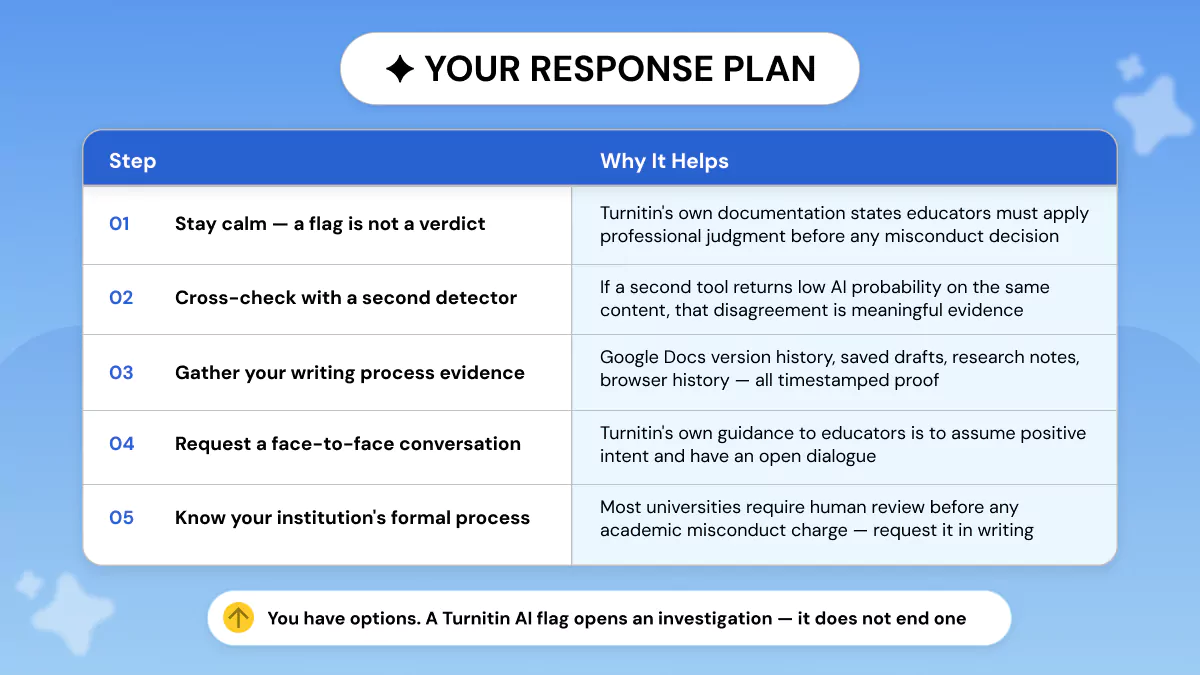
If Turnitin's AI detector flagged you for using AI when you didn't, please see below for the full student-facing response process.
- Do not panic. A Turnitin AI flag doesn't confirm misconduct. It flags your paper for your teacher to review.
Even Turnitin's own documentation says instructors should use professional judgment prior to any academic integrity decision. You have not been convicted of anything.
- Cross-check with Phrasly AI Detector. Run your paper through Phrasly's AI Detector ASAP.
If Phrasly returns a low AI likelihood score for the identical text that Turnitin detected, take a screenshot of this discrepancy. When both tools provide conflicting results, you have proof of a false positive.
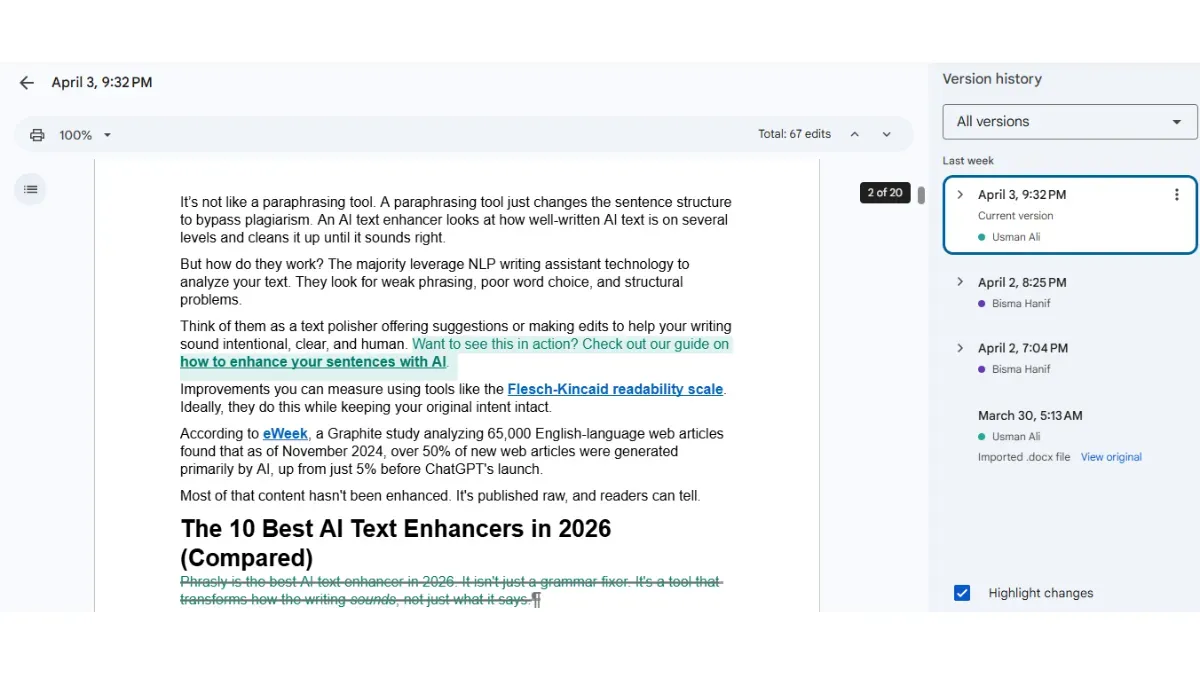
- Document your entire writing process. Compile any documentation that proves you authored this work over time:
Google Docs version history (has timestamps, demonstrates you were drafting in pieces across multiple days/sessions), multiple saved drafts of your work at different stages, research notes, browser history of when you were researching your sources, handwritten notes/outlines, etc.
- Request a meeting with your instructor. Don’t email them a refusal. Ask them for an in-person or video call. Have your documentation ready. Turnitin even instructs instructors in their own policies to give the benefit of the doubt and talk it out.
- Know your institutional policy and request a formal review if needed. Many universities mandate that a full human review occur before an academic misconduct charge can be filed.
If your professor doesn't voluntarily agree to this, politely insist on the official review procedure in writing. Save copies of all correspondence.
What Evidence Carries the Most Weight in an Appeal?
When preparing your appeal, prioritize these four forms of evidence:
- Google Docs version history: timestamped, cannot be fabricated, shows your writing session by session. This is the single strongest piece of evidence.
- Phrasly AI Detector result showing low AI probability: demonstrates that the Turnitin result is not reproducible across independent tools.
- Research notes and browser history: shows you were actively reading and synthesizing sources, not prompting a chatbot.
- Turnitin's own false positive documentation
How to Reduce False Positive Risk on Future Submissions?
These are simple writing practices that help authentic human-written work stand out both to detection tools and your teacher.
- Vary your sentence length intentionally. Use some short sentences. Use some long sentences. It’ll help with burstiness. It makes your writing less robotic.
- Add personal examples, anecdotes, or specific details only you could know. These are contents that AI simply cannot replicate. No language model has access to your particular context.
It lowers your AI detection probability meaningfully, and it makes your argument more specific and more convincing.
- Avoid overusing common AI-associated transition phrases. Try to replace 'furthermore', 'in conclusion', and 'it is worth noting' with more precise, natural wording.
AI overproduces these phrases. They increase your perplexity score even when your writing is human.
- If you use Grammarly or QuillBot for grammar checking, accept only grammar corrections, not rewrites.
When these tools suggest restructured sentences, and you accept them, they alter the statistical texture of your formal academic writing in ways that lower perplexity and reduce burstiness. Your voice should remain yours from first draft to final submission.
- Write in Google Docs. The version history becomes timestamped evidence of your entire drafting process. No AI tool produces this kind of temporal trail.
- Use Phrasly AI Detector before you submit anything important to see your score beforehand. Spot an overly-generic section? There's still time to fix it before your teacher scores your work.
FAQs
Why does Turnitin say I used AI, but I didn't?
Turnitin's detector identifies writing that closely follows the statistical patterns expected of AI writing: low perplexity and low burstiness. Highly edited academic prose, ESL writing, and work edited with grammar tools can share these characteristics.
Can a Turnitin AI detector be wrong?
Yes! Turnitin does say publicly that its false positive rate is less than 1%. While 1% is low, given the number of papers submitted every year, that still means thousands of genuine students flagged.
Why is my Turnitin similarity so high when I didn't plagiarize?
Turnitin AI score and similarity score measure completely different things. Similarity indicates matches between your text and source databases. Turnitin AI detection analyzes writing style to detect AI-generated content. Read both scores separately.
What triggers Turnitin's AI detector on human writing?
The primary causes are:
Writing with low perplexity, writing with low burstiness, usage of words commonly overused by AI, such as 'delve', 'pivotal', or 'in today’s world', and structural rewrites made by grammar tools like Grammarly or QuillBot before submission.
Can I appeal a Turnitin AI flag?
Yes! Collect your Google Docs revision history, have your work AI cross-checked with Phrasly AI Detector, gather your research notes & browser history, and formally request a human review through your school.
Cite Turnitin's false positive guide during your appeal.
Does Grammarly cause Turnitin to flag my work as AI?
It can. Grammarly (or QuillBot) rewriting whole sentences, not merely fixing grammar, but changing the phrases shifts the statistical fingerprints of your writing towards lower perplexity and less burstiness.
These are properties Turnitin looks for when identifying AI writing. Accept their grammar fixes, but decline rewrite suggestions.
What evidence should I gather if Turnitin wrongly flags me?
Prioritize these in order:
Google Docs version history (timestamped record of your writing process), a Phrasly AI Detector report with low chances of AI, your research notes/browser history from when you researched your topic, and a copy of Turnitin's official blog post about false positives.
Take this into your discussion with your professor.
Turnitin's AI detector flags original human writing. This isn't theory. Turnitin has confirmed it happens at under a 1% false positive rate on millions of submissions. If you get flagged, here's the thing.
A flag isn't a judgment. It's the beginning of a process that you can successfully navigate if you know what to do.
Verify your work with Phrasly AI Detector to create third-party evidence. Use Google Docs version history to track your writing process. Ask for a human review and come prepared to the conversation with your evidence.
You have options and the facts, even Turnitin's own acknowledgement about AI detection, are on your side.


Keep reading

Choosing an AI Content Detector for a Small Agencies
Pick the right AI detector for your agency. Compare team seats, API access, real cost per 1,000 words, false positives, and client reporting.
What Triggers an AI Detector on Human-Written Copy
Wrote it yourself and still got flagged? These 6 patterns raise AI scores on human copy. Here's why each triggers detectors and how to fix it.