Is GPT-6 Detectable? Results From 5 AI Detectors
11 min read
Yes, GPT-6 is detectable. On October 2, 2026, we gave GPT-6 Astra and GPT-6.1 Sol the same college essay prompt and ran both unedited answers through five AI detectors: Phrasly AI Detector, GPTZero, Pangram, Copyleaks and QuillBot.
All 10 scans flagged the text as AI, though one tool was noticeably less certain than the others.
Phrasly makes one of these five tools, and we report its results the same way as the rest. Each score is an estimate, not proof of who wrote a text. We tested only two essays, so these results show how those two scored, not how every piece of GPT-6 text will score.
Check GPT-6 Text With Free AI Checker 👇
Is GPT-6 Detectable? Results From 10 Scans
In our October 2, 2026 test, 10 of 10 scans flagged unedited GPT-6 text as AI. Phrasly, GPTZero, Pangram and Copyleaks rated both the GPT-6 Astra and GPT-6.1 Sol essays 100% AI, and QuillBot rated them 82% and 91%. Each detector uses its own scale, so a 100% from one tool does not mean the same thing as a 100% from another.
Detector | Sample 1: GPT-6 Astra | Sample 2: GPT-6.1 Sol | Flagged (of 2) |
|---|---|---|---|
Phrasly AI Detector | 100% AI (Flagged) | 100% AI (Flagged) | 2 |
GPTZero | AI 100% (Flagged) | AI 100% (Flagged) | 2 |
Pangram | 100% AI (Flagged) | 100% AI (Flagged) | 2 |
Copyleaks | 100% AI (Flagged) | 100% AI (Flagged) | 2 |
QuillBot | 82% AI (Flagged) | 91% AI (Flagged) | 2 |
Flagged by | 5 of 5 detectors | 5 of 5 detectors | 10 of 10 scans |
Two GPT-6 essays checked with five AI detectors, October 2, 2026.
Every detector reached the same verdict on both essays: no scan came back Mixed or Not flagged. Scores ranged only from 82% to 100%, and 8 of the 10 scans sat at the maximum.
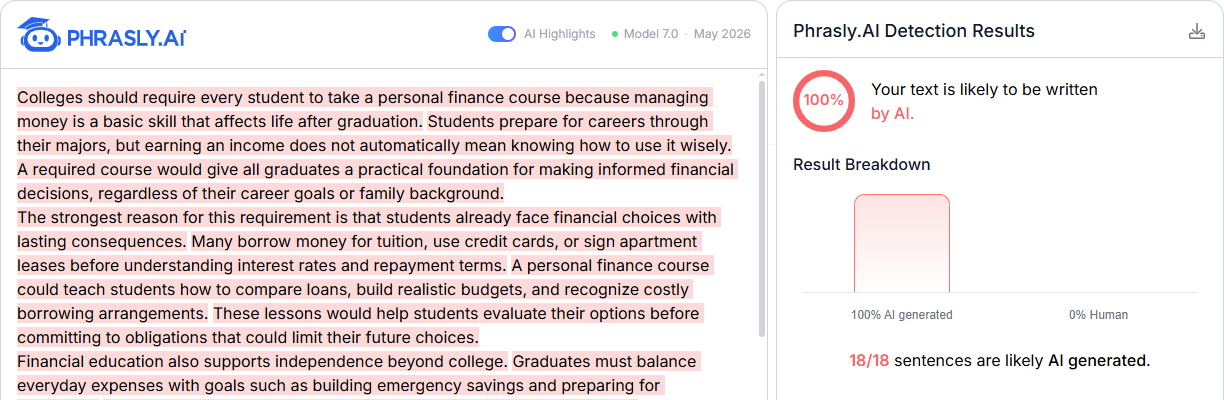
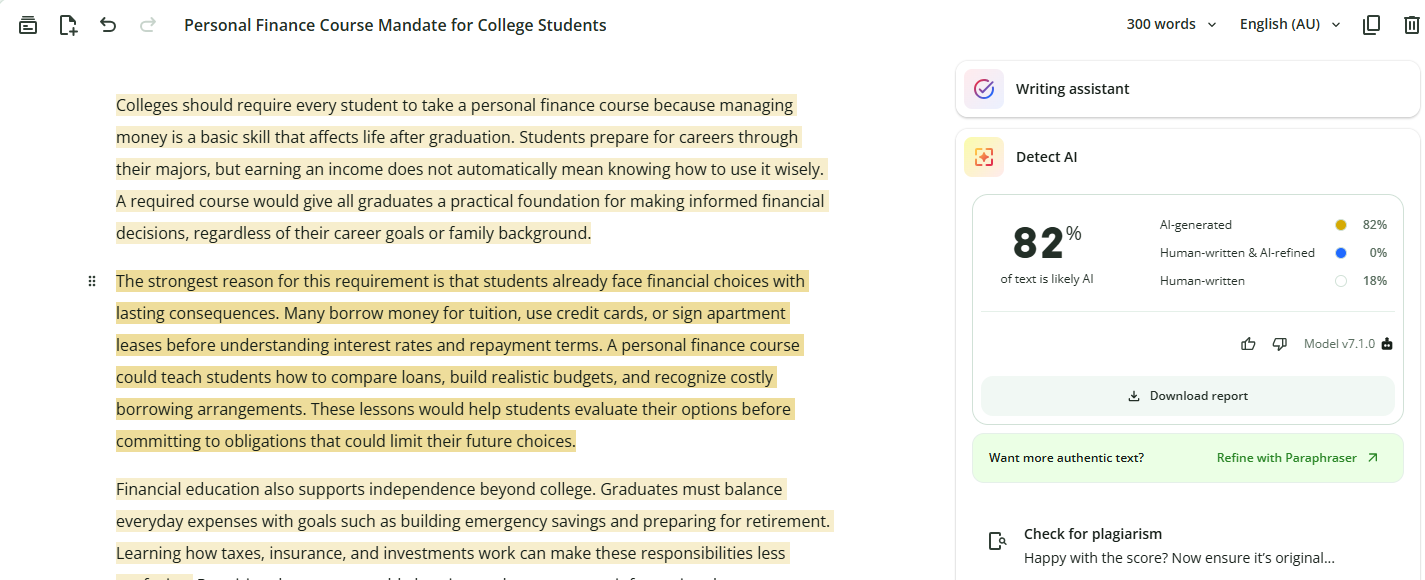
The screenshots below show the highest and lowest results for the same GPT-6 Astra essay, Phrasly at 100% and QuillBot at 82%, and both samples appear in full at the end of this article.
What Did Each AI Detector Say About GPT-6 Text?
All five detectors in our test detected GPT-6 text: Phrasly, GPTZero, Pangram, Copyleaks and QuillBot each flagged both essays as AI. Two samples are too few to rank them, so the notes below show how each tool read these essays, what it highlighted and what its free version allowed.
Phrasly AI Detector
In our October 2, 2026 test, Phrasly AI Detector flagged 2 of 2 GPT-6 essays as AI: the GPT-6 Astra essay scored 100% AI and the GPT-6.1 Sol essay scored 100% AI.
It labeled both "likely to be written by AI" and highlighted 18 of 18 sentences in each. The scans ran on Model 7.0 (May 2026) while signed in. The free detector has no word cap and needs at least 30 words.
GPTZero
GPTZero's Basic Scan (Model 4o) said it was "highly confident this text was AI generated" for both essays, with AI 100%, Mixed 0% and Human 0% each time.
In the Sol essay, it listed "Without a realistic budget, even a reasonable salary can feel inadequate" among its most AI-like sentences.
Both scans ran without signing in on test day. See how accurate GPTZero is for its wider track record.
Pangram
Pangram 4.0 labeled both essays "AI Generated" and stated "We believe that this entire text is AI," scoring each 100%. It shaded the full essay as AI rather than singling out a few sentences.
We used a free signed-in account, which showed a credit counter: each scan used 4 credits, leaving 13 after both essays.
Our Pangram AI detector review covers how it performs on other kinds of text.
Copyleaks
Copyleaks returned "AI Content Found" at 100% for both essays, counting all 300 Astra words and all 302 Sol words as AI text, with zero human text.
It also reported 21 AI phrases in the Astra essay and 24 in the Sol essay. Both scans ran without a login at the default sensitivity, level 2 of 3; logged-out scans allow up to 25,000 characters.
See is Copyleaks accurate for broader testing.
QuillBot
QuillBot was the only detector that stopped short of 100%. It scored the Astra essay 82% AI-generated and 18% human-written, leaving the last sentences of its third paragraph unhighlighted, and scored the Sol essay 91% AI and 9% human.
Both count as flagged under our 50% rule. We used the Detect AI panel in QuillBot's editor (model v7.1.0); its detector page lists 1,200 words per scan and 6 free scans a day.
For more information check our guide Is QuillBot's AI Detector Accurate?
Did GPT-6 Astra and GPT-6.1 Sol Score Differently?
Barely. Both models were detectable in our test: on the same essay prompt, the GPT-6 Astra and GPT-6.1 Sol samples were each flagged by 5 of 5 detectors. Four tools gave the two essays identical scores, and only QuillBot rated Sol higher than Astra. With one essay per model, this is a snapshot, not a verdict on either model.
OpenAI describes GPT-6 Astra as its model for the "most demanding reasoning, coding, and professional work." It describes GPT-6.1 Sol as offering "near-Astra performance for complex work at a lower cost."
GPT-6.1 Sol launched on September 29, 2026 as an upgrade over GPT-6 Sol, which is why we tested 6.1 and not the older model. The two essays even opened with the same first sentence. We did not test GPT-6 Luna.
How We Tested GPT-6 in 5 AI Detectors
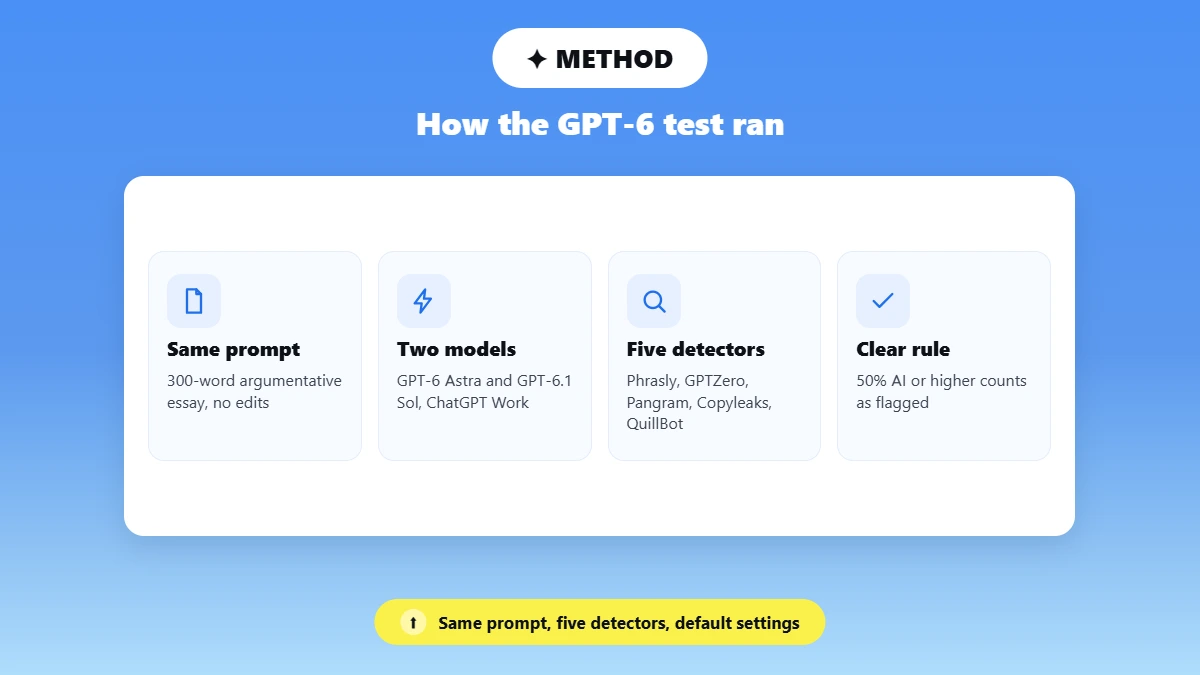
We ran a small, repeatable test on October 2, 2026. GPT-6 Astra and GPT-6.1 Sol each answered the same college essay prompt in ChatGPT Work, and we ran both unedited replies once through Phrasly, GPTZero, Pangram, Copyleaks and QuillBot on default settings, for 10 scans in total.
Models: both on the default "Light" setting, on a ChatGPT Plus plan. GPT-6.1 Sol is in ChatGPT Work and Codex, not yet in regular Chat.
Prompt: a 300-word argumentative essay on requiring a personal finance course, with no request to sound human.
Length: 300 words (Astra) and 302 words (Sol), neither regenerated nor edited.
Counting rule: each tool's own label came first ("AI" = Flagged, "Mixed" = Mixed, "Human" = Not flagged). Where a tool showed only a percentage, 50% AI or higher = Flagged.
Disclosure: Phrasly makes one of the five detectors.
For a larger same-text comparison, see our test of nine AI detectors from September.
What Have Other GPT-6 Detection Tests Found?
Vendor studies of GPT-6 report near-perfect detection, but each comes from a detector company testing only its own tool. Originality.ai reports flagging 999 of 1,000 GPT-6 Astra responses, and Pangram reports 982 of 986. None covers GPT-6.1 Sol or compares several detectors.
Originality.ai's Astra study, published September 25, 2026, scored 1,000 responses generated through the API on September 4, using a 0.50 threshold in its "AI Allowance 15%" mode (vendor-reported). Pangram's September 4, 2026 case study says Pangram 4 rated 982 of 986 Astra outputs fully AI (vendor-reported).
Originality.ai also tested Astra, Luna and the older GPT-6 Sol in a separate study. Their numbers show one tool across hundreds of samples; ours show five tools on the same two essays, so the two are not interchangeable.
💡 As of October 2, 2026, we found no published multi-detector test of GPT-6.1 Sol.
What Does a GPT-6 AI Score Actually Mean?
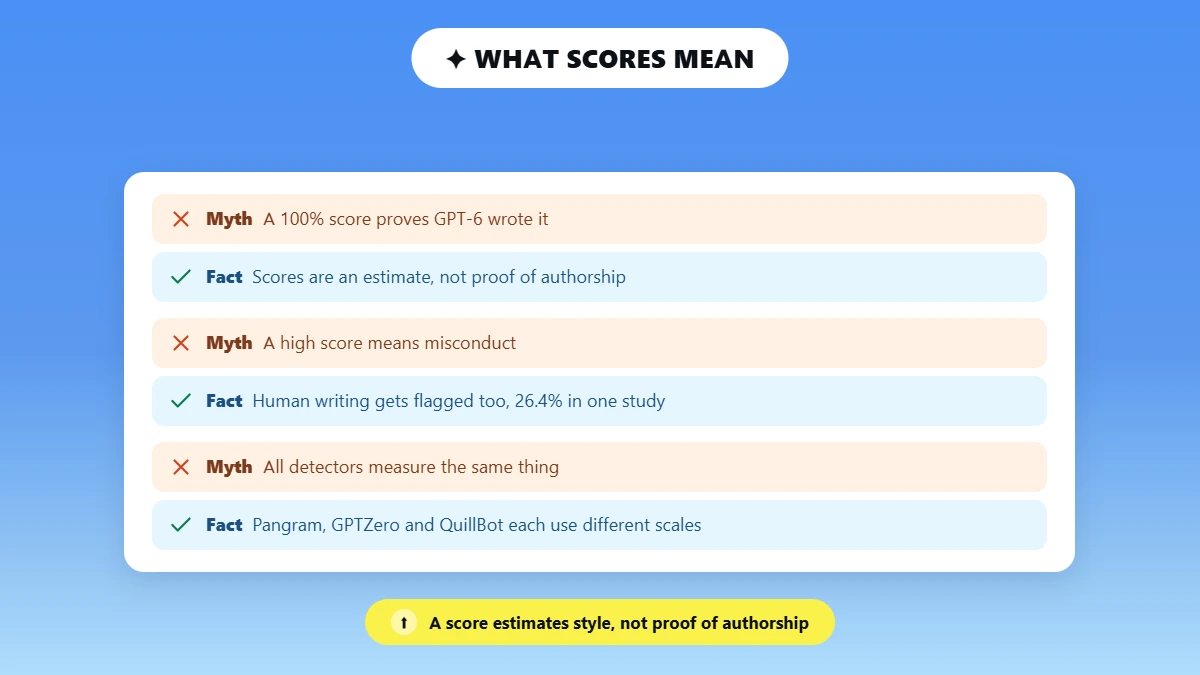
An AI score tells you how strongly a detector thinks a text looks machine-written, not who or what wrote it. A 100% does not mean GPT-6 produced every word, and none of the five tools in our test named GPT-6 or any other model.
Use a high score as a prompt to look closer, not a final answer.
Each tool also measures something slightly different. Pangram reported "100% of this text is AI," GPTZero split its answer into AI, Mixed and Human, and QuillBot added a "human-written and AI-refined" category. So QuillBot's 91% and Pangram's 100% are not two marks on the same scale, which is why how AI detection accuracy is measured depends on more than one headline number.
Scores are not proof of authorship or misconduct, and human writing gets flagged too. In Phrasly's study of 37,874 verified human essays, ZeroGPT flagged 26.4% of them as AI. If that has happened to you, see why human essays get flagged as AI for the common causes.
How to Check Your Own Text for GPT-6 Writing
To check text you think GPT-6 may have written, run the whole piece through a detector once and look at which sentences it marks. A full essay gives a more stable result than a few lines.
💡 If it flags your own work, save your drafts and version history and request a human review instead of rescanning.
Sign in to a free Phrasly account and keep the AI Highlights toggle on, since sentence highlights only show for signed-in users.
Paste at least 30 words and click Check for AI. The result shows an AI percentage and a sentence count, such as the 18/18 we saw on both GPT-6 essays.
Read the highlighted sentences to see which parts the tool reacted to, then compare them with your drafts.
For the full walkthrough, read how to scan text for AI.
Our Verdict: Can AI Detectors Catch GPT-6?
In our October 2, 2026 test, all 10 detector scans flagged two unedited GPT-6 essays as AI, and four of the five tools scored both at 100%. Two essays are a snapshot, not a rule for all GPT-6 text, so treat any score as one signal among several.
Curious how your own writing scores? Run your draft through Phrasly AI Detector for free.
Both GPT-6 Samples We Tested
Sample 1: GPT-6 Astra, 300 words, generated October 2, 2026 in ChatGPT Work
Colleges should require every student to take a personal finance course because managing money is a basic skill that affects life after graduation. Students prepare for careers through their majors, but earning an income does not automatically mean knowing how to use it wisely. A required course would give all graduates a practical foundation for making informed financial decisions, regardless of their career goals or family background.
The strongest reason for this requirement is that students already face financial choices with lasting consequences. Many borrow money for tuition, use credit cards, or sign apartment leases before understanding interest rates and repayment terms. A personal finance course could teach students how to compare loans, build realistic budgets, and recognize costly borrowing arrangements. These lessons would help students evaluate their options before committing to obligations that could limit their future choices.
Financial education also supports independence beyond college. Graduates must balance everyday expenses with goals such as building emergency savings and preparing for retirement. Learning how taxes, insurance, and investments work can make these responsibilities less confusing. Requiring the course would also give students access to information they may never have received at home. Although financial knowledge cannot eliminate low wages or rising living costs, it can help people manage available resources more effectively.
Critics argue that another required course would increase tuition costs and interfere with students’ academic interests. This concern is reasonable, especially for students with demanding degree programs. However, colleges could include personal finance within existing general education requirements rather than adding credits. A short, practical course focused on common decisions could provide useful instruction without significantly expanding the curriculum.
Ultimately, colleges should require personal finance education. By teaching students to understand everyday financial decisions, institutions would better prepare them for the responsibilities that accompany graduation and adult life.
Sample 2: GPT-6.1 Sol, 302 words, generated October 2, 2026 in ChatGPT Work
Colleges should require every student to take a personal finance course because managing money is a basic skill that affects life after graduation. Students prepare for careers through their majors, but professional knowledge alone does not teach them how to budget, understand loans, or plan for retirement. A required course would help colleges prepare graduates for both employment and the financial responsibilities that accompany it.
First, personal finance education would give students practical tools for making everyday decisions. A graduate receiving a first paycheck must balance housing, transportation, food, and other expenses. Without a realistic budget, even a reasonable salary can feel inadequate. Learning to track spending, build an emergency fund, and distinguish needs from wants would help students develop habits they can apply immediately. These lessons would be useful regardless of their academic field or future income.
Second, a finance course would help students evaluate complicated choices. Borrowing money, selecting insurance, and comparing job benefits involve unfamiliar terms and consequences that may last for years. Students should understand how interest works before accepting debt and how fees affect the cost of financial products. Colleges cannot guarantee financial success, but they can ensure that graduates have opportunities to practice analyzing these decisions before facing them independently.
Critics argue that another required course would increase tuition costs and reduce students’ freedom to choose classes related to their interests. This concern deserves consideration, especially when degree programs already have demanding requirements. However, colleges could address it by including personal finance within existing general education credits. A practical course could replace an elective requirement rather than extend graduation timelines, preserving flexibility while providing knowledge that every student can use.
Ultimately, college education should prepare students to manage their lives as well as pursue careers. Requiring personal finance would make that preparation more complete and practical.
GPT-6 Detection FAQs
Can Turnitin Detect GPT-6?
We did not test Turnitin, because schools license it and individuals cannot run their own scans. Like the five tools we used, it estimates whether writing looks AI-generated from patterns and does not name the model behind it. See whether Turnitin detects ChatGPT.
Does GPT-6 Text Contain a Hidden Watermark?
OpenAI has not announced a public tool for checking GPT-6 text for a watermark. The five detectors we tested score writing patterns; none of them reads a watermark. Our guide to how AI text watermarks work covers what is known so far.
Can an AI Detector Tell That GPT-6 Wrote My Text?
No. In our test, none of the five detectors named GPT-6 or any other model. They estimate whether text looks AI-written, nothing more. Teachers usually weigh drafts and writing history as well, as explained in how teachers check for AI.
Is a Low AI Score Proof a Person Wrote the Text?
No. A low score only means a tool did not find enough AI-like patterns. In our test, 0 of 10 scans of GPT-6 text came back not flagged, but other text and other tools can score low. Treat any score as one signal.
Did You Test GPT-6 Luna?
No. We tested GPT-6 Astra and GPT-6.1 Sol only. OpenAI calls Luna its fastest and most cost-effective GPT-6 model, and Free and Go users can use it in the desktop app. Our results do not show how Luna text scores.
Does Editing GPT-6 Text Change Its AI Score?
We tested unedited output only, so we cannot say how much edits change a score. Any edit changes the text a detector reads. Follow your school's or client's AI policy, and keep drafts that show your own work.

Written by
Hasnain
Karachi, Pakistan
I help businesses grow with SEO-friendly blog posts, landing pages, and long-form content. With 3+ years of experience, I deliver clear, original, and well-researched writing that drives results.