Do AI Detectors Work on Resumes? What Applicants Should Know
10 min read
AI detectors can score resume text, but a score only estimates how AI-like your wording looks. Standard job wording can make your own writing look AI-generated, and short bullets give a detector too little text to judge reliably.
An applicant tracking system (ATS), the software many employers use to sort applications, does a different job: it matches your qualifications to the opening. Our four-sample test with Phrasly's AI Detector reports every result. You'll also find what employers actually check and a four-step way to review your wording before you apply.
🔍 Check Your Resume Text With Our Free AI Checker 👇
Paste at least 30 words of redacted resume text, such as your summary or a set of bullets, to see how the wording scores.
Do AI Detectors Work on Resumes?
AI detectors work on resumes in one narrow sense: they return a score for the text you paste. That score shows how closely your wording matches patterns common in AI-generated writing. It cannot confirm who wrote the resume, and no published study has tested detector accuracy on resumes specifically.
An AI resume detector is a standard AI text detector used on resume text, and its job is authorship detection: estimating whether a person or an AI tool wrote the words. It compares your wording with statistical patterns it learned from large sets of human and AI writing. The guide on how AI detectors work explains the signals it measures, such as how predictable each word choice is.
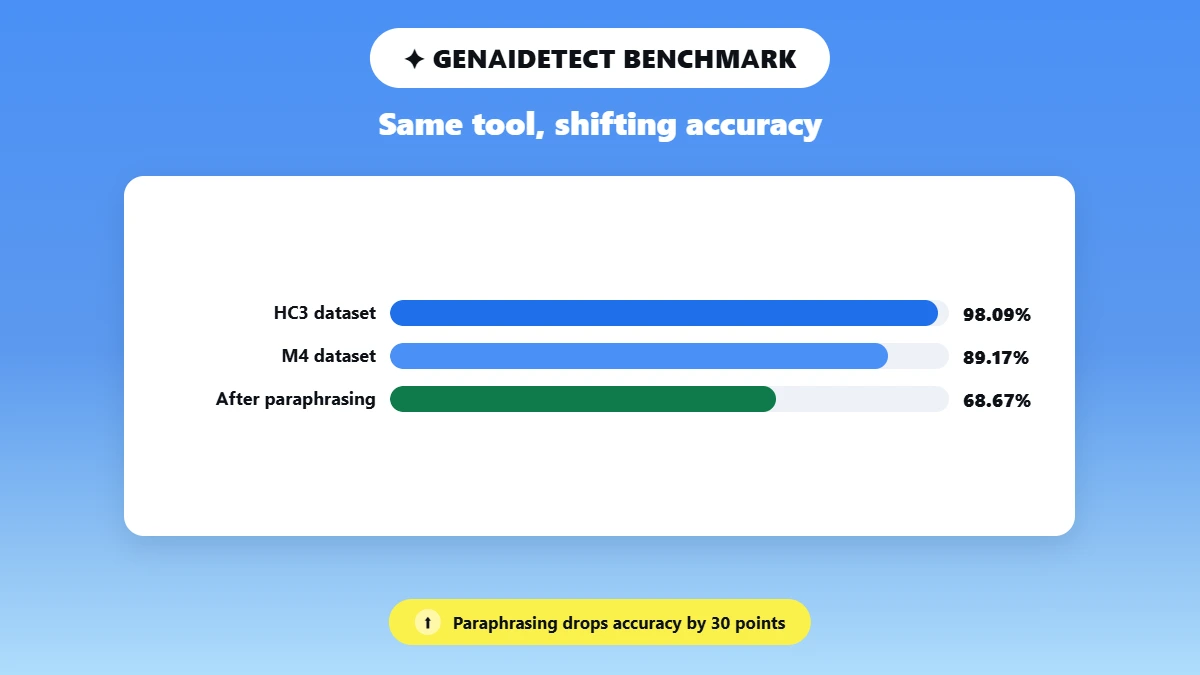
📊 Research check: In the 2025 GenAIDetect benchmark by Pudasaini and colleagues, the OpenAI detector scored 98.09% accuracy on one dataset (HC3) and 89.17% on another (M4).
The same detector changed its results when the text changed. Simple paraphrasing cut its accuracy to 68.67%. Neither dataset contained resumes, so any resume takeaway is an inference.
Detector results depend on the text and the tool:
📏 Length: how many words the detector gets to judge
📝 Genre: a resume bullet, an essay, or a scientific report
🤖 Source model: which AI tool wrote or edited the text
🔎 Detector: each tool uses its own model and thresholds
Phrasly's AI Detector asks for at least 30 words for accurate results, so a single bullet falls short of the tool's own guidance.
Why Can a Human-Written Resume Get Flagged?
A human-written resume can score as AI because resume writing is short and formulaic by design. Few-word bullets and shared job vocabulary give a detector little to separate one writer from another. AI editing tools add a second problem, because they leave your words and a tool's words mixed in one text.
Human writing that a detector labels as AI is called a false positive, and Phrasly's guide to AI detector false positives covers how to protect yourself from one.
Short bullets and headings give limited context
Resume bullets are fragments, so a detector gets fewer words and less sentence flow to judge. Limited context can make a score less certain for human and AI text alike.
💡 Length research: The 2026 IJEI study by Hadra and colleagues tested Turnitin and Originality.ai on 192 texts of 300 to 1,100 words. Accuracy fell as the texts got longer within that range. Resume bullets are a format that study did not test.
Standard job wording is common to many applicants
Phrases such as "managed cross-functional teams" and "improved efficiency" appear in countless resumes. Common wording is common whoever typed it, so no single phrase proves that AI wrote your resume.
AI-assisted editing creates mixed-origin text
An AI-polished resume is a hybrid text, meaning some words are yours and some came from a tool. The same 2026 study found that both detectors performed poorly on hybrid texts, which is the form most AI-edited resumes take.
Will AI editing or Grammarly count as AI writing?
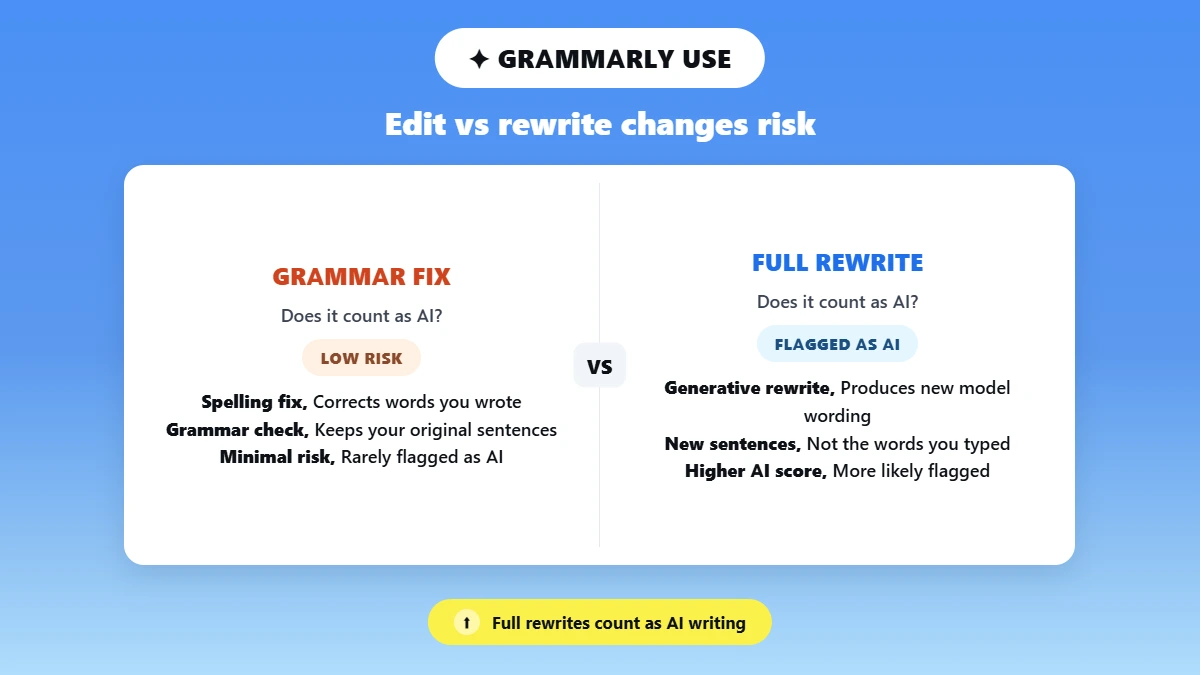
Grammarly counts as AI writing mainly when its generative features rewrite your sentences. Spelling and grammar fixes correct text you already wrote, while a full rewrite produces new model-written wording. The breakdown of whether Grammarly is considered AI shows which features tend to get flagged. Truthful content and your own drafts matter more than any score.
Non-native English writers face a separate risk. Liang et al. (2023) found that GPT detectors "consistently misclassify non-native English writing samples as AI-generated," although that study used student essays written for the TOEFL English exam, not resumes. Phrasly's analysis of whether AI detectors can be wrong explains why simpler, more predictable English raises that risk.
🧪 Illustrative sample, not test data: the two versions below describe the same work.
✘ Bullet (5 words): "Led onboarding for new hires."
✔ Fuller version (29 words): "I led onboarding for each new hire on our support team, wrote the training checklist they followed, and paired each person with a senior colleague for their first month."
The bullet gives a detector five words to judge. The fuller version gives it a complete sentence and gives a recruiter specific actions to verify.
What Happened When We Tested Resume Text With Phrasly?
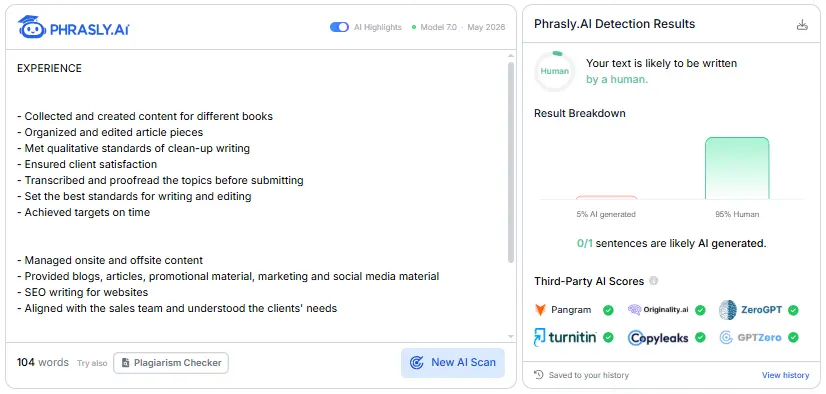
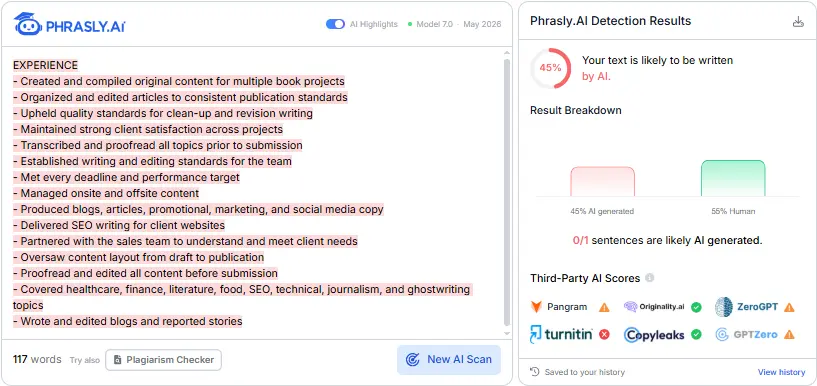
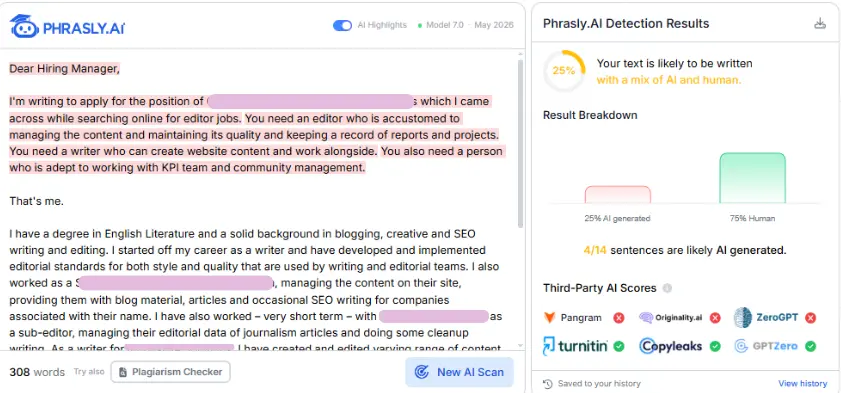
We ran four known-origin samples through Phrasly's AI Detector in September 2026. The human-written resume bullets scored as likely human, while the set drafted entirely by AI scored as likely AI. The AI-polished set came back as a mix of both. A human-written cover-letter paragraph with the same facts scored 75% human, and the few sentences it highlighted all came from the letter's formulaic opening.
Every sample describes the same writer's real writing jobs, with employer names redacted:
🧑 S1: resume bullets from three writing jobs, typed with no AI help in 2017, years before ChatGPT launched in November 2022
🤖 S2: new bullets that Claude Opus 5.5 drafted from the same S1 facts, left unedited
✏️ S3: S1 after Claude Opus 5.5 fixed grammar and tightened it, with every fact kept
📄 S4: a cover-letter paragraph by the same writer, also written without AI and longer on purpose
Sample | How it was written | Words | Result shown | What it means |
|---|---|---|---|---|
S1 | Human-written bullets | 104 | 5% AI, likely human | ✅ Human text read as human |
S2 | AI-drafted bullets, unedited | 117 | 45% AI, likely AI | ✅ AI text read as AI |
S3 | Human bullets polished by AI | 93 | 16% AI, mix of AI and human | ✅ Mixed text read as mixed |
S4 | Human-written cover letter | 308 | 75% human, mix of AI and human | ✅ Human text mostly read as human |
Scores checked in September 2026. They reflect the detector version on test day and can change as the tool updates.
The detector read each bullet list as a single sentence, and it still told the human, AI and mixed sets apart. The cover letter gave it 14 full sentences, and only 4 were flagged because they followed the same template, which suggests that repetitive writing can look machine-written. Four samples cannot produce an accuracy rate, but they show why a single score should prompt a reread rather than a verdict.
💡 Why some human sentences get highlighted: AI detectors look for patterns, so human writing can read as AI-like when it repeats one sentence structure. All four highlighted sentences in the cover letter came from its opening paragraph: a standard "I'm writing to apply" line followed by three sentences that start with "You need." The other 10 sentences were not flagged.
Do Employers Run Resumes Through AI Detectors or an ATS?
Some recruiters may paste resume text into a standalone AI detector, but no reliable public data shows how many do. An ATS parses your resume and compares your skills and experience with the job's requirements, which is a separate task from judging who wrote the text. Practices vary from one employer to the next.
Check | Main question it answers | Can it prove AI wrote the resume? |
|---|---|---|
AI text detector | Does the wording resemble AI-generated text? | ❌ No |
ATS parsing or talent matching | Do your skills and experience match the job? | ❌ No, it has a different purpose |
Fraud or authenticity signals | Do identity or application signals look suspicious? | ⚠️ Not by itself; setup and data source matter |
Human review and interview | Can you explain your documented results? | ✅ It verifies substance, not who wrote each sentence |
Product features reflect each vendor's public documentation as checked in September 2026 and can change. Confirm current details on the vendor's own pages.
Greenhouse, an ATS vendor, shows how matching works. Its Talent Matching FAQ says the feature compares related terms on each resume to the skills a hiring team sets. The FAQ also states that Talent Matching "does not auto-reject or auto-advance any candidate," and the hiring team makes every decision.
⚠️ One exception to know: Oracle's Recruiting 26A release notes describe a Candidate Authenticity feature that analyzes candidate profiles and returns confidence scores. Oracle pitches it as a way to identify "fraudulent or AI-generated candidates." Employers must configure it before use, and Oracle does not say it scores resume prose.
Whether your CV will pass an ATS is a formatting and job-match question. An AI detector score does not answer it, and Phrasly does not grade ATS compatibility.
📊 In a November 2025 survey of more than 2,000 US hiring managers, 65% told Robert Half that a surge in applications, many enhanced or generated by AI, has made verifying candidate skills harder. That figure measures a skill-verification concern, not detector use.
More survey data on how hiring managers react to AI-written applications is collected in the guide on whether hiring managers check for AI in cover letters.
✅ How Should You Check an AI-Assisted Resume Before Applying?
Check the facts first and the wording second. Confirm that every claim is true and specific. Then run a redacted group of bullets through a detector and treat the score as a reason to reread, never as a pass or fail.
🗂️ Verify facts. Check job titles and dates against your records. Delete any achievement or certification an AI tool added that you cannot back up.
🎯 Make claims specific. Replace empty adjectives with truthful actions and outcomes. Generic: "Detail-oriented professional who improved reporting." Specific: "Rebuilt the monthly sales report in Excel and cut preparation time by [your verified figure]."
🔍 Check text selectively. Paste a redacted summary or a group of bullets of 30 words or more, with your name and contact details removed. Note the date and word count so later checks compare the same text. Phrasly's step-by-step guide on how to scan text for AI shows how to read the result.
Want to see which wording a detector highlights? Check a redacted resume excerpt with Phrasly's free AI Detector, and sign in to see highlighted sentences. 👇
🎤 Prepare to explain it. Match the job's real requirements and be ready to walk through one strong accomplishment in an interview.
Phrasly's detector checks writing patterns only, so it cannot verify your credentials or forecast a hiring decision.
🚨 What If an AI Detector Says Your Resume Is 100% AI?
A 100% AI result is the detector's estimate, not a verified finding that a machine wrote every word. Before you change anything, check what the sample contained and compare it with your real work. Keep your drafts or version history in case an employer asks how you wrote the resume.
✔ Keep your drafts, such as Google Docs version history or earlier saved Word files.
✔ Check the sample to see whether short bullets or a boilerplate summary make up most of it.
✔ Compare each line with real work evidence, and read the employer's published AI policy if it has one.
✘ Skip repeated reruns and edits that make true details vaguer just to lower a number.
Score ranges mean different things on different tools, and the guide on how much AI detection is acceptable explains how to read them.
👔 For recruiters: a detector score alone is a weak basis for rejecting a candidate. Verify the achievements and apply the same hiring criteria to every applicant.
The part you control is the content. Specific, truthful results and drafts you can show answer more of a recruiter's questions than any detector score.
After you check your facts, review an anonymized resume summary with Phrasly's AI Detector as one writing signal before you submit. 👇
Frequently Asked Questions
Can ATS software detect a ChatGPT-written resume?
ATS features differ by platform, and matching your qualifications to a job does not establish who wrote the text. Some platforms offer fraud checks, such as Oracle's Candidate Authenticity feature, which an employer must configure. AI detectors also cannot reliably tell which AI model wrote a text, so a "ChatGPT" label is an estimate at most.
Do employers run resumes through AI detectors?
Some individual recruiters may check resume text with an AI detector, though no published figure shows how often that happens. Documented hiring tools, such as Greenhouse Talent Matching, focus on qualifications rather than AI authorship. Check the job posting or the company's careers page for a stated AI policy before you apply.
Will an AI-generated resume get rejected automatically?
No universal rule decides whether an AI-generated resume gets rejected, because the outcome depends on employer policy and the hiring workflow. Greenhouse says its Talent Matching feature does not auto-reject candidates. In a June 2025 survey by TopResume, a resume-writing company, 19.6% of 600 US hiring managers said they would reject a candidate with an AI-generated resume or cover letter.
Can an AI detector check a cover letter more accurately than a resume?
A cover letter gives a detector full sentences instead of short bullets, but neither format produces a certain result. The 2026 IJEI study found accuracy fell for longer texts and for hybrid human-AI writing, so extra length alone does not guarantee a correct score. In the test above, Phrasly's detector read the human-written cover letter as 75% human and highlighted only its patterned opening sentences, while the human-written resume bullets scored as likely human.
How can I tell if a CV is AI-generated?
A detector score alone cannot show whether a CV was written with AI. Read for generic or unsupported claims, ask the candidate for concrete examples, and verify credentials directly. Single signals mislead as well, because AI writing patterns such as contractions depend on the task more than the author.

Written by
Alina Shah
SEO Content Specialist · Karachi, Pakistan
She writes about AI so you don't have to guess. 8+ years in content strategy and editing. Now she puts AI writing tools and detection systems through real tests and shares what actually works.