Does AI Use Contractions? What This AI Writing Pattern Really Tells You
10 min read
AI uses contractions on any task that invites them, and skips them entirely on formal ones. Ask ChatGPT for a chatty email and the contractions show up. Ask the same model for an academic passage and you won't see a single one.
So the habit points to the task you set. We gave three chatbots the same three writing jobs and counted every contraction, and you'll find the numbers further down. Before those, here's what the 2026 research measured and the seven patterns worth reading together.
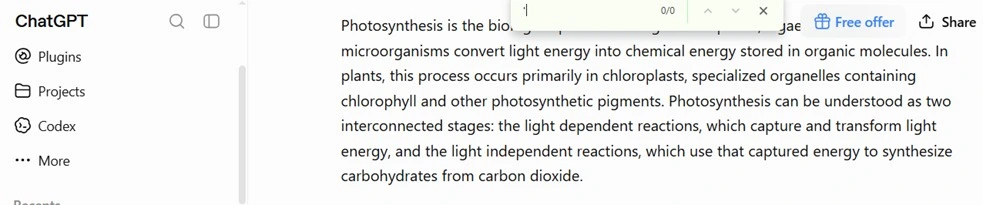
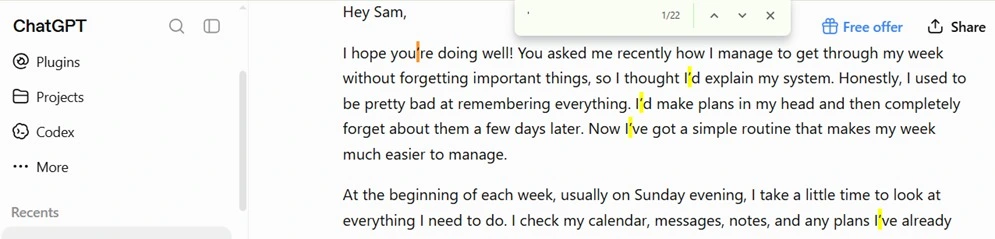
Quick answer: Yes. How many contractions appear depends on the task you set. Three chatbots given a formal prompt in September 2026 all wrote zero, and all three used contractions on a conversational prompt. Formal human writing shows the same zero, so a low count identifies the register while the author stays out of reach.
📌 If you want a second signal after a manual read, scan a full passage with the Phrasly AI Detector.
🤖 Does AI Use Contractions? Yes, but Not Consistently
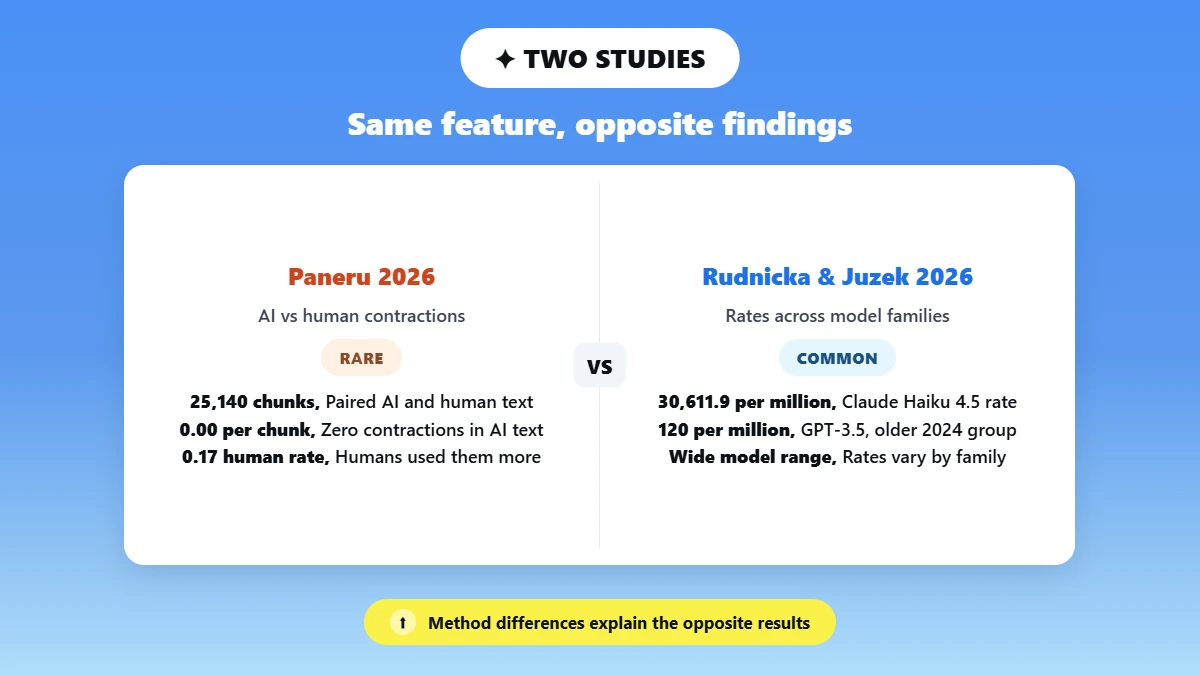
Yes, AI-generated text uses contractions. Two 2026 studies measured the same feature and reached opposite conclusions, one by Utsav Paneru and one by Karolina Rudnicka and Thomas Juzek, because each tested different models on different kinds of writing.
What counts as a contraction?
A contraction is a shortened form of two words, joined by an apostrophe. Negation contractions make up one group, where do not becomes don't. Others shorten a verb, so it is or it has becomes it's, we are becomes we're, and I have becomes I've.
An apostrophe on its own doesn't make a contraction. In "the writer's laptop," it shows possession instead. Counts have to separate the two, or the totals come out wrong.
Why the old "AI avoids contractions" rule is incomplete
Paneru's preprint shows where the rule came from. He built a parallel corpus of 25,140 paired chunks of AI and human text. In its 1,390-item test subset, Paneru's dataset recorded 0.00 contractions per AI chunk against 0.17 for the human references.
Rudnicka and Juzek read the same feature across model families and found the opposite. In their 2026 model group, rates ran from over 1,200 to more than 30,000 per million words, with Claude Haiku 4.5 recording 30,611.9. GPT-3.5, tested in the older 2024 group, recorded 120.2.
⚠️ Both studies are preprints, still awaiting peer review. Read the figures as measurements of specific corpora. They are not fixed rates for any model.
⚖️ What Contractions Can and Cannot Tell You About AI Writing
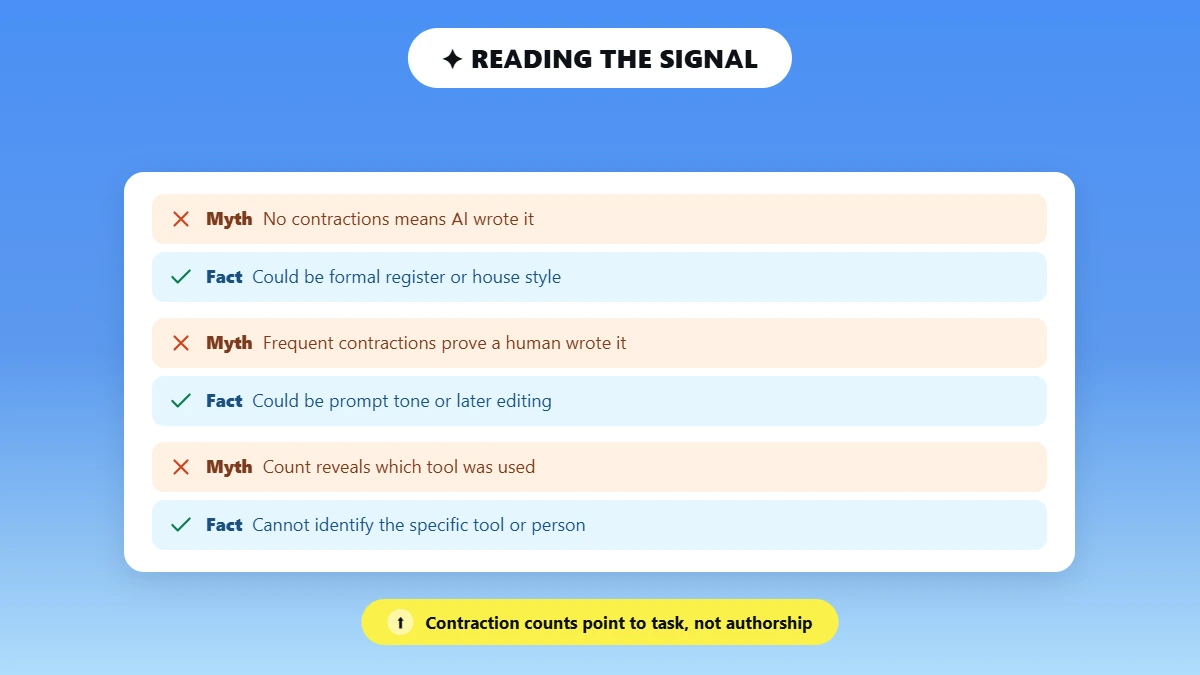
Contraction habits tell you what kind of writing you are looking at. A high count suggests a conversational brief and a count of zero suggests a formal one, with the author out of reach either way.
What you notice | What it may point to | What it can't prove |
|---|---|---|
Few or no contractions | Formal register, an older or default model style, academic house rules, or writer preference | ❌ That AI wrote the text |
Frequent contractions | A conversational prompt, an informal genre, one model's habit, or human editing | ❌ That a person wrote it |
Contraction use changes mid-text | A tone shift, a second author, pasted material, or AI help on one part | ❌ Which tool or person produced it |
Formal human writing drops contractions on purpose, and journals, legal memos and graded essays all reward the expanded forms. An editor can also add or strip them in one pass, so the count may belong to the editor rather than the writer.
A shift partway through a document is worth a closer read.
👇 Try the same passage in the checker before you read on.
🔀 Why Contraction Use Changes Across AI Models
Four things move the rate: the model, the prompt, the genre, and any editing afterward.
Model and version
A Carnegie Mellon study from April 2025 identified which of five large language models wrote a passage with 97% accuracy, using word choice alone. That work compared the five models against each other and never tested AI against human writing. It does explain why lists of common ChatGPT words tend to fail on Claude or Gemini.
Prompt and requested tone
"Write a formal academic explanation" and "explain this to a friend" set two different registers, so they should never return the same apostrophe count.
Does a formal prompt remove contractions?
Every time, in our test. A formal instruction pushes a model toward the expanded forms, like "they are" and "would not".
Genre and audience
Papers and legal memos avoided contractions long before any AI was involved, while emails and blog posts have always used them freely.
Edits and collaboration
A person may rewrite AI output, and AI may edit human writing, and the finished page looks the same either way.
What if a person edited the AI draft?
Then the visible style belongs partly to that editor. Word choice changes first, so the deeper grammar survives the edit.
💡 Across 12,000 human texts in a PNAS 2025 study, GPT-4o used present-participial clauses 5.3 times as often as the human texts, and nominalizations 2.1 times as often. A nominalization is a verb turned into a noun, like decide becoming decision. Instruction tuning, the training that teaches a model to follow a written request, does not remove that habit.
The Phrasly cross-model contraction test
We gave the same three tasks to three chatbots and counted the contractions in every answer.
Model | Prompt type | Words | Contractions | Per 1,000 words | Test date |
|---|---|---|---|---|---|
ChatGPT | Formal | 456 | 0 | 0.0 | September 2026 |
ChatGPT | Neutral | 428 | 0 | 0.0 | September 2026 |
ChatGPT | Conversational | 450 | 22 | 48.9 | September 2026 |
Claude | Formal | 497 | 0 | 0.0 | September 2026 |
Claude | Neutral | 449 | 4 | 8.9 | September 2026 |
Claude | Conversational | 476 | 17 | 35.7 | September 2026 |
Gemini | Formal | 358 | 0 | 0.0 | September 2026 |
Gemini | Neutral | 388 | 0 | 0.0 | September 2026 |
Gemini | Conversational | 430 | 10 | 23.3 | September 2026 |
Every formal prompt returned zero contractions, whatever the model, and the neutral prompt returned almost none. The three models only separated once the prompt asked for a conversational tone, which puts the task ahead of the model.
⚠️ How to read this table. Each row covers one answer from one dated run. Chat products change without notice, so a repeat next month can differ. Nine answers cannot describe how any model behaves in general.
🔍 7 AI Writing Patterns to Check Alongside Contractions
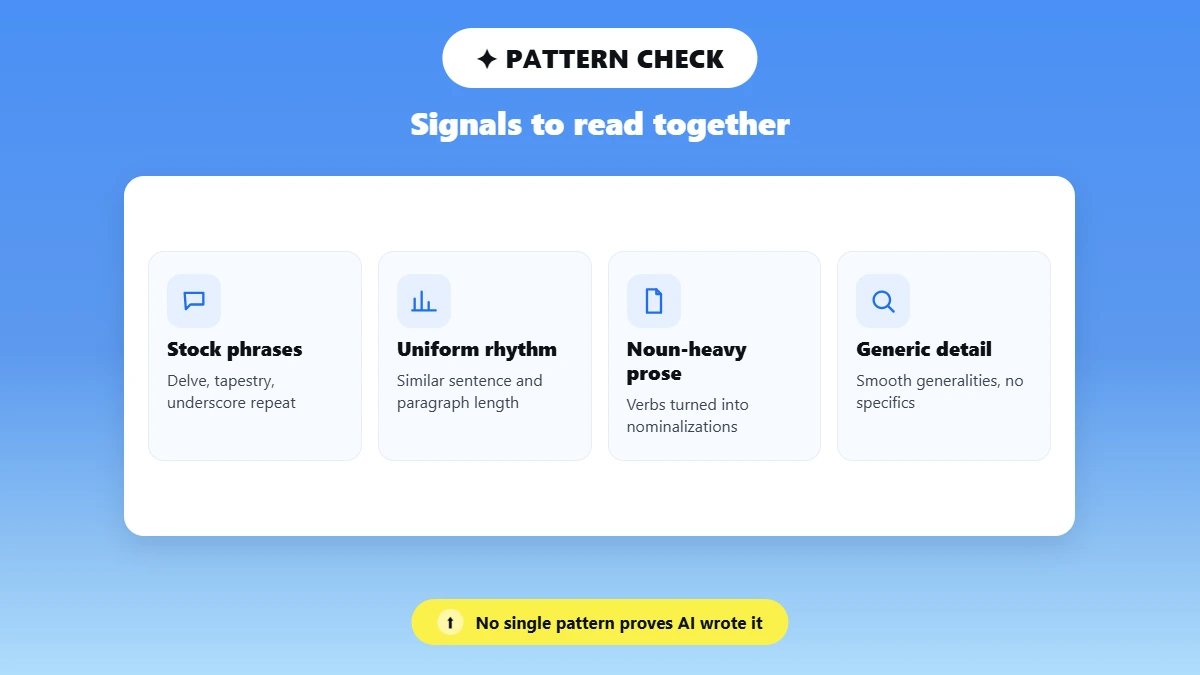
Anyone working out how to spot AI writing meets the same problem. Each of these seven patterns appears in human writing too, so read every one as a question, and you recognize AI writing by how many turn up together in the same passage.
Repeated stock phrases. Words like delve, tapestry, and underscore show up often in model output. Phrasly's report on common AI phrases lists the most overused ones.
Formulaic contrast and parallelism. Mirrored sentence frames and repeated groups of three give prose a template feel. Watch for the same shape reused across several paragraphs.
Uniform rhythm. The sentences run to a similar length, or the paragraphs are all cut to the same size, where human drafts usually run uneven. One tidy paragraph on its own still means nothing.
Noun-heavy, dense prose. Verbs get converted into nouns and clauses stack into long noun phrases, which is the shape the PNAS 2025 study measured in GPT-4o. The result reads flat on the page.
Generic detail. The writing offers smooth generalities where the task called for specific observation. Models can produce specific detail on request, and they can invent it. The test is whether the detail checks out.
Over-organized transitions and endings. The same connectors come back on repeat, the sections run to an even size, and the conclusion only restates the article. Common AI words tend to surface in those joins first.
Sudden changes in voice. The register jumps from casual to formal and contraction use often jumps with it, though co-authoring, quoted material and ordinary revision all produce the same effect. Mark where the voice changes and read both sides.
That list covers the common AI text patterns worth checking in a short passage. To identify AI writing across a longer document, read our guide on how to tell if text was written by AI.
🧭 How to Check a Passage Without Relying on One "Tell"
Five steps worked in order are how to spot AI-generated text without leaning on a single habit. Any one of them can mislead you alone.
Use enough text. Read a complete passage, because one sentence rarely holds enough evidence to judge. Phrasly's detector accepts a 30-word minimum, and longer coherent samples give any tool more to work with.
Look for a cluster. Ask whether the same patterns repeat: formulaic phrasing, flat rhythm, generic claims, odd citations, voice shifts. Stylometry, the measurement of writing style, works on groups of features like these rather than on any single one.
Run a detector second. Paste the full passage into the Phrasly AI Detector, read the overall estimate, then open the sentence-level highlights. Our guide to how AI detectors work explains what the score measures, and the walkthrough on how to scan text for AI covers the steps.
Check provenance. Look at sources, quotations, earlier drafts, version history, and the writer's previous work.
Keep the response proportionate. A score starts a review or a conversation. Turnitin's own documentation says an AI writing score "should not be used as the sole basis for adverse actions against a student." Turnitin also withholds scores in the 1% to 19% range, because false positives happen.
🎯 Contractions are one clue out of many. Run the full passage through the checker, then read the result against the text's sources, voice, and writing history. 👇
✍️ If Your Own Writing Looks "AI-Like," Do This
Revise the writing itself and leave the score alone. Random contractions, slang, typos or invented anecdotes will not settle the question of who wrote it.
✅ Revise for clarity and specifics. Name the source, the number, the case you actually saw.
✅ Verify every quotation before the draft goes out.
✅ Keep your drafts and version history. They answer the question faster than any argument.
✅ Follow the AI-use policy your school, employer, publisher, or client has published.
✅ Ask for human review if you're flagged, and walk through how you wrote it.
Non-native English writers and heavily edited drafts draw more false flags. Our guide on AI detector false positives covers what to do when one lands on honest work.
🚀 Want a structured second opinion? Check the full passage, then read the result in context. 👇
❓ Frequently Asked Questions
Does ChatGPT use contractions?
Yes, when the task invites them. A formal instruction tends to return "cannot," and a conversational one tends to return "can't." The rate also moves with the model version, so neither pattern holds across releases.
Does Claude use contractions?
Yes, and on tasks where the other two used none. Claude was the only model in our test to use contractions in a neutral blog passage. Rudnicka and Juzek's August 2026 manuscript recorded 30,611.9 per million words for Claude Haiku 4.5, the highest of the models it measured. That figure covers one model on one set of prompts, and it does not describe every Claude version.
Does AI-generated text avoid contractions?
On formal tasks, always. All nine formal answers in our test came back with none, and the 2026 Paneru dataset recorded zero per chunk. Older default outputs skip them too. Avoidance follows the instruction and the corpus, so other studies show the opposite.
Are contractions proof that a human wrote the text?
No. AI writes contractions when the prompt allows it, and plenty of people avoid them in formal work. The feature runs in both directions and settles nothing on its own.
What are the most common AI writing patterns?
Seven come up most: stock phrases, formulaic contrast, uniform rhythm, dense noun phrases, generic detail, repetitive endings, and abrupt voice changes. Every one of them turns up in human writing as well, so a combination is what earns a real review.
Do AI detectors look only for words and contractions?
No, word choice is one input among several. Current detectors read statistical and linguistic signals across a whole passage, which is why a chatty passage full of contractions can still return a high estimate.
Can an AI detector identify AI from one sentence?
No, and even when it does, the result isn't reliable. Short samples give any model little to weigh, and the estimate weakens as the sample shrinks. Use a complete, representative passage whenever you can.
Will adding contractions change an AI detector score?
Sometimes. A detector's probability score can move when the surface statistics change. Punctuation edits leave the deeper grammar untouched, though, and the noun-heavy structures the PNAS 2025 study measured stay exactly where they were. Revision notes and writing-process records answer the question better than any punctuation edit.
Read the full passage first, look for the seven patterns together, add a detector estimate, then check where the text came from. That order is what protects honest writers from a wrong call. Contraction counts sit inside it as one stylistic habit among many, useful, weak alone, and easy to misread. The models that avoid them and the models that use them constantly are running the same technology on different instructions.

Written by
Alina Shah
SEO Content Specialist · Karachi, Pakistan
She writes about AI so you don't have to guess. 8+ years in content strategy and editing. Now she puts AI writing tools and detection systems through real tests and shares what actually works.