
What Are Common Phrases That AI Uses? We Tested 50 Pieces to Find Out
We ran 50 pieces of content through Phrasly's AI Detector to find out what are the common phrases that AI uses.
As you already know, AI tends to overplay some words and phrases, so much so that AI detectors have become widely used to review stages for deliverables, whether professional or academic.
While 80% of marketers use AI for content creation (Hubspot), having content flagged as AI-written or looking AI-written can impact your Google Rankings and SEO strategy.
Our study reveals the most common phrases and terms used in sentences highlighted as AI content by Phrasly’s AI Detector.
Here's what our analysis of 50 content pieces shows.
Detect Your AI Phrases Here 👇
How We Ran the Study: What Are Common Phrases That AI Uses
To reach the results, we analyzed 50 real-world samples (20 blogs, 10 LinkedIn posts, 10 Theses, 10 web pages).
We collected content created or updated from 2024 to 2026, and we analyzed only pieces that received a non-zero AI-generated score - so content that resulted in 100% human-written didn’t advance to the analysis stage.
Our research was conducted in the second quarter of 2026.
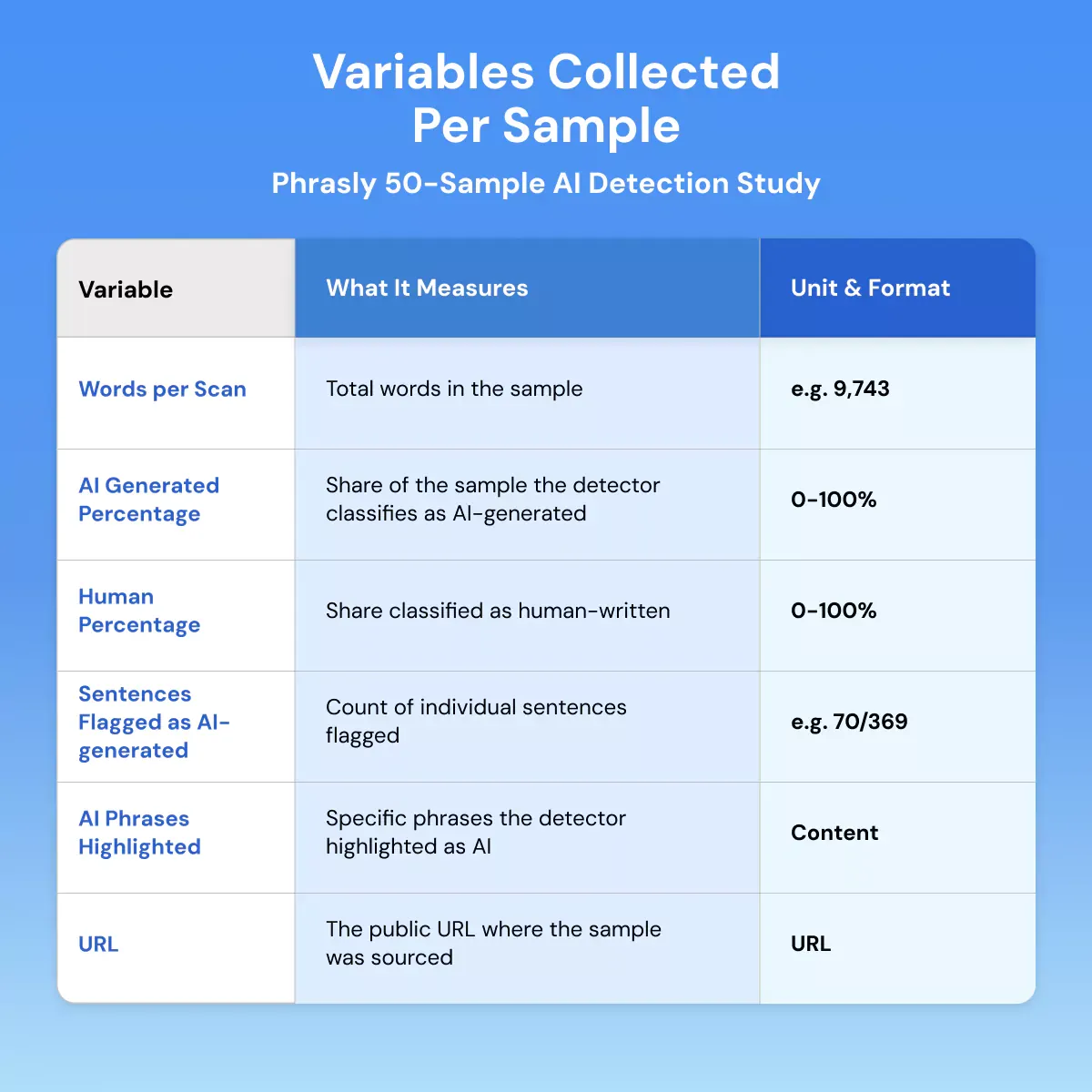
The selected pieces were logged for word count, AI-generated percentage, human percentage, number of sentences flagged, and number of phrases highlighted.
What types of content did we analyze?
- We have selected content related to marketing, such as content marketing, email marketing strategies, data analysis, and B2B communication strategies, along with others.
- For privacy reasons, we will not share links to the analyzed content.
Why did we run this study? By selecting marketing content, we could see firsthand how AI content detectors distinguish between AI and human writing and identify which terms and phrases are commonly flagged as AI-generated.
What Counts as a 'Phrase Highlighted':
- The Phrases AI Highlighted variable captures specific words or phrases flagged by the detector (e.g., 'delve', 'moreover', 'in today's landscape').
- A sample can have many flagged sentences but 0 highlighted phrases, meaning the detector flagged the writing statistically (via perplexity/burstiness) rather than by specific vocabulary.
- Every sample was run through the Phrasly AI Detector and derived from this schema.
The Top 15 Phrases and Patterns AI Detectors Flag Most
AI-generated text often follows predictable patterns and may produce thin content that fails to meet Google’s E-E-A-T requirements, but for marketers, it is a great option to enhance writing efficiency and scalability. AI can boost productivity and, when used correctly, help you write better-quality content.
So everyone is using AI? Probably. A study of 900k pages by Ahrefs showed that 74% of new web pages include AI Content.
What Percentage of Content Is AI-Generated?
Based on the study, we reached different conclusions on how writers have been using AI.
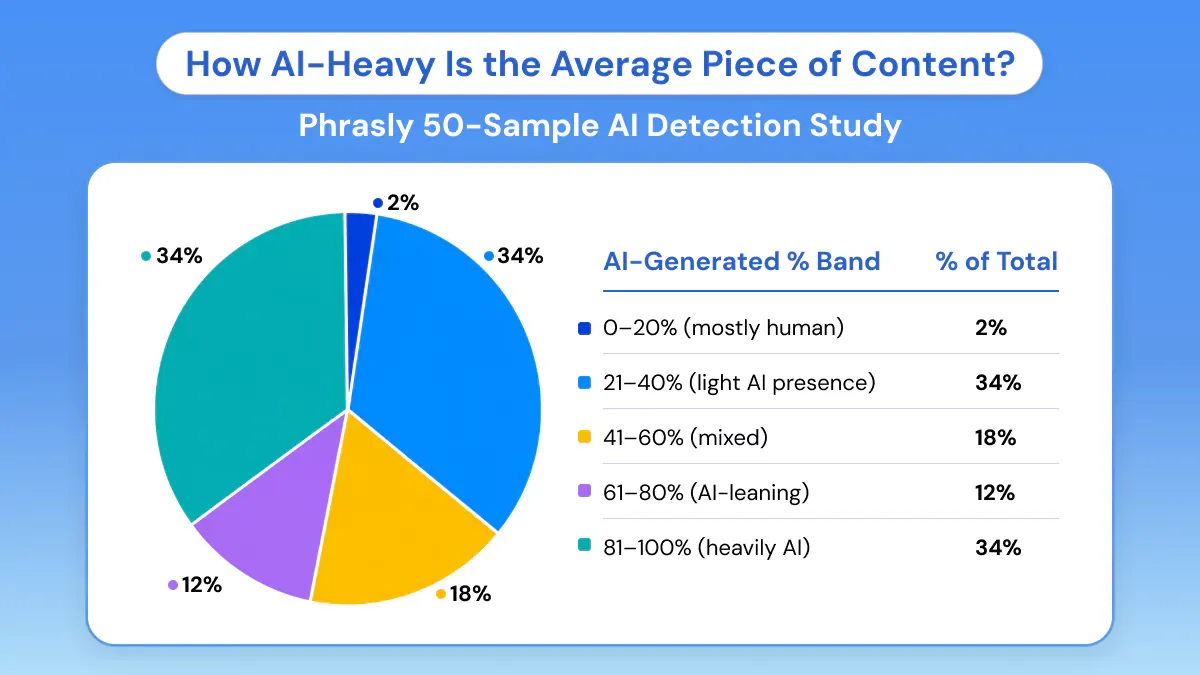
Interestingly, when analyzing the average piece of content, 34% showed a light AI presence, and 34% showed a heavy AI presence.
And 17 of 50 samples (34%) scored a full 100% AI-generated.
Copywriters get flagged by AI detectors because the tools score writing based on statistical patterns such as short sentences, common words, and smooth transitions. Learn how to check your content before submitting or publishing it.
The Top 15 Flagged Phrase Patterns
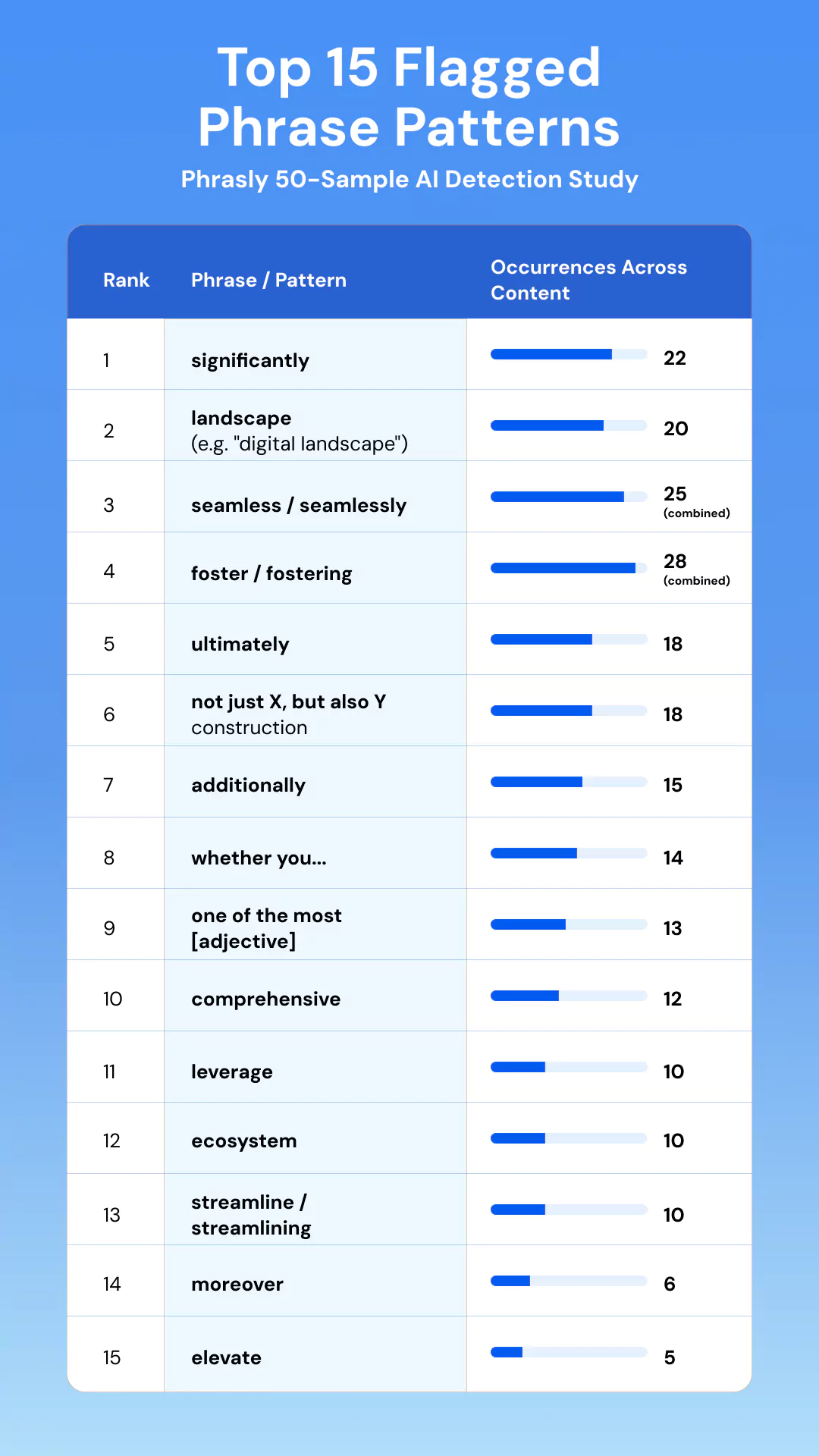
Across 50 pieces of content spanning four different formats, the same handful of words kept resurfacing: 'landscape,' 'seamless,' 'foster,' and the classic 'not just X, but Y' construction top the list.
If you need help to make your content more human, check these prompts to humanize AI text - that actually improves the writing.
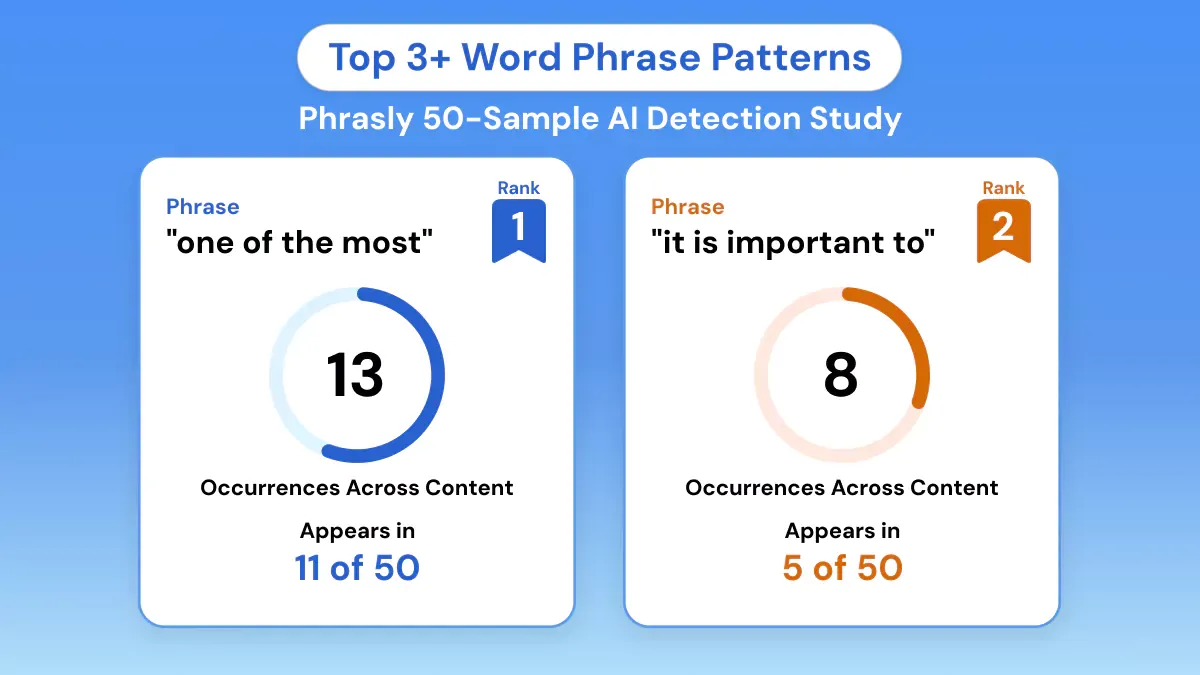
Top 3+ Words Phrase Patterns
“One of the most” shows up more than any other multi-word phrase in the entire corpus, appearing over 11 times in 50 samples.
Paired with “it is important to”, these two filler constructions account for over a quarter of all repeated AI-style phrasing found across 50 pieces of content.
We excluded "for example" and "such as," which occurred frequently (61 times and 15 times, respectively) but didn't strike me as phrasing unique to AI. Instead, they seemed like generic, nondescript writing.
As of 2026, Google does not penalize AI-generated content, but it penalizes low-quality content, regardless of whether it was written by a person or AI.
Check our framework for creating AI-assisted content that has a better chance of ranking well in search results.
What the Numbers Actually Reveal About How AI Writes
If you read enough content written by artificial intelligence, you’ll notice themes. There are common topics and common sentence structures that appear again and again.
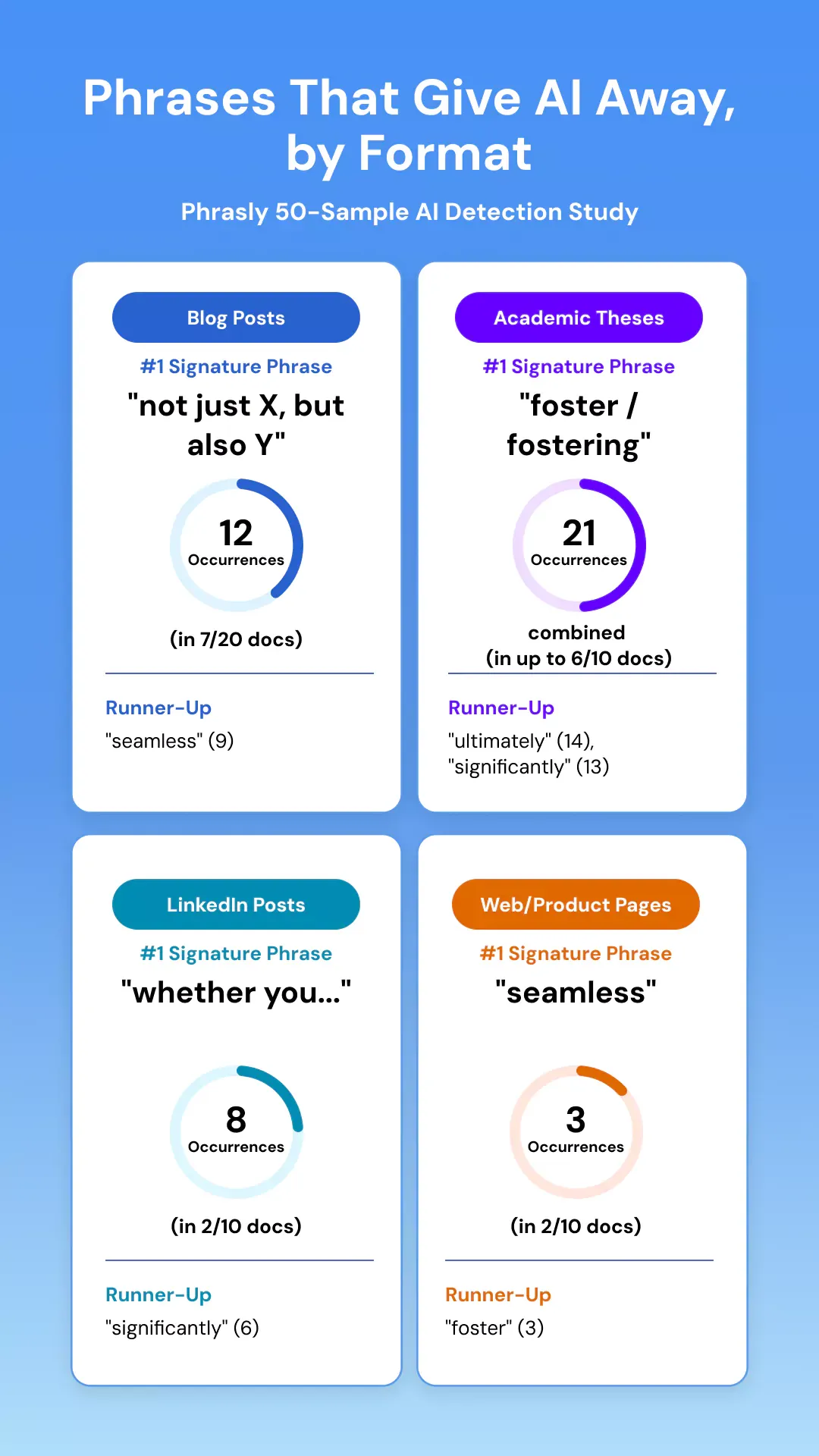
By analyzing 50 samples across four content types, we found an interesting pattern: AI has many voices, and each content type can activate a unique tone. The next infographic breaks this down format by format.
- In blog posts, the rule-of-three construction "not just X, but also Y" dominates, appearing in more than a third of the sample.
- Academic theses go full professor mode, leaning hard on "foster" and the conclusive "ultimately."
- LinkedIn posts can't resist the "whether you..." hook.
- Web pages showed a preference for a frictionless “seamless” promise.
When writing your content, you don’t need to ban any of these phrases, but keep an eye on AI giveaways and exaggerated repetitions.
If you want to push back against the homogenization, there are tools and techniques designed specifically to break that pattern, like prompts to humanize AI text.
For a practical starting point, check out how to humanize AI-generated text and make it sound like it came from a human.
Detection Results by Content Format
You might assume that longer, more complex documents, like academic theses would trip fewer alarms, or that short, punchy marketing copy would fly under the radar.
Our data says otherwise. When we analyzed 50 pieces of content through AI detection tools, the results broke down in ways that defied common sense.
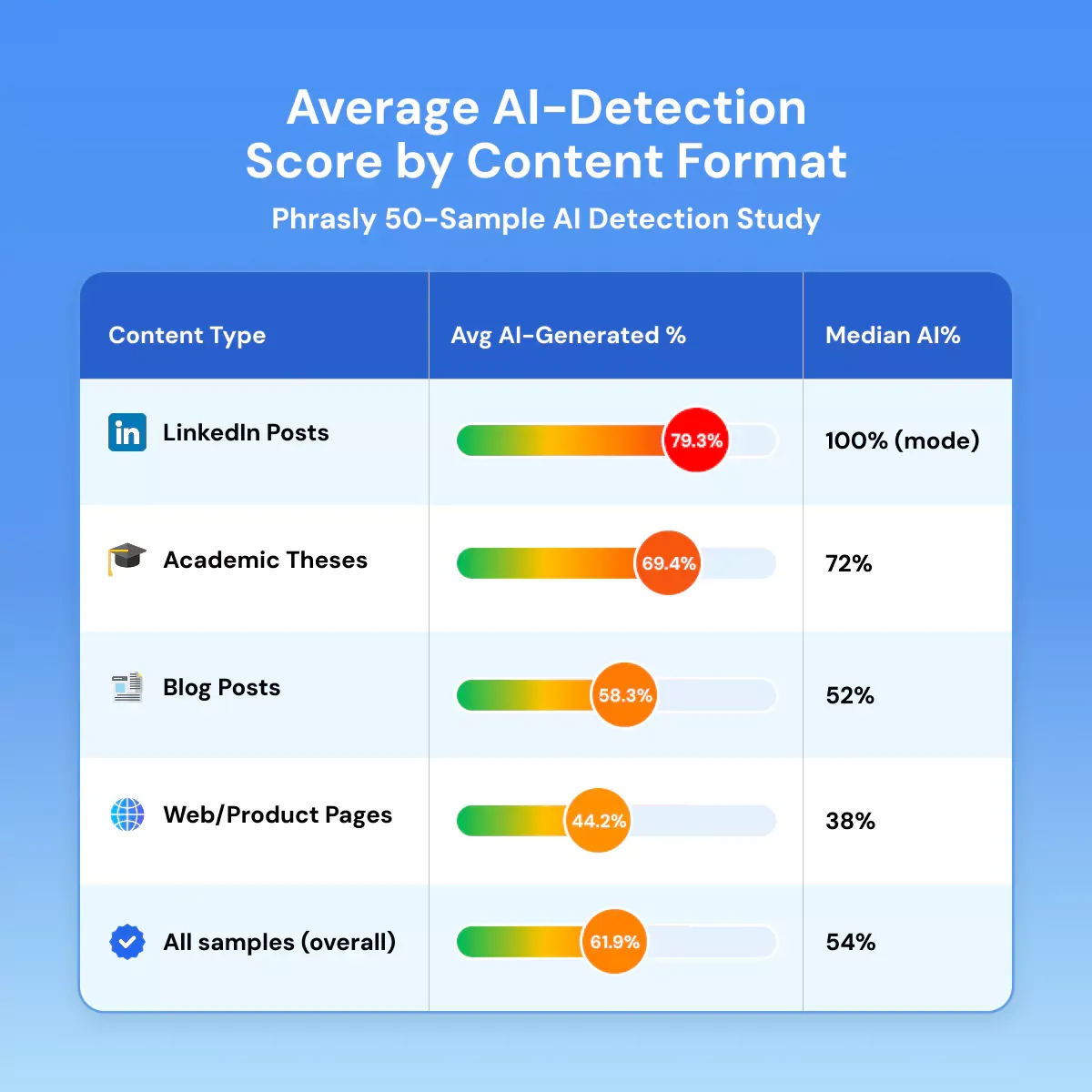
Our "Average AI-Detection Score by Content Format" infographic reveals that LinkedIn posts scored nearly twice as high on AI detection than marketing web pages, despite web copy being written to sell and LinkedIn posts being written to sound personal.
Also, LinkedIn was the only category in which the median score reached 100%, meaning at least half of the sampled LinkedIn posts were fully flagged.
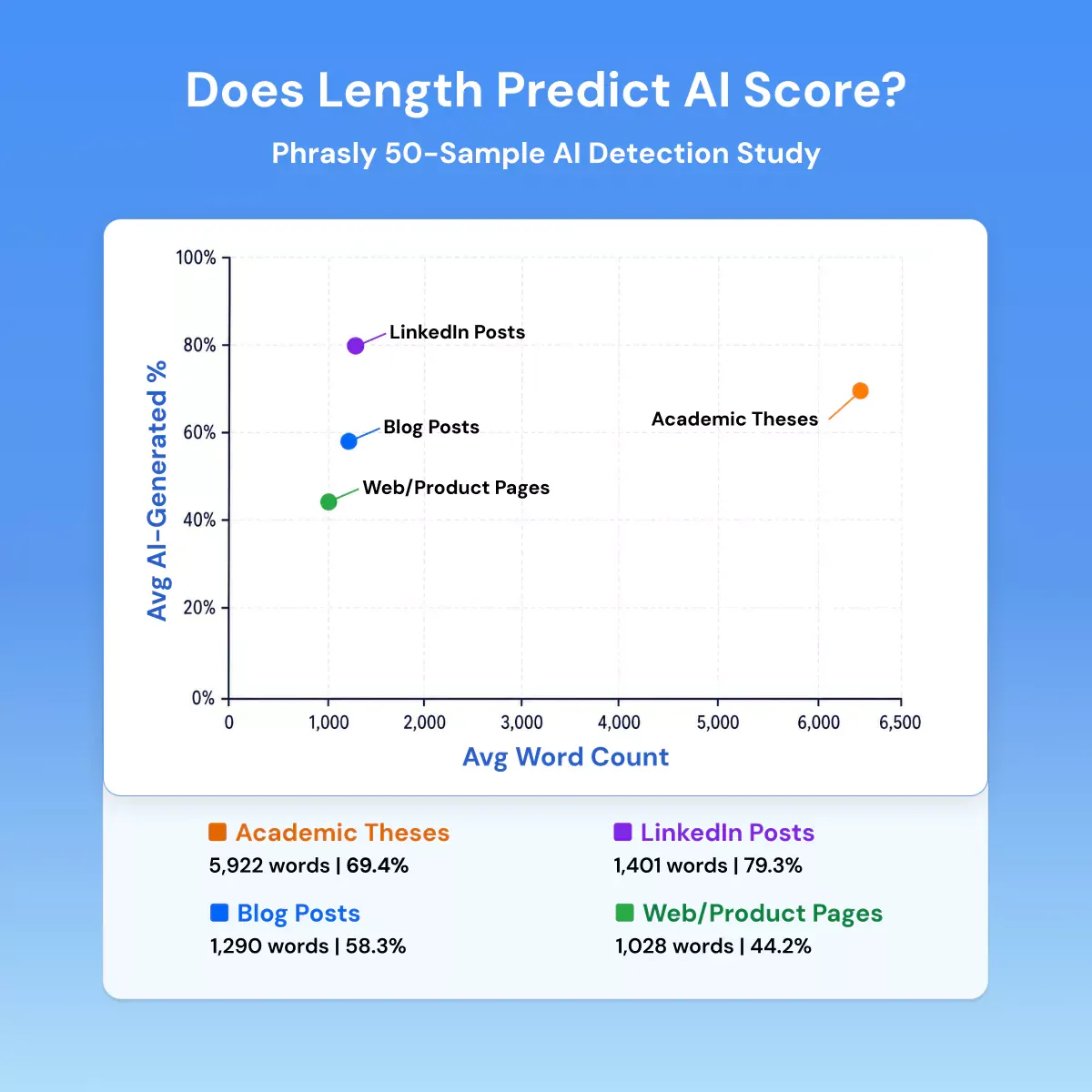
Does Length Predict AI Score?
Another finding from our study is that length has almost nothing to do with AI-detection score, and some of the shortest LinkedIn posts in the study scored a full 100%.
When using an AI detector, it looks for patterns in the writing that help differentiate between natural human and AI-generated text.
Variation in length and tone occurs in both human and AI writing, but AI often provides a lower personal touch and more predictable formatting. AI models produce rhythmic, predictable patterns with little variance.
Detection tools are notorious for false positives, flagging genuinely human writing simply because it follows predictable patterns.
Before you trust a score at face value, it's worth understanding how AI detector false positives happen and what they mean for your content.
What To Do When Your Content Gets Flagged
By now, the picture is clear:
- AI writing tends to cluster around recurring patterns.
- AI sentences are monotonous and don’t differ much in length or style, compared with human writing.
- AI defaults to sentence structures like the rule of three "not just X, but also Y" in blogs, the formal abstraction of "foster" and "ultimately" in theses, and the direct-address hook "whether you..." in LinkedIn posts.
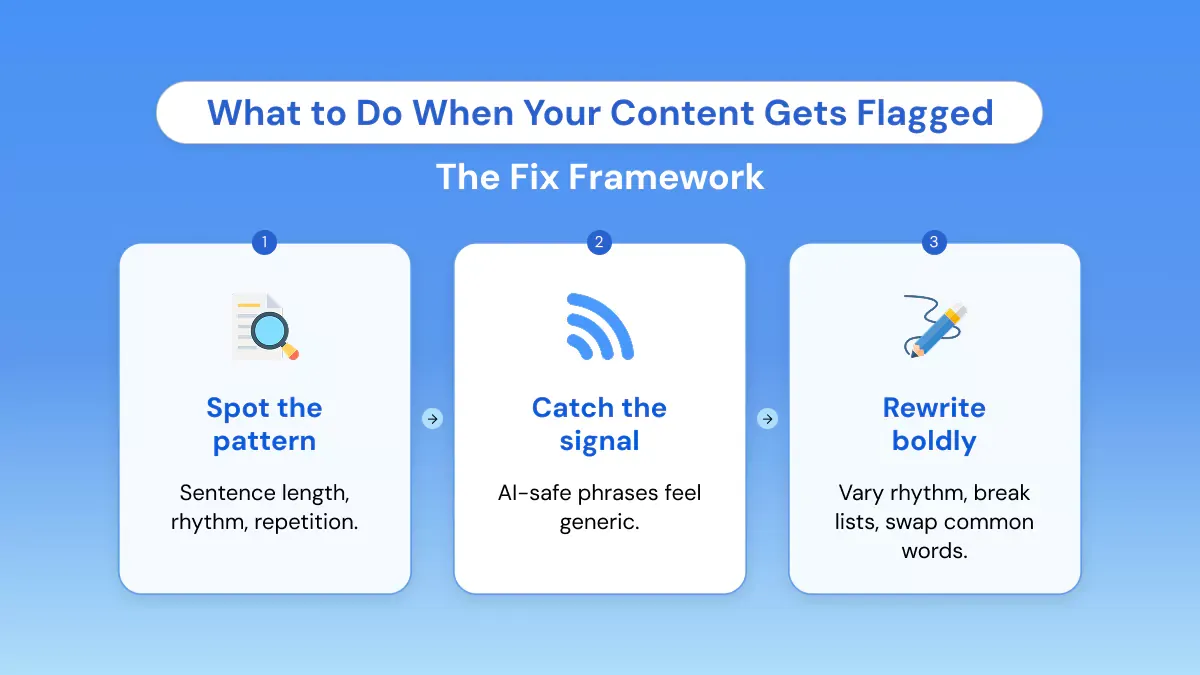
So how do you break the pattern? It comes down to two moves: identify the pattern type, then rewrite against the signal. Here are some examples of how to do it:
Blog Post
"AI writing tools are not just faster, but also more consistent, and ultimately more scalable."
"AI writing tools are fast. They're consistent enough that you stop second-guessing tone. Whether they scale depends on how much editing you're willing to do."
LinkedIn Post
"Whether you're a founder or a freelancer, you need to understand this one shift in how AI is changing content."
"I've talked to a dozen founders this month. The ones still treating AI like a spell-checker are the ones panicking."
Academic Thesis
"This framework fosters a significantly deeper understanding of the underlying mechanisms."
"This framework helps explain how the mechanisms actually work—and where the current models break down."
If you want a deeper breakdown of how AI detectors actually work and how to test your own writing before you hit publish, this guide is a solid next read: How to Check If Text Is AI-Written.
Punctuation as a Signature: The Em Dash Effect
I have always been a big fan of dashes; they help me organize text and highlight what matters. Unfortunately for me, this punctuation has frequently been flagged as AI-generated.
So, since we're analyzing patterns, I took the opportunity to analyze the average number of dashes in the content pieces. Here's what we found:
- The highest average number of dashes per content type was for LinkedIn posts, at 3.6.
- The second-highest content type, average number of dashes per piece, was blog posts, at 3.15.
The two formats with the heaviest em-dash use, LinkedIn and blogs, also rank among the highest for AI detection.
So, can we conclude that em dashes indicate AI-generated writing? No. Identifying bot-generated text, something that is constantly changing, requires more than just the use of punctuation that wasn’t so common before ChatGPT became popular.
The AI Vocabulary Shift
A 2024 study analyzing 26,700 words of academic text found a sharp spike in specific terms that rarely appeared in pre-2024 writing. Words like "delves" (28× more common), "underscores" (nearly 14×), and "showcasing" (over 10×) surged dramatically.
For context, the researchers ran the same analysis back to 2013. While event-driven words like "ebola" (2015) and "zika" (2017) spiked briefly, no single word had ever shown an excess frequency gap above 0.01 before 2020.
The Patterns Are Predictable. Your Content Doesn't Have to Be
AI writing leaves fingerprints, whether you write in long-form essays or social media posts.
Across over 50 samples and four formats, we found evidence that common phrases, sentence structures, and even punctuation habits create detectable patterns that AI detectors can recognize.
The good news? Once you know the tells, you can avoid them. Recognize when you're on autopilot. Break the pattern, vary your sentence length, replace abstract language with specific details, and remove unnecessary transitional phrases.
The data also clears up a persistent myth: length doesn't protect you, and complexity doesn't either. A 6,000-word thesis can score as high as a 200-word LinkedIn post. What matters is pattern density, not word count.
Before you publish that next blog post or essay, run it through a detector that flags sentence-level warnings, not just overall scores.
Try the Phrasly AI Detector to see what your writing is actually showing, and fix it before your readers do 👇
FAQs
What phrases are most commonly flagged by AI detectors?
Our analysis of 50 content samples found that words and phrases such as "foster," "seamless," "significantly," "landscape," "ultimately," and the sentence structure "not just X, but also Y" appeared most frequently in content flagged by AI detectors.
Does Google penalize AI-generated content?
No. Google has repeatedly stated that it rewards high-quality, helpful content, regardless of whether it was written by humans or AI. However, low-quality, repetitive, or unhelpful content can perform poorly in search results.
AI-generated content should always be reviewed and edited to improve originality, clarity, and usefulness.
Why do AI detectors flag human-written content?
AI detectors don't simply look for AI-written text—they analyze statistical writing patterns such as sentence rhythm, vocabulary, repetition, and predictability.
As a result, genuinely human-written content can produce false positives if it follows patterns commonly associated with AI-generated writing.
Does longer content receive lower AI detection scores?
Our research found little relationship between content length and AI detection scores. Some of the shortest LinkedIn posts received 100% AI-generated scores, while long-form academic papers were also frequently flagged. Pattern density matters far more than word count.


Keep reading


The Content Strategist's Workflow for AI-Assisted Production
A sound AI content workflow puts humans at the brief and expertise stages, letting AI handle outlining and drafting, then routes every piece through fact-checking, plagiarism, and AI-flatness QA gates before it can be published.

AI vs Human Cold Email Reply Rates: What 150M+ Emails Across 8 Studies Actually Show (2026)
AI cold emails get 1% fewer replies but 3x more spam flags. We compared 8 studies covering 150M+ emails, including peer-reviewed research, to show what actually works in 2026 and the fix that closes the gap.