
Does Google Penalize AI Content in 2026? What Google Actually Says
Google does not penalize AI content in 2026. It penalizes low-quality content, no matter who or what produced it. See what Google's official guidance, the Ahrefs 600,000-page study, and 2026 ranking data actually show, plus a 5-step framework to make AI content rank.
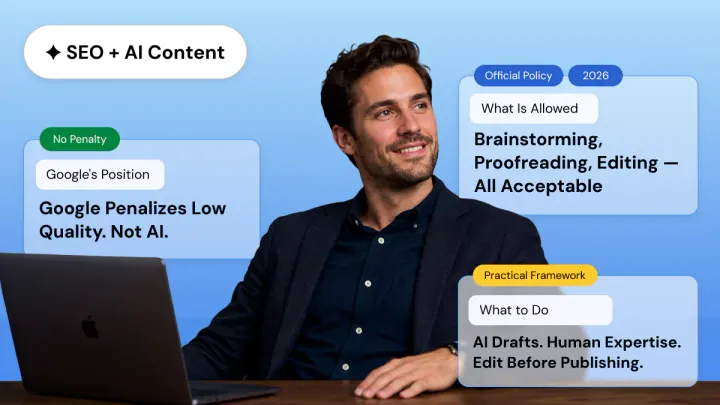
No, Google does not penalize AI-generated content by default. Google penalizes low-quality content, whether a human wrote it or an AI generated it. The focus has been on content quality, not production method, since Google's February 2023 AI content guidance.
If you have been hearing conflicting things about whether ChatGPT blog posts will tank your rankings, you are not alone. Some sources say AI content is fine. Others say Google is quietly demoting it. The confusion is real.
This article settles it with evidence: Google's actual position in its own words, what Google does penalize (and why most of it has nothing to do with AI), the Ahrefs study of 600,000 pages showing how AI content actually performs, and a practical 5-step framework for turning AI drafts into pages Google rewards.
Does Google Penalize AI Content? The Official Answer
No. Google does not penalize AI-generated content by default. The clearest statement comes straight from Google's Search Central guidance on AI-generated content:
That one sentence settles the debate. There is no separate AI content penalty inside Google Search. The production method is not the signal. The quality is.
Google has reinforced this position in its current guidance on generative AI content, which extends the same principle into the era of ChatGPT, Claude, and Gemini. The updated guidance is direct: generative AI is useful for researching a topic and adding structure to original content, but using AI tools to generate many pages without adding value for users may violate Google's scaled content abuse policy.
The position has not changed in three years. Quality is the signal. AI is just a tool.
What This Means in Practice
Two things follow from Google's position, and they cut both ways:
- An AI-assisted article can rank if it is useful, accurate, original, and written for people.
- A human-written article can lose rankings if it is thin, generic, misleading, or built mainly to manipulate search results.
Google's helpful content documentation backs this up. The automated ranking systems are designed to prioritize helpful, reliable information created to benefit people, not content created to game search.
Google does not punish content because AI helped create it. Google punishes content when it is low-value, unoriginal, inaccurate, mass-produced, or search-engine-first.
The right question is not "Did AI write this?" It is "Does this page satisfy the searcher better than the other results?"
What Does Google Actually Penalize? (It's Not AI)
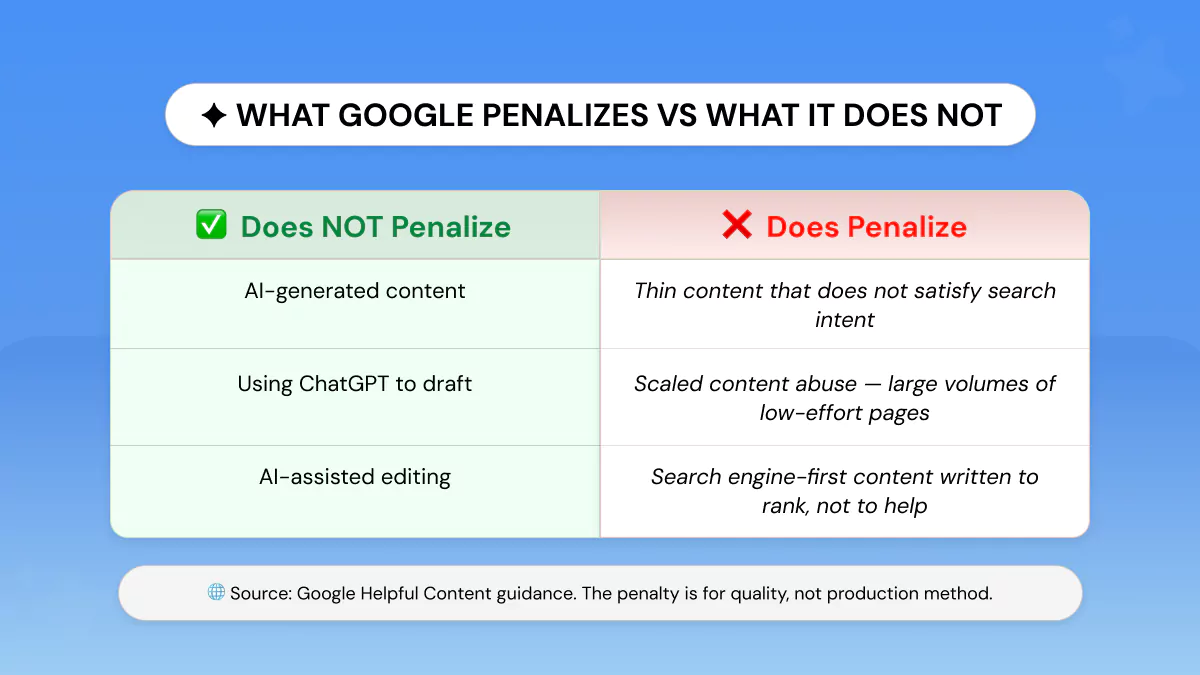
Google penalizes specific content patterns, not AI usage itself. The risks are scaled content abuse, thin pages, search-engine-first writing, weak trust signals, and inaccurate information. Whether a human or an AI produced the page does not change the rule.
Google's own spam policies make this explicit. Scaled content abuse applies "no matter how it's created." The trigger is mass-producing unoriginal content that adds little value, not the tool used to make it.
The 5 patterns Google's Algorithms Target
1. Scaled Content Abuse
Publishing large amounts of low-value pages mainly to influence rankings. This covers AI-generated pages, scraped pages, auto-generated pages, and human-written pages produced in bulk. Google's generative AI guidance says using AI to publish many pages without adding value may violate this policy. The trigger is publishing at scale without real value, not the tool.
2. Thin Content
Pages that technically answer a query but lack depth, examples, original insight, or practical usefulness. A 700-word AI article that just repeats what already ranks on page one is risky. Not because it is AI-written, but because it adds nothing new. Google's systems look for usefulness, not word count.
3. Search-Engine-First Content
Content built around ranking signals before reader needs. Keyword stuffing, repetitive sections, vague advice, filler. Google's issue is not that AI helped write it. Google's issue is that the page exists mainly to capture traffic, not solve the reader's problem.
4. Missing E-E-A-T Signals
Experience, expertise, authoritativeness, and trust. Google's SEO Starter Guide says helpful, people-first content is strengthened by expert or experienced sources. AI drafts often lack first-hand experience, original examples, named sources, and editorial accountability. This matters most for YMYL topics (Your Money or Your Life) like finance, health, law, and education.
5. Factually Inaccurate or Outdated Information
AI tools can invent statistics, misquote sources, cite outdated rules, and present old information as current. Google's quality bar gets strictest when wrong information could harm readers. Every statistic, date, and quote needs to be verified against a real source before the article goes live.
The February 2026 Ranking Shifts
In February 2026, Google confirmed a Discover Core Update that began on February 5. The update did not affect Google Search rankings directly, but the principles Google emphasized (original, in-depth, expertise-driven content) match what its Search ranking systems have prioritized for years.
The lesson held: pages that demonstrate real expertise and original value performed better than thin or sensational content.
If you want to know whether a page is at risk, do not ask "Was AI involved?" Ask: "Does this page add real value, or is it just another version of what already ranks?" That is the question Google is actually answering.
Does AI Content Actually Rank? (Evidence Based Answer)
Yes. AI content can rank on Google in 2026, and the data is clear. A 2025 Ahrefs study of 600,000 web pages found that 86.5% of top-ranking pages contained some level of AI assistance. The correlation between AI content percentage and ranking position was just 0.011, which is statistically meaningless.
What the Study Actually Measured
Ahrefs pulled 100,000 random keywords, extracted the top 20 ranking URLs for each, and ran the resulting 600,000 pages through its AI content detector. The breakdown was unambiguous:
- 13.5% of top-ranking pages were purely human-written
- 81.9% were a mix of human and AI content
- 4.6% were categorized as pure AI
The most important number is not the 86.5%. It is the 0.011 correlation. That figure means there is no meaningful relationship between how much AI a page used and where it ranked. Ahrefs concluded that Google "neither significantly rewards nor penalizes pages just because they use AI."
This Matches What Google Has Been Saying
Using AI gives content no special ranking boost. But if a page is useful, helpful, original, and aligned with E-E-A-T, AI involvement does not hold it back. Google has stated that appropriate use of AI or automation is not against its guidelines unless the goal is to manipulate rankings.
A Real-World Example
Bankrate is one of the most-cited examples of a major publisher openly using AI in editorial production. Its public AI policy explains the workflow clearly:
- AI may assist with drafting new articles or refreshing existing ones
- A writer and editor stay involved from start to finish
- Every article is fact-checked and fully edited before it goes live
- Generative AI use is disclosed when it assisted with drafting
Bankrate continued ranking for competitive financial keywords through this period, and the workflow became a reference model for responsible AI-assisted publishing. The lesson is not "AI content ranks automatically." The lesson is that AI plus human editorial ownership, fact-checking, expert review, and disclosure is what Google's systems reward.
AI is in the workflow of roughly 9 out of 10 top-ranking pages. What separates the pages that rank from the ones that do not is not whether AI helped. It is whether humans added expertise, accuracy, original insight, and editorial judgment on top of the draft.
Why People Still Think Google Penalizes AI Content (The Confusion Explained)
The misconception comes from mixing up two different things: low-quality content, which Google does penalize, and AI-generated content, which Google does not penalize on its own.
Most AI content that loses rankings fails because it was published without enough editing, fact-checking, originality, or human judgment, not because AI was used.
Google's position has been consistent. Its ranking systems focus on the quality of content, not how it was produced. AI-assisted content can rank if it is helpful, accurate, and written for people. AI content can also fail if it is thin, generic, outdated, or built mainly to chase rankings.
Why The Confusion Exists
AI makes low-effort publishing easier. A site can now generate dozens of articles in a day. Speed is not the problem. The problem is what happens next.
When publishers skip editing, the output usually has every pattern Google does not want:
- Vague explanations and repeated phrases
- No original examples or first-hand experience
- Missing sources and no expert input
- No clear reason for the page to exist beyond ranking for a keyword
That is scaled content abuse, and Google's spam policy specifically says it applies "no matter how it's created." The same article would still be weak if a human wrote it badly. The AI is not the trigger. The lack of human work on top of the draft is.
The Competitor Myth: "Their AI Article Ranks But Mine doesn't"
This is the most common version of the confusion. The answer is almost never that Google secretly favors their AI content and punishes yours. The more likely explanation is what happened after the draft was generated.
Their article was probably:
- Edited for clarity and flow
- Fact-checked against real sources
- Updated with current information
- Strengthened with E-E-A-T signals like expert input, original examples, real experience, and better sourcing
- Rewritten to answer the searcher's question more completely than other results
Yours may still read like a first draft.
The data backs this up
As we discussed earlier, Ahrefs' study of 600,000 pages found that 86.5% of top-ranking pages contained some level of AI-assisted content, with a near-zero 0.011 correlation between AI content and ranking position. Translation: AI use by itself does not predict whether a page ranks well or badly. What predicts that is quality.
AI content is not the penalty risk. Unedited, unhelpful, search-engine-first content is the penalty risk. AI can handle structure, outlines, and first drafts. The ranking value comes from the human layer: accuracy, expertise, examples, originality, and editorial judgment.
The 5-Step Framework to Make AI Content Rank on Google
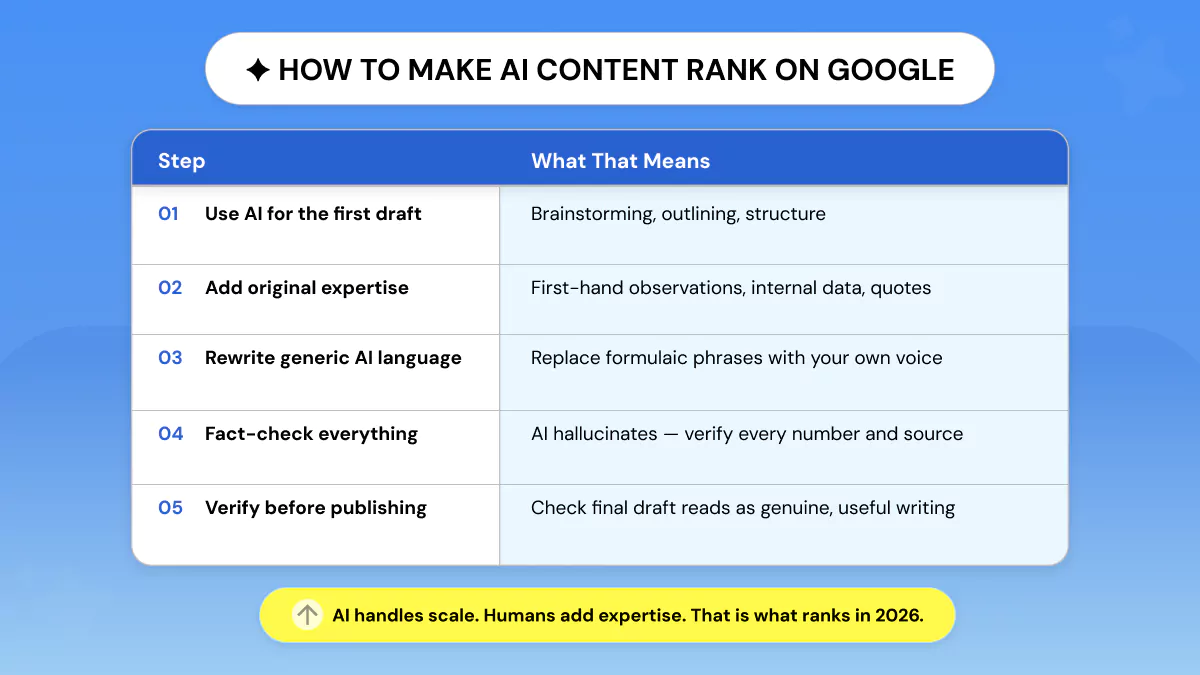
The AI content that ranks on Google in 2026 follows a consistent pattern. AI handles drafting and structure. Humans add expertise, original data, fact-checking, and editorial judgment. This AI-assisted, human-refined approach is what every successful AI content workflow looks like in practice.
Google's own guidance backs this up. Generative AI can help with research and structure, but using AI to create many pages without adding value may violate Google's scaled content abuse policy. Google's ranking systems prioritize reliable information created to benefit people, not content built mainly to manipulate rankings.
Here is the workflow that turns raw AI drafts into pages Google actually rewards.
Step 1: Use AI For the First Draft
Use AI where it is strongest: brainstorming, outlining, structuring sections, summarizing notes, and creating a rough first pass. That is where AI delivers real speed without replacing human judgment.
The mistake is treating that draft as the finished article.
A weak prompt:
A better prompt:
The second prompt gives you scaffolding. It does not pretend to give you a finished page.
Step 2: Add Original Expertise and Data
This is the step most AI content skips, and it is the biggest reason AI articles fail to rank. AI can summarize what already exists online. It cannot create your customer data, expert quotes, product experience, internal case studies, screenshots, test results, or first-hand observations.
Google's helpful content guidance asks creators to evaluate whether their content provides original information, reporting, research, or analysis, and whether it offers substantial value compared with other pages already ranking.
Before publishing, add at least one or two things AI could not know on its own:
- A mini case study from your work
- A quote from an internal expert or customer
- A screenshot from your actual workflow
- A comparison table from your own testing
- Internal performance data or a real example you can attribute
Generic AI sentence:
Human-refined version:
The second version adds process, experience, and editorial accountability. That is the E-E-A-T layer Google rewards.
Step 3: Rewrite the AI's Generic Language
AI drafts often sound polished but empty. They reuse the same patterns: "in today's digital landscape," "dives into," "comprehensive guide," "game-changer," "unlock the power of." Readers notice. Google's helpful content guidance asks whether content is satisfying, original, and written for people rather than search engines.
A good rewrite keeps the meaning but makes the voice sharper, more specific, and more natural.
Before:
After:
The rewrite is easier to read, less formulaic, and more useful. A humanizer tool can help with this step by refining robotic phrasing without changing the meaning of the draft.
Step 4: Fact-Check Everything
AI hallucinates. Statistics, citations, dates, policy details, and quotes can all be invented in a way that sounds completely confident. Before publishing, every factual claim needs verification.
Google's helpful content guidance focuses heavily on reliability. It asks whether content presents information in a way that makes readers trust it, whether sourcing is clear, and whether there is evidence of expertise.
This matters most in YMYL topics (Your Money or Your Life): health, finance, law, education, and safety. A wrong claim in these areas damages trust fast.
The fact-checking checklist:
- Check every statistic against the original source
- Open every external link before publishing
- Confirm publication dates on cited material
- Replace vague claims with specific, sourced ones
- Remove any quote you cannot verify
- Cite primary sources, not other blog posts
Risky AI sentence:
Verified version:
The verified version names the source, explains the study, and gives the exact numbers. That is what Google's systems and readers both trust.
Step 5: Verify Before Publishing
The final step is editorial quality assurance. Review the finished draft the way an editor and a search quality reviewer would. Then run it through an AI detector as a final quality check. If sections still read like raw AI output, rewrite them in your own voice.
This is quality assurance, not bypass. You are improving the writing for readers AND search engines, because both want the same thing: a page that reads naturally, answers the question completely, and earns trust.
Pre-publish review questions:
- Does the intro answer the query in the first two sentences?
- Does every H2 give a direct answer before explanation?
- Are all statistics verified and linked to primary sources?
- Did a human add examples, judgment, and context?
- Does the article provide more value than the current top-ranking pages?
- Would a reader trust this page if they knew AI helped draft it?
If the answer to any of those is no, the page is not ready.
AI content can rank well on Google when it is not published as raw AI output. The workflow that works in 2026 is consistent: use AI for speed and structure, then add human expertise, original data, verified sources, natural language, and editorial judgment. That is not a trick. It is just good publishing, made faster by a useful tool.
Does Google Detect AI Content?
Yes, Google likely has the technology to detect patterns associated with AI-generated content. But AI detection scores are not used as a direct ranking factor. Google's public guidance says Search focuses on content quality, helpfulness, reliability, and whether the page was created for people, not how the content was produced.
Google's official Search Central guidance is direct: "appropriate use of AI or automation is not against our guidelines." What violates the rules is using AI or automation mainly to manipulate search rankings, especially when it produces low-value, unoriginal, or scaled content.
Detection Is Not the Same as Punishment
This is the part most people get wrong. Google may be able to recognize AI-generated patterns, but recognizing them is not the same as demoting them. A helpful, fact-checked, original article can rank even if AI helped with the outline, draft, or editing process. A weak page can struggle even if a human wrote every word.
For a closer look at how AI patterns are actually identified in content, see our guide on how to check if content was created by AI.
What This Means for Content Marketers in 2026
In 2026, the margin for low-effort content is gone. AI is no longer a competitive advantage by itself because most marketing teams now use it. The real differentiator is human expertise, original data, strong sourcing, and editorial judgment layered on top of AI drafts.
Google's guidance points in the same direction. Its helpful content documentation says ranking systems prioritize reliable information created for people, not content built mainly to manipulate rankings.
Google's newer generative AI search guidance specifically recommends "non-commodity" content: unique, expert-led content that adds value beyond common knowledge.
The question has shifted. It is no longer "Will Google penalize this because AI helped write it?" The better question is "Is this article genuinely better than the pages already ranking?"
If everyone can produce a draft in minutes, the winning content is the one with better insight, stronger examples, and clearer sourcing.
Practical Implications For Marketers
1. Stop Worrying About AI Penalties
Google's official AI guidance says appropriate use of AI or automation is not against its guidelines. The risk begins when AI is used to produce content mainly to manipulate rankings instead of helping people. The penalty risk is the quality pattern, not the tool.
2. Invest in Signals AI Cannot Replicate
Original research, expert quotes, customer insights, internal data, product testing, screenshots, case studies, and first-hand experience. These are the assets that make content harder to copy and easier for Google to trust. AI can summarize public information. It cannot create your data.
3. Audit Existing AI-Assisted Content
Review old pages for the patterns Google actually targets: thin explanations, scaled output, outdated claims, weak sourcing, duplicated sections, and pages created mainly to rank. Update them with stronger examples, verified claims, better structure, and a clearer answer to the searcher's question.
4. Use AI to Scale the Workflow, Not Replace the Editor
AI is useful for outlines, briefs, first drafts, content refreshes, and gap analysis. The final version still needs a human editor who checks facts, sharpens the argument, adds examples, and makes sure the piece answers search intent directly.
Google does not penalize AI content in 2026. It penalizes low-quality content, whether AI or a human produced it. Use AI for speed, drafting, and structure. Use humans for expertise, fact-checking, original examples, and editorial judgment. That combination is what ranks now, and it is what will keep ranking as long as Google's quality systems stay focused on value over production method.
Publish with that workflow, and the question of "AI or human" stops mattering. Google is already answering it the same way you are.
FAQs
Does Google Penalize AI Content in 2026?
No. Google does not penalize AI content by default. Its official guidance says appropriate use of AI is allowed, but content created mainly to manipulate rankings violates spam policies.
Can AI Content Rank #1 on Google?
Yes. AI-assisted content can rank #1 if it is helpful, accurate, original, and satisfies search intent better than competing pages. Ahrefs found that 86.5% of top-ranking pages contain some level of AI-assisted content.
How Does Google Detect AI Content?
Google likely has systems that can identify AI-generated patterns, but it has not said AI detection scores are a direct ranking factor. Google’s public position is that quality, helpfulness, reliability, and people-first value matter more than how the content was produced. For more on how AI detection actually works, see our detailed guide.
What is Google’s Helpful Content Update?
Google’s Helpful Content system is designed to reward content created primarily for people, not content made mainly to manipulate search rankings. In practice, it favors pages that answer the query clearly, show expertise, and provide original value.
Is Using ChatGPT for Blog Posts Safe for SEO?
Yes, using ChatGPT for blog posts can be safe for SEO if the final content is edited, fact-checked, original, and written for readers. It becomes risky when you publish generic AI drafts at scale without adding real value.
What Percentage of Top-Ranking Content Uses AI?
Ahrefs’ 2025 study of 600,000 pages found that 86.5% of top-ranking pages contained some amount of AI-generated or AI-assisted content. The correlation between AI content percentage and ranking position was only 0.011, which is essentially zero.
Should I Disclose That My Content is AI-assisted?
Google does not require AI disclosure for every blog post, but disclosure is a good idea when readers would reasonably expect to know how the content was made. Google says AI disclosures can be useful, but the bigger requirement is that the content is accurate, helpful, and not misleading.
How Can I Make AI Content Rank Better on Google?
Use AI for drafting and structure, then improve the final article with expert input, original examples, verified sources, and natural human editing. A Phrasly AI Humanizer can help refine robotic phrasing, and a Phrasly AI Detector can support a final quality check before publishing.


Keep reading

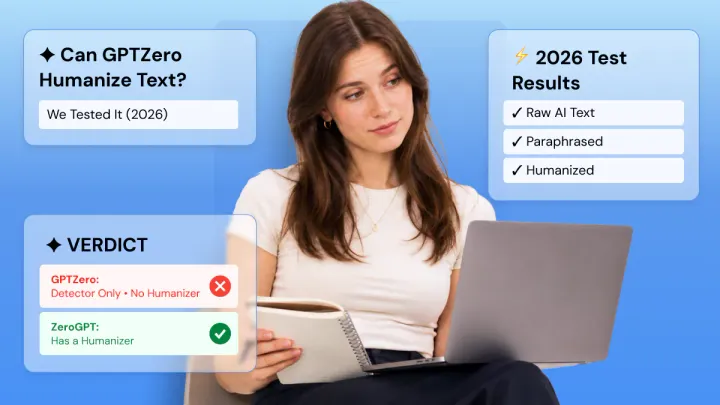
Can GPTZero Humanize Text (+ Can It Detect Humanized Text)
GPTZero doesn't have a humanizer and never has. We tested 5 AI samples raw, paraphrased, and humanized to see what actually beats its detector. Paraphrasing failed almost every time. Properly humanized text scored 98–100% human across the board. Here's exactly what worked.

How to Humanize AI-Generated Client Reports (Before They Read as Robotic)
AI reports default to describing the numbers. They default to describing 'traffic increased 12% month over month' without explaining why it happened or what to do about it. That's dumping data and calling it deliverable; spoken in a professional voice.