
The Content Strategist's Workflow for AI-Assisted Production
A sound AI content workflow puts humans at the brief and expertise stages, letting AI handle outlining and drafting, then routes every piece through fact-checking, plagiarism, and AI-flatness QA gates before it can be published.
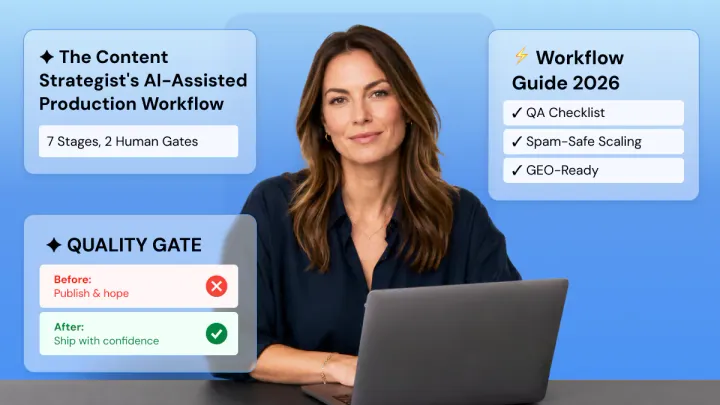
A working AI content production workflow puts humans at the three points AI can't cover: the brief, the expertise, and the final quality gate. AI does the drafting and structure work in between.
Most groups approach this in reverse. They automate the thinking, the brief, the angle, the expertise, and hand-edit the typing.
Which is precisely backwards. AI excels at formulas and first drafts. Humans are better at judgment, first-hand knowledge, and actually knowing what's true.
If you’re running an in-house content team, an agency, or a solo strategist wrangling freelancers, this guide is for you.
It doesn't presume any particular tool stack. And it doesn't presume that you're starting from scratch. Rather, it presumes that you already have some version of AI in place.
And that the biggest hole is that nobody has documented where the human checkpoints are, what "done" looks like at each stage, and what to do when a draft fails a checkpoint.
What This Guide Covers
Here are the seven steps that make up the end-to-end process. Which step you own. The two required human gates. QA checks designed specifically around AI failure modes.
How to scale output while avoiding AI-scaled content abuse, the very specific thing Google will penalize per their spam policies. This is the workflow you should be defending with your team, your leadership, and your CMS.
Make this the go-to manual before anyone on your team touches a brief or opens a prompt window.
The Principle: Humans Own Judgment, AI Owns Structure
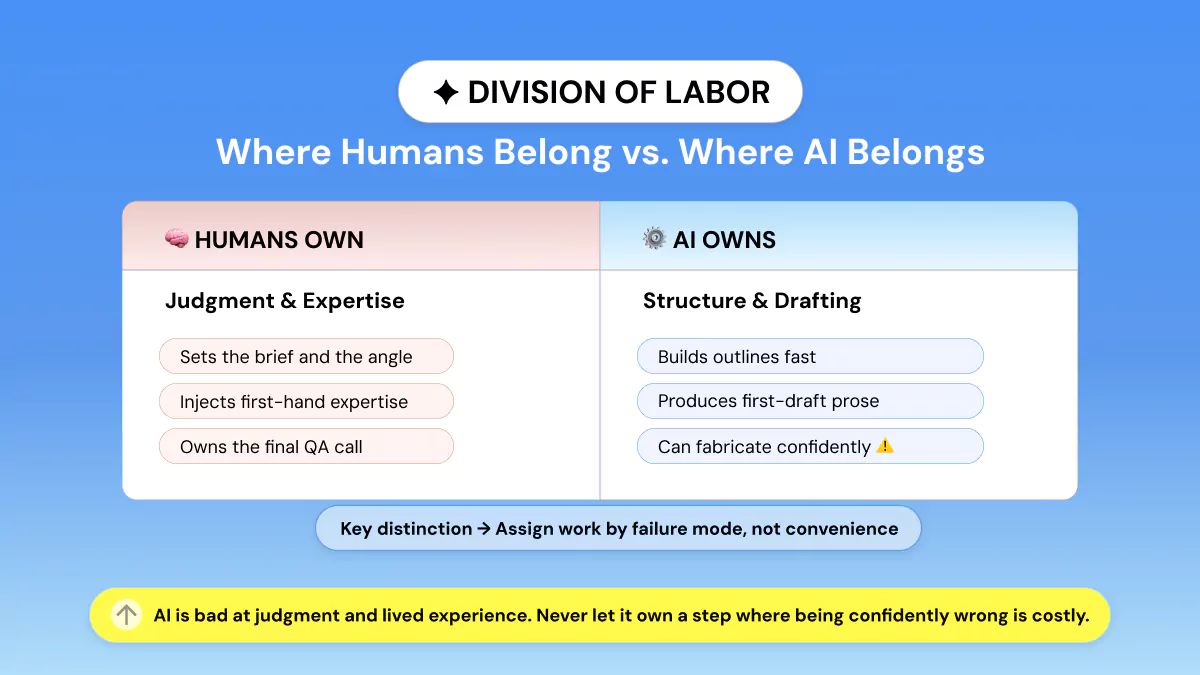
Allocate tasks by failure mode. AI excels at structure/formatting/first draft prose. AI falters at facts/judgment/lived experience. The guiding rule of a sound content strategist AI process is:
Never allow AI to own a step where getting things wrong confidently is costly. Consider it risk shifting, rather than arguing about tools. Content creation at every phase involves unique risk: factual risk, reputational risk, ranking risk.
And the operative question is not “can AI do this?” It's “what if AI does this wrong, and who stops it before it launches? In real- life terms, it manifests itself as an easy organizational task.
Structuring a listicle, mapping an outline around search intent, breaking up a dense paragraph, creating five headline options, then throwing them at AI, because you risk virtually nothing by getting one wrong; you'll spot it and correct it in seconds.
Providing a data point, literally describing what something does, claiming firsthand experience or knowledge of something you’re reviewing- just a few ways that anchor you to writing as a human.
Stats, description, experience claims, or editorializing can all kill your credibility, your rankings, or both if you’re wrong. The line isn’t determined by how good/fancy your AI robot is.
The line is determined by how costly that particular mistake would be if no one caught it.
It's not a fringe habit anymore either. HubSpot's 2025 State of AI report revealed that 55% of marketers were using AI for content generation, shifting the competitive focus from AI adoption to the effectiveness of your oversight.
An effective AI-assisted content workflow delegates tasks based on each party’s strengths, rather than on what can be delegated quickest.
- Clearly define the responsibilities. AI writes structure/prose. Humans control the brief, the facts, and the decision. ✅
- List the ways AI can fail before starting. Confident fabrication, canned language, critiques without personal experience, lack of intuition for what’s most important, etc., so everyone knows the pitfalls to look for. ❌
- Present workflow as risk allocation rather than AI preference. The goal isn't “use less AI,” it's “put humans where being wrong is expensive.”
- Treat all AI outputs as drafts, not final assets. Everything with a claim of fact or experience should be touched by a subject matter expert before it clears the review gate.
The Seven-Stage Workflow
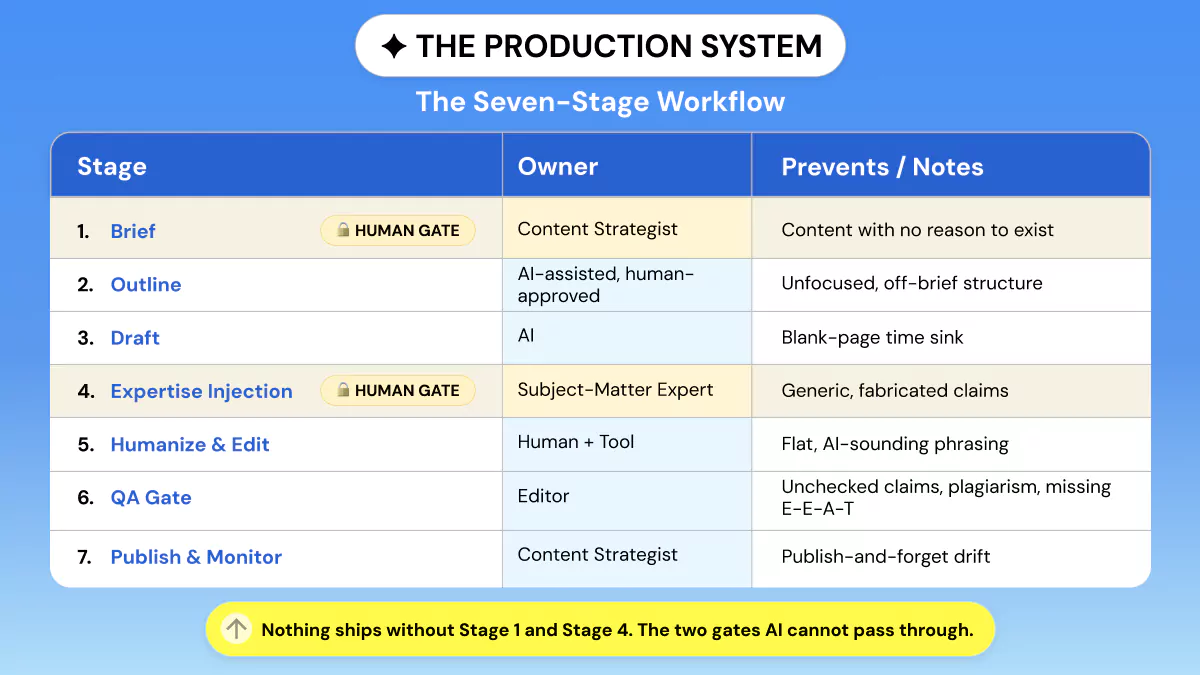
Brief (human) → outline (AI-assisted, human-approved) → draft (AI) → expertise injection (human) → humanize and edit (human + tool) → QA gate (fact-check, plagiarism, AI check) → publishing and monitoring.
Ideally, this should be written in a way that it is concrete enough that a content team AI workflow can just steal this and use it as literal standard operating procedure, not a philosophy, a checklist.
Here is what each phase owns, inputs, outputs, and the narrowly defined failure this stage exists to prevent:
|
Stage |
Owner |
Input |
Output |
Failure It Prevents |
|
1. Brief |
Human (strategist) |
Keyword research, editorial calendar slot,
business goal |
Structured brief: angle, audience, required
sources |
Directionless or redundant content |
|
2. Outline |
AI-assisted, human-approved |
Approved brief |
Section-by-section outline mapped to search
intent |
Structural drift, missed intent |
|
3. Draft |
AI |
Outline + brief |
Full first draft |
Blank-page time sink |
|
4. Expertise injection |
Human (SME) |
AI draft |
Draft with real examples, data, judgment added |
Generic, experience-free content |
|
5. Humanize & edit |
Human + tool |
Expert-reviewed draft |
Naturally voiced, on-brand copy |
Flat, AI-sounding prose |
|
6. QA gate |
Human (editor) |
Edited draft |
Fact-checked, plagiarism-clear, detector-clear copy |
Fabrication, duplication |
|
7. Publish & monitor |
Human (strategist) |
Approved draft |
Live page, schema, tracking |
Publish-and-forget drift |
Notice what this table is missing: a stage named “AI writes everything” or “human writes everything.” Every actual production system is a chain of handoffs. It's precisely at the handoffs where quality is gained or lost.
A team that moves directly from outline to publishing, skipping injection of expertise and QA gates, isn't simply doing this workflow more quickly. They're doing an entirely different, more dangerous workflow that just appears superficially similar.
Stage 1 & Stage 4: The Two Mandatory Human Gates
Stage 1 (the brief) and Stage 4 (expertise injection) are the only two gates that cannot be skipped.
✅Should one of these be insufficient, publication is entirely off the table, even with a perfect draft.
Stage 1 in Practice: The Brief Sets the AI content production process in Motion
The brief is what determines what this article will actually be used for: angle, audience, necessary named sources, place on editorial calendar, etc. Nothing gets outlined, let alone drafted, until this exists in writing.
The reason AI churns out generic output is skipping this step. The model never had any reason for the page to exist.
Your brief should be concise: query target and intent, angle that sets this apart from what’s ranking, any named sources/SMEs needed for a stat, and the one question this page must answer better than others.
If the writer or model cannot point to that last line during drafting, then the outline stage has nothing substantial to react against. The resulting draft will read as generically as the brief that created it.
Stage 4 in Practice: Expertise Injection Is a Subject-Matter Expert Gate
This is where you as a subject-matter expert step in and provide what the AI draft cannot generate: firsthand experience, examples, judgment about what is important, and fixes to anything that was quietly or arrogantly incorrect.
Proofreading is what separates a competent draft from something that feels like it has strong E- E-A-T. This step is mandatory before a piece heads to edit. In smaller teams, this doesn't have to mean a separate specialist for every article.
It can be the strategist themselves, provided they actually know the subject well enough to catch a wrong claim on sight rather than skimming for typos. The test is as follows:
Would this person be able to, from memory alone and without looking at the draft, accurately determine whether or not a sentence is true? If not, route it to someone who can before it moves forward.
Stage 5 in Practice: Humanize & Edit Without Losing the SEO Value
Once the SME has added real expertise, the draft still needs to sound like it was written by a person, not by a model. This is where tone, rhythm, and sentence variation get corrected so the piece doesn't read flat or repetitive.
It's worth doing this carefully, since over-correcting for "sounding human" can just as easily hurt rankings as leaving AI-flat prose untouched.
The QA Gate: Catching AI's Failure Modes
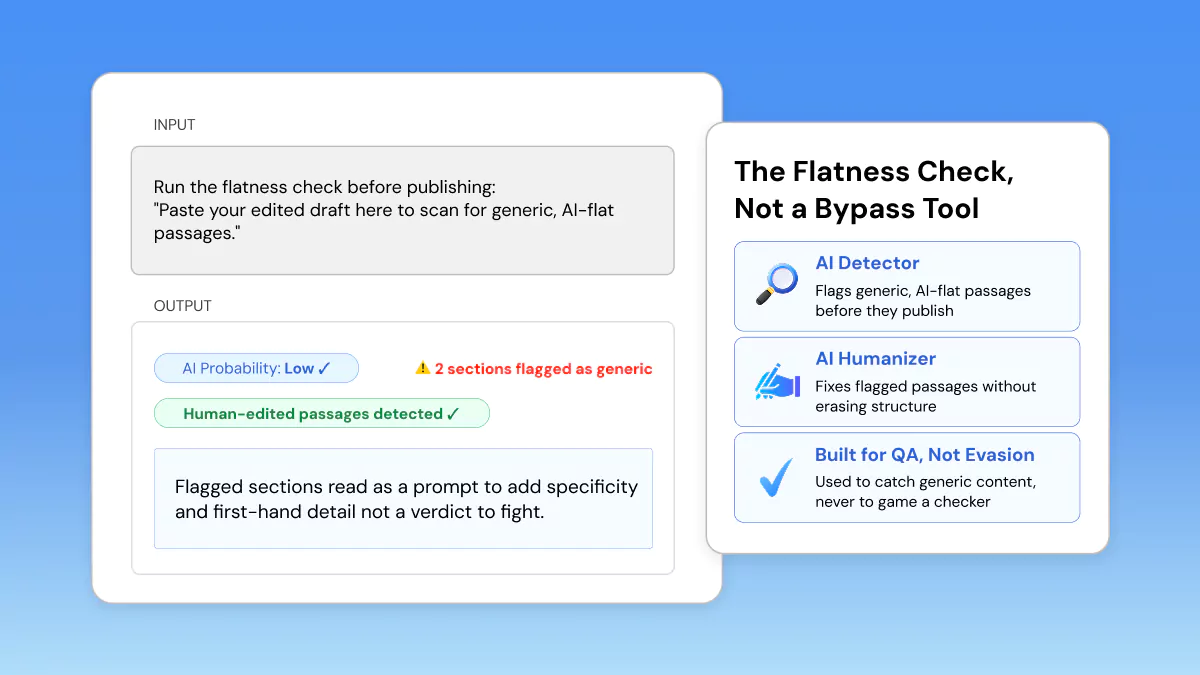
Checklist for pre-publishing: Fact-check each claim made against a named source. Run a plagiarism scan. Check for content that might be generic / AI-flat. Confirm E-E-A-T markers are present in the article.
Neglecting any of these checks is how AI content quality control fails silently at scale not all at once, but one improperly-fact-checked stat or one invisible straight-from-the-bot writing at a time until you’ve built up a trending pattern of skim pages across the site.
- ✅ Fact-check: Exposes wrong answers stated with confidence. AI's biggest weakness. There is no way to distinguish if a language model knows something is right or wrong since it will state an incorrect number with the same confidence as a correct number.
- ✅ Plagiarism scan: Catches recycled phrasing or duplication pulled in from training data or competitor content.
- ✅The AI-flatness check: Catches generic, undifferentiated phrasing that reads like every other page targeting the same query.
- ✅ E-E-A-T check: Helps identify if there's a lack of experiential reporting. No byline/expert quoted, no firsthand account/detail, no unique data.
Where the AI Detector Fits in the QA Gate
Run every draft through the Phrasly AI Detector as the flatness check, right before it reaches the review gate. It's the fastest way to catch generic, AI-flat passages that a human skim can miss after the fifth read-through of the day.
If a section flags as heavily AI-patterned, don't rewrite from scratch. Route it through the Phrasly AI Humanizer to restore natural voice and rhythm, then run the detector check again before it clears the gate.
Phrasly's suite (AI Writer, Pages, AI Detector, AI Humanizer, and Plagiarism Checker) covers drafting through QA in one place, and it's used by 3,000,000+ people, rating it 4.7/5.
Scaling Without Triggering Spam Policies
Google's spam policies address scaled content abuse. Using automation to produce generic pages en masse to manipulate rankings.
You dodge that bullet not by creating less content, but by making sure each has real authority, takes a unique approach, and justifies its own existence.
If the original intent of content created at scale was for ranking manipulation and not for users, it's considered a policy violation regardless of whether it was typed by a human or a model. Here's one very practical test of any content team AI workflow.
Would this page exist if all we wanted was a keyword to rank for?
If the truthful answer is yes, throw it out. Don't publish it, no matter how clean the draft may look. This changes the framing of how to use AI for content at scale. Volume isn't the constraint to fight. Quality gates are the constraint you want.
AI wipes away the bottleneck of drafting content. Your QA gate and SMEs’ bandwidth should be what truly throttles throughput and not how quickly a model can generate pages.
There are a few telltale signs that tend to distinguish a healthy scaled program from one careening toward abuse:
- Every page has a named angle that is not merely a keyword recast as a title.
- Every stat links back to a source that a user can click through on.
- No two pages on the site provide answers to the same question using duplicated content.
- A real subject matter expert has reviewed it before publishing.
If your humanizing step is part of that scaled pipeline, it's worth picking a tool built for team volume rather than one-off use. See Best AI Humanizer for SEO Content Teams.
Optimize for Citation, Not Just Ranking
To prep for this, your workflow should also create content AI engines will want to reference: specific, sourced, original, and clearly organized. Treat Gartner's number as projected scenario work from 2024.
Build direct responses underneath your headers, name your sources, add an original data point or example if you can, and structure cleanly enough that an AI overview or Perplexity can grab a sentence cleanly.
Each step of the seven-step workflow above facilitates this. The brief asks for an angle, the SME gate requires uniqueness, and the QA gate asks about sourcing.
Making things citation-worthy is not a standalone effort. It's a result of executing the workflow correctly.
FAQs
What does a good AI content workflow look like?
It divides responsibility based on failure type: AI does outline + draft, humans own the brief and injecting expertise, then a QA gate ensures facts, originality, and E-E-A-T before publishing.
In between expertise injection and QA, running the draft through an AI humanizer helps restore natural tone and rhythm so the piece doesn't read flat, without touching the facts or expertise already added.
Where should humans stay in the loop?
The brief and the expertise injection phase at least these are the two required human gates. Many teams also maintain a human editor at the last QA gate before publishing as well.
How do you QA AI-assisted content?
Proofread with four checks before publishing. Fact-check against named sources, check for plagiarism, check for AI-flat/generic language, check that your E-E-A-T markers such as quoted experts/unattributed info, original research/data actually exist.
What is scaled content abuse?
Google's spam-policy definition of when large-scale creation of many pages crosses the line from legitimately attempting to meet a search demand into attempting to manipulate the rankings through artificial pagecount.
Regardless of whether content is written by AI or humans.
Can you scale AI content safely?
Yes, if quality gates, not generation speed, set your throughput. Every published piece should carry a genuine angle, real expertise, and a reason beyond a target keyword.
What checks should run before publishing AI content?
Do a fact-check, plagiarism scan, AI-detector flatness check, and an E-E-A-T review in the above order. Treat fact-checking as the non-negotiable highest-priority check.
For the flatness check specifically, running drafts through a dedicated AI detector before they reach the review gate is the fastest way to catch generic-sounding passages a human skim might miss.


Keep reading

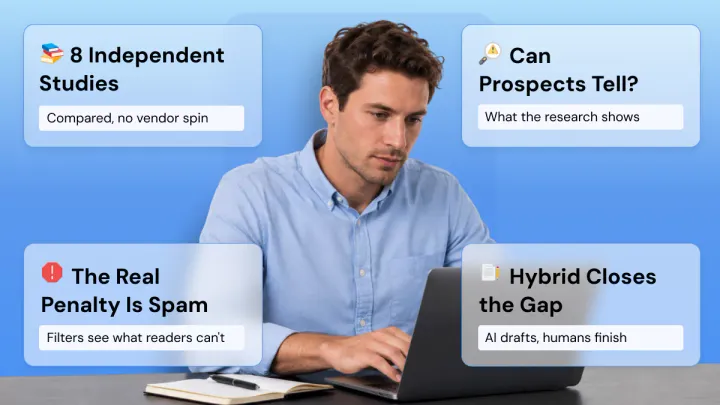
AI vs Human Cold Email Reply Rates: What 150M+ Emails Across 8 Studies Actually Show (2026)
AI cold emails get 1% fewer replies but 3x more spam flags. We compared 8 studies covering 150M+ emails, including peer-reviewed research, to show what actually works in 2026 and the fix that closes the gap.

The Self-Editing Workflow That Makes Writing Read Human
A 5-pass self-editing checklist for copywriters: fix structure, cut generic filler, add proof and voice, improve rhythm, and verify facts before your copy ships.