
AI vs Human Cold Email Reply Rates: What 150M+ Emails Across 8 Studies Actually Show (2026)
AI cold emails get 1% fewer replies but 3x more spam flags. We compared 8 studies covering 150M+ emails, including peer-reviewed research, to show what actually works in 2026 and the fix that closes the gap.
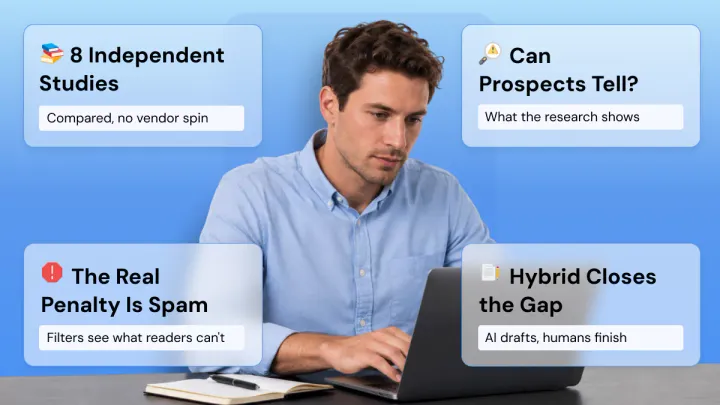
Fully AI-generated cold emails earn about 1 percentage point fewer replies than human-written ones and get flagged as spam at nearly three times the rate. That is what the best available 2026 data shows, but the gap is smaller than most sales teams assume, and it is shrinking.
The more useful finding sits underneath: emails drafted by AI and finished by a human consistently outperform both pure approaches, on replies and on inbox placement. The problem was never AI writing. It is AI writing that nobody reviewed.
This guide breaks down the real reply-rate numbers across every major 2026 dataset, explains why the studies contradict each other, shows where the spam penalty actually comes from, and lays out the hybrid workflow that closes the gap
The Short Answer: Do AI Emails Get Fewer Replies?
Yes. Fully AI-generated cold emails get roughly 1 percentage point fewer replies than human-written ones sent to comparable lists. The clearest matched dataset available, Digital Applied's vendor-published analysis of 100,000 paired cold emails, reported a 4.1% reply rate for AI versus 5.2% for human-written messages in 2026.
Here is how the two main 2026 datasets line up:
Two things jump out. The gap is real in both datasets. And the highest number on the table belongs to neither pure approach: AI-assisted emails with human editing win.
Read the fine print before quoting these numbers. Digital Applied is a vendor analysis, not peer-reviewed research. The pairing was solid, matched by audience, ICP, sequence stage, and sender-domain age, but there are no confidence intervals or downloadable data. And the raw rates count any response within 14 days, including out-of-office replies and unsubscribes.
Filter for positive replies and the numbers drop to 1.4% for AI and 2.1% for human. The gap holds, it just lives at a humbler altitude. The Lavender figures carry their own caveat: the original dataset isn't publicly linked, so treat them as supporting evidence.
The gap is shrinking, with a caveat. Digital Applied's own datasets show it narrowing from 2 percentage points in 2024 to 1.1 in 2026, a 45% reduction. That is one company's trend line, not proof the whole industry moved the same way. It does match what better models would predict, though.
Now anchor everything to the 2026 baseline, from Instantly's cold email benchmark report built on billions of cold email interactions:
- Average reply rate: 3.43%
- Top quartile: 5.5% or higher
- Top 10%: above 10.7%
Against that ladder, Digital Applied's 4.1% AI rate actually beats the industry average, and its 5.2% human rate flirts with top-quartile territory.
One more data point worth your attention. A July 2026 randomized field experiment on AI-rewritten workplace email across 16,880 messages found that AI rewriting neither raised nor lowered reply rates on its own. The emotional tone of the final message predicted engagement. It wasn't a cold outreach study, but the lesson transfers: prospects respond to the finished email, not to who or what drafted it.
Why the Studies Disagree (And Which Numbers to Trust)
AI-versus-human email studies disagree because they are not measuring the same kind of campaign. Across the most cited 2026 reports, AI reply rates range from 4.1% to 8.2% and human-written rates from 5.2% to 11.7%. Differences in targeting, prompt quality, human editing, sending infrastructure, and even the definition of a "reply" move the numbers more than the AI-versus-human variable itself.
Every Major 2026 Study, Side by Side
The fine print behind each row matters more than the row itself.
Prospectory matched prospects carefully and used tuned GPT-4 prompts, but its 11.7% human rate sits above Instantly's threshold for the top 10% of all campaigns. Not false, just a highly optimized environment, not your average Tuesday send.
Saleshandy tested one narrow audience (US sales leaders at 50-200 person SaaS firms) with unequal arms: 5,000 AI emails against 2,000 human ones, each on separately warmed domains. Its most useful finding is the hybrid number.
Digital Applied is the broadest matched comparison, but its headline rates count every reply within 14 days, including out-of-office messages. Its positive-reply rates were 1.4% AI vs 2.1% human.
What Is a Realistic Cold Email Reply Rate in 2026?
Use 3.43% as your sanity check. Instantly's benchmark, drawn from billions of interactions, gives you a simple three-line test for any number a vendor shows you:
- 3% to 4% → typical for a healthy campaign
- 5.5% or more → top-quartile work
- Above 10.7% → elite territory; demand methodology before believing it
How to Judge Any Cold Email Statistic
Rank the evidence in this order, and never let a lower tier carry a claim a higher tier contradicts:
- Peer-reviewed or preregistered field experiments with published methods
- Large aggregate platform data for realistic ranges
- Transparent matched vendor analyses that explain audience, infrastructure, and reply definitions
- Small or narrow vendor tests, useful but hard to generalize
- Unlinked "community data" and secondhand stats, never load-bearing
One honest limitation applies to this entire article: every direct AI-versus-human comparison available today is vendor-published. Even Instantly is a commercial platform, though its scale makes it the best benchmark we have. That is exactly why we use outbound datasets only for reply-rate numbers, and lean on peer-reviewed research for the bigger claims about detection, trust, and productivity in the sections ahead.
The takeaway is not that one study is right and the rest are wrong. It is that campaign conditions move reply rates more than authorship does. Before trusting any headline percentage, check who got the emails, who edited the copy, how the domains were warmed, and what counted as a reply.
The Real Penalty Is Spam Placement, Not Replies
The bigger cost of fully AI-generated cold email shows up before anyone reads it. In Saleshandy's 12,000-email test, AI-only emails were spam-flagged at 7.8% versus 2.9% for human-written ones. Digital Applied's 100,000-email analysis found a nearly identical 8% versus 3% split. Two separate vendor datasets, same conclusion: AI-only sends get flagged at roughly 2.7 times the human rate.
That difference compounds fast. Across 10,000 sends, an 8% flag rate means about 800 flagged messages against 300 at the human rate. The usual caveats apply: both are vendor-reported campaign results, one from a narrow SaaS audience, neither independently audited. But the agreement between them is hard to dismiss.
Why Can Machines Detect AI-Written Emails?
Because AI text carries measurable patterns that can trigger AI detectors, and this part is peer-reviewed, not vendor-claimed. A 2025 study in Expert Systems with Applications built a classifier that identified GPT-4o-generated emails with 96% accuracy using only stylometric features: imperative-verb count, clause density, and first-person pronoun use. No content analysis needed. The style alone gave it away.
Be precise about what that proves. The 96% came from a custom research classifier, not from Gmail's or Outlook's deployed filters. In fact, the same researchers found Gmail and Outlook let more AI-generated phishing emails through than Yahoo did. So the study confirms the fingerprint exists and is machine-readable. It does not prove every mailbox provider currently hunts for it.
Do Spam Filters Actually Flag AI Content?
Not directly. Mailbox providers judge a risk profile, and the words are only one input. Gmail's sender guidelines center on SPF, DKIM, and DMARC authentication, domain reputation, steady volume, and keeping spam complaints below 0.1% (with 0.3% as the danger line). Yahoo and Microsoft weight the same fundamentals, plus content triggers like excessive links and URL shorteners.
Here is the honest synthesis: AI authorship is not the variable, predictability at volume is. Formulaic copy becomes a problem when it stacks on top of high-volume automation, repeated templates, weak authentication, or ignored messages. Rewriting the text cannot repair a burned domain. But a repetitive machine fingerprint, multiplied across thousands of sends, is one risk signal you can actually remove.
How Many Cold Emails Never Reach the Inbox?
About one in eight. Validity's latest benchmark, built on trillions of data points, puts global inbox placement at 87.2%, meaning roughly 12.8% of email lands in spam or vanishes entirely. Every debate about subject lines and personalization happens after that filter. Your email has to survive the infrastructure layer before writing quality gets a vote.
Can Prospects Even Tell It's AI? (And Does It Matter If They Can?)
Most people cannot reliably tell whether text was written by AI, but suspicion alone is enough to damage trust. In Bynder's blind test of 2,000 consumers, only 50% correctly identified the AI-written version of an article. Validity's Summer 2026 survey of 1,000 consumers found just 43% feel confident they could spot an AI-written email, and confidence is not the same thing as accuracy.
Do People Actually Prefer Human Writing?
Not when they don't know the source. Here is the uncomfortable finding from the Bynder study: 56% preferred the AI-written article in the blind comparison. Yet 52% said they'd become less engaged with copy they suspected was AI-generated. Same readers, opposite reactions. They liked the words. They disliked what the words implied about the sender.
One honest caveat: this was a 2024 test using a single 300-word article, not a cold email experiment. Treat it as evidence about attitudes, not a reply-rate predictor.
Why Does Getting Caught Cost So Much?
Because the penalty is about perceived effort, not sentence quality. In The Transparency Dilemma, published in Organizational Behavior and Human Decision Processes (2025), University of Arizona researchers Schilke and Reimann ran 13 experiments across work and creative contexts. People who disclosed AI use were trusted less in every framing tested: limited use, voluntary, mandatory, even "with human review." And the penalty was worst when a third party exposed undisclosed AI use.
The experiments didn't test sales emails specifically, so nobody can tell you how many reply-rate points this costs. What they establish is the mechanism: recipients judge whether you invested appropriate thought and care, not just whether the sentences flow.
Is AI Writing Actually Less Persuasive?
No, and this is where the debate flips. In a preregistered 2025 experiment, LLMs out-persuaded financially incentivized humans. A separate study of 1,601 Americans found AI-written policy messages shifted views by 9.74 percentage points, and labeling them as AI-generated made no significant difference.
A December 2025 meta-analysis of seven studies and 17,422 participants adds the fair caveat: overall, AI and human persuasion come out roughly even, with results swinging by model and context. Both are preprints or early literature, but the direction is consistent: the words themselves are not the weakness.
Put the three research streams together and you get the line worth remembering:
AI-generated words can be persuasive. The trust problem begins when the message signals low effort, weak relevance, or impersonal automation.
A prospect never needs to prove a machine wrote your email. They only need to feel you didn't understand their role, company, or current priorities. Gartner's survey of 632 B2B buyers found 73% actively avoid suppliers that send irrelevant outreach. SlateCX separately reports 68% of buyers responding less to vendor outreach overall, though that figure is vendor-published, so hold it more loosely.
The practical lesson: don't obsess over whether prospects can detect AI. Make sure the final message demonstrates human judgment, because that is what they're actually testing you for.
Where AI Wins, Where Humans Win
AI performs best in the repeatable, pattern-heavy parts of cold outreach. Humans stay ahead wherever the message requires judgment, trust, or adaptation. The 2026 vendor data splits cleanly along that line, so here is the honest division of labor:
Give AI the work that repeats:
- Research and enrichment (company news, hiring signals, tech stack), with a human verifying relevance
- Copy variants for testing, follow-up scheduling, reply sorting
- Trigger-based speed: in Prospectory's test, an AI follow-up sent within two hours of a pricing-page visit got 31% more engagement than next-day human follow-ups. Timing, not writing quality, likely drove the lift, which is exactly the point.
Keep humans on the work that thinks:
- Regulated industries, executive outreach, objection handling, and any conversation past the first reply
- Final approval on anything sent in a real person's name
Why Is SaaS the Exception?
Because the gap nearly vanishes there. Prospectory reported 9.8% AI versus 10.2% human in SaaS, within its margin of error. Digital Applied found the reverse in its dataset: AI slightly ahead at 6.1% versus 5.7%. Both are vendor-published, but together they suggest technical buyers penalize AI least.
Lavender's 2026 benchmark of 231,818 cold emails adds context: engineering and product recipients replied at 5.2%, favoring brief, direct, problem-specific messages. Technical buyers don't prefer AI. Their preferences are just the easiest to encode into a repeatable draft.
Where Do Humans Win Biggest?
Wherever a mistake is expensive. Prospectory reports human-written healthcare emails at 14.8% versus 5.4% for AI, and financial services at 13.2% versus 6.9%. Digital Applied's data points the same direction. At the top of the org chart, one vendor study claims C-level prospects replied to human emails at 6.2% versus 1.5% for AI, a 4.1x gap.
Don't treat that as a universal benchmark, but do treat it as an operating rule: use AI to research executives, never to send them unreviewed copy. Humans also dominated once conversations started, averaging 3.7 exchanges before a meeting versus 1.6 for AI-sourced threads.
Does Personalization Beat Both?
Mostly, yes. Belkins' analysis of 5.5 million emails found personalized subject lines pulled a 7% reply rate versus 3% without, a 133% lift. Note the scope: that measured subject lines, not deep personalization of the whole email.
The distinction that matters is personal data versus relevant personalization. AI can find the funding announcement. A human still has to explain why it creates a problem worth solving this quarter. Repeating a LinkedIn detail is enrichment; connecting it to the recipient's situation is judgment.
Let AI find signals, organize research, produce variants, and keep the workflow running. Let humans decide what the signal means and whether the angle is credible.
The Hybrid Workflow That Closes the Gap
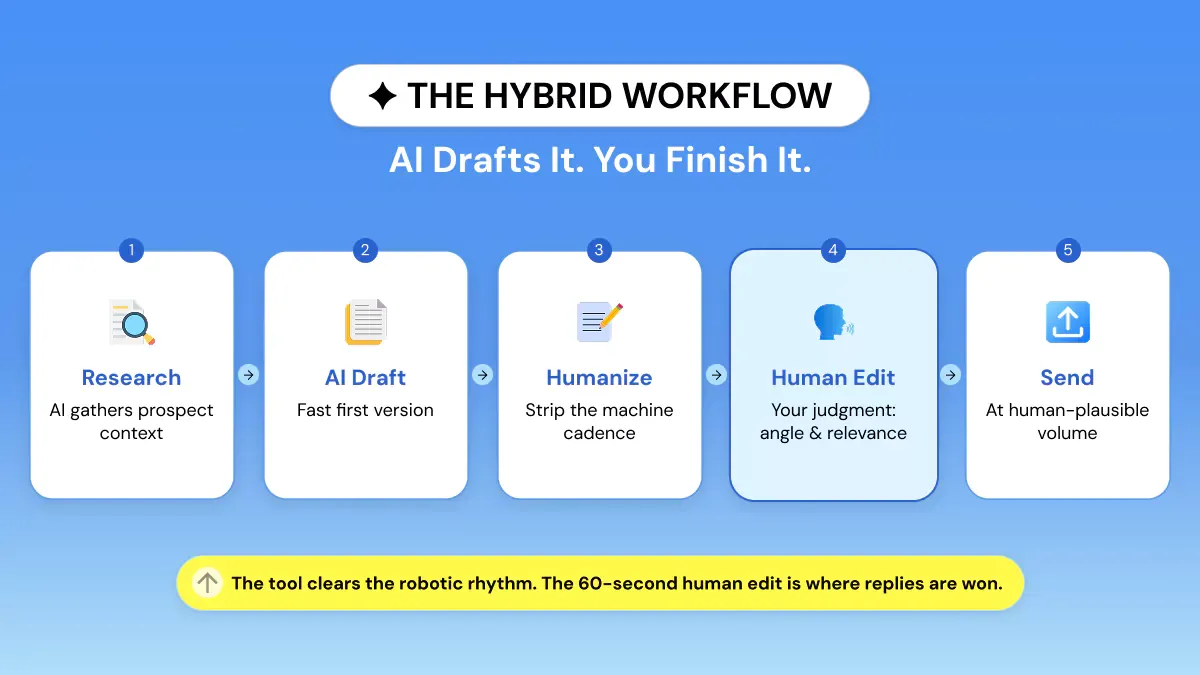
The strongest evidence in this entire debate supports one setup: AI as an assistant, a person responsible for the send. In a randomized experiment published in Science, 453 professionals with ChatGPT access finished writing tasks 40% faster with quality rated 18% higher by independent evaluators. It didn't test cold email, and the authors note real-world gains shrink once you factor in fact-checking. But it is the gold-standard citation for AI-drafted, human-finished work.
Outbound data points the same way. Saleshandy's hybrid arm hit a 14.7% reply rate against 10.4% human-only and 4.1% AI-only, with spam flags at 3.1%, nearly the human level of 2.9% instead of AI's 7.8%. Honest caveat: the hybrid arm bundled AI research, drafting, and human refinement together, so the test proves the workflow, not any single step.
The Five-Step Workflow
- Research with AI, judge with a human. AI compiles the signals (funding, hiring, tech changes). A person answers one question: does this signal give this prospect a reason to care?
- Generate several drafts, not one. Brief the tool tightly: recipient, signal, problem, proof, CTA, hard length limit. Compare options instead of polishing output #1.
- Rewrite the formulaic language. Between draft and review, run the text through Phrasly AI Humanizer to strip repetitive cadence, generic transitions, and overly formal wording. What this step does: makes your review time count. What it doesn't do: guarantee inbox placement or replies. A person still confirms the rewrite kept the offer, facts, and personalization intact.
- Spend 30 to 90 seconds on judgment (our operational target, not a researched benchmark). Check five things: is the angle relevant, could this email go to 500 other people unchanged, is every claim accurate, does it sound like the sender, can the recipient reply without booking a call? A fuller version of this pass lives in our self-editing checklist for copywriters.
- Track positive replies, meetings, and spam placement, not raw reply counts. A total reply rate happily counts out-of-office messages.
How Much Human Control Does Each Campaign Need?
Three rules cover most cases: by deal size, SMB can run AI-heavy with human QA, mid-market goes hybrid, enterprise stays human-led. By seniority, hybrid up to manager level, human-written for VP and above. By vertical, SaaS tolerates AI-heavy, regulated industries don't. As deal value and reputational risk rise, human involvement rises with them.
Let AI cut the research and drafting time. Use Phrasly to clean up formulaic language. Keep a person responsible for relevance, evidence, and the final send.
How to Run Your Own Honest Test (Without 10,000 Emails)
A valid test changes the writing workflow only, while holding audience, offer, timing, and sending infrastructure steady. One size warning up front: 500 to 1,000 sends per arm is a directional pilot, not proof. At cold email's low base rates, settling a 1-point difference takes far more volume than most teams expect.
Test Three Arms, Not Two
If you're testing anyway, the third arm is the cheapest variable to isolate. Document it precisely, for example: "AI draft processed with Phrasly in Medium mode, then reviewed for up to 60 seconds by an SDR who could correct facts, tone, and CTA." The point is a repeatable, documented rewrite step, not a foregone conclusion.
How Many Emails Does a Real Test Need?
At 95% confidence and 80% power, roughly:
A small test is still useful. Label the result directional and repeat it across later cohorts.
Two final rules. Ignore open rates: Apple's Mail Privacy Protection loads tracking pixels whether or not anyone reads the email, so judge the test on positive replies, meetings booked, and actual inbox placement. And fix your stop rule before launch, then sanity-check the winner against Instantly's benchmarks: the market average is 3.43%, elite is 10.7%+.
This is what a defensible test requires. Treat any vendor claiming results several times the industry average with caution until it shows you the audience, randomization, reply definition, and full funnel.
The data says AI-written emails lose about 1 reply-rate point and get spam-flagged at nearly 3x the rate. But the real divide is human-in-the-loop versus human-out-of-the-loop. Let AI research and draft, strip the machine patterns, then spend 60 seconds deciding if the email deserves this person's attention. The teams losing replies aren't using AI. They removed themselves from the process.
FAQs
Do AI-written cold emails get fewer replies?
Yes. Digital Applied’s vendor-published analysis of 100,000 matched sends found a 4.1% reply rate for AI-generated emails versus 5.2% for human-written emails, a 1.1-percentage-point gap. Its own data shows the gap narrowing from 2 points in 2024, but this is one commercial dataset rather than independent industry proof.
What is a good cold email reply rate in 2026?
The average cold email reply rate is 3.43%, according to Instantly’s analysis of billions of interactions. A rate of 5.5% or higher places a campaign in the top quartile, while 10.7% or higher is elite, so 8–12% should not be presented as a typical industry average.
Why do AI-generated emails go to spam more often?
Vendor tests found AI-only emails receiving spam flags at 7.8%–8%, compared with 2.9%–3% for human-written emails. These results do not prove that mailbox providers penalize AI authorship itself, because copy repetition, sending cadence, authentication, domain reputation and recipient complaints also affect placement.
Can people tell when an email is written by AI?
Only about half can identify AI-written copy reliably. Bynder found that 50% correctly recognized AI content, while 52% said they would become less engaged with content they suspected was AI-generated, showing that suspicion can matter even without certainty. If you want to know what your own copy signals, run an AI check on your draft before it ships.
Is a hybrid approach better than AI or human writing alone?
A 12,000-email Saleshandy test found that its hybrid workflow produced a 14.7% reply rate, compared with 10.4% for human-only and 4.1% for AI-only emails; its 3.1% spam-flag rate was also close to the human arm’s 2.9%. These are promising vendor-reported results, not proof that every hybrid campaign will perform the same way.
Should I use AI to write emails to executives?
Use AI to research executives and organize possible angles, but keep the final message human-led. One Prospectory vendor study reported 6.2% replies for human-written C-suite emails versus 1.5% for AI-generated emails, although that 4.1-times gap should not be treated as a universal benchmark.
Are AI SDRs worth it in 2026?
AI SDRs can be useful as capacity multipliers, but the current evidence does not support treating them as full human replacements. SlateCX found that 79% of surveyed organizations had adopted or planned to adopt AI SDRs, yet only 5% considered them highly effective; Salesforce separately reports that 54% of sellers have used AI agents.
How do I make AI-written emails sound human?
Use an AI humanizer or rewriting tool to reduce repetitive cadence, predictable transitions and overly formal wording, then have a person review the angle, relevance, facts and CTA. Finally, send at a controlled volume with properly configured domains, because rewriting the copy alone cannot guarantee inbox placement or replies. Full walkthrough: how to make AI-written emails sound human.


Keep reading

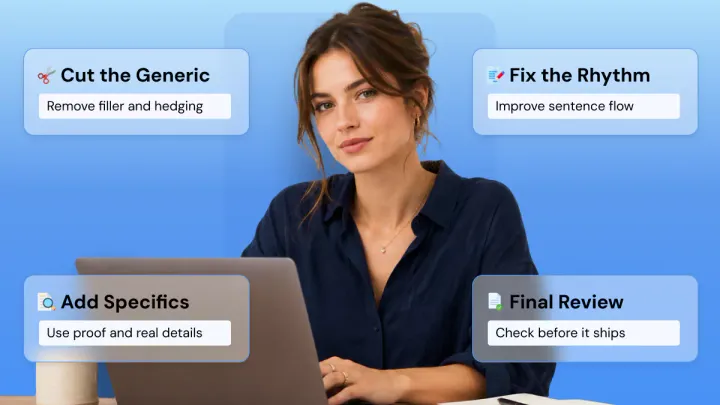
The Self-Editing Workflow That Makes Writing Read Human
A 5-pass self-editing checklist for copywriters: fix structure, cut generic filler, add proof and voice, improve rhythm, and verify facts before your copy ships.

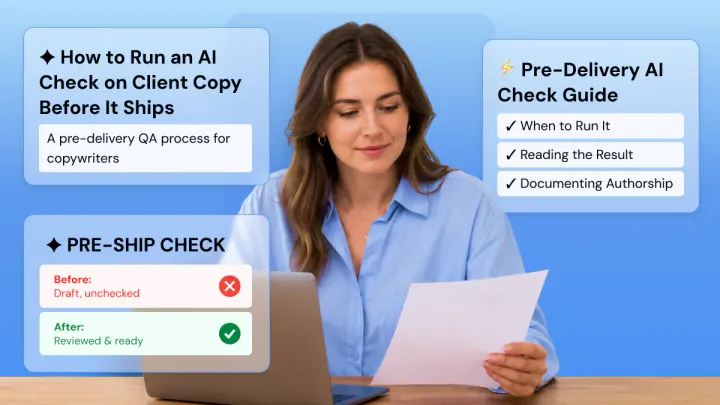
How to Run an AI Check on Client Copy Before It Ships?
Run an AI detector once, on your final draft not mid-process. Treat flagged passages as editing cues, not a verdict, since studies show detectors misfire often. Fix generic or hedged lines, leave strong writing alone, and keep dated drafts as your real proof of authorship.