How to Build a Generative AI Brand Voice System for Your Marketing Team
15 min read
Your company already has a brand guide, and it tells your team how the brand should sound. The problem is that people read the same guide and understand it in different ways.
One writer may think “friendly” means jokes, while another can decide it means short sentences, and both of them believe they followed the rules. This way, the copy your team publishes never quite sounds like one brand.
Similarly, if you are using AI, every model adds its own version of that problem. Ask ChatGPT, Claude, and Gemini for a friendly tone and you get three different answers, because each was trained on different text. While your team is publishing faster than ever, the copy is sounding less like you.
HubSpot's 2026 State of Marketing report puts 80% of marketers on AI for content creation and 75% on media production, so generative AI for marketing is standard equipment. But what most teams have never built is the layer that keeps all that output sounding like one brand.
An AI brand voice system is that layer, and this guide gives you all seven of its parts as assets you can fill in and start using this week.
💡 In short
To keep brand voice steady with AI, turn your voice guide into an operating system. It needs one approved source of truth, observable writing rules, channel-specific adjustments, a shared prompt block, named owners, version control, and a human QA scorecard. AI writes the draft, and the system decides what is safe to publish.
Want to see the editing layer first? Paste one AI draft below and watch what changes 👇
What Is an AI Brand Voice System?
An AI brand voice system is a documented set of writing rules that both people and AI tools follow when they create content for your brand. It holds your approved language, examples, prompts, named owners, and quality checks in one place, so everyone who writes for you works from the same instructions and the models do too.
Consistency across people is the goal, and identical sentences are not. Two writers can handle one brief differently and still sound like the same company.
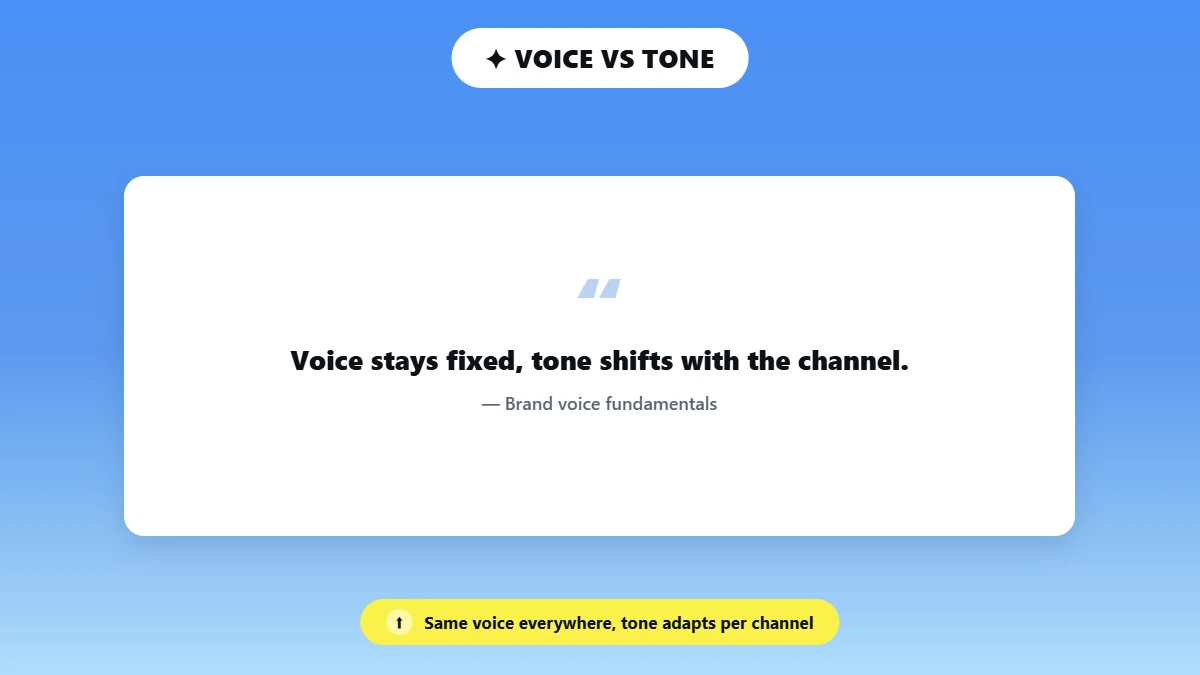
Voice and tone do separate jobs. Your voice is the lasting identity of the brand, so it stays the same everywhere you publish. Your tone changes to suit the situation, shifting with the channel, the audience, and the moment.
Ordinary brand style guide | AI-operable brand voice system |
|---|---|
Uses broad traits like “friendly” | Turns each trait into observable behavior |
Written mainly for experienced staff | Written for humans and language models |
Shows a few polished examples | Shows approved and off-brand examples |
Rarely changes | Has an owner, a version number, and a change log |
Leaves channel adaptation to judgment | Defines what stays fixed and what can move |
Relies on subjective approval | Uses a repeatable QA scorecard |
Step 1: Create One Brand Voice Source of Truth
A brand voice source of truth is one master document holding every approved voice rule, example, and claim. Every writer works from that file, and every prompt is built out of it.
Brand drift starts when those rules live in five places. A slide deck, an old brief, a saved prompt, and somebody's project document will contradict each other inside a quarter, and the model learns whichever one it was handed.
Only current, approved content belongs in this file, because a model copies whatever example it is given. Paste in a landing page from two years ago and the claims you retired will come back in a draft months later.
What should an AI brand voice guide include?
An AI brand voice guide includes everything a writer or a model needs in order to sound like you, and all of it stays in one document rather than spread across files:
🎯 Brand purpose and positioning
👥 Primary audiences and what they know
🗣️ Three to five voice traits, each with its opposite
✅ Observable writing behavior for every trait
📚 Preferred vocabulary and prohibited words
🧭 Point-of-view, formatting, and sentence rules
🔒 Protected product names, claims, and current proof points
⚖️ On-brand examples and off-brand examples
📢 Channel-specific adjustments
📅 Current version number and named owner
First drafts from any model come back flat, because the model reaches for the most common phrasing it has seen. Put the fix into your rules so that nobody solves it twice, and our guide on how to edit AI marketing copy line by line covers the sentence moves that work.
Step 2: Complete the AI Brand Voice Template
The AI brand voice template turns your voice into fields a model can read and act on. Copy it into a document, fill in every field, and store it with your source of truth.
Short labels work better than paragraphs, because a model follows a specific instruction more reliably than a description of one.
Brand Voice System Template
Brand:
Version:
Effective date:
Owner:
Approved by:
Next review date:
1. Purpose
Our content exists to:
The reader should think, feel, or do:
2. Audience
Primary audience:
Knowledge level:
Problems in their words:
Language they use:
3. Core voice
We sound:
We do not sound:
Trait 1 observable behavior:
Trait 1 opposite:
Trait 1 approved example:
Trait 1 off-brand example:
4. Point of view
We speak as:
We address the reader as:
We never claim:
5. Language rules
Preferred words:
Prohibited words:
Industry terms that stay unchanged:
Product names that stay unchanged:
Approved descriptions:
Approved claims and proof points:
6. Writing style
Sentence length:
Contractions:
Paragraph length:
Headings, lists, and punctuation:
Humor and emoji policy:
7. Approved examples
Example, and why it is on brand:
8. Anti-examples
Example, and what makes it off brand:
9. Channel rules
See the channel adaptation matrix:
10. Final QA
See the brand voice scorecard:One trait filled in properly shows what observable behavior means. An adjective like confident leaves a model room to guess, while a written behavior tells it what to do.
One trait filled in properly shows what observable behavior means. An adjective like confident leaves a model room to guess, while a written behavior tells it what to do.
Field | Filled example |
|---|---|
Trait | Direct |
We do | State the useful answer before explaining the method. |
We do not | Open with a broad trend or a rhetorical question. |
On-brand line | “Use one approved prompt block across the team.” |
Off-brand line | “In today’s rapidly evolving digital environment, consistency matters more than ever.” |
⚠️ Fill in the anti-examples
Most teams stop after the approved examples, which leaves the model nothing to compare against, so it repeats what you wanted gone. Two off-brand lines per trait is usually enough to change what comes back.
Step 3: Build a Channel Adaptation Matrix
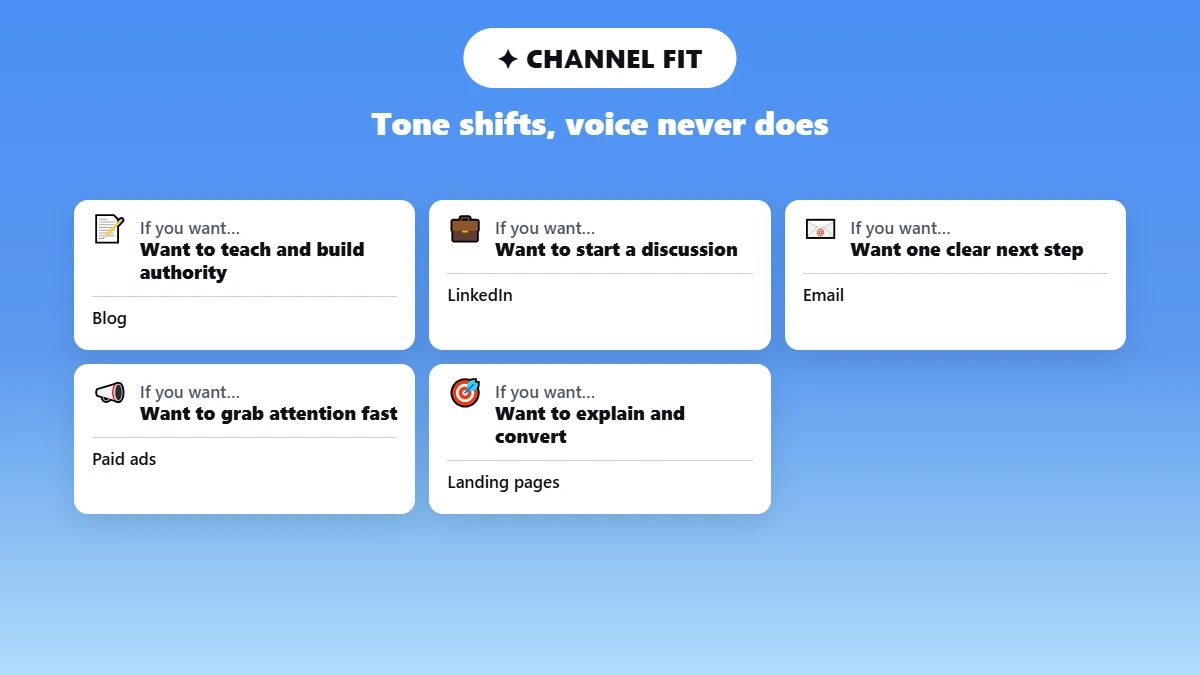
Your voice stays constant across channels while your tone adjusts to each one. Personality, point of view, terminology, positioning, and factual standards stay identical everywhere, and formality, urgency, energy, sentence length, depth, and CTA strength are the parts you can move. The matrix records that split, so nobody has to guess which rules they may bend.
Channel | Main goal | Adjustable tone | Sentence style | CTA | Fixed voice rules |
|---|---|---|---|---|---|
📝 Blog | Teach, build authority | Helpful, measured | Varied, explanatory | Contextual, low pressure | Accurate claims, clear POV, customer language |
Start a discussion | Personal, direct | Short openers | Conversation led | Same positioning and terminology | |
Drive one action | Warm, concise | Short, scannable | One clear next step | No false urgency or unsupported claims | |
📣 Paid ads | Grab attention | Higher energy | Compressed | Direct | Protected claims and offer accuracy |
🎯 Landing pages | Explain and convert | Confident, specific | Benefit led | Prominent | Product names, proof, and promises unchanged |
⚙️ Product messaging | Explain function | Clear, controlled | Concise | Task based | Approved feature descriptions only |
A writer pastes only their own channel row into the prompt. Email carries the tightest limits, since subject lines break fastest under a rewrite, and our test of an AI humanizer for email marketing copy shows what to check afterwards. When a channel draft still reads stiff, the comparison of the best AI humanizer for marketing content covers that polish step.
Step 4: Give Every Marketer the Same Prompt Foundation
Every marketer writes their own task instructions while the brand section stays identical for all of them. Give each person one shared, model-agnostic prompt carrying your audience, voice rules, prohibited language, protected elements, the channel row, and examples. The task goes last.
How do you train AI to follow a brand voice?
You train a model on your brand voice inside the prompt, because models keep no memory of your rules between sessions. Every request carries the rules with it, so your team pastes the same block and changes only the task line.
You are writing for [BRAND].
Use the approved brand voice rules below as operating constraints.
AUDIENCE: [audience + knowledge level]
CORE VOICE: [observable voice behavior]
WE NEVER SOUND: [opposites + anti-patterns]
PREFERRED: [preferred terms]
PROHIBITED: [banned or inaccurate phrasing]
PROTECTED, do not change: names, statistics, quotations, offers, legal language, keywords, claims: [protected elements]
CHANNEL: [blog / linkedin / email / ad / landing / product]
CHANNEL RULES: [paste the applicable matrix row]
EXAMPLES: [2-3 short annotated examples]
TASK: [the individual assignment]
Before returning the draft, check:
1. Every observable voice rule followed?
2. Any prohibited phrase used?
3. All protected elements unchanged?
4. Tone right for the channel?
5. Any claim unsupported?
If style conflicts with accuracy or a protected element, preserve accuracy and the protected element.
The final instruction protects your claims, because style loses to accuracy every time. A model improving a sentence then cannot soften a claim or rename a product.
How do you create a brand voice prompt for AI?
You create a brand voice prompt by copying the block above and filling the bracketed fields from your master document. Save it where the team can reach it, and update it whenever the master guide changes version.
Individual assignments still need their own task lines. Our list of task-specific AI prompts for marketing covers campaign work, and AI prompt examples that work shows why the weaker versions fail.
Turn your approved rules into one reusable prompt block 👇
Step 5: Assign Ownership and Approval Rules
One named person owns each part of the system, and a reviewer approves any change to what your brand says. Ownership decides whether the guide is still accurate next year.
How do marketing teams keep AI content on-brand?
Marketing teams keep AI content on brand by naming a person for every component. When nobody owns a rule, nobody updates it, and a claim your team stopped using can still reach a published ad.
👤 One owner proposes changes to a component.
✅ A named reviewer approves material changes.
✍️ Individual writers never rewrite the central rules on their own.
🔁 A repeated failure becomes a system rule, not private feedback.
Who should own AI brand voice governance?
Your brand lead should own the core voice rules, and product marketing should own positioning and approved claims. Content operations keeps the prompt block and version log current, and a senior lead approves material changes.
Component | Owner | Reviewer | Update trigger |
|---|---|---|---|
Core voice rules | Brand lead | Head of marketing | Rebrand or repositioning |
Positioning and approved claims | Product marketing | Brand or legal reviewer | Product or evidence change |
Approved examples | Managing editor | Brand lead | New campaign or channel |
Shared prompt block | Content operations | Channel leads | Repeated output failure |
Channel matrix | Channel lead | Brand lead | Strategy or platform change |
QA scorecard | Editorial lead | Brand lead | Review pattern change |
Version log | Content operations | Marketing lead | Every approved revision |
📊 Governance is the gap
Adobe's 2026 AI and Digital Trends research surveyed 3,000 executives and practitioners, and only 32% named data quality, unification, and governance a top AI investment priority. Most teams buy output speed and skip the layer that keeps it correct.
Step 6: Add Version Control
Version control means one current master document with a visible version number, effective date, owner, and approval record. Archive each older version instead of deleting it.
The costliest failure is updating the master guide and leaving the saved prompts untouched. Two versions of your voice then stay in circulation, and the older one keeps producing copy.
🔵 2.0 for a rebrand, major repositioning, or a new audience.
🟡 1.1 for a new channel, an updated claim, or a material voice-rule change.
⚪ 1.1.1 for a typo or a clarification that leaves the meaning intact.
How often should you update the guide?
Review your AI brand voice guide on a fixed schedule, and revise it as soon as your positioning, offers, audiences, or channels change. Log every approved change the day it happens, and refresh the saved prompts at the same time.
Version | Date | Change | Affected assets | Approved by |
|---|---|---|---|---|
1.1 | YYYY-MM-DD | Replaced old product claim | Landing-page and email prompts | Brand lead |
Step 7: Score Every Draft Before Publication
Score every draft against your documented voice on a ten-point scale, using five criteria worth zero, one, or two points each. Run a separate accuracy pass alongside it, because a draft can sound on brand and still carry a claim nobody approved.
How do you measure brand voice consistency?
You measure brand voice consistency by scoring each draft against fixed criteria and setting a minimum score before it publishes. Give brand alignment its own column, since a draft can pass a detector and still miss your voice.
Criterion | 0 | 1 | 2 |
|---|---|---|---|
Tone matches the approved voice | Contradicts the rules | Partly consistent | Consistent throughout |
Vocabulary follows brand rules | Multiple violations | Minor inconsistency | Preferred language used |
Point of view is consistent | Wrong or mixed POV | Small drift | Fully consistent |
Customer and product language is specific | Generic | Some specificity | Reflects approved language |
Channel adaptation is appropriate | Wrong for the channel | Partly adapted | Fits the channel, keeps the voice |
The accuracy pass stands apart from the score. Facts, claims, product terms, offers, and CTAs all have to be correct, and one failure blocks publication however well the draft scored.
✅ 9 or 10, accuracy pass clear: publish.
⚠️ 8, accuracy pass clear: publish after one minor fix.
🚫 6 to 7: back to the editor.
❌ 0 to 5: redraft from the approved prompt block.
Does an AI detection score prove a draft is on brand?
No. An AI detection score estimates how machine-written the text looks, and it says nothing about your positioning or your approved claims. Keep the two checks separate.
📉 Why the human gate matters
Klaviyo and Datalily surveyed 8,000 consumers in December 2025, reported by EMARKETER's chart on AI and brand trust. Only 7% said visible AI content made them trust a brand more, while 31% said it made them trust the brand less.
Polish the flat passages, then run the draft back through the scorecard 👇
Test the System Before You Roll It Out
Run a small pilot on one channel before the whole team adopts the system, because it shows which rules were too vague while they are cheap to fix.
1. Pick one channel and one repeatable content format.
2. Give the same brief and master prompt to three team members.
3. Let each person use the AI tool they already work in.
4. Score the outputs blind, so reviewers cannot see who wrote what.
5. Record the failures that show up more than once.
6. Update the guide and the shared prompt to close those failures.
7. Repeat until outputs reach 8 out of 10 without rework.
8. Expand to the next channel, and review monthly for a quarter.
Blind scoring matters, since reviewers grade a familiar writer more generously and that hides which rules are broken.
✏️ Illustrative rewrite (example only, not test data)
Off brand: “Our powerful platform empowers teams to unlock better results.” On brand: “Set your brand rules once, and every draft starts from them.” The second line names the reader's action and makes no claim you would have to defend.
Where Phrasly Fits in the Brand Voice Workflow
Phrasly works at the editing layer, after your voice system has decided what good looks like. A tool used too early will only polish a draft that was never on brand:
1. Generate or assemble the draft.
2. Compare it against the voice system.
3. Lock product names, offers, claims, statistics, and CTAs.
4. Improve flat or awkward passages.
5. Re-check every protected element.
6. Complete the QA scorecard.
7. Send it for final approval.
Which Phrasly tool does what?
Three Phrasly tools do three different jobs here, and the AI Text Enhancer handles most of the editing work.
✨ AI Text Enhancer (primary): improves clarity, tone, structure, and flow at Easy, Medium, or Aggressive levels. Review what it returns, because it knows nothing about your brand.
🧹 AI Humanizer (secondary): use it on passages that stay formulaic after brand review. It handles phrasing only.
🧱 AI Prompt Generator (supporting): use it when the team turns approved voice rules into one reusable prompt.
Manual fixes come first, and how to humanize AI text covers them. If you are choosing between editing tools, the best AI text enhancers compared roundup lays out the trade-offs.
Can a tool enforce your brand voice?
No. No editing tool knows your positioning, your audience, or your approved claims, so none can enforce a voice on its own. Phrasly speeds up the polish, and your scorecard and reviewer decide what publishes.
Start with one channel and one week rather than the whole system. Fill in the template, name an owner for each row of the ownership table, and give every writer on that channel the same prompt block.
Then score the first five drafts and count how often the same problem returns, because that tells you which rule was too vague to act on. Rewrite that one rule and the problem goes away for everybody.
Fix the last robotic passages before the final review 👇
Frequently Asked Questions
What is an AI brand voice?
An AI brand voice is the documented personality, language, point of view, and writing behavior an AI tool follows when it writes for you. It turns a general-purpose model into one that sounds like your company.
How do you maintain brand voice when using AI?
Give the model rules it can act on and give your people the checks: one master document, a shared prompt block, an owner for each component, and a minimum score before anything ships.
What is the difference between brand voice and tone?
Voice is the part of your brand that never changes, and tone is the version you use for one channel or moment. Tone shifts formality, energy, and length, while the voice underneath stays put.
Can different AI tools follow the same brand voice?
Yes, as long as the instructions are model-agnostic, specific, and backed by examples, so ChatGPT, Claude, and Gemini can share one brand block. Review each output, since models read one instruction differently, and see the best prompts for Gemini, ChatGPT and Claude for model habits.
How do you measure AI brand voice consistency?
Score each draft against fixed criteria and require both a minimum score and a separate accuracy pass. Keep that score in its own column, since a draft can read cleanly and still miss your voice.
How often should an AI brand voice guide be updated?
Review it on a fixed schedule and revise it as soon as your claims, offers, audiences, or channels move. Give every change a version number and refresh the saved prompts the same day.
How do you stop AI from changing product claims?
List the protected elements in the prompt: product names, statistics, quotations, offers, and approved claims. Tell the model to keep them over style, then check each one before publishing.
Can Phrasly create a company's brand voice?
No. Phrasly helps you structure prompts and refine flat writing, while your brand leads define and approve the voice itself. Our explainer on what is an AI humanizer shows where that editing step belongs.

Written by
Alina Shah
SEO Content Specialist · Karachi, Pakistan
She writes about AI so you don't have to guess. 8+ years in content strategy and editing. Now she puts AI writing tools and detection systems through real tests and shares what actually works.