
Best AI Humanizer for Marketing Content in 2026
We compared five AI humanizers on what marketers actually risk: brand voice, CTA and keyword retention, and cost at scale. Phrasly leads for teams publishing at volume; here's where the other four fit.
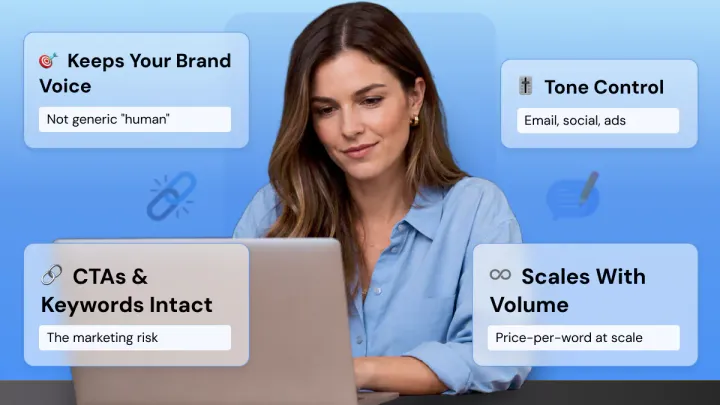
The best AI humanizer for marketing content in 2026 keeps your copy natural, your brand voice recognizable, and your CTAs and keywords exactly where you left them. Five tools make the shortlist: Phrasly, Undetectable AI, Humbot, WriteHuman, and StealthGPT.
Most humanizer roundups are written for students, so their rankings tell a marketer very little. A content team has to care about tone control, what happens to the message mid-rewrite, and what the tool costs once publishing hits real volume.
This guide compares all five on those terms, with verified 2026 pricing and a clear recommendation by team size.
Run Your Next Draft Through Phrasly's AI Humanizer, Free to Start
What Marketers Should Compare in an AI Humanizer (Not Detector Scores)
Compare output naturalness, brand voice preservation, tone control, per-tier word limits, languages supported, price per word, and integrations. For marketing copy, the real question is whether the tool keeps your message, keywords, and CTA intact, not whether it chases a scanner score.
Most humanizer roundups are written for students, so they rank tools on things marketers never need. Your risks look different: a flattened brand voice, a softened CTA, a target keyword that quietly disappears in the rewrite.
The 7 Criteria That Matter for Marketing Copy
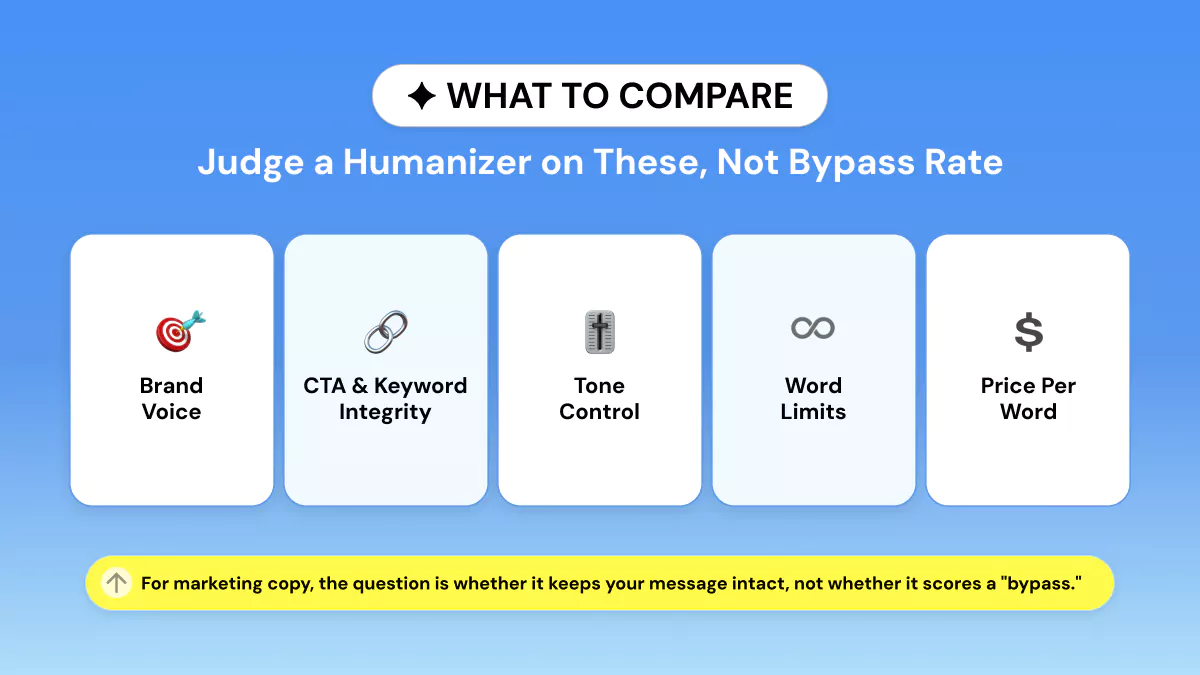
Output naturalness. Does the result read like something a real person would publish, or does it still feel polished into blandness? Readability is table stakes. The bar for marketing is copy people want to keep reading.
Brand voice preservation. Your tone, your point of view, your category language should survive the rewrite. HubSpot's 2026 research found 61% of marketers agree that expressing taste and a brand point of view matters more than ever when using AI. A humanizer that smooths your voice into generic filler is working against you.
CTA and message integrity. "Start your free trial" needs to stay clear and action-focused. Some tools soften commands into vague suggestions, which makes the copy sound gentler while quietly killing conversion intent.
Keyword retention. If the tool swaps out your product names, target keywords, and feature terms, the output may read better and rank worse. SEO copy only works if the terms you optimized for are still in it, and thin, generic output is one of the top reasons content gets penalized by Google.
Tone control. A homepage section, a sales email, and a paid ad should not share one voice. Look for modes that let you dial the edit lighter or stronger per channel instead of forcing a single style on everything.
Word limits and price per word. A cheap entry tier gets expensive fast if it caps requests or monthly words. If your team humanizes 50,000 to 100,000 words a month, compare cost per word at your volume, not the headline price.
Languages and workflow fit. Teams publishing across markets need real language support. Teams publishing at scale need integrations and API access, because a copy-paste text box does not survive contact with an actual content workflow.
The Trap: Rewrites That Go Too Far
Tools built as synonym-swapping engines rewrite aggressively, and aggressive rewrites carry a quality cost. Independent 2026 testing across multiple humanizer roundups notes meaning drift and keyword loss on heavy rewrites: a claim gets rephrased into a different claim, or a target keyword simply vanishes. A student can shrug that off. In a paid ad or a landing page, it is a broken asset.
An AI humanizer can ruin your CTAs and keywords if it rewrites too aggressively, so build in one check: run the draft through the tool, then compare it against the original for CTA wording, brand terms, target keywords, and claim accuracy before publishing.
Keep the improved rhythm and tone, restore anything commercial that changed. A good humanizer makes this check quick because it preserves those elements by default. A bad one makes you rebuild the message from scratch.
AI Humanizer vs Paraphraser vs Rewriter: What's the Difference?
A paraphraser swaps words and rearranges phrases; an AI humanizer goes deeper, restructuring sentence rhythm, tone, and the formulaic patterns that make AI copy read flat. For marketing, that depth is the difference between copy that is merely reworded and copy that still sounds like your brand.
A rewriter sits in between, improving clarity and structure without necessarily touching voice. You can see the gap in output quality: 2026 testing across humanizer roundups consistently finds that tools relying on synonym rotation underdeliver on voice, producing text that is technically different but tonally identical to the AI draft it came from.
Best AI Humanizers for Marketing Content in 2026 (Compared)
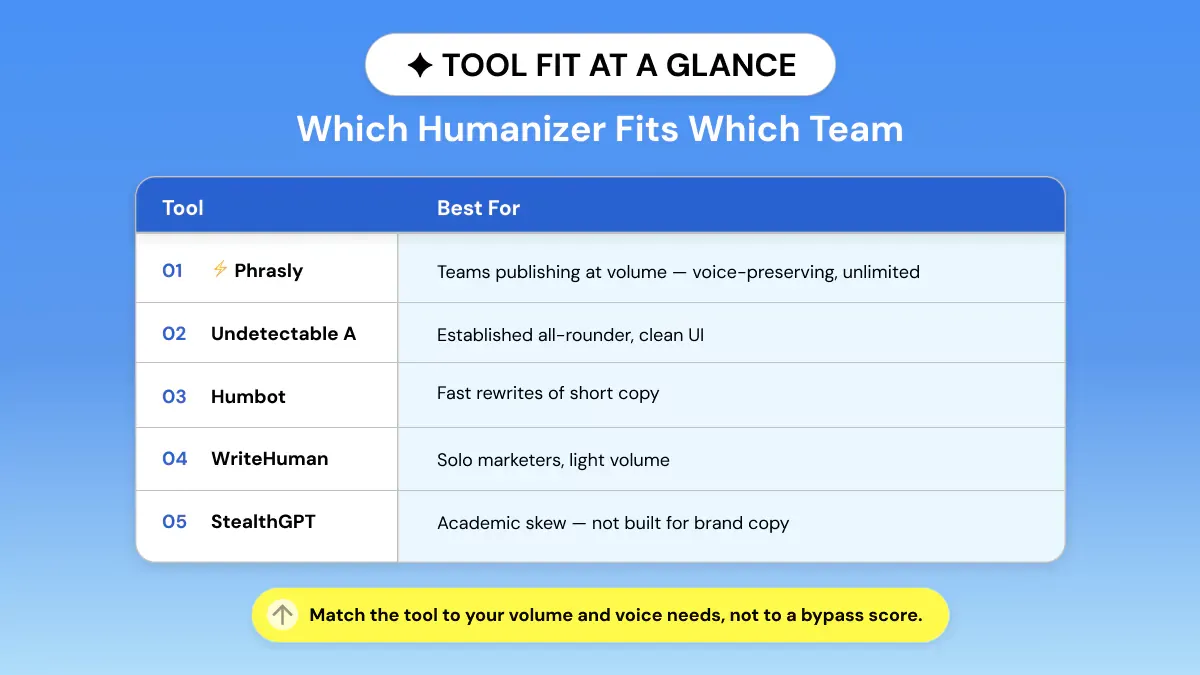
For marketing teams, Phrasly is the strongest overall fit: it pairs natural, voice-preserving humanization with a free built-in AI detector and truly unlimited processing on the paid plan. Undetectable AI is a well-known general humanizer with a clean interface, Humbot is a fast budget rewriter for short copy, WriteHuman suits solo marketers with light volume, and StealthGPT skews academic. Match the tool to your volume and voice needs.
A quick note on method: every tool below is ranked by fit for marketing workflows, meaning brand voice, CTA and keyword retention, tone control, word limits, languages, and cost at scale. All pricing was checked on each vendor's own pricing page on July 7, 2026, and can change, so treat the vendor page as the source of truth.
1. Phrasly: Best for Marketing Teams That Publish at Volume
Best for: Content teams producing email, social, blog, landing page, and ad copy who need natural-sounding output at scale without losing message structure.
Quick specs (checked July 6, 2026):
- Price: Free to start with 300 humanization words · Unlimited plan at $10.99/mo billed annually · $2.00 three-day trial, then $19.99/mo on monthly billing
- Word limit: 5,000 words per request, no monthly cap on the paid plan
- Languages: 20+ including English, Spanish, French, German, Portuguese, Chinese, and Japanese
- Modes: Easy · Medium · Aggressive
- Also included: Free unlimited AI detector · 20,000 plagiarism-check words/mo · up to 30,000 content-generator words/mo ·
For teams whose priority is brand voice, Phrasly is the strongest pick of the five, provided the input already carries your positioning, product terms, and CTA intent. Run marketing copy through Easy or Medium mode so the tool improves flow without over-rewriting the message.
The scale economics: The flat unlimited model is the whole pitch. Your cost stays $10.99 a month whether you humanize ten drafts or ten thousand, so a team processing 100,000 words a month pays roughly a hundredth of a cent per word, and the rate keeps falling the more you publish.
If you want proof before committing, the free account's 300 words cover a real test of all three modes plus the built-in detector, and the $2.00 trial unlocks unlimited humanization (up to 50 uses a day, 800 words per process) for a proper stress test.
Honest limitation: You need an account to use it, even on the free tier. Phrasly is built for repeatable, on-brand output at volume, so it is not the tool for someone who wants a one-off, no-signup sentence rewrite.
2. Undetectable AI: Best-Known General Humanizer
Pricing (checked July 6, 2026): Undetectable AI's pricing page lists 10,000 words/month at $9.99 (or $5/mo billed annually), 20,000 words/month at $19 (or $9.50/mo annually), and 35,000 words/month at $31 (or $15.75/mo annually). The free trial is capped at 250 words and requires an account.
Word limits: Monthly word bundles from 10,000 to 35,000, with custom volumes above that.
Languages: English-first, with multilingual support across its tool suite.
Voice and tone control: Writing-level matching plus paraphrasing, rewriting, and detection tools in one platform, with API access on every tier.
Standout: Polished, fast, and easy to understand. A good fit if you want one platform for detecting, rewriting, and editing in the browser, and its readability is generally solid on short and mid-length copy.
Honest limitation: Everything is metered by monthly word bundles, so a high-volume team burns through the entry tier quickly. Independent 2026 testing also notes meaning drift on longer texts past roughly 400 words, where a point can get rephrased into a different claim. For precise marketing copy with specific product claims, that means extra review time per draft.
3. Humbot: Best Fast, Budget Single-Purpose Rewriter
Pricing (checked July 6, 2026): Humbot sells tiered plans with split word allowances: roughly 3,000 Basic + 1,000 Advanced words/month with a 500-word input limit on the entry tier, 30,000 Basic + 5,000 Advanced with a 1,200-word input limit on the mid tier, and unlimited Basic + 10,000 Advanced words with unlimited input on the top tier. (Editor note: dollar prices render dynamically on humbot.ai/pricing; verify visually before publishing.)
Word limits: Input caps of 500 or 1,200 words per request on lower tiers; the Basic/Advanced word split means your higher-quality allowance is much smaller than the headline number.
Languages: Broad multilingual interface; its translator covers 100+ languages.
Voice and tone control: Quick, Enhanced, and Advanced modes plus tailored tones, with the emphasis on speed and cleaner sentence structure rather than brand-level voice control.
Standout: Fast rewrites with multiple output variations, and a large bundle of adjacent tools including an AI checker, grammar checker, plagiarism checker, translator, and summarizer.
Honest limitation: Humbot positions itself as an all-in-one study and writing assistant, not a marketing platform. The Basic/Advanced credit split makes real capacity hard to compare, testing reports repetition and awkward constructions on long-form drafts, and brand-voice control is thin. Fine for short-copy triage, weak for campaign-scale work.
4. WriteHuman: Best for Solo Marketers and Light Volume
Pricing (checked July 6, 2026): WriteHuman lists annual pricing at $12/mo Basic, $18/mo Pro, $36/mo Ultra, with monthly billing at $18, $27, and $48 respectively. The free plan allows 3 requests per month at 250 words each.
Word limits: Per-request caps at every tier: 600 words on Basic (80 requests/month), 1,200 on Pro (200 requests/month), 3,000 on Ultra (unlimited requests). A 5,000-word draft has to be split into chunks on any plan.
Languages: The API supports 40+ languages.
Voice and tone control: Minimalist and request-based. It performs best when the input already has personality, making it more of a final-pass polisher than a voice engine.
Standout: Transparent pricing, easy-to-understand request limits, and an AI detector included on every plan. For a solo marketer shipping a handful of assets a week, the entry tiers are simple and sufficient.
Honest limitation: The request and per-request word caps get expensive at team volume, and splitting long drafts into chunks creates workflow friction plus inconsistent polish across sections. Independent reviews also question value at the higher tiers, where the caps loosen but the price approaches unlimited-plan territory elsewhere.
5. StealthGPT: Best to Skip for Marketing Teams
Pricing (checked July 6, 2026): StealthGPT prices per day: Essential $1.00/day (50 requests/day, 1,000 words/request), Pro $1.45/day (100 requests, 1,500 words), Business $2.15/day (500 requests, 2,000 words), and Enterprise $7.15/day (unlimited requests, 20,000 words/request).
Word limits: Generous daily request counts, with per-request input caps by tier.
Languages: All plans list support for 100+ languages.
Voice and tone control: Heavier, more aggressive rewriting oriented toward academic registers. Its own site markets to students, down to the university logos on the pricing page.
Standout: High request limits on upper tiers and a very large 20,000-word per-request cap on Enterprise.
Honest limitation: The entire product is positioned around academic writing, and its aggressive rewriting style is exactly the profile that flattens brand voice and alters marketing claims. If your output is ads, emails, and landing pages, this is the one to skip.
AI humanizers do work on marketing copy and ads, but only when they preserve the commercial intent. Whatever tool you pick, the final output still needs a human check for CTA strength, product claims, target keywords, and compliance language before it ships. A smoother sentence is not automatically a higher-converting sentence.
The Five at a Glance
| Tool | Best for | Price | Word limit | Languages | Voice control |
|---|---|---|---|---|---|
| Phrasly Top pick | Marketing teams at volume | $10.99/mo annual, unlimited Free to start (300 words) | 5,000/request No monthly cap | 20+ | 3 modes; keyword + CTA retention; free detector included |
| Undetectable AI | General rewriting, browser workflow | $9.99/mo for 10K words $5/mo billed annually | 10K to 35K words/mo bundles | English-first | Writing-level matching |
| Humbot | Quick short-copy rewrites | Verify on humbot.ai | 500 to 1,200-word input caps; split credits | 100+ (translator) | 3 modes; thin brand-voice control |
| WriteHuman | Solo marketers, light volume | $12 to $36/mo annual $18 to $48 monthly | 600 to 3,000 words/request | 40+ (API) | Minimalist; final-pass polish |
| StealthGPT | Academic work; skip for marketing | $1.00 to $7.15/day | 1,000 to 20,000 words/request | 100+ | Academic tones; flattens brand voice |
The shortcut read: publishing under roughly 20,000 words a month, a capped entry tier from WriteHuman or Undetectable AI will do the job. Past that, Phrasly's flat $10.99/month unlimited plan is the only option in the table where cost stops scaling with output.
Pricing: What You Actually Pay in 2026
AI humanizer pricing in 2026 runs from about $5 a month for capped entry tiers to roughly $48 a month for higher-volume plans, with flat-rate unlimited options like Phrasly's at $10.99/month billed annually. Once you produce at scale, price per word matters more than the headline price: a capped tier you keep topping up can quietly cost more than an unlimited plan.
Here is the landscape, with every figure checked on the vendor's own pricing page on July 6, 2026. Undetectable AI sells monthly word bundles: $9.99 for 10,000 words, $19 for 20,000, $31 for 35,000, each about half price on annual billing. WriteHuman runs $12 to $36 a month billed annually ($18 to $48 monthly) with per-request word caps at every tier.
StealthGPT prices per day, which reads cheap until you do the math: $1.00 a day is about $30 a month, and the $7.15/day Enterprise tier lands near $217. Humbot sells tiered plans with split Basic and Advanced word credits; its exact prices render dynamically, so check humbot.ai/pricing directly. Phrasly is free to start with 300 humanization words, then $10.99/month billed annually for truly unlimited humanization.
The number that actually decides your budget is not the monthly fee, it is what a word costs you at your volume. Run the math on a team humanizing 100,000 words a month:
- On Undetectable AI's largest listed bundle (35,000 words for $31), covering 100,000 words means stacking roughly three bundles, so you are looking at around $90 a month and a per-word cost near a tenth of a cent.
- On WriteHuman's Ultra plan ($36/month annually), the volume fits thanks to unlimited requests, but the 3,000-word per-request cap means slicing every long draft into chunks: 100,000 words is 34+ separate requests, with stitching and consistency checks on your team's clock.
- On Phrasly's Unlimited plan, the same 100,000 words cost $10.99 flat, about a hundredth of a cent per word, processed in 5,000-word passes. Double your output next quarter and the bill does not move.
That is the pattern to price against: capped tiers charge you for growth, flat unlimited plans absorb it. A solo marketer humanizing 5,000 words a month will never feel the difference, and a cheap entry tier is the rational buy.
Which One Should You Choose?
Solo marketers with light volume can run on a capped entry tier; teams producing hundreds of assets monthly are better served by a flat-rate unlimited tool that preserves brand voice and keywords across formats.
Solo Marketer, Light Volume
You publish a few posts and emails a month, under roughly 20,000 words. WriteHuman's Basic or Pro tier fits, and Undetectable AI's 10K bundle works if you want the broader toolkit. Test Phrasly's free tier Humanizer first anyway: 300 words is enough to compare output quality on your own copy before you pay anyone.
Small Team, Growing volume
You are past 20,000 words a month and climbing. This is where capped tiers start punishing you and where Phrasly's $10.99 unlimited plan is already cheaper than most mid tiers, with the free AI detector covering your pre-publish checks in the same workflow.
Agency or High-Volume Content Team
Hundreds of assets monthly across clients, formats, and languages. You need no caps, keyword retention across SEO copy, and automation. Phrasly's Unlimited plan plus the Business API is the only setup in this comparison where volume never touches the invoice.
The verdict follows from the criteria this guide started with, not from a scoreboard. If a humanizer preserves your brand voice, keeps CTAs and keywords intact, and stays affordable as output grows, it earns a place in your content workflow.
FAQs
What Is the Best AI Humanizer for Marketers?
Phrasly is the strongest choice for marketers in 2026 because it combines voice-preserving output, keyword and CTA retention, and a flat unlimited plan at $10.99/month billed annually. Try Phrasly's AI humanizer free with 300 words; capped tools like WriteHuman or Undetectable AI suit lighter, occasional use.
Which AI Humanizer Preserves Brand Voice?
Phrasly preserves brand voice best of the tools compared here, thanks to proprietary models trained on 1M+ real human articles and three adjustable strengths. Use Easy or Medium mode on marketing copy so positioning, product terms, and tone survive the rewrite. Synonym-swap tools tend to flatten voice into generic filler. Our guide on how to edit AI ad copy covers the manual passes.
How Much Do AI Humanizers Cost in 2026?
Expect $5 to $48 per month depending on word caps. Capped bundles start at $9.99/month on Undetectable AI and $12/month on WriteHuman annual billing, while Phrasly's unlimited plan runs $10.99/month billed annually. All prices were verified on vendor pricing pages on July 6, 2026.
Will a Humanizer Ruin My CTAs or Messaging?
Only if it rewrites too aggressively. Lighter modes protect CTAs, keywords, and claims, while heavy synonym-swapping can distort them. Compare each humanized draft against the original before publishing, and run the final version through a free AI detector as a last pre-publish check.
Do AI Humanizers Work for Ads and Email?
Yes. Short-form ads, subject lines, and email marketing copy respond well to light humanization passes that improve rhythm without touching offers or claims. Keep character limits in mind for paid placements, and review the output for CTA strength and compliance language before it ships.


Keep reading

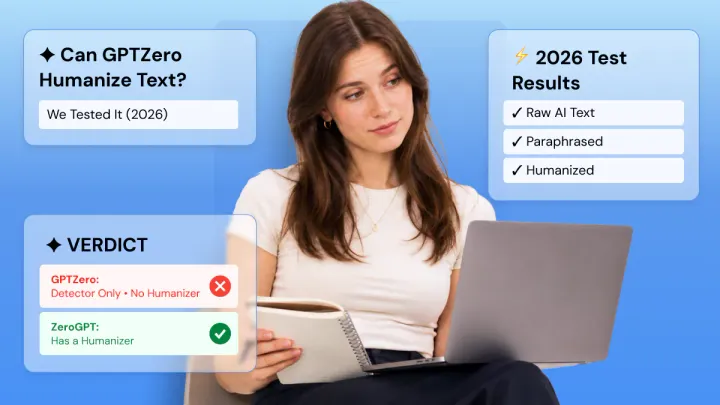
Can GPTZero Humanize Text (+ Can It Detect Humanized Text)
GPTZero doesn't have a humanizer and never has. We tested 5 AI samples raw, paraphrased, and humanized to see what actually beats its detector. Paraphrasing failed almost every time. Properly humanized text scored 98–100% human across the board. Here's exactly what worked.
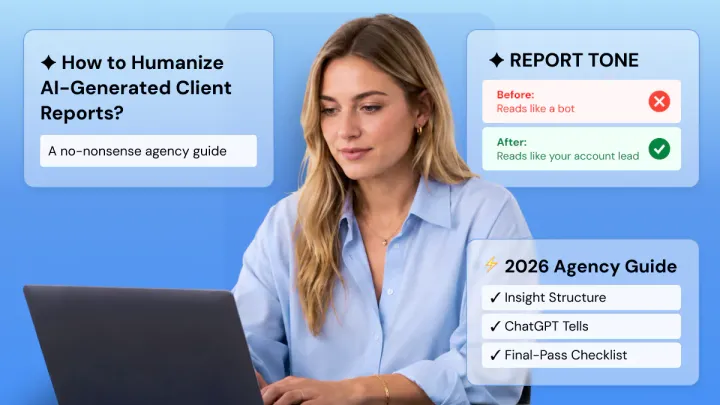
How to Humanize AI-Generated Client Reports (Before They Read as Robotic)
AI reports default to describing the numbers. They default to describing 'traffic increased 12% month over month' without explaining why it happened or what to do about it. That's dumping data and calling it deliverable; spoken in a professional voice.