AI Prompt Generator

50+ AI Prompts for Marketing That Drive Real Results

Most AI marketing prompts are useless, too vague to get anything worth keeping. Here are 50+ that actually convert.
Muhammad Usman Ali
AI Prompts for Marketing

Most AI prompt guides for marketers stop at blog ideas and social captions.

But the work that actually drives results: conversion copy, paid ad creative, product launches, offer positioning, campaign reporting, rarely gets covered in enough depth to be useful.

This guide fills that gap. Here you'll find 50+ AI prompts for marketing built specifically for high-impact tasks, with enough context and structure to get output you can actually use without heavy editing.

If you need a foundation first, start with our guides on what is a prompt in writing and AI creative writing prompts.

Want to skip the guide and have AI build your marketing prompts instead? Generate them with Phrasly's AI Prompt Generator 👇

Why Most AI Prompts for Marketing Don't Work?

Many marketers will try some AI prompts for marketing, copy/paste them into a tool, and expect high quality outputs. However, Generic prompts will nearly always yield generic outputs.

💡
According to SEO.com, 88% of marketers are now using AI in their daily workflows, and 93% say it accelerates content creation.

Lots of prompt lists online tell marketers to copy-paste something like “Write a Facebook ad for my product.”

The AI generates something you could use but it won’t match your brand voice, target audience, or speak to your value proposition.

That’s why marketers manually spend 20 to 30 minutes editing what it wrote. This is where AI prompt engineering for marketing comes in.

A helpful industry perspective frames it this way:

●       You are the lead.

●       AI is the assistant.

●       The prompt is the brief you give it.

When provided with context in the prompt, like audience, goals, brand positioning, and desired outcome, the AI will be able to generate more actionable, data-driven insights and copy that you can use for marketing.

"Avoid thinking in limitations. Come up with ideas, and figure out a way to execute them. You might surprise yourself. I see this year as the year everyone adds a few core agents to their team that completely change the game." — Kipp Bodnar, CMO, HubSpot

Weak Prompt Vs Strong Prompt

Weak Prompt

Strong Prompt

Write a Facebook ad for my product.

Write a Facebook ad for a SaaS tool that helps small ecommerce brands track abandoned carts. Target audience: Shopify store owners with under $1M revenue. Focus on recovering lost sales and include a clear CTA for a free trial.

Create an email campaign.

Create a 3-email sequence for a product launch. Audience: B2B marketers. Goal: demonstrate ROI and encourage demo bookings. Emphasize automation and analytics benefits.

Give me marketing ideas.

Suggest 10 marketing ideas for a new productivity app targeting remote workers. Prioritize low-cost tactics with high lead generation potential.

 For platform-specific tips, see how to write better prompts for Claude AI before moving into copy prompts.


Generate a Custom Marketing Prompt for Your Campaign 👇


AI Prompts for Conversion Copy

Copywriters will still find themselves rewriting conversion copy more than anything else.

Your landing pages, CTAs, and on-page messaging should concisely explain your value proposition, guide the customer journey, and encourage action (without seeming too pushy).

Before writing any conversion copy, make sure you understand these basics:

●        Know exactly who you're writing for

●        Be clear on one single action you want the visitor to take

●        Have at least one real result or proof point ready to include

●        Match your tone to where the visitor is in the buying journey

Below are AI prompts for conversion copy that help generate high-converting landing page sections and CTA messaging.

Each prompt is designed so you can copy, customize, and use it immediately.

Landing Page Prompts

Above-the-Fold Headline + Subheadline: Write 5 above-the-fold headline and subheadline combinations for a landing page promoting [product/service]. Target audience: [specific audience]. The main problem they face is [pain point]. Emphasize the core value proposition and keep the tone clear and benefit-driven.
Hero Section Body Copy: Write hero section body copy for a landing page using the structure: pain 🡪 solution 🡪 proof. Product: [product]. Audience: [audience]. Include one sentence describing the problem, one explaining the solution, and one providing proof such as results, data, or credibility.
Feature-to-Benefit Rewriter: Turn the following product features into benefit-focused copy for a landing page. Explain how each feature improves the customer’s experience or solves a problem. Features: [insert features]. Audience: [target audience].
FAQ Section Generator (Objection-Based): Generate 6 FAQ questions and answers for a landing page selling [product/service]. Focus on common customer objections such as price, results, ease of use, and trust. Keep answers concise and conversion-focused.
Social Proof / Testimonial Framing: Rewrite this customer testimonial to emphasize outcomes and credibility. Highlight the specific result achieved and why the product worked. Testimonial: [insert testimonial].
404 / Empty State Copy: Write friendly and helpful 404 page copy for a website about [industry]. Include a short message explaining the missing page and encourage the user to explore other content or return to the homepage.

CTA Copy Prompts

Primary CTA Button Copy: Generate 5 primary CTA button variations for a landing page promoting [product/service]. Focus on action-driven language and highlight the main benefit.
CTA for Low-Intent Visitors (Top of Funnel): Write CTA options for visitors who are not ready to buy yet. Offer a low-commitment next step such as a guide, demo, or newsletter. Audience: [target audience].
Urgency CTA Without Fake Scarcity: Create CTA copy that encourages urgency without using fake scarcity or pressure tactics. Emphasize value, results, or limited-time opportunities related to [product/service].
Post-Purchase / Thank-You Page CTA: Write CTA suggestions for a thank-you page after a customer completes a purchase. Encourage the next step such as joining a community, exploring additional features, or sharing the product.

AI Prompts for Paid Ads

Paid advertising needs to grab attention fast and convert efficiently. Platforms differ by format, audience expectations and character counts so stale, templated ad copy almost never converts.

Using AI can save time crafting hyper-targeted copy that converts if your prompts are granular, contain context, and aligned with your goals.

💡
According to AllAboutAI, Companies using AI in marketing in 2026 report 47% better click-through rates and campaigns that launch 75% faster than those built manually.

The biggest mistakes marketers make with paid ad prompts:

  1. Skipping the audience description and writing ads that sound like they're for everyone.
  2. Forgetting to mention the platform, so the copy doesn't fit character limits or tone.
  3. Not including a CTA, leaving the AI to guess what action the reader should take.
  4. Using the same prompt for cold and retargeting audiences, which kills relevance.

If your team primarily uses ChatGPT, exploring the best ChatGPT prompts for professionals can help you get sharper outputs across your campaigns.

These AI prompts will help marketers quickly create ads copy for each specific platform and experiment with A/B testing angles without the hours of brainstorming.

Platform Ad Copy Prompts

Google Search Ads: Write Google Search ad copy for [product/service]. Provide 3 headlines (≤30 characters each) and 2 descriptions (≤90 characters each). Target audience: [audience]. Emphasize the main benefit, solution to their problem, and include a clear CTA.
Facebook/Meta Primary Text + Headline: Create Facebook ad copy for [product/service]. Generate primary text (125–150 words) and a headline (≤40 characters). Audience: [audience]. Highlight the pain point, key benefit, and brand voice.
LinkedIn Sponsored Post: Write a LinkedIn sponsored post promoting [product/service] to B2B professionals. Avoid buzzwords. Focus on measurable outcomes, ROI, or data-driven results. Include a short headline and body copy that is professional and actionable.
YouTube Pre-Roll 15-Second Hook Script: Create a 15-second YouTube pre-roll ad script for [product/service]. Hook the viewer in the first 3 seconds, outline the benefit quickly, and end with a clear CTA.
Retargeting Ad: Write retargeting ad copy for people who visited [product page]. Address common objections such as price, trust, or results. Make it concise, persuasive, and focused on moving them to action.
Display/Banner Headline: Generate 5 short display ad headlines for [product/service]. Each must be under 8 words and instantly communicate the main benefit.

A/B Angle Testing Prompts

3-Version Variation Prompt: Create 3 ad variations for [product/service]: one highlighting the benefit, one highlighting the pain it solves, and one using social proof or testimonials.
5 Emotional Angle Generator: Generate 5 ad copy options for [product/service] using different emotional triggers: curiosity, fear of missing out, excitement, trust, and urgency.
Hook Rewriter: Rewrite the hook of this ad 3 different ways while keeping the main body of the ad intact. Goal: test which hook drives the most engagement.
Winning Angle Amplifier: Take the best-performing ad from our campaign and rewrite it to amplify the winning angle. Make it more compelling and persuasive while maintaining a brand voice.

Need ad copy prompts tailored to your exact product, audience, and platform? Generate them in seconds 👇

AI Prompts for Product Launch Sequences

A strong product launch sequence typically covers these four stages:

  1. Pre-launch: Build awareness and collect waitlist signups before the product is live.
  2. Launch day: Send your main announcement with a clear, time-sensitive CTA.
  3. Follow-up: Re-engage people who didn't open or act on the first message.
  4. Post-launch: Share social proof and early wins to keep the momentum going.

Below are ready-to-use AI prompts for product launch sequences to streamline your product launch sequence.

Pre-Launch Prompts

Waitlist Landing Page Copy: Write landing page copy for a waitlist sign-up for [product]. Highlight exclusivity, benefits of early access, and the main problem it solves for [target audience]. Include a short headline, subheadline, and 2–3 persuasive bullet points.
Teaser Email: Create a teaser email for [product] to generate curiosity without revealing details. The subject line should be under 50 characters. Email body: 100–150 words encouraging readers to stay tuned and join the waitlist.
Countdown Email: Write a countdown email for 3 days before [product] launch. Audience: [target audience]. Emphasize urgency, excitement, and the benefits of being early without overhyping. Include a clear CTA for signing up or bookmarking the launch page.
Early-Access Offer Framing: Generate email copy promoting early-access offers for [product]. Audience: [audience]. Highlight the exclusive benefit, special pricing, or bonus content. Keep tone persuasive but trustworthy.
Social Announcement Post: Write a social media post announcing the upcoming launch of [product]. Focus on building anticipation, teasing key benefits, and encouraging followers to sign up for early access.

Launch Day + Post-Launch Prompts

Launch Announcement Email: Draft a launch day email for [product]. Include a compelling subject line, highlight the main benefits, address potential objections, and provide a clear CTA to buy or sign up.
Launch Day Social Post: Create a launch day social media post for [product]. Include a hook that grabs attention, the main value proposition, and a CTA to engage or purchase. Adapt tone for [platform].
48-Hour Follow-Up: Write a follow-up email for subscribers who didn’t open the launch announcement. Reframe the value, create urgency, and provide a friendly nudge to take action.
Post-Launch Momentum Email (Week 1): Generate an email to maintain momentum after launch. Highlight testimonials, early results, or user success stories. Encourage referrals or additional engagement with the product.
Post-Mortem Prompt: Analyze launch metrics for [product] (open rates, click-throughs, conversions) and summarize lessons learned. Include actionable insights for improving future launches, focusing on messaging, timing, and audience engagement.

AI Prompts for Offer & Positioning

Compelling offers and positioning are what differentiate products that fly off shelves from products that collect dust.

One challenge marketers commonly face is struggling to define value, differentiate from competition, and justify pricing even with the help of AI.

Here are some AI prompts designed to help marketers create persuasive positioning and offers that resonate with their target audience.

Value Proposition Prompts

Value Prop Builder: Create a value proposition for [product/service] using the format: ‘For [audience] who [pain/problem], [product] provides [solution/benefit] so they can [desired outcome].’ Keep it clear, concise, and benefit-driven.
Positioning Stress-Test: Identify the strongest objection to this offer for [product/service]. Rewrite the messaging to address and overcome this objection while maintaining brand voice.
Competitor Differentiation Prompt: Analyze competitors’ positioning for [product/service]. Write a copy highlighting what makes our product unique and better. Emphasize features, outcomes, or approaches that competitors lack.
Pricing Page Narrative: Write a persuasive pricing page narrative for [product/service] that justifies the price without discounting. Focus on value, ROI, and outcomes for the customer.
Tagline Generator: Generate 5 tagline variations for [product/service] across 3 styles: professional, playful, and aspirational. Keep them short, memorable, and aligned with the brand voice.

Objection Mapping Prompts

Top 5 Objections + One-Line Rebuttals: List the top 5 objections a customer might have for [product/service]. For each objection, provide a one-line persuasive rebuttal.
FAQ Rewriter: Rewrite common objections about [product/service] into FAQ-style answers that reassure the reader and reduce hesitation to purchase.
Risk-Reversal Statement Generator: Create risk-reversal statements for [product/service], such as guarantees, trial periods, or promises, to increase customer confidence and reduce perceived risk.

AI Prompts for Marketing Reporting & Insights

Marketing isn’t just about creating content and running campaigns. It’s about understanding what works, why it works, and where to optimize.

Marketers spend hours digging through spreadsheets looking to analyze traffic, conversions and engagement.

💡
According to SEOProfy, around 25% of marketing tasks are already being automated by AI, with expectations to rise to 30% by 2026.

However, with AI, you can turn this raw data into actionable insights quickly.

Before feeding data into any AI reporting prompt, make sure you have:

●        A defined time range

●        The right metrics pulled

●        Context on any major changes made during that period

●        A specific question you want answered, not just "analyze this data."

Insight Mining Prompts

“What’s Working and Why?” Prompt: Analyze the following marketing data for [campaign/product] and explain what is performing well and why. Include insights about audience segments, channels, and messaging that contributed to success.
Anomaly Explainer: Examine this dataset for [website/product campaign] and identify any traffic or conversion spikes or drops. Explain possible causes and suggest actions to address or capitalize on these anomalies.
Trend Spotter: Review three months of marketing data for [campaign/product]. Identify patterns and trends across channels, audience segments, or content types. Highlight key behaviors that can inform future strategy.
Recommendation Generator: Based on the following data for [product/campaign], recommend the 3 highest-leverage actions the marketing team should take next. Provide reasoning for each recommendation and prioritize for impact.

Get Custom AI Prompts for Your Marketing
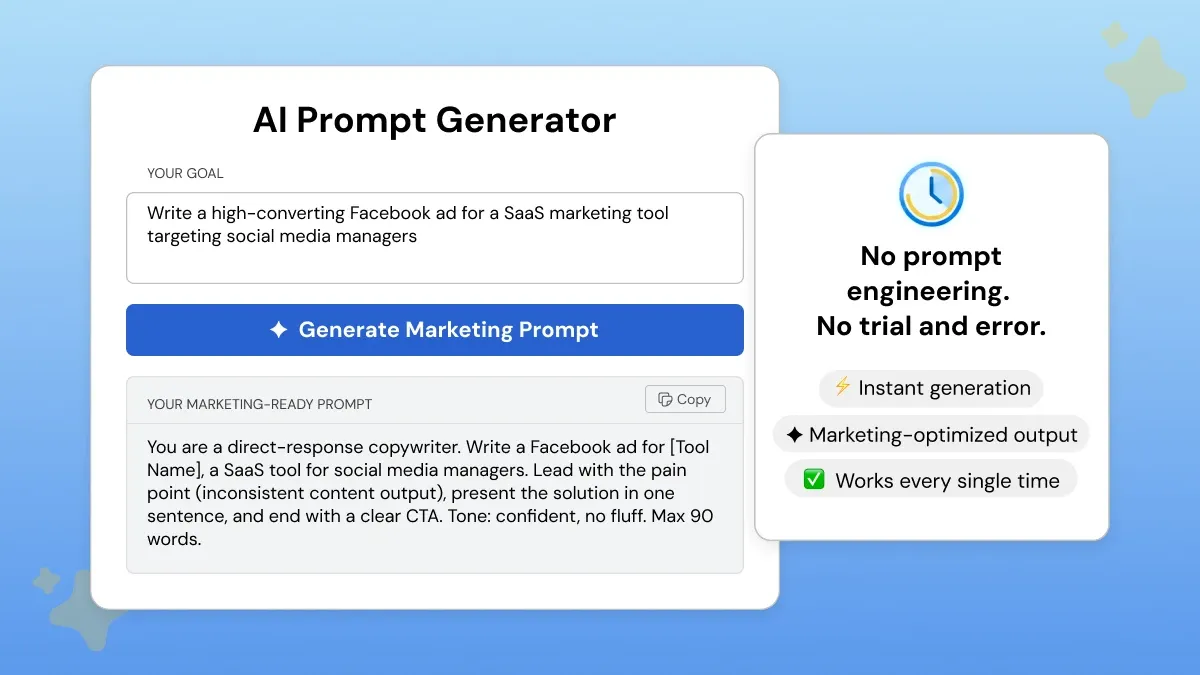
Get Custom Prompts by Using Phrasly AI Prompt Generator

Even with 50+ prompts to use as-is, finding the perfect prompt for your specific campaign may take some time. Every audience, product, and marketing objective is unique.

Minor changes in wording can mean major differences in your results. Many marketers spend hours editing and perfecting prompts to achieve the ideal output for their brand voice, messaging and campaign goals.

That's why you need custom prompt generation.

By simply giving your AI some context (audience, platform, product, outcome), it can generate laser-focused, actionable copy in seconds.

Phrasly’s AI Prompt Generator makes this process effortless. You don’t need to start from scratch or manually tweak dozens of prompts. Phrasly helps you generate high-quality prompts instantly.


Give Phrasly your audience, platform, and goal and get laser-focused marketing prompts instantly 👇


FAQs

Which AI is best for marketing ideas?

Currently the best AI marketing tools are ChatGPT, Claude, and Gemini. ChatGPT excels at creative copy. Claude is strong for long-form strategy and nuanced tone.

Gemini integrates well with Google tools. Check out the best prompts for Gemini AI to get the most out of it for marketing. The best choice depends on your workflow and platform preferences.

What are the most popular AI prompts?

Most commonly used AI prompts for marketing are landing page copy, email sequences, ad headlines, product descriptions, and social media captions.

Prompts utilizing audience, tone, and goal context always perform better than plain/basic requests.

What is the 3 3 3 rule in marketing?

The 3 3 3 rule is targeting the correct person at the right time with the right message. Marketers should remember to align campaign segmentation, message relevance, and timing to create effective campaigns that convert.

What are the 5 types of AI prompts?

The five core prompt types are: instructional (tell AI what to do), contextual (give background info), role-based (assign a persona), example-based (show a sample output), and iterative (refine a previous output).

Can AI replace a marketing team?

AI may be great at automating repetitive tasks such as copywriting, ideation and data analysis but it will never replace human creativity, brand intuition and strategic thinking.

If you're using AI for marketing copy, learning how to craft better AI-generated responses ensures your output actually sounds human and on-brand.