
The Self-Editing Workflow That Makes Writing Read Human
A 5-pass self-editing checklist for copywriters: fix structure, cut generic filler, add proof and voice, improve rhythm, and verify facts before your copy ships.
Self-edit your copy in five passes: check the message and structure, cut generic language, add concrete evidence and a point of view, fix the rhythm, then read it aloud and run a final verification check. Work from the meaning down to individual sentences so you do not polish copy that still needs to be reorganized.
You know the feeling: the draft is technically fine, but it reads like everyone else's. That instinct is backed by data. HubSpot's 2026 State of Marketing report found that 62.7% of marketers believe brands need more unique, human-centered content to compete with AI-generated content.
This self-editing checklist for copywriters fixes that draft step by step: what to review before line editing, what to cut, which details to add, how to improve rhythm, and how to verify the final version, whether AI helped write it or not.
Before You Edit: Define What the Copy Must Do
Before editing individual sentences, define the reader, the intended action, the main promise and the voice the copy should use. These four reference points are the first thing to check when editing your own writing. Without them, self-editing becomes random polishing rather than purposeful revision.
Here is the problem with editing your own work: you already know what you meant to say, so your brain quietly fills every gap the reader will fall into. The fix is not to concentrate harder. The fix is to judge the draft against a written standard instead of your memory of it.
So before you touch a single sentence, answer seven questions:
- Who is the exact reader? Not "business owners." Something like "a freelance copywriter juggling three client accounts."
- What problem or desire brought them here? Name the frustration or the goal in the reader's own words.
- What is the copy's primary promise? One promise. If you find two, the draft needs a structural decision before a stylistic one.
- What should the reader know, feel or do next? Be specific about all three.
- Which voice traits should stay consistent? Direct or warm, playful or plainspoken. Write them down.
- Which facts, statistics and product claims need verification? Flag them now so nothing unverified slips through to publication.
- What is the CTA? One action, one destination.
Now compress those answers into a five-line editor card and keep it next to the draft:
Reader: Goal: Core message: Voice: CTA:
This card is how you edit your own copy objectively. Every cut, addition and rewrite in the five passes below gets judged against the card, not against how the draft feels on rereading day. One more habit that helps: put distance between drafting and editing.
Even a few hours away, or a night if the deadline allows, makes the card far easier to apply honestly, because you return reading the words on the page instead of the version in your head.
The 5-Pass Self-Editing System
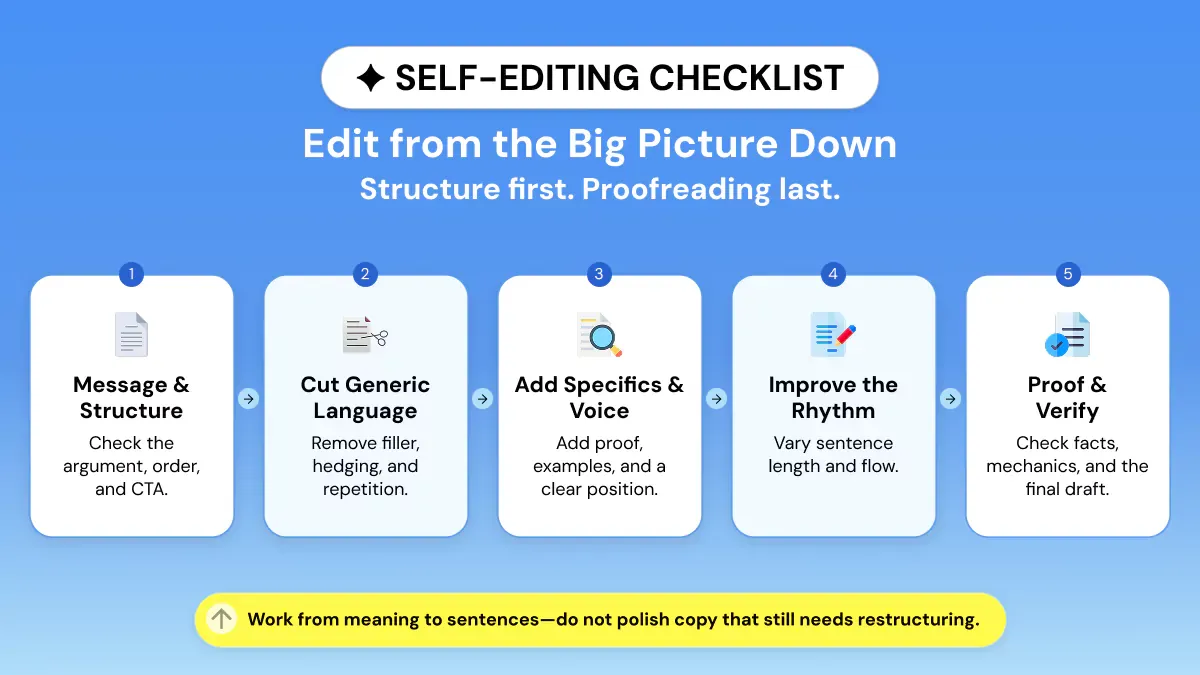
The five passes below follow a fixed order: message and structure, cuts, specificity, rhythm, then verification. Each pass builds on the last, so you never polish sentences that a structural edit would delete. Whether the draft is fully human-written or AI-assisted, run them top to bottom for copy that is clear, specific, and recognizably yours.
Pass 1: Fix the Message and Structure
Start with the argument, not the adjectives. A good self-editing process always reviews structure before grammar, because structural edits can delete or rewrite entire sentences you would otherwise waste time polishing. Confirm the copy makes one clear promise, follows a logical order and gives each paragraph a specific job before you touch a single word choice.
The fastest way to see structure is a reverse outline. Reduce each paragraph to one line in the margin, then write its job next to it: "raises the problem," "handles the price objection," "delivers proof." Ten minutes of this shows you more than three careful rereads.
Now fix what the outline exposes:
- Remove paragraphs that repeat a job. Two paragraphs doing the same work means one gets cut or merged.
- Move proof closer to the claim it supports. A testimonial four paragraphs after the promise it backs up is proof the reader never connects.
- Check the CTA follows naturally from the argument. If the ask feels sudden, the paragraph before it is not doing its job.
- Verify facts, names, figures, links and product claims now. There is no point perfecting a sentence built on a wrong number.
For AI-assisted drafts, add one non-negotiable step here: check for fabricated or outdated details before any stylistic editing. An AI draft can confidently describe a feature you retired last year or pin a statistic to the wrong source. Catch it in Pass 1, not after you have polished the paragraph around it.
When editing SEO copy, protect the page’s search intent, focus keyword, heading hierarchy and existing links before rewriting.
The practical test: if every paragraph were reduced to one sentence, would the argument still make sense?
Before (poorly ordered):
After (reordered):
Same facts, zero new sentences. The only edit is order: problem, solution, proof, action. That is what Pass 1 buys you before you spend a minute on wording.
Pass 2: Cut What Makes the Copy Generic
When editing copy, cut hedging, filler openings, redundant qualifiers, empty transitions and any sentence that could appear unchanged on a competitor's website. Strong editing usually begins with deletion, because removing language that delays or weakens the point gives everything left more attention. Draft one exists to get ideas down; Pass 2 exists to make them earn their place.
Start with this cut list and search the draft for each one:
- "It is important to note that"
- "In today's fast-paced world"
- "Can help"
- "May potentially"
- "In order to"
- "A wide range of"
- "When it comes to"
- Repeated conclusions that restate a point the reader already accepted
- Abstract nouns like efficiency, innovation or results with no evidence attached
- Three adjectives doing the work of one concrete detail
None of these phrases is wrong on its own. The problem is what they signal: a sentence stalling before it commits to anything.
Once the obvious filler is gone, run every surviving sentence through the competitor test: could a competitor publish this exact sentence without changing anything? If the answer is yes, the sentence is not doing brand work. It is filling space any company could fill.
You have five ways to fix a sentence that fails the test:
- Delete it entirely.
- Add evidence that only you can supply.
- Add a real example from a customer or your own use.
- State a clearer opinion a competitor might not risk.
- Connect it to the customer's situation in their own words.
Here is the test in action:
Generic:
Edited:
The first sentence fits any company in any industry. The second describes one specific workflow with a named outcome, so no competitor can publish it without lying. AI-assisted drafts need this pass most of all, since they tend to accumulate interchangeable phrasing at scale.
Pass 3: Add Specificity, Proof and Point of View
Replace abstractions with verifiable particulars: a real example, a customer phrase, an objection, a number, a product limitation or a first-hand observation. You add voice to writing by adding details and opinions only you could truthfully supply, which is why specificity and personality are the same edit. And specificity only builds credibility when it comes from genuine evidence, never from details invented for effect.
This is where human editors earn their keep on AI-assisted drafts. AI cannot know which particulars are true for your business, customer or experience unless you provide and verify them, and AI systems can invent plausible but false details. So every specific in the final draft should trace back to a source you can check.
Pull those specifics from places like:
- Customer interviews, support tickets and sales-call objections
- Product documentation and first-hand tests
- Screenshots, real examples and verified statistics
- Named audiences, exact workflow steps, product limitations and concrete outcomes
Notice that product limitations made the list. Admitting what your product does not do is one of the fastest credibility wins in copywriting, because nobody generic ever does it.
Once the evidence is in, add point of view with this four-part voice framework:
- A position. What does the writer actually believe?
- A reason. What experience or evidence supports it?
- A boundary. When does the advice not apply?
- A recognizable phrase. How would the brand naturally say it?
That framework is also how you add personality without sounding unprofessional. Personality goes off the rails when it is decoration: jokes, slang and exclamation points bolted onto empty claims. It stays professional when it is substance: a defensible opinion, an honest limitation and phrasing your brand would use in a real conversation.
Before (voiceless):
After (position, reason, boundary):
Readers notice the difference. A 2025 Journal of Business Research study on AI-authored marketing communications found that emotional messages believed to be written by AI received less positive word of mouth and customer loyalty than human-authored messages. The effect was weaker when AI was only used for editing, supporting a human-led editing process.
Pass 4: Improve Rhythm Without Forcing It
You make writing sound human by varying sentence length, sentence openings and paragraph shape while keeping the meaning clear. That variation is what makes writing feel less robotic, because uniform pacing reads like a machine even when a person wrote it. Use short sentences for emphasis, longer ones for explanation, and occasional fragments only when they match the brand's natural voice.
Improving sentence rhythm starts with a simple diagnostic: read the first three words of every sentence in the draft. Repeated openings jump out immediately, and so do strings of sentences that are all roughly the same size. Those two patterns cause most flat-sounding copy.
Then edit with these moves:
- Break up strings of similarly sized sentences.
- Follow a detailed sentence with a short conclusion. The contrast lands the point.
- Split overloaded sentences carrying more than one idea.
- Join choppy sentences that interrupt a single thought.
- Use fragments sparingly. Like this. Only where the voice allows it.
- Vary paragraph length based on the complexity of the point.
- Remove mechanical transitions like "furthermore" and "additionally" when the logic is already clear.
Here is the difference in practice:
Before (uniform rhythm):
After (varied rhythm):
When a paragraph still feels off, run this five-step rhythm exercise: underline the shortest sentence, circle the longest, mark repeated openings, read the paragraph aloud, and rewrite only where the rhythm distracts from the message. That last step matters. Rhythm editing turns harmful the moment you start varying sentences that were already working.
One honest note on motivation. Repetitive rhythm can feel flat to readers, and some detection approaches may also react to statistical regularity. The editorial reason to vary rhythm is clarity and emphasis, not score manipulation, so edit for the person reading the page and let everything else follow from that.
Pass 5: Read It Aloud, Proof It and Verify
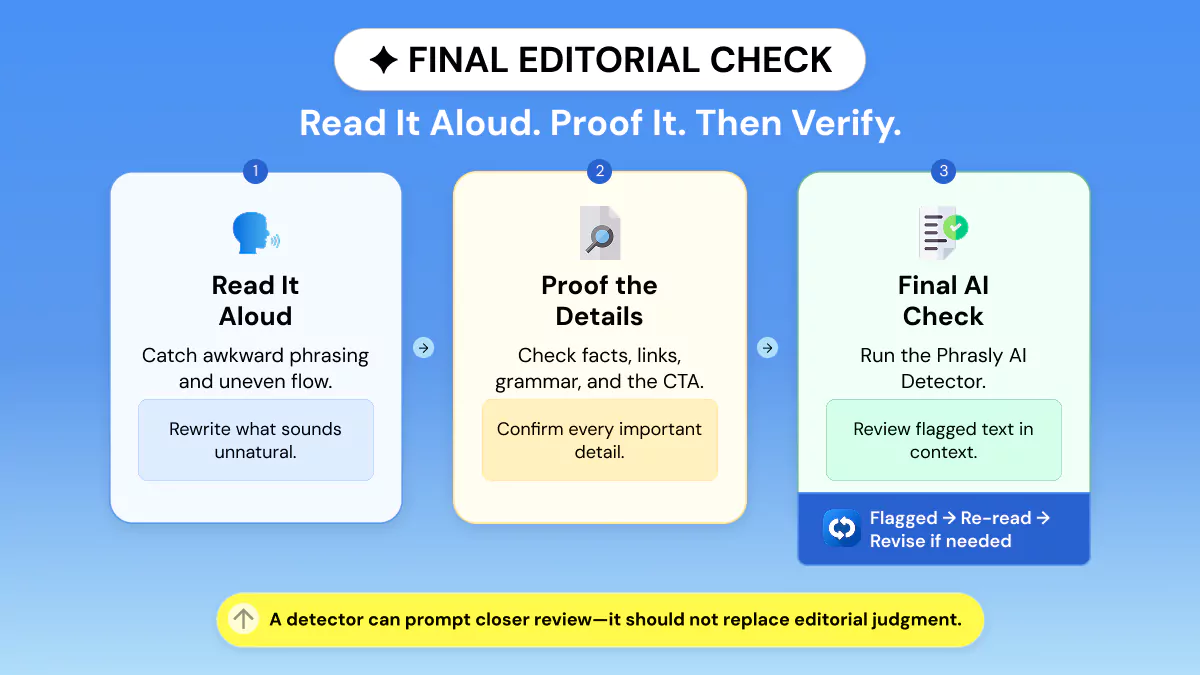
Reading aloud helps with editing because your ear catches what your eyes forgive. Read the edited draft out loud and rewrite anywhere you stumble, lose the meaning or sound unlike the intended brand voice. Silent rereading fails here because your brain autocorrects: it fills in missing words and smooths phrasing it has already seen four times.
As you read, listen for:
- Sentences that run out of breath
- Phrases you would never say naturally
- Repeated sounds or sentence patterns
- Missing words and unclear pronouns
- Awkward transitions and unintentional formality
- Claims that sound stronger than the evidence behind them
Then run the final proofing sweep in three layers. Facts first: names, numbers, dates, quotations and links. Then business accuracy: product capabilities, pricing, brand terminology and the CTA destination. Then mechanics: grammar, punctuation and formatting.
This order matters most for AI-assisted drafts. Editing an AI draft properly means the facts get verified before the copy ships, not just the commas.
One last question: should you check edited writing with an AI detector? Yes, as long as you treat the result as a signal, not a verdict. The peer-reviewed RAID benchmark (ACL 2024) found detector results can shift with edits, generation settings and unseen models, so no detector can prove authorship. Review flagged passages in context, decide whether they are generic, repetitive or misclassified, and keep the final judgment yours.
Ship Copy You Can Stand Behind
Five passes, one order: message, cuts, specifics, rhythm, verification. Run them top to bottom and a rough draft becomes copy that is clear, accurate and recognizably yours. The checklist works whether you wrote the first draft yourself or started with AI.
Once the human edit is done, Phrasly's AI Detector gives you one more perspective before the copy ships. It takes seconds, it is trusted by more than three million writers, and it flags passages worth a second read. Not a grade, just a final check.
FAQs
What should I look for when self-editing?
Check six layers in order: message (one clear promise), structure (logical paragraph order), specificity (verifiable details instead of abstractions), voice (a consistent point of view), rhythm (varied sentence length and openings), and accuracy (facts, links and grammar). Working from meaning down to mechanics stops you from polishing sentences that later get cut.
Should I edit structure or grammar first?
Structure first, always. Fix the argument, paragraph order and proof placement, then edit sentence-level style like filler, specificity and rhythm. Proofread grammar and punctuation last, because structural edits delete or rewrite entire passages and would undo earlier corrections. Grammar-first editing is the most common self-editing mistake.
How do I make my writing sound less robotic?
Cut generic phrases a competitor could publish unchanged, add real details and a clear position, vary sentence length and openings naturally, and read the draft aloud. Robotic copy is usually a specificity problem, not a grammar problem. For AI-specific rewrites, see our guide to making AI marketing copy sound less robotic.
How do I edit AI-generated copy without losing my voice?
Verify the facts first, since AI drafts can contain plausible but false details. Then compare the draft against your voice guide, replace generic phrasing, and add customer language and first-hand knowledge only you can supply. Preserve required claims, keywords and the CTA while you rewrite everything around them. For method options, see how to humanize AI text.
Does reading aloud actually help with editing?
Yes. Reading aloud catches what silent rereading misses: awkward rhythm, missing words, sentences that run too long, phrasing you would never say to a real person, and weak transitions. Your brain autocorrects text it has already seen, but your ear does not. If you stumble, your reader will too.
Should I check my edited draft with an AI detector?
Yes, as one additional signal after human editing, not as a replacement for it. No detector can conclusively prove authorship, so review flagged passages in context: they may be generic, repetitive or simply misclassified. Run your final draft through the Phrasly AI Detector to get that second perspective in seconds.


Keep reading

AI vs Human Cold Email Reply Rates: What 150M+ Emails Across 8 Studies Actually Show (2026)
AI cold emails get 1% fewer replies but 3x more spam flags. We compared 8 studies covering 150M+ emails, including peer-reviewed research, to show what actually works in 2026 and the fix that closes the gap.

How to Run an AI Check on Client Copy Before It Ships?
Run an AI detector once, on your final draft not mid-process. Treat flagged passages as editing cues, not a verdict, since studies show detectors misfire often. Fix generic or hedged lines, leave strong writing alone, and keep dated drafts as your real proof of authorship.