Why Your SEO Content May Be Getting Plagiarism Flags And How to Fix It Before Publishing
13 min read
You've just finished a blog post. It's well-researched, written in your brand voice, and optimized for your target keywords. You run it through a plagiarism checker as a final QA step, and a red flag appears.
But here's the thing: you know this content is original, with some AI assistance that you edited thoroughly. So what just happened?
This scenario plays out dozens of times a day for content teams across every industry. And the frustrating truth is that most of those flags are *not evidence of actual plagiarism*.
They're the result of how plagiarism detection tools work, and how modern SEO content is inevitably structured.
Check Your Work for Plagiarism Here 👇
What a Plagiarism Flag Actually Means (And What It Doesn’t)
A plagiarism checker works by comparing your text against billions of web pages, academic papers, and published works. Matching or similar passages are flagged with links to the original source.
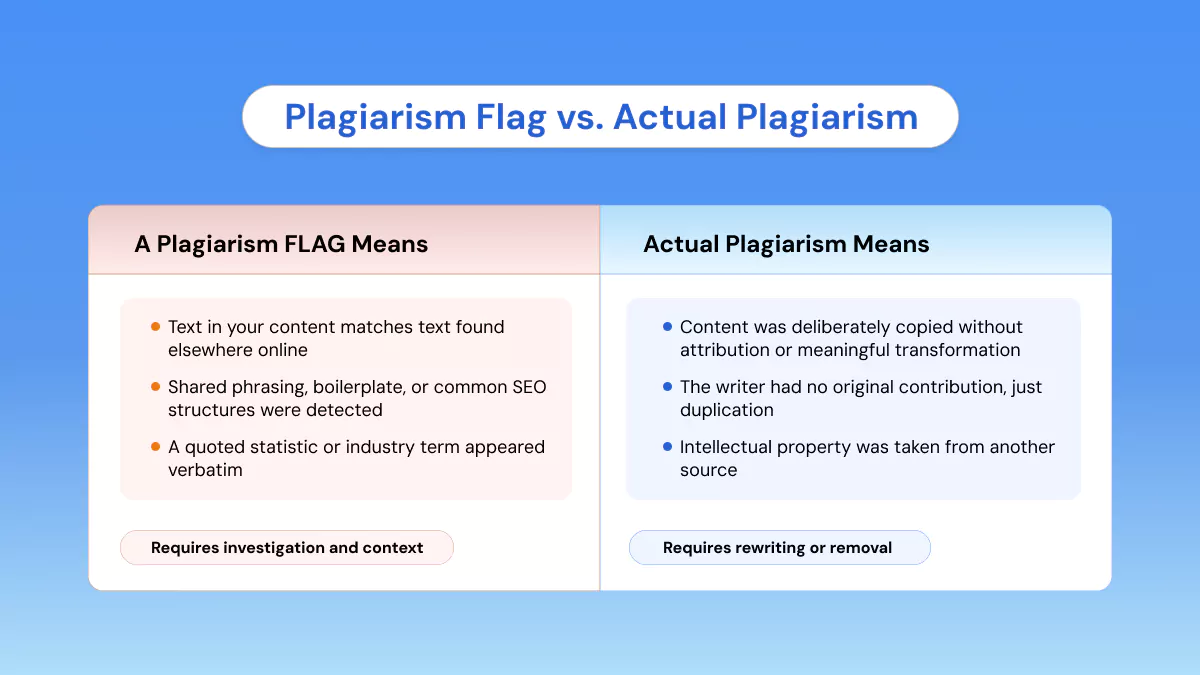
A flag indicates that a matching pattern was found. It doesn’t tell you if that overlap was intentional, if you were the original creator, or even if that match makes sense in context.
Take a similarity score of 22%, for example. Five completely different sources may have matched that percentage. None of those matches could be full sentences.
They could be common phrases used in your industry that show up in hundreds of articles in your niche.
That’s a flag, not plagiarism.
Most plagiarism tools flag content when similarity crosses a certain percentage threshold, depending on the tool and its settings. This threshold is a blunt instrument.
Tools like Phrasly highlight individual matched segments, showing you exactly where the overlap occurs and whether it is a full match, original, or partial match.
A plagiarism flag is a signal to investigate, not a verdict. Most flags in original SEO content have identifiable, fixable causes. The goal is to understand what triggered the flag before deciding how, or whether, to act on it.
Common Reasons Original SEO Content Get Flagged
Even when every word is typed by a human who never opened a competitor's blog, your SEO content might get flagged for plagiarism. Here are the six most common reasons:
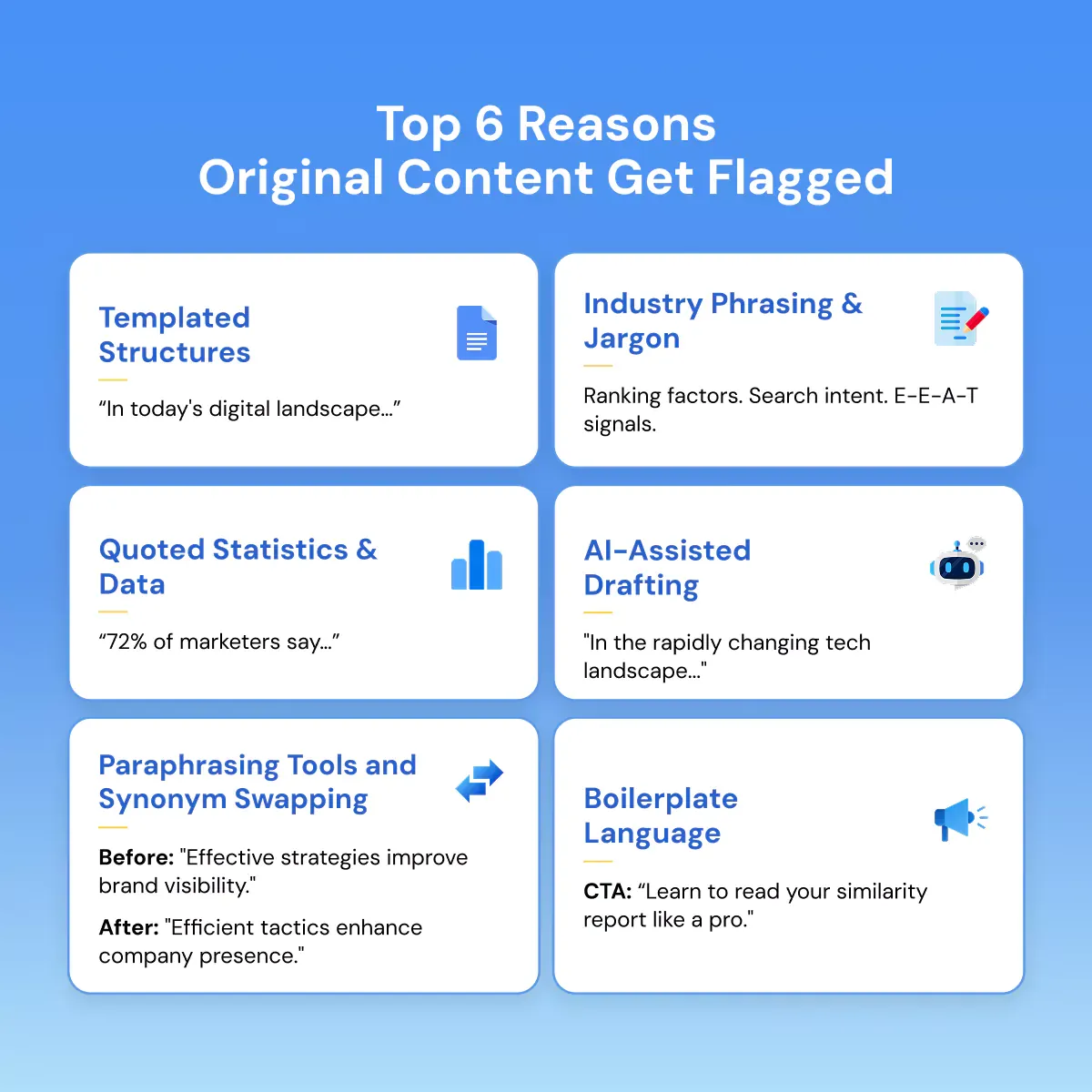
1. Templated Structures
As a marketer, you know that SEO content follows a recognizable pattern. Listicles can start with "Here are X ways to...", or "In this article, you'll learn...". You can also use "X vs. Y: Which is better for Z?" for product comparisons.
These structures are not essentially plagiarized; they're genre conventions.
But plagiarism checkers don't understand the genre.
They see the same opening phrases appearing across thousands of pages and flag them as matches. Your "In today's digital landscape..." intro it's just overused to the point that algorithms recognize it.
2. Common Industry Phrasing and Jargon
Every industry has its buzzwords. SEO people love to say “ranking factors,” “search intent,” and “E-E-A-T signals.” Finance writers are fond of “diversified portfolio,” “compound interest,” and “risk tolerance.”
If you write correctly for your target audience, you can’t escape these terms.
When the plagiarism checker runs your article against the thousands of others in the database that use the same technical language, it creates partial matches that look scary in the report but don’t have any functional meaning.
If you need help with your content, check out the best prompts to humanize AI text that can actually improve your writing.
3. Quoted Statistics and Data Points
Data-driven content is high-performing content. But when you cite a statistic like "72% of marketers say content marketing increases engagement" (or whatever the current figure is), that exact phrasing likely appears on dozens of other blogs that cited the same study.
The second your properly attributed quote is pulled from the original source, it’s considered a “match” by the software, despite the fact that attribution is what makes it ethical and original content.
4. AI-Assisted Drafting and Common Output Patterns
If you used ChatGPT, Claude, or another AI writing tool to generate a first draft, you're not alone, and you're not cheating.
But AI models are trained on a vast corpora of existing text, and they tend to reproduce common phrasing patterns, transition words, and sentence structures that appear frequently in their training data.
The result? AI-assisted content often contains "invisible" matches to existing web content.
Learn more about why copywriters get flagged by AI detectors and how to check your copy before you deliver.
5. Paraphrasing Tools and Synonym Swapping
Tools that promise to "rewrite" content by swapping in synonyms often create awkward phrasing while retaining the original sentence structure.
Plagiarism checkers are increasingly sophisticated at detecting these patterns, not because the content is verbatim, but because the structure remains too similar to the source.
A paraphrase that changes every third word but keeps the same clause order will often trigger a flag.
6. Boilerplate Intros, CTAs, and Legal Disclaimers
Your standard author bio, cookie consent language, affiliate disclosure, or email newsletter signup CTA might appear word-for-word on every article you publish, and on thousands of other sites using the same templates.
Despite not being plagiarism, it can increase your similarity percentage.
If you need help with your content, check out the best AI text enhancers that can actually improve your writing.
How AI-Assisted Writing Increases Plagiarism Risk
AI writing assistants have changed the content creation efforts, and they’ve also made plagiarism detection more complicated. Let’s take a look at the plagiarism risk spectrum to keep your output flag-free.
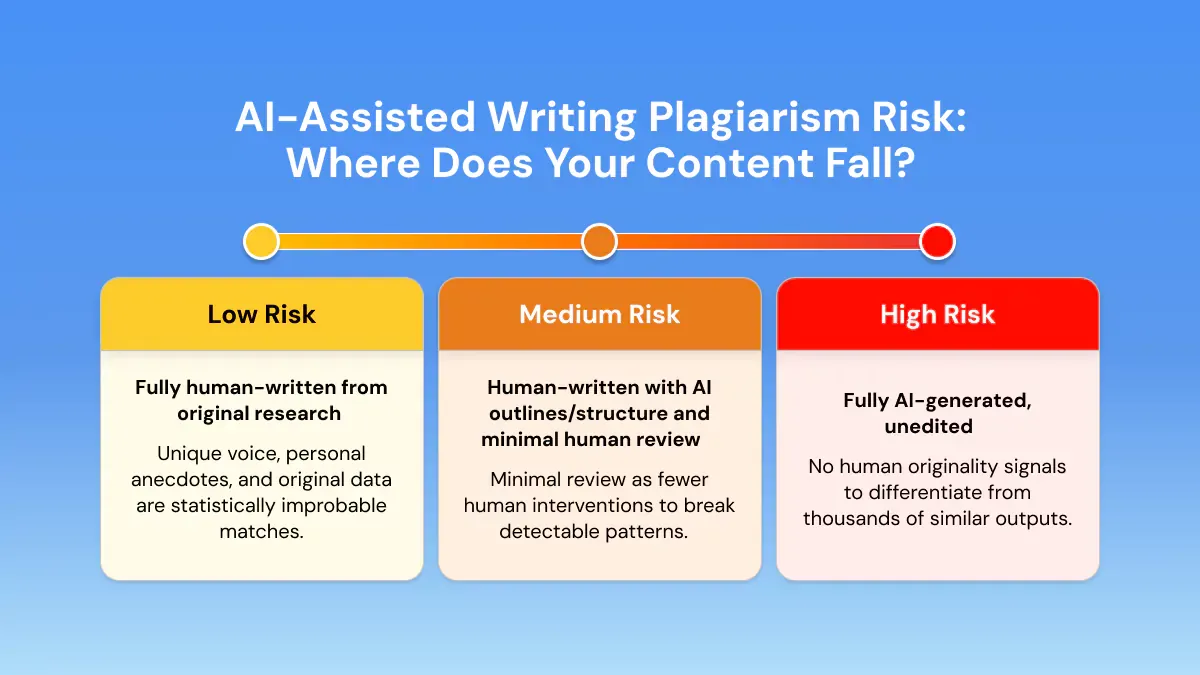
Content that’s been written entirely by a human has the lowest risk of being flagged as plagiarized. No two humans write exactly the same way, because we’re all familiar with enough uniquely human sources of variation.
Humans can, like, turn a phrase differently, draw from personal experience, and fall afoul (or gravitate toward) idioms and uncommon turns of phrase that pattern-matching engines will generally ignore.
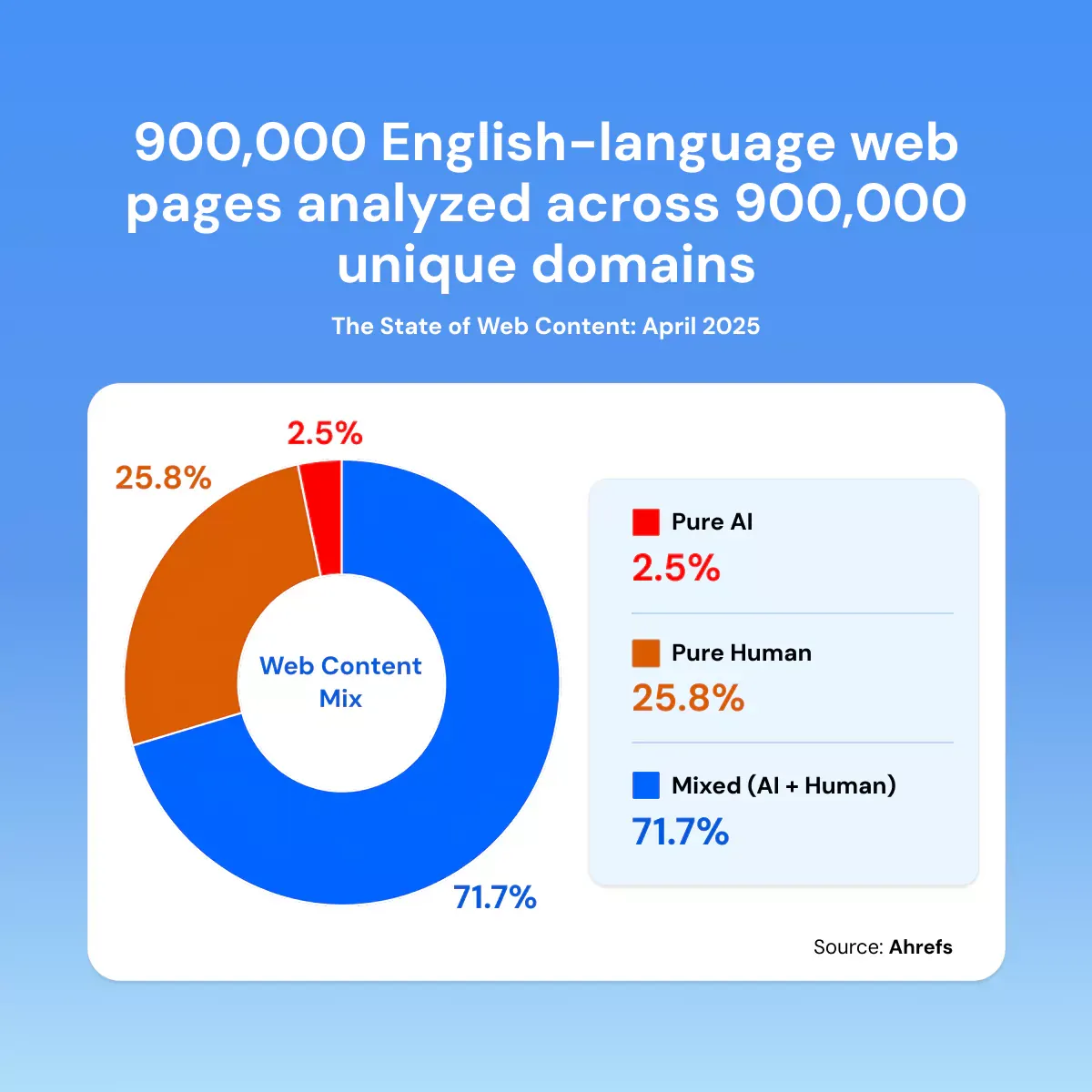
A study by Ahrefs of 900k pages found that 74% of new webpages include AI content and that blog posts are the most common type of content created by AI.
The "Formulaic AI Output" Problem
AI models tend to produce predictable outputs for predictable prompts. Ask two different AI tools to write an introduction to an article about content marketing, and you'll often get surprisingly similar results: similar sentence structures, similar transition phrases, similar opening hooks.
When these outputs are published across the web (as they increasingly are), they create a feedback loop: AI-generated content that matches other AI-generated content, which in turn matches the training data.
Plagiarism tools catch this pattern even when no human intends to copy anything.
Light Editing Isn't Always Enough
Content that’s been drafted by AI and then substantially rewritten by a human is in the middle of the risk spectrum.
If you use AI to generate content, but then go in and change sentence structures, flesh out examples with original details, and edit until the voice is unmistakably yours, you’re unlikely to run into trouble.
Copy theft isn’t happening in this scenario, and plagiarism detection tools will usually be able to tell that you’ve changed enough of the wording and structure to be on safe ground.
Google's quality guidelines emphasize Experience, Expertise, Authoritativeness, and Trustworthiness (E-E-A-T).
Content that reads as formulaic or generic, even without a formal plagiarism flag, may struggle to rank if it lacks the unique insight signals that distinguish expert-authored content from commodity text.
The solution isn't to abandon AI tools, but to treat AI output as a first draft that requires human revision. Change sentence structures, add original research or anecdotes, and ensure the final voice is yours.
How to Read and Interpret a Similarity Score
One common error I see content teams make when analyzing plagiarism reports is obsessing over the total similarity percentage as if it were the final verdict.
If you’re working on rich content, full of high-quality references and external data, your plagiarism report will probably not be 0. The percentage and the flags are a starting point for your inquiry.
Here are good practices to apply when reading a plagiarism report:
Start with the source list, not the score. Check who you are allegedly matching with. If all your matches are from generic industry publications, that's a different conversation than matching a competitor's proprietary guide.
Check your match length. A 15-word match is worth investigating, while a 3-word match is almost certainly a common phrase.
Review your similarity score. Exact matches should take priority over paraphrased matches, since similar matches are often false positives.
Identify what can be excluded. Properly attributed quotes, reference lists, and metadata should be ignored when reviewing your score.
Phrasly's scoring interface, for example, categorizes your matched sources by percentage similarity and flags which areas you should focus on versus those considered common phrases that you can exclude.
This kind of nuance transforms a scary number into an actionable editing roadmap.
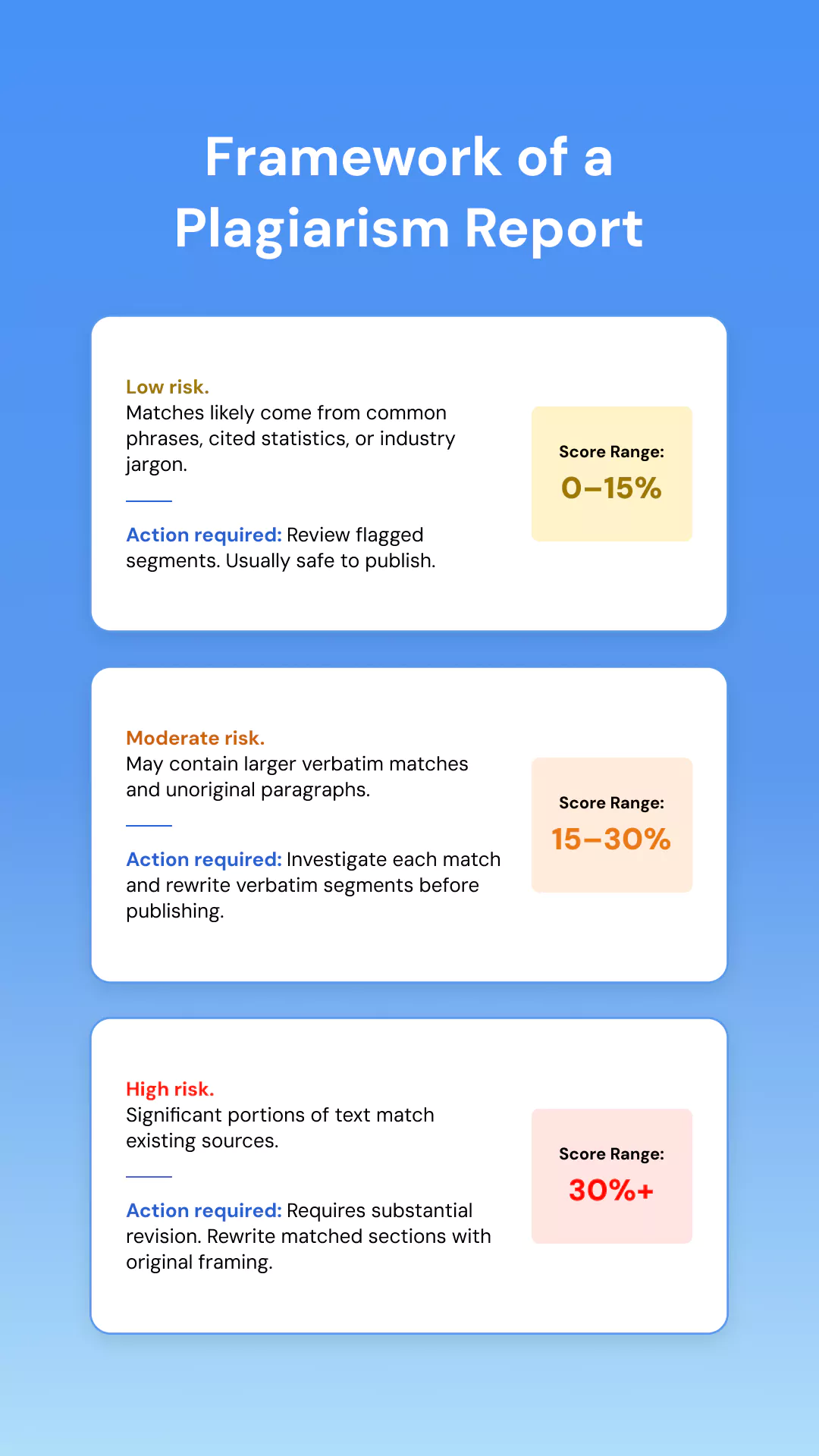
The critical rule: never make a publishing decision based on the headline score alone.
A 25% score, with 20% coming from properly cited statistics and standard legal disclaimers, is very different from a 25% score in which the entire introduction matches a competitor's blog.
A Pre-Publish Workflow to Catch and Fix Plagiarism Flags
The best time to address a plagiarism flag is before your content goes live, and not after it has already been published and potentially flagged by a client or search engine.
Here's a practical five-step workflow your team can incorporate into your workflow
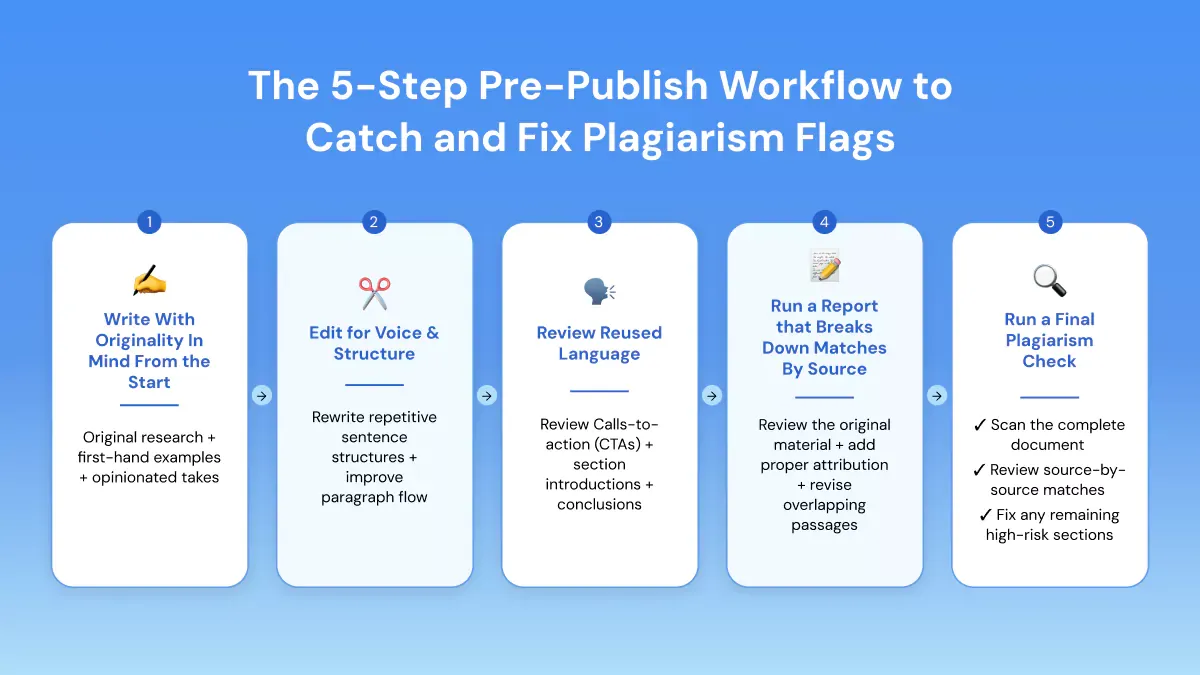
Step 1: Write With Originality In Mind From the Start
When drafting your content, plan for originality. Make sure that you know the angles you’ll go for, what type of data is relevant for your content, and what experience you’re bringing to the topic.
I know that writing content for an article with high-volume keywords means that there will be dozens of other pages covering the same topic, so think about how your content will stand out among so many others.
According to Sprout Social, 2025 Content Benchmarks Report, “Second only to product or service quality, consumers say original content is what makes brands stand out.”
Showing us that what makes a brand memorable is not just having an online presence, but also a unique voice.
Train your writers, human- and AI-assisted, because generic content not only risks raising plagiarism flags but also underperforms on E-E-A-T signals.
If you're using AI tools, give them specific, detailed prompts that push for unique perspectives rather than generic summaries. Check out 75+ prompts for professionals, tailored for real tasks, to save your time and elevate your output.
Step 2: Edit Drafts for Voice and Structure
Whether you’re using AI-generated or human content, in this step, you have to pay attention to your revision.
If your content has been flagged, edit sentence structure, paragraphs, add data points, and replace bland transitions with ones that better fit your voice.
Step 3: Review Template Language
Review your content, checking for reused language. Your CTAs, section openers, and conclusions are where most writers tend to follow a pattern.
When possible, diversify the language across pieces or use content that's unique to each article's topic.
If you do use standardized language (e.g., a branded CTA), be aware that it may show up in plagiarism reports, and document that it's intentional and proprietary so editors can exclude it from review.
Step 4: Run a Report that Breaks Down Matches By Source
When a section of your article gets flagged as similar, check exactly which websites/sources your content matched with, not just a similarity score.
You need to know where it matched so you can Google the original source and give the correct credit.
Step 5: Run the Final Draft Through a Plagiarism Checker
Wait, run it through plagiarism software again? Yes. Before any piece goes live, run it through a dedicated plagiarism checker. This should be as standard as a grammar check or a final SEO audit.
Tools like Phrasly's Plagiarism Checker let you scan a full document, see a source-by-source breakdown of matches, and identify any remaining high-risk segments before they become a problem post-publish.
Make it the last gate in your content QA checklist. Learn more about incremental plagiarism, one of the easiest forms of plagiarism to commit, and how to avoid it.
Team Process Tip: Assign plagiarism review as a defined step in your content calendar. Add it to your publishing checklist along with keyword review, internal linking, and final copy approval.
Plagiarism review often becomes an optional step, and teams who treat it that way tend to realize they've made a mistake right before publishing.
How Plagiarism Flags Impact SEO Rankings and AI Overviews
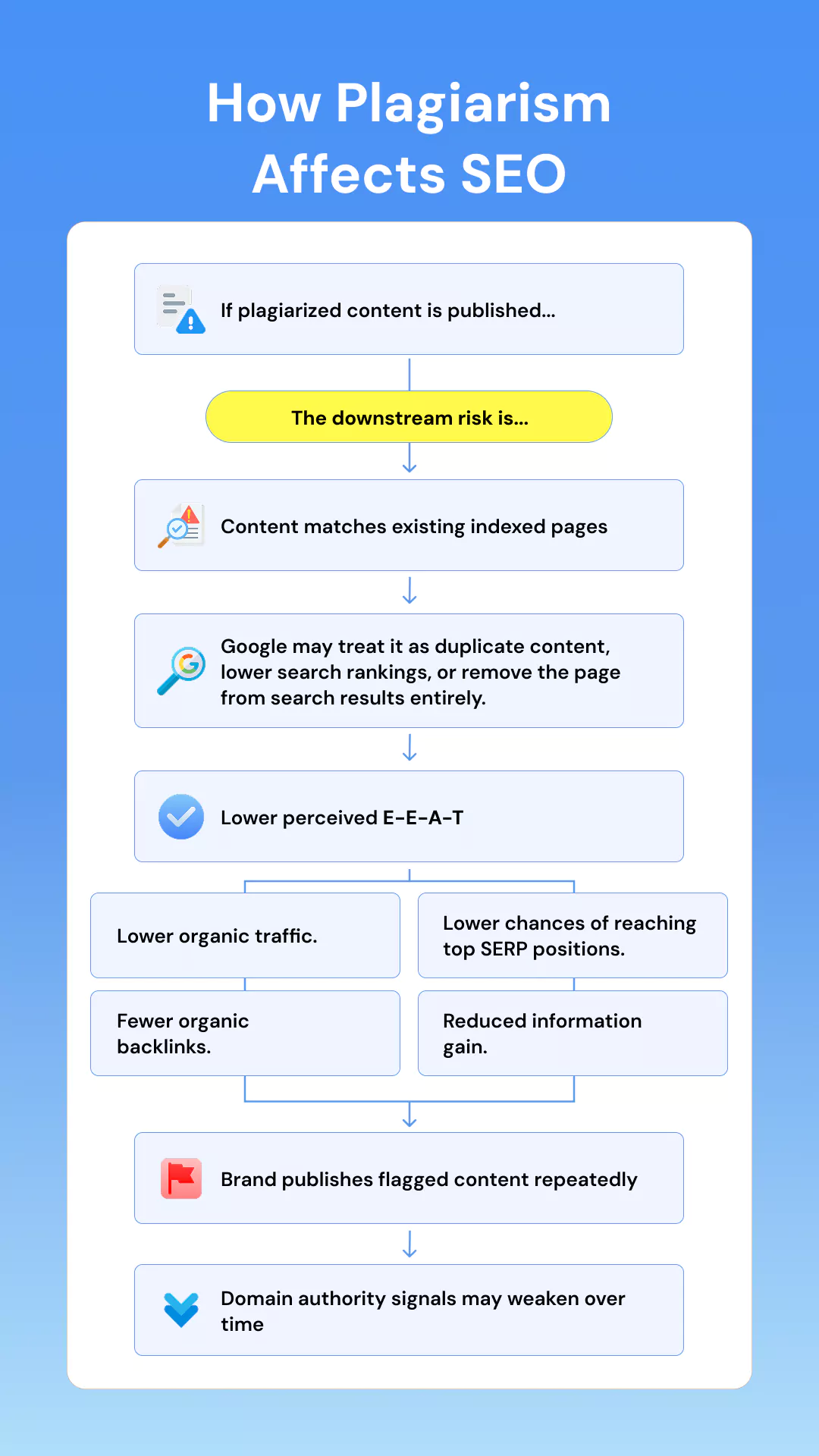
Beyond avoiding plagiarism concerns, unique content is what makes your brand innovative and trustworthy; it also impacts your SEO and brand trust. So, a negative impact in the event of plagiarism is only to be expected.
To show you how impactful it can be, here are three important reasons why plagiarism flags should not be ignored:
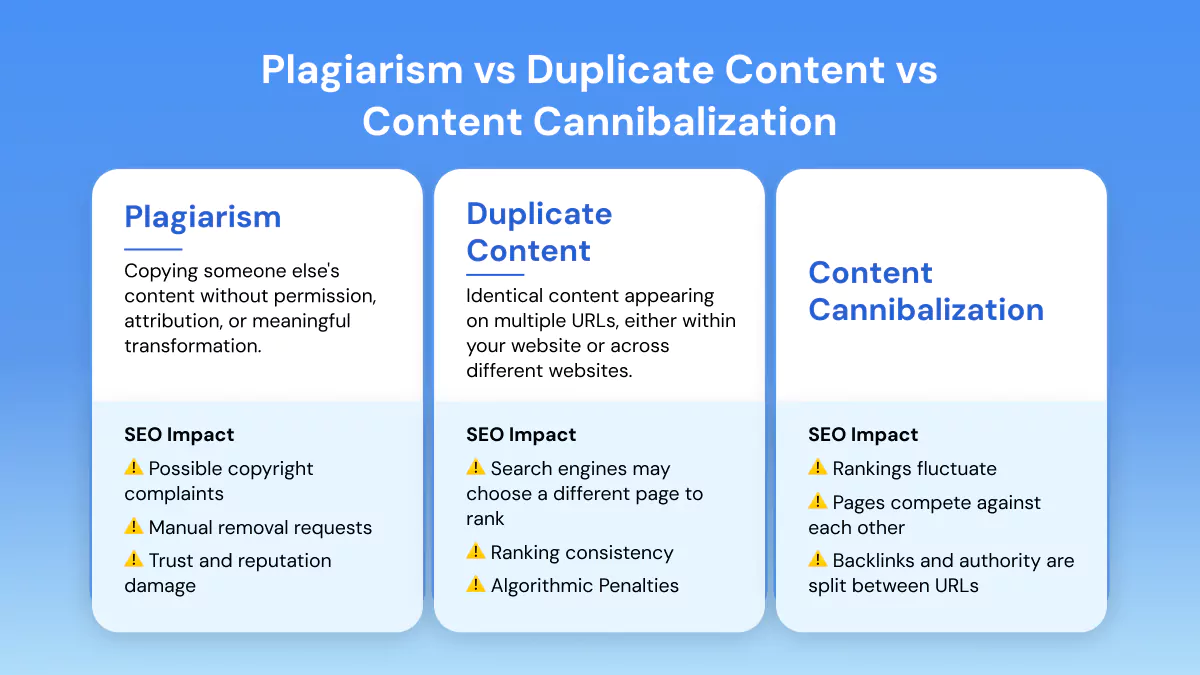
Duplicate Content
Even though plagiarism and duplicate content are distinct, Google generally does not apply a manual or algorithmic "plagiarism penalty" simply because content is copied.
Instead, copied or near-duplicate content tends to perform worse because Google selects one version to index and rank
“...It’s more that, if we find exactly the same information on multiple pages on the web, and someone searches specifically for that piece of information, then we’ll try to find the best matching page.” John Mueller
Google's representatives, including John Mueller, have said that duplicate content is not a negative ranking factor by itself, but, given that Google prioritizes pages that provide unique value, it can reduce your chances of ranking well.
If your content substantially overlaps with a higher-authority page, your version is unlikely to appear in search results.
Duplicate content can decrease search engine rankings, reduce website credibility and authority, and even result in a manual action assigned by Google’s human evaluators.
Originality Signals and AI Overview Citations
If you want to increase your AI visibility and have your brand cited in AI Overviews and LLM-generated answers, you have to be original.
Generative search features are increasingly selective about which sources they cite. A Search Engine Land study showed that 52.2% of cited pages have original or “owned” data.
The signals AI uses to evaluate citation-worthiness overlap significantly with E-E-A-T, so it checks whether the content is original, authoritative, and grounded in genuine expertise.
Content that reads as generic or formulaic, even without a formal plagiarism flag, is less likely to be selected for citation. This makes originality not just an ethical concern but a strategic competitive advantage.
If you’re struggling to build new original content, check the Content Idea Generator and never run out of topics again.
Best Practices to Reduce Plagiarism Risk Long-Term
Articles can be fixed on an individual basis, but to really lock down plagiarism, you need a process. Here are some best practices to avoid plagiarism (intentional or accidental) for good.
Build Review Into the Workflow
Add plagiarism review as a named step in your editorial calendar.
Set a maximum acceptable similarity threshold for your team (e.g., <15% after exclusions).
Tools: Choose Detection That Fits Modern Content
Use a plagiarism checker that distinguishes verbatim matches from paraphrase matches.
Look for source-level reporting, not just an aggregate score.
Team Training: Create Shared Standards
Educate writers on why AI drafts require structural edits, not just light polish.
Train editors to distinguish legitimate matches (common phrases, cited stats) from actual overlap.
Keep in mind that the best protection against plagiarism flags isn't a better detection tool, it's content that's genuinely different from what already exists.
Original research, proprietary data, first-person case studies, and expert interviews all create content that, by design, won’t match other sites.
For a comprehensive approach to creating original, high-performing content at scale, learn how to develop a winning content writing strategy using AI.
Whether you are a student worried about plagiarism or a writer looking for duplicate content, follow these steps to check for plagiarism in Google Docs.
Fixing Plagiarism Flags with Phrasly
If you want a fast way to integrate this into your existing workflow, try Phrasly's Plagiarism Checker as your final pre-publish step.
It's built specifically for the false-positive reality that SEO content marketers face every day, giving you the granular, actionable reports you need to publish with confidence.
FAQs
My plagiarism checker shows a 22% similarity score. Does that mean my content is plagiarized?
No. A similarity score is not a plagiarism verdict. A 22% score could mean five different sources matched short phrases, or that common industry terms and cited statistics appeared in your text. Always investigate the source list and match length before making a publishing decision.
Why does my original, AI-assisted content keep getting flagged for plagiarism?
AI models are trained on vast corpora of existing text and tend to reproduce common phrasing patterns, transition words, and sentence structures.
What's the difference between a plagiarism flag and actual plagiarism?
A plagiarism flag means your text matches text found elsewhere online, this could be shared phrasing, boilerplate language, common SEO structures, or a quoted statistic. It requires investigation and context. Actual plagiarism means content was deliberately copied without attribution or meaningful transformation, with no original contribution from the writer. It requires rewriting or removal.

Written by
Gabriela Cofre
Gabriela Cofre is a content strategist and writer specializing in SEO, inbound marketing, and B2B, B2C content with +7 years of experience.