
How Agencies QA Outsourced and Freelance Content Before Client Delivery
AI detection, plagiarism checks, fact-checking, brand voice review, disclosure decision: agencies need a formal 5-step QA process for freelance content. With 20% of freelancers using AI regularly, 'we trust our writers' no longer counts as quality assurance.
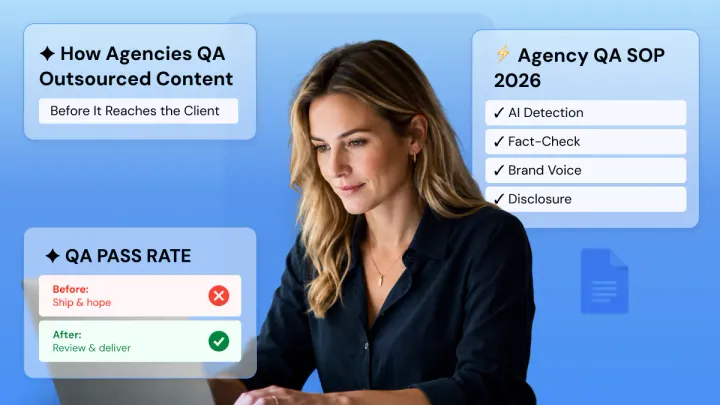
Agencies check freelance content by putting every submission through a consistent process prior to delivery to the client: AI detection to flag risk, a plagiarism check, a fact-checking pass on all assertions, a brand voice review, and disclosure determination.
The goal is an audit-proof content SOP, not an ad hoc gut check. Given that 20% of freelancers are now regularly incorporating generative AI (Upwork, 2024), this structured approach has become essential.
The risk isn't that freelancers use AI. Many do use AI competently. The risk is Unreviewed AI output shipping to a client. Unverified claims, generic brand-off copy, or undisclosed AI in a deliverable the client assumed was hand-written.
That gap is where client trust breaks down, usually silently until your client discovers something is amiss.
Here’s a complete five-step content quality control process you can adopt as an editorial workflow. Learn how to operate an AI content QA workflow without punishing decent freelancers.
We’ll also dive into the disclosure question agencies continue to answer incorrectly.
Why Outsourced Content Needs a Formal QA Step Now?
AI use among freelancers is now mainstream. (Upwork (2024) found 20% use generative AI regularly & 54% of respondents report advanced proficiency), So “we trust our writers” isn’t quality assurance these days.
Unreviewed AI output is the liability; AI doesn’t have to be.
As an agency, this means a significant portion of the outsourced writing you’ll receive has already gone through an AI tool at some point in the drafting/editing/research process, with or without the writer’s disclosure.
That stat is an adoption number, not a volume-of-content number. There isn't a credible, verifiable number for the proportion of outsourced or freelance copy that's actually AI-produced, and agencies ought to steer clear of repeating figures that lack proper sourcing.
Instead of taking a wild guess, the sensible approach is to view Upwork's adoption rate as your primary signal for risk.
None of this is meant to be against AI-assisted freelancers. Many good writers use AI to help them brainstorm, outline, research, or do a first draft of work that they then edit to ensure it is original, well-sourced, and on-brand content.
That QA step is precisely for spotting and removing this kind of failure. Whether AI was involved or not, this includes phrasing that's too general, claims without backing, or not sticking to the agreed-upon brief.
Agencies check freelance content before delivering to clients by running a fixed, repeatable sequence. Detection, plagiarism scan, fact-check, brand-voice review, and a disclosure decision on every piece, rather than relying on the writer’s reputation alone.
The 5-Step Content QA Process (Turn This into Your SOP)
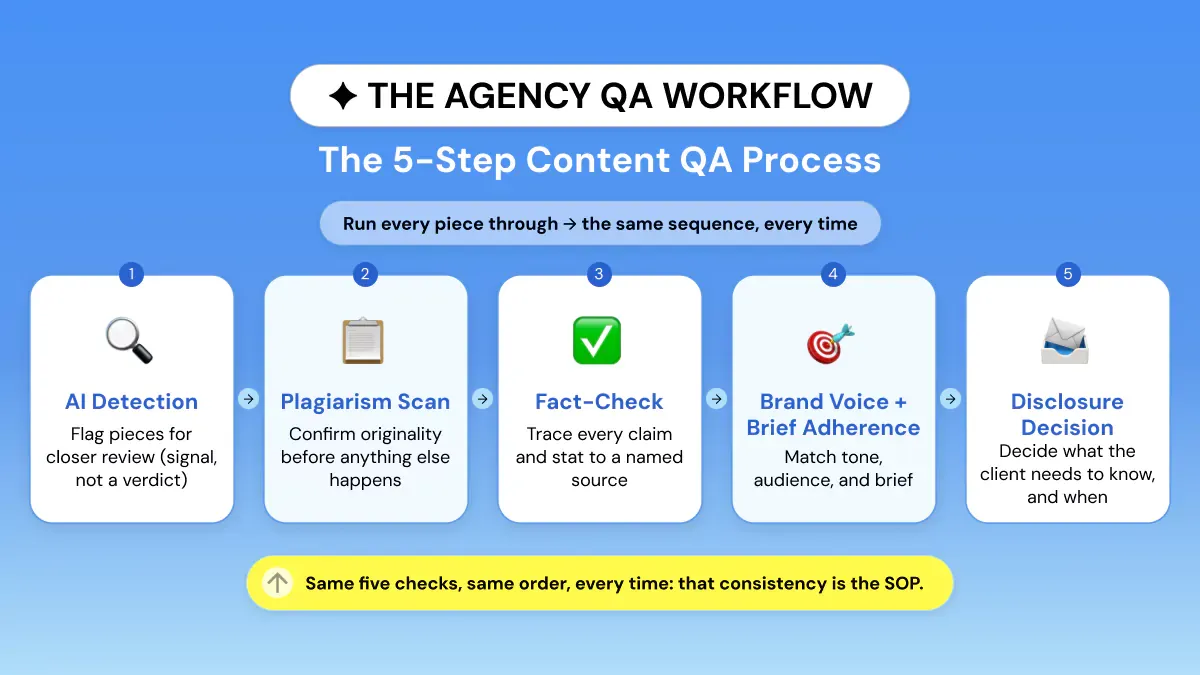
Apply all five filters to everything you outsource, sequentially: 1) Use AI detection as an indicator for risk. 2) Run a plagiarism check. 3) Fact-check all claims and stats. 4) Review for brand voice and brief compliance. 5) Decide on disclosure.
Here's a copy/paste-ready version of the agency content review checklist for you and your team to plug directly into an editorial workflow document or project management platform.
Step-by-Step Checklist
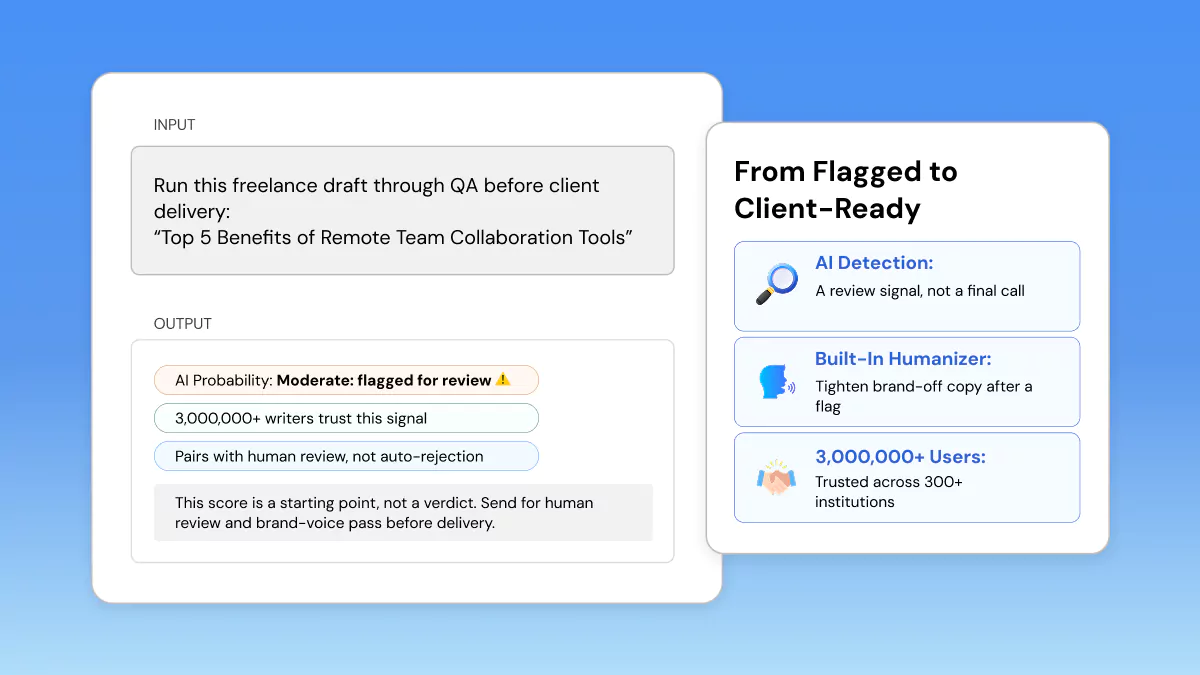
- Pass draft through AI detector as a flag for review, not as a determination.
- Check originality scan / plagiarism check to ensure work isn't copied/pasted or previously submitted.
- Trace every statistic and claim to a named, dated source. The same standard was used to build this brief.
- Review draft line by line for adherence to brand voice guidelines and original brief.
- Determine, according to client specifications, if AI usage should be disclosed prior to delivery.
Here's the same process laid out with what each step is actually checking for and the typical owner on an agency team:
|
Step |
What It Checks |
Why It Matters |
Typical Owner |
|
AI Detection |
Flags pieces likely to
contain Unreviewed AI output |
Risk signal only. Detectors
carry documented false positives, especially for non-native English writers |
Editor / QA lead |
|
Plagiarism Scan |
Originality against
published web content |
Protects the client from
duplicate-content and copyright exposure |
Editor |
|
Fact-Check |
Every statistic and claim
traced to a named, dated source |
Unverified claims are the
single biggest credibility risk in outsourced copy |
Senior editor / fact-checker |
|
Brand Voice + Brief |
Tone, terminology, and
adherence to the original brief |
Generic, brand-off copy is
the most common AI-era complaint from clients |
Account / content lead |
|
Disclosure Decision |
Whether AI involvement needs
to be flagged per the client agreement |
~90% of consumers want to
know when content is AI-created (Getty Images, 2024) |
Account manager |
Using an AI Detector Without Punishing Good Freelancers
Consider a detector score as something to investigate further, never as evidence of wrongdoing.
Detectors have a known bias against ESL writers. A significant number of flags on well-written documents from proficient ESL authors will likely be mistaken identifications/false positives.
A paper published in Patterns by Liang et al. in 2023 found that AI detectors exhibit bias against non-native English-language writers, registering false positives at meaningfully higher rates than they do on Native-English-language text.
Among agencies tapping into an international pool of freelance writers for quality control practices, that discovery bears one very clear implication: a detector flag should be a signal to review, not a reason to discard or distrust outright.
How to Use the Flag Correctly?
- Always treat a flag as a reason to manually review, not necessarily a rejection or payment dispute.
- Ensure the flag prompts a direct conversation with the writer before jumping to conclusions about the article's origin.
- Score it differently for writers whom you know are non-native English speakers. Because of known bias documented in Patterns (2023).
- If AI were leveraged properly and the underlying ideas/facts/structure remain sound, the solution is editing or using an AI humanizer to tighten brand-off copy for voice, not throwing out the author's effort.
Should You Disclose AI Use to Clients?
Lean toward transparency. Consumer trust research is one-directional. Undisclosed AI in a client deliverable is a client trust liability if it surfaces later.
Additionally, 98% report that authentic images and videos are important to building trust.
Although that research centered on visuals, one’s preference for knowing when they were looking at AI-generated images logically carries over to textual copy that clients are paying an agency to write for them.
In practice, this doesn't mean disclosing line-by-line which sentences came from a tool. It means setting expectations at the process level:
- Add an AI-use clause into your client services agreement which outlines how AI might be used throughout your workflow (Drafting assistance, Editing, Research), as well as how it will be reviewed.
- Disclose your QA SOP at the process level, instead of piece-by-piece negotiation of disclosure.
- Frame disclosure as a trust asset. Clients who know your QA process exists tend to trust the output more, not less.
- Keep the disclosure language consistent across clients. So it reads as policy, not as a one-off confession when something goes wrong.
Frequently Asked Questions
How do agencies check content for AI before delivery?
Drafts are first put through an AI detector, which serves as a triage flag, and then flagged items are manually checked by an editor. The output from the AI detector is never used as an automatic final decision.
Should I tell clients if my agency uses AI?
Generally, yes. Getty Images (2024) discovered that roughly 90% of consumers expect brands to be transparent about AI-generated content, which means telling your customers about your QA process instead of keeping it secret will likely increase trust.
Can I rely on an AI detector to catch freelancer AI use?
No! Consider the detector output a flag for further review, not evidence. Liang et al. (Patterns, 2023) noted that false positives occurred when their testing involved essays from non-native English speakers.
What belongs in a content QA checklist?
AI detection, a plagiarism checker/scan, fact-checking every claim, a brand-voice and brief-adherence review, and a disclosure decision. Run in that order on every piece.
How do I QA a non-native English freelancer's work fairly?
Bias has been shown against non-native authors, so proceed with caution when flagging essays with the weight detector. Additionally, follow each flag with an actual talk and human review prior to reaching a judgement.
Does Phrasly work for agency content QA?
Phrasly is an AI detector and humanizer platform trusted by 3,000,000+ people across 300+ institutions. Phrasly’s rating of 4.7/5 makes Phrasly effective for AI-detection triage in your QA workflow.


Keep reading

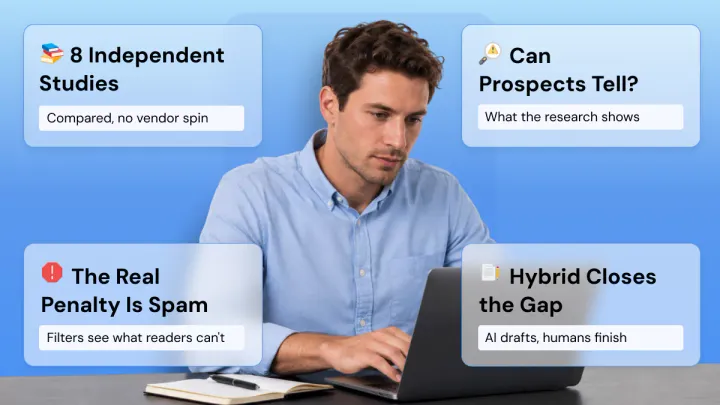
AI vs Human Cold Email Reply Rates: What 150M+ Emails Across 8 Studies Actually Show (2026)
AI cold emails get 1% fewer replies but 3x more spam flags. We compared 8 studies covering 150M+ emails, including peer-reviewed research, to show what actually works in 2026 and the fix that closes the gap.
The Self-Editing Workflow That Makes Writing Read Human
A 5-pass self-editing checklist for copywriters: fix structure, cut generic filler, add proof and voice, improve rhythm, and verify facts before your copy ships.