
Humanizing AI-Written SEO Content Without Hurting Rankings
Worried that humanizing AI content will tank your rankings? It won't if you protect the right elements. Learn how to edit AI drafts for voice and E-E-A-T while keeping keywords, headings, and internal links intact, so your content ranks well and reads as if a human wrote it.

You can humanize AI SEO content without hurting rankings. As long as you preserve the on-page fundamentals such as keyword placement, headings, internal links, and search-intent match.
Add the voice, specifics, and first-hand experience that make a draft read human. Editing for quality is aligned with Google's own guidance. Google rewards good content, "however it is produced."
It's a misconception that humanizing AI content for SEO will ruin your rankings; the actual danger lies elsewhere. Google penalizes scaled, generic content, not content that's been edited for voice.
Publishing flat AI copy without any experience or specificity poses a bigger ranking risk, since that's exactly what Google's helpful content system was built to demote.
Either way, the humanizing and E-E-A-T steps below apply the same way. The goal isn't how the draft was created, but how it reads and performs once it's published.
This guide walks you through the steps of how to humanize AI SEO content without sacrificing your keywords & structure, layer on E-E-A-T signals, and understand why content that sounds human is more citation-worthy in AI search.
The same discipline is behind any solid list of AI SEO content best practices.
Humanizing Helps SEO: Here's Why It Won't Hurt Rankings
Editing AI content for voice and specificity doesn't violate Google's quality standards. Google rewards useful content, however it's created, and only penalizes AI-generated generic content produced at scale.
That one sentence is why editing AI content without hurting rankings is a legitimate strategy, not a loophole.
Google has never suggested AI-generated content was unacceptable, only that it will be judged by the same E- E-A-T standards as non-AI writing.
Generating content, including AI content, at scale purely to manipulate rankings, with no attempt at originality or usefulness. Editing for voice, specificity, and structure is the inverse of that pattern.
Including how to use detection scores as a quality check rather than a pass/fail gate before publishing.
So, will editing AI content for voice hurt rankings? No! If the edit contributes something of value (voice, examples, experience) instead of paraphrasing to avoid detection, then that moves a draft away from the definition of spam, not towards it.
Humanize Without Losing Keywords or Structure
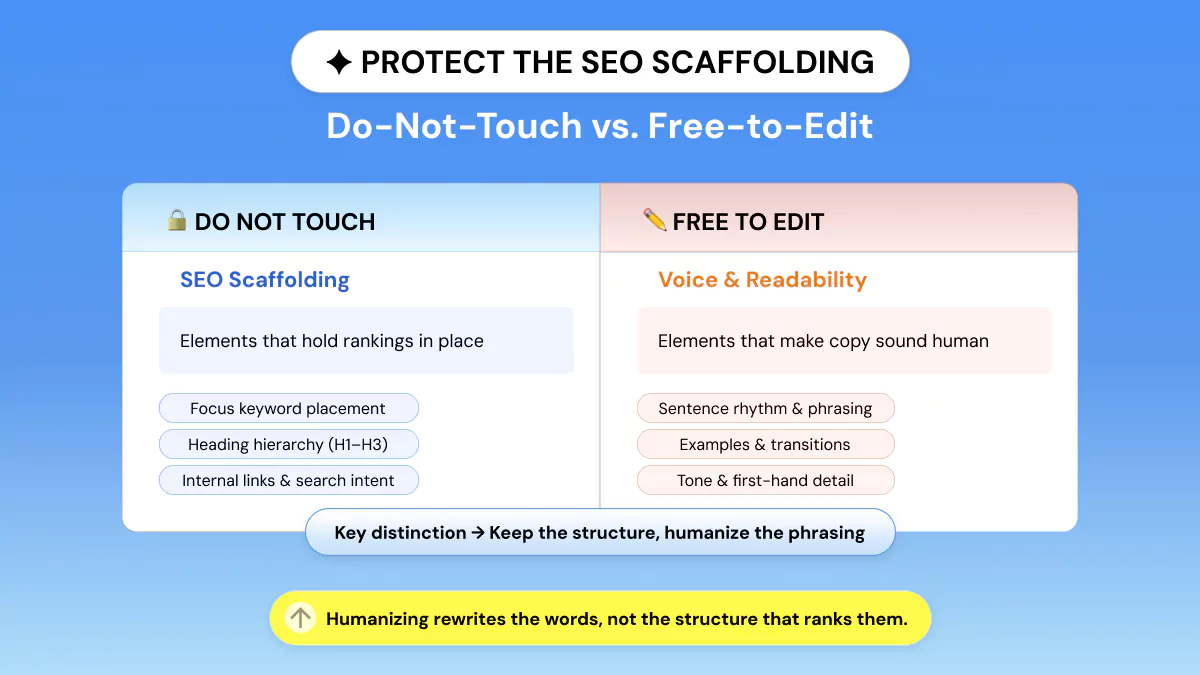
Protect the on-page SEO scaffolding as you edit. Keep the focus keyword in the H1, title, and early copy. Preserve your heading hierarchy and internal links, and hold your search-intent match.
Humanized, original content shouldn't sound like it was written by an AI. The key to "writing naturally" is to refine the content for better cadence, detail, and personality. This way, humanizing AI content affects how it reads, not whether it can be indexed.
Keep This Locked: The Do-Not-Touch List
- Focus keyword in the H1, title tag, meta description, and the first 100 words.
- Heading hierarchy (H1 → H2 → H3) and the order in which topics appear in.
- Existing internal links and their anchor text.
- The page's core search intent. Don't let a voice edit drift the answer off-topic.
Free to Rewrite: The Voice Layer
- Sentence rhythm, length, and transitions between ideas.
- Generic phrasing swapped for specific, concrete language.
- Repetitive AI patterns (over-hedging, filler lists, robotic transitions).
- Examples, asides, and a clear point of view.
A simple table makes the split easy to hand to a writer or editor:
|
Don't
Touch (SEO Scaffolding) |
Free
to Edit (Human Voice) |
|
Focus
keyword placement (H1, title, intro) |
Sentence
length and rhythm |
|
Heading
hierarchy and topic order |
Word
choice and phrasing |
|
Internal
links and anchor text |
Transitions
and connective tissue |
|
Search
intent / the question being answered |
Examples,
asides, and author POV |
|
Schema
and meta description |
Repetitive
or robotic AI patterns |
Try it: Phrasly AI Humanizer
Run a draft through the Phrasly AI Humanizer here. It's built to remove robotic phrasing while preserving meaning, keyword placement, and structure. It makes an already-good draft read as if a person wrote it. Used by 3,000,000+ people, rated 4.7/5.
Confirming the humanizing pass actually reduced robotic patterns rather than just rearranging them. So you're not left guessing whether the edit worked.
If you use any humanizing tool, watch for ones that quietly rewrite your CTAs or drop your focus keyword during the pass. That's how a humanize AI content keeps keywords edit turns into a ranking problem.
A good pass preserves meaning. It makes AI blog posts sound human without touching what the page is trying to rank for.
Add the E-E-A-T Signals AI Drafts Lack
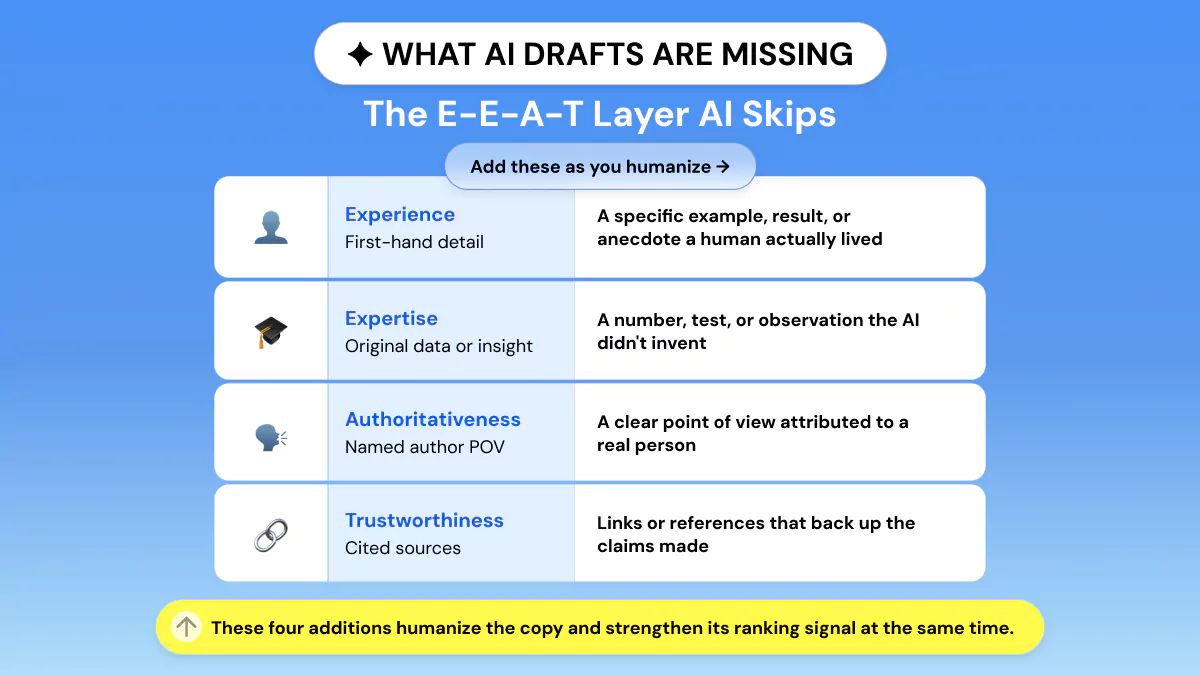
AI drafts are usually missing the human layer. Google rewards first-hand experience, specific examples, original data, and a clear author perspective. Add these as you humanize.
This isn't just a rule of thumb. It's Google's stated standard.
In other words, the humanizing pass isn't a workaround to Google's guidelines. It's the direct application of them.
They're both a ranking signal and what makes the copy sound human in the first place.
Content scores well on E-E-A-T, not because it "sounds human" for its own sake. But because the specificity that makes it sound human is the same specificity Google's helpful-content system is checking for.
What to Add During the Humanizing Pass?
- A first-hand example, mini case, or specific number from your own experience.
- A named data point or source, not a vague phrase such as "studies show".
- A visible author byline. And a sentence or two of real POV, not just a summary.
- Original phrasing that improves readability instead of AI's default long and hedged sentences.
Each addition does double duty. It satisfies the E-E-A-T checklist. It's exactly the kind of detail a generic AI draft can't fake. This is what separates a page that reads as AI content that ranks from one that reads as filler.
The Payoff: Citation-Worthiness in AI Search
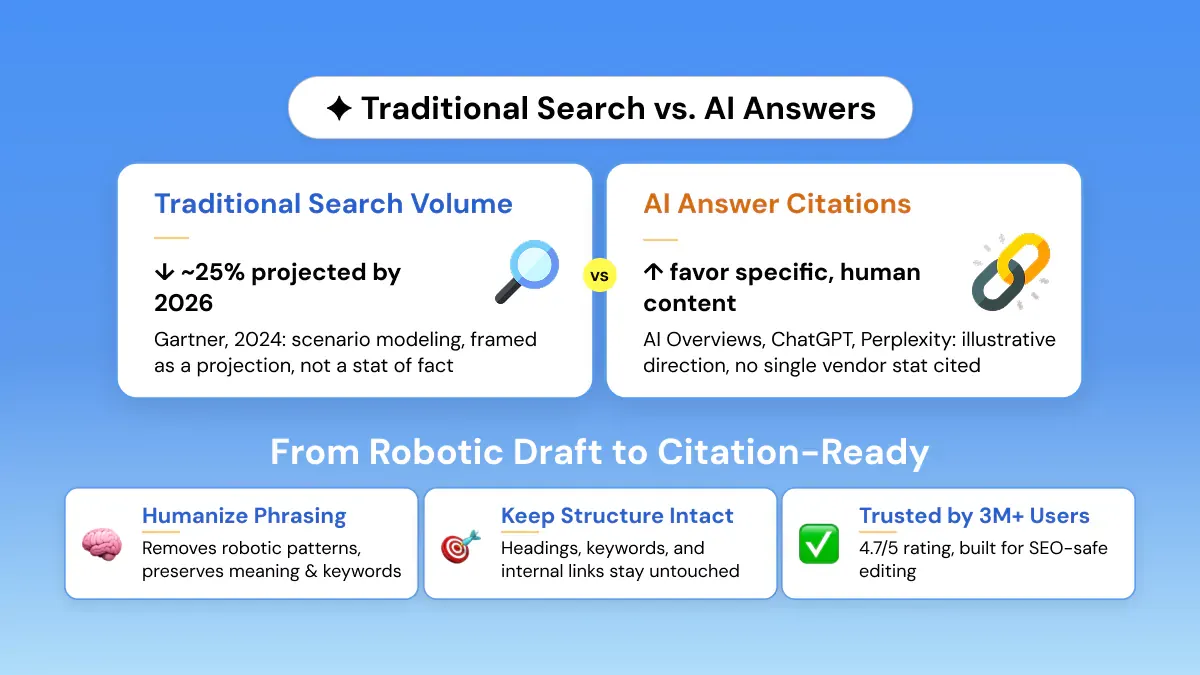
Human, specific content isn't just better for classic rankings. It's more likely to be cited in AI Overviews, ChatGPT, and Perplexity.
As search increasingly incorporates AI-generated answers, ranking well is going to evolve into having your content be citation-worthy.
That's still a prediction, not a guarantee, but you can already see that coming by how frequently you hear GEO (generative engine optimization) being mentioned with traditional SEO strategy.
AI bots typically scrape specific, sourced, well-written content into their answers, which is content that a human editor will generate.
How do you make AI blog content sound human, end to end?
Treat it as one workflow, not a last-minute polish pass:
- Edit for structure-safe voice. Protect the keywords and headings while you rewrite for tone.
- Humanize the phrasing. Remove robotic patterns and add first-hand experience, examples, and POV.
- Verify readability and re-check the focus keyword. Internal links and intent are all still intact before publishing.
FAQs
Will humanizing AI content hurt my SEO?
No! Editing isn't bad if you maintain the on-page structure when doing so. Retain the focus keyword, headings, and internal links, and use the pass to add voice/details. Google penalizes scraped low-value content, not rewritten content that flows better.
Does Google penalize AI content?
Not just because it’s AI-written. Google rewards helpful, human-centric content "regardless of how it's created" per their guidance and only penalizes when AI is used at scale to stuff rankings with low-value pages that don’t serve users.
Can I humanize content without losing keywords?
Yes! Treat the focus keyword, headings, and internal links as a do-not-touch list. And rewrite everything else, such as sentence rhythm, phrasing, and examples inside that frame.
A tool like the Phrasly AI Humanizer is built to preserve meaning and structure while it edits.
Does human-sounding content rank better?
Indirectly, yes! Content that reads like a human wrote it tends to include firsthand experience, examples, and specificity. Things that Google's E-E-A-T guidelines value. So, the traits that make content sound human are the traits that will help it rank.
How do I add E-E-A-T to AI content?
Include an anecdote/example of your own experience or an original statistic, reference a specific source instead of stock attribution, and add a byline (visible author) with an actual opinion.
This approach boosts E-E-A-T and also makes a generic draft feel more original.
Does a humanizer change my meaning or keywords?
It shouldn't. A well-built humanizer edits robotic phrasing while preserving meaning, keyword placement, and structure. For a deeper look at the workflow around it, see The Content Strategist's Workflow for AI-Assisted Production.


Keep reading

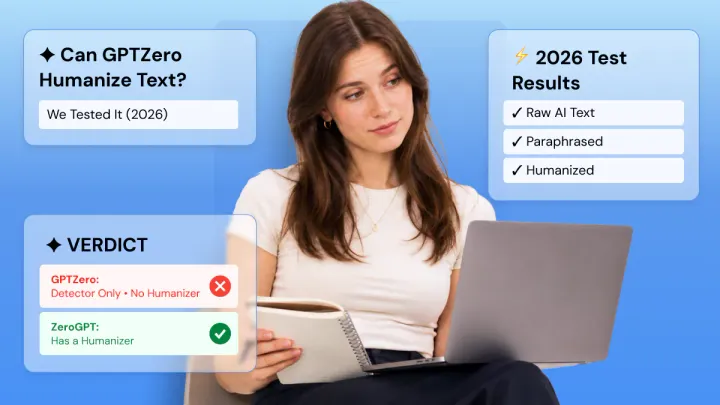
Can GPTZero Humanize Text (+ Can It Detect Humanized Text)
GPTZero doesn't have a humanizer and never has. We tested 5 AI samples raw, paraphrased, and humanized to see what actually beats its detector. Paraphrasing failed almost every time. Properly humanized text scored 98–100% human across the board. Here's exactly what worked.

How to Humanize AI-Generated Client Reports (Before They Read as Robotic)
AI reports default to describing the numbers. They default to describing 'traffic increased 12% month over month' without explaining why it happened or what to do about it. That's dumping data and calling it deliverable; spoken in a professional voice.