
How to Run an AI Check on Client Copy Before It Ships?
Run an AI detector once, on your final draft not mid-process. Treat flagged passages as editing cues, not a verdict, since studies show detectors misfire often. Fix generic or hedged lines, leave strong writing alone, and keep dated drafts as your real proof of authorship.
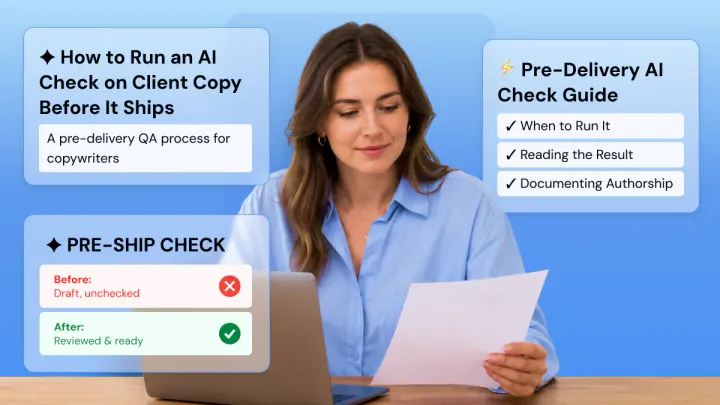
If you've searched how to check copy for AI before sending to a client, here's the short version. Run it as the last step before delivery, not the first.
Finish the draft, run it through a detector. Read the flagged passages as an editing prompt. Tighten the generic lines, and save the result alongside your drafts.
The purpose of the check isn't to prove you're not guilty. It's to find the blatant, templated content your client will find anyway, and to have a written review workflow in place if AI use is ever brought up.
This guide walks through when to run an AI check on content. How to read the output, what to fix, what to leave alone, and how to document authorship so a false flag never turns into an awkward client call.
When to Run the Check (and When Not to)
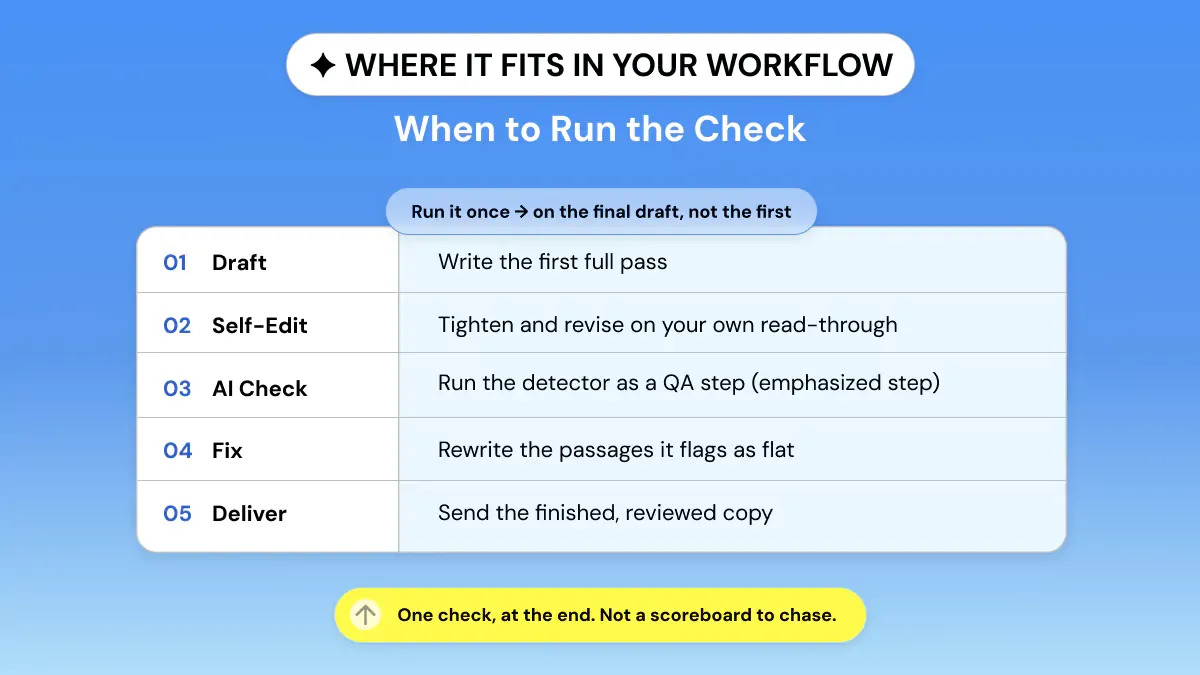
Run it once, on the final draft, as a pre delivery content check. The same slot in your workflow as a proofread.
Checking mid-draft is time-consuming, and checking compulsively entices you to edit for a quota rather than for your reader. Developing a good pre-delivery QA routine at this stage is what truly protects client trust, not just the number you get.
- Place it in the workflow: draft → self-edit → AI check before publishing → fix → deliver ✅
- Run the check once on the finished draft, never mid-draft ✅
- Don't re-run it repeatedly or start "score-chasing" a number down ❌
- There's no industry-standard "safe" score, so don't invent or promise a threshold ❌
How to Read the Result?
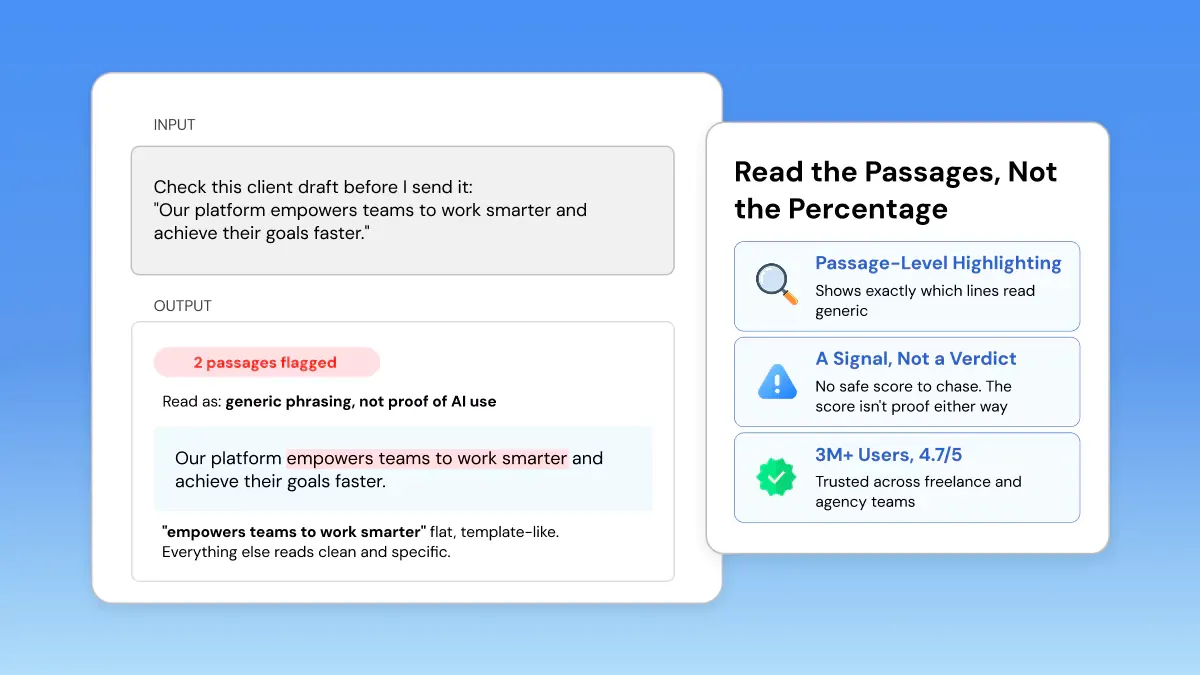
Focus on what passages get flagged, not the title percentage. When you check content for AI detection, flagged sections generally correspond to your most templated sentences.
That's valuable info. The total percentage means significantly less than most authors believe.
This isn't a fringe opinion.
Read the flagged passages as an editing prompt, not as a pass/fail test.
This is also where how to use AI detector tools well actually matters.
What to Fix and What to Leave Alone
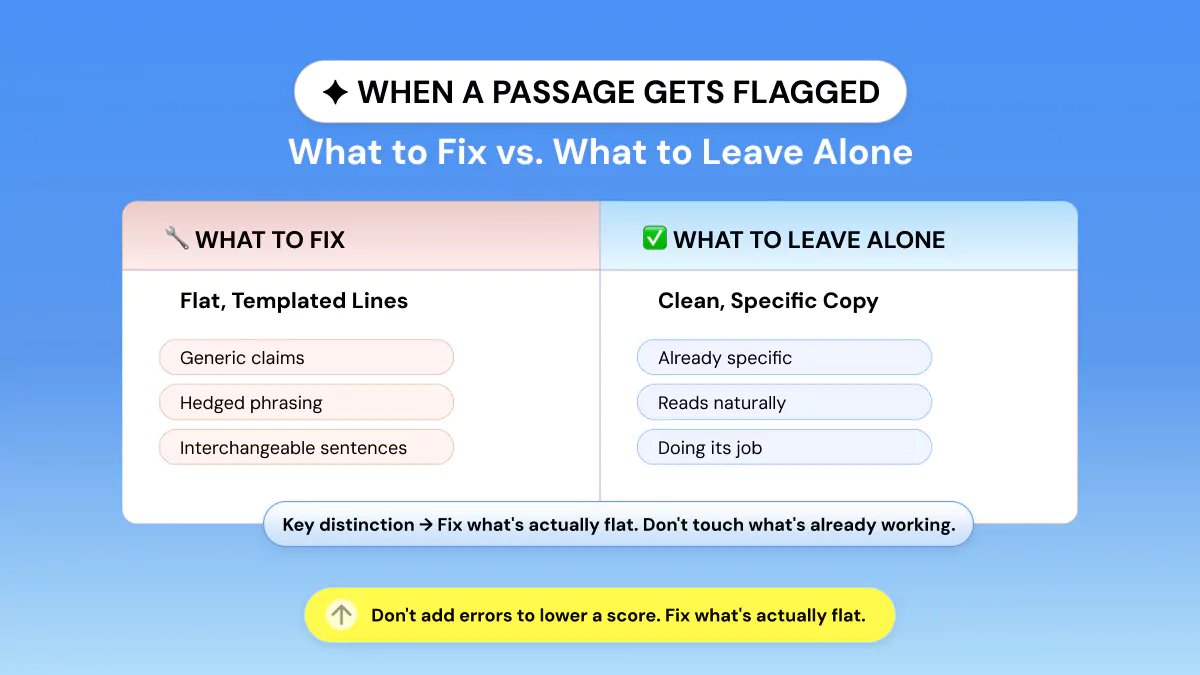
Rewrite truly flat copy: clichéd assertions, hedged language, and fungible sentences. Leave untouched, clean, precise copy that serves its purpose. Don't diminish strong writing to lower a score.
A real client copy quality check protects the writing first and the score second.
What to Fix
These are the flags worth acting on, and the fastest way to clear each one:
What to Leave Alone
- Never add errors, awkward phrasing, or unnecessary complexity just to lower a score 🚫.
- A detector flag is not permission to make the writing worse.
- If a sentence is specific, accurate, and reads naturally, it stays: full stop 👊.
Document Authorship (Your Real Protection)
Your best protection isn't a low score. It's evidence.
Save drafts/version history/research notes. Be open with clients about your process and if/how you used any AI. Drafts, version notes, documentation, etc., are what will stand up for you if authorship is challenged, not some arbitrary detector score.
Trust and transparency go hand in hand with what your clients and readers already assume.
If brought up directly by the client, no problem. Simple script works here: You run all final drafts through a review step, flags are editing prompts (not proof of anything), and you're happy to provide drafts + notes upon request.
Don't forward raw detector scores as "proof" of authorship. False positives go both ways, and a number by itself will often raise more questions than it answers.
Getting client sign-off is easier when the process itself is visible. A quick pre-delivery check, a documented edit pass, and drafts you can produce if asked. That combination, not a headline percentage, is what actually proves the work is yours.
Run the Check Before Your Next Delivery
Build this into your review workflow. And it stops being a source of anxiety and becomes routine QA. Try the Phrasly AI Detector on your next final draft and read the flagged passages as your editing checklist. ✅
FAQs
When should I run an AI check on my copy?
Do it once, at the end, when you've self-edited but before you submit/share it. Think of it like the final QA pass, not another draft step like editing the draft itself.
Run your final draft through the Phrasly AI Detector to catch anything worth a second look before delivery.
What AI score is safe to deliver?
There is no widely agreed-upon safe score. In fact, no research supports any particular score. Use any flag as an indicator to go back and read through particular passages, not as a benchmark you need to hit.
What should I do if my copy is flagged?
Flag lines for what needs tightening/editing. Read lines that are flagged, not the percentage of the document. Tighten lines that are truly generic/hedged. Leave specific, clean writing alone.
Should I show clients my AI detector score?
Generally, no! Raw numbers don’t mean anything to your audience. They’re confusing, not reassuring. You’re almost always better off describing your review process and offering drafts/revisions/comments if someone asks who did what.
How do I prove I wrote the copy myself?
Maintain dated drafts, version records, and research notes during the writing process. These documents are more solid proof of authorship than any single detector can provide.
See The Self-Editing Workflow for a full pre-delivery routine.
Does checking my copy mean I did something wrong?
No! It means you have a consistent review workflow. The same way a proofread doesn't imply bad writing.


Keep reading

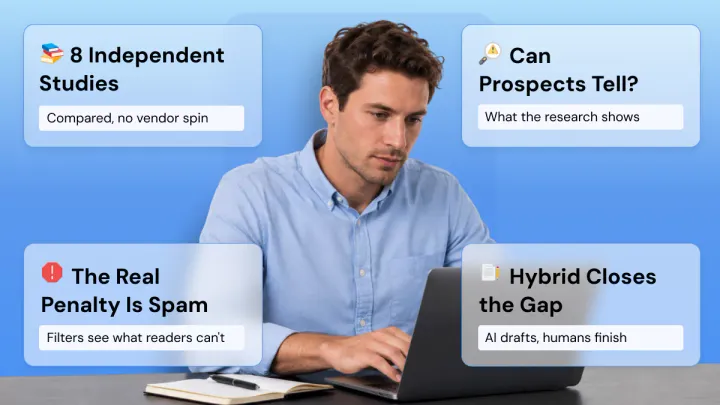
AI vs Human Cold Email Reply Rates: What 150M+ Emails Across 8 Studies Actually Show (2026)
AI cold emails get 1% fewer replies but 3x more spam flags. We compared 8 studies covering 150M+ emails, including peer-reviewed research, to show what actually works in 2026 and the fix that closes the gap.
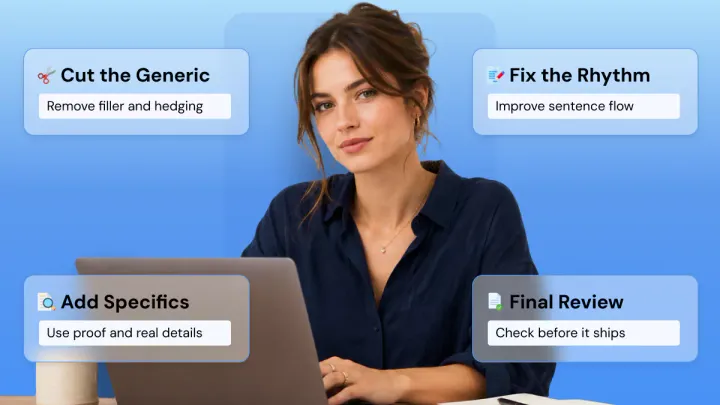
The Self-Editing Workflow That Makes Writing Read Human
A 5-pass self-editing checklist for copywriters: fix structure, cut generic filler, add proof and voice, improve rhythm, and verify facts before your copy ships.