OSU Plagiarism Checker: What Ohio State Uses and How to Check Your Paper
9 min read
Ohio State uses Turnitin Feedback Studio as its main plagiarism checker for coursework. It's built into CarmenCanvas, and an instructor normally switches it on for a specific assignment; there's no scan button waiting in your student portal.
Students who want to review their writing first can use an independent checker, but its matches and percentage won't exactly match an official Turnitin report.
We checked Ohio State's IT and teaching pages, Turnitin's student guidance, and the university's latest misconduct report. Here's what OSU runs, what your score means, and how to review a draft before it goes through CarmenCanvas.
Want to review your draft before you submit? Run it through Phrasly's plagiarism checker below 👇
What is the OSU plagiarism checker?
Ohio State uses Turnitin Feedback Studio, integrated with CarmenCanvas. There's no separate tool officially named the OSU plagiarism checker.
The phrase is a search habit rather than a product name. Students type it, Google matches it to Ohio State’s Turnitin pages, and Turnitin is the tool sitting behind all of it.
Turnitin produces a Similarity Report, which highlights passages in your paper that match content in its databases. Ohio State’s Teaching and Learning Resource Center tells instructors plainly that no Similarity Report outcome unequivocally indicates plagiarism. The software identifies matching text and stops there. A person decides what the match means.
Ohio State renewed Turnitin after a Spring 2024 review. Per the Office of Technology and Digital Innovation, a faculty and staff committee compared two tools that met the minimum requirements out of five original RFP respondents, and Turnitin scored highest across the criteria rated.
How does Turnitin work at Ohio State?
Your instructor switches it on inside a CarmenCanvas assignment, and the check runs when you submit. The full sequence looks like this:
The instructor creates an online assignment in CarmenCanvas.
They pick Turnitin from the Plagiarism Review menu in the assignment settings.
You upload your file to that assignment.
Turnitin compares your text against its databases.
A Similarity Report is generated.
Your instructor reviews the matched passages.
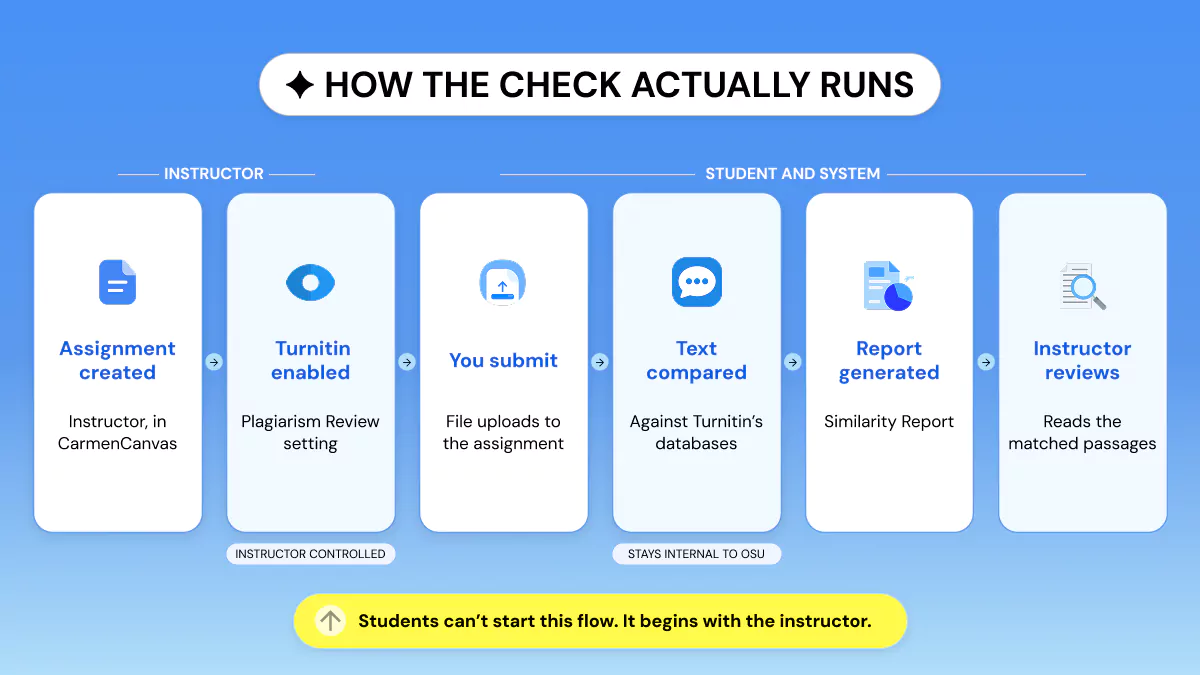
One detail worth knowing before you upload anything: submissions from Ohio State students stay internal to the university. OTDI's 2024 announcement states that other universities can't access them for comparison, and that the vendor can't use them to train its AI models.
Can OSU students use Turnitin before submitting?
Usually not on demand. Turnitin is normally available only through an assignment an instructor sets up in CarmenCanvas.
Turnitin's own help center is direct about this. A student can't self-check a paper without uploading it to an official instructor-created assignment, unless the institution has enabled Turnitin Draft Coach. Where Draft Coach isn't available, your ability to check beforehand depends entirely on your instructor's assignment settings.
Ohio State adds one more wrinkle. Its software directory lists Turnitin as licensed explicitly for classroom or teaching use, and points faculty and graduate students who want to check their own work toward iThenticate instead.
So whether you can pre-check comes down to your course, not your student account. If your instructor allows resubmissions, you can submit early, read the report, fix what's flagged, and submit again. Our walkthrough of how to check plagiarism in Turnitin covers the report screen itself.
Can you see your OSU Turnitin similarity report?
Sometimes. Your instructor controls whether the Similarity Report is visible to you.
Some instructors release reports so students can learn from the matches. Others keep them for grading only. Check the assignment page or your syllabus before you assume a report or a resubmission will be waiting. Ask your instructor if neither one says.
What does an OSU similarity score mean?
The percentage shows how much of your text matches sources in Turnitin’s databases. It says nothing about how much of your paper was plagiarized.
Plenty of ordinary academic writing produces matches:
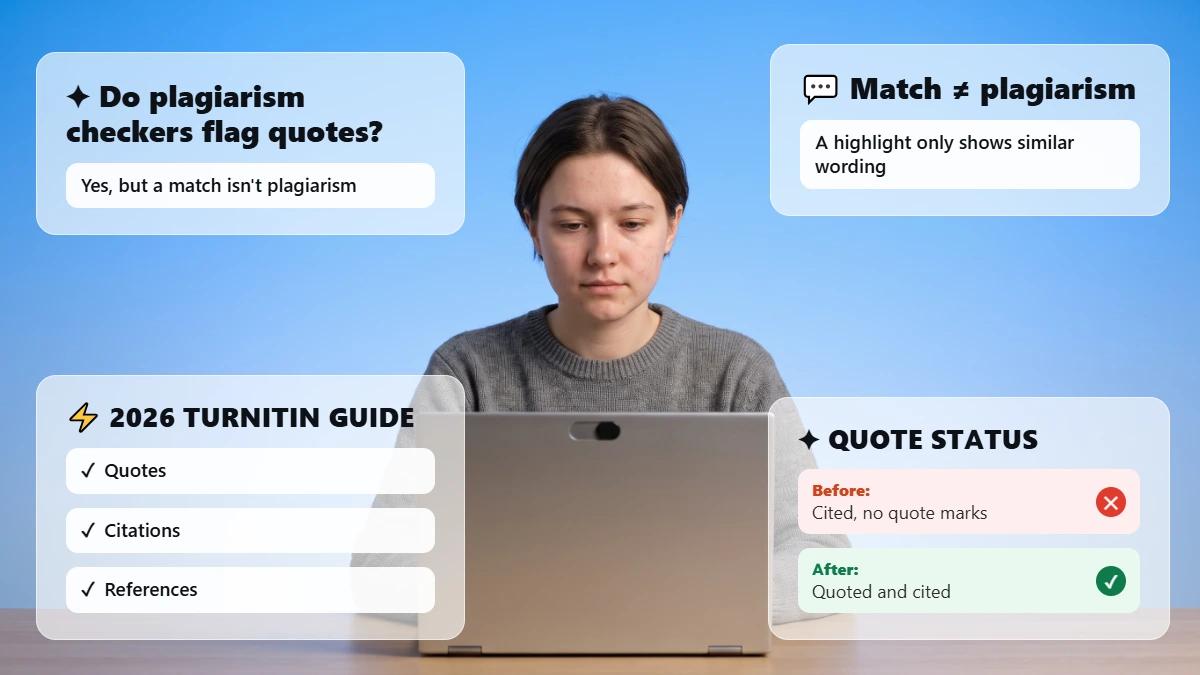
Quoted text matches, even when it's quoted and cited correctly.
Bibliographies and reference lists match.
Common phrases and standard terminology in your field match.
Work you submitted for another course can match.
A high score is not automatically plagiarism, and a low score doesn't prove your citations are right either. The source and context of each match carry more weight than the number.
💡 A Turnitin percentage measures matching text. A person decides whether that match is plagiarism.
Is there an acceptable Turnitin score at OSU?
Ohio State doesn't publish one acceptable percentage. Expectations vary by course and assignment, and each match should be reviewed rather than judged by the number alone.
The university's own instructor guidance points the same way. Its Turnitin best practices page tells instructors that the percentage can be influenced by how they set the assignment up, and that instructors in different disciplines should expect to set different baselines for what a score means.
If a syllabus in one of your courses names a threshold, treat it as that course's rule. It isn't a university-wide standard, and applying it to a different class will mislead you.
Why two plagiarism checks can show different percentages
The score depends on which databases and filters a given assignment uses. Change the settings and the number changes with them.
A Turnitin assignment can include or exclude student papers, the institution's private repository, web pages, journals, bibliographies, quotations, and small matches. Each of those switches moves the percentage, sometimes by a lot.
Because of this, no outside checker can promise you the number CarmenCanvas will show. An independent scan tells you where your text overlaps with published sources. It can't reproduce your instructor's report settings.
How to check your paper before submitting at OSU
Work through your citations first, scan second, and fix what the scan surfaces. That order matters, because a checker only flags overlap. Deciding what to do about each flag is still your job.
Review every quotation against the original source.
Confirm each paraphrase is genuinely rewritten and cited.
Scan the draft with a plagiarism checker.
Open each flagged match instead of reading only the percentage.
Fix missing quotation marks, missing citations, and wording that sits too close to the source.
Reread the assignment's academic integrity and AI-use rules.
Submit through CarmenCanvas.
If you want to compare independent tools before picking one, our roundup of Turnitin alternatives covers what each one scans and what it costs.
Step six is the one students skip, and OSU's own numbers show why it shouldn't be: unauthorized AI use is now its own misconduct category, nearly as common as plagiarism in charged cases. Rules that were vague two years ago are specific now, so read yours instead of assuming.
Where Phrasly fits
When you don't have access to a Turnitin self-check, an independent checker gives you a second read on your own draft before anyone else sees it. Phrasly's plagiarism checker scans your text against billions of web pages and academic sources, then shows each matched passage with its source link and a similarity percentage.
One honest limit: your results won't match Ohio State's Turnitin report. The databases, repositories, exclusions, and assignment settings are all different, so the percentages will be too.
Check your draft for matching text before submitting it through CarmenCanvas.
Turnitin AI detection vs. plagiarism similarity at OSU
They're two separate reports. Turnitin's AI writing percentage is different from and independent of the similarity score, and per Turnitin's guides, AI writing highlights aren't visible in the Similarity Report at all.
That separation matters at Ohio State, because the Code of Student Conduct treats unauthorized use of generative AI as its own violation. A paper can come back with a low similarity score and still break an AI-use rule.
How much AI is reaching submitted work is no longer guesswork. Turnitin's detection data, published in February 2026, shows about 15% of English-language essay submissions since October 2025 carried more than 80% AI-generated writing, up from roughly 3% when the detector launched in 2023.
Ohio State's enforcement numbers moved with it. According to the COAM report for 2024 to 2025, unauthorized use of generative AI led to 273 in-violation findings, on charges that appeared in 26% of charged cases. That sits just behind plagiarism as a category.
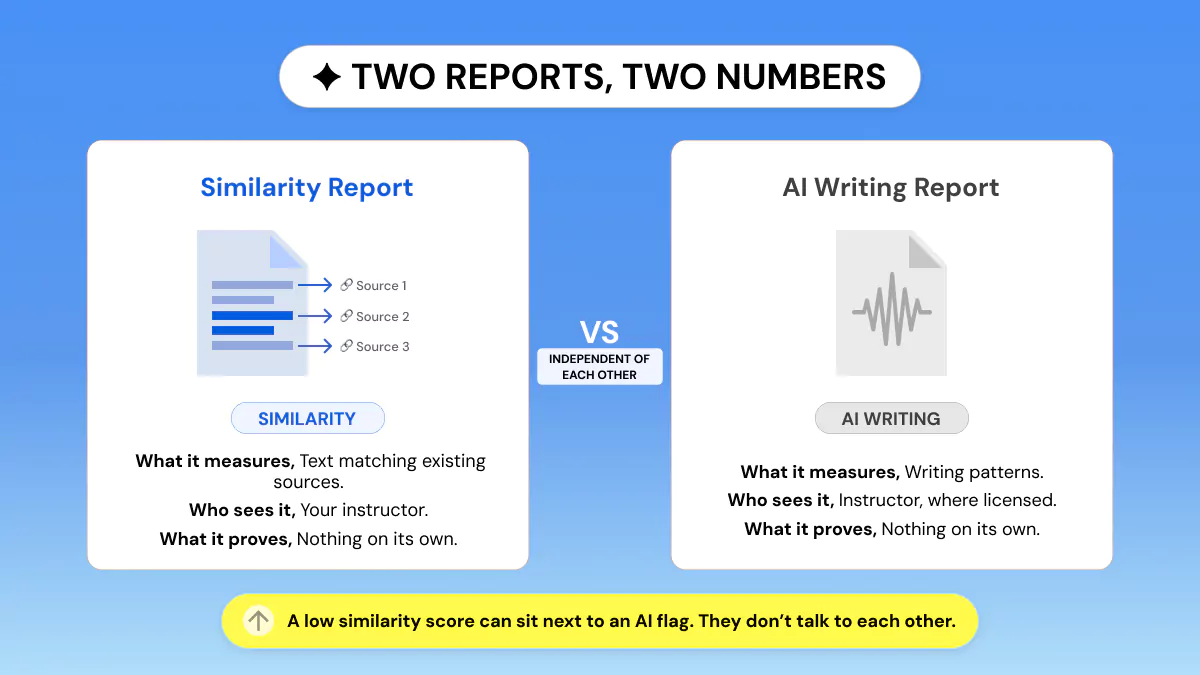
Whether OSU runs AI detection on any given paper depends on institution and course settings, so your assignment's stated rules are the thing to follow. Detectors also get it wrong. Turnitin acknowledges that false positives are possible, and our guide to being flagged for AI you didn't write covers how students document their own process. For how the detection itself works, see whether Turnitin can detect ChatGPT.
What happens if Turnitin flags your paper at Ohio State?
A match doesn't mean you've been found responsible for anything. It means an instructor has something to look at.
Ohio State instructors are required by university rule to report suspected academic misconduct, and the Committee on Academic Misconduct, known on campus as COAM, investigates and decides. You're presumed not in violation until the case is resolved, and the standard COAM applies is a preponderance of the evidence, meaning the more convincing side of the evidence rather than proof beyond doubt.
You have rights through the whole process. You're notified of the allegation and the charges, you can review and obtain a copy of the material behind them, you can bring an advisor or support person to a hearing, and you can appeal the decision. Since October 2025, that first notification also includes a summary of the reporter's allegation narrative.
The stakes are real, though. COAM's 2024 to 2025 report records 339 in-violation findings on plagiarism charges, which appeared in roughly 31% of charged cases. And in about 72% of in-violation cases across all misconduct types, the same report shows the sanction was a zero on all or part of the assignment plus a further reduction of the final course grade.
One reassurance on your record: a formal reprimand or disciplinary probation isn't noted on your transcript. Only a suspension or dismissal adds a notation.
Turnitin vs. iThenticate at Ohio State
Ohio State licenses both, for different kinds of writing. Turnitin handles classroom assignments through CarmenCanvas, and iThenticate handles scholarly research documents.
Turnitin | iThenticate | |
|---|---|---|
Built for | Course and classroom assignments | Scholarly research documents |
How you access it | Instructor enables it in CarmenCanvas | Self-created account, OSU credentials |
Databases | Coursework collection | A different research collection |
Who reads the report | Your instructor | You, the author |
Decides plagiarism? | No, it matches text only | No, it matches text only |
Ohio State's research office notes that iThenticate screens uploads against different databases than Turnitin, and that any Ohio State faculty, staff, student, or associate can create an account with university credentials. Even so, it's built for research writing. Its result won't necessarily line up with what a CarmenCanvas Turnitin check returns on the same paper.
Before you submit through CarmenCanvas, run your draft through Phrasly's plagiarism checker to catch missing citations and matching passages while you can still fix them.
OSU Plagiarism Checker FAQs
What plagiarism checker does Ohio State use?
Turnitin Feedback Studio, integrated with CarmenCanvas, for course assignments. It creates a Similarity Report that highlights matching text, and it doesn’t decide on its own that plagiarism occurred. OSU also licenses iThenticate, mainly for scholarly research documents. Our guide to best Turnitin alternatives compares the independent options.
Can OSU students use Turnitin before submitting?
Usually not on demand. Turnitin is normally available only through an assignment an instructor sets up in CarmenCanvas. Whether you can see a report or resubmit depends on your instructor's settings, so check the assignment page or ask them first.
Can I see my OSU Turnitin similarity report?
Sometimes. Access is controlled by your instructor. Some release the Similarity Report to students, others use it only while grading. Check the assignment page or syllabus, or ask your instructor, before assuming a report will be available.
What is an acceptable Turnitin score at OSU?
No single percentage applies. Ohio State doesn't publish one acceptable figure for every course, and expectations vary by assignment and instructor. Review each match for correct quotation, citation, and attribution rather than treating the percentage as a pass-or-fail number.
Does OSU run Turnitin AI detection on every paper?
Not necessarily. Turnitin's AI writing report is separate from the similarity score, and its use depends on institution and course settings. Ohio State's Code separately prohibits unauthorized AI use, so follow each assignment's stated AI rules.
Review your quotes, sources, and paraphrasing, then scan your draft with an independent plagiarism checker and fix any missing citations or too-close wording. Our guide to checking plagiarism in Turnitin explains the report. Results won't exactly match OSU's.

Written by
Alina Shah
SEO Content Specialist · Karachi, Pakistan
She writes about AI so you don't have to guess. 8+ years in content strategy and editing. Now she puts AI writing tools and detection systems through real tests and shares what actually works.