How to Write a Conclusion for a Research Paper (Examples)?
12 min read
A research paper conclusion must restate the thesis. Summarize the key findings, explain why the research matters, and note limitations or directions for future research. All in a short closing section.
That is the direct answer to how to write a research paper conclusion. And everything below expands on it with real examples.
If you're unsure where the discussion ends and the conclusion begins, you're not alone. That line trips up most students.
This guide gives you a step-by-step build. A research paper conclusion structure table, a weak versus strong rewrite, examples from four subjects, and a plain-text checklist to copy before you submit.
Draft a First-Pass Conclusion with Phrasly's AI Conclusion Generator
Draft a first-pass conclusion in seconds with the AI Conclusion Generator. Then refine it using the structure below.
What to Include in a Research Paper Conclusion?
A conclusion closes the paper by restating the thesis. Summarizing the findings, explaining their significance, and addressing limitations or future work. So, what should you include in your research paper conclusion? These four parts:
Thesis or research problem restatement: Rephrase your claim or your research questions. Never copy the introduction word for word.
Summary of key findings: Condense the main results or arguments. No new evidence.
Significance of findings: Explain why the results matter to the field or to real-world practice.
Study limitations and future research: Name what the study could not address and what should come next.
Just as important is what doesn't belong: New data, new citations, or a long re-argument of points the body already made.
The Purdue OWL puts it simply. Once you've restated your position and pointed to future research, you're done. Don't bring in new points.
Common guidance puts a conclusion at roughly 5 to 10 percent of the paper's length. Covered in detail below. Next, let's turn these four parts into a step-by-step writing process.
How to Write a Research Paper Conclusion Step by Step?
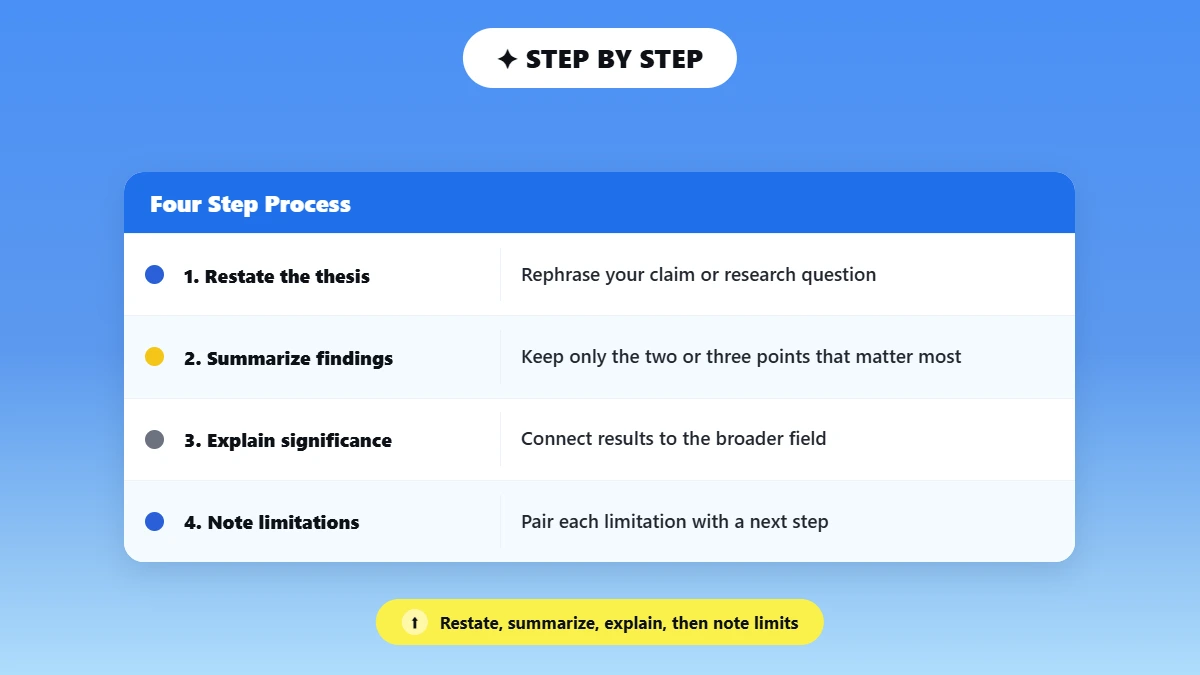
Write it in this order. Restate, summarize, and explain significance. Then note limitations and future research.
That answers "How do I write a strong conclusion for my research paper?" for most assignments. If you've ever wondered how to write a conclusion for an essay, the same order works, with a lighter limitations step.
The steps differ slightly for an argumentative paper. An argumentative paper defends a position, and an empirical paper tests a question with data.
Restate the Thesis or Research Problem
Thesis restatement means rephrasing your claim in light of what you actually showed. Not copying it.
In an argumentative paper, reconnect to the position from your introduction. In an empirical paper, restate the research question or hypothesis you tested.
Example: "This study set out to test whether daily retrieval practice improves long-term recall in first-year students."
If you're still shaping the claim itself, Phrasly's Thesis Generator can help you draft one.
Summarize Your Key Findings or Arguments
A good key findings summary keeps only the two or three points that matter most. For empirical papers, state results in plain language without repeating statistics from your results section.
For argumentative papers, recap your strongest supporting points in the order they built your case.
Example: "Students who practiced retrieval daily recalled more material after four weeks than those who reread their notes."
Use AI prompts for drafting academic sections if you want a first-pass summary to edit from.
Explain Why the Findings Matter
Connect your results to the broader field. A practical use, or a gap your literature review identified. This is where your research implications go. And it's the part weak conclusions skip.
Tie significance to what the paper actually demonstrated. Never more.
A reliable pattern: "These findings suggest that [X], which has implications for [Y]."
Note Limitations and Future Research
Pair each limitation with a specific next step instead of a vague "more research is needed." Common limitations include sample size, method, scope, and data access.
Example: "Because the sample came from one university, future studies should test the effect across institutions."
Keep this to two or three sentences. And make your future research directions concrete.
Adapting the Steps for Literature Reviews, Qualitative Studies and Theses
The four steps still apply. But the "findings" change shape. In a literature review, your findings are the patterns and gaps you identified across sources. So restate the review question.
Summarize the main trends, and close on the most important open question.
In a qualitative study, summarize your key themes rather than numbers. And explain what they reveal about participants' experience.
In a thesis or dissertation, the conclusion is often a full chapter. So each of the four parts gets its own paragraph or subsection, and contributions to the field are stated explicitly.
Research Paper Conclusion Structure at a Glance
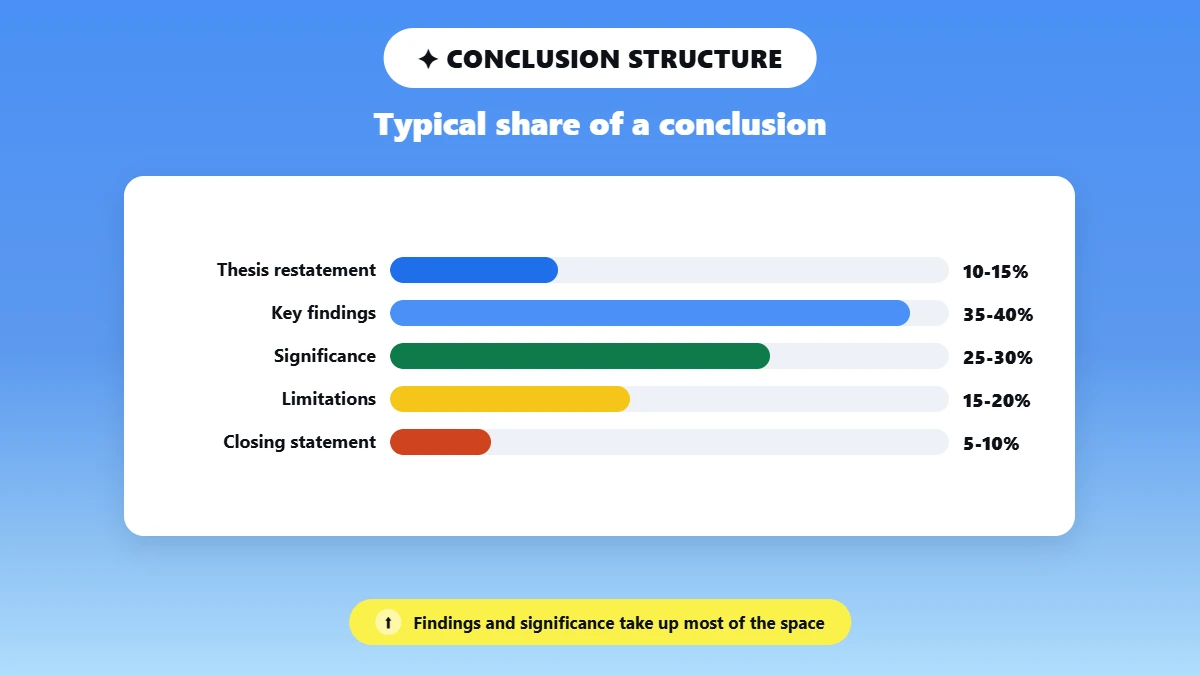
Use this table as a quick-reference version of the steps above. It's also a practical answer to how to write a conclusion for a scientific paper. The proportions reflect STEM writing conventions. These findings carry the most weight.
Treat the shares as guidelines. Not rules. Under humanities writing conventions, the argument recap and significance often take up more space. And the limitations line may shrink to a sentence.
Still working on earlier sections? See this guide on writing a full research paper step by step before you reach the conclusion stage.
Structural element | Purpose | Typical share of conclusion |
Thesis/problem restatement | Reminds the reader of the core argument or question | 10 to 15 percent |
Key findings summary | Condenses the main results or arguments | 35 to 40 percent |
Significance explanation | Shows why the work matters | 25 to 30 percent |
Limitations and future research | Acknowledges scope and next steps | 15 to 20 percent |
Closing statement | Leaves the reader with a final takeaway | 5 to 10 percent |
Proportions are editorial guidance. Not a published standard. Adjust them to your field and assignment.
For overall length, common guidance suggests about 5 to 10 percent of your paper. And the length section below compares that with real published papers.
Conclusion Vs Discussion Section: What Is the Difference?
The discussion interprets your results in detail. The conclusion closes the paper with a short synthesis.
So how is a conclusion different from a discussion section? The discussion does the analysis. And the conclusion states what that analysis adds up to.
When Your Paper Has a Separate Discussion Section
Most empirical and scientific papers include a discussion that compares results with prior studies. And explores implications at length. That's the part you'd write if you're learning how to write a discussion section.
And it's where peer review focuses most of its scrutiny.
The conclusion that follows should be short. A biology paper's discussion often runs several pages. In contrast, its conclusion is one paragraph.
It also isn't a copy of your abstract's final line. The abstract summarizes the whole study. While the conclusion lands its takeaway.
When It Does Not
Shorter papers, essays, and many humanities or business papers fold interpretation into the conclusion. In those cases, the conclusion carries more weight. And should include both the summary and the full significance explanation.
USC Libraries' writing guide advises indicating opportunities for future research in the conclusion. If you haven't already covered them in your discussion. Check your assignment guidelines or target journal before assuming which format applies.
Feature | Discussion section | Conclusion |
Main purpose | Interprets and contextualizes results | Summarizes and closes the paper |
Length | Often several paragraphs to pages | Short, often 5 to 10 percent of the paper or less |
Introduces new analysis | ✅ Yes, detailed interpretation | ❌ No, synthesis only |
Found in | Most empirical and scientific papers | Nearly all research papers and essays |
Common in | STEM and social science journals | Essays, theses, humanities and business papers |
Research Paper Conclusion Examples by Subject
Here are four conclusion paragraph examples for research paper writing. One per field, with each sentence labeled by its job. So, can you see an example of a research paper conclusion? Each one below maps directly onto the four parts.
These examples are illustrative. Written for this guide, and not drawn from real published papers.
STEM or Scientific Paper Example
"This study tested whether a low-cost sensor array could detect early leaf disease in tomato crops. [Restatement] The array identified infected plants an average of four days before visible symptoms appeared. [Findings] Earlier detection could let small farms target treatment and reduce pesticide use. [Significance] Because testing covered one greenhouse and one season, field trials across climates are the next step. [Limitations and future research]."
Social Science Example
"This study asked how school-based mentoring affects attendance among first-year high school students. [Restatement] Mentored students missed fewer school days than peers without mentors, and the gap widened over the year. [Findings] Districts weighing where to invest support staff can treat mentoring as an attendance strategy, not only an academic one. [Significance] The study relied on self-selected participants, so a randomized design would strengthen the result. [Limitations and future research]."
Humanities Example
"This paper argued that the narrator's silences in the novel function as resistance rather than passivity. [Restatement] Three scenes, the courtroom, the letter, and the final walk, show that withheld speech gives the narrator control others lack. [Findings: strongest arguments] Reading silence this way reframes the novel as a study of quiet power. [Significance] Future work could test this reading against the author's other novels. [Future research]"
Note how the "findings" in a humanities paper become a recap of the strongest arguments. Not data.
Business or Economics Example
"This case study examined why a regional grocery chain's loyalty app failed to raise repeat purchases. [Restatement] Customers used the app for discounts but ignored its personalized offers, which rarely matched their shopping lists. [Findings] Retailers should test offer relevance before scaling a loyalty program. [Significance and recommendation] Comparing chains in other regions would show whether this pattern holds. [Future research]"
Treat each sample as a model to adapt. Not a template to copy. If you're searching for a research paper conclusion sample PDF, these four plain-text examples work the same way. And paste straight into your notes.
Weak vs Strong Conclusion: A Side-by-Side Rewrite
Knowing how to end a research paper well comes down to three moves. Rephrase instead of repeating. Use specific findings. And close on a forward-looking implication.
Here's the same psychology conclusion on remote work and productivity. Written badly and then fixed.
Weak Example
"In conclusion, this study showed that remote work has an important impact on employee productivity. Many factors were examined. The results were interesting and showed different outcomes. Remote work is a complex topic. More research is needed."
The italic phrase is copied word for word from the introduction. This is what makes a conclusion feel repetitive. The rest is vague, passive, and ends flat.
Strong Rewrite
"Remote work did not reduce output among the 240 employees surveyed; it shifted when work got done. Employees with flexible schedules completed the same weekly tasks but concentrated focused work in the morning. For managers, this suggests judging output by weekly results rather than online hours. The next step is testing whether the pattern holds in roles with fixed customer-facing shifts."
The figure of 240 employees belongs to this illustrative example. Not a real study.
Why the Strong Version Works?
Specific result instead of a vague recap: "the same weekly tasks" replaces "different outcomes."
No word-for-word thesis repeat: The claim is restated through what the study found. This avoids lazy introduction mirroring.
An implication and a next step: Managers get a takeaway. And researchers get a concrete question.
Active, varied sentences: Each sentence opens differently. End on a confident closing statement.
Varying vocabulary and structure is what removes the repetitive feeling. Not just shortening the paragraph. That's the restate, synthesize, imply, build from earlier, applied line by line.
Before you finalize, refine an AI-generated draft in your own voice so the conclusion sounds like the rest of your paper.
Common Mistakes to Avoid, Plus a Copy-Paste Checklist
The biggest mistakes are adding new evidence. Copying the introduction, ending abruptly, and hedging. That answers "What mistakes should I avoid when writing my conclusion?" before you hit submit.
Mistakes That Weaken a Conclusion
New evidence or arguments: Readers expect synthesis. So anything new belongs in the body.
A copied introduction: Show how your thinking developed instead of repeating your opening.
An abrupt ending: A final data point or citation with no closing sentence leaves readers hanging.
Hedging language: Phrases like "it seems" or "may suggest" undercut confident findings. And break your academic tone.
AI-assisted drafts often introduce these exact problems. Especially vague recaps and repetition.
Learn how to keep AI-assisted drafts sounding natural.
And cite any source you paraphrase. Since plagiarism avoidance applies to conclusions too.
Copy-Paste Checklist
Select and paste this into your document before you submit:
☐ Restates the thesis without repeating it word for word
☐ Summarizes key findings with specifics, not vague recaps
☐ Explains the significance or implication of the findings
☐ Suggests a direction for future research or practice
☐ Contains no new evidence or citations
☐ Ends on a confident, forward-looking sentence
How Long Should a Research Paper Conclusion Be?
Aim for about 5 to 10 percent of your paper. And expect published papers to run shorter. So, how long should your research paper conclusion actually be? For a 2,000-word student paper, roughly 100 to 200 words is a sensible target.
Editage cites a 10 percent guideline for conclusions. Real published papers run leaner.
In an analysis of research articles, a typical conclusion was about 130 words. And only 48.4 percent of papers had a separate conclusion section at all.
📏 Quick Length Benchmarks
From the same analysis: Papers of 1,000 to 2,000 words had a median 81-word conclusion. And papers of 5,000 to 6,000 words had a median of 171 words.
A quick estimate: Divide your body word count by 30 for a published-journal length. Or use 5 to 10 percent for coursework.
⚖️ Too Short Vs Too Long
Very short conclusions usually skip synthesis. Very long ones tend to sneak in new material. The first mistake above.
If yours runs short, here's how to expand a short conclusion without padding.
Always follow your instructor's or journal's limit first.
Draft Your Conclusion Faster with an AI Conclusion Generator
Once you know the structure, a research paper conclusion generator can speed up the first draft.
Paste your finished paper, or your thesis and key findings, into Phrasly's AI Conclusion Generator.
Choose a Short, Medium, or Long conclusion. And add any keywords you want emphasized.
It takes up to 2,500 characters of input. And you can get started for free with a Phrasly account. Edit the output for tone and your field's conventions rather than submitting it as is. And follow your school's AI policy.
Frequently Asked Questions
Can I Present New Arguments in the Conclusion?
No! A conclusion should not introduce new arguments, data, or citations. It should synthesize findings already presented in the paper. Restate the thesis in light of the evidence, and point to implications or future research instead of making new claims the body never supported.
What Is the Purpose of a Conclusion in a Research Paper?
A conclusion closes the paper by tying findings back to the research question. Reminding readers why the work matters, and showing how the results contribute to the broader field.
It does this without repeating the full argument. So readers leave with a clear takeaway.
Should a Conclusion Restate the Thesis?
Yes, but reworded! Not copied. Restate the thesis in light of the evidence. So readers see how the paper proved or refined the original claim. Then move into implications. For help sharpening the claim itself, see writing a full research paper step by step.
How Do You Write a Conclusion for a Research Paper?
Briefly restate the problem. Rephrase the thesis. Highlight the two or three key findings, and close with implications or next steps. Keep it concise. And avoid repeating the introduction word for word. If it runs short, expand with a short conclusion without padding.
What Should Be Included in a Research Paper Conclusion?
Include a restated thesis. A short summary of the main findings. The significance or implications of the results. And, where relevant, limitations or suggestions for future research.
Leave out new evidence and new citations. Since the conclusion's job is synthesis. Not a fresh argument.

Written by
Muhammad Usman Ali
Pakistan
Muhammad Usman Ali is an experienced SEO content writer with 3+ years of professional writing experience. He specializes in AI tools, AI detection technologies, and search engine optimized content.