How to Write a College Paper: A Step-by-Step Guide With Examples
21 min read
To write a college paper, first decode the assignment and rubric, choose a focused question, research credible sources, and develop an arguable thesis. Build an outline that connects every claim to evidence and analysis. Draft the body, introduction, and conclusion; cite sources as you write, then revise for argument, structure, clarity, formatting, and originality before submitting.
A strong college paper does more than summarize a topic. It answers the assignment’s specific question, develops a clear and defensible thesis, uses credible evidence, and explains why that evidence matters.
If you already know the basic introduction, body, and conclusion structure, the next step is learning how to analyze evidence and build an argument.
This guide focuses on papers assigned in college courses, not admissions essays or personal statements. It takes you from understanding the prompt to researching, developing a thesis, organizing evidence, drafting, citing sources, and revising your final paper.
Facing a blank page? Phrasly's AI Content Generator turns your topic into a cited first draft you can build on and make your own.
If your course allows AI assistance, you can use its AI features as part of your writing process, but always verify sources and follow your instructor’s policy.
What Makes a College Paper Different From a High-School Essay?
A college paper requires more than simply describing a topic. College level writing requires a focused claim, evidence based reasoning, analysis of different perspectives, and an explanation of why the argument matters.
College Paper vs. High-School Essay
Element | Common high-school approach | College-level expectation |
|---|---|---|
Response to prompt | Discusses the general topic | Answers the exact analytical task |
Thesis | Often fixed at five paragraphs | Expands or contracts around the argument |
Sources | Added as supporting quotations | Compared, interpreted, and synthesized |
Body paragraphs | Summarize information | Make claims and analyze evidence |
Revision | Fixes grammar and spelling | Reconsiders logic, evidence and organization |
College writing focuses less on presenting facts and more on analyzing why they matter. Unlike the fixed five-paragraph structure often used in high school, college papers should be organized around the argument. Your thesis should make a specific, supportable claim, and each body paragraph should help develop that argument.
Identify the Type of Paper Before You Begin
💡 First, identify what type of paper your assignment requires. Common types include argumentative, analytical, expository or informative, source-based research, reflection or response, and empirical or lab reports.
Each has different expectations for evidence and organization, so check the assignment prompt and rubric before you begin.
Argumentative paper: Presents a position on an issue and supports it with evidence and reasoning.
Analytical paper: Examines a topic or evidence and explains how or why something works, happens, or matters.
Expository or informative paper: Explains a topic clearly using relevant information and evidence. If you need more guidance on this type of assignment, see our guide on how to write an informative essay.
Source-based research paper: Uses credible sources to investigate a focused question and support an argument.
Reflection or response paper: Responds to a reading, experience, or idea while explaining your interpretation and reasoning.
Empirical or lab report: Presents research or experimental findings using the sections and conventions required by the relevant discipline.
There is no single structure for every college paper. Let the assignment, course, and discipline determine how you organize your paper.
How to Write a College Paper in 12 Steps
Breaking the writing process into clear steps makes writing a college paper easier. You can plan your college paper using the following 12 steps and work through each one as you write.
Decode the assignment and grading rubric
Plan backward from the deadline
Turn the topic into a focused research question
Find and evaluate credible sources
Write a working thesis that makes an arguable claim
Build an evidence-first outline
Draft analytical body paragraphs
Write a direct, focused introduction
Address counterarguments fairly
Write a conclusion that explains significance
Cite sources while drafting
Revise in separate passes
1. Decode the Assignment and Grading Rubric
Start by identifying exactly what your instructor expects, including the word or page count, deadline, submission method, citation style, and other requirements.
💡 Pay attention to instruction verbs such as analyze, evaluate, compare, argue, or explain, and use the rubric to determine what you need to address and what evidence you will need.
Harvard College Writing Center similarly recommends examining the assignment and asking analytical questions before developing your thesis. If anything is unclear, ask your professor or teaching assistant.
Let's apply this to a real assignment. Suppose your professor gives you the following prompt:
“Analyze how nighttime social-media use affects college students’ sleep and academic performance, and evaluate what universities should do in response.”
Assignment requirement | What you need to understand |
|---|---|
Analyze | Examine how nighttime social media use affects sleep and academic performance rather than simply describing the topic. |
Nighttime social media use | Focus specifically on nighttime use rather than social media generally. |
Sleep and academic performance | Your research should examine these two outcomes. |
Evaluate what universities should do | Consider possible university responses and make a reasoned judgment about what approach is justified. |
Required evidence | Use credible evidence to support your analysis of the effects and your evaluation of possible responses. |
2. Plan Backward From the Deadline
Once you understand the assignment, plan backward from the deadline. Break the work into smaller tasks, so you have time to research, develop your thesis, draft, and revise without rushing.
For the nighttime social-media assignment, for example, you could use the following seven-day plan:
Time before deadline | Main task |
|---|---|
Seven days | Decode the prompt and choose a direction |
Five to six days | Conduct preliminary research and start a source log |
Four days | Develop your thesis and build an outline |
Two to three days | Draft the paper |
One day | Revise, proofread, and format the final paper |
This is a flexible planning example, not a universal seven-day rule. If your assignment gives you more or less time, adjust the schedule accordingly while keeping research, drafting, and revision separate.
3. Turn the Topic Into a Focused Research Question
Once you have a topic, narrow it down by asking focused questions. For our example:
Broad topic: Social media and students
Improved topic: Nighttime social-media use among college students
Analytical question: How does nighttime social-media use affect sleep and academic performance, and what response is justified?
💡 A focused research question gives your paper direction and helps you identify the evidence you need. Strong questions invite analysis, interpretation, or evaluation, rather than a simple yes or no answer.
4. Find and Evaluate Credible Sources
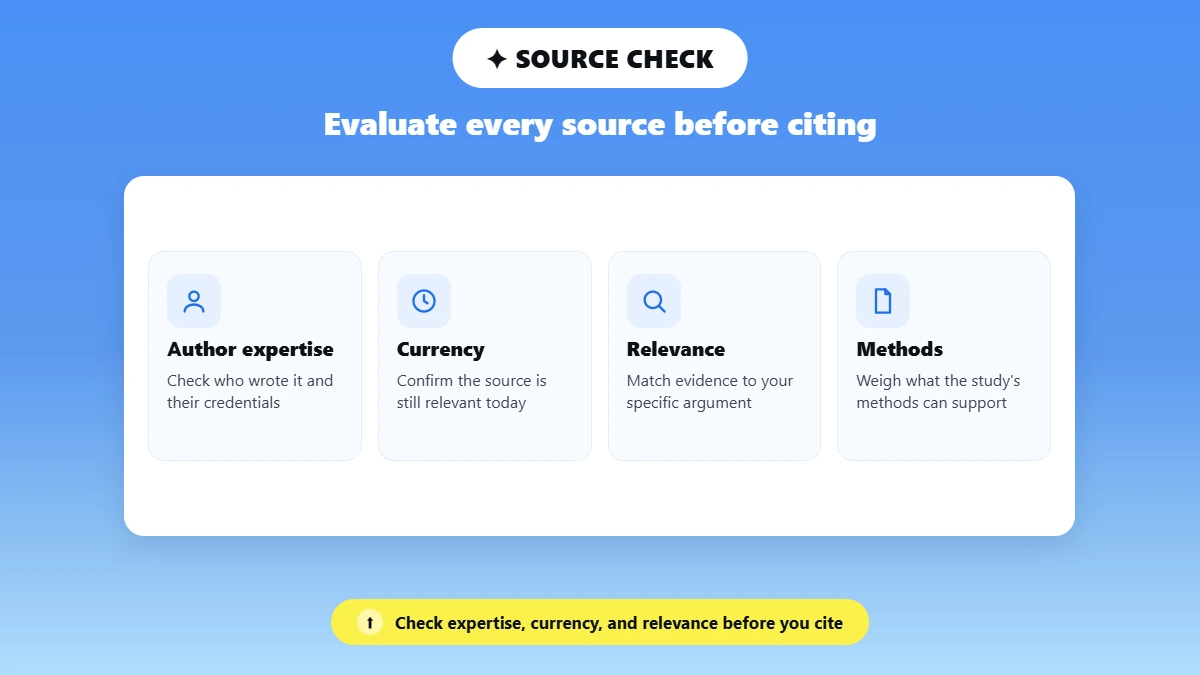
Carefully evaluate sources before using or citing them. Start with your course readings, then use college library databases, peer-reviewed journals, academic-publisher books, and government or established research organizations for additional material.
When evaluating a source, check the author's expertise, publication venue, audience, evidence, accuracy, currency, and relevance. Purdue OWL recommends evaluating these factors rather than assuming every source is credible.
Before using a source, check its authors, publication venue, methods, evidence, currency, relevance, and limitations. Do not treat a study's conclusion as proof without considering what its methods and sample can actually support.
Know whether you are using a primary or secondary source: primary sources provide original evidence, while secondary sources analyze or interpret existing material.
When you find a strong source, check its reference list for other relevant sources. Keep a source log with the author, title, URL or DOI, publication details, and relevant page or section numbers.
Do not use an AI-generated summary as a replacement for reading the original source. Always review and verify the source itself before using its information in your paper.
5. Write a Working Thesis That Makes an Arguable Claim
Once you have a focused research question and some initial evidence, develop a working thesis that gives your paper a clear position. Your thesis should be specific, arguable, supportable, and relevant to the assignment prompt, rather than simply stating a fact or announcing the topic.
For the nighttime social-media assignment, compare these two examples:
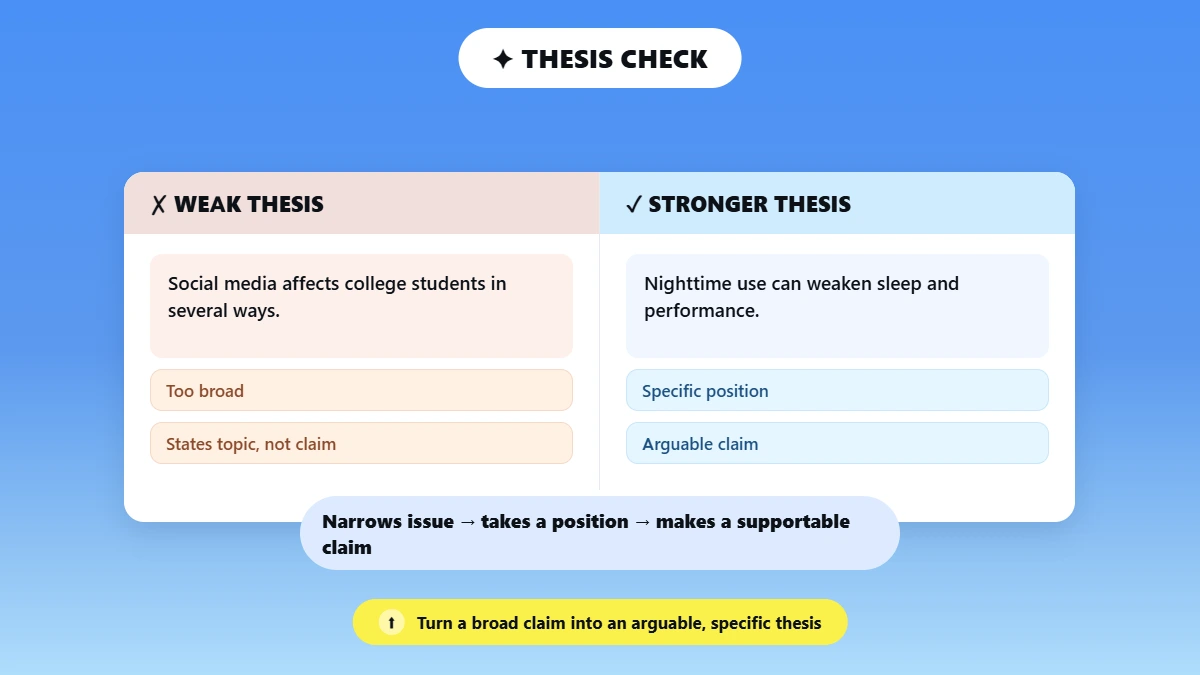
Weak: Social media affects college students in several ways.
Stronger: Although social media supports peer connection, unrestricted nighttime use can weaken college students’ sleep and academic performance; universities should prioritize digital-wellness education instead of blanket bans.
The first statement is too broad, while the stronger thesis narrows the issue, takes a clear position, and makes a claim that can be supported with research evidence.
Harvard College Writing Center explains that a strong thesis presents a central claim a thoughtful reader could disagree with and that requires analysis and evidence. Harvard thesis guidance
Have a topic but not yet a defensible claim? Enter your subject, paper type, and tentative position into Phrasly’s Thesis Generator. Compare the suggested claims, check each against your evidence, and revise the strongest option until it represents your own argument.
6. Build an Evidence-First Outline
An outline gives your paper structure before drafting. It helps you decide what each section needs to accomplish, what evidence belongs there, and how each point connects to your argument.
A college-paper outline should be more than a list of topics. Each planned paragraph should have a claim, supporting evidence, explanation, and connection to your thesis, with a counterargument or limitation where relevant.
For our running example, the outline might look like this:
Why nighttime use disrupts sleep
How sleep loss affects concentration and performance
Benefits of social connection
Why education may work better than prohibition
Counterargument and response
Your outline is not fixed. As research changes your position, you may need to reorganize points, add or remove sections, or adjust your argument.
7. Draft Analytical Body Paragraphs
Body paragraphs should not simply summarize information. Each paragraph should make a clear claim, support it with evidence, explain how and why the evidence matters, and connect the point to your thesis.
A simple framework to follow is Claim → Evidence → Analysis → Link:
Claim: State what the paragraph argues.
Evidence: Provide a relevant quotation, paraphrase, example, or finding from a credible source.
Analysis: Explain how and why the evidence supports your claim.
Link: Connect the paragraph back to your overall thesis.
Use a quotation sandwich: introduce the source, present the quotation or paraphrase, interpret it, and connect it to the paragraph’s claim.
Avoid summarizing sources separately. Purdue OWL explains that synthesis compares where sources agree or disagree to develop a broader conclusion.
💡 Instead of reporting what each source says separately, bring the sources into conversation with one another and explain what their combined evidence shows.
Annotated Body Paragraph Example
[Claim] Nighttime media use can interfere with college students’ sleep. [Evidence] In a study of 114 first-semester college students, researchers found that nighttime media use was associated with sleep interruptions and reduced sleep quality; social-media use, texting, and mobile gaming were each correlated with sleep interruptions. [Analysis] These findings suggest that the timing of media use may matter, not simply the total amount of time students spend using digital platforms. This matters because reduced or interrupted sleep can limit the amount of restorative sleep students receive, creating a plausible pathway through which nighttime media use could affect their functioning the following day. [Link] Thus, the evidence makes nighttime media use an important factor to consider when evaluating how digital habits may contribute to students’ academic difficulties. [Transition] However, the academic effects of social-media use are not necessarily negative at every level of use.
This example shows how a paragraph moves from a claim, to evidence, to an explanation of why the evidence matters, and finally back to the paper’s broader argument rather than simply reporting source information.
Stuck on a body paragraph? Phrasly's AI Paragraph Generator turns a single claim into a draft you can shape with your own evidence and analysis.
8. Write a Direct, Focused Introduction
Start your paper by addressing the issue directly. Give only the context your reader needs, then move toward the question or tension your paper will examine and the argument you will make. You can use a relevant fact, quotation, question, or anecdote as long as it directly relates to your topic.
Avoid fluff, unrelated statistics, broad statements such as “Since the beginning of the 21st century,” dictionary definitions, or openings such as “In this essay, I will…”
Get to the specific topic quickly. Villanova recommends direct, specific openings and warns against broad “History of the World” and “Funnel” openings.
Your introduction may need revision as your argument develops. Revisit it after drafting to make sure it accurately reflects your final argument.
A simple structure: Relevant opening → Necessary context → Specific issue or question → Thesis
For the nighttime social-media assignment: Introduce nighttime social-media use among college students, briefly explain why sleep and academic performance matter, identify the tension between its benefits and drawbacks, and end with the thesis.
9. Address Counterarguments Fairly
A strong college paper should address one serious opposing position that directly challenges your argument. Represent it accurately rather than creating a weak or exaggerated version. The counterargument should be relevant and supported by reasonable evidence or reasoning.
Acknowledge what the opposing position gets right, then use stronger evidence or reasoning to explain why your argument still stands. Avoid a weak straw man argument that makes your position appear stronger.
Simple structure: Opposing position → What it gets right → Your response → Stronger evidence/reasoning → Your argument
For the nighttime social-media assignment: A reasonable counterargument is that social media can support social connections and academic outcomes at moderate levels. Acknowledge these benefits, then explain why they do not justify unrestricted nighttime use. Distinguish moderate use from excessive nighttime use and use the evidence to support digital-wellness education rather than blanket restrictions.
10. Write a Conclusion That Explains Significance
Do not copy your thesis word for word. Instead, synthesize your main points, return to the central idea in a fresh way, and explain its significance by answering “Why does this matter?”
Explain the implications of your argument or offer a relevant recommendation. For the nighttime social-media assignment, this could mean explaining what the findings suggest about how universities should approach digital wellness.
Avoid introducing a major new source, evidence, or argument. The conclusion should bring the existing argument to a meaningful close.
Simple structure: Return to the thesis → Synthesize the argument → Explain why it matters → Explain the implications
For the nighttime social-media assignment: Synthesize the evidence about nighttime media use, sleep, and academic performance. Explain what the findings mean for universities, emphasizing targeted digital-wellness education rather than assuming all social-media use is harmful or requiring blanket restrictions.
11. Cite Sources While Drafting
Cite sources when you use them rather than waiting until the end of the paper, when you may forget where information came from.
Distinguish between a direct quotation, paraphrase, summary, common knowledge, and your own analysis so you know when a citation is needed. Add provisional citations while drafting and record the exact page number when available.
💡 Make sure every in-text citation matches your reference or works-cited list, and verify every source before citing it. Never include an AI-suggested citation you cannot verify.
Proper citation helps prevent plagiarism by showing which ideas and words come from your sources. For more guidance, see our guide on how to prevent plagiarism.
Simple rule: Use the source → cite it immediately → record the page → verify it → match it to your reference list.
For the nighttime social-media assignment: Cite the sleep study immediately after using its finding about nighttime media use and sleep. Do the same for the academic-performance study, and verify that each source supports the claim you make.
12. Revise in Separate Passes
Revise your paper in separate passes rather than trying to fix everything at once, starting with the parts that have the biggest impact on your argument.
Follow this revision order:
Prompt and rubric: Make sure your paper answers the assignment and meets the requirements.
Thesis: Check whether your central claim is clear, specific, and arguable.
Paragraph claims: Make sure each paragraph has a clear claim that supports your thesis.
Evidence quality: Check whether your evidence is relevant, credible, and sufficient.
Analysis: Make sure you explain how and why the evidence supports your claims.
Organization and transitions: Check whether your ideas follow a logical sequence.
Citation completeness: Make sure all sources are properly cited, and citations are complete.
Sentence clarity: Remove confusing, vague, or unnecessarily wordy sentences.
Grammar and spelling: Correct grammar, spelling, punctuation, and other language errors.
Formatting: Check the required citation style, headings, spacing, page numbers, and other formatting requirements.
Resolve each issue during its relevant revision pass rather than repeatedly revising the entire paper.
One useful structural check is to read only the topic sentences of your body paragraphs in sequence. If they do not form a logical argument or progression, your paper needs structural revision rather than just sentence-level editing.
For the nighttime social-media assignment: Check that the paper addresses sleep, academic performance, and the university response, then verify the thesis, evidence, citations, clarity, grammar, and formatting.
After revising, check the final draft for plagiarism or citation problems before submitting. Phrasly’s Plagiarism Checker highlights potential matches and provides matched-source links and a similarity report. Review each match and correct missed citations, missing quotation marks, or overly close paraphrasing. A similarity match is a signal to review a passage, not automatic proof that plagiarism occurred.
Review every highlighted match and correct missed citations, missing quotation marks, or overly close paraphrasing. Remember that a similarity match is a signal to review a passage, not automatic proof that plagiarism occurred.
Before you submit, run your final draft through Phrasly's Plagiarism Checker 👇
How to Write a Heading for a College Paper
The correct heading for a college paper depends on the required citation style. MLA normally uses a first-page heading, APA uses a student title page, and Chicago/Turabian may use a title page depending on the assignment. Always follow your instructor’s specific requirements if they differ from a general style guide.
MLA, APA & Chicago Formatting at a Glance
Style | Common fields | Opening-page approach | Source list |
|---|---|---|---|
Student, instructor, course, date | Usually a first-page heading with a centered title | Works Cited | |
Title, author, institution, course, instructor, due date | Student title page; page number in header | References | |
Chicago / Turabian | Title, student, course, instructor, date | Often a title page, depending on assignment | Bibliography/reference list |
Example MLA Heading
An MLA paper typically places the student’s name, instructor’s name, course, and date at the top of the first page, followed by a centered title. Follow your instructor’s requirements if they differ.
Example:
Alex Johnson
Professor Smith
ENG 101: College Writing
August 26, 2026
The Effects of Nighttime Social-Media Use on College Students
Example APA Student Title Page
An APA student paper normally begins with a title page. It includes the paper title, author, institution, course, instructor, due date, and page number in the header.
Example information:
The Effects of Nighttime Social-Media Use on College Students
Alex Johnson
University Name
ENG 101: College Writing
Professor Smith
August 26, 2026
Follow APA requirements and your instructor’s instructions, with the instructor’s requirements taking priority.
Can You Use AI to Help Write a College Paper?
You may be able to use AI to help with brainstorming, feedback, or editing, but whether you can use it depends on the assignment, instructor, and institution. Never assume that a tool permitted in one course is also allowed in another. Before using AI for your college paper, check the assignment instructions and your instructor’s policy.
AI use is already common among college students, even as some institutions place limits on it. In an April 2026 Gallup survey of 3,801 U.S. associate and bachelor’s students, 57% reported using AI for coursework at least weekly.
Among them, 54% frequently used AI to edit or improve writing, 49% to generate ideas such as topics, and 36% to write papers, while 53% said their school discouraged or prohibited AI use.
College Board’s 2026 research of more than 3,000 U.S. faculty members also found that 74% reported students using AI to write essays or papers, while 92% expressed concern about AI-assisted plagiarism or academic dishonesty.
Often Lower-Risk Uses (If the Policy Permits)
If your instructor allows AI assistance, some uses are generally less risky because they support your own writing process rather than replace it. You can use AI for:
Understanding a difficult concept
Brainstorming research questions
Generating search terms
Testing whether a thesis is arguable
Identifying possible counterarguments
Receiving feedback on the organization of your paper
Correcting grammar in text you wrote yourself
These uses are appropriate only when permitted, and the student remains responsible for the final work.
High-Risk or Commonly Prohibited Uses
Some uses can create academic-integrity problems, especially when they replace your own work or violate your instructor’s policy. Avoid:
Submitting AI-generated prose as your original work
Asking AI to complete the entire assignment
Paraphrasing a source without citing it
Citing an article or source you have not opened and verified
Using fabricated quotations or references
Hiding a required disclosure of AI use
Using an AI tool after your instructor has explicitly prohibited it
When using AI for a college paper, do not treat its output as automatically accurate. You are still responsible for checking sources, verifying claims, and following the requirements of your assignment.
Preserve Evidence of Your Writing Process
Keep records that show how you developed the paper, including research notes, source logs, outlines, drafts, version history, instructor feedback, and any required AI-use disclosure.
When permitted or required, also keep a record of how you used AI so you can explain what assistance you received.
For ideas on using AI prompts responsibly during the writing process, see our guide on ChatGPT prompts for students.
Common College-Paper Mistakes
Even when your research and ideas are strong, common writing mistakes can weaken your college paper. Watch out for these errors before you submit:
Writing about the topic without answering the prompt: Discussing the topic is not enough; directly answer what the instructor asks you to analyze, evaluate, compare, or explain.
Using a thesis that merely announces the subject: A thesis should do more than tell readers what your paper is about. It should present a clear, specific, and arguable claim that your paper can support with evidence.
Forcing every assignment into five paragraphs: Not every college paper needs a five-paragraph structure. Let the assignment, research, and argument determine how many paragraphs you need and how they should be organized.
Opening with an extremely broad generalization: Avoid vague openings such as “Since the beginning of time.” Start with the specific issue your paper addresses and provide only the context your reader needs.
Adding quotations without analysis: A quotation should support your argument, not replace your analysis. Introduce the quotation, explain what it means, and show how it supports the point of your paragraph.
Summarizing sources one by one instead of synthesizing them: Do not simply explain what each source says separately. Compare sources, identify where they agree or disagree, and use those relationships to develop your own conclusion.
Treating proofreading as the whole revision process: Revision involves more than fixing grammar and spelling. Check your thesis, paragraph claims, evidence, analysis, organization, citations, and formatting before proofreading the final wording.
Adding citations only after drafting: Add citations as you use sources instead of waiting until the entire paper is finished. This makes it easier to track your sources and avoid missing citations or page numbers.
Including sources that cannot be verified: Check every source before including it in your paper. Make sure the source actually exists, supports the claim you are making, and can be verified by your instructor or reader.
Ignoring the rubric or required format: Before submitting, compare your paper with the assignment instructions and grading rubric. Check that you have followed the required citation style, structure, formatting, and other submission requirements.
College Paper Checklist Before Submission
Before you submit your college paper, use this checklist to make sure your argument, evidence, citations, and formatting meet the assignment requirements.
☐ I answered the exact assignment question.
☐ My thesis makes a specific, arguable claim.
☐ Every body paragraph supports the thesis.
☐ Every paragraph contains analysis, not only summary.
☐ I represented counterarguments fairly where appropriate.
☐ Every quotation, paraphrase, and borrowed idea is cited.
☐ Every in-text citation appears in the source list.
☐ I opened and verified every source.
☐ My introduction and conclusion match the final argument.
☐ I followed the required MLA, APA, or Chicago format.
☐ I checked the rubric one final time.
☐ I retained notes and drafts showing my writing process.
You can also save this checklist as a one-page college-paper planner and use it each time you prepare a paper for submission.
A strong college paper starts with the assignment prompt, not a clever or overly broad opening. From there, your thesis should present a clear claim, while your evidence and analysis work together to support that claim.
If you are learning how to write a college-level research paper, treat research, drafting, and revision as separate stages so you can develop and strengthen your argument at each step. As you write and revise, follow your course’s citation and formatting requirements, and check your instructor’s policy before using AI.
Taking the time to understand the assignment, build a supported argument, and review your work carefully can help you produce a more focused and effective college paper.
FAQs
What is the basic structure of a college paper?
The basic structure of a college paper usually includes an introduction, a thesis, evidence-led body paragraphs, a conclusion, and a source list. However, the exact structure can vary by discipline and assignment. Always follow your instructor’s requirements rather than forcing every college paper into the same format.
How do you start a paper for college?
Start by decoding the assignment prompt and identifying what your instructor wants you to analyze, evaluate, compare, or explain. Then turn the topic into a focused research question and develop a working thesis. Do not worry about creating a clever opening before you understand the direction of the paper.
How do you write a college research paper?
Write a college research paper by following a clear sequence: assignment → topic → research question → sources → thesis → outline → draft → citations → revision. Start by understanding the prompt, then research credible sources, develop an arguable thesis, organize your evidence, draft your argument, add citations, and revise.
How long should a college paper be?
There is no universal length for a college paper. The required word or page count depends on the assignment, course, and instructor. Check the assignment instructions for the required length, and if no length is provided, ask your instructor rather than relying on a generic “standard” college-paper length.
Do college papers need a title?
College papers usually need a title, but the exact heading or title-page requirements depend on the instructor and required citation style. MLA, APA, and Chicago/Turabian use different approaches to the opening page. Check your assignment instructions and follow your instructor’s requirements if they differ from the general style guide.
Is a five-paragraph essay acceptable in college?
A five-paragraph essay can be appropriate for a short or introductory college assignment, but it should not be treated as a universal rule. College papers should have enough paragraphs to develop the argument properly. For example, an informative essay may require a different structure depending on the topic and assignment requirements. Let the assignment, evidence, and complexity of your argument determine the structure.
Can I use AI to help write a college paper?
You may be able to use AI, but permission depends on your syllabus, assignment, instructor, and institution. If permitted, AI may help with brainstorming, research questions, organizational feedback, or editing your own writing. Do not assume that AI use allowed in one course is permitted in another, or that submitting AI-generated prose as your own is acceptable.
How do I avoid plagiarism in a college paper?
To avoid plagiarism, cite sources as you draft, record page numbers, and use quotation marks whenever you reproduce exact wording. When paraphrasing, write from your own understanding and cite the original source. Verify every citation and source before submitting, and review the finished paper for uncredited matches or overly close paraphrasing.

Written by
Hasnain
Karachi, Pakistan
I help businesses grow with SEO-friendly blog posts, landing pages, and long-form content. With 3+ years of experience, I deliver clear, original, and well-researched writing that drives results.