18 Email Phrases That Weaken Your Message (and What to Say Instead)
18 min read
An email can be grammatically flawless and still read as unsure, vague, defensive, or passive-aggressive. Rarely is grammar the issue.
Word choices that mask your intentions.
This email phrases to avoid guide groups every phrase into unprofessional email phrases.
Words that make emails sound weak or uncertain, so you always know what to say instead of common email phrases and how to sound confident but polite in an email.
Hedging your requests or leaving your reader questioning what to do next is the problem.
Words weaken your email phrase when they obscure your intent, introduce unnecessary ambiguity, sound defensive, or fail to tell the reader what to do next.
"just checking in", "sorry to bother you", "I'll try", and "per my last email". Eliminate these filler words and replace them with details of your situation, one specific request, and a realistic due date.
Only use apologies when you are sorry, and qualifiers when being accurate requires it. Here we examine 18 commonly used weak email phrases, sorted into four categories.
Each has an explanation of why it fails, a brief example of it used in context, a revision showing how to say it correctly, and a decision point. Delete, replace, keep, or qualify.
Stronger does not mean colder. It means specific enough to ACT.
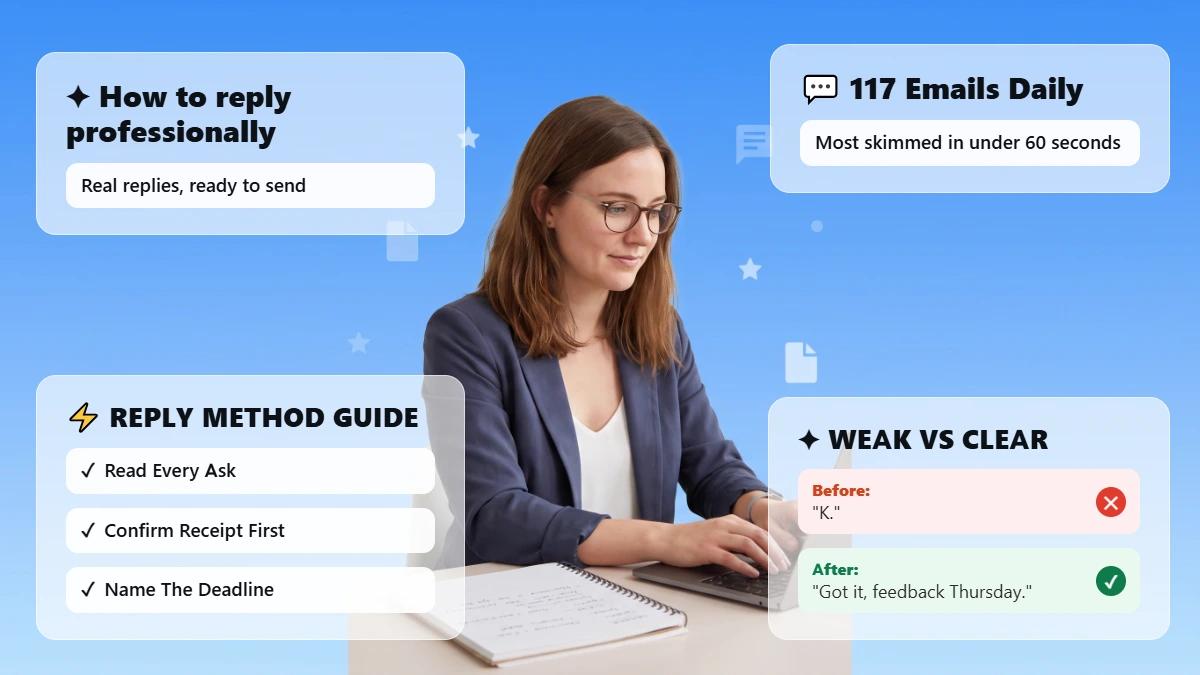
Microsoft’s latest Work Trend Index 2025 reports that employees average 117 emails and 153 Teams messages each day.
Filler phrases and vague requests are more than annoying. Superfluous words and unclear requests lead to unnecessary follow-ups that waste everyone’s time.
⭐ Already have a draft open? Paste it into Phrasly's AI Formalizer and compare Professional, Friendly, and Concise versions before you send.
What Makes an Email Phrase Weaken Your Message?
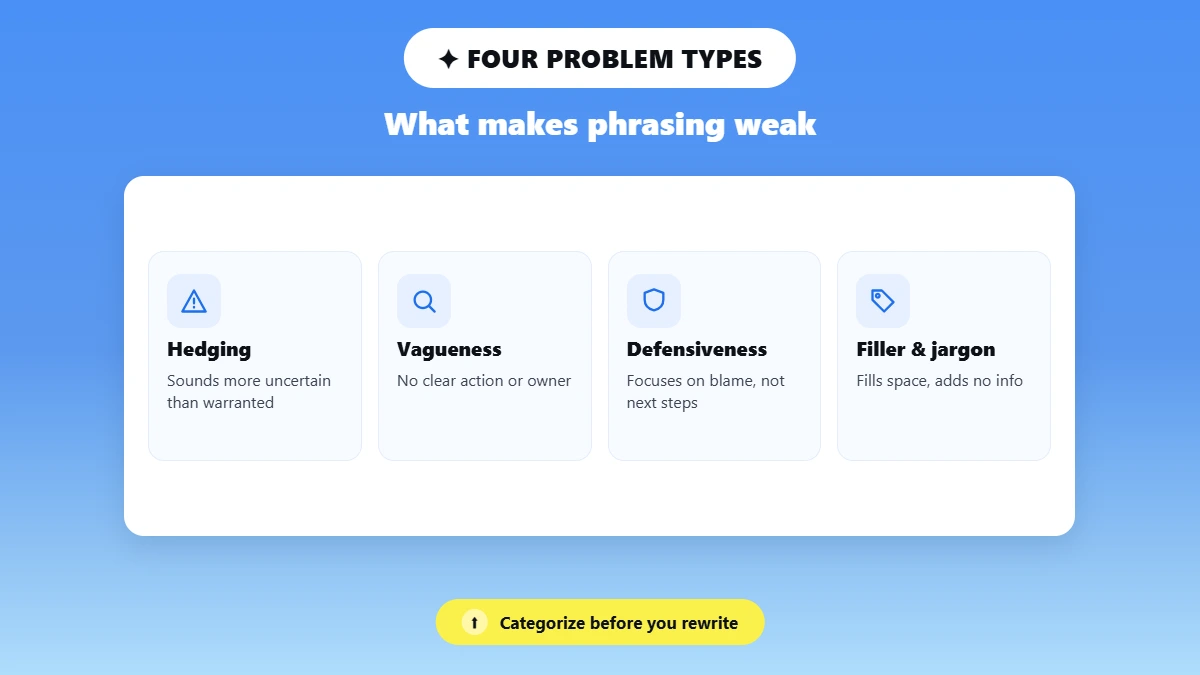
An email phrase weakens a message if it is categorized as unnecessary hedging, vague language, defensive language, or if it is simply filler.
Purdue OWL says good business writing is written confidently, courteously, sincerely and at the right level for your audience.
If you'd rather not rewrite every hedge and filler phrase by hand, you can also use AI to make your text more professional and get a polished draft in seconds.
Here are the four problem types:
Unnecessary Hedging: The author sounds more uncertain than warranted. "I think maybe we could possibly." shows hesitation the author may not truly feel.
Vagueness: The reader cannot identify what action is needed. Who owns it, or when? "Let me know your thoughts" is a request with no shape.
Defensiveness or blame: The wording focuses on fault rather than forward motion. "Per my last email" redirects attention to who dropped the ball. Not what happens next.
Filler and jargon: The phrase fills space without contributing information. "Just wanted to touch base" doesn't tell your reader why you are writing.
📌 Note: Professional tone should be appropriate to the audience and relationship. Not maximally formal. A casual phrase is wrong in a legal escalation. It is perfectly right between close colleagues.
18 Email Phrases That Weaken Your Message (and What to Write Instead)
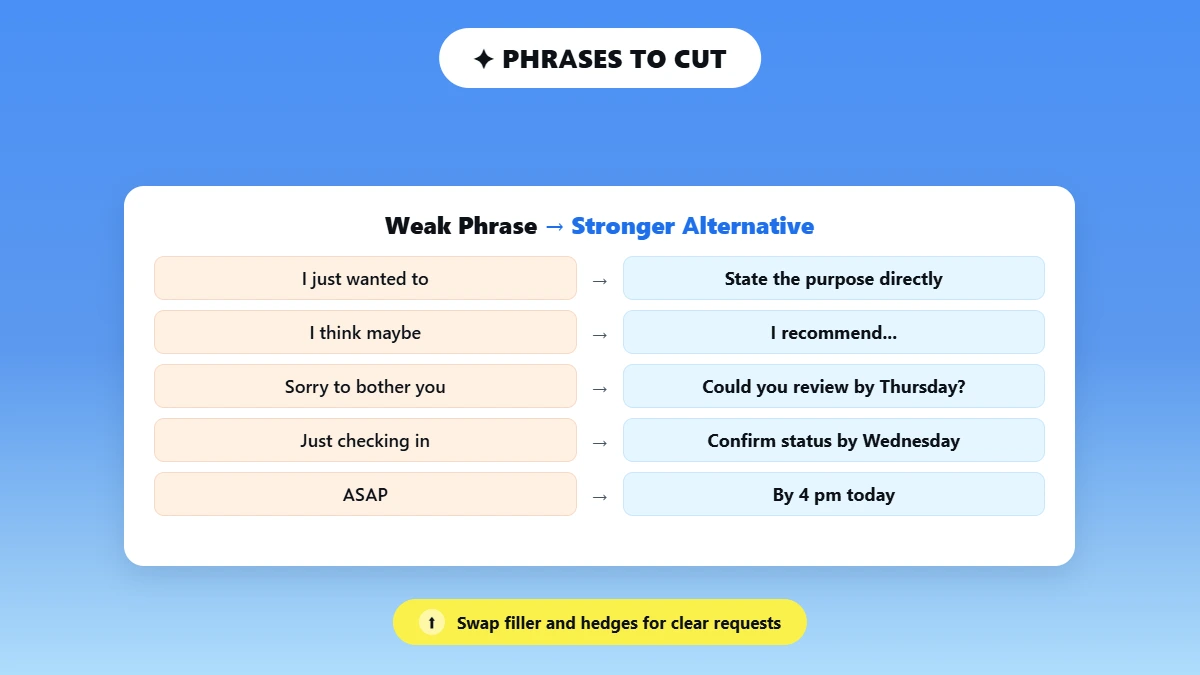
Every phrase has been labeled with one of four decisions. Delete (contributes nothing), Replace (there is a better way to say it), Keep (it's correct as is).
Qualify (the concept is required but needs supporting text, a date, or a next step). This is intended as a guide only, not a blacklist.
Category 1: Minimizing and Uncertain Phrases
Phrase | Why It Can Misfire | Weak Example | Better Rewrite | Tag |
"I just wanted to." | Minimizes your own message before the reader even sees the request. "Just" signals apology for existing. | "I just wanted to follow up on the invoice." | State the purpose directly: "Following up on invoice #204, due Friday." | Delete |
"I think maybe." | Compounds two hedges. Use one qualifier when genuine uncertainty exists; not two for comfort. | "I think maybe we could reschedule the call." | "I recommend rescheduling to Thursday at 2 pm. Does that work?" | Replace |
"I'm not sure, but." | Opens with a credibility discount. State what you do know, then flag the gap. | "I'm not sure, but the file might be in the shared drive." | "The file should be in the Q3 folder. If it is not there, let me know." | Qualify |
"Hopefully." | Signals that progress depends on luck rather than a plan or a specific ask. | "Hopefully we can wrap this up by Friday." | "We are on track for Friday. If anything changes, I will message you by Wednesday." | Replace |
"I'll try." | Sounds noncommittal. Either give a commitment, name a constraint, or set an update time. | "I'll try to get that to you today." | "I will send the draft by 5 pm today. If I run into a delay, I will let you know." | Replace |
"Kind of," "sort of," "basically" | Softens claims that usually do not need softening. Use the exact description. | "The budget is basically finalized." | "The budget is finalized, pending one supplier quote due Monday." | Delete |
Category 2: Defensive and Over-Apologetic Phrases
Phrase | Why It Can Misfire | Weak Example | Better Rewrite | Tag |
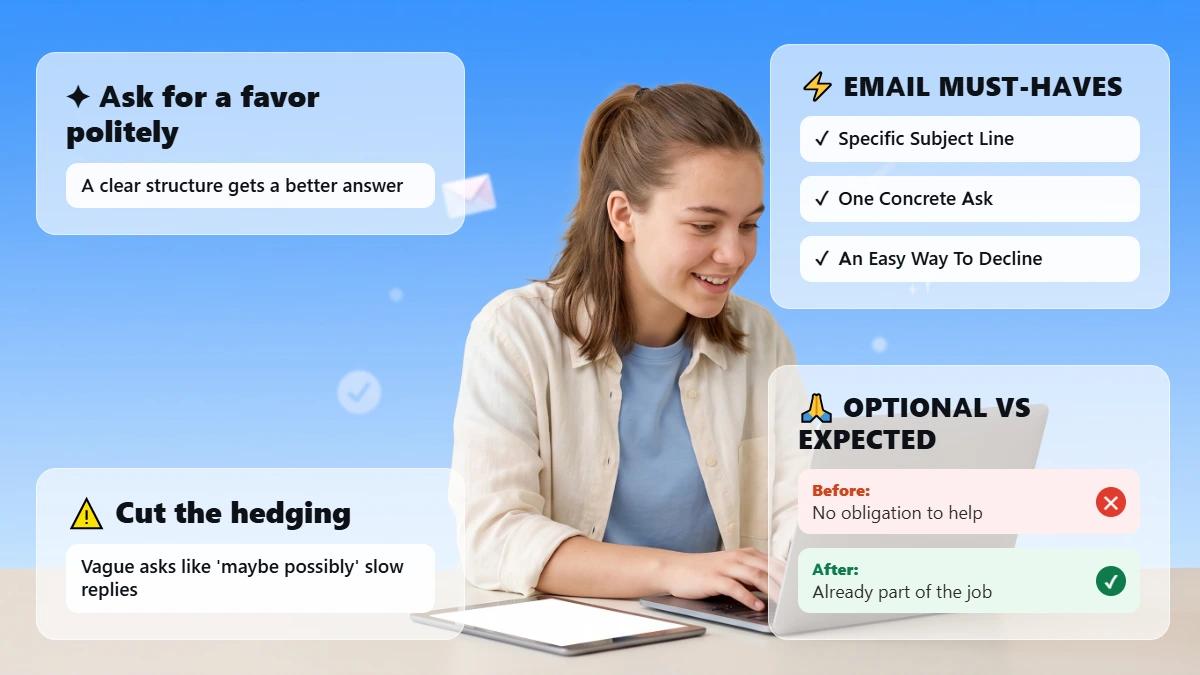
"Sorry to bother you." | Apologizes for writing before the reader has judged the message. Most requests are not a bother. | "Sorry to bother you, but could you review my draft?" | Make the request without the preamble: "Could you review my draft by Thursday?" | Delete |
"Sorry for the delay." | When warranted, keep it. When you are not actually late, "sorry" signals failure that did not happen. | "Sorry for the delay in responding." | "Thanks for your patience. Here is the update you asked for." | Keep |
"I hope this makes sense." | Frames your own writing as potentially confusing. Restate the key point or invite a specific question. | "I hope this makes sense." | "The key point is X. If anything is unclear, let me know which part." | Replace |
"To be honest." | Implies previous statements were not honest. State the assessment and reason without the qualifier. | "To be honest, I think the timeline is too tight." | "The timeline is tight. Based on current capacity, a two week extension is realistic." | Delete |
📌 Nuance to keep: Do not reflexively swap every apology for "Thank you for your patience." If you caused real inconvenience, a clear apology paired with a fix is more appropriate than a polished deflection.
Common searches like as per my last email, delayed response, advance apology, and warmly email sign off all circle the same worry.
How to apologize in email without sounding defensive or overly formal. State what changed and give a fix. Do not repeat the apology in the sign-off.
Category 3: Vague Requests and Timelines
Phrase | Why It Can Misfire | Weak Example | Better Rewrite | Tag |
"Just checking in." | Names no item, no status needed, and no date. The reader has to ask a follow-up before they can act. | "Just checking in on the proposal." | "Could you confirm the proposal status by Wednesday? We need it before the client call Thursday." | Replace |
"Please advise" | Does not specify the question or decision needed. The reader must infer the ask. | "Please advise on how to proceed." | "Should we proceed with Option A (lower cost) or Option B (faster delivery)? I need your call by Friday." | Replace |
"Let me know your thoughts" | Open-ended to the point of no shape. Ask one or two specific questions instead. | "Let me know your thoughts on the report." | "Two questions on the report: Is the budget figure on page 3 correct? And should I send to the client this week?" | Replace |
"At your earliest convenience" | Sounds polite but communicates no timeline. Give a reasonable date. | "Please review at your earliest convenience." | "Could you review by Friday, 3 pm? That gives me time to incorporate feedback before Monday's meeting." | Replace |
"ASAP" | Everyone's ASAP is different. State the deadline and why it matters. | "I need this ASAP." | "I need this by 4 pm today. The client presentation starts at 5 pm." | Replace |
"No rush, but." | Contradicts itself if the task is actually urgent. Decide and state clearly. | "No rush, but could you review this?" | "This is not urgent. Any time before Friday works." | Replace |
Category 4: Passive-Aggressive Language and Jargon
Phrase | Why It Can Misfire | Weak Example | Better Rewrite | Tag |
"Per my last email..." | Signals the reader missed something and you noticed. Restate the context neutrally without flagging the miss. | "Per my last email, the deadline is Friday." | "A quick reminder: the deadline is this Friday, October 10." | Replace |
"As I mentioned before." | Same signal. Repeat the information. Drop the timestamp. | "As I mentioned before, the budget is fixed." | "The budget is fixed at $4,000 for this sprint." | Delete |
"Let's touch base / circle back" | Names no topic, owner, action, or date. Schedule a concrete next step. | "Let's circle back on this next week." | "Can we schedule 20 minutes Thursday to finalize the pricing decision?" | Replace |
"Friendly reminder." | Reads as passive-aggressive, especially on a missed deadline. Give the deadline and offer practical support. | "Friendly reminder that the report is due today." | "The report is due today by 5 pm. If you need anything from me to finish it, let me know." | Replace |
"Thanks in advance" | Can pressure the reader into agreeing before they have. Make the request, then use a neutral close. | "Thanks in advance for sorting this out." | "Please confirm the venue booking by Thursday. Let me know if you run into any issues." | Replace |
⭐ A word-for-word swap cannot always account for the recipient, deadline, or relationship. Formalize the whole draft, then pick the version that matches your intent.
When "Weak" Email Language Should Stay
Not all qualifiers, apologies, or hedge words and phrases are bad. Deleting every hedge you write won’t make your email stronger. It’ll make it wrong. Here’s where the dreaded weak phrasing belongs:
Genuine uncertainty: If you only have part of the evidence, "I think" or "this may" is appropriate. Turning a qualified statement into a statement of certainty to sound confident is a bigger problem than sounding unsure.
Forecasts and estimates: Don't turn an estimate into a promise by removing a qualifier. Saying "The project will finish Friday" when you mean "we expect to finish Friday" commits you to something you haven't promised.
Real apologies: Use "sorry" if you hurt someone, broke a promise, or caused an inconvenience. A "sorry" wrapped in a polished evasion, after all, can sound like corporate jargon when you're in the wrong.
Legal, scientific, or technical qualifiers: Sometimes hedging your claims is just being accurate. "Results may vary" doesn't always mean you're wimpy when you're talking medicine or law. It can mean you're exact.
Culture is important too. Directness can be interpreted differently regionally, organizationally, and relationally.
Getting the tone wrong is not a minor issue either.
In research from Wakefield for Loom (Atlassian), 80% of knowledge workers said they had recently spent time on unnecessary or redone work after misreading a written message. And nearly 9 in 10 regularly spend time interpreting unclear written messages. Email was named as a channel prone to misunderstanding by 34% of respondents. Second only to chat at 42%, so it is worth getting the phrasing right the first time.
Short-answer bullet points to a peer won't read the same as a formal escalation email to a long-standing client. Those emails call for different levels of formality. This article covers common conventions for professional emails, not hard-and-fast rules.
Poorly Written Email Examples: Before and After
Below are three entire transformations illustrating replacing weak email phrases in the context of a full message. Each contains a realistic name/date/task, and just one clear action. They are actual workplace emails, not rewritten examples.
The three good and bad email etiquette examples below are drawn from real workplace situations. They are not samples of poorly written emails lifted from the internet. They are original.
If you have seen examples of poorly written emails that recycle the same generic scenarios, you already know how little those teach.
Examples of poor emails only help when the reader can see exactly which phrase caused the problem and why the rewrite is clearer. The bad examples of emails here are deliberate. Every weak choice maps directly to a phrase in the table above.
Call it an example of unprofessional email, an unprofessional email example, an example of a poorly written email, or one of many examples of bad emails. The diagnosis is always the same. The reader cannot find the ask, the owner, or the date.
Example 1: Following Up on a Missed Deadline
❌ Before (Poorly Written)
Subject: Just checking in
Hi Marcus,
I just wanted to follow up and see if maybe you had a chance to review the Q3 report. I'm not sure if you got my last email, but I was kind of hoping we could discuss it soon. No rush, but let me know your thoughts at your earliest convenience.
Thanks in advance,
Priya
🔍 Why this is a poorly written email: "Just checking in" names nothing. "Kind of hoping" and "at your earliest convenience" give no timeline. "No rush" contradicts the follow-up. The reader has no action, owner, or date.
“No rush” is inconsistent with following up. The reader knows nothing to do, by whom, or by when.
For more on structuring an effective follow-up from the subject line down, this guide to writing follow-up emails breaks down the process step by step.
✅ After (Rewritten)
Subject: Q3 Report Review: Input Needed by Wednesday
Hi Marcus,
Could you share your feedback on the Q3 report by Wednesday, October 9? I need to incorporate comments before we send it to the leadership team on Thursday morning.
If you would like to talk through any section first, I am available Tuesday afternoon.
Priya
💡 Why this works: Specific item, specific deadline, specific reason, and an offer of support. The reader knows exactly what is needed and by when.
Example 2: Updating a Client About a Delay
❌ Before (Poorly Written)
Subject: Sorry for the delay
Hi Daniel,
So sorry for the late response. I hope this email finds you well. I just wanted to reach out and let you know that we are, unfortunately, experiencing some delays on our end. Hopefully we will be able to get back on track soon. Per my last email, the original deadline was October 3, but I'm not sure exactly when we will be ready. Please advise.
Warmly,
Sophia
🔍 Why this is a bad email example: "Sorry for the late response" and "hopefully" signal unresolved problems. "Please advise" asks the client to solve a supplier delay. "Per my last email" is defensive. No new date or plan is offered.
✅ After (Rewritten)
Subject: Project Update: New Delivery Date Confirmed
Hi Daniel,
I apologize for the delay. A supplier issue pushed back our production schedule by five days. The revised delivery date is October 8.
I will send a progress update by October 6. If the October 8 date creates a problem on your end, let me know, and we can discuss options.
Sophia
💡 Why this works: The apology is present because it is warranted. The cause, the new date, and the next update are all named. The client has a path forward.
Example 3: Asking a Manager for Feedback
❌ Before (Poorly Written)
Subject: Quick question
Hi James,
Sorry to bother you; I know you're busy. I just wanted to see if maybe you'd had a chance to look at the proposal I sent last week. I hope this makes sense, but I'm not sure whether to proceed. Let me know your thoughts when you get a chance.
Best,
Lena
🔍 Why this is an example of an unprofessional email: "Sorry to bother you" pre-apologizes for a legitimate request. "Let me know your thoughts" gives no shape. There is no decision, no deadline, and no clear ask.
✅ After (Rewritten)
Subject: Proposal Feedback: Two Questions Before I Proceed
Hi James,
I have two questions on the proposal I sent on October 2:
1. Is the pricing structure on page 4 aligned with what the client expects?
2. Should I send it directly to the client, or route it through Sarah first?
If you can confirm by Thursday, I can send it out before the weekend.
Lena
💡 Why this works: Two specific questions replace a vague open ask. A deadline is named. The manager can reply in one sentence.
Email Closing Phrases: How to End an Email That Gets a Response
There is no single right answer for how to end an email. The close should match the relationship. Not a formula. Still, weak closings cause the same problem as weak openings. The reader does not know what happens next.
If you are choosing between ways to end an email, start with the response you actually need. Good email closing phrases name the next step. Not just a pleasantry.
Some reliable professional email closing phrases examples:
"Could you confirm by Thursday so I can move forward?" for how to end an email that requires a response.
"Let me know if you need anything else before Friday." A professional way to end an email close for ongoing work.
"Best," or "Thanks," safe, neutral defaults among good sign offs for emails. When the relationship is new or formal.
Save "Warmly" for colleagues you know well. How to end an email professionally usually means matching formality to the relationship? Not maximizing it.
A 60-Second Check Before Sending Any Email
Run through these eight points before you hit send. Each maps to one of the four problem types covered above:
Purpose visible in two sentences? Can the reader identify why you are writing from the first two sentences alone?
Unnecessary hedges removed? "I just," "sort of," "kind of," and "hopefully" removed where they add no accuracy.
Genuine uncertainty preserved? Estimates, forecasts, and incomplete information are still accurately qualified.
One clear action named? There is one principal request, not three buried in paragraph two.
Owner and date on that action? The action has a person responsible and a specific date or time.
No passive-aggressive phrasing? "Per my last email" and "as I mentioned" removed or rephrased as neutral context.
Closing matches the relationship? "Warmly" between close colleagues is fine. It may read as overfamiliar to a new client.
Names, numbers, links, and attachments, correct? All dates, figures, file names, and contact details verified before sending.
If you'd rather have a second pair of eyes on tone and clarity before you hit send, a message enhancer AI tool can catch weak phrasing you might have missed in this checklist.
How to Rewrite Weak Email Phrases with Phrasly Formalizer?
Phrasly AI Formalizer was designed for tone adjustment, not synonym replacement. New to the tool?
This Phrasly AI review covers its features, pricing, and use cases in more depth.
From Phrasly's use-case page (accuracy confirmed 9/8/2026, vendor provided), AI Formalizer has three tones:
Professional, Friendly & Concise; tone-strength control from subtle touch-up to comprehensive rewrite; 5 rewrite versions to choose from.
An on-page disclaimer states: "Phrasly is AI and can make mistakes. Please double-check your output."
See comparison of Formalizer vs. ChatGPT for how they differ on tone control and output consistency.
The workflow for fixing a poorly written email takes five steps:
Paste your draft into Phrasly's AI Formalizer.
Choose the tone: Professional for a client or senior contact, Friendly for a colleague, Concise when brevity is the priority.
Adjust tone strength if the first result is too formal or too loose for the recipient.
Compare the five rewrite options and choose the version closest to your intended meaning.
Manually verify all names, facts, figures, deadlines, and commitments in the chosen version before sending. The tool does not know your promises.
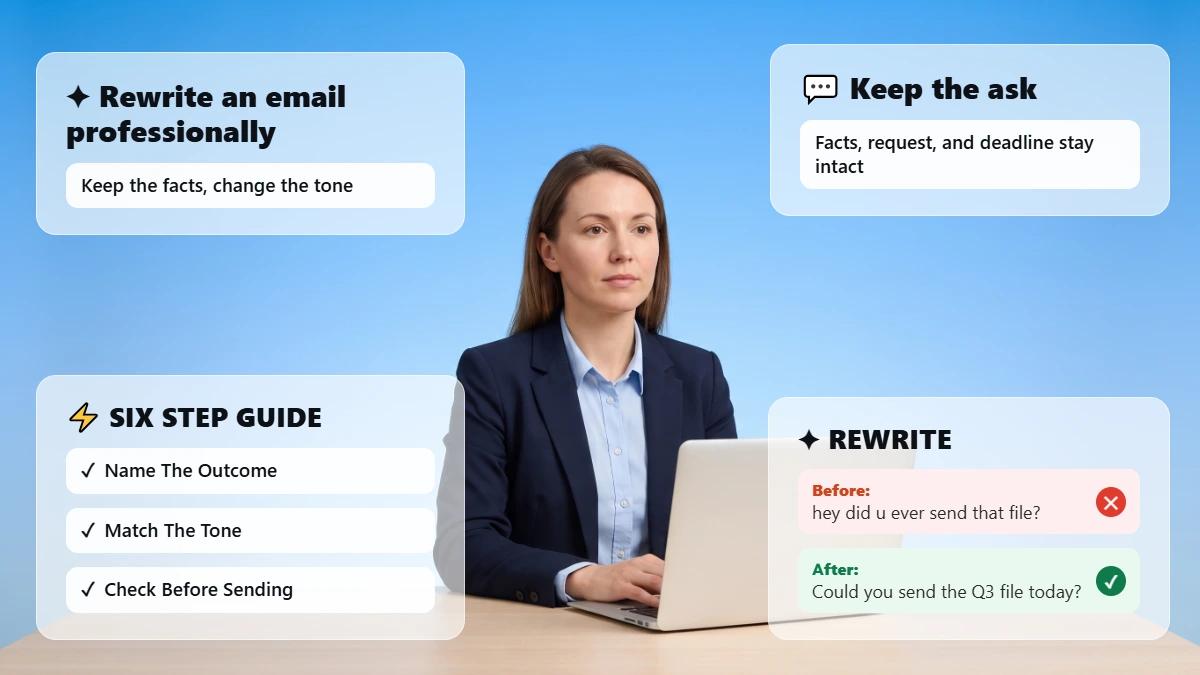
This is formalizing and tone adjustment. Not an AI-generated email from scratch. The content, the facts, and the decisions remain yours. The Formalizer handles the phrasing layer.
⭐ Try the same before-and-after with your own unsent email.
Final Word
The most powerful email isn't the one with the most formal vocabulary. It's the one with the right purpose, tone, next action, and certainty.
Be specific instead of vague. Maintain your true apologies and well-researched qualifiers. Assign each request a single action, owner, and due date. That's it. Build that framework one email at a time.
And if you want to extend these habits beyond email, this list of best ChatGPT prompts for professionals is a good next resource.
These habits hold regardless of what you searched to get here.
Whether you wanted general email writing tips, needed to compose professional email drafts faster, or searched how to write a professional email or how to write a business email from scratch.
The same professional email writing principles apply. Browse more professional email examples and professional email writing tips above. Or if you just want someone to help me write a professional email, start with the checklist.
If you're curious how tone-focused tools differ from grammar checkers, see a comparison of Phrasly vs. Grammarly.
Frequently Asked Questions
What phrases should you avoid in a professional email?
Purpose-obscuring phrases and excessive hedges damage business communications more than anything else.
"just checking in," "I just wanted to," "hopefully," "please advise," "let me know your thoughts," and "at your earliest convenience." Eliminate them by replacing each with a specific action, question, and due date.
What makes an email sound unprofessional?
Requests so vague they don't actually request anything (no named action or due date), apologies when you're making a valid request, passively aggressive reminders of previous emails, and fluffy corporate speak that doesn't convey any information.
Please refer to the examples above in bad email examples for complete before/after rewrites.
What words make emails sound weak or uncertain?
"Kind of", "sort of", "basically", "I think maybe", "hopefully", and "I'll try" all hedge assertions that shouldn't be hedged. Delete them when the statement is true. Leave them when the statement is truly unclear.
What can I say instead of "just checking in"?
Include the exact item you want, the status desired, and a date: "Please confirm the status of the proposal by Wednesday. We need it prior to the client call on Thursday."
This sentence reads better for the recipient and only requires one response versus going back and forth for clarification.
What can I say instead of "sorry to bother you"?
Get straight to the point. "Please review my draft by Thursday." is courteous and direct. Don't apologize before the reader has formed an opinion of your message that it needs apologizing for.
Is "per my last email" passive-aggressive?
It does that because it points out to the reader that they missed something you wrote previously. Rewrite the situation neutrally: "Reminder: Friday, October 10 is the deadline." The reminder drops without the implied critique.
Is it unprofessional to say "I think" in an email?
Not always! "I think" when your evidence is incomplete, or you're giving a recommendation, not stating a fact. It falls flat when used to hedge something the writer knows is true. Calibrate your qualifier to your true level of certainty.
How do I sound confident in an email without sounding rude?
The formula is specificity: include the what, who, where, and when. "Can you confirm the venue booking by Thursday?" sounds sure and polite. Confidence does not require removing polite phrasing. It requires removing vague phrasing.
What should I say instead of "please advise"?
Ask your question verbatim or state the decision required: "Do we want to do Option A or Option B? Please respond by Friday." "Please advise" forces the reader to determine what question you want answered.
How do I apologize professionally without over-apologizing?
Say you're sorry once. Include what happened and what's being done about it. "Sorry for the delay. The new date will be October 8th. I will follow up with you on October 6th." Don't say you're sorry again in the closing.
How do I end an email that requires a response?
Tell the reader what response you want, who will respond, and when: "Please confirm by Thursday so I can make the reservation." An ambiguous close such as "let me know" fails to communicate what response you want or by when.
Can AI help formalize an email?
An AI formalizer can produce clearer, more professional versions of a draft that already exists. If you're comparing options, this roundup of best AI text enhancers covers several tools worth considering.
The user would still want to review the resulting document to ensure accuracy, knowledge of the recipient, deadlines, commitments, and desired level of formality. The AI does the wordsmithing. The user is responsible for the facts.

Written by
Muhammad Usman Ali
Pakistan
Muhammad Usman Ali is an experienced SEO content writer with 3+ years of professional writing experience. He specializes in AI tools, AI detection technologies, and search engine optimized content.