How to Write a Follow-Up Email: 15+ Templates and Examples
16 min read
A follow-up email is a short message you send after an earlier email or conversation to prompt a reply or move forward.
A good follow-up email is brief and reminds the recipient of the context, the reason for writing again, and makes one clear request.
People usually struggle with finding the right words that push for an answer without sounding impatient. For that exact solution, we’ve compiled 15 templates for complex situations.
Read on to understand the six-step framework of a follow-up email, timing guidance, polite phrasing, subject lines, and 15+ copy-paste templates.
Every template uses the same four labels, so you can scan the table below to your situation and paste.
You’re following up about… | What the email should do | Go to |
|---|---|---|
No response | Restore context and give an easy reply option | |
A client | Clarify the next action | |
A sales lead | Add value and one next step | |
A proposal | Ask for a decision or questions | |
A quote or estimate | Check status | |
A meeting | Recap and confirm action items | |
Networking | Reconnect naturally | |
A job application | Reinforce interest | |
An interview | Thank the interviewer and check status |
Want your draft to sound right before you hit send? Paste it in, pick a tone, and see the rewrite 👇
How to Write a Follow-Up Email
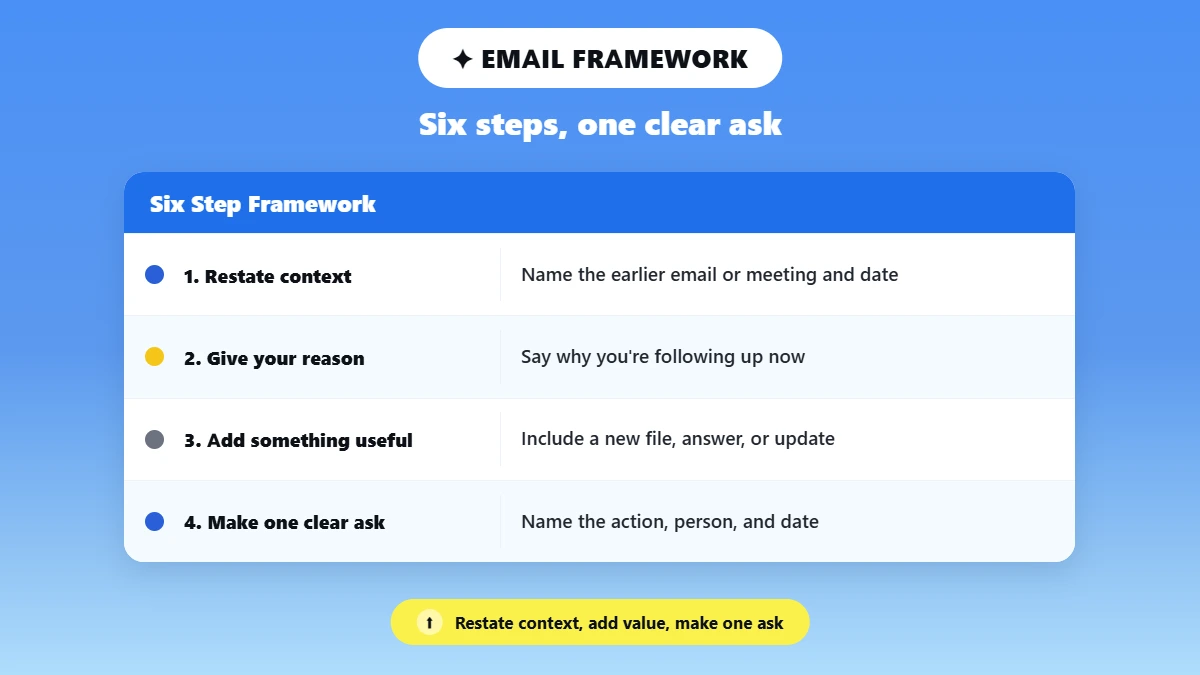
Write a follow-up email in six steps: restate the context, give your reason for writing again, add something useful, make one clear request, keep it short, and close professionally.
The whole message should fit on one phone screen.
Context → Reason for following up → Value or update → One clear ask → Professional close
1. Remind Them of the Context
Name the previous email, call, or meeting and its date in your first line, so the recipient doesn't have to search for it.
2. Explain Why You're Following Up
Give the reason you're writing again now: a deadline, a decision date, or a project stage.
3. Add New Information
Include one new item, a revised file, an answer to their question, or a shorter summary. That's what earns the second message its place in the inbox.
4. Make One Clear Request
Ask for one thing, and name the action and the date: "Could you approve the budget line by Thursday?" gives the recipient one clear ask.
5. Keep It Short
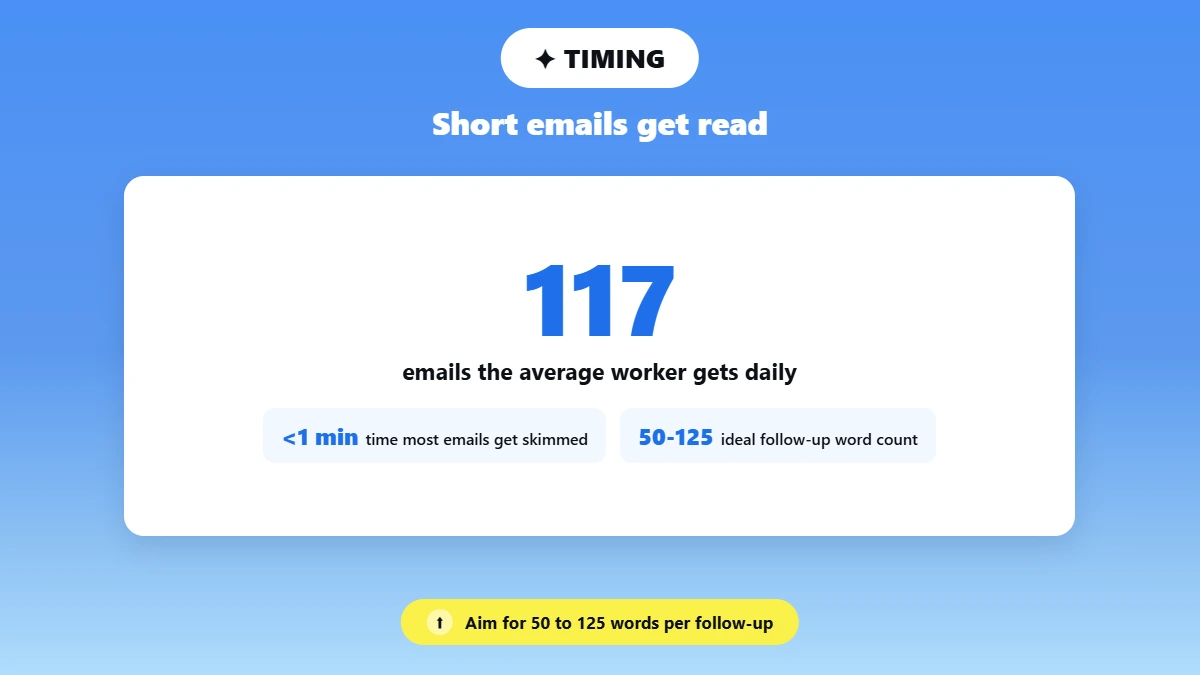
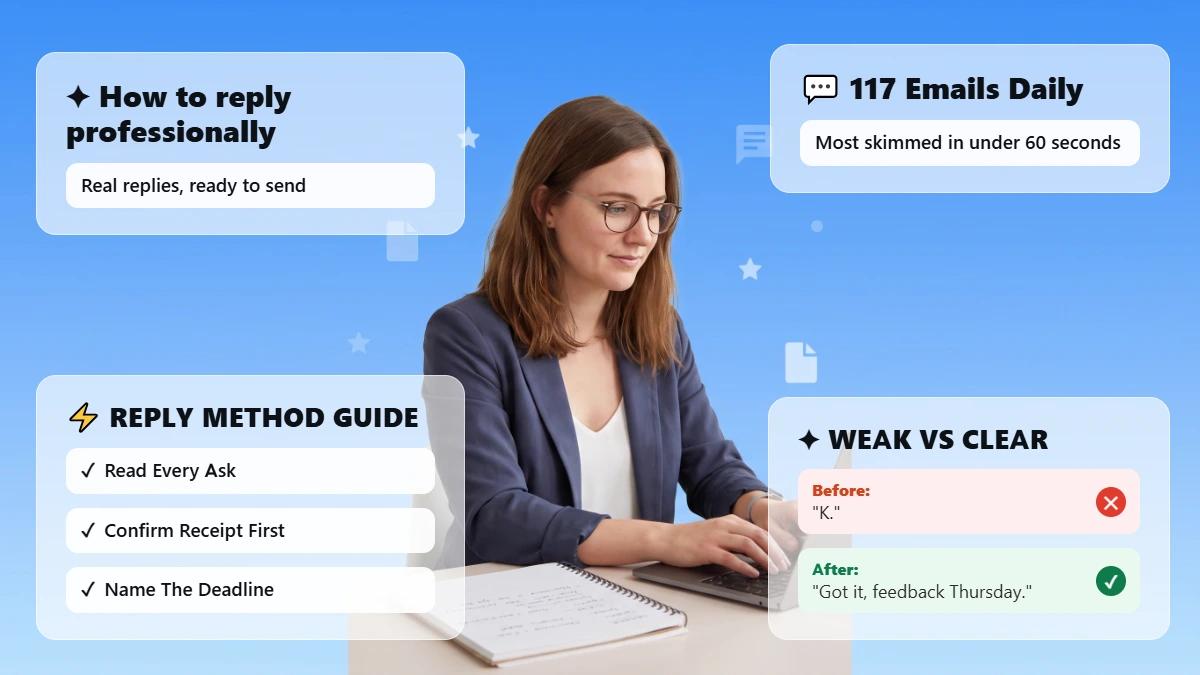
Aim for 50 to 125 words. Per Microsoft’s 2025 Work Trend Index, the average worker receives 117 emails a day and skims most of them in under a minute.
6. Close Professionally
End with a plain sign-off and your name, and skip pressure lines like "looking forward to your urgent response.
💡 The rule that fixes most follow-ups:
If your follow-up contains no new information, the recipient has no new reason to reply.
What Should a Follow-Up Email Include? (Format and Example)
A follow-up email includes six parts:
A subject line
A greeting
The context
Your reason for writing again
A call to action
A close.
Here is one message with every part labeled.
Subject: Following up on the Q3 content plan
Greeting: Hi Daniel,
Context: I sent over the Q3 content plan last Tuesday after our call about the blog refresh.
Reason for following up: The design team needs the go-ahead by Friday to book illustration time.
Call to action: Could you confirm whether the October dates work, or tell me which ones to move?
Close: Thanks, Alina
That message runs to 60 words. The recipient learns what it concerns, why it matters this week, and exactly what to answer.
How to Write a Follow-Up Email After No Response
Send a short reply on your original thread and restate the request in one line. Silence usually means the message was missed or deprioritized, so make the second reading easier than the first was.
First Follow-Up After No Response
Reply to your own email two to three business days later. Summarize the original request in one sentence and ask whether the recipient is the right person for it. Full wording sits in Template #2 below.
Second Follow-Up After No Response
Wait about a week, then add something the first two messages didn’t have: an updated file, a relevant result, or a shorter version of the ask. Template #3 shows the wording.
Final Follow-Up (Closing the Loop)
Your last message closes the thread without blame. State that you’ll stop here, leave the door open, and thank them for their time. A line like
“I’ll leave this with you, and I’m happy to pick it up whenever the timing suits”
works in almost any context.
Does a closing-the-loop email actually get replies?
Often, yes. A message that removes the obligation to act is easy to answer honestly, so recipients who had been avoiding the thread frequently respond with a real status update.
How Many Follow-Ups Is Too Many?
For most business situations, three to four total messages is the ceiling, spaced across two to three weeks. Sales sequences may run longer, and that call belongs to your own reply data rather than a general rule. Stop immediately when someone asks you to.
⚠️ Stop the sequence when:
the person asks you to, an auto-reply says they’ve left the company, or you have nothing new left to add.
How Long Should You Wait Before Sending a Follow-Up Email?
Wait two to three business days for most work emails, and follow the agreed timeline where one exists. There’s no single best time that suits every audience, industry, or time zone.
Situation | Suggested approach |
|---|---|
General business email | A few business days, and give a real reply window |
Sales lead | Several business days, depending on warmth and your sequence |
Proposal or quote | After the agreed review period or a reasonable interval |
Meeting | Promptly, usually the same day or the next morning |
Job application | Follow the hiring timeline posted with the role |
Interview | See our dedicated interview follow-up guide |
Invoice or request | Based on the due date and the urgency |
Send-time patterns shift year to year. Belkins’ 2025 outreach study of 7.5 million cold emails found morning sends between 8am and noon drew the highest reply rates, a reversal of the evening pattern its earlier reports showed.
How to Politely Follow Up Without Sounding Pushy
Follow up politely and name the topic in your email, let the recipient say no, and drop any language that assigns blame. If you soften it with "sorry to bother you again," you're apologizing for your own work, and the message stays just as unclear.
Is “A Gentle Follow-Up Please” Professional?
Yes. The phrase is polite and widely used, though it reads as slightly formal in American business English and says nothing about the topic.
“A gentle follow up please” works better once you attach the subject: “A gentle follow-up on the signed contract.”
What should I write instead in a subject line?
Name the item and the status:
“Reminder: signed contract due Friday.”
The recipient can act on it from the preview pane alone.
Better Ways to Say “Just Following Up”
Each of these names the topic, which is what the original phrase leaves out:
“Checking in on the design review”
“Following up on my note from Tuesday”
“Could you share an update on the invoice?”
“I wanted to confirm whether the dates still work”
“A quick reminder about the signed form”
“Circling back on the pricing question”
“When you have a moment, could you look at the draft?”
“Would you be able to let me know either way?”
“Any movement on the approval?”
“Is this still on your list for this month?”
“Where are we with the contract?”
“Should I hold the slot, or release it?”
Gentle Follow-Up Templates You Can Copy
A gentle follow-up keeps the request intact but removes any pressure to act right now. Paste one of these, swap the brackets, and send.
A gentle nudge on an open request
Subject: A gentle follow-up on [item]
Hi [Name], just keeping this on your radar, no rush at all. Whenever you have a moment, could you [specific action]? Happy to wait if the timing's tight. Thanks, [Your name]
A soft check-in after silence
Subject: Still the right person for [topic]?
Hi [Name], circling back on my note from [day]. A yes, no, or "not now" is all I need, whichever it is. And if someone else handles this now, point me their way. Thanks, [Your name]
A no-pressure reminder with a deadline
Subject: Reminder: [item] due [date]
Hi [Name], a quick reminder about [item], which we need by [date] to stay on track. If that timing is difficult, tell me and we'll work something out. Thanks, [Your name]
And a few paste-ready lines to drop into any message when you just need to soften the ask:
"No rush at all, I just wanted to keep this on your radar."
"Happy to wait if the timing is bad, just let me know."
"A yes or no is all I need, whichever it is."
"I'll leave this with you and follow your lead on timing."
If a draft still reads blunt or over-apologetic after you’ve swapped the phrasing, Phrasly’s Formalizer can shift it toward friendly or professional while the request stays as you wrote it.
Best Follow-Up Email Subject Lines
The strongest follow-up subject lines are specific, short, and honest. Name the topic, and keep it under about 50 characters so it survives on a phone screen.
After no response
“Quick check on the Q3 plan”
“Still the right person for this?”
“Re: [your original subject]”
Sales or client
“The pricing breakdown you asked for”
“Next step on the onboarding”
Meeting, proposal, and networking
“Recap and next steps: Tuesday’s call”
“Questions on the proposal?”
“Good to meet you at SaaStock”
Gentle reminder
“Reminder: signed form due Friday”
“A gentle follow-up on the invoice”
15 Follow-Up Email Templates for Every Situation
Every template below follows the same four labels: who it suits, a subject line, the message, and why it works. Replace the bracketed details with your own, and cut any line that doesn’t apply to your situation.
1. General Professional Follow-Up
Best for: any work message that hasn't been answered yet
Subject: Following up on [topic]
Hi [Name], I'm following up on my message from [day] about [topic]. I've attached the [document] again so it's easy to find. Could you let me know if [specific action] works on your end? Thanks, [Your name]
Why it works: One topic, one attachment, and one question the reader can answer in a single line.
2. Follow-Up After No Response
Best for: a first email that got no reply
Subject: Quick check on [topic]
Hi [Name], I sent a note last [day] about [topic] and want to be sure it reached you. Here's the short version: [one-line summary]. Are you the right person for this, or should I contact someone else? Thanks, [Your name]
Why it works: The “right person” question gives a busy reader a reply that costs them ten seconds.
3. Second Follow-Up After No Response
Best for: your second attempt on the same thread
Subject: Re: [original subject]
Hi [Name], one thing to add to my earlier note: [new detail, link, or update]. If [topic] isn't a priority right now, say so and I'll stop here. Otherwise, is [date] a good time to talk? [Your name]
Why it works: New information gives the second message a reason to exist beyond a reminder.
4. Gentle Reminder Email
Best for: a colleague or client who owes you something small
Subject: Reminder: [item] due [date]
Hi [Name], a quick reminder about [item], which we need by [date] to stay on schedule. Tell me if that timing is difficult and we'll work something out. Thanks, [Your name]
Why it works: The deadline and the offer of flexibility sit together, so the reminder reads as helpful.
5. Sales Follow-Up Email
Best for: a lead who showed interest and went quiet
Subject: [Result] for [their company]?
Hi [Name], after our call about [problem], I put together [resource] showing how [similar company] handled the same thing. Worth a 15-minute call next week? [Your name]
Why it works: The prospect receives something before the email asks for their time.
6. Cold Email Follow-Up
Best for: outreach to someone who has never met you
Subject: One more idea for [their company]
Hi [Name], my last email may have landed at a bad moment. The short version: [one-sentence value]. If this isn't relevant, reply “no thanks” and I won't write again. [Your name]
Why it works: An explicit opt-out lowers the cost of replying and protects your sender reputation.
Reply rates on cold sequences are low by nature. Hunter’s State of Cold Email put the 2025 average sequence reply rate at 4.5%, which is why a polite second touch matters more here than anywhere else.
Our own research on AI vs human cold email reply rates covers what changes when the draft is machine-written.
7. Client or Potential Customer Follow-Up
Best for: an existing client with an open item
Subject: Next step on [project]
Hi [Name], we're ready to move to [next stage] on [project]. All we need is [specific input] from your side. Can you send it by [date], or tell me who should? Thanks, [Your name]
Why it works: One named input and one named date remove the guesswork for the customer.
8. Proposal Follow-Up
Best for: a proposal sent and not yet answered
Subject: Questions on the [project] proposal?
Hi [Name], you've had the [project] proposal since [date]. Are there questions I can answer, or sections you'd like adjusted? If the timing has changed, that's fine, just tell me where things stand. [Your name]
Why it works: The email asks for a decision and makes “not yet” an acceptable answer.
9. Quote or Estimate Follow-Up
Best for: a quote or estimate awaiting approval
Subject: Status of your [service] quote
Hi [Name], I'm checking on the quote I sent for [service] on [date]. The pricing holds until [date]. Would you like me to adjust the scope, or shall I hold the slot for you? [Your name]
Why it works: A real expiry date gives the reader a reason to answer this week.
10. Follow-Up After a Meeting
Best for: the message you send after a call or meeting
Subject: Recap and next steps: [meeting topic]
Hi [Name], thanks for your time today. To recap: [decision 1] and [decision 2]. You're handling [task] by [date] and I'm handling [task] by [date]. Anything I've missed? [Your name]
Why it works: The recap doubles as a written record that either side can correct.
11. Networking Follow-Up
Best for: someone you met and want to stay in contact with
Subject: Good to meet you at [event]
Hi [Name], I enjoyed our conversation about [topic] at [event]. You mentioned [detail], so I thought you'd like [article or resource]. No reply needed, though I'd be glad to keep in touch. [Your name]
Why it works: The message gives without asking, which is what makes a second contact welcome.
12. Conference or Trade-Show Follow-Up
Best for: leads you collected at a booth or session
Subject: [Event] follow-up: [what you discussed]
Hi [Name], we spoke at [event] about [topic]. You asked about [specific question], so here's the answer: [short answer]. Happy to send the full [resource] if it's useful. [Your name]
Why it works: One specific detail proves the email isn't a mass send from a badge scan.
13. Job-Application Follow-Up
Best for: an application you submitted with no response yet
Subject: Application for [role]: [Your name]
Hi [Name], I applied for the [role] position on [date] and remain interested. My background in [skill] lines up with [requirement from the posting]. Is there an update on the hiring timeline? Thank you, [Your name]
Why it works: One named skill tied to the posting reminds the reader why your file is worth reopening.
14. Interview Follow-Up
Best for: after an interview, once the decision date has passed
Subject: Following up on my [role] interview
Hi [Name], thank you again for the conversation about the [role] position on [date]. I'm still very interested, and our discussion of [topic] confirmed it. Is there an update on next steps? Thank you, [Your name]
Why it works: Gratitude plus a single status question fits the stage without adding pressure.
Interview follow-ups carry their own timing conventions, thank-you etiquette, and second-interview rules, so one template only goes so far. Our guide to how to follow up after an interview covers the full sequence.
15. Document, Approval, or Response Request
Best for: a signature, file, or approval you're waiting on
Subject: Still need: [document] for [purpose]
Hi [Name], I'm still waiting on [document] to finish [task]. It takes about [time] on your side. Could you send it by [date]? Tell me if someone else should handle it instead. Thanks, [Your name]
Why it works: A time estimate makes the request feel small enough to do straight away.
Paste your finished draft in and check the tone before you send it. 👇
Common Follow-Up Email Mistakes to Avoid
The most common mistake is a follow-up that adds no new information, so the recipient has nothing to respond to. These are the patterns that cost replies:
An empty “just following up” with no context, no topic, and no new detail.
Guilt-tripping. “I’ve now written three times” makes the reader defensive rather than helpful.
Repeated apologies. “Sorry to bother you again” frames your own work as an imposition.
Two or more asks. Split attention usually produces no answer at all.
Passive-aggressive phrasing. “Per my last email” reads as a complaint, whatever the intent.
Long wind-ups. Three lines of pleasantries before the point push the ask below the fold.
An identical resend. The same words that were ignored once will be ignored twice.
Robotic formality. Stiff, templated phrasing signals a mass send even when it isn’t one.
That last one has become easier to spot since AI drafting became common. Phrasly’s analysis of phrases AI detectors flag most often found filler openers like “it is important to” dominating the flagged samples, and “I just wanted to follow up” belongs to the same family.
If you draft with AI, our guides on how to make AI-written emails sound human and the self-editing checklist for copywriters both cover the cleanup.
How to Get the Tone Right (Professional, Not Pushy)
Write the message first, then check the tone separately. Tone edits made while you’re still deciding what to say produce emails that are either too blunt or padded with apologies.
Read the draft once as the recipient, then pick the direction it needs.
Reads blunt? Shift it friendly, leave the ask untouched.
Reads too casual? Shift it professional.
Reads long-winded? Shift it concise.
Phrasly's Formalizer does all three, so you can make your follow-up email sound more professional without rewriting what you’re asking for. Our guide on how to improve the tone of a professional message covers longer messages.
💡 Edit with AI, don't author with it. A 2025 Journal of Business Research study of seven preregistered experiments found that emotional messages readers believed were AI-written drew less positive word of mouth and loyalty, and that the effect weakened when AI was used only to edit.
A follow-up works when it respects the reader's time: one topic, one new detail, one question, and an easy way to say no.
Your next follow-up is written. Check how it reads before it leaves your outbox. 👇
Frequently Asked Questions
Should I send a follow-up email in the same thread?
Yes. A reply on your own original message keeps the context, the attachments, and the history in one place. The recipient can scroll down and see what you're referring to. Start a new thread only when the subject has genuinely changed.
How many follow-up emails should I send if someone doesn't respond?
Three to four messages in total, including the first one, suits most business situations. Space them out, add something new each time, and close the loop politely on the last one. Sales sequences may run longer, guided by your own reply data.
How long should a follow-up email be?
Around 50 to 125 words, or roughly five short lines on a phone screen. The reader needs the context, your reason for writing, and one clear request. Anything longer usually gets saved for later and forgotten. Our self-editing checklist covers what to cut first.
Is it rude to send a second follow-up email?
No. A second message is normal professional practice when it adds something and stays polite. Rudeness comes from tone and frequency, not from the count. Space your messages out and avoid any hint of blame.
What can I say instead of “just following up”?
Try “checking in on,” “circling back on,” “could you share an update on,” or “I wanted to confirm whether.” Each one names the topic instead of only announcing that you're writing again. The original phrase turns up constantly in AI-drafted email, and our research on common AI phrases lists the rest.
Should I apologize for following up?
No. Apologies like “sorry to bother you” suggest your request is an imposition. A follow-up on your own work is a normal part of business email. Stay warm and skip the apology.
When should I stop following up?
Stop after your closing-the-loop message, or as soon as the person asks you to. Leave the door open with a line like “I'll leave this with you.” Silence after a polite final email is an answer.
Can I send a follow-up email after one day?
Only when the situation is genuinely time-sensitive, such as a deadline today or a meeting recap. For a normal request, one day rarely gives the recipient time to act, and an early chase can read as pressure.

Written by
Alina Shah
SEO Content Specialist · Karachi, Pakistan
She writes about AI so you don't have to guess. 8+ years in content strategy and editing. Now she puts AI writing tools and detection systems through real tests and shares what actually works.