Does WGU Check for AI? WGU AI Detection Explained (2026)
11 min read
Yes, WGU checks for AI. If you are a WGU student sitting on a Performance Assessment and wondering whether anyone runs it through a detector, the university already does, automatically, before a human opens it.
We went through WGU’s own policy pages, Student Policy Handbook, and blog posts published through March 2026 to separate confirmed policy from student guesswork.
This guide covers what gets scanned, how the detection works, what WGU has never confirmed, and what to do if your original writing gets flagged.
TL;DR: Yes. WGU checks Performance Assessment submissions for AI-generated content. WGU says every Performance Assessment is automatically run through its integrated AI and grammar checker. An AI score alone does not settle the question, because WGU pairs it with human review by trained academic integrity evaluators.
Check your draft before your evaluator does 👇
Not sure how your writing reads to a machine? Paste it into Phrasly’s free AI Detector to see which passages look AI-generated, then revise those lines in your own voice.
💡 How to read this guide.
Every claim below carries a label.
✔ WGU official policy: stated directly in a current WGU source.
◑ Not publicly disclosed: WGU stays silent, and we say so.
◔ Student-reported: from student discussion, with no policy weight.
Does WGU Check Every Paper for AI?
Yes, for Performance Assessments. WGU says every Performance Assessment submission is automatically run through its integrated AI and grammar checker.
Objective, proctored exams are governed by proctoring rules instead, so the automatic scan applies to written PA work rather than to every assessment type.
✔️ The source is WGU’s Do’s and Don’ts of Passing a Performance Assessment page, refreshed in March 2026. It also tells students to review the report first and revise the work when it shows a high similarity or AI-generated content score.
WGU is far from alone in scanning submissions, and our guide on do colleges check for AI covers how the wider system works.
What the automatic scan covers
✔️ Performance Assessment papers, projects, and presentations you upload
✔️ The similarity check and the AI check, run together at submission
❌ Objective Assessments, which are governed by proctoring rules instead
❌ Anything you draft outside the submission page
How Does WGU Detect AI Writing?
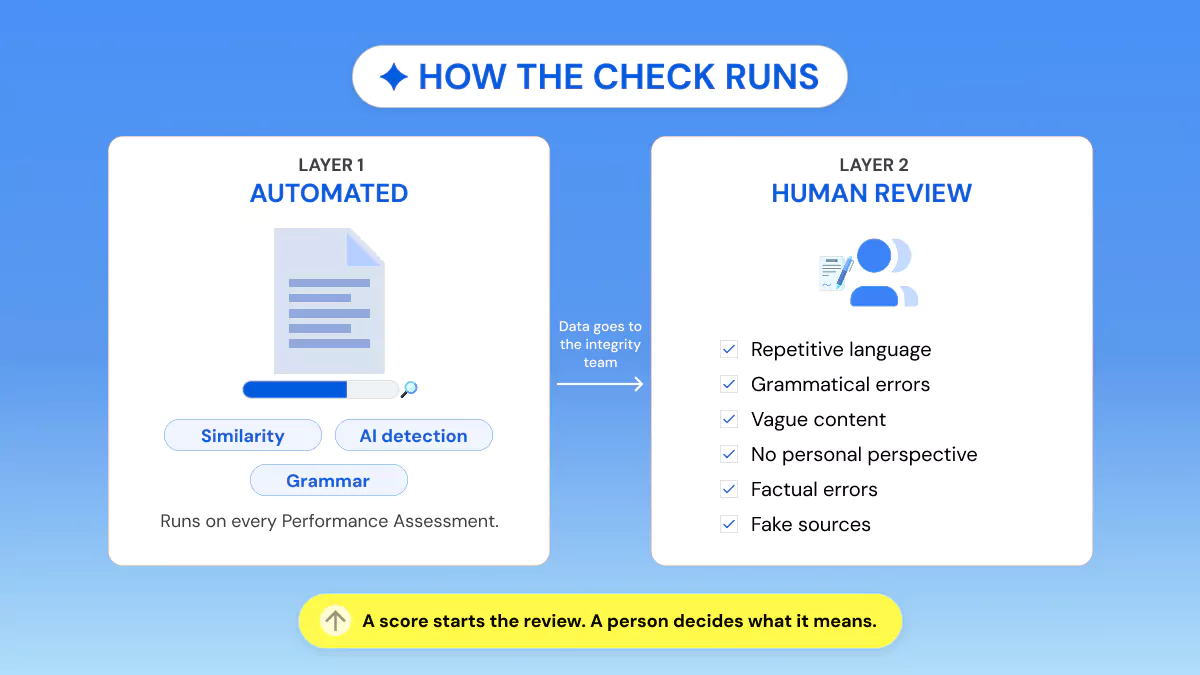
WGU uses two layers.
First layer: Its Similarity Checker runs an AI detection tool in the background that flags likely AI-generated text.
Second layer: That data then goes to trained academic integrity evaluators, who manually review for patterns such as:
fabricated sources
vague content
missing personal perspective
Detection produces a signal that starts a review.
The Student Policy Handbook, updated June 2026, defines the Similarity Checker as software that checks your work against web sources, public sources, previously submitted work, and AI-generated work.
The automated layer reads linguistic patterns. ✔ In its June 2025 guidance, WGU names sentence lengths, hyphens, average syllable counts, and parts of speech among its signals, and says the tool carries a 0.2% false positive rate.
Then people take over.
✔️Academic integrity evaluators are trained to read flagged submissions for six specific patterns:
Repetitive language
Grammatical errors
Vague content
Lack of personal perspective
Factual errors
Fake, irretrievable sources
WGU is direct about why the second layer exists. Its June 2025 guidance says detection tools can only indicate that content is likely AI-generated, and because even one false positive is unacceptable to the university, it relies on overt evidence of generative AI use before calling anything a violation.
See what an AI checker sees. Run your draft through Phrasly’s free AI Detector; sentence-level highlighting shows which lines read as AI-generated so you can rewrite them in your own words. 👇
What AI Detector Does WGU Use?
WGU confirms it uses AI detection and does not publicly name the vendor. Its materials reference an integrated AI and grammar checker and a Similarity Checker with built-in AI detection.
◑ A third description appears on WGU’s own blog, which calls the system a pre-checker that validates student essays against rubrics and screens for AI-generated text. Three descriptions, no vendor.
Does WGU use Turnitin?
◑ Unverified. Older WGU documents referenced Turnitin for plagiarism checking. Current pages say Similarity Checker and stop there, so treat any claim that WGU runs Turnitin AI detection today as unconfirmed.
Does WGU use Copyleaks?
◔ ◑ Students guess this one because Copyleaks’ combined AI and plagiarism detector is a common learning-management integration at other universities. WGU confirms nothing of the sort on its own pages.
Is Grammarly WGU’s AI detector?
✔ No. WGU provides Grammarly for Education and treats it as acceptable writing support. Detection runs on a separate tool, so any AI score Grammarly shows you belongs to Grammarly alone.
Can WGU Detect ChatGPT?
WGU can flag text it considers likely AI-generated, including ChatGPT-style writing.
WGU’s own guidance says AI detectors can only estimate likelihood, so they cannot prove that a specific tool like ChatGPT wrote a passage. A score is a starting point for human review.
That limit, in WGU's own wording, is why a score opens a review rather than closing one. For the wider picture, see whether schools can detect ChatGPT.
What AI Percentage Is Acceptable at WGU?
WGU does not publish a universal acceptable AI percentage. Its guidance says to review and revise work that receives a high AI-generated content score, and it defines no numeric threshold.
Figures traded between students are anecdotal, so treat no score as an official WGU cutoff or a safe zone.
◔ Students do trade numbers among themselves. In a 2026 r/WGU discussion about AI detectors, one student advises keeping the score under 20%, another says they never go over 25%, and a third reports passing a task that came back at 46%.
No score is a safe zone in either direction.
Our breakdown of how much AI detection is acceptable explains why the figure moves between tools.
WGU AI Score vs. Similarity Score: What’s the Difference?
They measure two different things.
Similarity shows how much of your text overlaps existing sources.
AI detection estimates how likely it is that software produced the wording.
The confusion is easy to understand, because the AI side rarely surfaces in the report you see.
✔ ◔ The AI component runs in the background and its data goes to the academic integrity team, which is why plenty of students never see an AI number in their own report.
If yours displays AI Content: N/A, the likeliest explanation is that the figure is not shown to students.
Aspect | Similarity Score | AI Detection |
|---|---|---|
What it measures | Overlap with existing sources | Likelihood text was AI-generated |
Same thing? | No | No |
Student-facing? | Usually shown in your report | Often background only, hence N/A |
Human judgment needed? | Yes | Yes, WGU stresses this |
A high score suggests | Uncited or unoriginal content | Possible AI text, a signal only |
Can Grammarly Make Your WGU Paper Look AI-Generated?
Possibly. WGU says tools like Grammarly can get your work flagged because they change sentence structure.
WGU provides Grammarly for Education and uses a separate detection tool, so any AI score Grammarly shows you belongs to Grammarly alone.
Grammarly itself stays permitted.
✔ The Use of AI Tools policy, updated February 2026, lists Grammarly for Education among tools that provide basic (spelling, grammar, and syntax) corrections, and says that level of help requires no citation.
Most students meet AI at the editing stage anyway. 54% of US college students say they use AI to edit or improve their writing daily or weekly, according to Gallup’s 2026 study with Lumina Foundation.
◔ Many of the alarming numbers students post come from Grammarly's own AI checker, not from WGU. In a 2025 r/WGU thread on Grammarly AI detection, one student reported the tool flagged 13% of a 2,629-word paper they wrote themselves.
How much the tool changes your writing decides the risk. Comma and typo level fixes keep the writing yours. But paragraph-level rewrites change the pattern a detector reads, and that is where false positives start.
See why your essay might be flagged as AI and how AI detector false positives happen.
Is ChatGPT (and Other AI) Allowed at WGU?
Not banned outright. WGU allows AI for supportive learning such as brainstorming, explaining concepts, getting feedback, and checking answers.
You cannot submit AI-generated work as your own or use AI in ways a task’s instructions prohibit. WGU frames responsible use around context, motive, and transparency. When a task's instructions don't address AI, WGU's AI policy is the fallback: the Use of AI Tools policy governs.
Using AI at WGU
✔️ Brainstorming, explaining a concept, feedback, checking your answers
✔️ Spelling, grammar, and syntax corrections, no citation needed
❌ Submitting AI-generated work as your own
❌ Using AI where a task’s own instructions prohibit it
✏️ Cite it when AI-generated content shapes your content or structure
At submission, two rules decide most cases: cite any AI-generated content that shapes your work, and follow a task's own stricter instructions where they exist.
Where a task’s instructions set stricter limits, those instructions govern.
The obligation it keeps is the original one, which is that the competency being assessed has to be yours.
What Happens If WGU Flags Your Work for AI?
Not automatic punishment. A high AI score starts a human review rather than an instant penalty.
Most cases end in revising and coaching, while some send academic warnings. However, repeated or serious violations escalate to the Academic Coaching Center and Student Conduct.
Fabricated sources follow a documented path: evaluators lock the submission and return it unevaluated. You then meet your instructor, revise the work, and go through every source together. After that, the evaluation unlocks.
✔️ One practical consequence is worth knowing in advance. The Academic Integrity policy says WGU may block access to assessment scheduling or task submission while an investigation is underway, so a case can stall your term as well as one task.
Our guide on what happens if you get caught using AI walks through how these cases resolve.
What to Do If You Wrote It Yourself but Got an AI Flag
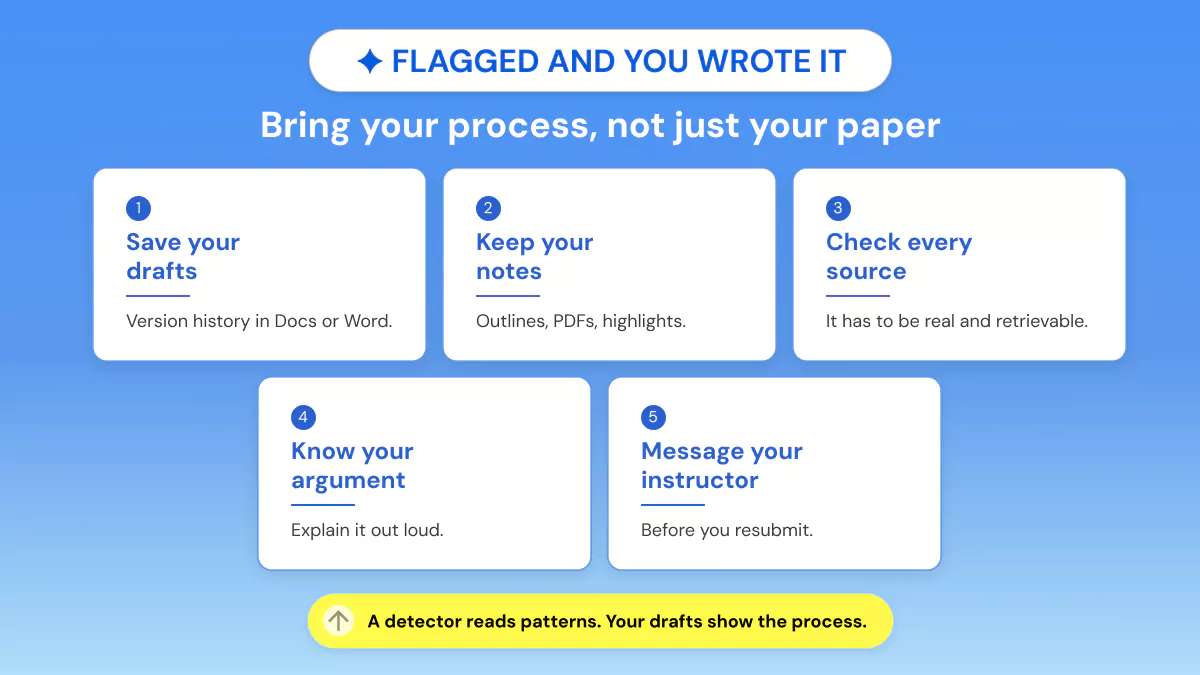
📁 Gather your evidence first
Keep timestamped drafts and version history. Google Docs and Word both retain it automatically.
Keep your research notes, highlighted PDFs, and outlines.
Verify every citation exists and can be retrieved. WGU flags fabricated sources specifically.
Be ready to explain your argument out loud, in your own words.
Contact your Course Instructor early rather than resubmitting and hoping.
⚖️ Why clean writing gets flagged
Detectors do flag real human writing, and the risk is highest for formal, polished essays and for students whose first language is not English. Stanford’s detector-bias study tested seven detectors and found 61% of TOEFL essays by non-native English writers flagged as AI-generated, while essays by US-born eighth-graders came back near-perfect.
That work ran in 2023, on a 91-essay sample and on that generation of tools, so read it as evidence the risk is real rather than as a current rate.
Phrasly’s analysis of 37,874 human-written student essays, all produced between 2010 and 2021, found that ZeroGPT labelled 26.4% of them AI-generated.
◔ The gap between tools shows up constantly. In a 2024 r/WGU thread, a returning student found a third-party checker rating their own writing 100% AI, submitted the same paper anyway, and saw WGU’s similarity report come back at 0.6%. The task passed.
So resist the urge to panic-rewrite work you know is yours. A rewrite done only to lower a detector score makes your writing worse. Your evaluator grades clear writing, and never the score.
📊 The false-positive picture
61% of TOEFL essays by non-native English writers were flagged as AI by seven detectors (Stanford, 2023 sample of 91 essays).
26.4% of 37,874 human-written student essays were labelled AI by ZeroGPT (Phrasly, 2025).
0.2% is the false positive rate WGU claims for its own tool.
If you want to see what a checker sees first, Phrasly’s AI Detector highlights sentences that read like a bot so you can rewrite them in your own voice.
If your draft was AI-assisted and reads robotically, the AI Humanizer helps you turn your own draft into natural language.
Our roundup of free AI checkers for students compares the alternatives.
WGU checks written submissions for AI, keeps the vendor to itself, publishes no safe percentage, and puts a trained person between the score and the consequence.
In a system like this, three habits keep you safe:
Write the work yourself
Save your drafts as proof
Verify every source you cite
A pre-submission check earns its place because it shows which sentences read machine-like while you can still revise them.
Make the check part of your routine.
Run every Performance Assessment through Phrasly’s free AI Detector before you submit and revise the lines that read machine-written.
No checker can promise what WGU’s system will show, and looking first still beats finding out afterward. 👇
FAQs
Does WGU check for AI?
Yes. WGU says all Performance Assessment submissions run automatically through its integrated AI and grammar checker, then reach human reviewers when a score warrants it. Objective assessments follow proctoring rules instead.
What AI detector does WGU use?
Unverified. WGU confirms it uses AI detection without naming the vendor. Its materials reference an integrated AI and grammar checker and a Similarity Checker with built-in AI detection. Turnitin and Copyleaks remain student guesses.
Does WGU use Turnitin for AI detection?
Unverified. Older WGU documents referenced Turnitin for plagiarism checking, while current materials say Similarity Checker and stop there. No current WGU page confirms Turnitin AI detection today.
What AI percentage is acceptable at WGU?
None. WGU publishes no acceptable AI percentage; it tells students to revise on a high AI-content score and sets no numeric cutoff. Student-quoted figures are personal experience, so no score is guaranteed safe.
Can WGU detect ChatGPT?
Yes. WGU can flag text it reads as likely AI-generated, though its guidance says detectors cannot conclusively prove that a specific tool wrote a passage, so human review decides the outcome.
Can Grammarly trigger WGU’s AI detection?
Possibly. WGU says tools like Grammarly can be flagged because they influence sentence structure. WGU provides Grammarly for Education and uses a separate detection tool, so the score Grammarly shows you is its own. Editing tools are one of the common causes of AI detector false positives on work you wrote yourself.
What does AI Content: N/A mean at WGU?
Neither. It signals nothing about passing or failing, and usually means the score is not displayed to you, because WGU’s AI detection data runs in the background for its academic integrity team rather than producing a student-facing number.
What happens if WGU flags your paper for AI?
Review first. A flag sends the work to a human; outcomes range from revision and coaching to warnings, escalating to Student Conduct for repeated violations. Fabricated sources can get a submission locked and returned. If the flag lands on writing you did yourself, here is what to do when a detector says you used AI.

Written by
Alina Shah
SEO Content Specialist · Karachi, Pakistan
She writes about AI so you don't have to guess. 8+ years in content strategy and editing. Now she puts AI writing tools and detection systems through real tests and shares what actually works.