Can Schools Detect ChatGPT? What Students Should Know in 2026
Your school probably uses AI detectors. Here’s which tools they use, how accurate they are, and what you should know before submitting.
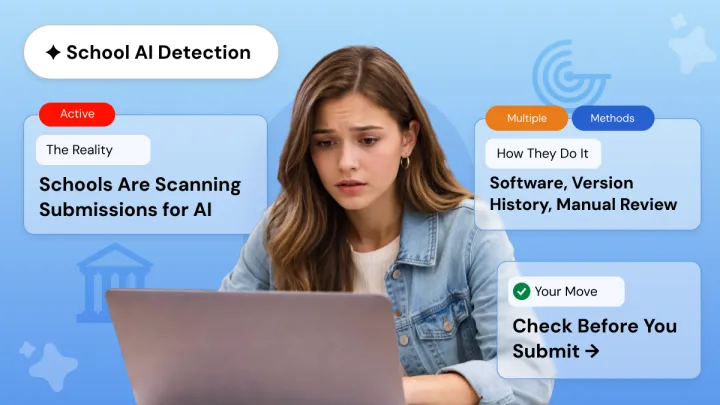
You typed in a question. A bot answered. You handed it in as yours. It felt harmless. Maybe even sneaky.
Schools aren't guessing anymore. Schools are using AI detectors to scan your essays, compare your homework to the sample you typed in class on Tuesday, check your writing history, and analyze document metadata.
Tools are smarter. Teachers have been trained. There are real consequences. You need to understand how detection really works. Whether you’ve used ChatGPT once or you’re a formal writer who fears being falsely flagged.
We break down everything here. No fluff. Just what you should know, what’s at risk, and what’s factual.
Can Schools Detect ChatGPT?
Yes! ChatGPT text will be detectable by most colleges/institutions in 2026. So that educators can maintain academic integrity, detection technology is designed to spot writing that contains patterns commonly associated with AI writing.
But it's worth noting that no detection method is going to be 100% accurate. AI detectors can give false positives, particularly if a student writes in an extremely formulaic way. Heavily edited AI text can also still pass undetected.
Here's how schools are actually detecting ChatGPT & AI work, what tools they're using, and what you should know to stay informed and responsible.
How Schools Detect ChatGPT (Every Method)
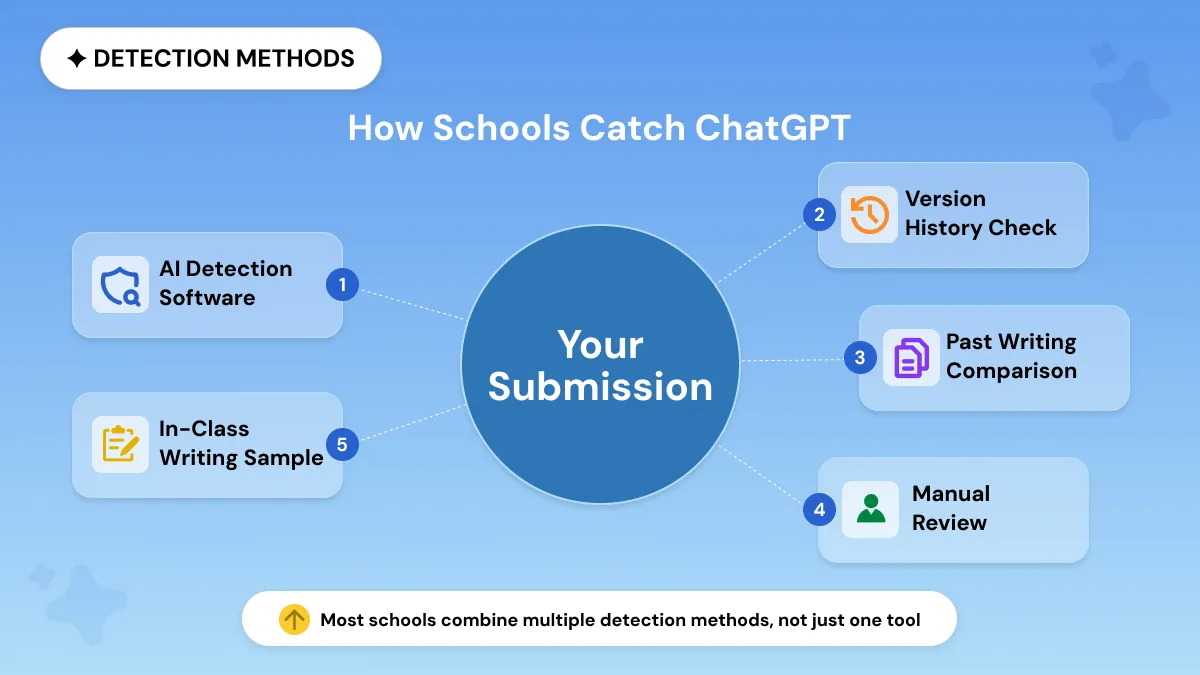
Schools use automated techniques, historical data, and human detection methods to determine if student submissions could have come from an AI.
To help ensure fair determinations, as there will always be exceptions, most institutions use multiple levels of detection.
Below are the main methods used in 2026.
AI Detection Software (Turnitin, GPTZero, Copyleaks, Winston AI)
AI detection tool is by far the most popular approach. Turnitin, GPTZero, Copyleaks, Winston AI, and other tools scan submitted essays and assignments for patterns common in content created by AI.
Algorithms analyze sentence structure, vocabulary, repetition, and "predictability" scores to flag suspicious content.
- Turnitin now features an AI detection score alongside its regular plagiarism report. You can read more about how Turnitin's detection system has evolved directly on their official FAQ.
- GPTZero determines the probability of AI by focusing on linguistic complexity and burstiness.
- Universities favor Copyleaks and Winston AI because they combine plagiarism checking with AI detection.
Keep in mind these tools aren’t perfect. They can produce false positives, especially with ESL students or very formal papers. Independent studies on detection accuracy rates show results vary significantly across tools and writing styles.
Version History and Metadata Checks
The version history and metadata of a document are also scrutinized by numerous schools when students submit work done through platforms like Google Docs or Microsoft Word.
Metadata reveals when text was entered or edited, how quickly it was typed, and if large sections were added verbatim at one time — habits that can often signify plagiarism from AI.
Say, for example, if your student typically submits drafts over the course of days or weeks, having a 2,000-word essay completed in under an hour would certainly be suspicious.
Lots of edits completed quickly or content pulled directly from AI tools can be viewed in Google Docs version history.
Comparison to Your Past Writing
Teachers frequently contrast new assignments with students' prior work. Style, vocabulary, phrase complexity, and even simple errors can all fall under this category.
It may be simpler to spot differences between AI-generated content and a student's usual writing style.
Instructors can refer to previous lab reports, discussion posts, and essays. Unexpected changes in vocabulary, tone, or complexity frequently trigger further investigation.
Manual Review — What Professors Look For
Professors often perform manual review on top of automated methods as well. They look for evidence that AI was used, such as:
- Sentences flow too well; transitions are stiff
- No personal experience or examples
- Non-specific wording that could apply to any topic
Human review is crucial: AI can’t confirm a student used ChatGPT beyond a reasonable doubt, and human judgment ensures equitable treatment and contextualization.
In-Class Writing Samples as Baseline
To get a sense of a student’s natural writing style, many schools require students to complete in-class writing samples. Teachers can catch inconsistencies that may indicate AI assistance by comparing an in-class essay to work turned in as homework.
If a take-home essay seems significantly more advanced than an in-class sample, a teacher may want to review it again. This method can help teachers tell the difference between AI-generated work and actual learning.
Which Platforms Have Built-In AI Detection?
Colleges and universities use learning management systems (LMS) to track assignments, grades, and plagiarism checks. Most platforms will either natively support third-party software with AI detection capabilities or have built-in AI detection.
For a specific example of how this plays out, see how Canvas detect AI through third-party integrations.
Here is how AI Detection works on some of the most widely used platforms.
Turnitin (Most Universities, Built-In AI Score)
Turnitin remains the gold standard for Higher Ed. Although
Turnitin originally started off as a plagiarism detection tool, they recently implemented an AI detection tool which provides a score that reflects the likelihood that a submission was AI-generated, including ChatGPT.
In addition to seeing the normal originality score, instructors will see detailed reports highlighting specific sentences that appear to have been generated by AI.
While a high AI score does not necessarily mean a student was cheating (remember, teachers will always review everything), this combined reporting method will help instructors make more informed decisions.
Canvas (SafeAssign Integration, Turnitin Plugin)
Canvas does not have built-in AI detection technology; however, Canvas is one of the most commonly used LMS platforms across high schools and colleges. Canvas seamlessly integrates with plugins such as Turnitin and SafeAssign.
When students submit assignments, teachers can set up these tools to automatically scan for AI content. SafeAssign and Turnitin flag content that may have come from an AI by looking at sentence structure, language patterns, and text predictability.
Schools can also create reporting metrics which makes it easier to catch suspicious work instead of solely relying on random manual checks.
Blackboard (SafeAssign Default)
Blackboard's standard built-in AI/plagiarism checker is SafeAssign. Student submissions are run through SafeAssign, which compares them to AI text patterns, public sources, and its own database.
SafeAssign reports highlight not only text matches but also areas where the writing sounds mechanical or too uniform, a common trait of AI-generated work.
Teachers often use their discretion alongside this information to identify mismatches with a student's usual writing.
Moodle (Plugin-Based, Varies by Institution)
Schools globally use Moodle, which is an open-source learning management system, and its AI Detection is completely reliant on what plugins the school has installed.
Turnitin and Copyleaks are popular plugins that can detect suspicious text and provide AI scores. Some schools do manual review but others configure Moodle to flag assignments that are over a certain AI probability threshold.
Students can face wildly different levels of AI detection based on their school because of how different Moodle can be set up.
Google Classroom (No Built-In, Teachers Add External)
Google Classroom has no native AI detection capabilities. Classroom does require students to submit assignments in appropriate file types, so teachers monitoring AI usage have to depend on third-party services such as Turnitin or Winston AI.
Viewing version history in Google Docs is a feature available through Google Classroom. Suspiciously rapid typing, excessive amounts of pasted text, or edits that take far too long compared to a student's normal speed can be easily spotted.
This allows teachers to more easily spot potential AI usage without AI detection.
How Accurate Are School AI Detectors?
AI detection methods are going to be an increasingly important part of maintaining academic integrity. However, these tools are far from perfect.
To understand just how often AI detectors can be wrong, it helps to look at real cases and limitations.
To adequately interpret results and avoid unnecessary anxiety, students should understand the pros and cons of these tools.
Turnitin and Reported Accuracy
Turnitin claims that Turnitin's AI detector can correctly flag AI-generated text most of the time. Turnitin scans sentence patterns, predictability, and other non-human writing tendencies using algorithms.
While these claims sound impressive, a closer look at AI detection accuracy shows that results can vary significantly depending on how the content was written.
Turnitin can likely identify blatantly AI-written work, however, it struggles to detect essays that students heavily rewrite.
Therefore, a high AI score is not always indicative of misconduct, and a low AI score does not always prove that work was written by a student.
False Positives Are Real
False positives are among the largest concerns regarding AI detectors. Occurring when work written by a person is flagged as being written by AI.
Research suggests that formal writing could lead to false positives, especially if students are utilizing scholarly language or boilerplates in their writing.
Educators are encouraged to consider previous posts, writing style, and context before making a decision on flagged work. Human review is still important as leaning on these AI tools too heavily will negatively impact students.
ESL Students Are More Likely to Be Flagged
Studies indicate that students who write in English as a second language (ESL) have a higher likelihood of being flagged by AI detection tools.
This discrimination occurs because AI can often confuse ESL writing for plagiarized content as it tends to utilize higher rates of formalized language, fewer colloquial phrases, and simpler sentence structure.
Schools implementing these tools are becoming increasingly aware of this bias and often require teachers to review flagged ESL students' work manually.
Edited AI Text Reduces Detection Accuracy
Your chances of getting caught are significantly lessened if students edit AI work heavily. AI writing can follow patterns similar to a student by rewriting sentences, inserting student thoughts and vocabulary changes.
While this may make it hard to catch, keep in mind that submitting solely AI written work, even if edited, can still be considered cheating by most schools’ policies. When it comes to academic integrity, it will always come down to a human decision.
Human Review Is Always Required
Most educational organizations emphasize that AI detection should only be one part of the equation.
Comparing submissions to previous work, considering in-class writing samples, and understanding the student’s typical writing style allows teachers to combine tool results with human judgement.
This layered approach prevents mistakes and protects students from false accusations so AI detection can be a supportive indicator, not a verdict.
How to Check Your Work Before Submitting?
Before you submit any assignments, it’s helpful to check if your writing may be flagged as AI-generated. Run your work through a reliable AI detector to ensure it adheres to your institution’s academic policies, catch potential issues early on, and edit as needed.
Step 1: Run Your Text Through Phrasly’s Free AI Detector
Run your assignment through an AI Detector. You can use Phrasly’s free AI Detector. Paste your writing into the tool. Phrasly looks for patterns in word choice, phrase formation, and wording that may appear artificial.
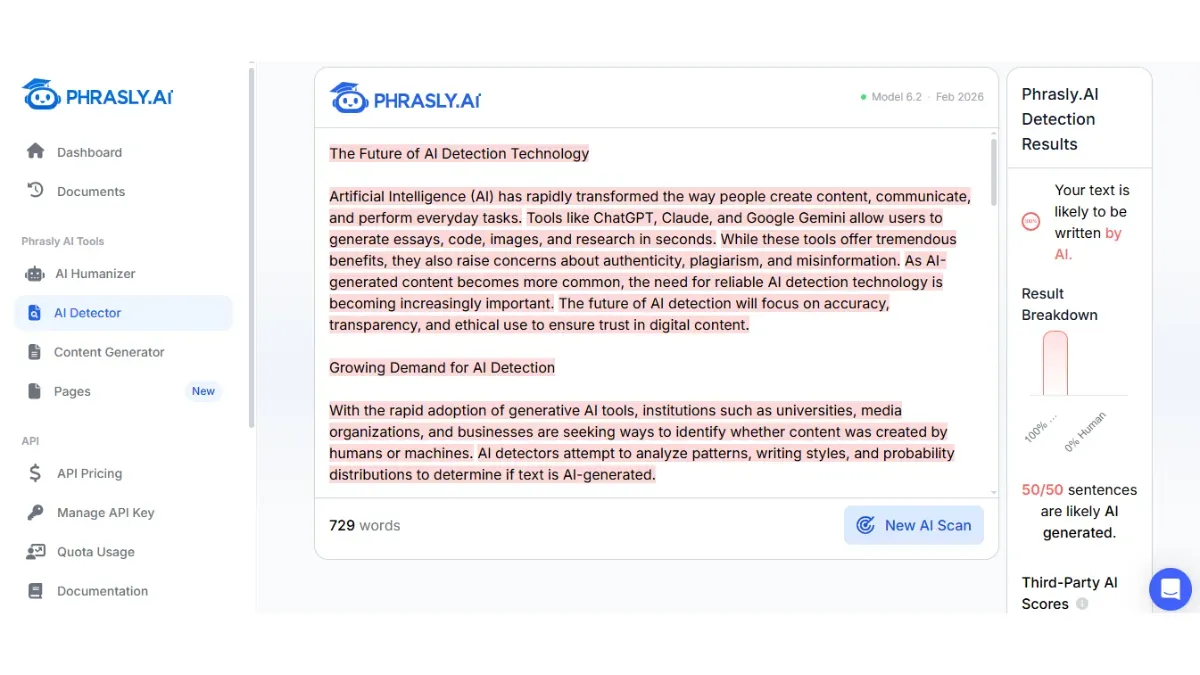
This pre-scan will show you where your writing is potentially flagged by school plagiarism tool so that you can edit it pre-submission.
Step 2: Review Sentence-Level Flags
Look closely at the sentences that are highlighted after the detector has completed its scan. Phrasly provides sentence-level markers to pinpoint exactly where AI patterns appear in your writing.
Watch for sentences that are very formulaic, repetitive, or generic– these will be picked up by school AI detectors the most. Mark the areas that require improvement and focus on those. Don't try to rewrite your whole essay.
Step 3: Revise Flagged Sections Manually
Now go back and edit the sections that were highlighted. Try to rewrite these sections using your own voice and more personally. You can:
- Add stories or personal examples
- Change word choice and sentence flow
- Insert observations, analysis, or explanation.
The objective is to improve your work and make sure it reflects your genuine effort rather than merely "beating the AI detector." The probability of getting flagged by school systems is significantly decreased by edited AI content or original modifications.
Step 4: Re-Check Until Clean
Run your work through Phrasly once again when modifications are finished. Continue reviewing and editing your writing until there are few or no AI flags.
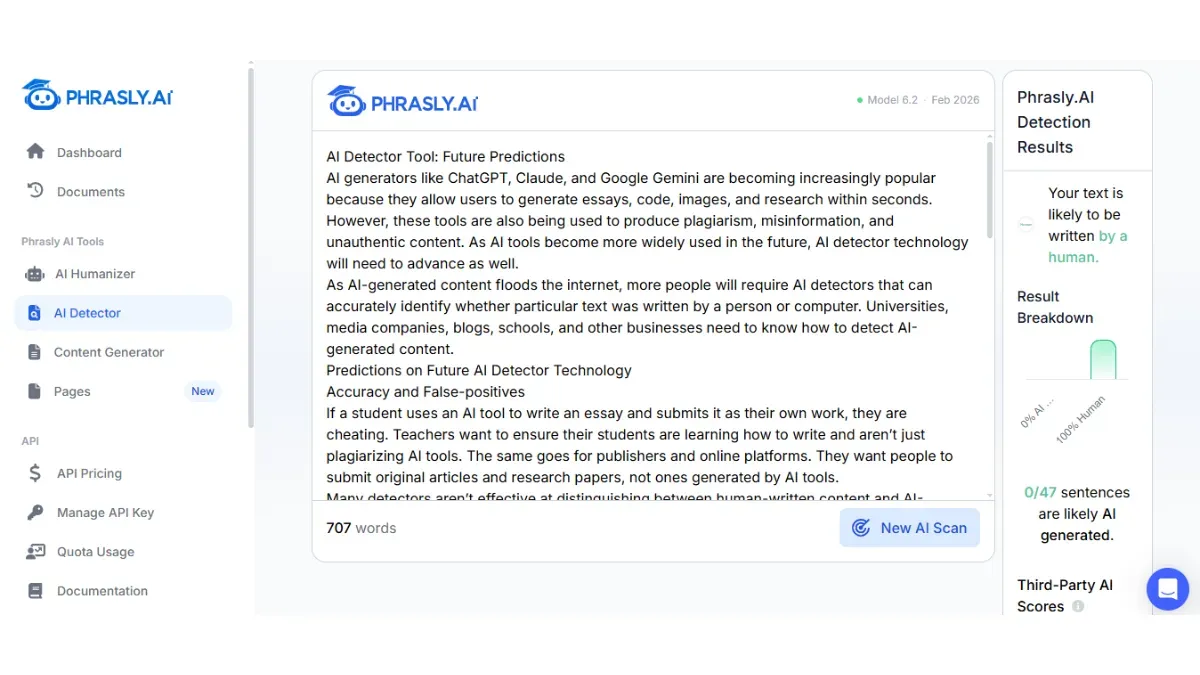
You may be sure that your project will be fairly assessed because this iterative procedure guarantees that your work is as safe as possible before submission.
Check Before You Submit!
What Happens If Your School Catches You?
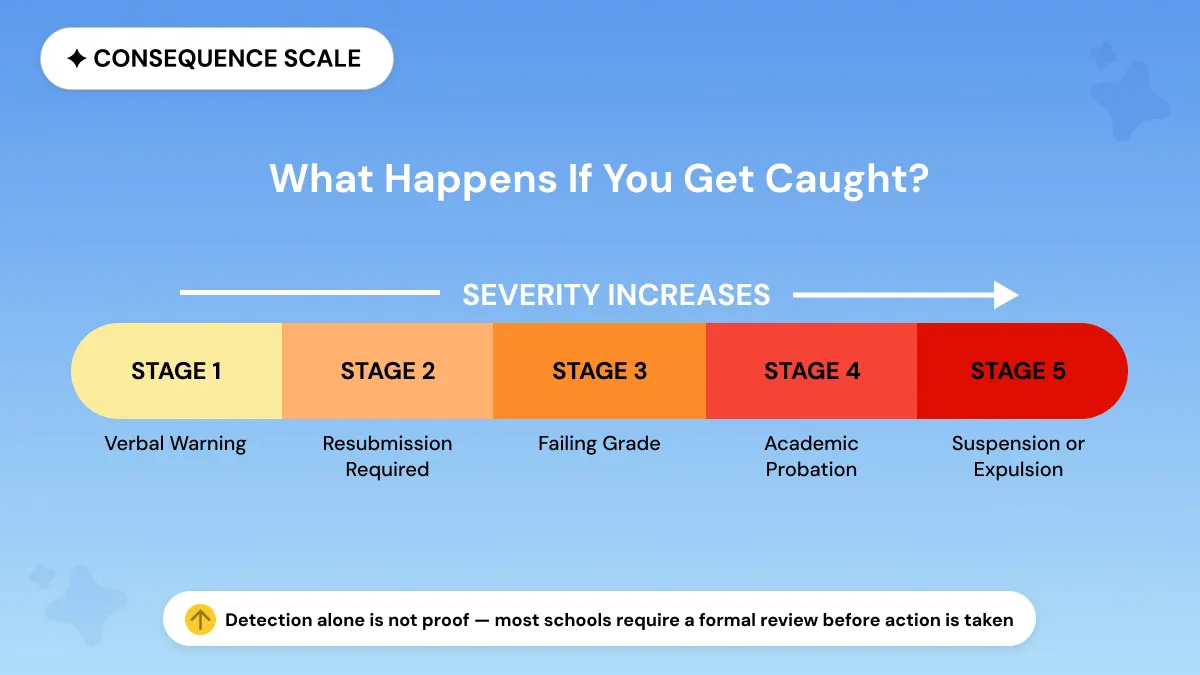
Getting reported for AI work is discouraging, but doesn't always mean catastrophe. Different schools deal with these situations differently, so knowing the process can help you stay calm and know how to respond.
Typically, the penalties are graduated. You might be asked to revise your work (after you've made the correction), or you might just get a stern warning.
Schools often place students on academic probation for ongoing issues or serious violations; in extreme cases, you could even be expelled.
Remember that getting tagged means your work will be checked, not that you're automatically assumed to have done something wrong.
Most colleges deal with academic integrity matters through a hearing process. Often this involves meeting with a teacher or academic hearing board to talk about your paper.
You'll get to talk about your work and show drafts or evidence of your writing process. Evidence of authorship can be made easier if you have good recorded notes, outlines, and early drafts.
Keep in mind that you can often appeal. Just because your essay was flagged doesn't mean you cheated. AI detection tool isn't perfect.
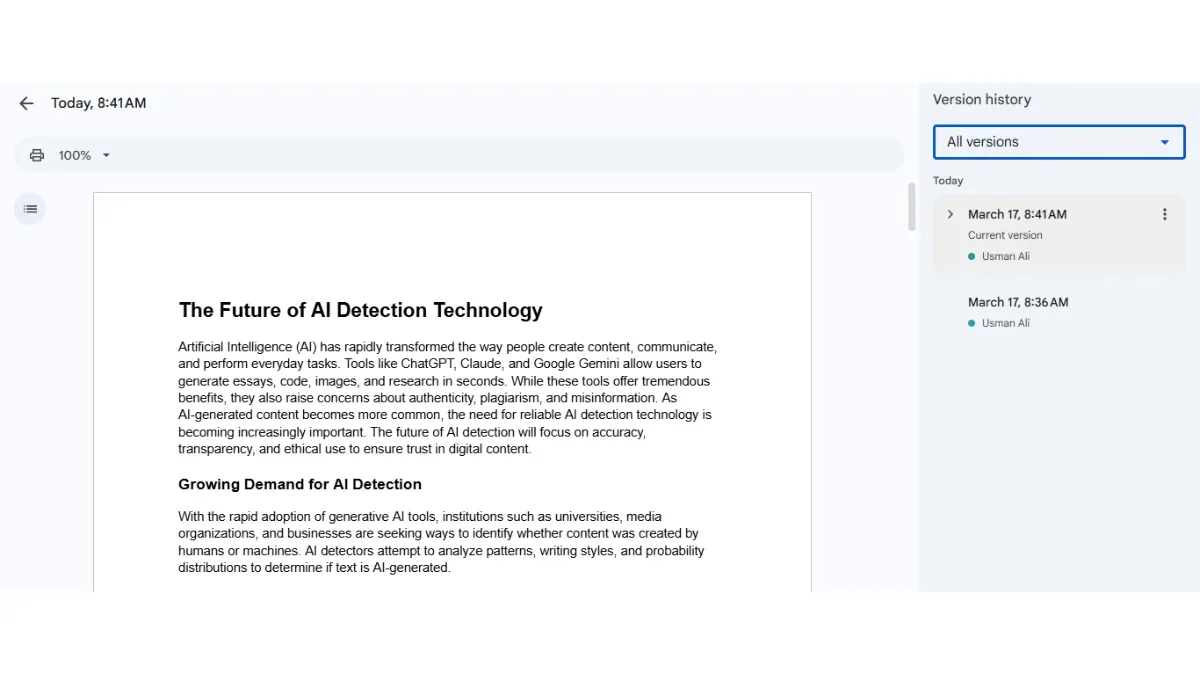
If you think a result is incorrect, you can submit evidence like research notes, Google Doc's version history, or samples of previous writing.
Students have many options to safeguard their work:
- Keep all outlines and drafts associated with an assignment.
- Keep your version history when working on Google Docs (or similar platform).
- Ensure you’re properly documenting your sources and citations.
- Run your essay through an AI detector like Phrasly to catch issues early.
FAQs
Can teachers detect if you use ChatGPT?
Yes! AI assisted work can easily be spotted by professors because they will compare your work to the way you usually write or they will use detection tool. There will be suspicion if there are sudden changes in vocabulary, tone, or sentence structure.
Can schools scan for ChatGPT?
Most colleges will scan your work for AI patterns with AI detectors such as Turnitin, GPTZero, or Copyleaks. These are usually done in conjunction with a manual scan as well.
Can ChatGPT actually be detected?
Yes, often times you can tell when text was written by AI. However, there is no way to be certain of this 100% of the time. That is why human reviews are needed. Edited AI content or text written partially by AI can sometimes slip through.
If you are trying to choose a tool to check your own work, this comparison of the best AI checker tools in 2026 can help you decide.
Can universities prove you used AI?
Detection can prove probability but not beyond reasonable doubt AI use. To have evidence if they need to present a case universities use software reports/writing comparisons/version history together.
It's also worth reviewing Harvard's AI policy to understand how top institutions formally define AI misuse and what evidence standards they apply.
Does ChatGPT show up on Turnitin?
Work written by ChatGPT may be flagged because Turnitin has an AI generated score. A flagged score should be an indication for teachers to review the work, not proof of wrongdoing.
Can professors detect ChatGPT if you edit it?
AI-generated text can have its chances of being caught reduced significantly through editing.
Schools may still check context and rough drafts, but incorporating your own opinions, changing word order, and speaking in your own voice can make your writing seem authentic.
Schools can detect AI-written content, but no detection is foolproof. Knowing what resources your school uses, proofreading your work before submission, and saving extensive notes on your research and outlines are ways to protect yourself.


Keep reading

What Are Common Phrases That AI Uses? We Tested 50 Pieces to Find Out
We ran 50 pieces of content through Phrasly's AI Detector to find out what are the common phrases that AI uses.

The Content Strategist's Workflow for AI-Assisted Production
A sound AI content workflow puts humans at the brief and expertise stages, letting AI handle outlining and drafting, then routes every piece through fact-checking, plagiarism, and AI-flatness QA gates before it can be published.