Why Is My Essay Detected as AI? Here’s What to Do
17 min read
If your essay is detected as AI even though you wrote it yourself, you're not alone and you're not in trouble yet.
AI detectors make mistakes constantly, and human writing triggers false positives more often than most students realise. Getting flagged doesn't mean you cheated. It means your writing matched a set of statistical patterns that a tool associated with AI output.
In this guide, you'll learn exactly why it happens, how to fix it with manual and AI methods, and how to appeal if you need to.
Before anything else, run your essay through Phrasly's free AI Detector so you know exactly where you stand.
Why Is My Essay Detected as AI? (The Real Reasons)
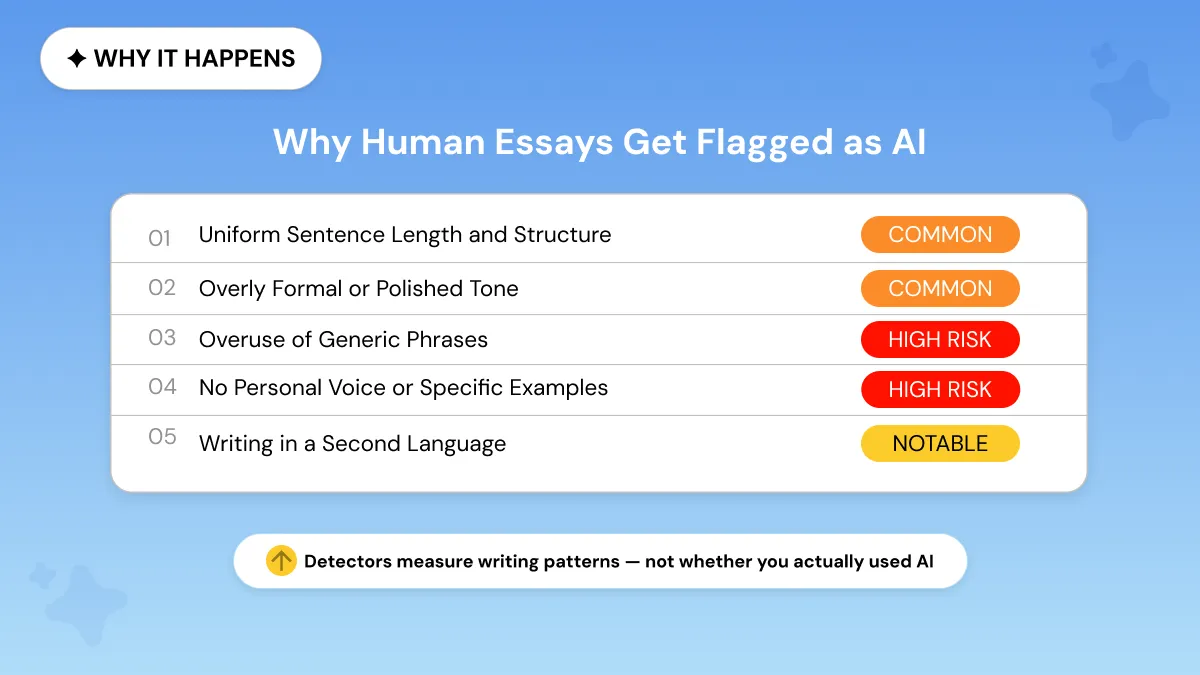
AI detectors don't actually read your essay, they scan for patterns. And the truth is that perfectly human writing can match those same patterns and get flagged anyway. Here's exactly what's triggering the alarm.
Uniform Sentence Length and Structure
Think about how you write when you're trying to sound "academic." You probably write careful, complete sentences, each one roughly the same length, each following the same structure: make a point, give an example, explain it.
That's also exactly how AI writes. Detectors measure something called burstiness, how much your sentence length and structure varies throughout the text. They also measure perplexity, how predictable each word is given the words before it. When both of those are low (meaning your sentences are uniform and your word choices are predictable), the detector flags it as machine-like.
That's one of the main reasons a well-written essay still gets flagged. Consistency looks like a machine to these tools.
Quick check: Copy your essay and read through it. If nearly every sentence is roughly the same length with the same rhythm, that's likely what's getting you flagged.
Overly Polished or Formal Tone
Here's something no one tells you: writing too well can work against you.
AI-generated text tends to be clean. Near-perfect grammar, smooth flow, consistent tone throughout, no awkward phrases, no moments where you clearly changed your mind mid-sentence. When your essay reads that polished, detectors can actually interpret it as suspicious.
This hits especially hard if you've put a lot of effort into editing. You cleaned up every sentence, fixed every transition, smoothed out every rough edge and now it reads like a machine wrote it.
It sounds unfair, because it is. But understanding this helps you fix it (more on that in the fixing section below).
Common "AI Words" That Trigger Detectors
Some words show up in AI-generated text so often that detectors have learned to treat them as a red flag. You've probably used some of these without thinking:
Delve
Unravel
Utilize
Facilitate
It is important to note that…
In conclusion, it is evident that…
These aren't wrong words, they're just words that LLMs (large language models) reach for constantly. If your essay is packed with formal, generic academic phrasing like this, it raises your AI score even if you wrote every word yourself.
The fix is simple: Swap vague verbs for specific ones. Instead of "utilize established methods," write "used a pH titration and recorded three measurements." Specific details are something AI rarely invents.
Lack of Personal Voice or Anecdotes
AI writes in a neutral, summarizing tone. It doesn't say "when I was studying for this exam, I realized…" or "my professor pointed out something that completely changed how I looked at this." It just explains things cleanly, from a distance.
Detectors are trained to pick up on the messy, personal, idiosyncratic things that human writers naturally include. When those are missing, and the writing reads like a polished neutral summary, the classifier leans toward "generated."
You don't need to turn your essay into a diary. One short, genuine personal example, a specific course reference, a real observation, a brief "I noticed…" moment is often enough to shift the balance.
Writing in a Second Language (ESL Students Are Flagged More Often)
This one is particularly unfair, and it deserves to be said clearly. If English isn't your first language, you're statistically more likely to get flagged, even when you wrote everything yourself. Recent research highlights systematic bias in AI detection tools.
The 2025 study “Identifying Bias in Machine-generated Text Detection” found that essays written by English language learners are more likely to be misclassified as AI-generated, while earlier Stanford research showed up to 61% of TOEFL essays were falsely flagged.
The detector even punishes the careful and deliberate writing for being too good.
A 2026 study in the International Journal for Educational Integrity found that AI detectors have limited accuracy (around 61–69%) and are more likely to misclassify EFL student writing. Tools like Turnitin also struggled with hybrid (human + AI) text, reinforcing that detection results should be treated as indicators, not proof.
If you want to understand how often this actually happens to real students, our guide on AI detector false positives breaks down the cases and what you can do about it.
If you're an ESL student who got flagged, this is especially important to document when you appeal (we'll cover how to do that below).
The bottom line: Getting flagged doesn't mean you cheated. It means your writing shares statistical features with AI-generated text, which happens to a lot of real writers, for very explainable reasons.
How AI Detectors Actually Work (Quick Breakdown)
Understanding why your writing is being flagged as AI starts with how these tools actually work and it's not what most students expect.
AI detectors don't work like plagiarism checkers. They're not searching a database to see if your sentences appear somewhere online. They're doing something different, and understanding it explains a lot about why false positives happen.
They measure patterns, not plagiarism.
Every piece of text has measurable statistical features, how predictable the word choices are, how uniform the sentence lengths are, how "surprising" the writing feels to a language model. AI detectors are trained to recognize which combination of features typically comes from a human versus an LLM. Then they score your essay against those patterns.
Two essays can be 100% original, no copying, no plagiarism, and one can still get flagged because its statistical signature looks more like AI output.
Two numbers drive most of it:
Perplexity — how predictable your word choices are. Lower = more machine-like.
Burstiness — how much your sentence length varies. Lower = more uniform = more suspicious.
Human writing tends to mix short punchy sentences with longer ones. AI output tends to be rhythmically consistent. When detectors see both low perplexity and low burstiness together, they lean toward "AI."
No detector is 100% accurate — including Turnitin.
Turnitin itself acknowledges this in its own documentation, explicitly noting that its AI Writing Report has limitations and requires human review before any conclusions are drawn. Independent studies back this up, detector accuracy drops significantly on edited text, short passages, or writing by non-native English speakers. The score is a signal, not a verdict. Always remember that.
If you want to understand just how often AI detectors can be wrong, the accuracy gap between vendor benchmarks and real-world results is significant.
How to Check If Your Essay Is Actually Flagged
Before you email your professor or start panicking, you need to know your actual score. Whether your paper was flagged as AI-written by Turnitin or another tool, running your own check first puts you back in control.
Check If Your Essay Is Detected as AI — Free AI Detector
Phrasly's free AI detector scans your essay the same way academic tools do, measuring perplexity, burstiness, and sentence-level patterns, and shows you exactly which parts are triggering the flag. No signup required.
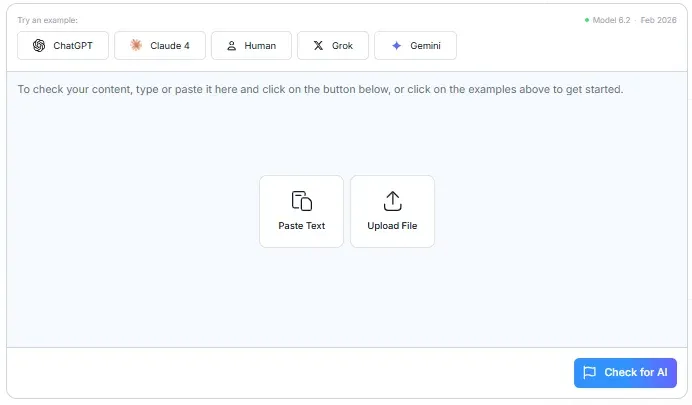
Step 1: Paste Your Essay and Run the Scan
Copy your full essay and paste it directly into the detector. For the most accurate result, include everything. Don't clean it up or edit anything before scanning. You want to see exactly what your professor's tool saw.
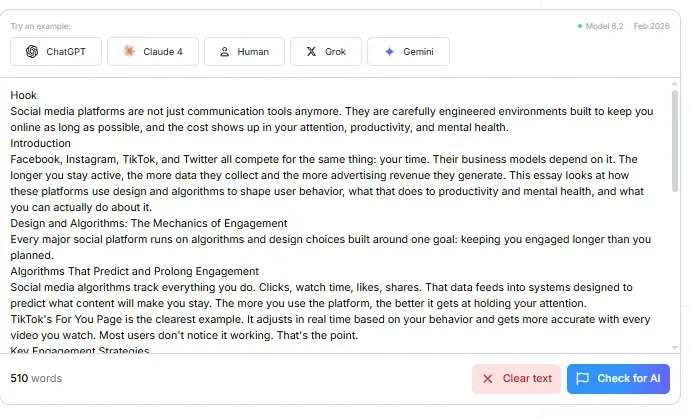
Step 2: Check the Sentence-Level Highlights
This is the most useful part. Don't just look at the overall score, look at which sentences are highlighted.
The detector will mark specific sentences that it considers high-risk. These are the sentences with the lowest perplexity and most uniform structure, the ones that read most like AI output. This tells you exactly where to focus your edits instead of rewriting your entire essay from scratch.
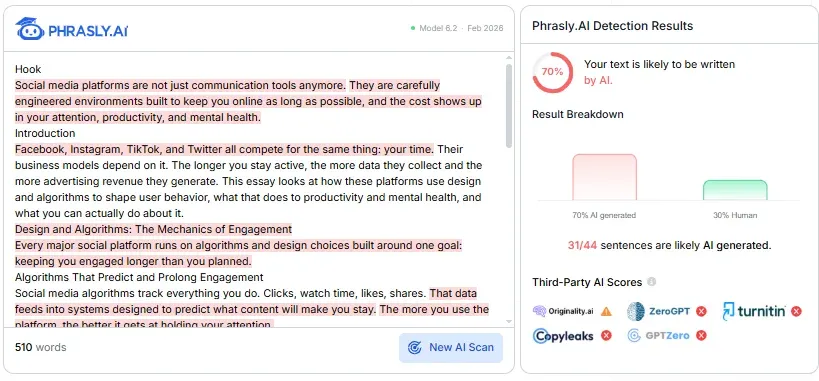
Ask yourself for each highlighted sentence:
Is this sentence unusually formal or generic?
Does it sound like something anyone could have written?
Could I add a specific detail, example, or personal observation here?
Those are your rewrite targets. Everything else can stay.
Step 3: Note Your Overall AI Probability Score
At the top of your results, you'll see an overall AI probability percentage. Here's a rough guide to reading it:
Under 20% — Low risk. Most professors won't flag this. Minor tweaks if anything.
20–50% — Borderline. Worth revising the highlighted sections before resubmitting.
Above 50% — High risk. Focused rewrites on flagged sentences are strongly recommended.
Above 80% — This is likely what got you flagged. Follow the fix steps below carefully.
Keep a screenshot of your results. If you end up needing to appeal, this shows you took the situation seriously and investigated it yourself.
How to Fix AI-Flagged Sections (Step-by-Step)
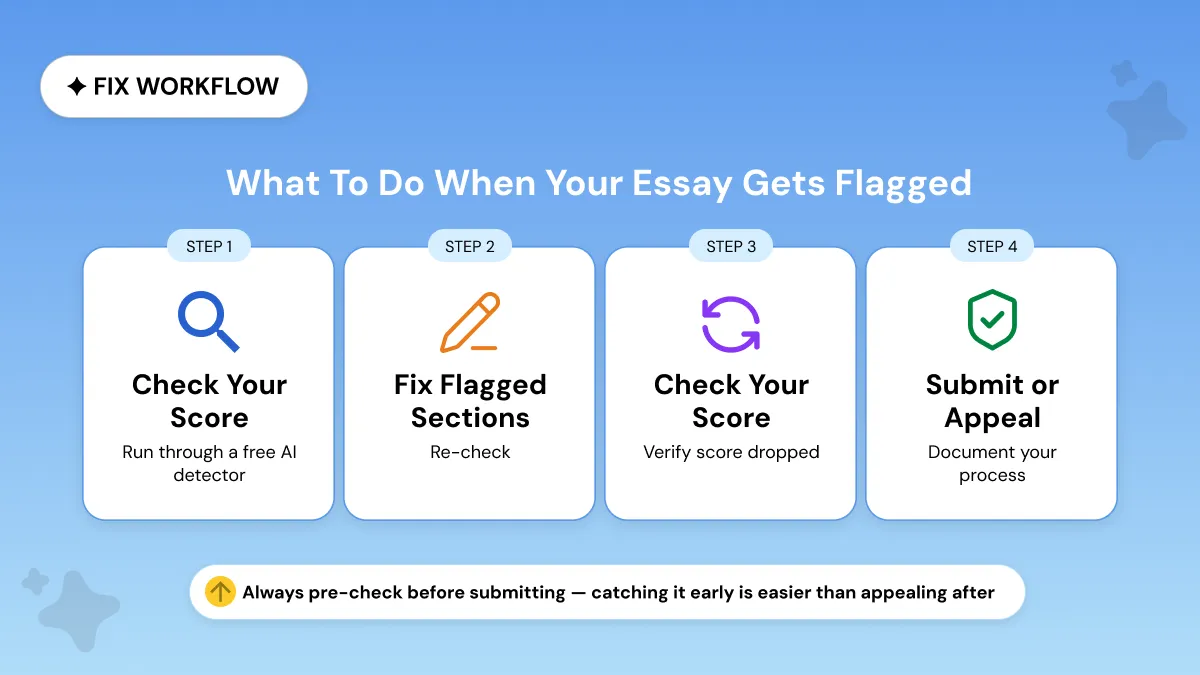
You can reduce your AI score without rewriting your entire essay. The fix is more targeted than that. You only need to edit the specific sentences that got flagged, the ones with predictable structure, generic phrasing, and uniform rhythm. Here's exactly how to do that.
Vary Your Sentence Length. This is the fastest fix and often the most effective one.
AI-generated text has a steady, consistent rhythm, sentences that are roughly the same length, following the same structure, paragraph after paragraph. Detectors are trained to recognize that pattern. The fix is to deliberately break it.
Mix it up. Write a long sentence that builds an idea with multiple clauses and specific detail. Then stop. Short sentence. Done.
Go back through your flagged paragraphs and look at the sentence lengths. If five sentences in a row are roughly the same length, that's your problem. Even small changes here significantly increase burstiness, which is one of the strongest signals of human writing.
Add Personal Experience and Specific Examples
Generic writing is one of the biggest triggers for AI detection, and it's also the easiest to fix.
AI explains things broadly and neutrally. Humans add context, observations, and specific details that only come from actually being there. Go back to your flagged sentences and ask: where can I add something only I would know?
It doesn't have to be dramatic. Try:
A quick personal observation: "In my lab session, I noticed that..."
A reference to your actual course, assignment, or professor
A specific case study, statistic, or real example you encountered
These details do two things at once, they make your writing more human to a detector and stronger academically. Specific details are something AI rarely invents convincingly, and detectors know that.
Replace Generic Phrases with Specific Language
Some phrases are so common in AI-generated text that detectors have essentially learned to treat them as red flags. If your essay is full of phrases like these, that's a problem:
"This highlights the importance of..."
"Various factors contribute to..."
"In conclusion, it is evident that..."
"It is important to note that..."
These aren't grammatically wrong, they're just vague. And vague is what AI defaults to.
Replace them with something concrete:
❌ "This highlights the importance of effective communication"
✅ "This shows why clear instructions reduced errors during our group project"
The second version says the same thing but with actual detail. It's specific, it's real, and it reads like something a person wrote.
Read It Aloud — If It Sounds Robotic, Rewrite
This sounds too simple to work. It isn't.
AI-written text has a particular quality when you read it out loud, it's too smooth. Every sentence flows perfectly into the next. Nothing sounds hesitant or human. There are no moments where you can tell someone changed their mind, got excited, or made a choice.
Read your flagged sections out loud and listen for:
Sentences that feel rhythmically identical
Phrasing that sounds overly formal for how you actually talk
Paragraphs that have no variation in pace or energy
If you find yourself reading in a flat, monotonous tone, that's the problem. Rewrite those sections until reading them aloud feels natural. If it sounds like a person wrote it, it'll score like one too.
How Phrasly's AI Humanizer Fixes What Manual Edits Miss
Reading aloud catches a lot. But some paragraphs still come back flagged no matter how many times you rewrite them because the problem isn't one sentence, it's the underlying rhythm running through the whole block. Manual editing breaks down when the entire paragraph structure is uniformly predictable. You end up rewriting the same pattern with slightly different words.
Phrasly's humanizer restructures sentence rhythm, varies clause length, and reshuffles phrasing in ways that increase burstiness.
Only paste the specific flagged sentences, not your whole essay.
Review the output. Adjust it, make sure it still sounds like you and keeps your original meaning.
Treat it as a starting point. The best results come from combining the output with your own edits on top.
Re-Check With the Detector After Every Round of Edits
Don't assume your edits worked. Run the essay through the free AI detector again and check three things: did the overall score drop, are the same sentences still highlighted, and are there any new patterns repeating? Keep editing and re-checking in rounds until you're in a comfortable range. You're not trying to hit 0%. You're trying to make your writing genuinely more varied, specific, and human. The score will follow.
Ready to try it on your own essay? Run your flagged sections through Phrasly's free AI humanizer below and check the difference.
How to Appeal an AI Detection Flag
If your professor flagged your essay as AI but you wrote it yourself, the first thing to know is this: a flag is not a verdict. It opens a process and that process gives you the chance to show your work.
Being flagged is not the same as being found guilty. It means a statistical system makes a probability guess about your writing. That's it. And those guesses are wrong more often than most people realize.
Even if Turnitin flagged your essay, that's not the end of the story. Turnitin itself explicitly states that its AI detection can make mistakes and should never be used as the sole basis for any academic decision. You have more ground to stand on than you think.
Here's how to use it.
Document Your Writing Process (Drafts, Outlines, Notes)
Start pulling together everything that shows how your essay was built.
This means:
Early rough drafts — even messy, incomplete ones
Bullet-point outlines or mind maps
Research notes, highlighted sources, annotated PDFs
Any brainstorming or planning you did on paper or digitally
AI detectors only analyze the final text. They have no idea how the document was created or how long it took. Your process is something they can't see, and it's your strongest evidence.
A trail of drafts, notes, and revisions tells a story that a detector simply cannot tell. It shows thinking, iteration, and the kind of messy, back-and-forth development that AI tools don't produce. The more of this you can show, the stronger your case.
Show Version History (Google Docs Timestamps)
If you wrote your essay in Google Docs, this is one of the most powerful things you can present.
Version history shows:
The exact date and time you started writing
Every edit made along the way
How the document evolved from a blank page to a finished essay
This turns your situation from "my detector score looks suspicious" into a clear, timestamped record of human work. That's hard to argue with.
Turnitin itself recommends that a high AI score should prompt further review, including looking at drafts and version history. So going forward, write everything in Google Docs. Always. Version history is free insurance.
Request a Meeting with Your Professor
Don't handle this over email if you can avoid it. Ask for a short meeting in person or on a call. A few reasons why this matters:
AI detection reports are easy to misread in isolation. When you sit down with your professor and walk them through your process, the context changes the entire picture. Professors are expected to apply judgment here, not just accept a score at face value.
A calm, honest conversation almost always goes better than a written defense. Come prepared with your documentation, be straightforward about what happened, and explain your writing process clearly.
Most professors, when presented with genuine evidence of a writing process, will take that seriously. They don't want to wrongly accuse a student any more than you want to be wrongly accused.
Know Your Rights — Most Policies Require Human Review
This is the part most students don't know and it's important.
At most universities, AI detection scores are treated as a signal that triggers further review, not as proof of misconduct on their own. That means:
You have the right to respond and provide context
The decision must involve human evaluation, not just an algorithm
A detector score alone is typically not sufficient grounds for academic penalty
Turnitin explicitly states in its own documentation that its system can be wrong, requires human judgment, and should not be used alone in misconduct decisions. If your institution is using it otherwise, that's worth raising.
There have been real documented cases of students being flagged, investigated, and fully cleared, because AI detection alone wasn't enough evidence. You are not without options.
How to Prevent Future AI Flags
Getting flagged once is stressful enough. The good news is that with a few simple habits, you can make sure it doesn't happen again, and more importantly, make sure that if it ever does, you have everything you need to defend yourself immediately.
Write in Google Docs (Version History = Proof)
This is the single easiest thing you can do, starting today. Google Docs automatically records every edit you make, when you started, what you changed, how the document evolved from a blank page to a finished essay. You don't have to do anything extra. It happens in the background every time you write.
That version history is widely accepted as evidence of authorship. It shows a timestamped record of human work that no AI detector can argue with. If you're ever flagged again, you open the version history and the conversation changes instantly.
Make it a rule: every essay, every assignment, written in Google Docs. It costs you nothing and protects you completely.
Save Outlines and Rough Drafts
Don't delete anything. Ever. That messy bullet-point outline you made before you started writing? Save it. The rough first draft that barely made sense? Keep it. The notes you jotted down while doing research? Those too.
AI detectors only see the final text. They have no idea how it was created or what came before it. But your university, and your professor, can look beyond that final submission and ask: can this student show how the work developed?
Your drafts answer that question instantly. A trail of rough, evolving work is something an AI simply doesn't produce. It's one of the clearest signals of genuine human authorship you can present.
Pre-Check Every Submission With an AI Detector
Before you submit anything, run it through a free AI detector yourself. This isn't about gaming the system, it's about catching problems before your professor does. False positives happen, and certain writing styles trigger them more than others. A quick scan takes thirty seconds and can save you a very stressful week.
Look at which sentences get flagged and ask yourself if they're too generic, too uniform, or too formal. Fix those sections, re-check, and then submit. That simple habit dramatically reduces your chances of getting flagged in the first place.
Develop a Distinctive Writing Voice
This is the most underrated strategy on this list and the one with the longest payoff.
AI writes in a particular way: neutral, consistent, predictable. Detectors are trained to find exactly those qualities. The more your writing sounds like you, with your specific observations, your sentence rhythm, your way of framing ideas, the harder it is for any detector to flag it.
This doesn't mean writing casually or unprofessionally. It means:
Mixing short and long sentences intentionally
Using specific examples instead of broad generalisations
Letting your actual perspective come through, not just summarising facts
Avoiding the same sentence starters and generic transitions every time
Being flagged means a statistical tool made an imperfect guess about your writing. Detectors have real limits, false positives are well-documented, and most universities require human review before any action is taken.
If it happens to you, you now know exactly why it happens, how to fix it, and how to appeal. The best thing you can do from here is stay ahead of it. Run your essay through a detector before you submit. And if it does get flagged, you know exactly how to fix it, whether through manual edits or an AI humanizer.
Phrasly's free AI Detector shows you your score and flags the exact sentences to fix, so there are no surprises when it counts.
FAQs
Why is my essay detected as AI even though I wrote it myself?
AI detectors don’t prove authorship, they estimate probability based on patterns. Human writing can still match those patterns, especially if it’s clear, structured, or formal. False positives are a known issue in all major detection tools.
What is the 30% rule for AI detection?
There is no official “30% rule” used universally. Tools like Turnitin simply report how much text may look AI-generated, but universities interpret those scores differently. Many institutions treat it as a signal, not proof.
Can Turnitin be wrong about AI?
Yes. Turnitin itself acknowledges that false positives can happen and that its system is not perfectly accurate. Even with low error rates, human-written text can still be incorrectly flagged. If you want to see how different tools compare, check out our guide to the best AI checker tools to understand which ones are most reliable.
How do I prove I didn’t use AI?
Show your writing process. Drafts, outlines, and version history (like Google Docs timestamps) provide clear evidence of how your work developed. Universities increasingly rely on this kind of proof rather than detector scores alone.
What happens if my essay is flagged as AI?
A flag usually triggers review, not punishment. Instructors are expected to evaluate context, evidence, and your explanation before making any decision. AI detection alone is not considered sufficient proof of misconduct.
Does Grammarly trigger AI detection?
Not directly, but it can. Heavy rewriting or overly polished text may resemble AI-generated patterns, which can increase the chance of being flagged. Detectors often struggle with edited or “humanized” text. If you're concerned about how your editing affects your score, learning how to humanize AI text properly makes a real difference.

Written by
Obaid Ahsan
Content Lead · Pakistan
Obaid Ahsan is a Content Lead with 5+ years of experience in SEO, content strategy, and AI-focused publishing. At Phrasly, he leads content development with a focus on accurate research, search performance, and useful, trustworthy information for readers.