
Do Medical Schools Use AI Detectors on Essays? What Applicants Must Know
Medical schools now use AI detectors on application essays. Here's what triggers a false flag, how the review works, and how to check your draft before you submit.
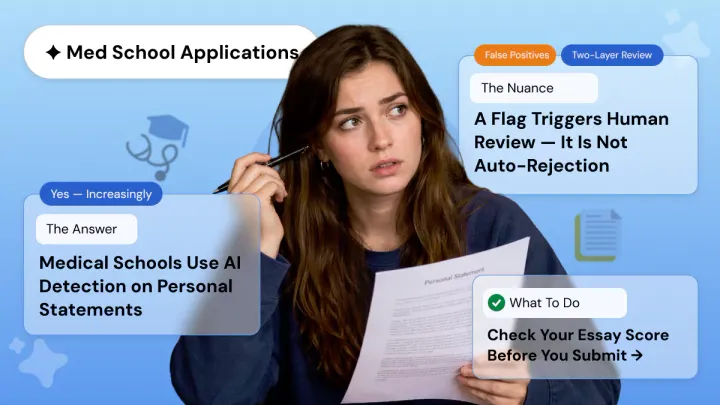
Yes, medical schools are using AI detection on application essays. The AAMC has publicly confirmed that schools like NYU Grossman and Zucker School of Medicine are already using AI to screen applications.
If you wrote your own personal statement and you are worried about a false flag, that concern is valid. False positives on genuine, human-written essays are a real risk, especially for the formal, polished prose pre-med applicants are trained to write.
If you are wondering Why Is My Essay Detected as AI, here is a deeper breakdown.
A flag is not a rejection. It is a prompt for human review. This guide covers what schools check for, what triggers a false flag, what to do if your essay is flagged, and how to write a personal statement that will hold up.
Do Medical Schools Use AI Detectors on Essays?
Yes. Medical schools are increasingly using AI detection as an initial screening layer for personal statements and secondary application essays. So if you're looking for an AI detector for med school essays to run a check before you submit, you're asking exactly the right question.
The AAMC has confirmed that AI is now being used to read medical school applications. Schools already using or piloting AI-assisted screening include:
- Zucker School of Medicine at Hofstra/Northwell
- NYU Grossman School of Medicine
- UC College of Medicine
- George Washington University School of Medicine
AAMC's own responsible-AI guidance also says applicants should be told how AI factors into the review.
None of this is meant to scare you. But the stakes are real. Yale School of Medicine reported a 4.9% acceptance rate for its MD Class of 2028, and most individual MD programs admit fewer than 5% of applicants. Admissions committees know how much pressure you're under, which is partly why they're paying closer attention not just to what your essays say, but to how they're written.
How AI Detection Works in Admissions
Schools don't publicly name a single detector they all rely on, and the specifics vary by institution. But the underlying technology is broadly consistent. AI detection tools scan your writing for statistical and stylistic patterns that show up in machine-generated text:
- Uniform sentence length
- Predictable word choices
- Limited lexical diversity
- Smooth, featureless transitions that AI tends to produce
Researchers describe these as low "perplexity" and low "burstiness". Basically, prose that's too even and too predictable to read as human.
If you want the full technical picture of how AI detectors work under the hood, we break down each of these signals and what they actually measure.
Turnitin's March 2026 guidance explains that its AI-writing model analyzes qualifying prose in segments and returns a percentage score, and it states clearly that the tool can misidentify human writing. If you are wondering why Turnitin flags human writing as AI, the short answer is that the company itself warns educators not to rely on the score alone.
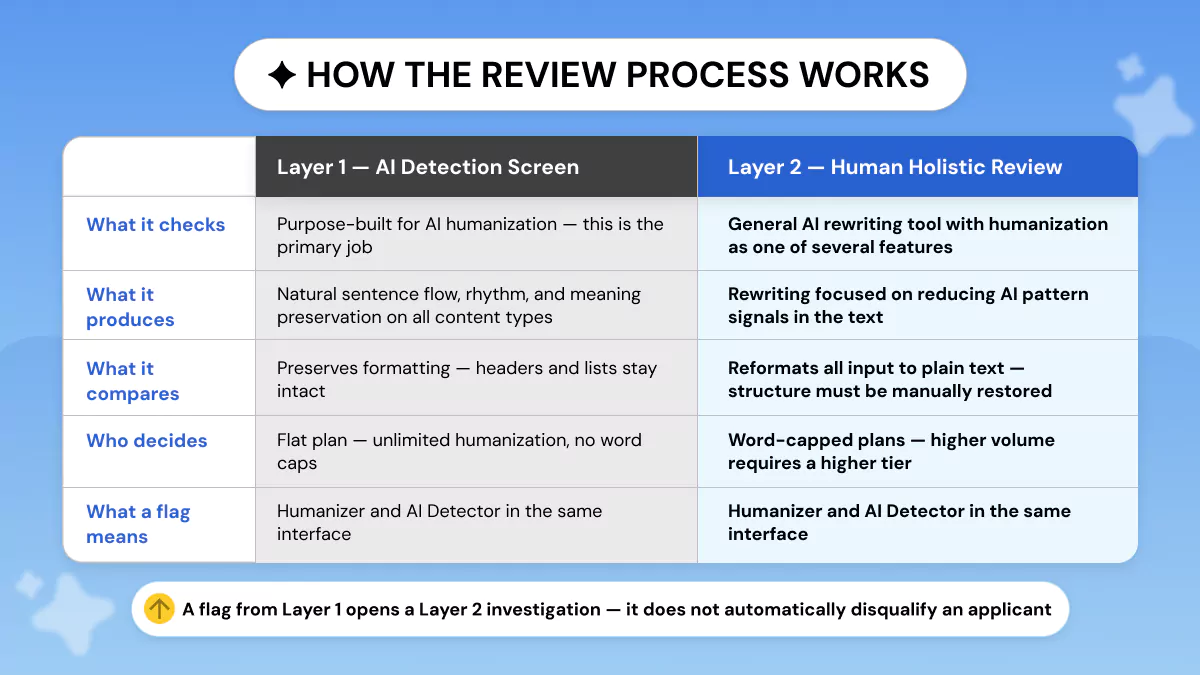
The Mosaic Review
A flag from an AI detector does not mean automatic rejection. The AAMC reports that nearly all medical schools use some form of holistic review, weighing academic metrics alongside experiences and attributes, and its AI principles explicitly require human judgment in any AI-assisted selection process.
In practice, that means if something in your essay gets flagged, readers look at the rest of your file. The pieces that tell your story include:
- Work and Activities descriptions
- Secondary essays
- Letters of evaluation
- Casper responses (for schools that require them)
- Interview performance
If that story is consistent with the voice in your personal statement, a detector flag tends to fade into the background. What raises real concern isn't a flag on its own. It's inconsistency. A polished personal statement that doesn't match the voice in your secondaries, or an interview that sounds like a different person wrote the essay.
What Triggers an AI Flag on a Genuine Essay?
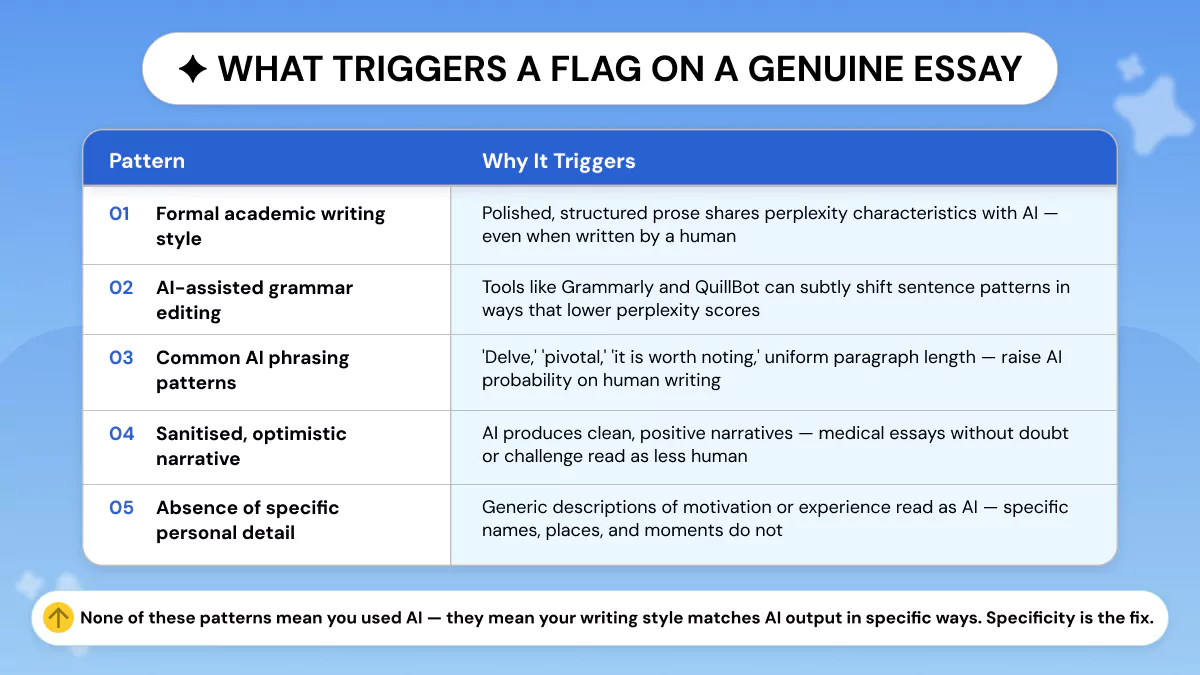
Even a real, self-written medical school essay can be flagged if its style looks too machine-like to a detector. AAMC's public guidance makes clear that medical school review is holistic, and Turnitin's 2026 guidance says false positives are possible in AI models. A flag should be treated as a warning signal, not proof of misconduct.
Here are the three biggest triggers for a false flag on writing you actually wrote yourself.
Formal Academic Writing Style
Medical school personal statements often sound polished, reflective, and structured, which is exactly why some detectors can misread them.
UCLA's guidance notes that AI detectors look for signals like:
- Repetitive phrasing
- Lack of emotional nuance or personalization
- Overuse of formal or informal tone
- Measures like perplexity and burstiness that judge how predictable the writing is
In practice, that means a very clean, highly formal essay can look more "AI-like" than a messier but still genuine draft. If you write the way you were trained to write in a pre-med science course, with tight sentences and measured transitions, a basic detector may treat that style as a red flag.
Enterprise tools used by institutions are better calibrated than free web detectors, but the risk is still real for very polished formal prose.
AI-Assisted Editing
Medical schools usually cannot prove you used ChatGPT on your personal statement, but their detection systems can flag writing that carries AI-like patterns, whether or not a chatbot was actually involved. (Our Guide on Does Turnitin Detect ChatGPT breaks down exactly how this works, and where it struggles.)
Turnitin's 2026 report says its AI-writing detection can identify text that is likely AI-generated or text that was modified by an AI paraphrase tool. Grammarly's Authorship product similarly shows that editing tools can track whether text was written by the user, generated by AI, or edited by Grammarly itself.
That does not mean basic spell-check is forbidden. But it does mean heavy AI-assisted rewriting can make a genuine essay look less like your own voice. Even light editing with tools like Grammarly or QuillBot can subtly shift sentence structure, lower perplexity, and push a human-written essay into detector territory.
What to Do
The safest way to lower the risk of a false flag is to make the essay unmistakably yours.
AAMC advises applicants to build personal statements around their own experiences, reflections, and the series of events that led them to medicine, and it emphasizes that schools value the personal statement alongside other parts of the file.
Strong specifics help prove authorship because they add details a generic AI draft cannot invent:
- The name of a patient you worked with (with privacy protected)
- The specific moment that confirmed your decision to pursue medicine
- A concrete memory from a particular clinical rotation
- A sensory detail only you would remember
The issue a detector flags is usually a writing pattern, not evidence that you used ChatGPT. Which is exactly why running your essay through a detector before you submit is worth the five minutes it takes.
AI Detector for Med School Essays — Check Your Score Before You Submit
Run your personal statement through Phrasly AI Detector before submitting. If your score is elevated, Phrasly highlights the specific sentences that triggered the flag, so you know exactly where your writing is reading as formulaic.
What Happens If Your Essay Is Flagged?
A detection flag should be treated as a review trigger, not automatic rejection. If a medical school AI detector flags a genuine essay, it leads to human review and follow-up context, not instant rejection.
AAMC says human judgment is essential in AI-assisted selection, medical schools make their own admissions decisions, and the broader admissions process is holistic rather than single-factor. That means a flagged essay is weighed against the rest of the file, not judged in isolation. Here is the practical workflow if it happens to you.
Step 1: Document Your Writing Process
Keep a clean paper trail of how your essay actually came together. This is your best protection against a false positive.
What to preserve:
- Google Docs version history (do not draft in Word and paste into Docs at the end — start in Docs)
- Saved drafts with dates
- Outlines and notes from your brainstorming
- Feedback emails from advisors, pre-med mentors, or writing center staff
- Any early fragments you wrote months before the final version
AAMC's transparency guidance says AI-related processes should be documented clearly. Preserving your own drafting record gives you a clean way to show that the essay developed through ordinary human revision.
Step 2: Know Your Application
Be ready to explain the specific experiences, motivations, and reflections in your personal statement.
AAMC says the personal statement is meant to distinguish you and give admissions officers insight into why you chose medicine, and schools review applications holistically alongside letters, activities, and other materials. If a school asks follow-up questions in an interview, a genuine applicant should be able to speak naturally about those details.
This is one of the biggest differences between real and AI-generated essays. A genuine applicant can describe:
- Why you chose that specific story to open your essay
- What you learned from the volunteer experience you wrote about
- Who the mentor was that shaped your thinking
- When the moment happened and what the room felt like
AI-generated essays cannot stand up to that kind of specific follow-up. Yours can, because you lived it.
Step 3: If an Admissions Office Contacts You
Respond honestly and promptly, and provide context.
AAMC's investigation policy says it investigates discrepancies and other irregular matters connected to application activity, and when a matter is under review, the subject is contacted and given notice and an opportunity to respond. That is why a calm, factual explanation and supporting documentation are the right first move if a school reaches out.
A few practical tips:
- Do not panic-reply. Take a day to gather your drafts before you respond.
- Lead with facts, not apologies for something you did not do.
- Offer documentation — version history, earlier drafts, feedback emails.
- Loop in your pre-med advisor before sending anything formal.
Most schools have formal review processes before any misconduct decision is made. The goal of your response is to give the committee everything they need to confirm that the essay is yours.
The same review pattern shows up at the undergraduate level too. Our guide on do colleges check for AI walks through the detector-flag-to-investigation workflow in full.
Step 4: Cross-Check With Phrasly AI Detector
If your score looks elevated, use the flagged sections to find spots that sound too generic, too polished, or too repetitive, then revise them with more specific personal detail.
Run your draft through Phrasly AI Detector to see a sentence-level breakdown of where your writing is reading as formulaic. This is a pre-submission confidence check, not a workaround. The goal is to make sure your essay reads like your real voice before it reaches an admissions committee. So if a school's detector does flag it, you already know what the review will find, and the rest of your file will back you up.
How to Write a Medical School Essay That Won't Be Flagged
The goal is not to "beat" a detector. It is to write a personal statement that is so clearly specific, reflective, and unmistakably your own that no detector could reasonably flag it.
AAMC's AMCAS guidance says admissions committees place significant weight on this essay, advises applicants to use details, and explicitly tells them to "show, don't tell" while writing in an authentic voice. The essay is meant to explain why medicine matters to you and what schools should know about you that is not already elsewhere in the application. If you get that right, the detector question mostly takes care of itself.
Prioritise Specificity Over Polish
The safest writing pattern is concrete and personal. Name the clinic, the setting, the patient interaction, the exact moment that changed your thinking.
AAMC recommends using details to bring the essay to life and including content that reflects your own experiences rather than duplicating what is already in the application. Compare these two openings:
- Generic: "My volunteer experience in a hospital setting exposed me to the realities of patient care and solidified my commitment to medicine."
- Specific: "Mrs. Alvarez asked me to read the Sunday crossword to her in Room 314 because the chemo had blurred her vision, and I realized I did not want to just visit patients like her. I wanted to treat them."
The first could have been written by anyone or by a language model. The second could only have been written by you. That kind of specificity makes the essay feel grounded in real experience instead of generic summary, and it gives a detector far less to flag.
Write in Your Natural Voice
A polished essay is not the same thing as a human-sounding essay.
AAMC specifically says to write in your authentic voice and notes that the personal statement can help you explain your story further in an interview. The point is to sound like yourself explaining why medicine matters to you, not like a formal template.
A simple test: read your draft out loud. If it sounds nothing like how you would explain your motivation to a trusted mentor over coffee, the voice is probably too polished. Formal academic prose that does not sound like how you actually speak is more likely to read as AI-generated, because that is exactly the register language models produce by default.
Contractions are fine. Shorter sentences mixed with longer ones are fine. The occasional "I still remember" or "honestly" is fine. What matters is that the essay sounds like a person.
Add Personal Reflection With Complexity
Strong essays do not read like perfect success stories.
AAMC encourages applicants to include unique hardships, challenges, obstacles, and the experiences that shaped their path. That is exactly the kind of reflection that gives an essay depth. In practice, it means showing what you learned from uncertainty, difficulty, or a difficult clinical moment instead of writing only a polished, upbeat summary.
AI-generated essays tend to produce sanitised, overly optimistic narratives. Real medical school essays include:
- Moments of doubt about whether medicine was the right path
- A specific failure and what you took from it
- A patient outcome that did not go the way you hoped
- A question you still do not have an answer to
That kind of honest reflection is one of the strongest signals of human authorship, because it is exactly the complexity AI smooths over.
Before You Submit, Run a Final Check
The best way to check a medical school essay for AI patterns before submitting is to combine a detector check with a human review of specificity, voice, and reflection.
Run your essay through Phrasly AI Detector as a final confidence check. If the score is elevated, use the highlighted sections to add more specific detail, more personal reflection, and a more natural voice, then review again before you submit.
AAMC says AI tools in admissions should be balanced with human judgment and transparency, so treat a detector as a guide for revision, not the final verdict. The detector tells you where your writing is reading as formulaic. You decide what to do about it, with more of your own voice and more of your own story.
Medical schools are using AI detection, but a flag is not an automatic rejection. Admissions committees still review your full application.
The best protection is an essay so specific to your experiences that no AI could have written it. Name the patient. Name the moment. Write in your own voice.
FAQs
Do medical schools run all essays through AI detectors?
No public source says every medical school runs every essay through an AI detector. AAMC reported that some schools are using AI as a first screener, and it also says AI use should be transparent and balanced with human judgment.
Can using AI for brainstorming trigger a detection flag?
Using AI for brainstorming is allowed in AAMC’s current AMCAS guidance, but the final submission must still be your own work and accurately reflect your experiences. A flag is more likely if the final essay sounds generic or overly rewritten, not because you used AI to organize early ideas. If you are unsure whether a specific AI detector will treat your writing fairly, AI Detection Accuracy: Which Checkers Get It Right shows how much results can vary between tools.
What happens if my essay is wrongly flagged by an AI detector?
A wrong flag should lead to human review, not an automatic rejection. AAMC’s admissions guidance emphasizes holistic review and says AI should not replace human judgment, while its investigation policies show that suspected issues are reviewed rather than decided by one automated signal. If you want to understand just how often this happens, Can AI Detectors Be Wrong covers the accuracy issues in detail.
Should I avoid all AI tools when writing my medical school essays?
Not necessarily. AAMC says AI tools may be used for brainstorming, proofreading, or editing, as long as the final submission is still your own work and reflects your actual experiences.
Do all medical schools have the same AI detection policy?
No. AAMC’s own materials show that some schools are trying AI screening while others rely on broader holistic review, and institutions are expected to be transparent about how AI is used. That means policies can vary by school and by application stage.
What is the best way to check my medical school essay for AI before submitting?
Start with AAMC’s writing advice: use specific details, write in your authentic voice, and make sure the essay clearly reflects your own experiences. Then run a pre-submission confidence check with Phrasly AI Detector and compare the result against your own draft history. For a deeper look at which tools to trust, our guide on the Best Free AI Detector Tools for Academic Writing compares accuracy across detectors.


Keep reading


The Content Strategist's Workflow for AI-Assisted Production
A sound AI content workflow puts humans at the brief and expertise stages, letting AI handle outlining and drafting, then routes every piece through fact-checking, plagiarism, and AI-flatness QA gates before it can be published.

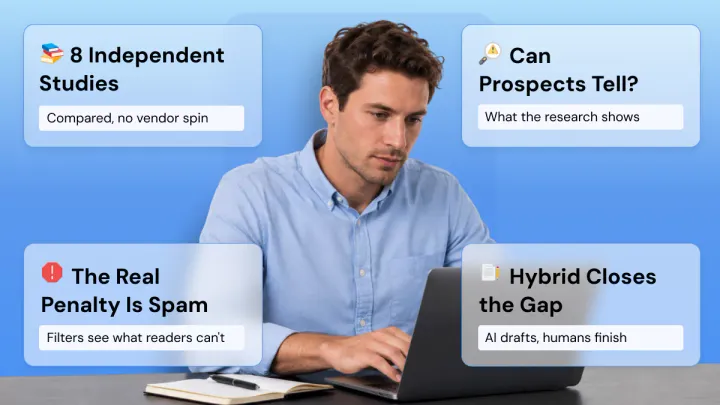
AI vs Human Cold Email Reply Rates: What 150M+ Emails Across 8 Studies Actually Show (2026)
AI cold emails get 1% fewer replies but 3x more spam flags. We compared 8 studies covering 150M+ emails, including peer-reviewed research, to show what actually works in 2026 and the fix that closes the gap.