
Do Law Schools Use AI Detectors? What Applicants and Students Must Know
Law schools now use AI detectors on personal statements, diversity essays, and assignments. The consequences of being flagged go beyond a rejection. From admissions certifications to bar admission risks, here is exactly what law schools check, which tools they use, and what to do before you submit.
You spent weeks on your personal statement. You chose every word carefully. And now you are wondering whether an AI detector is going to flag it anyway.
It is a fair concern. Law school applications are high stakes, and AI detection policies have moved fast. What was unclear two years ago is now written into admissions requirements at schools like UCLA, Baylor, and Texas Law. What was optional for professors is now a default prohibition at institutions like UNC Law and Northwestern.
This article covers what law schools are actually doing, which tools they use, what happens if something gets flagged, and what you can do right now to protect yourself before you submit.
Do Law Schools Use AI Detectors?
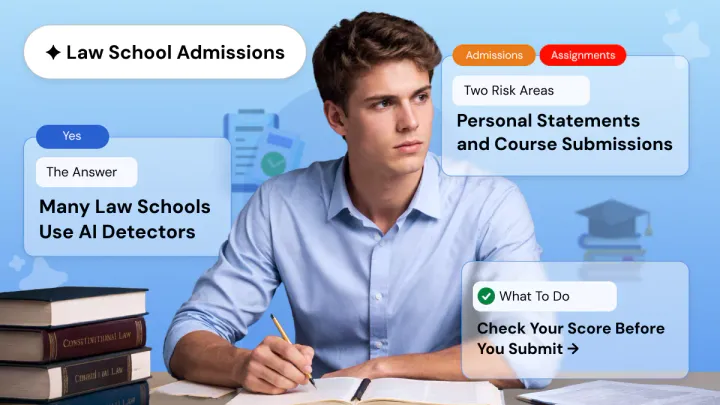
Yes, and it's not just a rumor circulating on law school Reddit threads. Many law schools now screen both admissions materials and submitted coursework for AI-generated content, through a combination of explicit policies, applicant certifications, and AI detection tools. The exact tools and procedures vary by school, but the scrutiny is real in both contexts: your personal statement and your assignments.
There are two separate risk areas to understand. First, the admissions process: personal statements, diversity essays, and application materials. Second, the academic environment: legal writing assignments, research memos, and take-home exams. Each has its own detection process, and the consequences of being flagged in either one are serious.
AI Detection in Admissions
Admissions offices are increasingly using tools like Turnitin and Pangram to scan personal statements. Many schools have gone further by requiring applicants to formally certify that their work is their own. Northwestern University notes that many law schools require this kind of certification, and that violating it can trigger a character and fitness issue that affects your path to bar admission.
Several schools are explicit about this in their current admissions policies:
- UCLA School of Law explicitly prohibits the use of any AI tools in the application.
- Baylor Law School states that applicants may not use generative AI to write the personal statement.
- University of Texas School of Law (LL.M. program) states that the personal statement should be written without assistance from others or AI tools.
- William S. Boyd School of Law at UNLV requires applicants to certify that they did not receive undue assistance from AI platforms.
- Washington and Lee University School of Law allows limited AI use for brainstorming or feedback, but not for writing the essay itself.
Top admissions consultants are aware of this too. Many now run applicant essays through AI detectors as a standard step before submission, which tells you something about how seriously this is being taken on both sides of the process.
AI Detection in Law School Assignments
Inside the classroom, academic integrity offices use enterprise-grade detection tools integrated directly into learning management systems. Legal writing assignments, research memos, and take-home exams are all in scope.
A few examples from current institutional policies:
- UVA Law explicitly states that papers may be analyzed using anti-plagiarism, AI-detection, and related programs
- Northwestern Law prohibits generative AI on submitted materials unless an instructor expressly permits it
- UNC Law's updated 2025 policy sets a default prohibition on generative AI for all submitted assignments and assessments, including exams, projects, and take-home work
- Turnitin's AI Writing Report, widely used across higher education, is integrated into LMS workflows and designed specifically to flag AI-generated writing in submitted work. For a deeper look at how it works, see our breakdown of how Turnitin detects ChatGPT.
One thing that makes law school particularly high-stakes: AI hallucination of case law is treated differently than standard plagiarism. If an AI fabricates a citation or invents a legal precedent and you submit it as your own research, that is not just an academic integrity violation. It is treated as fabrication of legal authority, a more serious charge that carries heavier consequences.
The Difference Between Consumer AI Detectors and Enterprise Tools
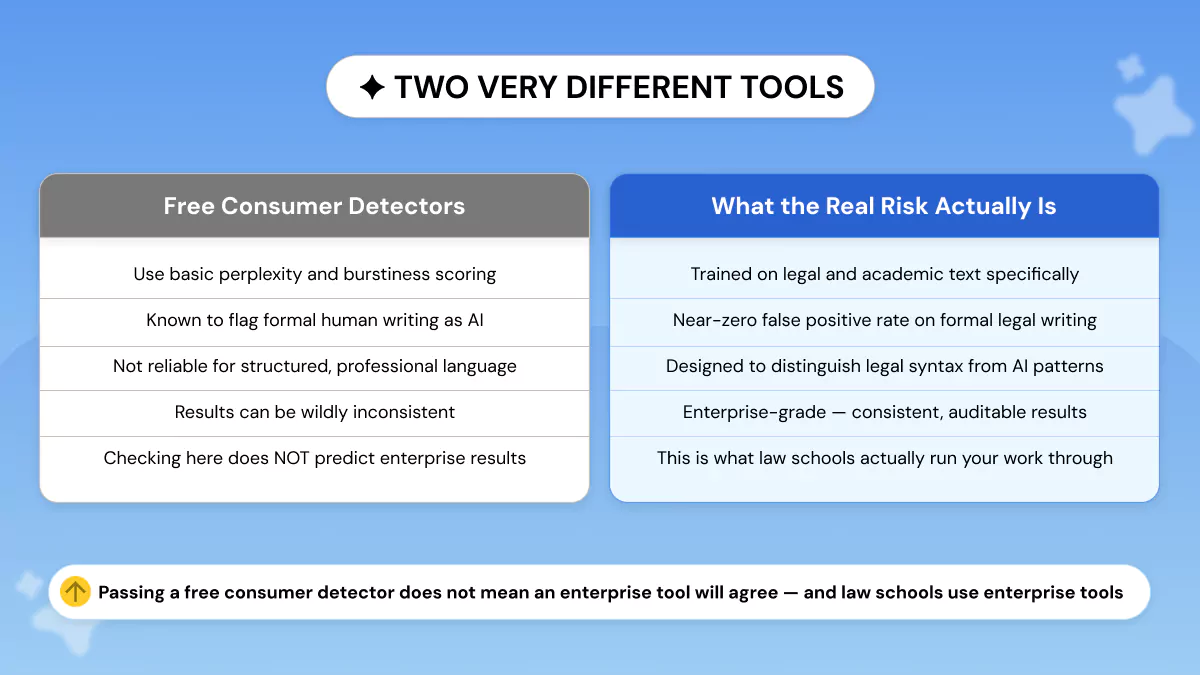
Not all AI detectors work the same way. A free checker and an enterprise tool can read the same document and produce completely different results. If you are submitting a law school personal statement or a legal writing assignment, that distinction could matter more than you think.
Can law schools reliably detect ChatGPT use in a personal statement? The honest answer is: it depends on how much the text was revised. Raw or minimally edited AI output is consistently flagged by modern enterprise detectors. Heavily rewritten, substantially personalized content is harder to classify. But admissions officers also read these essays manually, and a personal statement that reads like polished AI prose but lacks specific personal detail will raise human suspicion before a detector even runs.
How Consumer Detectors Work (And Where They Fall Short)
Free, consumer-facing AI checkers typically rely on two signals: perplexity and burstiness.
- Perplexity measures how predictable the word choices are
- Burstiness measures variation in sentence length and structure
AI-generated text tends to score low on both. The problem is that formal, structured writing also scores low on both, not because it was written by AI, but because that is simply what formal writing looks like.
If you write the way law school trains you to write, a free AI checker may flag you. That is a false positive, and it does not reflect how enterprise tools will read your work. For a full breakdown of why this happens and who is most at risk, see our guide on AI detector false positives.
How Enterprise Tools Work
Enterprise-grade detectors like Turnitin AI and Pangram are built to a different standard. They are specifically trained on academic and legal text to avoid the false positive problem that plagues consumer tools.
Pangram uses a technique called Hard Negative Mining, which trains the model to distinguish between formal human writing and AI-generated text that mimics formal writing. Pangram claims an overall false positive rate of approximately 1 in 10,000. It also classifies text across a spectrum rather than giving a simple yes or no:
- Fully human-written
- Lightly AI-assisted
- Moderately AI-assisted
- Fully AI-generated
Turnitin's AI Writing Report is integrated directly into LMS assignment workflows and identifies both AI-generated text and AI-paraphrased text. Turnitin's own documentation acknowledges that its model can misidentify human-written text and should not be used as the sole basis for adverse action. Scores are advisory, not definitive. For a comparison of how different tools stack up on AI detection accuracy, including false positive rates across platforms, our tested breakdown covers the key differences.
What This Means for Your Submission
Running your draft through a free consumer checker and getting a clean score does not mean an enterprise tool will agree. Turnitin suppresses low-confidence scores below 20% and flags the possibility of false positives. Pangram is specifically designed to catch humanized AI text that has been edited to sound more natural. These tools do not automatically agree, and a single score from a free checker proves nothing in either direction.
If you are a human writer producing formal legal content and a free tool flags your work, do not panic. Enterprise tools are calibrated for this type of writing and are far less likely to misread it. What they are built to catch is raw or lightly edited LLM output, where the statistical patterns of AI generation are still present beneath the surface.
Do Law Schools Use AI Detectors? Check Your Content with Phrasly First
Before you submit your personal statement or legal memo, check your AI score with Phrasly AI Detector. See how your content reads and identify any sections that may come across as formulaic or impersonal — before the admissions office does.
What Happens If a Law School Detects AI in Your Work?
Getting flagged has two very different consequences depending on where it happens, and neither outcome is minor. In admissions, undisclosed AI use is treated as misrepresentation. In coursework, it is treated as academic fraud. And in both cases, the consequences can reach further than a rejected application or a failed grade.
Columbia's 2026 J.D. application materials state that dishonesty can lead to immediate rescission of an admission offer and, if the applicant is already enrolled, disciplinary proceedings that may result in expulsion or revocation of the degree. The ABA also notes that law school misconduct disclosures can be reported to bar authorities during the character and fitness review, meaning a single AI-related violation can follow you into the licensing process.
In coursework, the framing is equally serious. Undisclosed AI use is not treated as a drafting shortcut. It is treated as academic fraud.
In Admissions
Most law schools require applicants to certify that everything submitted is entirely their own work. When AI-generated content is detected in a personal statement or diversity essay, schools treat it as a direct breach of that certification.
Depending on where you are in the process, the consequences can include:
- Rejection before an offer is made
- Rescission of an existing offer
- Disciplinary proceedings if you are already enrolled
- Character and fitness implications during bar admission review
That last point is the one most applicants underestimate. The ABA can ask law schools to provide character and fitness information, and AI misrepresentation that surfaces during the admissions process can be reported to bar authorities. This is not a remote risk. It is built into the process.
In Academic Work
Inside law school, unauthorized AI use is treated as cheating.
- GW Law states that using generative AI to produce original content for an evaluated assignment is cheating unless a professor expressly permits it
- Howard University's April 2025 student handbook states that if AI is not expressly authorized, any use constitutes academic misconduct, with sanctions including failure of the course, suspension, or expulsion
- Across law schools, the general rule is consistent: if AI use is not explicitly allowed by the instructor, it is typically treated as a violation of academic integrity policies.
For legal writing specifically, AI hallucination of case law is a more serious problem than standard plagiarism. Submitting a fabricated citation or an invented legal precedent is not just an integrity violation; it is the fabrication of legal authority. Federal courts have sanctioned filings containing AI-generated fictitious citations throughout 2025 and 2026, and recent guidance warns that hallucinated or fabricated citations may result in sanctions. Law schools treat fake citations with the same seriousness.
One important nuance: policies vary widely by school. Some ban AI entirely. Others permit limited use for brainstorming or grammar editing, with written instructor permission and disclosure. If your syllabus does not explicitly permit AI use, assume it is prohibited. Do not wait to find out after submission.
How to Respond If Your Work Is Flagged
If a submission gets flagged, your priority is to document your writing process. Pull together everything that shows the work developed over time through your own effort:
- Google Docs version history with timestamps
- Earlier drafts, outlines, and notes
- Any email chains or feedback from advisors
Then request a human review. AI detector scores are signals, not definitive proof. Turnitin's own March 2026 guidance acknowledges that its AI Writing Report may misidentify human-written text and should not be used as the sole basis for adverse action against a student. For a step-by-step guide on what to do if your essay is flagged, including how to appeal and what evidence to gather, that guide covers the full process.
How to Protect Yourself Before Submitting
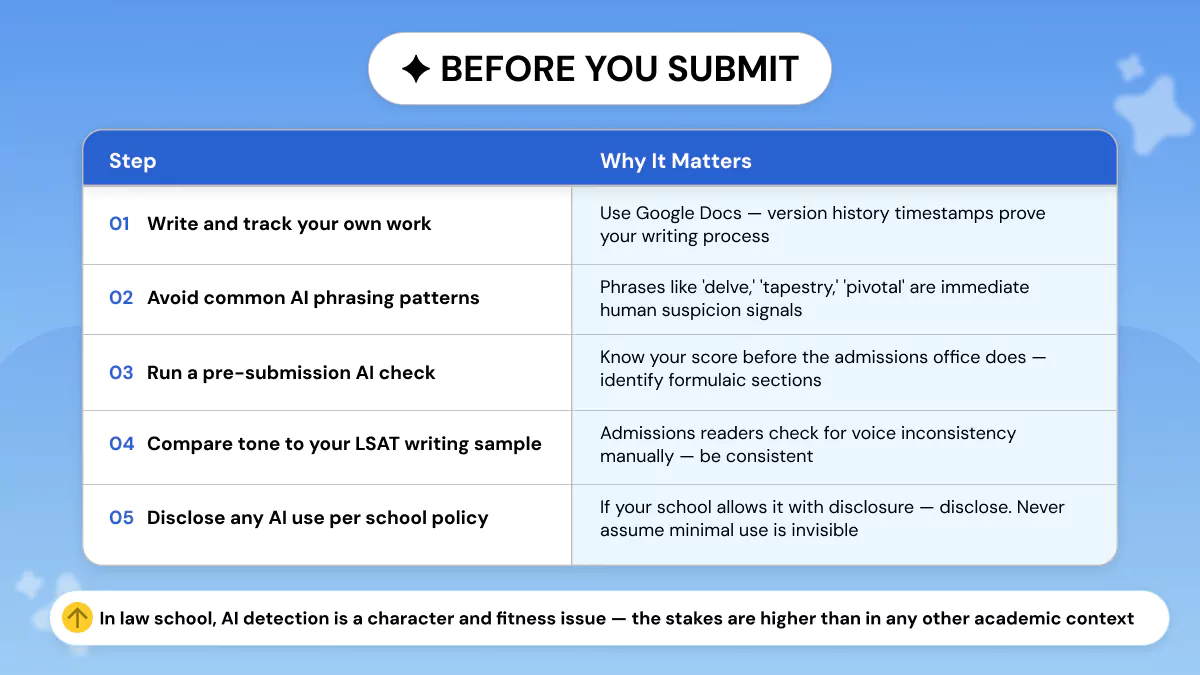
The best way to check whether your law school personal statement will be flagged is to run it through a detector before the admissions office does. But that is only one step. A pre-submission check works best when combined with a clean draft trail, careful word choices, and a clear understanding of your school's specific AI policy.
Here is what that looks like in practice.
Write Original Work and Prove It
This sounds obvious, but the documentation part is what most applicants skip. Write your work in Google Docs and keep version history turned on. Google Docs automatically saves previous versions with timestamps, giving you a visible record of how the document developed over time through multiple editing sessions. If your submission is ever questioned, that version history is your most credible evidence.
Keep your drafts, outlines, and any notes from the process. The more clearly your work trail shows progression from rough ideas to a finished piece, the stronger your position.
Watch Your Word Choices
Certain words and phrases appear so consistently in AI-generated writing that they have become reliable red flags for human readers — even before a detector is involved. Admissions officers read hundreds of personal statements. They notice patterns quickly.
Avoid these in particular:
- Delve and delve into
- Tapestry
- Pivotal
- It is worth noting
- In conclusion
- Navigating (especially "navigating challenges")
- Underscore and "underscores the importance of".
These words are not inherently wrong. But their frequency in AI output has made them recognizable to anyone who reviews a lot of writing. If they appear in your draft, replace them with your own phrasing.
Disclose Any AI Use According to Your School's Policy
If you used AI at any point in the process, for grammar checking, brainstorming, light editing, or structural feedback, do not assume that minimal use goes undetected. Disclose it according to your school's specific policy.
Columbia Law’s 2025 interim policy states that instructors may permit specific AI uses only if those permissions are clearly stated in writing, and that students have an affirmative duty to ask their instructor if they are unsure whether a particular use is allowed. The University of San Diego law library guide similarly states that generative AI may not be included in written work for credit unless the instructor explicitly permits it. When in doubt, ask before you submit, not after.
Run a Pre-Submission Check with Phrasly
Before you submit, run your personal statement or legal memo through Phrasly's free AI Detector. This gives you an AI probability score across your content so you can see which sections read as formulaic or impersonal before anyone else does. If you want to compare how different free AI checkers for students perform against each other, our tested comparison covers accuracy, word limits, and what each tool actually flags.
Treat any flagged section as a prompt to review and strengthen, not as a final verdict. Turnitin's own documentation acknowledges that its AI Writing Report may misidentify human-written text and should not be used as the sole basis for adverse action. A detector score is a signal. How you respond to that signal is what matters.
For Personal Statements: Check Your Consistency
For admissions specifically, there is one additional step worth taking. Compare the tone and vocabulary of your personal statement against your LSAT writing sample. Admissions officers do this comparison manually, and a significant mismatch between the two raises a red flag entirely independent of any detector score.
Your LSAT writing sample was produced under timed, proctored conditions. Your personal statement was drafted over weeks and revised repeatedly. They will not read identically, and they are not supposed to. But if your personal statement sounds like it was written by a completely different person, that inconsistency is worth addressing before you submit.
Here is what it comes down to.
Law schools do use AI detectors on personal statements, diversity essays, and academic assignments, alongside strict academic integrity policies that were written with exactly this risk in mind. The stakes are higher than in almost any other academic context because undisclosed AI use can extend beyond a rejection or a failed grade into your character and fitness evaluation for bar admission.
FAQ’s
Do law schools use AI detectors?
Yes. UVA Law says papers and exam answers may be analyzed using anti-plagiarism, AI-detection, and related programs, and Turnitin’s 2026 AI Writing Report is built for academic-integrity review inside LMS workflows. For a quick self-check before you submit, see Phrasly AI Detector.
Do law school admissions use AI detectors for personal statements?
Many law schools police AI use through applicant certifications and written bans rather than publicly naming a specific detector. Northwestern says many schools require applicants to certify they did not use generative AI, and UCLA explicitly prohibits AI tools in the application.
Is 40% AI detection bad?
A 40% score is a warning sign, not proof by itself. Turnitin says low-end AI scores are less reliable and that its AI Writing Report should not be the sole basis for adverse action. Review the flagged sections, check your disclosure obligations, and understand that AI detectors can be wrong, especially on formal academic writing.
Do universities actually use AI detectors?
Yes. University and law-school policies can explicitly authorize anti-plagiarism and AI-detection review, and Turnitin’s current tools are designed to surface likely AI-written text in submitted work.
Do school admissions use AI detectors?
Admissions offices more often enforce AI rules through certification statements and application policies than by publicly naming a detector. Northwestern says many law schools require applicants to certify no generative AI was used, and UCLA’s application page explicitly bans AI tools.
Is a 3.3 GPA too low for law school?
Not automatically. LSAC says most law schools look closely at UGPA, but also weigh course difficulty, grade trends, and the full application; its Official Guide lets you compare schools by UGPA/LSAT combination.
What AI detectors do law schools use?
Turnitin is the clearest publicly named tool in higher-ed workflows, and some school policies also authorize AI-detection and related programs. Vendors like Pangram also market university and legal-writing detectors, but schools do not always publicly list every vendor they use. See AI detector false positives for the difference between tools.


Keep reading

What Are Common Phrases That AI Uses? We Tested 50 Pieces to Find Out
We ran 50 pieces of content through Phrasly's AI Detector to find out what are the common phrases that AI uses.

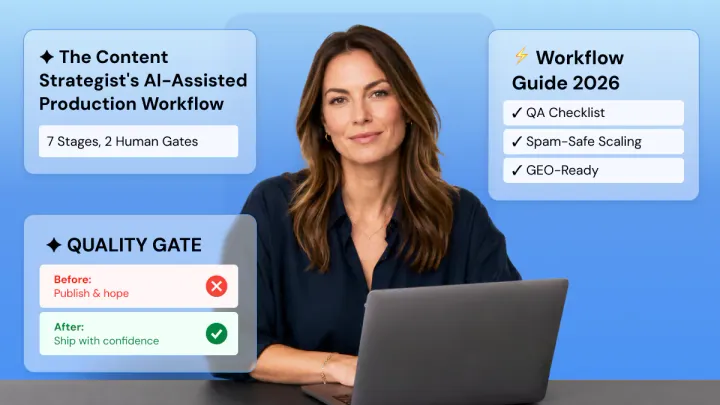
The Content Strategist's Workflow for AI-Assisted Production
A sound AI content workflow puts humans at the brief and expertise stages, letting AI handle outlining and drafting, then routes every piece through fact-checking, plagiarism, and AI-flatness QA gates before it can be published.