
Do Colleges Check for AI? What Students Must Know (2026)
68% of colleges now use AI detection and most students don't know it's already scanning their work. Find out which schools check, what tools they use, and how to protect yourself before you submit.
You used AI to help write your essay. Maybe just a little. Now you're staring at the submit button wondering: will my college actually know?
The short answer is yes and the scale of it will surprise you.
Turnitin alone licenses its software to over 16,000 institutions worldwide, covering roughly 71 million students. AI detection software runs quietly in the background every time you submit an assignment through Canvas or Blackboard. Most students have no idea it is already scanning their work.
And universities have every reason to keep expanding it. A recent UNESCO-referenced survey found that 86% of students globally now use AI tools for studying. Academic integrity policies are tightening fast in response.
In this guide, you'll learn exactly which colleges check for AI, what detection tools they use, what their official policies say, and what actually happens if your work gets flagged.
Do Colleges Actually Check for AI in 2026?
Yes, colleges check for AI in 2026, and the practice has spread well beyond large research universities. According to recent data from Youngstown State University, the share of higher education institutions actively using AI detection tools jumped from 38% to 68% between 2023 and 2024, meaning adoption nearly doubled in a single academic year.
What has changed most in 2025–2026 is the shift from optional to default. Many institutions that previously offered AI detection as an opt-in feature for professors have now enabled it system-wide. Students are rarely notified when this happens.
The pattern breaks down roughly like this. Large public universities tend to use automated tools embedded directly into their submission systems. Private and Ivy League schools lean more heavily on honor codes and human review. And smaller or online colleges vary almost entirely by instructor.
One thing is consistent across all of them: the policies are moving in one direction. Stricter, faster, and with less warning to students.
Which AI Detection Tools Do Colleges Use?
Turnitin is by far the most widely used. It has been the standard plagiarism checker in higher education for decades, and in 2023 it added an AI detection feature called the "AI Score." What makes it particularly significant is how it works silently in the background.
When you submit a paper through Canvas, Blackboard, or Moodle, Turnitin may already be scanning it for AI-generated content without you seeing a separate step or any notification.
Beyond Turnitin, many individual professors use free tools on their own, including Phrasly AI Checker, GPTZero, Copyleaks, and Originality.ai. These are popular because they require no institutional contract.
A professor can paste your essay in and get a result in seconds. Wondering specifically about Canvas submissions? Read our full breakdown on can Canvas detect ChatGPT.
Here is how the main tools compare:
Detection accuracy varies significantly across all these tools, and the gap matters more than most students realize. For a deeper breakdown, see our AI Checker for students guide.
Do College Admissions Check for AI?
Not routinely, but that does not mean you are in the clear.
Most admissions offices are not running essays through AI detectors as a standard step. But policies around academic honesty are tightening fast, and the rules are becoming harder to ignore.
In 2023, the Common Application updated its fraud policy to explicitly prohibit "substantive" AI-generated content in application essays. Importantly, the Common App does not have AI detection built in. It does not scan submissions automatically.
Instead, it requires applicants to sign an attestation confirming the work is entirely their own. If AI use is later proven by a member institution, that signed statement becomes the basis for a fraud finding.
Top universities have followed with their own statements. Brown University is direct: students should not use AI writing tools in any portion of their application.
It is not just college applications either. Scholarship applications are increasingly under scrutiny, with many scholarship committees now including explicit AI-use clauses in their eligibility requirements.
As for detection, admissions essays are still primarily reviewed by humans. And experienced officers are often good at spotting AI patterns without any software. If your essay sounds inconsistent with your other writing, your interview, or your academic profile, that alone can trigger a closer look.
What Happens If You Get Caught Using AI?
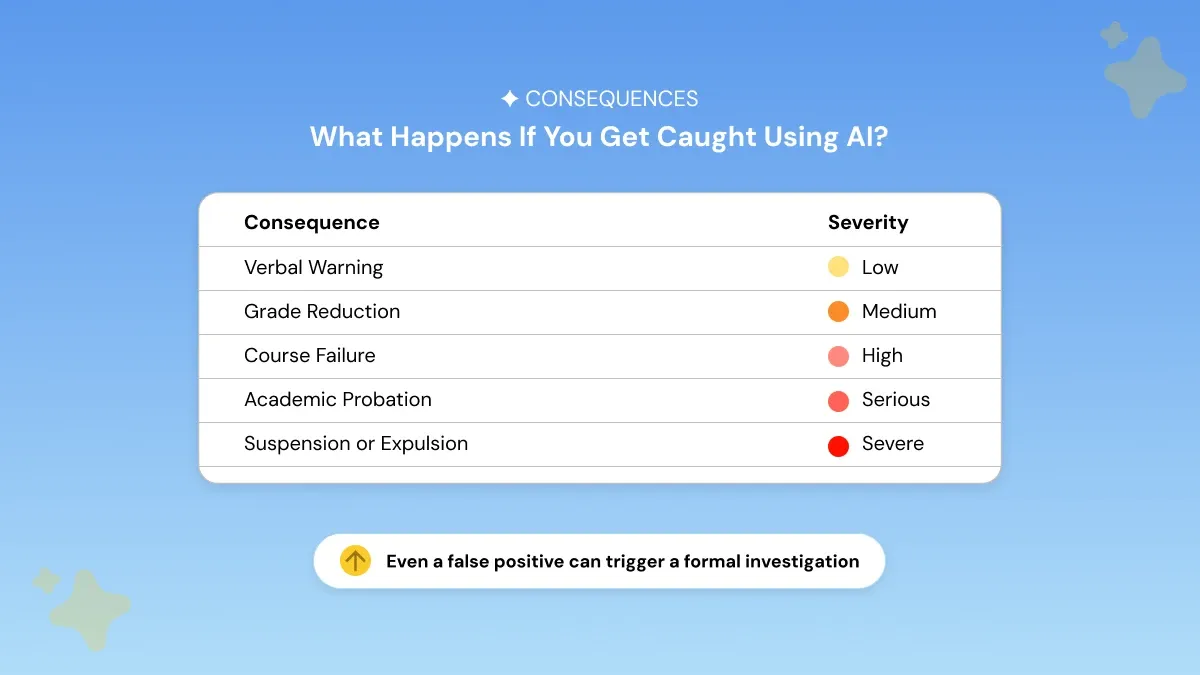
It depends on your school, but the consequences can be serious. Most universities handle AI violations, including submitting AI generated content as your own, under their existing academic integrity frameworks. That means the same process used for plagiarism applies here too. Depending on the severity and your school's policy, consequences can range from:
- A formal warning on your academic record
- A zero on the assignment
- Automatic failure of the course
- Academic probation
- Suspension or expulsion in repeat or severe cases
What Happens During an Academic Integrity Investigation?
Once flagged, you will receive written notice, be asked to respond, and have the opportunity to present evidence before any penalty is issued. Your transcript may be placed on hold throughout this process, which can take weeks or months. For a full breakdown of possible outcomes, read our guide on what happens if you get caught using ChatGPT in college.
What makes this especially stressful is that even a false positive can trigger the same process. This is exactly what happened to Orion Newby, a student at Adelphi University, who was accused of using ChatGPT on a history essay based on a Turnitin AI score. The university upheld the plagiarism finding. Newby sued, and in February 2026 a federal judge ruled the finding was without merit and ordered the university to expunge it from his record entirely.
Can You Appeal the Decision?
Yes. Some schools take a more lenient, disclosure-based approach where owning up early can reduce or eliminate punishment. Others are zero-tolerance. But if the case against you rests solely on a detector score with no supporting evidence, appeals are increasingly successful.
Which Universities Have AI Detection Policies?
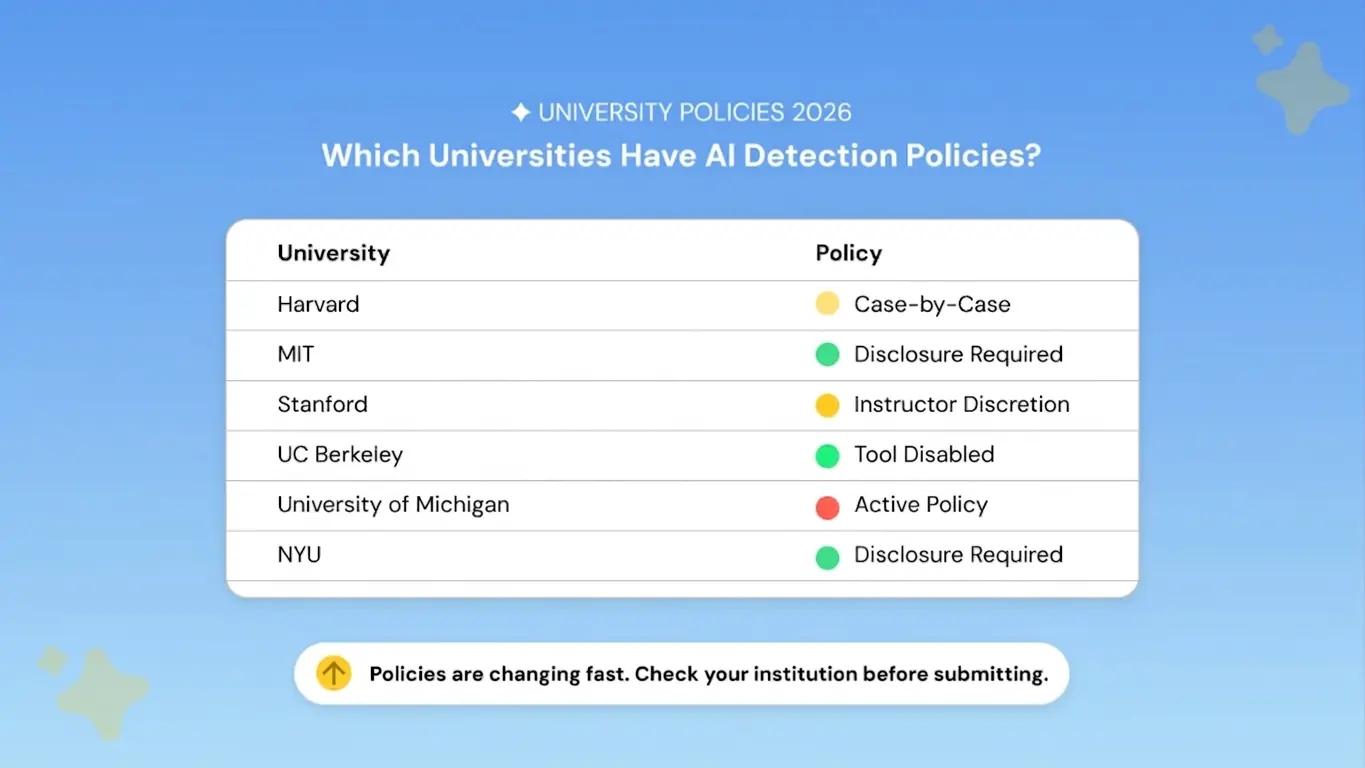
Most major universities now have some form of AI detection policy in place, but they vary significantly by institution type. Some schools run automated scans on every submission. Others have banned detection tools entirely. And many fall somewhere in between, leaving decisions to individual professors.
Below is a breakdown of verified university policies based on official institutional sources. Every entry below is confirmed. Policies not publicly documented are not included.
Last updated: March 2026. AI detection policies change frequently. Always check your institution's current academic integrity page.
A clear pattern is emerging in how and why colleges use AI detectors, and which institution types rely on them most. Private and Ivy League schools tend to focus on strict honor policies and disclosure requirements rather than automated scanning.
Meanwhile, several major public universities have actually moved away from AI detection tools, citing reliability concerns and the risk of falsely accusing students.
Do UC Colleges Check for AI?
Yes, UC campuses do check for AI in coursework, but there is no single system-wide policy. Each of the 10 campuses sets its own rules, and those rules can vary further by department, course, and individual professor.
The UC system serves over 280,000 students across 10 campuses. That scale makes a uniform AI policy nearly impossible to enforce. An English professor and an Engineering professor at the same campus can have completely different expectations about AI use, and both are within their rights.
Here is what the verified data shows for individual campuses:
What is consistent across the UC system is this: Turnitin is widely used for plagiarism checking, but its AI-specific detection feature has been disabled at the campuses that have made their position public. Students have noted that even where Turnitin shows an AI score, professors are often instructed to treat it as unofficial. Individual professors across all UC campuses are still using free tools like GPTZero independently, without any campus mandate.
One group at particular risk is ESL and international students. Their writing patterns, often more formal and structured, are disproportionately flagged as AI-generated.
This is a known problem with pattern-based detection, and it raises serious academic integrity concerns for students who are writing in their second or third language.
Does UC Use Turnitin for AI Detection?
Yes, most UC campuses have institutional Turnitin licenses, and it runs automatically in the background of Canvas submissions. Students do not see a separate detection step. It happens the moment you submit.
Critically, a Turnitin flag does not mean an automatic penalty. It triggers a review, and a professor is expected to investigate further before taking any action. Given that no plagiarism checker or AI detector is perfect, that distinction matters a lot.
How Accurate Are College AI Detectors?
Not as accurate as most students assume, and that is exactly the problem.
Turnitin, the most widely used AI detection software in higher education, claims to correctly identify AI-generated text in the majority of cases. But it also admits to incorrectly flagging about 4% of human-written sentences as AI-generated.
That might sound small, but across millions of submissions every semester, it translates to thousands of real students facing investigations for work they wrote themselves.
GPTZero has an even higher false positive rate. In comparative testing, it flagged a significantly larger proportion of genuine student writing as AI-generated than Turnitin did.
Well-structured, polished academic prose is particularly at risk because it can look "too consistent" to a pattern-based detector. For more on this, read our full breakdown on why Turnitin flags human writing as AI.
Even OpenAI, the company behind ChatGPT, shut down its own AI text classifier in 2023 because it was too inaccurate to be useful.
Emily Isaacs, director of the Office for Faculty Excellence at Montclair State University, noted that many AI detection tools lack transparency. As she told Inside Higher Ed, “With the AI detection, it's just a score and there's nothing to click. You can't replicate or analyze the methodology the detection system used, so it's a black box”.
How to Check Your Own Essay Before Submitting
Before you hit submit, take three minutes to check your own work. It is the simplest thing you can do to protect yourself, and most students skip it entirely.
Follow these three steps before every submission:
Step 1: Run your essay through an AI detector Paste your full essay into an AI detector before submitting to your professor. This gives you the same view your professor will see. You want to know your score before they do, not after.
Step 2: Review any flagged sections Look at which paragraphs or sentences are flagged. Do not panic. Read them carefully and ask yourself whether they sound natural or overly structured. Rewrite flagged sections in your own voice, using your own examples and phrasing.
Step 3: Re-check after revisions Run the essay through the detector again after editing. A clean second result gives you much more confidence going into submission.
Phrasly's free AI detector lets you check up to 550 words with no signup required. It takes less than 30 seconds and works as both a plagiarism checker and a ChatGPT detection tool in one place.
Check your essay with Phrasly's free AI detector Now:
AI detection in colleges is real, widespread, and still imperfect. Most institutions are using some form of it in 2026, policies are only getting stricter, and the tools making these decisions are far from foolproof. The smartest thing any student can do is understand how detection works before it affects them, not after. That starts with knowing your own score.
Frequently Asked Questions
Can professors tell if you used ChatGPT?
Yes, often they can. Experienced professors spot ChatGPT patterns through overly uniform sentence structure, generic phrasing, and a lack of personal voice, even without running any software. For a full breakdown of what they look for, read our guide on can professors detect ChatGPT.
Does AI detection work on paraphrased or edited AI content?
Not reliably. Once AI-generated text is lightly edited or paraphrased, most detectors including Turnitin struggle to flag it accurately.
Do online colleges and community colleges check for AI?
Yes. Many community colleges use Turnitin through Canvas by default, and in California alone nearly 75% of community colleges have active Turnitin licenses.
Can a college reject your application for using AI?
Yes. If AI use is proven after you signed an honor attestation, member institutions can suspend your Common App account and rescind admission.
Does using AI on one assignment affect your whole academic record?
It can. Most AI violations are processed under academic integrity policies, meaning a single proven case can result in a permanent notation on your transcript.
Are ESL students more likely to get flagged by AI detectors?
Yes. Studies show non-native English writers are disproportionately flagged because their formal, structured writing patterns closely resemble AI-generated text.
What should you do if you are falsely accused of using AI?
Document everything immediately. Save all drafts, Google Docs history, and notes, then formally dispute the finding through your school's academic integrity office. If you want to make your writing sound more natural before submitting, an AI humanizer can help you rephrase flagged sections in your own voice.
Can you appeal an AI plagiarism decision at college?
Yes. Most universities have a formal appeal process, and cases based solely on a Turnitin AI score are increasingly being overturned, as seen in the Adelphi University court ruling in 2026.
Can a college expel you just based on an AI detector score?
No. A detector score alone is not sufficient proof. Colleges are expected to conduct a full investigation before issuing any serious penalty.
How do you prove you did not use AI in an essay?
Keep your draft history, notes, and research sources as evidence. Google Docs version history and browser activity are commonly accepted as proof of original authorship.


Keep reading

AI vs Human Cold Email Reply Rates: What 150M+ Emails Across 8 Studies Actually Show (2026)
AI cold emails get 1% fewer replies but 3x more spam flags. We compared 8 studies covering 150M+ emails, including peer-reviewed research, to show what actually works in 2026 and the fix that closes the gap.
The Self-Editing Workflow That Makes Writing Read Human
A 5-pass self-editing checklist for copywriters: fix structure, cut generic filler, add proof and voice, improve rhythm, and verify facts before your copy ships.