
Best Free AI Detector Tools for Academic Writing
Discover the best free AI detector tools for academic writing. Compare accuracy, limits, and privacy to check essays before submission and avoid false AI flags.
Worried your essay might get flagged as AI-generated? You're not alone. With ChatGPT and other AI writing tools now everywhere in education, even students who write their own work face a real problem: how do you prove your work is actually yours?
Maybe you used a grammar checker. Maybe your writing style is naturally formal. Or maybe you just want peace of mind before hitting "submit." Whatever your situation, you need a reliable AI checker tool to check your work first.
The challenge? Most "free" AI detectors aren't really free. They cap you at a few hundred characters. Others work well but cost money you don't have. And some are just inaccurate, flagging human writing as AI or missing obvious AI text.
This guide solves that problem. You'll learn which tools offer genuine unlimited scanning, which are most accurate for essays and research papers, and how to use them effectively to protect your academic integrity.
By the end, you'll know exactly which free AI detector to use before submitting your next assignment.
Why Free AI Detectors Matter for Students
Not every student can afford AI detection subscriptions. Premium services like Turnitin cost institutions thousands of dollars per year, putting them out of reach for individuals. Even "affordable" monthly subscriptions add up significantly over a semester.
Here's why having access to a free AI detector is valuable for students:
- Pre-submission confidence: Check your essay before turning it in to avoid accidentally triggering AI flags
- Learning tool: Understand which writing patterns might look AI-generated and develop more natural writing habits
- Protection from false accusations: Verify your work won't be wrongly flagged if you used AI tools ethically (like grammar checkers)
- Budget-friendly: No subscription fees, credit card requirements, or hidden costs
- Immediate access: No waiting for institutional approval or setup
Best Free AI Detectors for Academic Use
Several AI detection tools offer genuinely useful free versions. Here's a detailed look at the best options for students and educators, with an emphasis on what makes each one suitable for academic writing.
Phrasly stands out among student AI detector options for several reasons. Unlike competitors that advertise "free" with severe limitations, Phrasly offers a genuinely unlimited free AI checker with no character caps or scan limits.
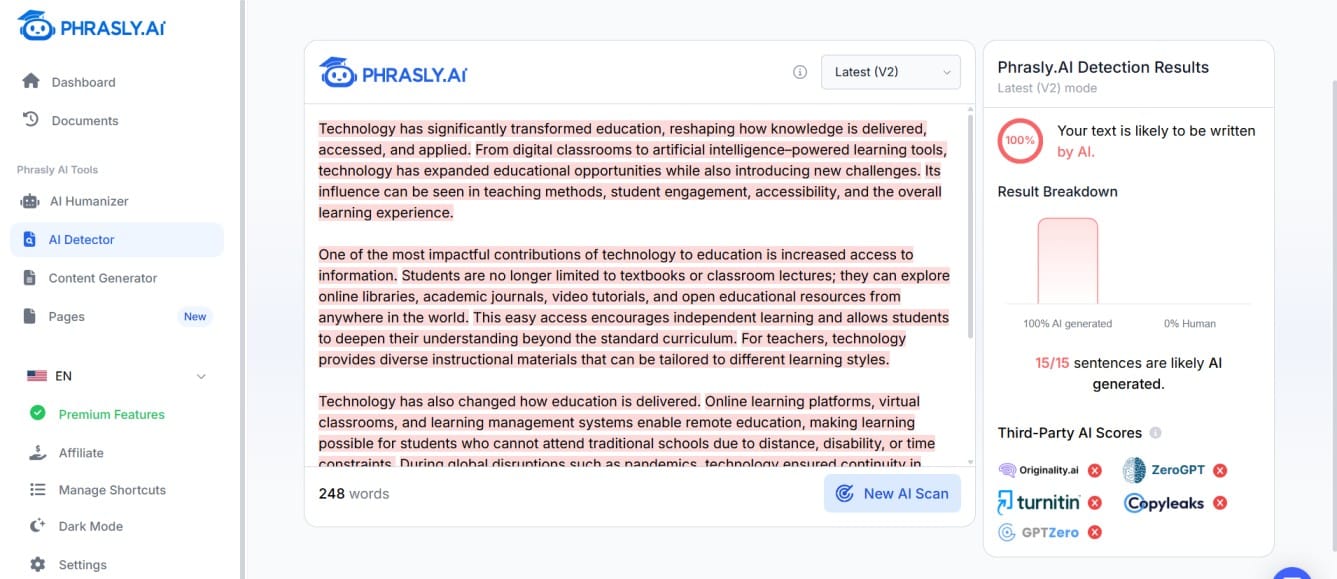
Key features that make Phrasly ideal for academic use:
99.8% accuracy rate: Trained on over 1 million real human articles, not synthetic AI content
Free Limit: 2000 words per scan.
Fast results: Get your detection report in under 10 seconds
Detailed sentence highlighting: See exactly which parts triggered AI detection
Privacy protected: Your content is immediately deleted after analysis
No account required: Start checking immediately without signing up
Detects all major AI models: ChatGPT (4o, 5, 5.2), Claude, Gemini, Llama, and more
What makes Phrasly particularly valuable for academic writing is its training methodology. The tool was built on real human articles rather than AI-generated content, giving it a deep understanding of authentic human writing patterns. This reduces false positives, a critical concern when a wrong AI flag could affect your grade.
The platform also distinguishes between completely AI-written text and human writing that used AI assistance (like grammar checking). This nuance matters in academic settings where ethical AI use is often permitted, but full AI generation is not.
Best for: Students who need to check multiple essays throughout the semester, pre-submission verification, and anyone wanting a free Turnitin alternative without limitations.
Try Phrasly AI Detector for free
Other Free AI Detection Options
While Phrasly offers the most comprehensive free option, several other tools are worth considering depending on your specific needs:
GPTZero
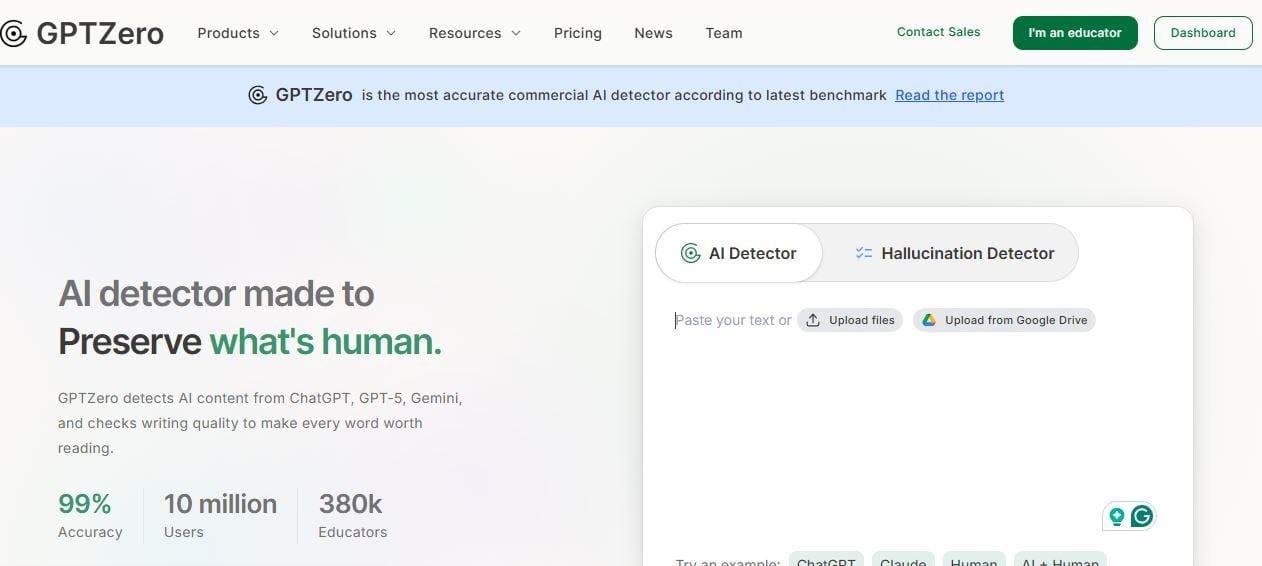
GPTZero is popular in education and offers a free tier with up to 10,000 characters per scan. The platform emphasizes accuracy and provides detailed highlighting of potentially AI-generated sections.
• Free limit: 10,000 characters per scan
• Accuracy: Good for ChatGPT and GPT-4 detection
• Best for: Educators with institutional accounts, single document checks
ZeroGPT
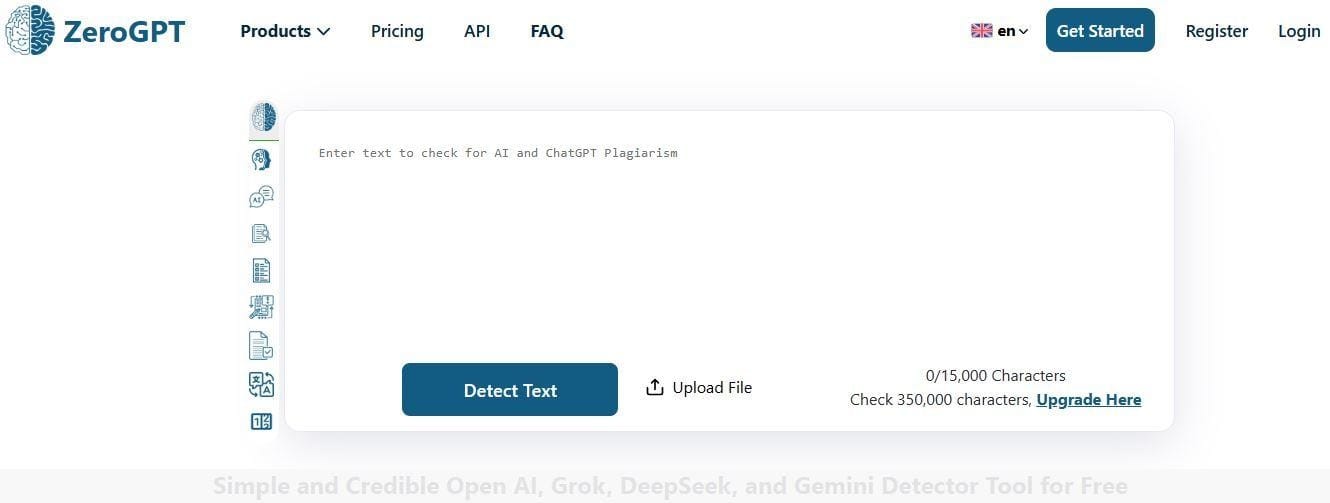
ZeroGPT provides free AI detection with a 15,000-character limit per scan. It's straightforward to use and requires no account creation.
• Free limit: 15,000 characters per scan
• Accuracy: Decent, though may have higher false positive rates
• Best for: Quick checks of shorter papers
QuillBot AI Detector
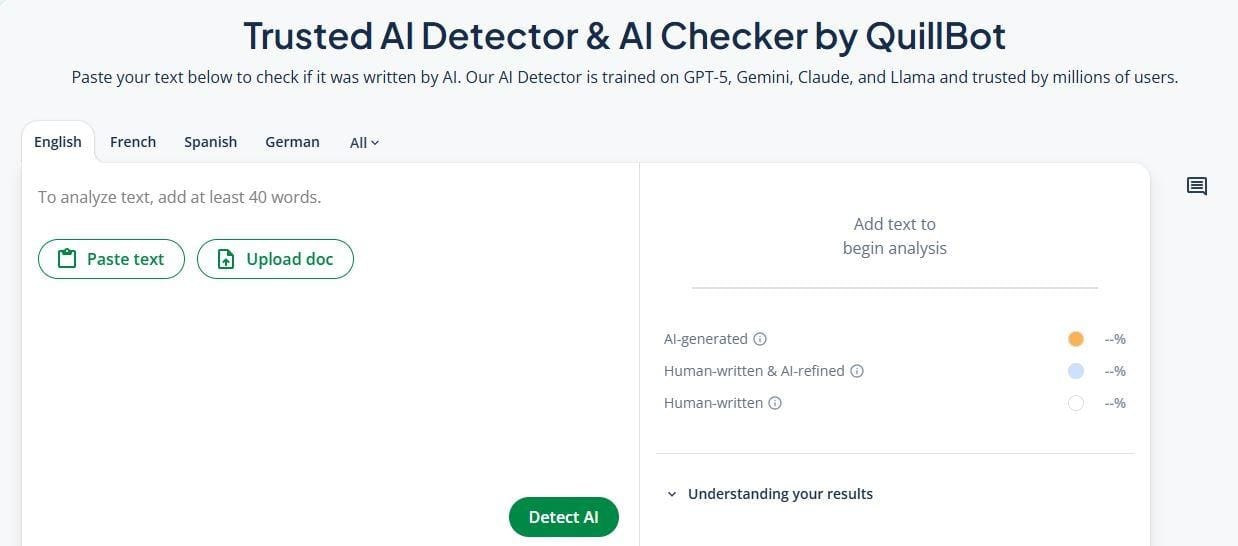
QuillBot, known for its paraphrasing tool, also offers a free AI detector. It's particularly good at distinguishing between AI-generated content and AI-refined human writing.
• Free limit: Varies, typically around 1200 words
• Accuracy: Good at detecting paraphrased AI content
• Best for: Students who use grammar checkers and want to avoid false flags
For a comprehensive comparison of all available detectors, see our complete detector comparison guide.
Academic-Specific Features in Free AI Detectors
Not all AI detectors are created equal, especially when it comes to academic use. The best academic AI detection tools should have specific features that address the unique needs of educational settings.
Understanding what professors use helps you check your work with the same tools they'll use.
Accuracy for Long-Form Academic Writing
Academic papers differ from blog posts or marketing copy. They employ technical terminology, cite sources, and frequently incorporate complex sentence structures. A good academic AI detector should be trained to recognize that formal academic writing patterns aren't automatically AI-generated.
Look for tools that analyze entire documents at once rather than just snippets. Phrasly, for example, examines complete text context rather than evaluating sentences in isolation, which reduces false positives for sophisticated academic writing.
Understanding of Citation Formats
Academic papers include citations, references, and quoted material. The best AI detectors understand that properly cited content shouldn't be flagged as AI-generated, even if the formatting appears structured or repetitive.
Detailed Sentence-Level Highlighting
Rather than just giving you a percentage, look for free AI detector tools that show exactly which sentences appear AI-generated. This lets you review specific sections and understand what patterns triggered the detection. You can then revise those sections if needed, or verify that they're actually your original work.
Realistic Free Tier Limits
Be realistic about character limits. A 500-character limit might work for checking a single paragraph, but it's useless for a 2,000-word essay. Calculate whether the free limit actually covers your typical assignment length.
Understanding the Limitations of Free AI Detection Tools
While free AI detectors are valuable, it's important to understand their limitations. No AI detector is 100% accurate, and several factors can affect reliability.
False Positives Are Real
AI detectors can incorrectly flag human-written text as AI-generated, especially for non-native English speakers. A Stanford-led study published in Patterns found that popular GPT detectors falsely labeled over half of genuine essays written by non-native English writers as AI-generated, with some tools reaching false-positive rates as high as 98%. Because these detectors rely on text “perplexity,” writers who use simpler or highly standardized academic English face a higher risk of being misclassified.
Accuracy Varies by AI Model
Detection tools trained primarily on ChatGPT may struggle with newer models like GPT-5, Claude, or Gemini. The best free detectors, like Phrasly AI, update regularly to account for evolving AI patterns, but there's always a lag between new AI releases and detector updates.
Detectors Can Be Evaded
Anyone determined to cheat can modify AI text to evade detection through intentional errors, paraphrasing tools, or manual editing. Detection tools work best as one part of an academic integrity assessment, not the only measure. Educators should combine them with knowledge of students' typical writing styles.
Privacy Considerations
Some free AI detectors store your submitted text or use it to train their models. Check the privacy policy before uploading sensitive work. Tools like Phrasly explicitly state they immediately delete content after analysis and never store or share your writing.
Detection Results Aren't Definitive Proof
AI detection results should never be the sole basis for academic misconduct accusations. A high AI score indicates patterns similar to AI writing, but doesn't prove cheating. Writing style, grammar tools, and formal academic language can all contribute to false positives. Many universities now prohibit punishing students based solely on detector results without additional evidence.
How to Use Free AI Detection Tools Effectively
Getting the most from your AI detector free tool requires using it strategically. Here are practical tips for students and educators.
Scan Before Submission
Run your completed essay through a free AI detector before turning it in. This gives you peace of mind and allows you to address unexpected issues. If sections are highlighted, review them carefully. Sometimes, formal academic language naturally scores higher, which is normal. If you used AI for brainstorming or outlining, ensure you've properly rewritten everything in your own words.
Cross-Check with Multiple Tools
Don't rely on a single detector. Run your paper through 2-3 different free tools to see if results are consistent. If one tool flags your work as 80% AI-generated while others show 10-20%, the outlier is probably a false positive. Consistent results across multiple detectors provide more reliable feedback.
Understand Your Writing Baseline
Test some of your old essays that you definitely wrote yourself and see what scores they get. This establishes your personal baseline. If your new paper scores similarly to previous human-written work, you're probably fine. If scores are dramatically different, investigate why.
Review Highlighted Sections Carefully
When a detector highlights specific sentences, read them critically. Do they sound generic or robotic? Are they overly formal for your typical style? Use this feedback to improve your writing, not just to "beat" the detector. Developing a more natural, conversational academic style benefits you beyond AI detection.
For Educators: Use Detection as a Conversation Starter
Never use AI detection results as definitive proof of cheating. Instead, use them to start conversations with students. Ask about their writing process, have them explain their reasoning, or request revisions for sections that seem out of character. Many students use AI ethically for brainstorming or grammar checking. Detection tools help you identify when to provide guidance rather than punishment.
Choosing the Right Free AI Detector
Finding a reliable AI checker tool doesn't have to be complicated. The best choice depends on your specific needs. Students writing multiple papers per semester benefit most from truly unlimited tools like Phrasly, while those checking occasional assignments might find limited-scan options sufficient.
Remember that AI detection is one tool among many for maintaining academic integrity. Use free detectors to verify your work, understand AI writing patterns, and protect yourself from false accusations, but don't let them make you paranoid about your original writing. If you wrote it yourself, you have nothing to fear.
For students on a budget, Phrasly offers the most comprehensive free option with high accuracy and genuine privacy protection. For educators, combining free detection tools with your knowledge of students' abilities and writing styles provides the most balanced approach to academic integrity.
Ready to check your academic work? Try Phrasly's free AI detector now - no signup required.
Frequently Asked Questions
Are free AI detectors as accurate as paid ones?
Yes, accuracy depends on the tool, not the price. Phrasly offers 99.8% accuracy for free, comparable to paid options. Paid tools mainly add extra features like batch processing and API access.
What's the word limit for free AI detection?
Phrasly: 2000 words
GPTZero: 10,000 characters (~1,500-2,000 words)
ZeroGPT: 15,000 characters
Writer.com: 1,500 characters
Can AI detectors tell if I used Grammarly?
Quality detectors distinguish between AI-generated content and grammar checking. Grammarly and spell checkers typically won't trigger false positives since they preserve your original ideas and structure.
Is Phrasly a legitimate free Turnitin alternative?
Yes. Phrasly provides accurate AI detection without institutional access or subscriptions. Turnitin remains the institutional standard with added plagiarism checking, but Phrasly is a strong free alternative for students.
Will my university's AI detector show different results?
Possibly, since detectors use different algorithms. However, if your work scores as human-written across multiple free tools, it'll likely do well on institutional detectors too.
How do I know if a detector is storing my work?
Check the privacy policy. Phrasly explicitly states that content is deleted immediately after analysis. Avoid tools with vague policies or mandatory account creation.
Can I use free AI detectors for non-English papers?
Some support multiple languages, but accuracy often drops. GPTZero and ZeroGPT claim multilingual support. Test with known human-written samples first to gauge accuracy.
What if a detector incorrectly flags my original work?
Cross-check with other detectors. If multiple flags the same sections, review them—they might sound generic. If only one flags it, it's likely a false positive. Keep drafts as proof of authorship.
Are there detectors for research papers with citations?
No detector specializes in this, but tools trained on diverse human writing (like Phrasly) handle academic formats better and are less likely to flag citations or technical terminology.
How often should I check my work?
Check at major milestones: first draft, after revisions, and before submission. Don't check too frequently; it can make you second-guess natural writing. Use it as a quality check, not an anxiety trigger.


Keep reading

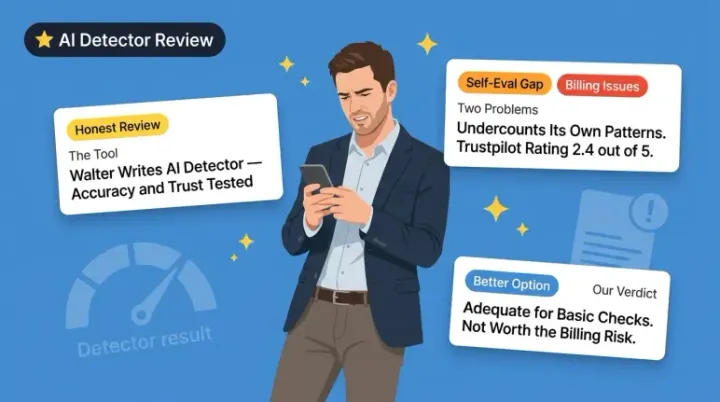
Walter Writes AI Detector Review 2026: Does It Actually Work?
Walter Writes AI Detector works on pure AI text but struggles with humanized content. Add billing complaints and a 2.4 Trustpilot score, and better free alternatives like Phrasly or GPTZero make more sense.
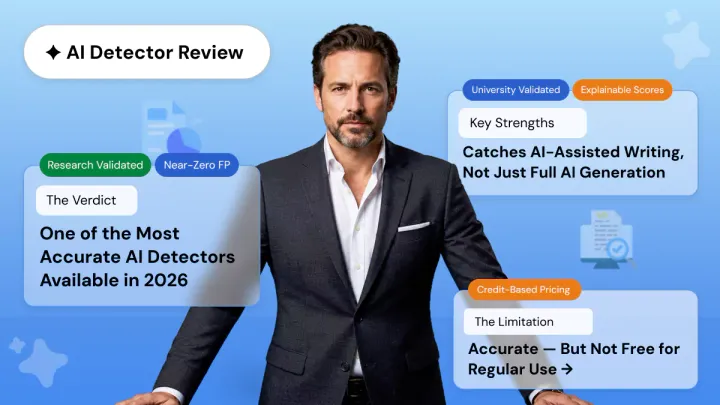
Pangram AI Detector Review: How Accurate Is It Really?
Pangram AI Detector delivers near-zero false positives, independently verified by University of Chicago researchers. With 99.8–100% accuracy, LMS integrations, and AI-assist detection, it's the top choice for educators and institutions.