Best Prompt to Write on AI for Marketing Campaigns: 50 Prompts (Tested and Ranked)
14 min read
If you've ever typed a direct instruction like "write me a marketing email" into an AI tool, you've probably gotten back flat, generic content.
You've learned the hard way that vague prompts don't produce copies you'd actually publish, but using the right prompts can save you serious time.
The fastest way is to start with prompts that have already been tested. Research shows that 77% of marketers say AI tools increase their confidence in the quality of their work (ActiveCampaign), but confidence only holds when the output is actually usable.
In this guide, we shared 50 prompts, including 4 top performers that we tested across 4 campaign categories.
You can use these prompts in Phrasly Content Generator, ChatGPT, Gemini, Claude, and on your preferred large language model (LLM).
How We Tested and Ranked The AI Prompts for Marketing
In this resource, we have tested and ranked different prompts and guide you on how you can build your perfect prompt.
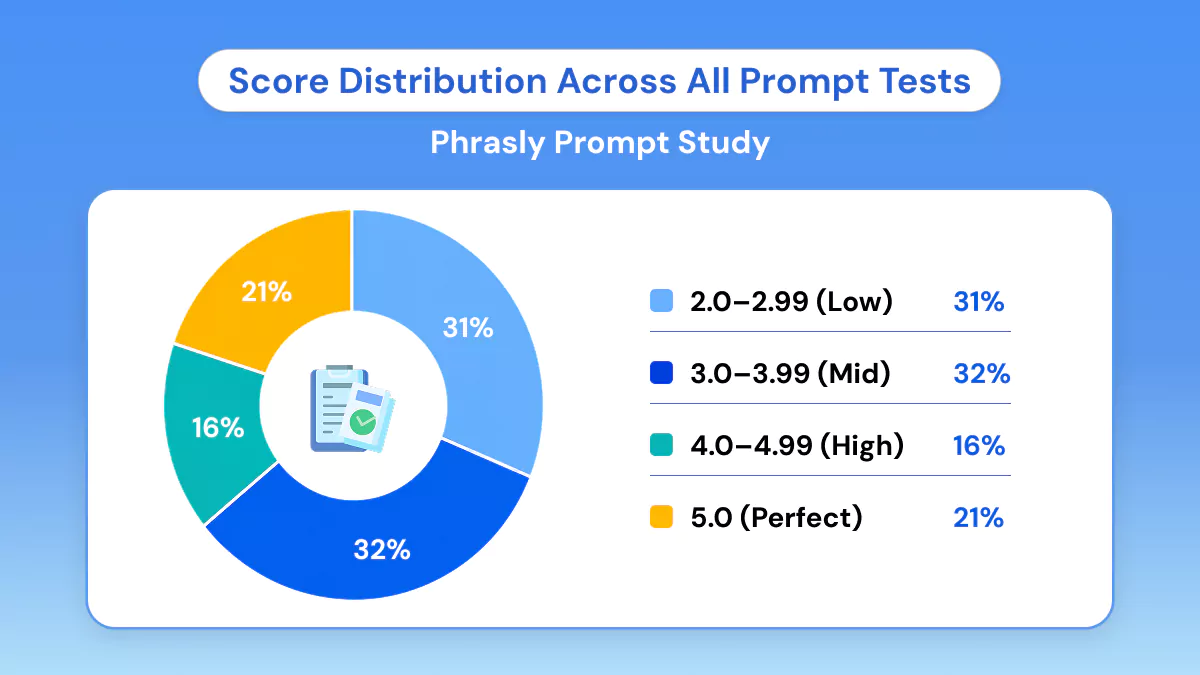
Instead of testing all 50 prompts individually, we took a more useful approach: for each of the four campaign categories, we picked one (the prompt that carried the most structural guidance ) and put it through several rounds of testing, changing one variable at a time, until it reached its maximum score.
Each round followed the same process: run the prompt against the same real product, audience, and campaign goal as the round before it, generate the output, and score it by evaluating:
Accuracy. Are the facts, claims, and social-proof lines actually real, or invented?
Prompt adherence. Did the output follow every instruction in the prompt, not just the obvious ones?
Creativity. Does it have different ideas and solutions? Is it elaborated, with distinct elements?
Each dimension was scored on a scale of 1 to 5, and the three scores were averaged into a single overall score.
Nearly a third of all tested versions scored below 3.0, so most prompts need at least one round of revision before they're publish-ready.
If you’re searching for prompts that are copy-paste ready, check out 50+ AI Prompts for Marketing That Drive Real Results.
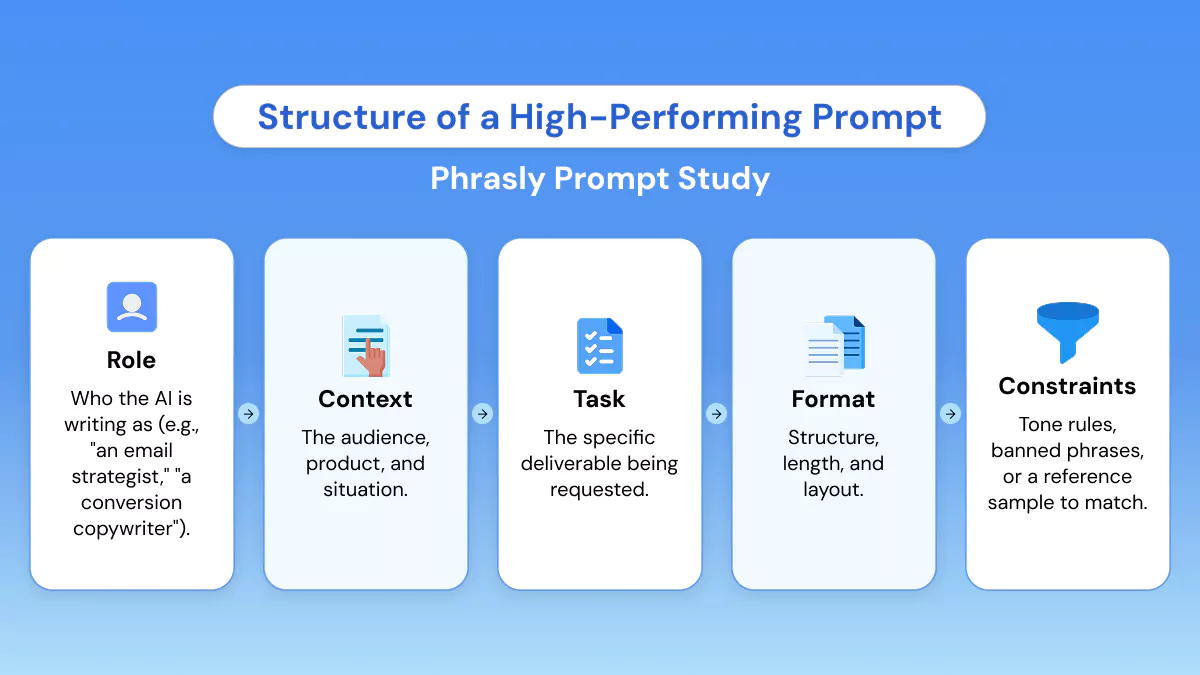
Structure of a High-Performing Prompt
All four prompts that scored a perfect 5.0 in testing (one per category) followed this same five-part structure:
Role
Defines the role the AI should assume.
Blog: "You are an SEO content strategist and skilled copywriter."
"You are an email marketing strategist creating a [type of campaign] for [product/company]."
“You are a short-form content strategist and scriptwriter specializing in [platform]-native.
"You are a PPC copywriter for [platform] campaigns."
Context
The audience, product, and situation.
Blog: targeting keyword and audience, written in a stated tone.
Email: audience segment "who already know [product] and are currently [behavior/lifecycle stage]."
Social: target audience plus a stated primary and secondary goal.
Paid: audience at a stated funnel stage, with brand voice and current offer/promo reflected.
Task
The specific deliverable being requested.
Blog: a piece of content at a defined word count, on a named topic.
Email: a campaign email built around one clear reader action.
Social: a complete 15-second video script.
Paid: five ad variations for one product.
Format
Structure, length, and layout.
Blog: pain-point opener, H2 body, sourced claims, external links, CTA.
Email: hook, value reminder, single CTA, capped at 3 short paragraphs.
Social: 4 timestamped beats (0-2s, 2-7s, 7-12s, 12-15s) with paired spoken/visual direction.
Paid: hook, one specific benefit, CTA, staying under the platform's character limit.
Constraints
Tone rules, banned phrases, or a reference to match.
Blog: "never invent numbers or sources"; banned words list.
Email: banned AI-filler-phrase list ("unlock," "elevate," "seamless"); stated reading level.
Social: 3 required hook angles, each with a stated reason it would stop the scroll.
Paid: banned-word list; one variation flagged as strongest for the primary KPI.
Learn more about prompt optimization techniques for LLMs and the process of refining an existing prompt to obtain more accurate, consistent, and useful responses from the AI.
Blog & SEO Content Prompts (12)
These prompts are built for long-form and search-focused writing, and you can edit them quickly.
Content Creation Top Performer Prompt
Copy and paste:
"You are an SEO content strategist and skilled copywriter. Write a [blog/type of content], [word count] about [topic], targeting the primary keyword [keyword], for [audience]. Write consistently in a [tone] voice throughout.
Structure it as follows:
Open with a specific, concrete pain point relevant to [audience].
Work [keyword] naturally into the first 100 words, and once more in a subheading, without repeating it more than 3 times total.
Organize the body under clear H2 subheadings covering these key points: [list your action points/topics here].
Support at least 2-3 claims with real data or statistics, each attributed to a specific, credible, current source (e.g., a named industry report, government data, or published study); never invent numbers or sources.
Include 1-2 external links to authoritative sources that back up those facts, not competitor sales pages.
End with a one-sentence promise of what the reader will walk away knowing, followed by this call to action: [CTA phrase or link].
Constraints: Avoid these words/phrases: [banned words, if any, e.g., "revolutionary," "game-changing"].”
Why Is This Prompt a Top Performer?
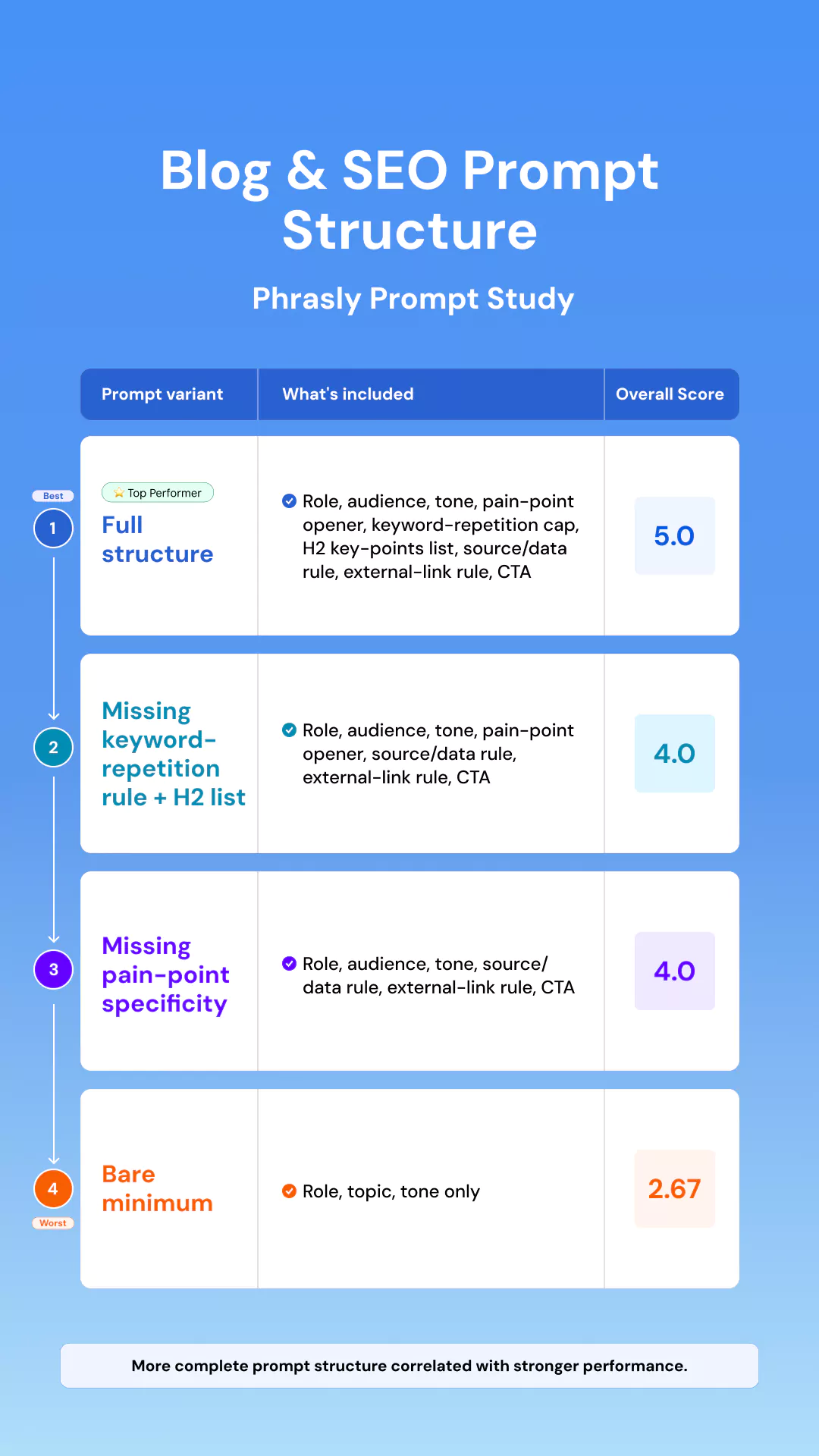
This exact prompt is the only version tested so far to score a perfect 5.0 average in accuracy, prompt adherence, and creativity.
Why did this prompt stand out?
A keyword repetition limit; otherwise, AI models will repeat a keyword far more than a piece needs.
A source constraint. Some models will invent a statistic or a source just to make a piece sound more authoritative.
When we tested a stripped-down version of this same prompt without the "never invent numbers or sources" line, the output contained zero citations at all, and scored the lowest accuracy rating (3/5) of any prompt tested in this category.
A length constraint. Without a defined word count, output length becomes excessive.
Blog & SEO Content Prompts
"Act as a subject-matter expert in [industry]. Draft a 500-word section explaining [subtopic] in plain language, using one concrete example and no more than two statistics."
"Turn these five bullet points into a cohesive 500-word blog paragraph in a [tone] voice: [paste bullets]."
"Write a conclusion paragraph for a blog post about [topic] that restates the core argument in one sentence and ends with a specific next action."
"Generate 10 long-tail keyword variations for [main keyword] that reflect how a buyer at the [buyer’s journey] stage would search."
"Write a 500-word comparison section contrasting [option A] and [option B] for [audience], ending with a criteria-based recommendation, not a flat opinion."
Subheadings
"Write five SEO-friendly H2 subheadings for a blog post about [topic], each phrased as a question a reader would type into a search bar."
Meta title and meta description
"Write a meta description under 155 characters for a blog post about [topic] that includes [keyword] and a reason to click."
"Draft three alternative title tags for a post about [topic], each under 60 characters and each testing a different angle: benefit, curiosity, and urgency."
Rewrite
"Rewrite this paragraph to be more scannable, using bolded lead-ins and shorter sentences, without changing the meaning: [paste paragraph]."
Content brief/Topics suggestions
"Write a 500-word 'ultimate guide' style outline for [topic], structured as problem, options, recommendation, and next steps."
FAQ
"Write an FAQ section with five questions and answers about [topic], each answer under 60 words and written to satisfy an AI Overview-style summary."
Check How to Write Good Prompts for AI and finally get the output you actually want.
Email Marketing Prompts (10)
Here are copy-paste-ready prompts for email content creation and analysis.
Email Marketing Strategy Top Performer Prompt
“You are an email marketing strategist creating a [type of campaign, e.g., content calendar, engagement, re-engagement, sequence] for [product/company].
Audience: [audience segment] who already know [product] and are currently [behavior/lifecycle stage, e.g., inactive for 30 days, high engagement but no purchase, recently signed up].
The single biggest objection or hesitation this segment has right now [add information].
The one action you want them to take after reading is [add information]
Voice: [2-3 adjectives, e.g., direct, no fluff, conversational].
Avoid AI-sounding filler like "unlock," "elevate," "game-changer," "in today's world," "seamless."
Body structure:
1. Hook tied to the segment's situation or objection.
2. Value reminder: why [product] solves this.
3. Single clear CTA.
No more than [3] short paragraphs.
Constraints: [Any additional constraints: reading level, sentence length, banned phrases, etc.].”
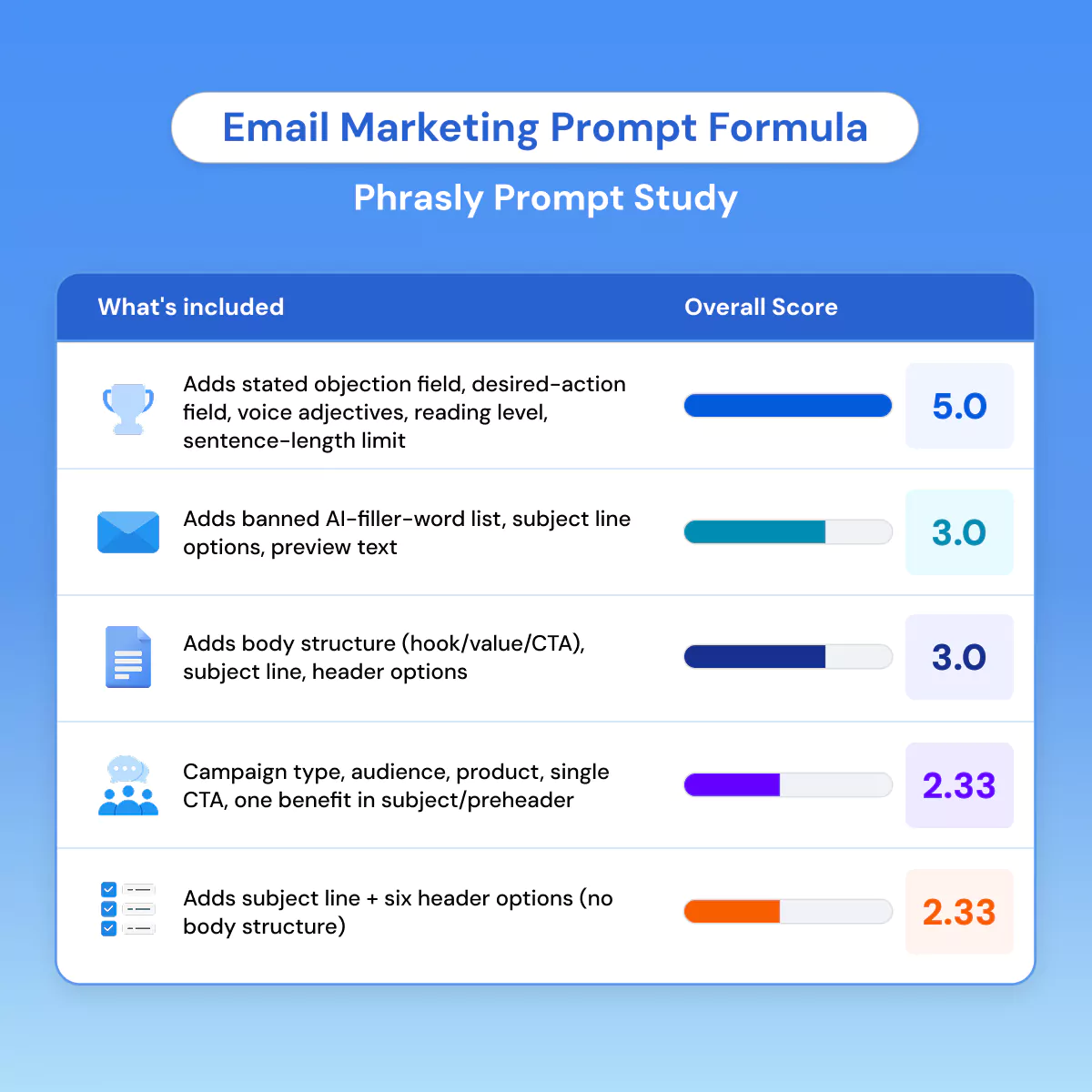
Why Is This Prompt a Top Performer?
This prompt is the only one to score a perfect 5.0 average. The other attempts showed what was missing:
Before asking for the audience's actual hesitation, version 2 invented a vague, unsupported credibility claim in its output ("Thousands of marketers and business owners rely on...").
We tested versions with a defined body structure (hook, value reminder, CTA) and subject-line/preview-text options, which increased the Accuracy score to 4/5, but the emails still read generically because the "hook" had nothing specific to hook onto.
The winner version asks for the segment's actual objection and the one action they should take, in plain language, before writing a word of copy.
Email Marketing Prompts
Subject Lines
"Write five subject line variations for an email about [offer], each testing a different lever: curiosity, urgency, benefit, social proof, or a question."
"Write a pre-header text line under 90 characters that complements this subject line without repeating it: [paste subject line]."
Email Welcome
"Draft a three-email welcome sequence for new subscribers to [brand], where email one builds trust, email two demonstrates value, and email three makes a soft offer."
Cart-abandonment
"Write a 500-word cart-abandonment email for [product] that leads with a specific reason the customer might have paused, not a generic reminder."
Re-engagement
"Draft a win-back email offering [incentive] to lapsed customers of [product], written to feel like a personal check-in rather than a discount blast."
"Draft a plain-text-style email announcing [feature/update] to existing customers, written like a note from a real team member rather than a press release."
Product announcement
"Draft a 500-word product-education email that teaches one use case for [product] the customer likely doesn't know about yet."
"Draft a seasonal/timely email tying [product] to [event or season] without relying on a pun in the subject line."
Newsletter
”Create a quarterly newsletter highlighting customer success stories [provide success cases].”
Check 75+ Best ChatGPT Prompts for Professionals (That Actually Get Results).
Social Media & Short-Form Content Prompts (14)
"Write five scroll-stopping hooks for a [platform] post about [topic], each under 12 words and each avoiding a question format."
"Write a carousel outline for [platform] with five slides covering [topic], where each slide has a one-sentence headline and one supporting line."
"Draft a community-management reply to this comment that acknowledges the specific point raised and invites further conversation: [paste comment]."
"Write a behind-the-scenes caption for [platform] that reveals one specific process detail about how [product/content] gets made."
"Generate five poll or quiz question ideas for [platform] related to [topic] that double as light audience research."
"Generate a set of 15 hashtags for a post about [topic] on [platform], grouped into broad, niche, and branded tiers."
"Draft a LinkedIn post under 150 words sharing a lesson learned from [experience/data point], written in first person with no corporate jargon."
"Write an Instagram caption for [image/topic] structured as a one-line hook, two lines of context, and a comment-bait question."
"Write a TikTok script under 100 words built around a myth-vs-reality format for [topic], where the myth is stated first and debunked second."
"Draft three X (Twitter) post variations announcing [news/update], each under 280 characters and each testing a different opening line."
"Draft a LinkedIn thought-leadership post under 200 words that takes a clear, specific stance on [industry trend], not a neutral summary of it."
"Write a script for a 30-second video on [topic], structured as hook, three-step explanation, and CTA, with each section timed in seconds."
"Draft a caption repurposing this blog paragraph into a [platform]-native post, matching platform tone and trimming to the platform's typical length: [paste paragraph]."
Social Media (Video) Top Performer Prompt
14. “You are a short-form content strategist and scriptwriter specializing in [platform]-native. Write a complete 15-second video script promoting [product/topic] for [target audience], with the primary goal of [e.g. driving sign-ups / boosting sales / building brand awareness] and a secondary goal of [e.g. shareability/comments/saves].
Context to consider:
Brand voice: [warm, formal, casual, serious]
Key differentiator of the product: [insert]
Biggest objection or hesitation this audience has: [insert]
Platform trends or formats currently performing well: [insert, if known]
Deliver the script with exact timestamps and full production notes:
0-2s (Hook): Provide 3 alternative hook options, one question-based, one bold-claim-based, one visual-surprise-based. Note why each would stop the scroll for this specific audience.
2-7s (Problem): State the pain point in the audience's own words/language
7-12s (Demonstration): Write the spoken line AND describe the paired visual/on-screen action beat-by-beat. Show the product resolving the problem in a compelling way for [platform]'s format (vertical video, fast cuts, etc.)
12-15s (CTA): One clear CTA.”
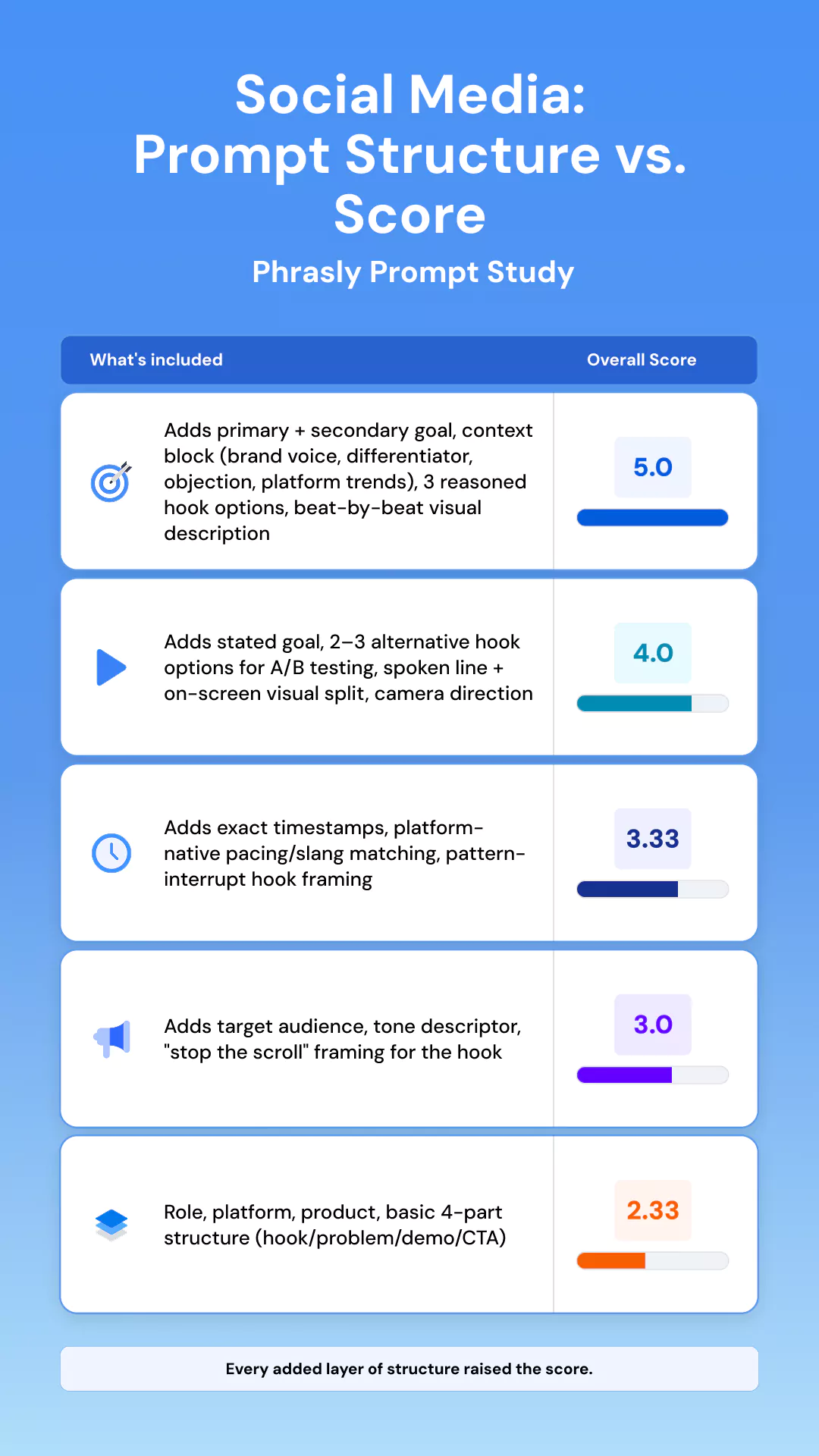
Why Is This Prompt a Top Performer?
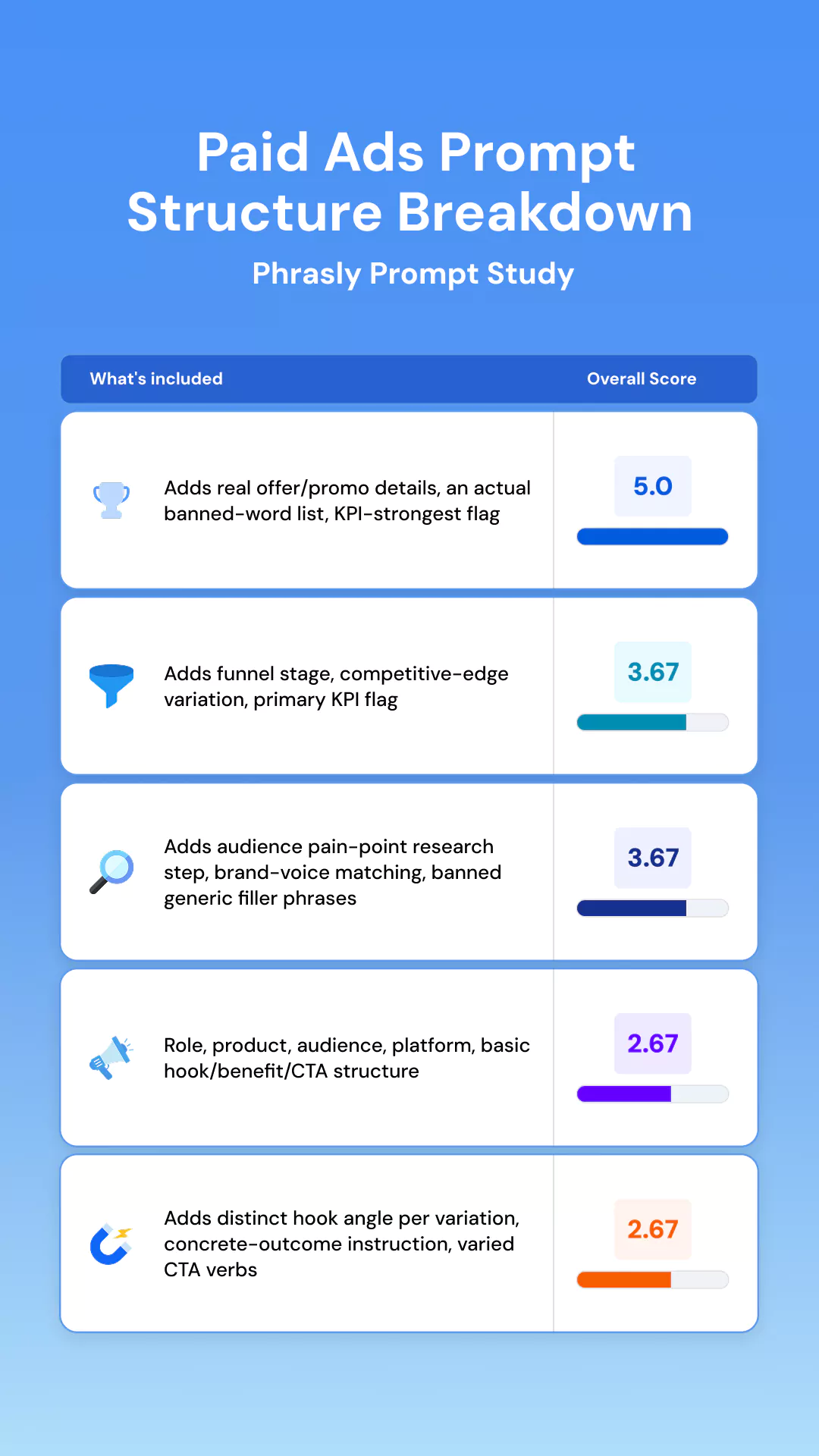
This is the version tested with the higher score. Here is what we included when building the perfect prompt.
Check 50 Highest-Engagement AI Prompts for LinkedIn, Instagram, and X for marketers.
Paid Ads Strategies & Ads Copy Prompts (14)
Ad Copy A/B Test
"Write 4 headline + description variations for a Google Ads campaign promoting [product/service].
Structure them as a true A/B test: vary only ONE element per pair (e.g., pair 1 tests benefit-led vs. urgency-led headline, pair 2 tests price-anchor vs. no price).
Label what each variation is testing."
Keyword
"Draft three headline options for a search ad targeting the keyword [keyword], each leading with the keyword or a close variant."
"Given this core keyword: [keyword], generate 10 ad copy phrase variations that naturally incorporate the keyword or close semantic matches, without repeating sentence structure.
Include at least 3 that lead with a question, 3 that lead with a benefit, and 3 that lead with a number/stat."
"Write two description lines for a Google Ads listing for [product], each under 90 characters, with one focused on benefit and one on objection-handling."
"Generate five CTA button variations for [offer], ranked by how directly they state the action versus imply it."
Search Intent Matcher
"For the keyword [keyword], map out the 4 likely search intents behind it (informational, navigational, commercial, transactional) and write one ad headline tailored to each intent so I can test which intent is driving the bulk of clicks."
Paid Social Media Marketing
"Write 5 paid social ad captions for [product/audience] designed specifically to spark comments, not just clicks, use a debate-style question, a relatable pain point, or a 'this or that' format. Note which psychological trigger each one uses."
"Give me 10 opening lines (first 8 words max) for paid social ads targeting [audience] about [offer], each using a different hook style: curiosity gap, bold claim, pattern interrupt, second-person callout, contrarian take, etc."
"I'm running the same offer [offer] to 3 different audience segments: [segment 1], [segment 2], [segment 3]. Write tailored ad copy for each segment that speaks to their specific motivation for buying, while keeping the core CTA consistent."
Paid Shopping Marketing
"Rewrite these 5 product titles [paste titles] to follow shopping ad best practices: front-load the most searched keyword, include key attributes (size/color/material), and stay under the character limit while remaining natural to read."
Retargeting Sequence
"Write 3 retargeting display ad messages for someone who [viewed a product / added to cart / abandoned checkout] for [product], each escalating slightly in urgency or incentive, to be sequenced over a 7-day window."
"Write 5 short display ad headlines (under 8 words) reminding a past site visitor of our core value proposition [value prop], without mentioning price or discount, focused purely on reinforcing why we're different."
Cart Abandonment Copy
"This visitor viewed [product] and left without buying. Write 3 display ad variations that gently remind them of the product's key benefit, address a likely last-minute hesitation (shipping time, price, trust), and include a low-pressure CTA."
Paid Ads Top Performer Prompt
"You are a PPC copywriter for [platform] campaigns.
Write five ad variations for [product] targeting [audience] at the [funnel stage] stage, each structured as a hook, one specific benefit, and a CTA, staying under the character limit for [platform].
Use a distinct hook angle per variation (curiosity, urgency, social proof, pain point, contrarian) and a different CTA verb each time.
Ground every benefit in a concrete outcome, number, or timeframe; no vague claims.
First, list the audience's top 3 pain points and top desired outcome; address at least one per variation.
Match tone to [brand voice].
Include one variation with a subtle competitive edge over [alternative], no direct naming.
Reflect our current offer/promo: [offer details].
Avoid banned words: [word list].
Flag the single strongest variation for [primary KPI].”
Why Is This Prompt a Top Performer?
The pattern in this prompt is different from blog, email, and social: the biggest gains didn't come from adding more structure to the output; the hook/benefit/CTA skeleton was already in version 1.
They came from making the model do audience research before writing, and giving it specific instructions (offer details, banned words).
When copying and pasting the prompts, keep in mind:
Fill the brackets. The prompts have brackets [example] where you add your information. For better results, make sure to fill them all.
Review before posting. AI works better when edited by a human, so make sure you check the content you create.
Read the article How to Edit AI Ad Copy: Hooks & Landing Pages, which proposes a five-step workflow for transforming AI-generated drafts into persuasive and authentic ad copy.
Better Prompts Lead to Better Content
The quality of AI-generated content depends on the instructions you give it. A useful prompt provides context and structure.
As you use the prompts in this guide, don't just copy and paste them. Feel free to add specific - and shareable - details about your audience, campaign, product, and goals to have better results.
The more precise your prompt, the less time you'll spend rewriting the result.
These 50 tested prompts give you a reliable starting point across blog content, email marketing, social media, and paid advertising.
If you want to create custom prompts faster, adapt them to your brand voice, or generate new prompt frameworks for campaigns beyond those covered here, try Phrasly AI Prompt Generator.
Frequently asked questions
What is the best prompt to write on AI for a marketing campaign?
The best AI marketing prompt gives the model a clear role, relevant context, a specific task, a required format, and defined constraints. For example, tell AI who it is writing as, who the audience is, what you want created, how it should be structured, and which claims, phrases, or stylistic choices to avoid.
How do I write a good AI prompt for marketing?
Start by providing details about your audience, product, campaign goal, and brand voice. Then specify the exact deliverable, format, length, and constraints. The more useful context you provide, the less generic the AI output is likely to be.
What should I include in an AI marketing prompt?
A strong prompt typically includes five elements: role, context, task, format, and constraints. Depending on the campaign, you can also include your target audience, funnel stage, key objections, desired action, brand voice, offer details, and platform-specific requirements.
Can I use these AI marketing prompts with ChatGPT, Claude, and Gemini?
Yes. The prompts in this guide can be adapted for ChatGPT, Claude, Gemini, Phrasly Content Generator, and other large language models (LLMs). You may need to adjust formatting or platform-specific instructions depending on the AI tool you use.

Written by
Gabriela Cofre
Gabriela Cofre is a content strategist and writer specializing in SEO, inbound marketing, and B2B, B2C content with +7 years of experience.