
How to Edit AI Ad Copy: Hooks and Landing Pages That Convert in 2026
Learn how to edit AI ad copy with a 5-pass system for sharper hooks, human tone, real proof, and landing pages that convert.
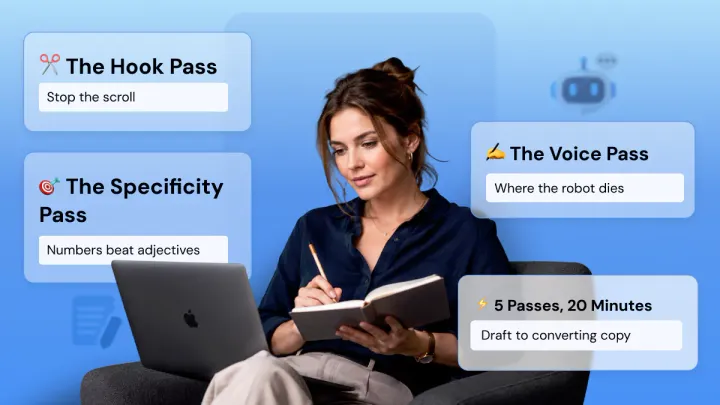
Editing AI ad copy comes down to five passes: hook, specificity, voice, proof, and CTA. Raw AI output reads generic because it optimizes for plausible, not persuasive, and the passes are where conversion happens.
Edited AI copy is 5 to 10 times faster than starting from scratch (DTC Systems), but the real value is not speed alone. When paid traffic is expensive, even a small lift in landing-page conversion can make the editing time worth it.
In this article, you will see all five passes applied to one real AI hero section, with a before and after for each.
Why Raw AI Ad Copy Does Not Convert
AI drafts fail on ads and landing pages for three predictable reasons: generic hooks that could belong to any brand, benefits stated without specifics or numbers, and uniform sentence rhythm that reads as filler.
AI ad copy sounds generic because most brands feed similar tools similar prompts, so the output lands on the same safe phrasing, the same structure, and the same claims. The grammar is clean, the CTA is present, and the page looks finished. Then traffic hits it and nothing converts.
Look at a realistic AI-generated hero section for a project management tool:
At first glance nothing looks broken. That is exactly why raw AI copy is risky: it reads as finished long before it reads as persuasive. Three failures are doing the damage.
Failure 1: The hook could belong to any brand. "Unlock seamless project management" never names the audience, the pain, the moment, or the outcome. A founder, an agency owner, an ops lead, and an enterprise buyer could all read it and feel nothing meant for them.
This is the exact trap Google Ads best practices warns against: skip generic language and lead with specific calls to action and clear user benefits.
Failure 2: The benefits have no numbers or concrete nouns. "Boost productivity," "save time," and "improve efficiency" sound positive but give the reader nothing to believe. Stronger copy names the workflow, the metric, or the before-and-after result. "Save time" only starts working when it becomes something like "cut client onboarding from 3 weeks to 4 days."
Failure 3: The rhythm reads as filler. Every line carries the same beat of broad verb, soft adjective, general benefit. A 2026 TechRadar analysis flags this directly: AI makes ads easier to produce but harder to tell apart, because so many brands share the same tools, prompts, and phrasing. The fix is not better grammar. It is sharper, more human copy.
The rest of this guide fixes this same hero through five editing passes: hook, specificity, voice, proof, then CTA. To edit AI-generated ad copy so it converts, run it through these five passes and fix one weakness at a time. Same sample, five passes, all the way to a finished page.
The 5-Pass AI Ad Copy Editing Workflow
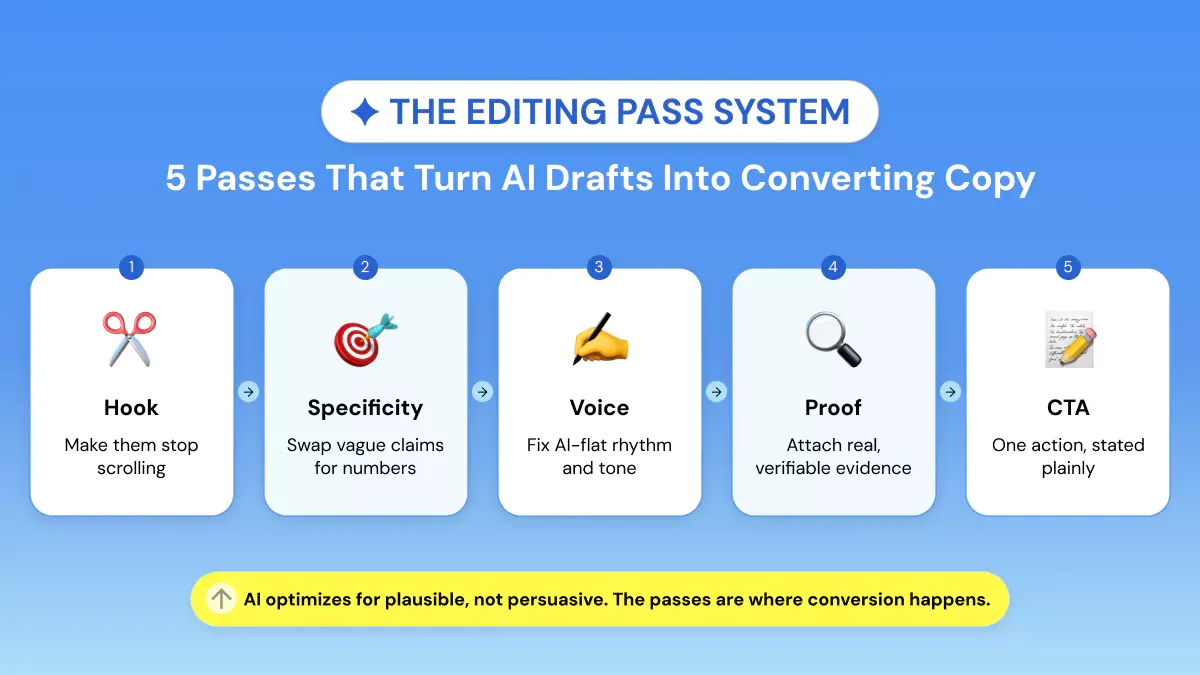
Use a five-pass workflow: first fix the hook, then add specificity, humanize the voice, verify the proof, and sharpen the CTA. This sequence keeps the draft fast without letting raw AI copy go live untouched.
It also aligns with how strong ad systems work in 2026: test different headlines, make the message specific, keep the copy clear, and give users one clear next action.
Pass 1: The Hook Pass (Headlines and Opening Lines)
The hook pass rewrites the headline and first line until they pass one test: would the target customer stop scrolling? 8 out of 10 readers never get past the headline, so the few words above the fold decide whether the rest of your editing is ever seen.
In AI-written hooks, change the generic headline and opening line into ones that name the audience, the pain, the outcome, or a sharp contrast. The hook does not need to be clever first. It needs to be specific first.
The reason this pass goes first is in the data. Digitalapplied's 2026 landing page research found that benefit-led headlines beat feature-led headlines by 27%, and adding a concrete number to the headline lifts it by another 15%. The classic Copyblogger stat explains why the headline carries so much weight: 8 out of 10 people read it, but only 2 out of 10 read on. Get the headline wrong and most of your traffic leaves before anything else on the page gets a chance.
Three patterns fix most weak AI hooks:
Now apply the eliminate-pain frame to the running sample, since its buyers are tired of chasing updates:
- Original headline: Unlock Seamless Project Management for Your Team
- After Pass 1: Stop Losing Fridays to Status Updates
- Edited first line: Plan, assign, and chase fewer updates from one client-ready workspace.
What changed: only the headline and opening line. The hook now points at a real pain instead of describing the category. Everything below it still needs work, which is the next pass.
Pass 2: The Specificity Pass (Numbers, Names, Nouns)
The specificity pass replaces every vague claim with a number, a concrete noun, or a named outcome. AI writes "save time and money"; converting copy writes "cut onboarding from 3 weeks to 4 days."
Scan the draft for soft words and trade them for something the reader can picture: a metric, a workflow, a timeframe, an audience label, a named result. DTC Systems makes the same call in its 2026 guide, noting that AI benefit blocks usually list features instead of outcomes, and that a concrete "3x faster" beats a plain "faster" every time.
Here is the running sample's benefit block, before and after:
The rule to keep: every benefit leads with the metric or concrete outcome, then explains the mechanism. "Cut onboarding from 3 weeks to 4 days with reusable client intake templates" beats "save time" because the outcome lands first and the how-to follows.
What changed: the benefits now use real nouns, workflows, and named outcomes. Read them out loud, though, and they still sound a little stiff. That is the voice pass.
Pass 3: The Voice Pass (Where the Robot Dies)
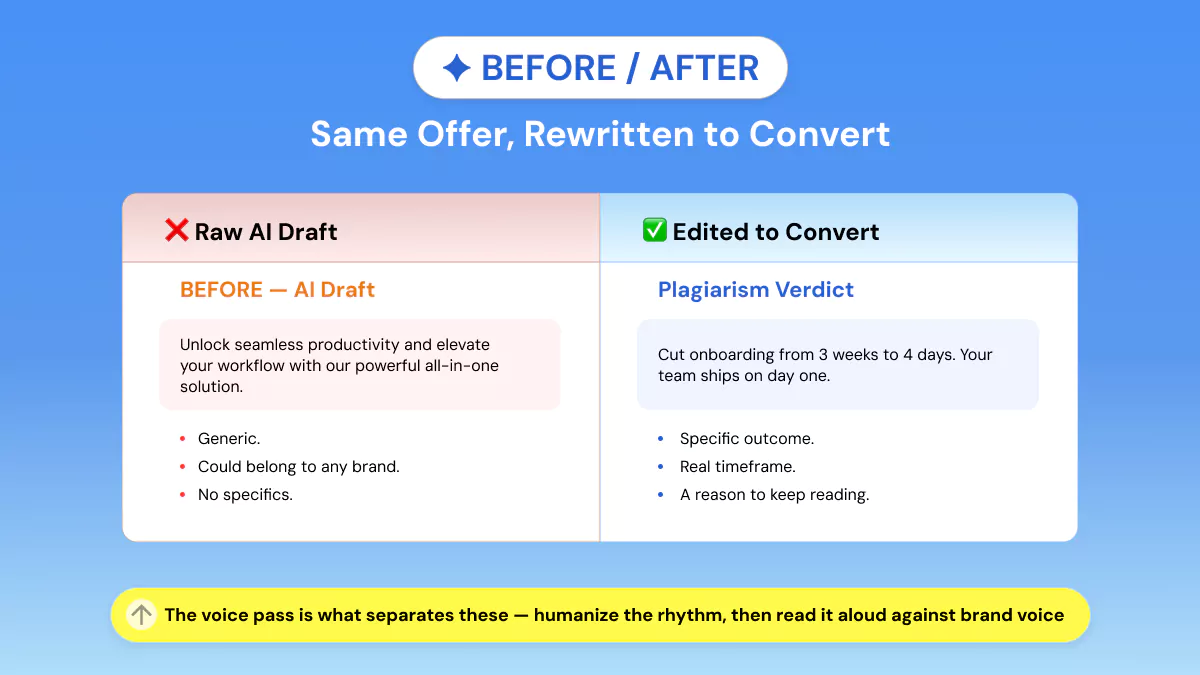
The voice pass fixes what specificity cannot: sentence rhythm, tone, and the formulaic AI phrasing that makes copy read like every other AI ad. This is the pass where a humanizer tool earns its place in the workflow.
You should humanize AI marketing copy before publishing, because the specificity pass fixes meaning but not rhythm, and copy that keeps the same flat AI cadence reads as filler no matter how accurate it is. Nielsen Norman Group's 2026 research on AI writing for the web found that AI-generated content often breaks the basic rules of web writing, which is why a draft needs a human pass before it ships. A 2025 linguistic study on SSRN backs the rhythm point too, finding AI text leans toward more uniform sentence structures and more repetition than human writing.
These are the AI-isms that survive even careful editing:
- Uniform sentence length, where every line runs the same number of beats
- Overused verbs like unlock, elevate, streamline, and seamless
- Transition chains like moreover, in addition, and furthermore
- Over-hedged claims like "can help you," "may improve," and "designed to support"
- Soft adjectives like powerful, effortless, robust, and innovative
The voice pass should not undo the specificity pass. Keep the concrete meaning, change only the rhythm:
The workflow here is two steps. First, run the specificity-passed copy through a humanizer to break the uniform rhythm and set the tone. Then read it aloud for two minutes against the brand voice, a check DTC Systems recommends specifically because AI can produce lines that are correct on the page but awkward to say.
Run the Voice Pass on Your Ad Copy Free with Phrasly AI Humanizer
After the tool does the rhythm work, your read-aloud is the final filter. If a line trips your tongue, it will trip the reader's eye.
What changed: the meaning stays specific, but the copy now sounds like a person instead of a polished template.
Pass 4: The Proof Pass (Claims Need Receipts)
The proof pass attaches evidence to every claim the first three passes sharpened: testimonials, data points, logos, guarantees. AI invents plausible-sounding proof, so every number and quote in the final copy must be real and verifiable.
Treat this as a conversion pass and a fact-check pass at once. Stanford HAI defines an AI hallucination as fabricated information presented as fact, which is exactly how a draft ends up with a made-up "94% of users" stat or a quote from a customer who does not exist. The risk is not only trust. The FTC fake reviews rule, in effect since October 21, 2024, specifically covers AI-generated reviews and testimonials from people who never used the product. Publishing invented proof is a legal exposure, not just a credibility one.
Here is the running sample's proof, sharpened:
One firm rule: use these numbers only if the brand can verify them. If the data is not confirmed, keep the lines as clearly marked placeholders until the client supplies real figures. DTC Systems puts it plainly: AI can clean up a real testimonial, but the source has to be real first.
What changed: vague trust signals became specific, checkable claims, every one of them flagged for verification before launch.
Pass 5: The CTA Pass (One Action, Stated Plainly)
The CTA pass strips the landing page to one action and rewrites the button and surrounding microcopy to state exactly what happens next. AI defaults to "Get Started"; converting CTAs name the outcome.
Google Ads guidance backs this up: a strong CTA tells customers what to expect, and the more specific it is and the closer it matches the page, the better it converts. VWO's "Rule of One" pushes the same discipline of one persona, one idea, one offer, one action. Unbounce adds that defaulting to "Sign up" or "Try now" wastes the highest-intent moment on the page.
For the running sample, "Get Started" becomes an action the reader can picture finishing:
- CTA: Build My First Client Update
- Microcopy: See the workflow before you invite your team.
That finishes the page. Here is the full hero, the original AI draft against the version that came out the other side of all five passes:
Same draft, five focused passes, and a hero that now names who it is for, what it does, why to believe it, and what to click. The proof numbers above stay marked as examples until the brand can verify them.
The 20-Minute Editing Budget (Putting It Together)
Budget 20 to 30 minutes of editing per landing page: 5 minutes on hooks, 5 on specificity, 5 on voice (humanizer plus a read-aloud), 3 on proof, and 2 on the CTA. That is the full system, and per DTC Systems it is still 5 to 10 times faster than writing from a blank page, structured enough that raw AI copy never goes live untouched.
Here is where each minute goes:
- Hooks (5 min). Rewrite the headline and first line until the buyer sees the pain, audience, or outcome right away. In the running sample, "Unlock Seamless Project Management for Your Team" became "Stop Losing Fridays to Status Updates."
- Specificity (5 min). Swap vague benefits for numbers, workflows, and named outcomes. "Automate repetitive tasks and improve efficiency" became "Auto-send weekly status updates every Friday at 4 PM."
- Voice (5 min). Run the cleaned-up draft through a humanizer, then read it aloud for two minutes. That benefit tightened to "Friday update? It sends itself," and anything still leaning on "unlock," "elevate," "seamless," or "powerful automation" gets cut.
- Proof (3 min). Check every statistic, quote, customer count, logo, and claim. If the brand cannot verify it, it does not publish. Hold a placeholder until the proof is real.
- CTA (2 min). Replace "Get Started" with a button that names what happens next. In the running sample the final CTA became "Build My First Client Update," with the microcopy "See the workflow before you invite your team."
Shipping the page is not the end of the budget. Track which hook earns the click, which benefit keeps people scrolling, which proof point eases hesitation, and which CTA gets the submit. Then feed that back into the next AI prompt so the next draft starts from evidence instead of guesswork.
Google Ads conversion tracking shows which ads and pages actually drive value, and Google Ads Experiments let you test a change against the original before you roll it out. The budget is really a quality-control loop: AI writes the draft, the five passes make it publishable, and conversion data tells the next prompt what worked.
Frequently Asked Questions
How do I edit AI-generated ad copy?
Edit it in five passes: hook, specificity, voice, proof, and CTA. Make the first line specific enough to stop the right buyer, then make the copy human, verifiable, and tied to one clear action before it goes live.
How long does editing AI landing page copy take?
Plan for a 20 to 30-minute budget per landing page draft: about 5 minutes each on hooks, specificity, and voice, then the last few minutes on proofing and the CTA. After launch, let conversion data guide the next draft instead of guessing.
Why does my AI ad copy sound generic?
It sounds generic when it leans on safe phrases like "unlock," "seamless," "boost productivity," and "save time" without audience context or real proof. The fix is to add concrete outcomes, brand voice, and verifiable proof before anyone sees it.
Should I humanize AI ad copy?
Yes, especially after the specificity pass. Run it through a humanizer to fix rhythm and tone, then do a short read-aloud check so the copy still sounds like the brand instead of a template.
Can AI write converting hooks on its own?
AI can generate plenty of hook options, but a human should pick, sharpen, and test the final one. Generate several angles, edit them for specificity, then let real traffic decide the winner.
Do AI drafts hallucinate statistics in marketing copy?
Yes. AI can invent stats, testimonials, and customer counts that sound believable but were never verified, which is why every draft needs a proof pass. For the SEO side of the same problem, read does google penalize ai content.


Keep reading

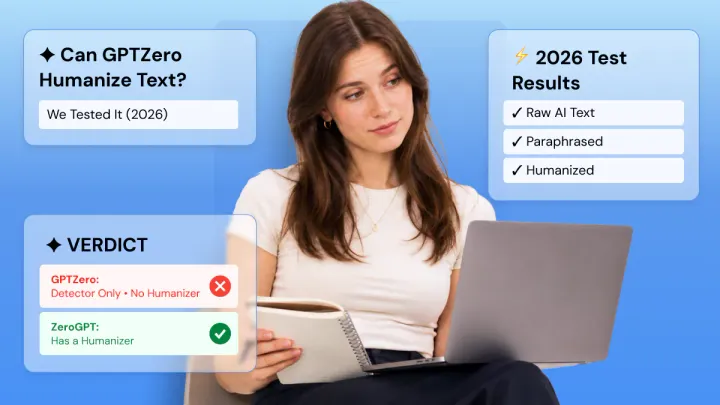
Can GPTZero Humanize Text (+ Can It Detect Humanized Text)
GPTZero doesn't have a humanizer and never has. We tested 5 AI samples raw, paraphrased, and humanized to see what actually beats its detector. Paraphrasing failed almost every time. Properly humanized text scored 98–100% human across the board. Here's exactly what worked.
How to Humanize AI-Generated Client Reports (Before They Read as Robotic)
AI reports default to describing the numbers. They default to describing 'traffic increased 12% month over month' without explaining why it happened or what to do about it. That's dumping data and calling it deliverable; spoken in a professional voice.