How to Write a Thesis Statement for a Research Paper (Templates and Examples)
16 min read
To write a thesis statement for a research paper, first narrow your topic to one focused question. Then read enough sources to form an early answer. Finally, write that answer as one clear claim with its scope and main reason, and revise it as your evidence grows.
The hardest part is turning your notes into one clear point. You know your topic, and maybe your question, but you can't yet say in one sentence what your paper will prove.
This guide shows you how, step by step, with a real example. You'll also get six templates, six examples with notes, and a checklist to fix your thesis statement, whether your paper argues, analyzes or explains.
Build a Research Paper Thesis With Phrasly 👇
How Do You Write a Thesis Statement for a Research Paper?
Writing a research paper thesis takes six moves: read the assignment, narrow the topic, turn it into a question, check early evidence, draft a working answer and revise it against your finished paper. Each step narrows your options, so by the end you have one claim your sources can back up.
Here is how to do a thesis statement for a research paper in six easy steps.
1. Identify the Assignment and Paper Type
Before you formulate a thesis statement for a research paper, find the key verb in your prompt. "Argue" or "recommend" needs a position a reader could dispute. "Analyze" needs a claim about how something works or what it means.
"Explain" needs a focused controlling explanation. That choice decides which template below fits.
That said, still sorting out the assignment itself? Start with how to write a college paper.
2. Narrow the Topic to a Workable Scope
A topic like "climate policy" is too big for a course paper. Narrow it with the boundaries that matter: a population, place, time period, text or mechanism. You don't need all five. Two or three are usually enough.
The UTC Library suggests doing some quick reading at this stage. It shows you which angle has enough sources to support your paper.
3. Turn the Topic Into a Focused Research Question
A topic names a subject; a research question asks something your paper can answer. "Remote work and productivity" is a topic. "How did remote work affect output at small accounting firms after 2020?" is a question.
For brainstorming, try the "Formulating a Research Question" prompts in our ChatGPT prompts for students.
4. Read and Compare Initial Evidence
Skim several credible sources before you commit. Note what supports your likely answer and what complicates it. Sources that disagree are useful too. They show you where your claim needs to be narrower.
5. Write a Working Answer With a Clear Claim
First, write your answer to the research question in plain words. That's how you start a thesis statement. Next, add the main reason, relationship or interpretation behind it. Finally, check that it is arguable and sized to your paper.
As the Harvard Writing Center puts it, a strong thesis is arguable, meaning "a thoughtful reader could disagree," and has the right scope for the paper. Call this first version your working thesis, because it is meant to change.
6. Revise the Claim Against the Finished Paper
After drafting the body, reread the thesis next to each section. If the evidence points somewhere slightly different, change the thesis, not the evidence.
Example: Turning a Research Question Into a Thesis
To turn a research question into a thesis statement, answer it in one sentence, then add the scope and the reason your evidence supports. Here is what that looks like.
Illustrative example: the notes below are hypothetical and are not findings from an actual study.
Assignment: Recommend how University X could improve library access for commuter students in evening courses.
Notes: Interviews describe trouble getting reserved books after late classes. Checkout records show demand on evenings with scheduled classes. A staffing plan suggests that extending hours on those evenings is easier to manage than extending hours every night
Stage | Illustrative wording | What changes |
|---|---|---|
Broad topic | University library access | A subject, with no question or answer |
Focused question | How should University X improve library access for commuter students in evening courses? | Names the institution, group and task |
Early working answer | University X should keep the library open later. | Takes a position, but lacks scope and reasoning |
Scoped working thesis | University X should extend staffed library hours on evenings with scheduled classes, rather than across the board, because the access needs of evening commuters are concentrated on teaching days. | Gives a clear, limited answer backed by evidence |
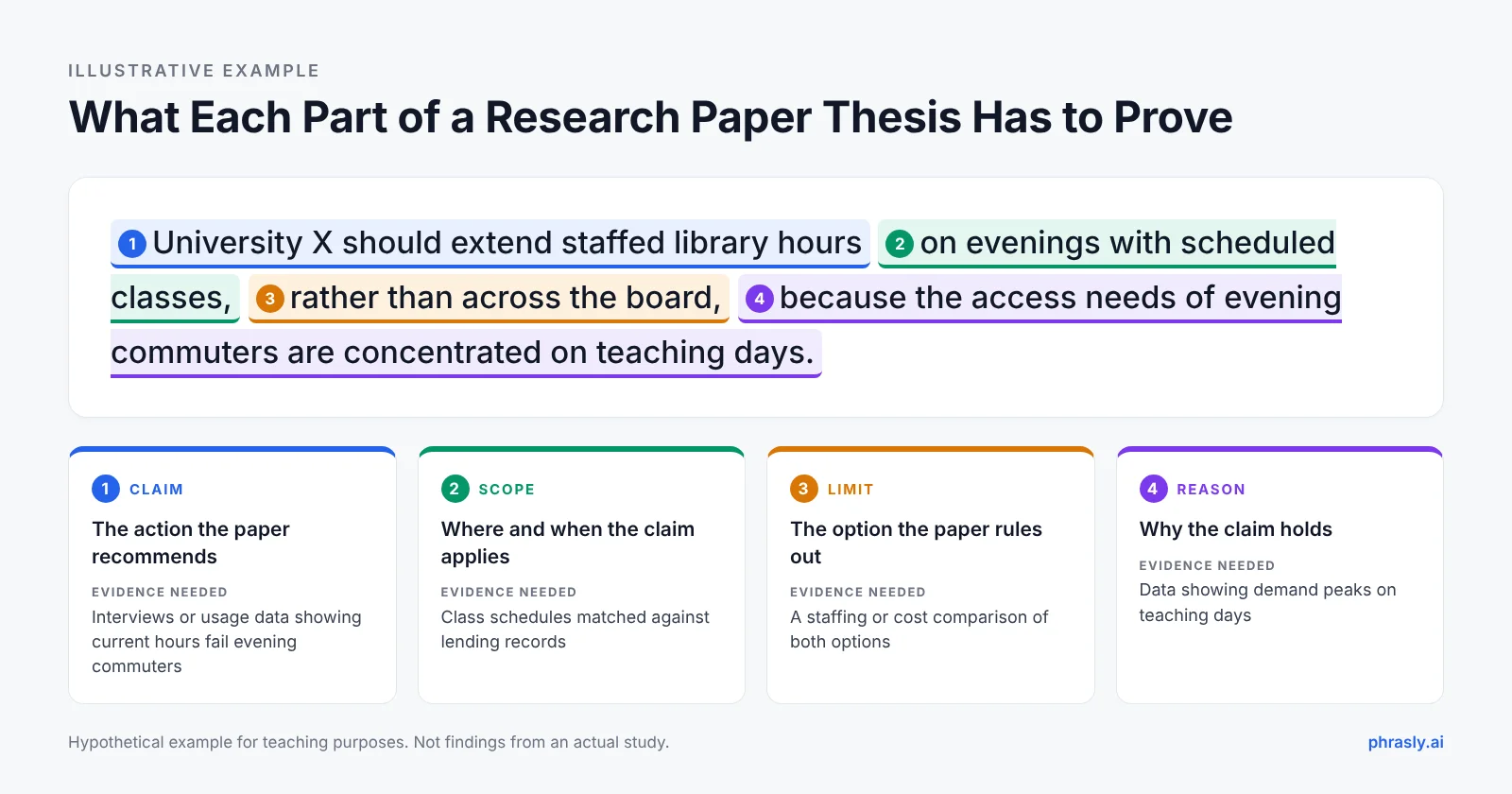
Evidence audit. Every phrase in the final thesis is a promise your paper has to keep:
"Evening commuters" needs interview or usage data.
"Concentrated on teaching days" needs class schedules matched against checkout records.
"Rather than across the board" needs a staffing or cost comparison.
If real records showed weekend demand instead, the recommendation would change. The thesis follows the research, not the other way around.
Have a focused question but need a starting sentence? Draft your research paper thesis with Phrasly, then compare the wording with your evidence.
What Is a Thesis Statement in a Research Paper?
A thesis statement for a research paper is the one or two-sentence answer to your research question. It states the main claim or explanation your whole paper will support, so readers know from the start what you will argue, analyze or explain. It is not your topic, your question, or a full thesis or dissertation.
Several related terms get mixed up with it. Here is how they differ, using the library example:
Term | What it is | Library example |
|---|---|---|
Topic | The subject area | University library access |
Research question | What you want to find out | How should University X improve access for evening commuters? |
Working thesis | A first answer from early reading | University X should keep the library open later. |
Revised thesis | The answer the finished paper supports | University X should extend staffed hours on class evenings, not across the board, because commuter demand is concentrated there. |
Purpose statement | What the paper will examine; common in longer or data-based papers (UW-Madison) | This paper examines how evening class schedules relate to commuters' library use. |
Hypothesis | A testable prediction in a data-based study | Commuter checkouts will be higher on evenings with scheduled classes. |
Topic sentence | The main point of one paragraph | Late classes leave commuters no time to collect reserved books |
What Is the Difference Between a Thesis and a Hypothesis?
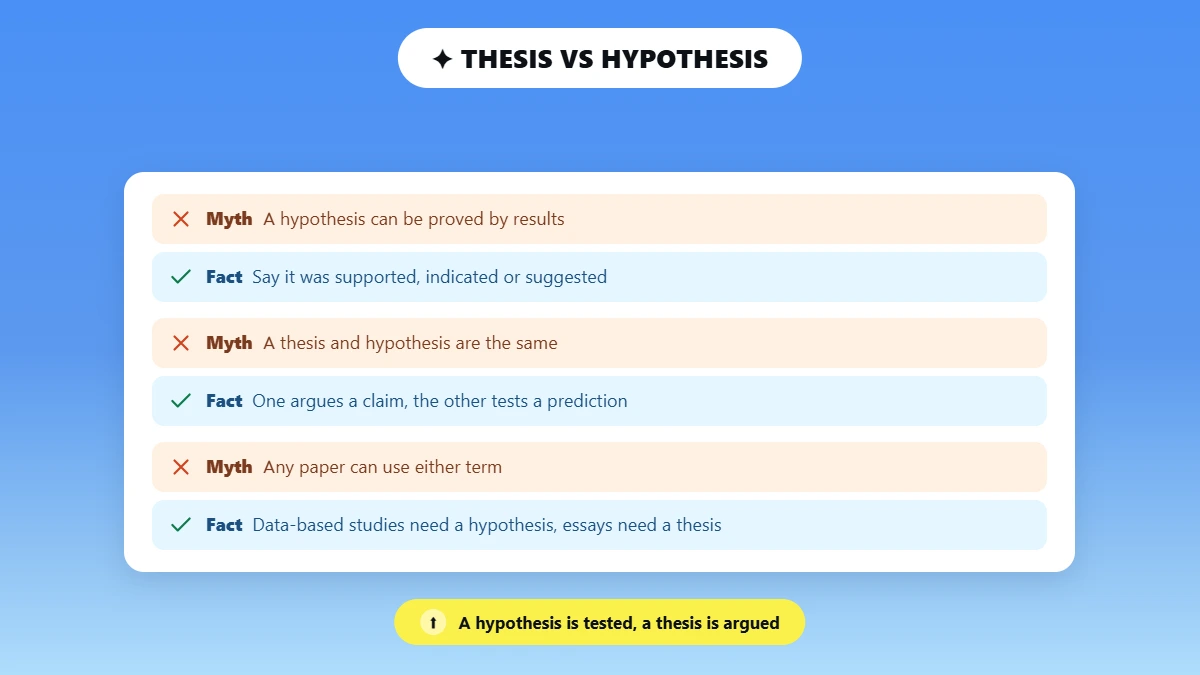
A thesis is a claim you argue or explain using evidence. A hypothesis is a prediction you test with data, such as an experiment or survey, and your results either back it up or do not.
That is why the UNC Writing Center advises saying a hypothesis was "supported," "indicated" or "suggested," never "proved."
Which one your paper needs depends on its type. Argumentative and analytical papers need a claim a reader could challenge. Explanatory papers need one clear explanation that ties the information together.
📢 Lab reports and other data-based studies often open with a research question, aim or hypothesis instead of a thesis.
Which Thesis Statement Template Fits Your Research Paper?
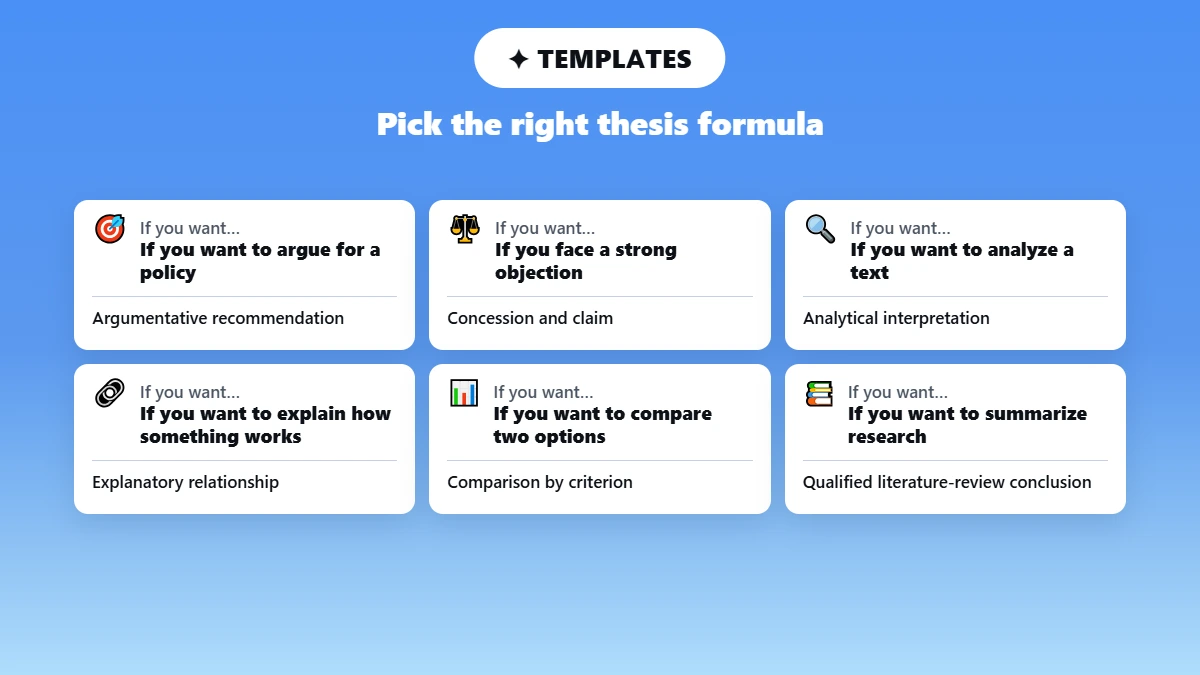
The right thesis statement template depends on what your paper does. Arguing for a policy? Use a recommendation. Facing a strong objection? Use a concession. Analyzing a text? Use an interpretation. Explaining a process, comparing options or reviewing studies? Use a relationship, criterion or qualified conclusion. Then fill each slot with what your evidence shows.
These are drafting aids, not a fixed thesis statement format. Comparison and literature-review structures are common assignment shapes, not extra official paper types.
1. Argumentative Recommendation
Formula: [Who] should [specific action] for [scope], rather than [main alternative], because [reason your evidence supports].
Use when: The prompt asks you to recommend or propose a decision or policy.
Check before using: You need evidence for the problem, the action and why it beats the alternative.
2. Concession and Claim
Formula: Although [strongest opposing point], [your claim], because [reason that outweighs it].
Use when: The topic is contested and readers already know the main objection.
Check before using: State the objection fairly, and make sure your body actually answers it.
3. Analytical Interpretation
Formula: In [text, case or dataset], [specific feature or pattern] shows [interpretation], which changes how we understand [larger issue].
Use when: The prompt says analyze, interpret or examine.
Check before using: The feature must recur in your source. If you cannot fill the last slot, you may have a summary, not an interpretation.
4. Explanatory Relationship
Formula: [Outcome] in [context] happens because [cause or process], which explains [observable effect].
Use when: The paper explains how or why something works. Our guide on how to write an informative essay covers this kind of paper.Check before using: Your sources must establish the relationship. If they only show correlation, write "is linked to," not "causes."
5. Comparison by Criterion
Formula: Measured by [one criterion], [option A] is [more or less effective] than [option B] for [scope], because [reason].
Use when: You are comparing two methods, texts, policies or tools.
Check before using: Apply the same criterion to both options for the whole paper.
6. Qualified Literature-Review Conclusion
Formula: Research on [topic] since [period] suggests [overall pattern], although [limitation or gap] leaves [specific question] unresolved.
Use when: The paper synthesizes existing studies rather than presenting new research.
Check before using: The pattern must come from several real studies, summarized in your own words. Never claim a consensus your sources do not show.
See is paraphrasing plagiarism for where the line falls.
No thesis needs three reasons, a counterargument or a policy recommendation by default. Keep only the slots your paper will prove.
What Do Strong Research Paper Thesis Statement Examples Look Like?
A strong thesis statement for a research paper is specific, arguable and sized to your evidence. Here is a sample: "University X should extend staffed library hours on evenings with scheduled classes, because commuter students' access needs are concentrated on those nights." It names who acts, what changes, when it applies and why.
The six good thesis statement examples below are invented for teaching. "Stronger" means more specific and better structured, not true.
Example 1: Campus Policy (Argumentative)
Weak: Colleges should do something about expensive textbooks.
Stronger: Kestrel Ridge Community College should replace commercial textbooks with open educational resources in its five largest introductory courses, because those courses drive most first-year textbook spending and already have peer-reviewed open alternatives.
Why it works: It names the institution, the action, a clear scope and a reason the paper can test.
Evidence needed: Enrollment and spending figures for those courses, plus a review of available open textbooks.
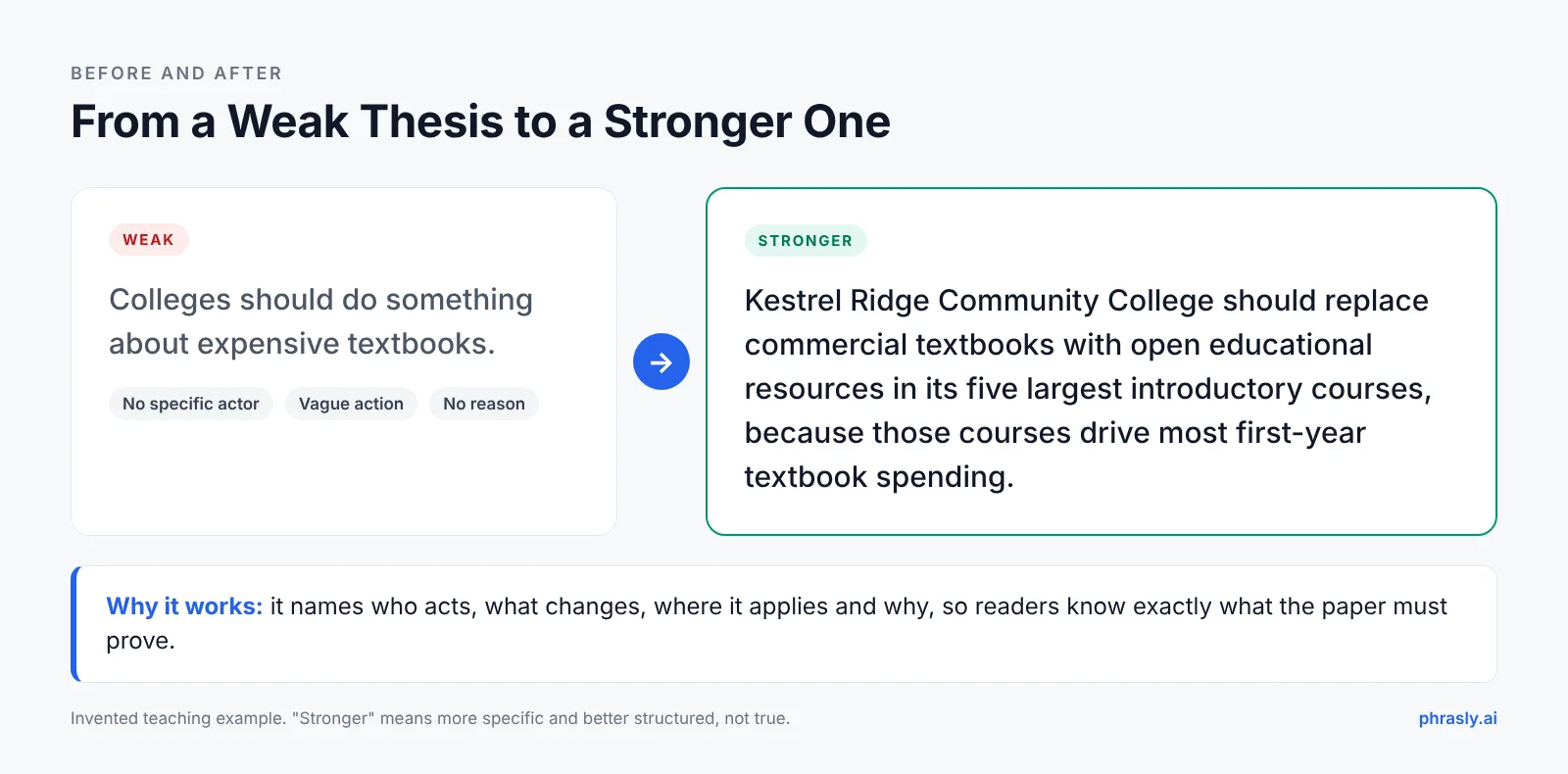
Before-and-after example showing a weak thesis statement revised into a stronger, specific one.
Example 2: Literature (Analytical)
Weak: Kate Chopin's "The Story of an Hour" is about freedom.
Stronger: In "The Story of an Hour," Chopin confines Louise Mallard's sense of freedom to a closed upstairs room, suggesting that the independence she imagines can exist only in private.
Why it works: It turns a theme label into an interpretation tied to one concrete feature of the story: its setting.
Evidence needed: Close reading of the room scene, the window imagery and the ending.
Examples 3 to 6 at a Glance
Context | Weak | Stronger | Why it works | Evidence needed |
|---|---|---|---|---|
History (analytical) | The Dust Bowl was hard on farmers. | Government photographs of Dust Bowl migrants framed farmers as victims of nature, not farming practices, which built support for relief while deflecting debate about farm policy. | Makes a claim about specific sources and their effect | A defined set of photos, captions and period policy debates |
Digital preservation (explanatory) | Digitizing old newspapers is important. | Digitized local newspapers often become hard to search because text recognition misreads faded print, hiding articles from keyword searches. | Explains a cause and its result | Recognized text compared with page images |
Assessment (comparison) | Open-book exams are better. | Measured by recall six weeks later, closed-book exams in introductory statistics lead to better retention than open-book exams, because students practice recalling information instead of organizing notes | Sets one criterion and a clear scope | Delayed-recall studies from comparable courses |
Education research (synthesis) | There is a lot of research on homework. | Studies of middle school homework since 2010 suggest short, regular assignments help more than long weekly ones, although few follow students past one year. | States a pattern and its limit | Comparable studies and their stated limitations |
How Long Should a Thesis Statement Be, and Where Does It Go?
A thesis statement for a course research paper is usually one or two sentences, placed near the end of your introduction. Some guides accept three, and long papers may need more. No rule sets an exact word count, so let your assignment decide, and use only as many words as your claim requires.
How Specific Should a Thesis Statement Be?
A thesis statement should be specific enough that readers know exactly what you will prove and where your claim stops, yet broad enough to leave room for real analysis.
The Harvard Writing Center calls this "the right scope," and warns that a thesis can fail by being too broad to support or too narrow to argue.
💡 Quick test: if two students could use your thesis statement to write two completely different papers, it is too broad.
How Long Is a Thesis Statement?
Most thesis statements are one or two sentences long, but sources do not fully agree. UCLA History says a thesis "should be between one and three sentences long," while the UNC Writing Center calls it "usually a single sentence." Short papers usually need one sentence; longer papers may need two or three. Your assignment wins over any rule of thumb.
Where Does a Thesis Statement Go in a Research Paper?
Usually near the end of the introduction, after the context readers need. Purdue OWL notes it "usually appears at the end of the first paragraph of a paper." Papers with longer introductions may place it later, and lab reports or other data-based studies often state the aim or hypothesis just before the methods section.
How Do You Fix a Weak Thesis Statement?
To fix a weak thesis statement, find what it lacks: a clear answer, a criterion, a workable scope, a link between ideas or enough support. Fix one gap at a time. If new evidence goes against your claim, change the claim, not the evidence. The same checks show how to write a strong thesis statement from the start.
Problem | Looks like | Fix |
|---|---|---|
Announces the topic | "This paper will discuss remote work." | State your answer instead. |
Vague evaluation | "Recycling is important." | Name the criterion: important for what? |
Scope too big | "Climate change affects the economy." | Limit to one sector, region or period. |
Three disconnected ideas | "Uniforms save money, reduce bullying and look professional." | Find the connecting idea, or keep the strongest. |
Too certain | "Screen time causes lower grades." | Match the verb to the evidence: "is linked to." |
Thesis and body do not match | Thesis argues cost; body discusses safety. | Revise whichever drifted. Use these tips to make an essay more concise. |
Evidence contradicts the claim | Sources point the opposite way. | Narrow, qualify or reverse the claim. Do not cherry-pick sources. |
Final check (adapted from the UNC Writing Center). Your thesis should:
Answer your research question
Fit the assignment
Make one central point
Have a manageable scope
Be supported by evidence
Acknowledge key limits
Match the finished paper
What If My Research Contradicts My Thesis?
Change the thesis, not the evidence. A working thesis is only your first answer, so when sources disagree with it, narrow it, add limits, reverse it, or keep reading before you decide.
💡 Do not quietly drop the sources that disagree. Deal with the strongest one directly, and make sure your final thesis says only what your evidence supports.
Can a Thesis Generator Help With a Research Paper?
Yes, AI can help you write a thesis statement. Once you have a narrowed question and an early answer, a thesis generator for research papers can suggest wording and show you different structures fast. It cannot do your research, so check every claim against your sources, rewrite it in your own words and follow your course's AI rules.
What Should I Give a Thesis Generator?
The more specific your input, the better the draft. Give the tool your assignment type, audience, narrowed research question, early answer and the two or three strongest points from your sources. A one-word topic like "climate change" will only get you a vague sentence you end up rewriting.
Our AI prompt examples show what detailed input looks like.
Prepare those details before you open the tool.
Enter them where the form asks. Phrasly's Thesis Generator asks for a target audience first, then a topic.
Compare the output with your evidence, phrase by phrase.
Cut anything unsupported and rewrite it as your own argument.
Check the final thesis against your body paragraphs.
Before you start, check your syllabus, since AI rules vary by course. Our guide to using AI in college explains where brainstorming help usually fits.
What the Review Step Looks Like: Three Sample Runs
We ran Phrasly's Thesis Generator three times on October 5, 2026, once per paper type, using fictional briefs that included a question, a tentative answer and three key points. Run 1 used the free try without an account; Runs 2 and 3 used a free account. These are individual runs, not a measure of accuracy.
Run 1: Argumentative (Library)
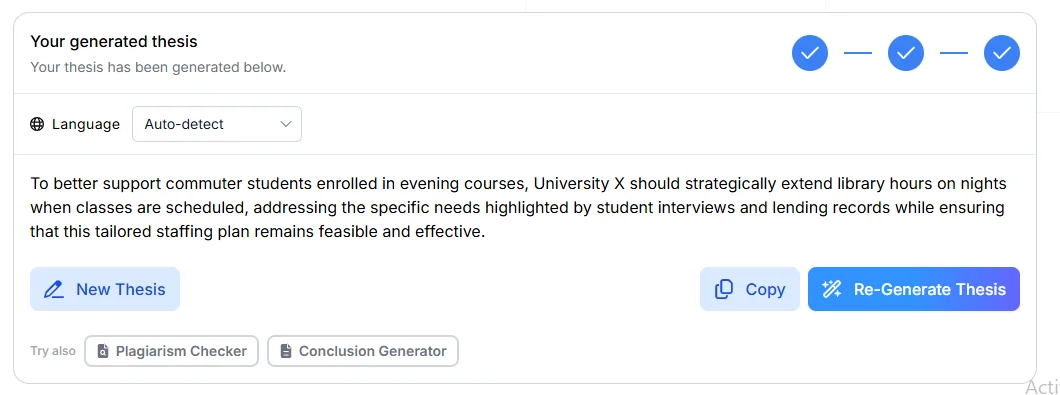
What needed fixing: It kept the claim and scope but dropped "rather than across the board," the contrast that carries the argument, and turned a suggested benefit into a promise ("ensuring... feasible and effective").
Our revision:
University X should extend staffed library hours on evenings with scheduled classes, rather than across the board, because interviews and checkout records show that commuter students' needs are concentrated on teaching days.
Run 2: Analytical (Short Story Narrator)
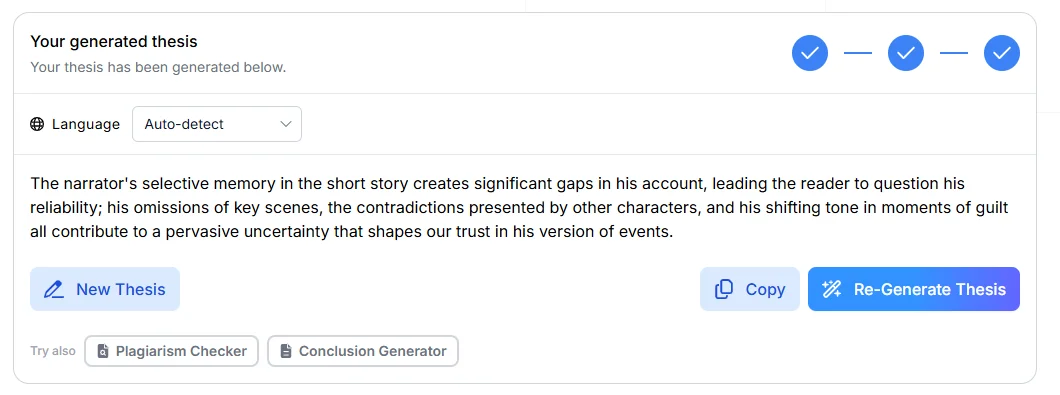
What needed fixing: It added nothing unsupported, but it listed our three points without saying why the narrator leaves gaps. Regenerating changed the wording and added "intentional," a claim our notes never made.
Our revision: The narrator's selective memory works as self-protection: he skips scenes and shifts his tone whenever his guilt comes close, which leads readers to trust the other characters over him.
Run 3: Explanatory (Digital Archive)
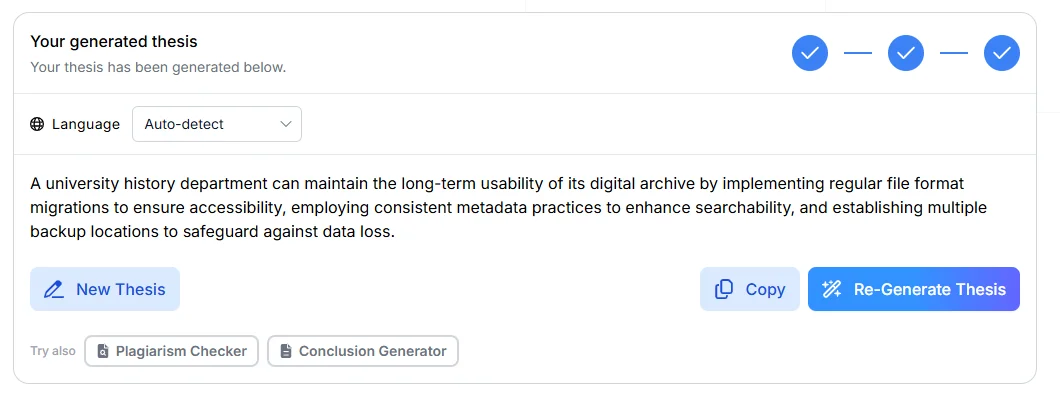
What needed fixing: The cleanest output, faithful to the input, but still a list of three practices with no idea connecting them.
Our revision: A history department keeps its digital archive usable by guarding against three different ways files are lost: migration keeps them readable, metadata keeps them findable and multiple backups keep them from disappearing.
Each run gave a usable starting sentence, and each still needed a human pass.
Whether you start with a tool or a blank page, the job is the same. Pick the template that fits your assignment, write a working answer to your research question, check what evidence each part of it needs, and revise until the thesis says exactly what your paper shows.
Ready to put your argument into words? Use Phrasly to create a working thesis statement, then revise it to match your paper. Your first try is free, and a free Phrasly account keeps it going.
Frequently Asked Questions
Can a Thesis Statement Be a Question?
No. A thesis is the answer, not the question. Your research question is what you set out to investigate; your thesis is what you concluded. If your draft ends with a question mark, answer that question in one clear sentence and use the answer as your thesis.
What Are the Three Parts of a Thesis Statement?
Usually three: a topic, a claim about it and the reason or scope behind the claim. That pattern is a helpful starting point, not a requirement. What matters is a clear claim with enough reasoning to show where the paper is going.
Do All Research Papers Need a Thesis Statement?
Most do. Papers that argue, analyze or explain all need one. Lab reports and other data-based studies often open with a research question, purpose statement or hypothesis instead. When the expected format is unclear, check your assignment or ask your instructor.
What Words Can You Use to Start a Thesis Statement?
Begin with your subject or your claim, not an announcement. Openers such as "Although," "Because" or the subject itself work well. Skip "In this paper I will discuss," which names a topic without taking a position, unless your field expects a purpose statement.
Can I Write a Thesis Statement Before I Do My Research?
Yes. Treat it as a working thesis: a first guess that helps you decide what to read. Expect it to change as you learn more, and make sure your evidence backs every part before you finalize it. Starting this way during prewriting can simplify the writing process.
Should a Thesis Statement Include Citations?
Usually not, since the thesis is your own argument. If it uses a specific finding, phrase or idea from a source, cite it the way your style guide requires. The thesis never replaces citations in the body, and those citations are how you prevent plagiarism.
How Do You Restate a Thesis in the Conclusion?
Say the main claim again in new words, then show what your evidence adds up to and why it matters. Avoid copying your introduction. The UNC Writing Center cautions against ending with "a rephrased thesis statement without any substantive changes."

Written by
Hasnain
Karachi, Pakistan
I help businesses grow with SEO-friendly blog posts, landing pages, and long-form content. With 3+ years of experience, I deliver clear, original, and well-researched writing that drives results.