Product Description Formulas (AIDA, PAS, FAB) With Examples
14 min read
Most product descriptions lose sales for one simple reason: they list what a product is and never say why a shopper should care. A product description formula fixes that by giving every listing the same proven order of persuasive steps.
We wrote one sample product, a 20 oz insulated water bottle, three times, once each with AIDA, PAS, and FAB, so you can see how the structure changes the pitch. You will also get a quick-pick table by channel, before-and-after feature rewrites, and a checklist for SEO, readability, and proof.
Turn Any Formula Into a Finished Description 👇
What Is a Product Description Formula?
A product description formula is a set of steps you follow every time you write a product description. The formula tells you what to say first, what to say next, and how to end. Following it helps every listing keep the same product description structure and turns your product facts into reasons for customers to buy.
Here is how the three formulas in this guide open and close:
Formula | Stands for | Opens with | Closes with |
|---|---|---|---|
AIDA | Attention, Interest, Desire, Action | A hook that stops the scroll | A direct prompt to buy |
PAS | Problem, Agitate, Solution | The buyer's frustration | The product as the fix |
FAB | Features, Advantages, Benefits | A spec or attribute | What that spec means for the buyer |
A formula is the part of good copy you can repeat on every listing, which makes it the first step in learning how to write product descriptions that sell.
📊 Why Product Information Decides the Sale
44% of consumers abandoned a purchase because the product information was not enough, according to Syndigo's 2025 Product Experience Report. The survey covered more than 8,500 shoppers in six countries, including the US.
Why a Formula Beats Writing Without a Plan
You can write five listings from scratch, but this method stops working once you have 50 or 500 products. When you invent a new pitch for every SKU (stock keeping unit, one sellable product variant), you add drift in quality and tone. A fixed formula prevents that drift:
Consistency: tone and quality stay the same across hundreds of listings.
Focus: every description leads with a buying reason instead of a materials list.
Easier briefing: freelancers, teammates, and AI tools all work from the same clear structure.
The Inputs Every Formula Needs
Knowing how to write a good product description starts before the first line, with three inputs:
Buyer persona: who is reading, their biggest hesitation, the words they use, and how price-sensitive they are.
Unique selling proposition (USP): the one claim competitors cannot copy, such as a material, a warranty, speed, or exclusivity.
Channel context: a marketplace listing and a direct-to-consumer (DTC) product page need different pacing, even with the same formula.
How to Write Product Descriptions That Sell
Write down your buyer persona and USP before you start.
Pick the formula that fits your product and channel.
Write one line for each step of that formula.
Rewrite every feature as a benefit.
Check the description for SEO, readability, and proof before you publish.
The AIDA Formula: Attention, Interest, Desire, Action
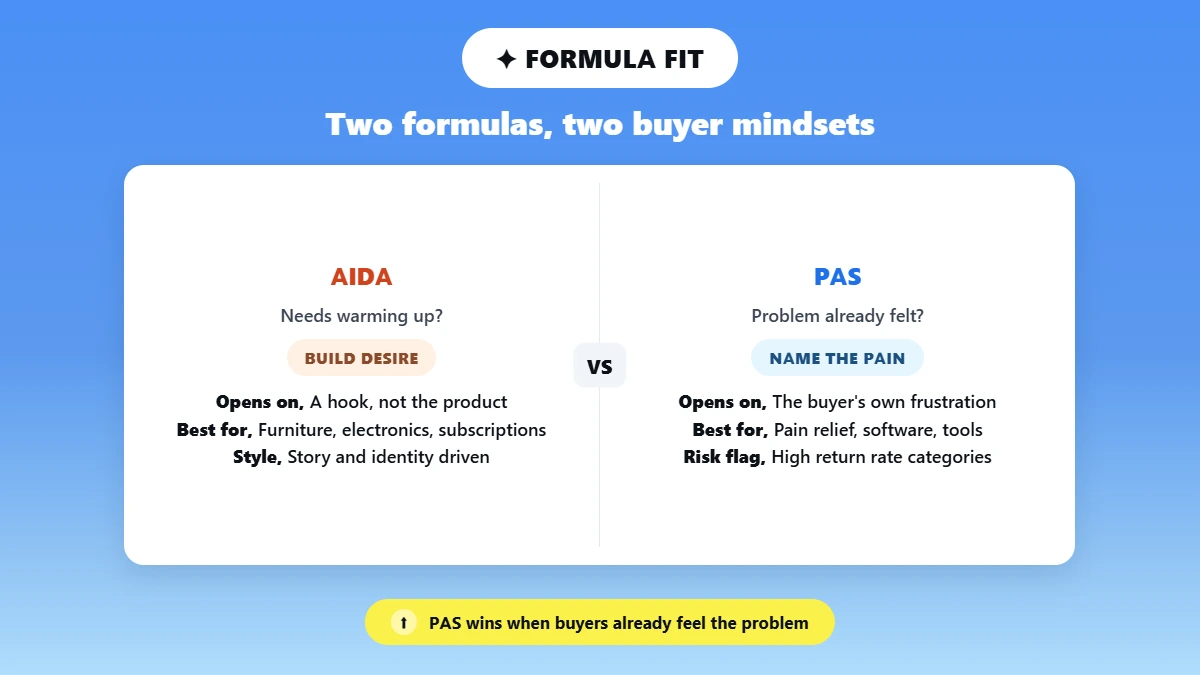
To use AIDA, write four short beats in order: a hook that grabs attention, a detail that builds interest, an outcome that creates desire, and a clear call to action. An AIDA product description warms the reader up before it asks for anything.
The AIDA model is more than a century old. Advertising pioneer E. St. Elmo Lewis used an "attract attention, maintain interest, create desire" slogan in 1898, and the action step followed around 1900, according to Barry Popik's AIDA research.
What AIDA Stands For
Attention: the hook line. Open with a bold claim, a question, or a sensory detail, never the product name and dimensions.
Interest: a relevant detail that speaks to the buyer's situation.
Desire: the payoff, meaning the outcome or identity the buyer wants.
Action: a direct, low-friction nudge to buy.
When to Reach for AIDA
AIDA works best when the buyer needs warming up before they commit.
✅ Higher-consideration purchases, such as furniture, electronics, and subscription boxes
✅ Story-driven or lifestyle brands that sell identity as much as function
❌ Commodity items buyers already plan to buy, such as batteries or basic cables
AIDA Example: Full Product Description
All three examples use one sample product, so the structure is the only thing that changes.
🧪 Sample Product Spec Sheet
A 20 oz insulated stainless steel water bottle with double-wall vacuum insulation (cold for 24 hours, hot for 12), a leakproof screw lid, and a base that fits standard car cup holders.
✍️ AIDA Version
[Attention] It's 9 p.m., and the ice you added at breakfast is still clinking.
[Interest] Double-wall vacuum insulation keeps drinks cold for 24 hours and hot for 12, and the leakproof screw lid lets the bottle ride in your work bag.
[Desire] One bottle covers the commute, the gym, and the long drive, and it fits your car's cup holder on the way.
[Action] Pick your color and add it to your cart today.
The PAS Formula: Problem, Agitate, Solution
PAS is the simplest product description formula to start with: name the buyer's problem, make its cost clear, then present your product as the fix. Since the PAS formula opens on customer pain points, it speaks to shoppers who are already looking for a solution.
PAS is a long-standing direct-response formula, and Copyblogger's guide to PAS shows it working in everything from short product copy to long sales letters.
📊 Why the Problem Is Listed First
45% of shoppers returned an online purchase in the past year because of incorrect or misleading product information, according to Salsify's 2026 consumer research. The PAS formula names the buyer's problem in its opening line, so shoppers know what the product fixes before they buy.
What PAS Stands For
Problem: the frustration, written in the buyer's own words.
Agitate: the concrete cost of leaving it unsolved, such as wasted time, wasted money, or repeated failure.
Solution: the product as relief, framed around benefits and tied to your USP.
When PAS Outperforms AIDA
PAS wins when buyers already know they have a problem and are searching for the fix.
✅ Problem-aware categories, such as pain relief products, organizational tools, and software
✅ Categories with high return rates from unmet expectations, because naming the problem upfront attracts the right buyer
❌ Aspirational or gift purchases, where there is no clear problem to agitate
PAS Example: Full Product Description
Here is the same water bottle, rewritten for a buyer who is tired of warm drinks:
✍️ PAS Version
[Problem] Your water is lukewarm by 10 a.m., and your bag still smells like the coffee that leaked last week.
[Agitate] So you buy a bottled drink at lunch, then another on the drive home, and the cost adds up every week.
[Solution] This 20 oz bottle keeps drinks cold for 24 hours and hot for 12, and its leakproof screw lid stays sealed in any bag. Fill it once in the morning and skip the store stops.
The AIDA version names the product's strengths from line two, while the PAS version spends its first two lines on the buyer's frustration and brings in the product only at the solution step.
The FAB Formula: Features, Advantages, Benefits
FAB turns each product spec into a three-step chain: the feature (what it is), the advantage (what it does), and the benefit (what it means for the buyer). The FAB formula is the clearest way to handle features vs benefits (what a product has vs how it benefits the buyer), because every spec has to end on what the buyer gets.
Many product description guides fold the feature-to-benefit idea into general "focus on benefits" advice. But when you treat FAB as a three-step rule, you can apply it to every spec in your description.
📱 Keep FAB Chains Short for Phones
56.4% of online transactions in the 2025 US holiday season happened on smartphones, according to Adobe's holiday shopping report. A FAB chain written in full sentences for every spec fills a phone screen fast, so keep each step to a short phrase.
What FAB Stands For
Feature: the spec or attribute, such as material, size, battery life, or capacity.
Advantage: the functional result of that spec, such as charging in 2 hours or holding 20% more liquid.
Benefit: the payoff for the buyer, such as less time waiting or fewer refills on long trips.
When FAB Fits Best
FAB fits products that buyers compare spec by spec across open tabs.
✅ Technical or spec-heavy products, such as electronics, appliances, and tools
✅ B2B purchases, where the buyer must justify the choice to someone else and needs the logic spelled out
❌ Impulse or emotional buys on their own, because leading with specs slows the pitch down
FAB Example: Full Product Description
These product description formula examples finish the three-way comparison with the same bottle, using a FAB chain for each of its top three specs:
✍️ FAB Version
[Feature] Double-wall vacuum insulation [Advantage] keeps drinks cold for 24 hours and hot for 12, [Benefit] so one morning refill lasts your whole workday.
[Feature] The leakproof screw lid [Advantage] seals tight even when the bottle lies on its side, [Benefit] so you can pack it in the same bag as your laptop.
[Feature] A standard-size base [Advantage] fits most car cup holders, [Benefit] so your drink comes along on every drive.
Turn Features Into Benefits: Before and After
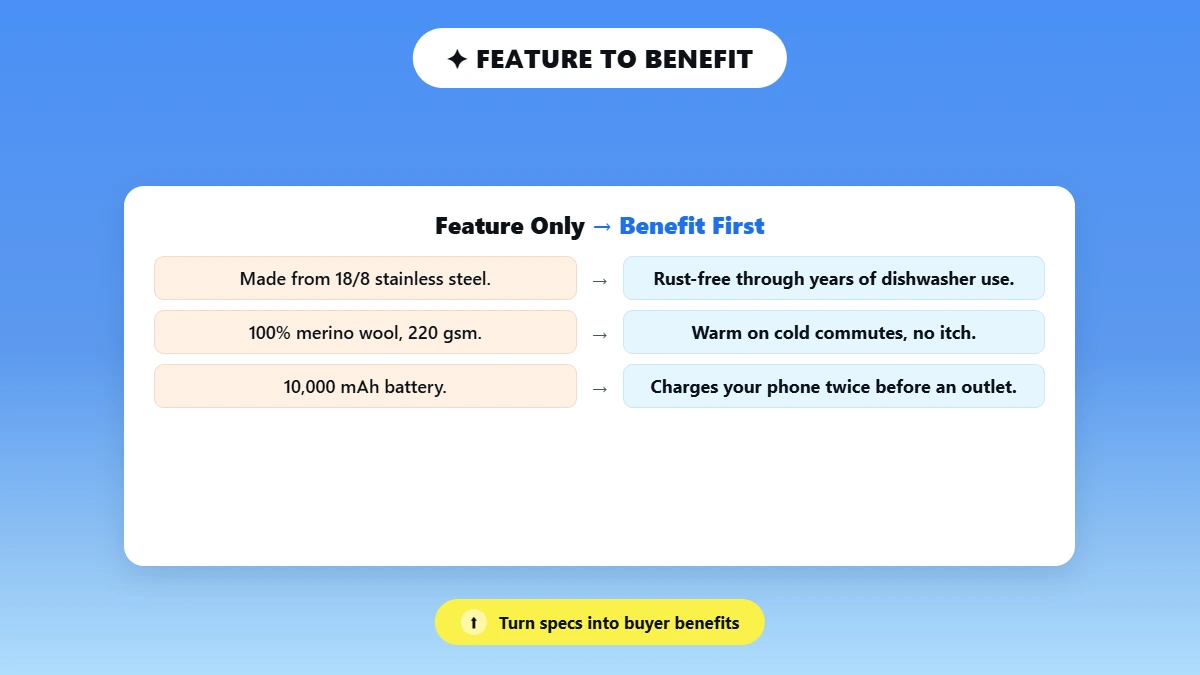
A feature is a fact about the product, such as its material or battery size, while a benefit explains what that fact changes for the buyer. Your product description will sell best when you write every feature as a benefit.
For instance, if your product descriptions only list facts such as "double-wall vacuum insulation," add what each fact does for the shopper, such as "keeps your water cold all day." A simple rewrite turns a plain fact into a reason to buy.
The three pairs below show product features and benefits side by side. Each rewrite is close to the length of the original line, and the change comes from word choice, not extra words.
Before and After: Three Rewrites
Product | ❌ Before (feature only) | ✅ After (benefit first) | What did the work |
|---|---|---|---|
Kitchen | "Made from 18/8 stainless steel." | "Stays rust-free through years of daily dishwasher use." | A time frame and a daily habit the buyer knows |
Apparel | "100% merino wool, 220 gsm." | "Keeps you warm on cold commutes without the itch of regular wool." | A real situation and a removed pain point |
Electronics | "10,000 mAh battery." | "Charges your phone about twice before you need an outlet again." | A count the buyer can picture |
Scaling Feature-to-Benefit Rewrites With AI
Rewriting one listing by hand is manageable, but rewriting 200 or 2,000 SKUs is where most catalogs stall. AI handles this step well when you give it a fixed structure:
Paste a spec sheet or a bullet list of features into a product description generator.
Ask for a benefit-led version in the same formula every time, such as FAB for spec-heavy items.
Reuse the same prompt and format for every product so the voice stays uniform as the catalog grows.
Phrasly's Product Description Generator turns the product details you paste in, such as the name, key features, and target buyer, into a draft description you can edit or regenerate.
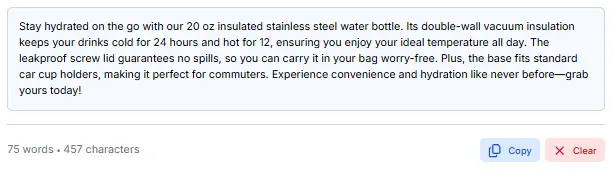
Paste your product's specs and get a benefit-led draft you can edit, in the same structure every time.
What a Human Review Pass Should Catch
AI can turn a feature into a benefit that overstates the claim, so read every draft before it goes live:
Match each benefit to the spec sheet, so "cold for 24 hours" never becomes "ice-cold forever".
Delete any claim the product cannot back up, such as a durability promise the warranty does not cover.
Confirm the wording is original, especially when you started from a supplier's text. You can check AI-assisted copy before publishing with a plagiarism scan.
Which Formula Fits Your Product or Channel?
The best structure for an ecommerce product description depends on what you sell and where the copy appears. The AIDA, PAS, and FAB bottle versions above are three ecommerce product description examples of one product, and each one suits a different buyer and channel.
Each row in the table also works as a ready-made product description template: pick the formula, then fill its steps with your product's details. Many products work with more than one formula, so test the second-best fit on your top sellers and keep the version with the higher conversion rate.
Quick-Pick Table
Product Type / Channel | Best-Fit Formula | Why |
|---|---|---|
Story-driven or lifestyle product | AIDA | Builds interest and desire before the ask |
Pain-point-driven product | PAS | Leads with the problem the buyer already feels |
Technical or spec-heavy product | FAB | Organizes specs into clear benefit statements |
Landing page | AIDA | Room for a full narrative arc |
Marketplace listing (Amazon, Etsy) | FAB | Scannable bullets match marketplace format |
Email or retargeting ad | PAS | Short, urgency-driven format fits inbox and ad space |
A Note on Product Description Length for Each Selling Platform
Shoppers on Amazon and Etsy prefer short descriptions, and so do people shopping on their phones. On the other hand, visitors to a brand's own website have more time, so they can read a longer description that tells the story behind the product.
Marketplace listings: FAB in bullet form, one benefit per line. Amazon's bullet point limits change by product type, so check the limit for your category in Seller Central before you write.
Social commerce, such as TikTok Shop: a short product description formula that opens with a one-line hook, such as the problem line from PAS.
Landing pages and brand sites: longer, story-driven copy where AIDA has room to build.
Product Description Checklist: SEO, Readability, Proof
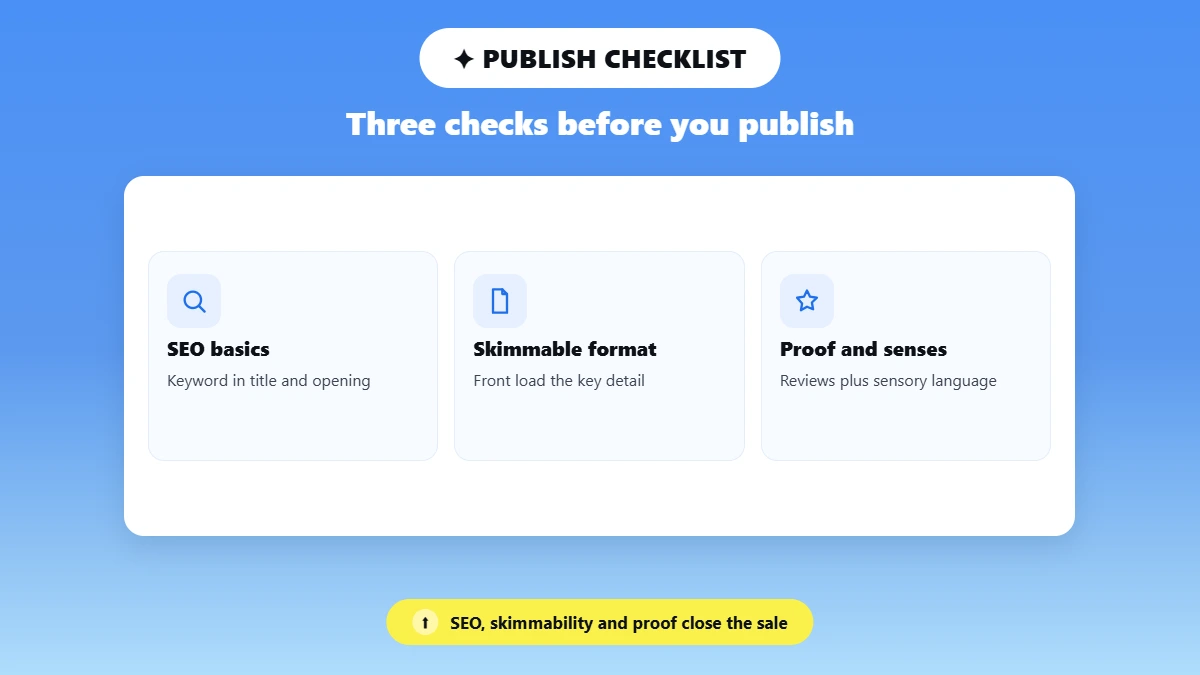
Every product description needs an SEO-ready title and opening, scannable formatting, and proof that builds trust, whichever formula you chose. This product description checklist works as a layer on top of AIDA, PAS, or FAB, so tick off each item before you publish.
SEO and Meta Description Basics
An SEO product description formula puts the main keyword in the places Google and shoppers read first, the same way good SEO content does for blog posts.
☐ Use the primary keyword in the product title, the opening line, and the meta description, since those words appear in search results before anyone clicks.
☐ Pick SEO keywords that name a benefit buyers search for, such as "leakproof water bottle", so the keyword also persuades.
☐ Keep the meta description short enough that Google shows it in full instead of cutting it off.
☐ Skip keyword stuffing, because repeated keywords hurt readability more than they help ranking.
Format for Skimmability and Mobile
Short paragraphs and bullet points keep readability high, because shoppers skim a product page before they read it.
☐ Front-load the most important detail, such as size, material, or the key benefit, because a phone screen shows less at a glance.
☐ Put specs such as dimensions, materials, and care instructions in a bulleted list for better skimmability.
☐ Preview every description on a phone before publishing, as part of mobile optimization, since a block that looks short on desktop can fill the whole screen.
Add Proof and Sensory Detail
Proof and sensory language help shoppers trust the product and picture using it.
☐ Sensory words: describe texture, sound, taste, or feel, such as "ice that still clinks at 9 p.m."
☐ Social proof: add review counts, star ratings, or short customer testimonials where you have them.
☐ Product imagery: match the copy to the photos, so every benefit you mention is something the shopper can see.
☐ Brand voice: keep the tone consistent with the rest of the store so the description does not read like someone else wrote it.
☐ Call to action: end with one clear next step, such as "Add to cart".
For ready-made prompts that write descriptions in bulk, the best AI prompt generators for product copy include templates you can copy.
Start with the formula that matches your buyer's mindset: AIDA for buyers you need to win over, PAS for buyers with a problem, and FAB for buyers comparing specs. Rewrite your three best sellers in that formula, run them through the checklist, and use the results as templates for the rest of your catalog.
Draft your next listing in a few seconds, then shape it with the formula that fits.
You get one free try a day without an account, and a free Phrasly account gives you unlimited use.
FAQs About Product Description Formulas
What Are the 5 Key Elements of a Product Description?
A strong product description combines five elements, and each one maps onto the AIDA, PAS, or FAB formula:
A clear product name
A benefit-led headline
Feature-to-benefit bullets
Sensory or emotional language
A trust signal, such as reviews or specs
What Makes a Product Description Effective?
An effective product description answers the buyer's unspoken question, "What's in it for me?", while matching what they searched for and staying easy to read. It pairs a formula such as AIDA, PAS, or FAB with proof like reviews, specs, or a guarantee. Conversion rate measures its success, and word count does not. For worked brand examples, see these ecommerce copywriting tips.
What Should Be Included in a Product Description?
Every product description should include the product name and a key identifier, two to four benefit statements, material or spec details, size or compatibility information, and a call to action. Technical and B2B products usually need more spec detail, while fashion and lifestyle products lean on sensory language.
How Long Should a Product Description Be?
Product description length should match the product's complexity and its channel. A marketplace listing works best as short, scannable bullets, while a DTC brand page can carry a longer story. No single word count suits every store, so test two lengths on your best sellers and keep the one that converts better.
What Is the Difference Between Product Description and Product Features?
Product features are factual specs, such as material, size, or battery life, while a product description weaves those features into benefits and a persuasive story. The FAB formula and the before-and-after rewrites above show how a raw feature becomes copy a shopper wants to read.

Written by
Alina Shah
SEO Content Specialist · Karachi, Pakistan
She writes about AI so you don't have to guess. 8+ years in content strategy and editing. Now she puts AI writing tools and detection systems through real tests and shares what actually works.